Page 784 of 3171
BL-200
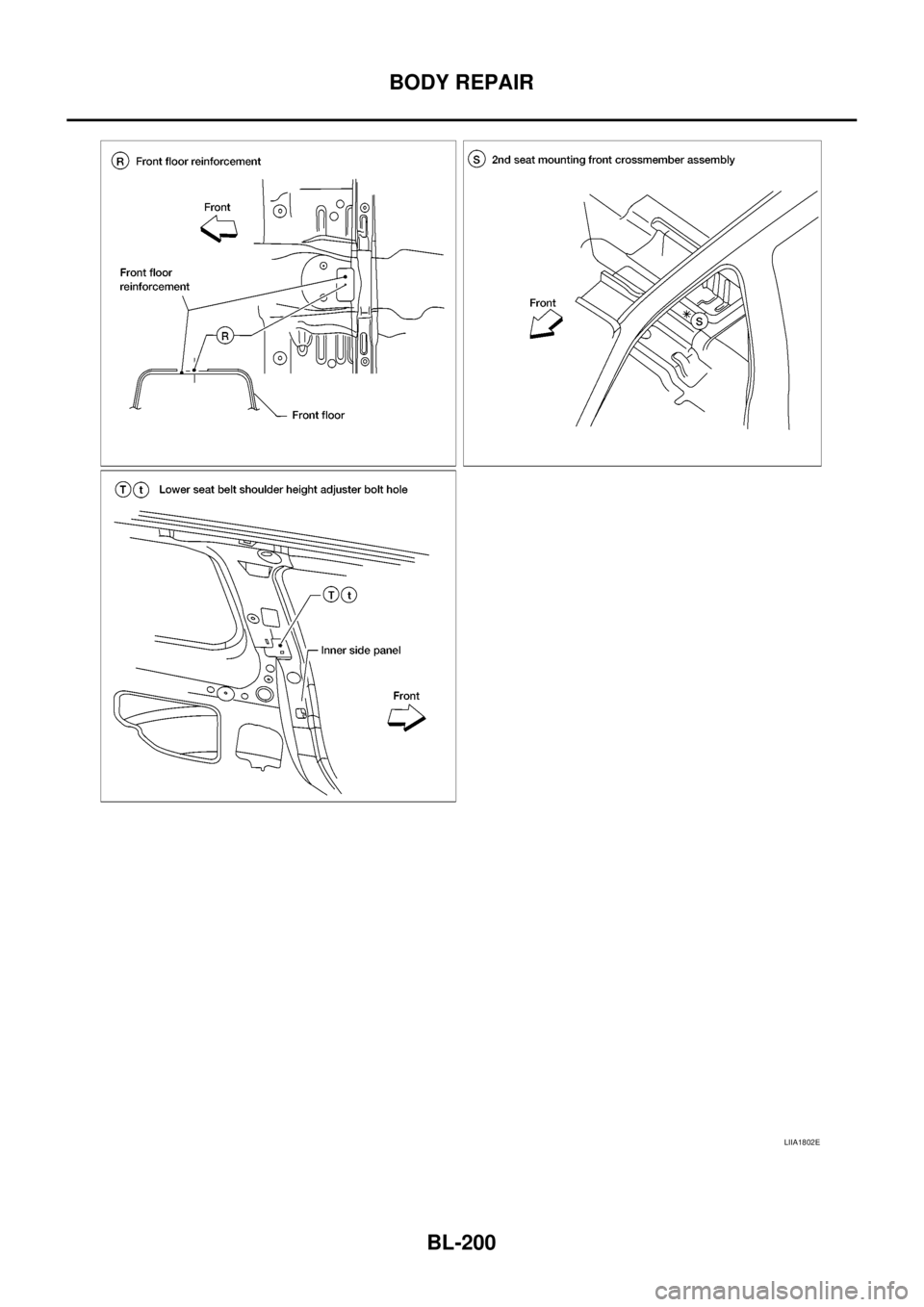
BODY REPAIR
LIIA1802E
Page 785 of 3171
BODY REPAIR
BL-201
C
D
E
F
G
H
J
K
L
MA
B
BL
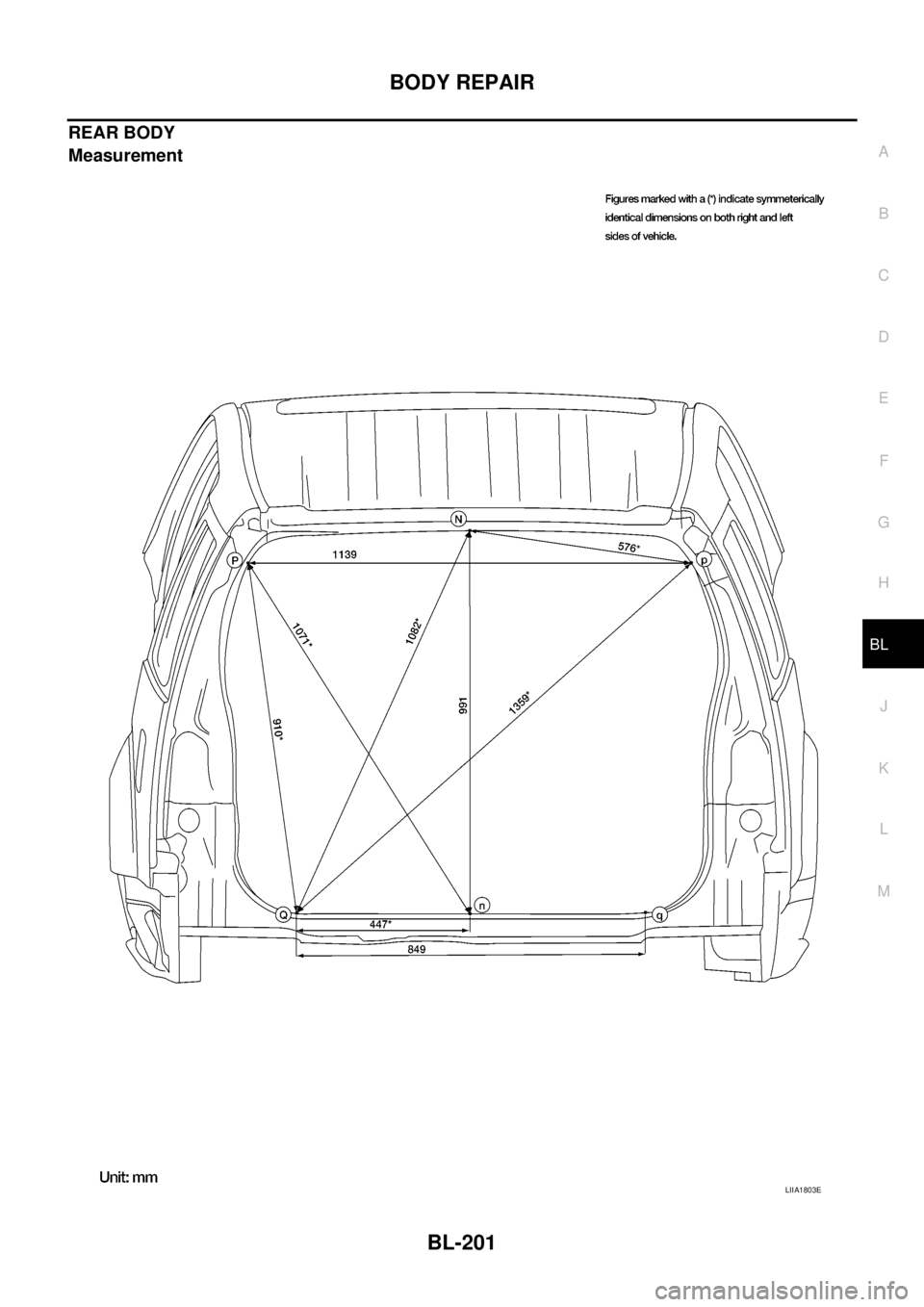
REAR BODY
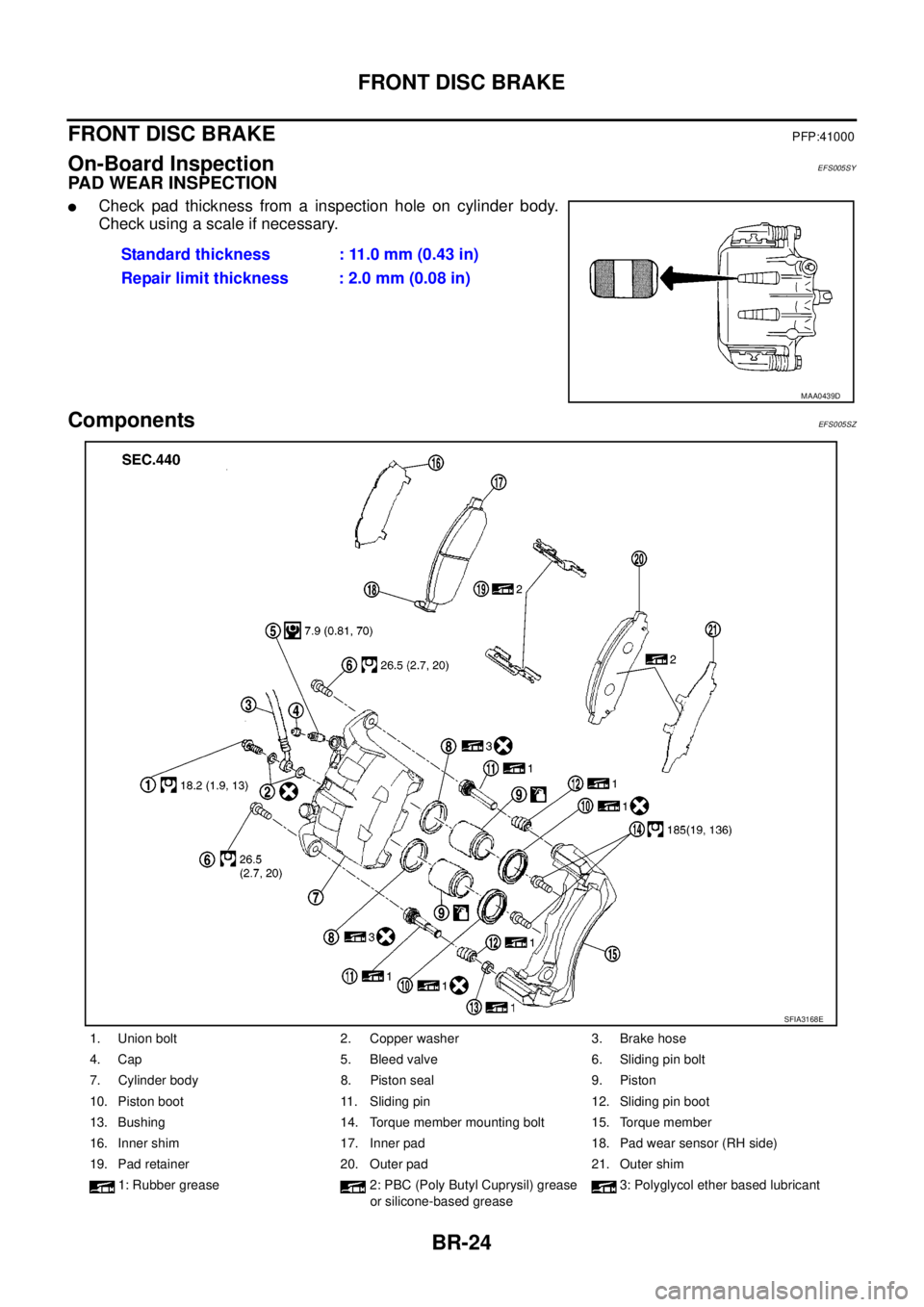
Measurement
LIIA1803E
Page 786 of 3171
BL-202
BODY REPAIR
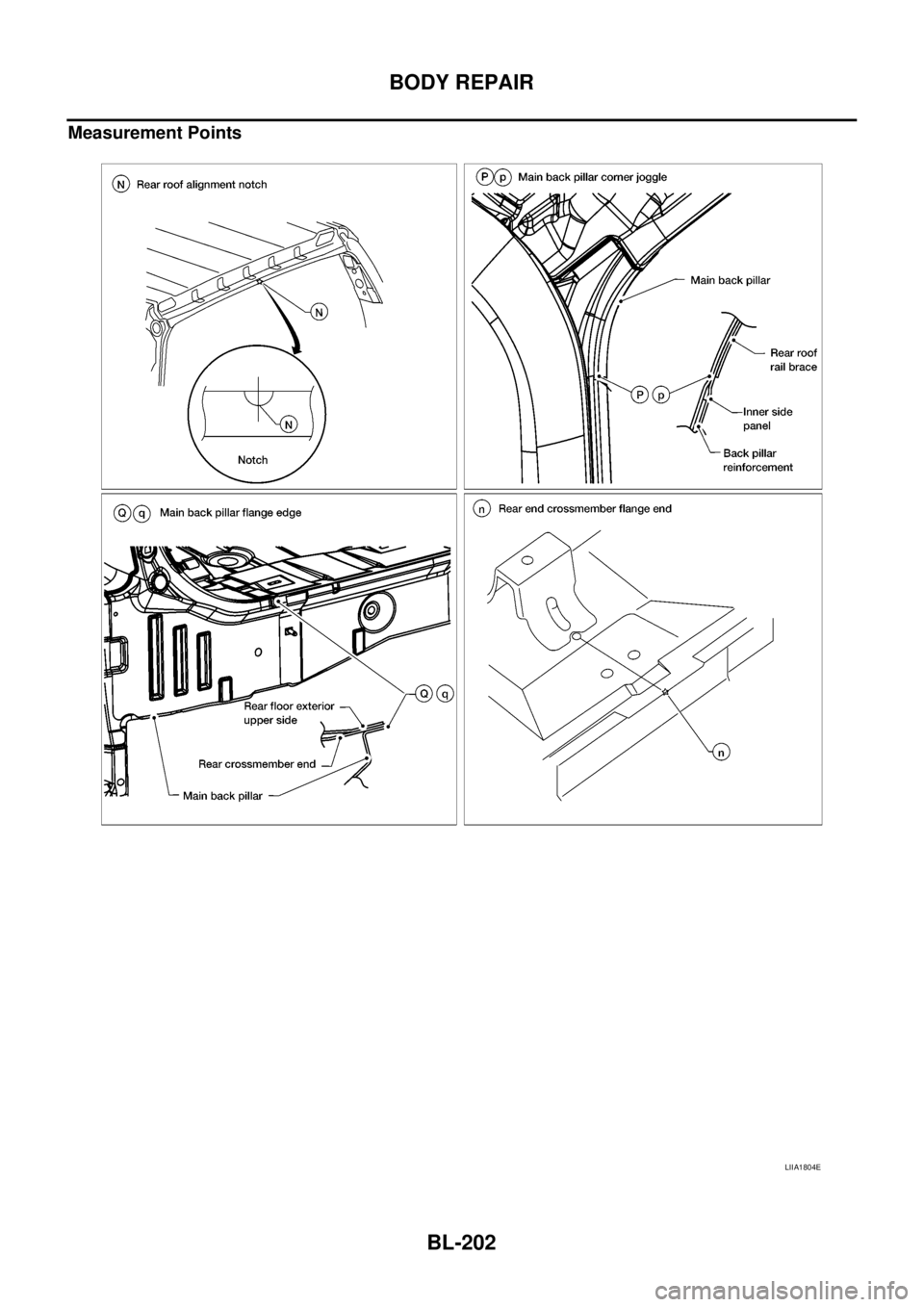
Measurement Points
LIIA1804E
Page 799 of 3171
BRAKE TUBE AND HOSE
BR-13
C
D
E
G
H
I
J
K
L
MA
B
BR
CAUTION:
lAll brake tubes and hoses must be free from excessive bending, twisting and pulling.
lMake sure that there is no interference with other parts when turning steering both clockwise and
counterclockwise.
lBrake tube and hose is an important safety part. Always disassemble the parts and retighten their
fittings, if a brake fluid leak is detected. Replace applicable part with a new one, if damaged part is
detected.
lBe careful not to splash brake fluid on painted areas; it may cause paint damage. If brake fluid is
splashed on painted surfaces of body, immediately wipe off them and wash it away with water.
lDo not bend or twist brake hose sharply, or strongly pull it.
lCover the open end of brake tube and hoses when disconnecting to prevent entrance of dirt.
lRefill with new brake fluid “DOT 3” or “DOT 4”.
lNever reuse drained brake fluid.
Removal and Installation of Front Brake Tube and Brake HoseEFS005SM
REMOVAL
1. Drain brake fluid. Refer toBR-10, "Drain and Refill".
2. Using a flare nut wrench, disconnect brake tube from brake hose.
3. Remove union bolt and remove brake hose from caliper assembly.
4. Remove lock plate and remove brake hose from vehicle.
INSTALLATION
1. Assemble the union bolt and copper washers to the brake hose.
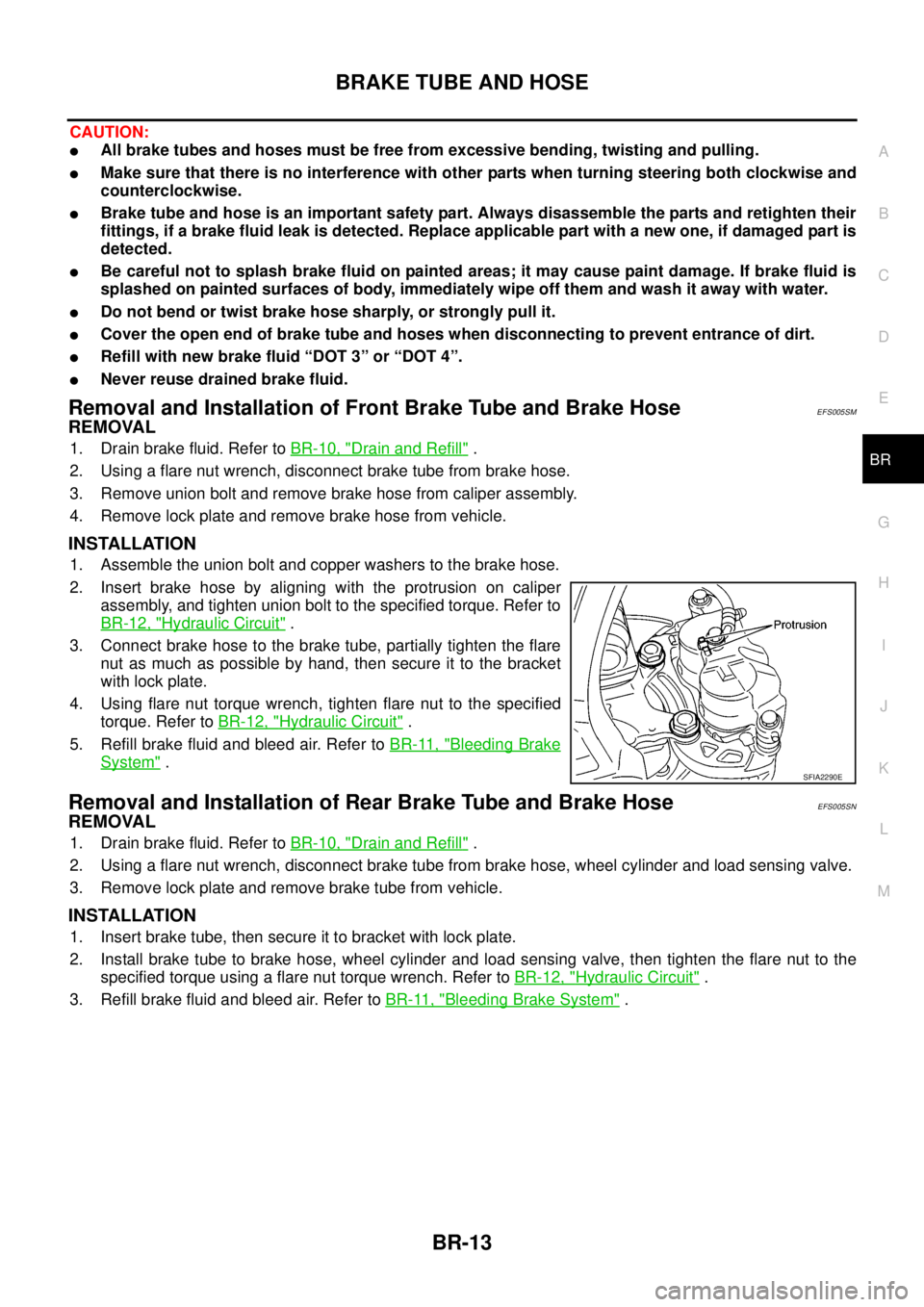
2. Insert brake hose by aligning with the protrusion on caliper
assembly, and tighten union bolt to the specified torque. Refer to
BR-12, "
Hydraulic Circuit".
3. Connect brake hose to the brake tube, partially tighten the flare
nut as much as possible by hand, then secure it to the bracket
with lock plate.
4. Using flare nut torque wrench, tighten flare nut to the specified
torque. Refer toBR-12, "
Hydraulic Circuit".
5. Refill brake fluid and bleed air. Refer toBR-11, "
Bleeding Brake
System".
Removal and Installation of Rear Brake Tube and Brake HoseEFS005SN
REMOVAL
1. Drain brake fluid. Refer toBR-10, "Drain and Refill".
2. Using a flare nut wrench, disconnect brake tube from brake hose, wheel cylinder and load sensing valve.
3. Remove lock plate and remove brake tube from vehicle.
INSTALLATION
1. Insert brake tube, then secure it to bracket with lock plate.
2. Install brake tube to brake hose, wheel cylinder and load sensing valve, then tighten the flare nut to the
specified torque using a flare nut torque wrench. Refer toBR-12, "
Hydraulic Circuit".
3. Refill brake fluid and bleed air. Refer toBR-11, "
Bleeding Brake System".
SFIA2290E
Page 802 of 3171
BR-16
LOAD SENSING VALVE
Inspection
EFS006A8
INSPECTION
1. With the vehicle in unladen condition, a person should sit in driver's seat at the rear. Then he/she should
get out of car gently. (This is to stabilize suspension deflection.)
NOTE:
“Unladen condition”: with full coolant, lubricant, 6 to 8 litters of fuel, spare tyre, jack, and hand tools
loaded.
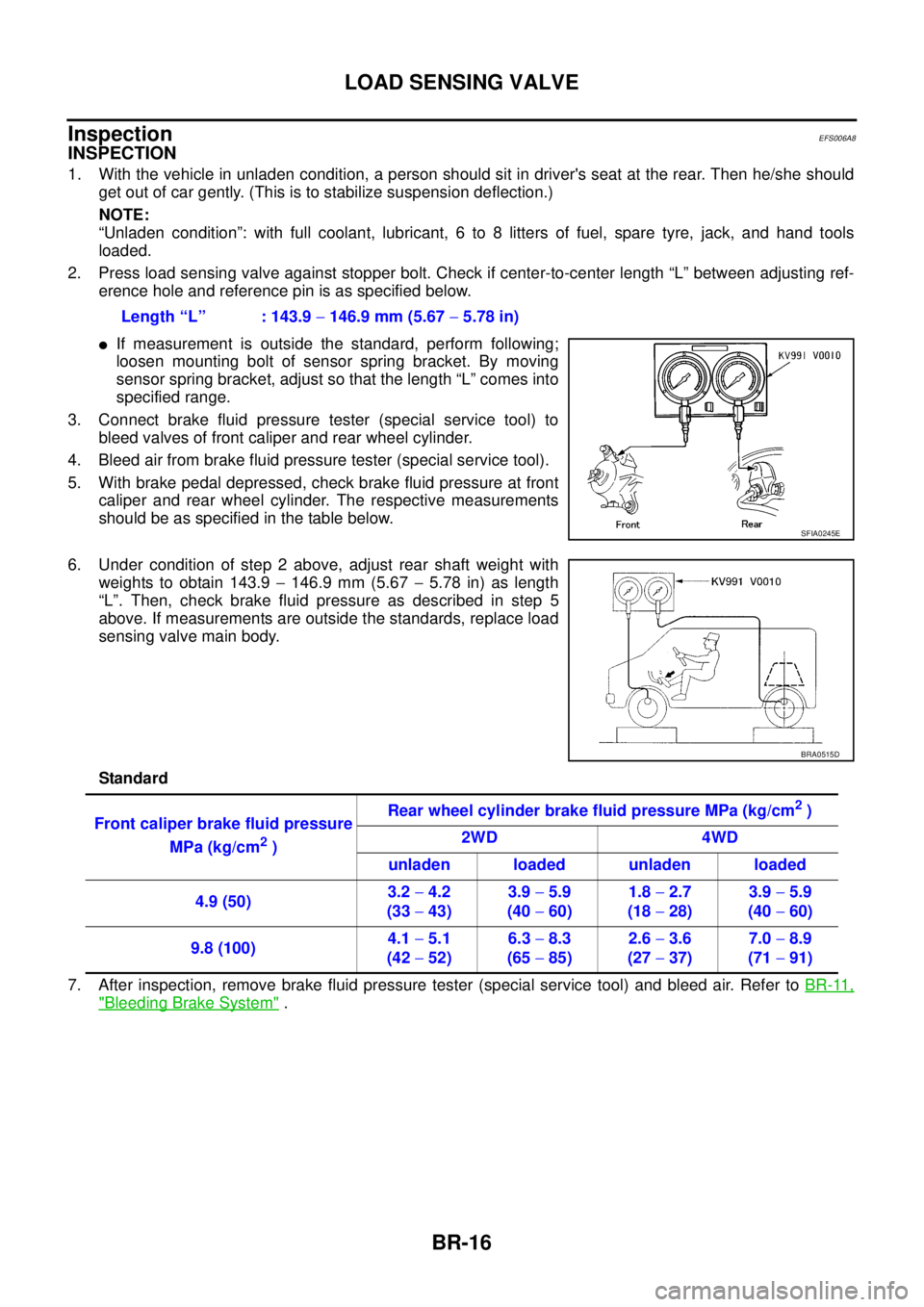
2. Press load sensing valve against stopper bolt. Check if center-to-center length “L” between adjusting ref-
erence hole and reference pin is as specified below.
lIf measurement is outside the standard, perform following;
loosen mounting bolt of sensor spring bracket. By moving
sensor spring bracket, adjust so that the length “L” comes into
specified range.
3. Connect brake fluid pressure tester (special service tool) to
bleed valves of front caliper and rear wheel cylinder.
4. Bleed air from brake fluid pressure tester (special service tool).
5. With brake pedal depressed, check brake fluid pressure at front
caliper and rear wheel cylinder. The respective measurements
should be as specified in the table below.
6. Under condition of step 2 above, adjust rear shaft weight with
weights to obtain 143.9-146.9 mm (5.67-5.78 in) as length
“L”. Then, check brake fluid pressure as described in step 5
above. If measurements are outside the standards, replace load
sensing valve main body.
Standard
7. After inspection, remove brake fluid pressure tester (special service tool) and bleed air. Refer toBR-11,
"Bleeding Brake System". Length “L” : 143.9-146.9 mm (5.67-5.78 in)
SFIA0245E
BRA0515D
Front caliper brake fluid pressure
MPa (kg/cm
2)Rear wheel cylinder brake fluid pressure MPa (kg/cm
2)
2WD 4WD
unladen loaded unladen loaded
4.9 (50)3.2-4.2
(33-43)3.9-5.9
(40-60)1.8-2.7
(18-28)3.9-5.9
(40-60)
9.8 (100)4.1-5.1
(42-52)6.3-8.3
(65-85)2.6-3.6
(27-37)7.0-8.9
(71-91)
Page 804 of 3171
BR-18
BRAKE MASTER CYLINDER
Disassembly and Assembly
EFS005SS
DISASSEMBLY
CAUTION:
lMaster cylinder assembly cannot be disassembled.
lRemove reservoir tank only when absolutely necessary.
Pull reservoir tank off master cylinder sub-assembly, then remove grommets from master cylinder sub-assem-
bly body.
ASSEMBLY
CAUTION:
lDo not use mineral oils such as kerosene, gasoline during the cleaning and assembly process.
lDo not drop parts. If a part is dropped, do not use it.
1. Apply brake fluid to the grommet and attach to the cylinder body.
2. Install reservoir tank onto the cylinder body.
Page 810 of 3171
BR-24
FRONT DISC BRAKE
FRONT DISC BRAKE
PFP:41000
On-Board InspectionEFS005SY
PAD WEAR INSPECTION
lCheck pad thickness from a inspection hole on cylinder body.
Check using a scale if necessary.
ComponentsEFS005SZ
Standard thickness : 11.0 mm (0.43 in)
Repair limit thickness : 2.0 mm (0.08 in)
MAA0439D
1. Union bolt 2. Copper washer 3. Brake hose
4. Cap 5. Bleed valve 6. Sliding pin bolt
7. Cylinder body 8. Piston seal 9. Piston
10. Piston boot 11. Sliding pin 12. Sliding pin boot
13. Bushing 14. Torque member mounting bolt 15. Torque member
16. Inner shim 17. Inner pad 18. Pad wear sensor (RH side)
19. Pad retainer 20. Outer pad 21. Outer shim
1: Rubber grease 2: PBC (Poly Butyl Cuprysil) grease
or silicone-based grease3: Polyglycol ether based lubricant
SFIA3168E
Page 811 of 3171
FRONT DISC BRAKE
BR-25
C
D
E
G
H
I
J
K
L
MA
B
BR
WARNING:
Clean dust on caliper and brake pad with a vacuum dust collector to minimize the hazard of air- borne
particles or other materials.
CAUTION:
lWhile removing cylinder body, do not depress brake pedal because piston will pop out.
lIt is not necessary to remove bolts on torque member and brake hose except for disassembly or
replacement of caliper assembly. In this case, hang cylinder body with a wire so as not to stretch
brake hose.
lDo not damage piston boot.
lIf any shim is subject to serious corrosion, replace it with a new one.
lAlways replace shim as a set when replacing brake pad.
lKeep rotor out of brake fluid.
Removal and Installation of Brake PadEFS005T0
REMOVAL
1. Remove tyre from vehicle.
2. Remove lower sliding pin bolt.
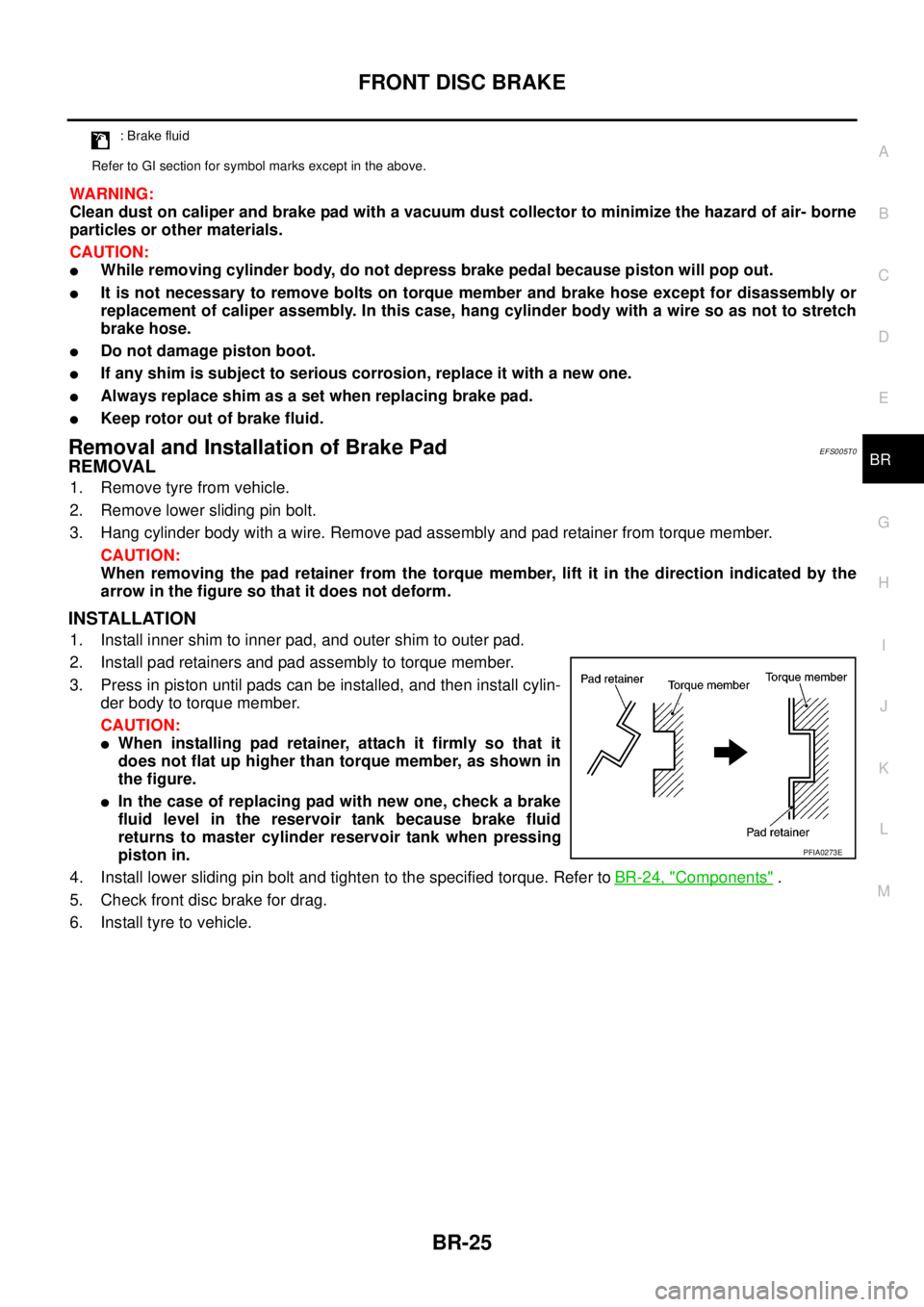
3. Hang cylinder body with a wire. Remove pad assembly and pad retainer from torque member.
CAUTION:
When removing the pad retainer from the torque member, lift it in the direction indicated by the
arrow in the figure so that it does not deform.
INSTALLATION
1. Install inner shim to inner pad, and outer shim to outer pad.
2. Install pad retainers and pad assembly to torque member.
3. Press in piston until pads can be installed, and then install cylin-
der body to torque member.
CAUTION:
lWhen installing pad retainer, attach it firmly so that it
does not flat up higher than torque member, as shown in
the figure.
lIn the case of replacing pad with new one, check a brake
fluid level in the reservoir tank because brake fluid
returns to master cylinder reservoir tank when pressing
piston in.
4. Install lower sliding pin bolt and tighten to the specified torque. Refer toBR-24, "
Components".
5. Check front disc brake for drag.
6. Install tyre to vehicle.
: Brake fluid
Refer to GI section for symbol marks except in the above.
PFIA0273E