Page 876 of 3171
CL-12
OPERATING CYLINDER
CAUTION:
Keep painted surface on the body or other parts free of clutch fluid. If it spills, wipe up immediately
and wash the affected area with water.
2. Remove clutch hose from operating cylinder assembly.
3. Remove operating cylinder assembly mounting bolts, and then remove operating cylinder assembly from
the vehicle.
INSTALLATION
Note the following, and install in the reverse order of removal.
lInstall clutch hose with care so that it will not be bent or twisted.
lTightenclutchhosetothespecifiedtorque.
CAUTION:
Do not reuse copper washer.
lAfter completing the procedure, bleed the air from the clutch hydraulic system. Refer toCL-8, "Air Bleed-
ing Procedure".
Disassembly and AssemblyECS00ICO
DISASSEMBLY
lRemove dust cover and push rod. Then remove piston, piston cup and piston spring from cylinder body.
INSPECTION AFTER DISASSEMBLY
Check for any of the conditions shown below. If any malfunction is found, replace the part concerned.
lDamage to cylinder internal surface or piston sliding surface. Foreign matter, wear, corrosion, or pinhole
lSettling of piston spring
lCracked or deformed dust cover
ASSEMBLY
1. Apply rubber lubricant to cylinder body internal surface and rubber grease to piston cup and piston. Insert
piston assembly and piston spring into cylinder body.
2. Apply rubber grease to dust cover and then install push rod and dust cover.
Page 877 of 3171
CLUTCH PIPING
CL-13
D
E
F
G
H
I
J
K
L
MA
B
CL
CLUTCH PIPINGPFP:30650
Removal and InstallationECS00ICP
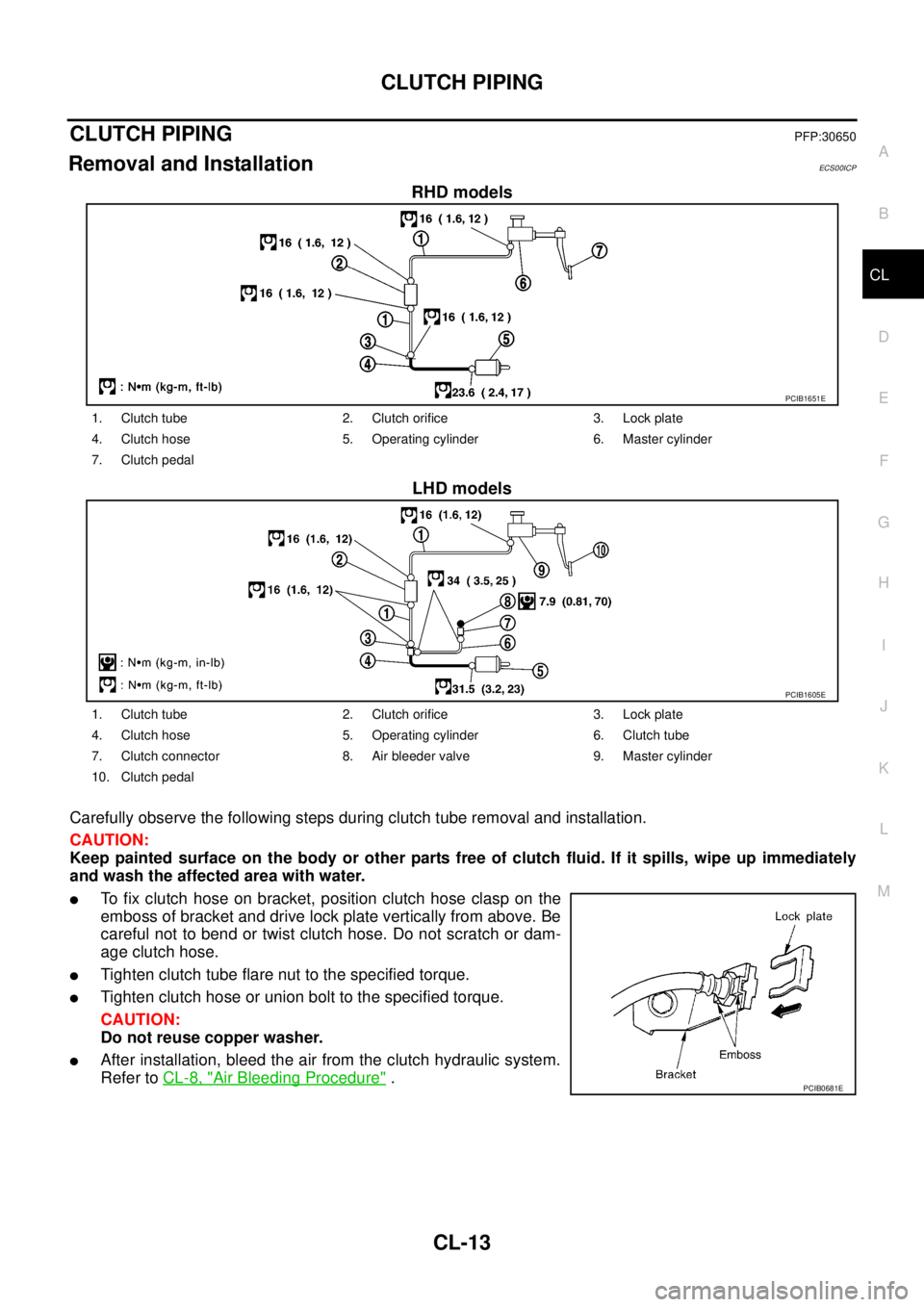
RHD models
LHD models
Carefully observe the following steps during clutch tube removal and installation.
CAUTION:
Keep painted surface on the body or other parts free of clutch fluid. If it spills, wipe up immediately
and wash the affected area with water.
lTo fix clutch hose on bracket, position clutch hose clasp on the
emboss of bracket and drive lock plate vertically from above. Be
careful not to bend or twist clutch hose. Do not scratch or dam-
age clutch hose.
lTighten clutch tube flare nut to the specified torque.
lTighten clutch hose or union bolt to the specified torque.
CAUTION:
Do not reuse copper washer.
lAfter installation, bleed the air from the clutch hydraulic system.
Refer toCL-8, "
Air Bleeding Procedure".
PCIB1651E
1. Clutch tube 2. Clutch orifice 3. Lock plate
4. Clutch hose 5. Operating cylinder 6. Master cylinder
7. Clutch pedal
PCIB1605E
1. Clutch tube 2. Clutch orifice 3. Lock plate
4. Clutch hose 5. Operating cylinder 6. Clutch tube
7. Clutch connector 8. Air bleeder valve 9. Master cylinder
10. Clutch pedal
PCIB0681E
Page 906 of 3171
CO-22
WATER PUMP
lEngine coolant will leak from cylinder block, so have a receptacle ready below.
CAUTION:
lHandle the water pump vane so that it does not contact any other parts.
lWater pump cannot be disassembled and should be replaced as a unit.
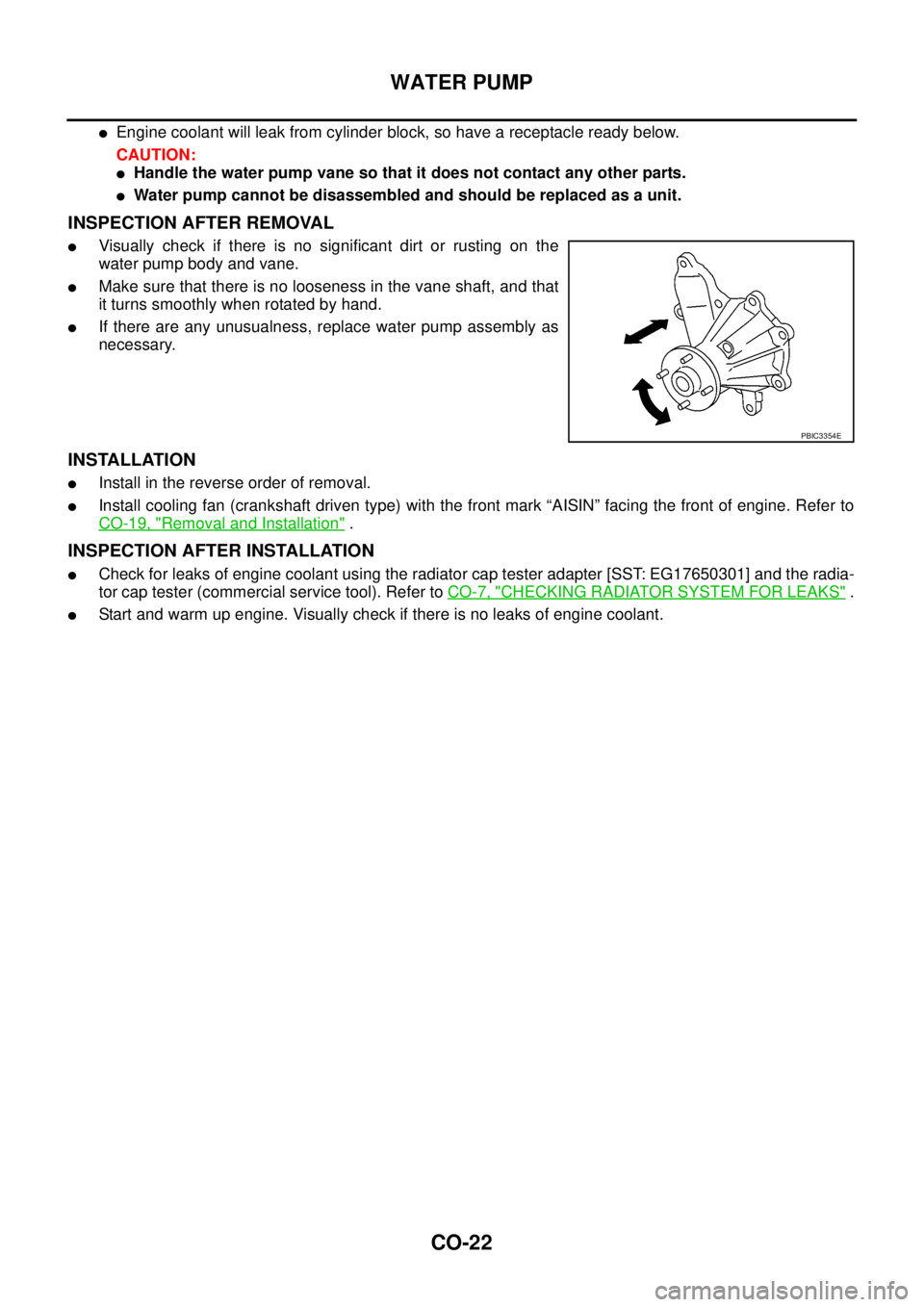
INSPECTION AFTER REMOVAL
lVisually check if there is no significant dirt or rusting on the
water pump body and vane.
lMake sure that there is no looseness in the vane shaft, and that
it turns smoothly when rotated by hand.
lIf there are any unusualness, replace water pump assembly as
necessary.
INSTALLATION
lInstall in the reverse order of removal.
lInstall cooling fan (crankshaft driven type) with the front mark “AISIN” facing the front of engine. Refer to
CO-19, "
Removal and Installation".
INSPECTION AFTER INSTALLATION
lCheck for leaks of engine coolant using the radiator cap tester adapter [SST: EG17650301] and the radia-
tor cap tester (commercial service tool). Refer toCO-7, "
CHECKING RADIATOR SYSTEM FOR LEAKS".
lStart and warm up engine. Visually check if there is no leaks of engine coolant.
PBIC3354E
Page 992 of 3171
EC-12
PRECAUTIONS
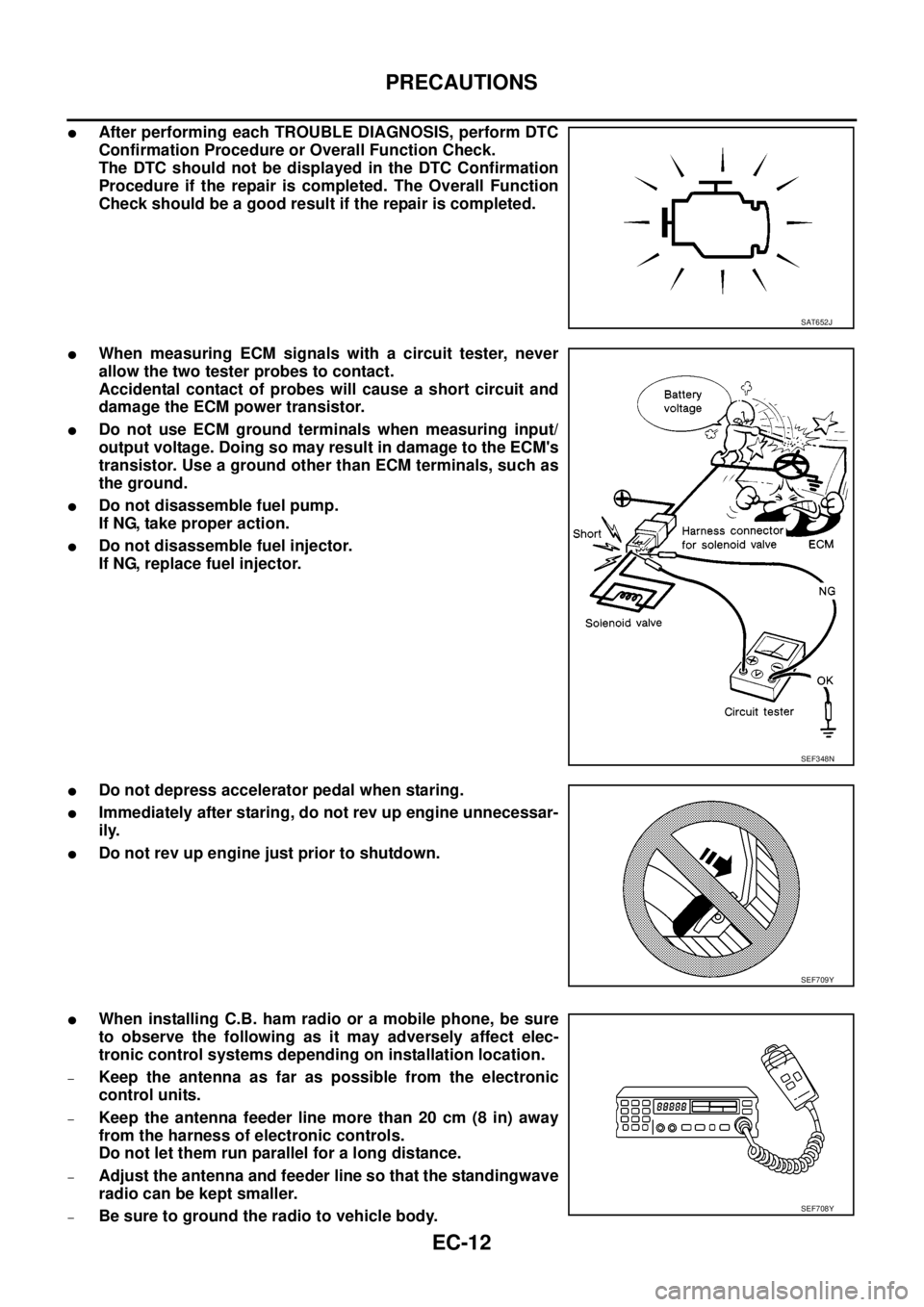
lAfter performing each TROUBLE DIAGNOSIS, perform DTC
Confirmation Procedure or Overall Function Check.
The DTC should not be displayed in the DTC Confirmation
Procedure if the repair is completed. The Overall Function
Check should be a good result if the repair is completed.
lWhen measuring ECM signals with a circuit tester, never
allow the two tester probes to contact.
Accidental contact of probes will cause a short circuit and
damage the ECM power transistor.
lDo not use ECM ground terminals when measuring input/
output voltage. Doing so may result in damage to the ECM's
transistor. Use a ground other than ECM terminals, such as
the ground.
lDo not disassemble fuel pump.
If NG, take proper action.
lDo not disassemble fuel injector.
If NG, replace fuel injector.
lDo not depress accelerator pedal when staring.
lImmediately after staring, do not rev up engine unnecessar-
ily.
lDo not rev up engine just prior to shutdown.
lWhen installing C.B. ham radio or a mobile phone, be sure
to observe the following as it may adversely affect elec-
tronic control systems depending on installation location.
–Keep the antenna as far as possible from the electronic
control units.
–Keep the antenna feeder line more than 20 cm (8 in) away
from the harness of electronic controls.
Do not let them run parallel for a long distance.
–Adjust the antenna and feeder line so that the standingwave
radio can be kept smaller.
–Be sure to ground the radio to vehicle body.
SAT652J
SEF348N
SEF709Y
SEF708Y
Page 1022 of 3171

EC-42
TROUBLE DIAGNOSIS
Symptom Matrix Chart
EBS01KCW
SYSTEM — Basic engine control systemSYMPTOM
Reference
pageHARD/NO START/RESTART (EXCP. HA)
ENGINE STALL
HESITATION/SURGING/FLAT SPOT
KNOCK/DETONATION
LACK OF POWER
POOR ACCELERATION
HI IDLE
LOW IDLE NO START (with first firing)
NO START (without first firing)
HARD TO START WHEN ENGINE IS COLD
HARD TO START WHEN ENGINE IS HOT
AT I D L E
DURING DRIVING
WHEN DECELERATING
Warranty symptom code AA AB AC AD AE AF
Fuelpump 55555555 55 5 —
Fuelinjector 3333333334433EC-125
Glow control system 1 1 1 1 1EC-295
Engine body 3 3 3 3 3 3 3 3 4 4 3EM-106
EGR system33EC-302
Air cleaner and duct33EM-15
Fuel rail pressure relief valve 3 3 3 3 3 3 3 3 3 3 3EC-88
ENGINE CONTROL
Fuelpumpcircuit 44444444 44 4EC-217
Fuelinjectorcircuit 1111111111111EC-125
Fuel injector adjustment value 1 1 1 1EC-25
Mass air flow sensor circuit 1 1 1EC-92
Engine coolant temperature circuit 1 1 1 1EC-103
Vehicle speed signal circuit1LAN-30
Accelerator pedal position sensor circuit 1 1 1EC-108
,
EC-142
,
EC-275
Fuel rail pressure sensor circuitEC-118
Page 1024 of 3171

EC-44
TROUBLE DIAGNOSIS
SYSTEM — Basic engine control systemSYMPTOM
Reference
page
ROUGH IDLE/HUNTING
IDLING VIBRATION
SLOW/NO RETURN TO IDLE
OVERHEAT/HIGH ENGINE COOLANT TEMPERATURE
EXCESSIVE FUEL CONSUMPTION
EXCESSIVE OIL CONSUMPTION
ABNORMAL SMOKE COLOR
DEAD BATTERY (UNDER CHARGE)
Malfunction indicator illuminates.
Can be detected by CONSULT-II?BLACK SMOKE
WHITE SMOKE
Warranty symptom code AG AH AJ AK AL AM AP HA
Fuel pump 5 5 5 5 1 1 —
Fuel injector 3 3 3 4 3 3 1 1EC-125
Glow control system1EC-295
Engine body 3 3 3 3 1 3EM-106
EGR system3EC-302
Air cleaner and duct3EM-15
Fuel rail pressure relief valve 3 3 3 3EC-88
ENGINE CONTROL
Fuel pump circuit 4 4 4 4 1 1EC-217
Fuel injector circuit 1 1 1 1 1 1 1 1EC-125
Fuel injector adjustment value 1 1 1 1 1 1EC-25
Mass air flow sensor circuit 1 1 1EC-92
Engine coolant temperature circuit 1 1 1 1 1EC-103
Vehicle speed signal circuit11LAN-30
Accelerator pedal position sensor circuit 1 1 1EC-108
,
EC-142
,
EC-275
Fuel rail pressure sensor circuit11EC-118
Page 1054 of 3171
EC-74
POWER SUPPLY AND GROUND CIRCUIT
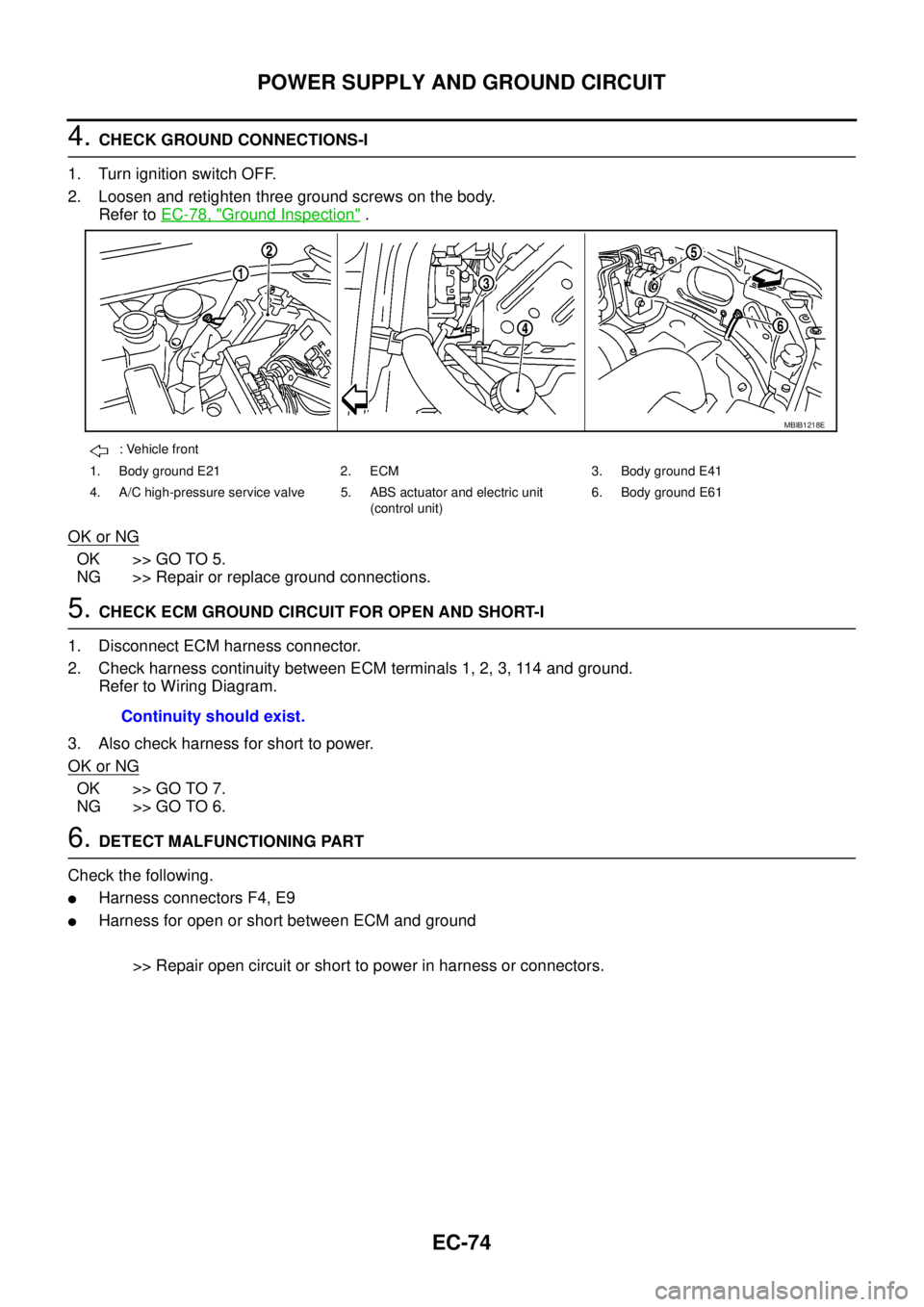
4.CHECK GROUND CONNECTIONS-I
1. Turn ignition switch OFF.
2. Loosen and retighten three ground screws on the body.
Refer toEC-78, "
Ground Inspection".
OK or NG
OK >> GO TO 5.
NG >> Repair or replace ground connections.
5.CHECK ECM GROUND CIRCUIT FOR OPEN AND SHORT-I
1. Disconnect ECM harness connector.
2. Check harness continuity between ECM terminals 1, 2, 3, 114 and ground.
Refer to Wiring Diagram.
3. Also check harness for short to power.
OK or NG
OK >> GO TO 7.
NG >> GO TO 6.
6.DETECT MALFUNCTIONING PART
Check the following.
lHarness connectors F4, E9
lHarness for open or short between ECM and ground
>> Repair open circuit or short to power in harness or connectors.
: Vehicle front
1. Body ground E21 2. ECM 3. Body ground E41
4. A/C high-pressure service valve 5. ABS actuator and electric unit
(control unit)6. Body ground E61
MBIB1218E
Continuity should exist.
Page 1057 of 3171
POWER SUPPLY AND GROUND CIRCUIT
EC-77
C
D
E
F
G
H
I
J
K
L
MA
EC
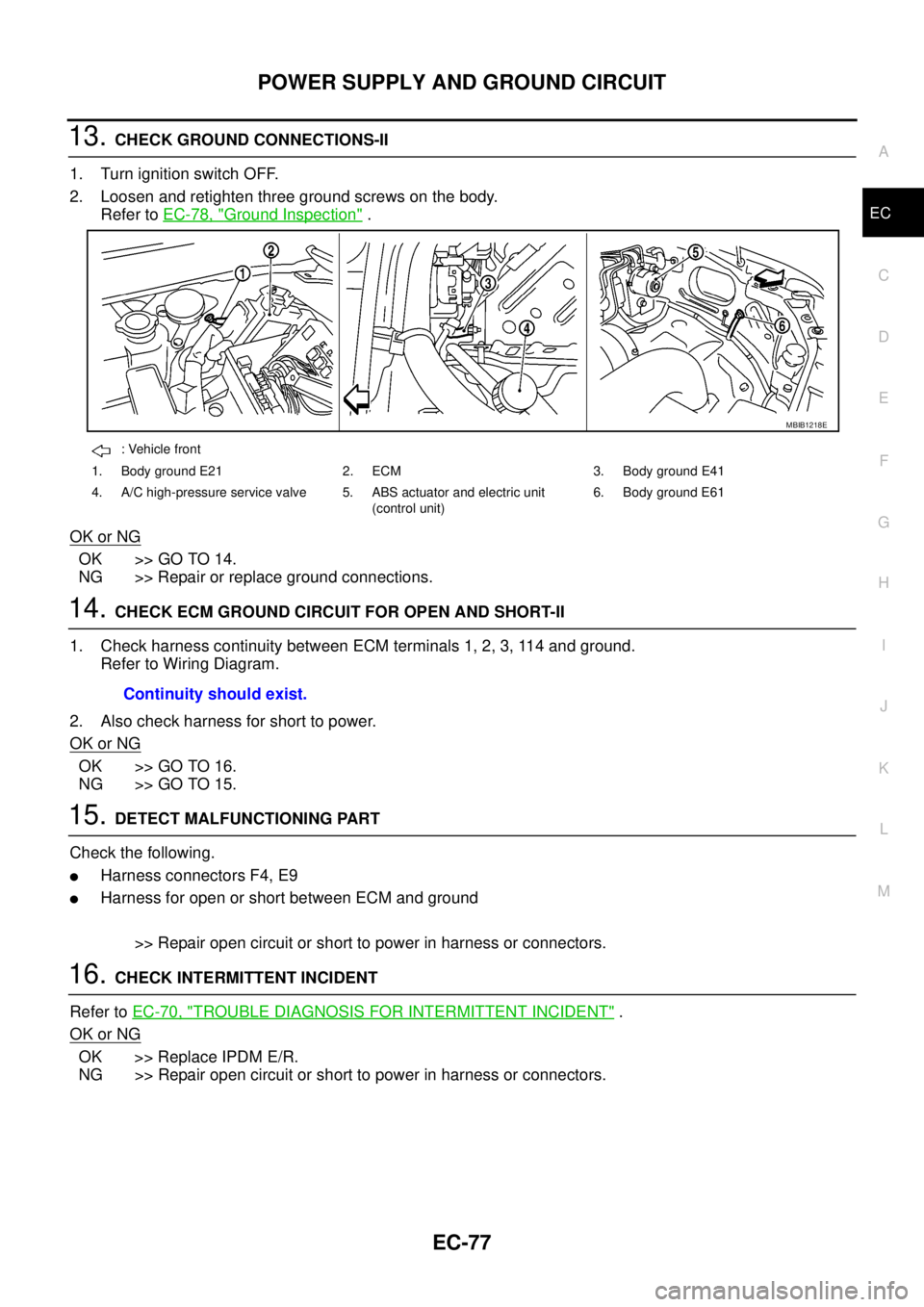
13.CHECK GROUND CONNECTIONS-II
1. Turn ignition switch OFF.
2. Loosen and retighten three ground screws on the body.
Refer toEC-78, "
Ground Inspection".
OK or NG
OK >> GO TO 14.
NG >> Repair or replace ground connections.
14.CHECK ECM GROUND CIRCUIT FOR OPEN AND SHORT-II
1. Check harness continuity between ECM terminals 1, 2, 3, 114 and ground.
Refer to Wiring Diagram.
2. Also check harness for short to power.
OK or NG
OK >> GO TO 16.
NG >> GO TO 15.
15.DETECT MALFUNCTIONING PART
Check the following.
lHarness connectors F4, E9
lHarness for open or short between ECM and ground
>> Repair open circuit or short to power in harness or connectors.
16.CHECK INTERMITTENT INCIDENT
Refer toEC-70, "
TROUBLE DIAGNOSIS FOR INTERMITTENT INCIDENT".
OK or NG
OK >> Replace IPDM E/R.
NG >> Repair open circuit or short to power in harness or connectors.
: Vehicle front
1. Body ground E21 2. ECM 3. Body ground E41
4. A/C high-pressure service valve 5. ABS actuator and electric unit
(control unit)6. Body ground E61
MBIB1218E
Continuity should exist.