1973 DATSUN B110 checking oil
[x] Cancel search: checking oilPage 312 of 513

EMISSION
CONTROL
AND
TUNE
UP
Fig
ET
11
Checking
spark
plug
gap
Checking
distributor
ignition
wiring
and
ignition
coil
Distributor
Check
centrifugal
advance
unit
for
loose
connection
or
improper
operation
If
it
is
not
operating
properly
the
trouble
may
be
due
to
a
sticky
spring
or
excessively
worn
parts
This
operation
needs
a
distributor
tester
As
to
inspection
procedure
and
reference
data
refer
to
relative
topic
under
Distributor
in
Section
EE
Page
EE
32
If
vacuum
advance
mechanism
fails
to
operate
proJr
erly
check
for
the
following
items
and
correct
the
trouble
as
required
1
Check
vacuum
inlet
for
signs
of
leakage
at
its
connection
If
necessary
retighten
or
replace
with
a
new
one
2
Check
vacuum
diaphragm
for
air
leak
If
leak
is
found
replace
diaphragm
with
a
new
one
3
Inspect
breaker
plate
for
smooth
moving
If
plate
does
not
move
smoothly
this
condition
could
be
due
to
sticky
steel
balls
or
pivot
Apply
grease
to
steel
balls
or
if
necessary
replace
breaker
plate
as
an
assembly
For
vacuum
advance
characteristics
refer
to
Distribu
tor
in
Section
EE
Page
EE
32
Ignition
wiring
Use
an
ohmmeter
to
check
resistance
of
secondary
cables
Disconnect
cables
from
spark
plugs
and
install
the
proper
adapter
between
cable
and
spark
plug
Remove
distributor
cap
from
the
distributor
with
secondary
cables
attached
Do
not
remove
the
cables
from
the
cap
Check
the
resistance
of
one
cable
at
a
time
Connect
the
ohmmeter
between
the
spark
plug
adapter
and
the
corresponding
electrode
inside
the
cap
If
resistance
is
more
than
30
000
ohms
remove
the
cable
from
the
cap
and
check
cable
resistance
only
If
the
resistance
is
still
more
than
30
000
ohms
replace
cable
assembly
T
I
II
Fig
ET
12
Checking
high
tension
cables
Ignition
coil
Check
ignition
coil
for
appearance
oil
leakage
or
performance
For
details
refer
to
Section
EE
Page
EE36
Checking
distributor
cap
and
rotor
Note
This
operation
is
to
be
performed
while
chekcing
distribuotr
points
Inspect
distributor
cap
for
cracks
and
flash
over
External
surfaces
of
all
parts
of
secondary
system
must
be
cleaned
to
reduce
possibility
of
voltage
loss
All
wires
should
be
removed
from
distributor
cap
and
coil
so
that
terminals
can
be
inspected
and
cleaned
Burned
or
corroded
terminals
indicate
that
wires
were
not
fully
seated
which
causes
arcing
between
end
of
wire
and
terminal
When
replacing
wires
in
terminal
be
sure
they
are
fully
seated
before
pushing
rubber
nipple
down
over
tower
Check
distributor
rotor
for
damage
and
distributor
cap
for
cracks
ET
7
Page 328 of 513

EMISSION
CONTROL
AND
TUNE
UP
CD
@
Fresh
air
Blow
by
gas
Air
used
in
filtering
oil
1
PCV
valve
2
Flame
arrester
3
Oil
filler
cap
4
Baffle
plate
and
steel
net
E
C002
Fig
ET
J8
Crankcase
emission
control
system
at
full
throttle
open
Checking
and
replacing
PCV
valve
Test
PCV
valve
in
accordance
with
the
following
me
thod
With
engine
running
at
idle
remove
the
ventilator
hose
from
PCV
valve
If
the
valve
is
working
a
hissing
noise
will
be
heard
as
air
passes
through
the
valve
and
a
strong
vacuum
should
be
felt
immediately
when
a
finger
is
placed
over
the
valve
inlet
If
the
valve
is
plugged
replace
with
a
new
one
Check
for
deposit
plugging
in
the
hose
Clean
if
necessary
Intake
manifold
l
illlr
nnnl
UUUU
l
I
G
EC014
FigET
39
Cross
sectional
view
of
PCV
valve
Checking
ventilation
hoses
I
Check
hoses
and
hose
connections
for
leaks
2
Disconnect
all
hoses
and
blow
them
out
with
compressed
air
If
any
hose
can
not
be
free
of
obstructions
replace
with
a
new
one
Insure
that
the
flame
arrester
is
surely
inserted
in
the
hose
between
the
air
cleaner
and
rocker
cover
EVAPORATIVE
EMISSION
CONTROL
SYSTEM
Checking
engine
compartment
hose
connections
and
fuel
vapor
control
valves
Checking
fuel
tank
vapor
liquid
separator
and
vapor
vent
line
I
Check
all
hoses
and
fuel
tank
ftIler
cap
2
Disconnect
the
vapor
vent
line
connecting
flow
guide
valve
to
vapor
liquid
separator
ET
23
Page 348 of 513
ENGINE
J
I
r
I
I
J
fj
7
L
j
8
if
d1
I
ilfi
3
c
7
I
t
j
v
1
Ji
Fig
EM
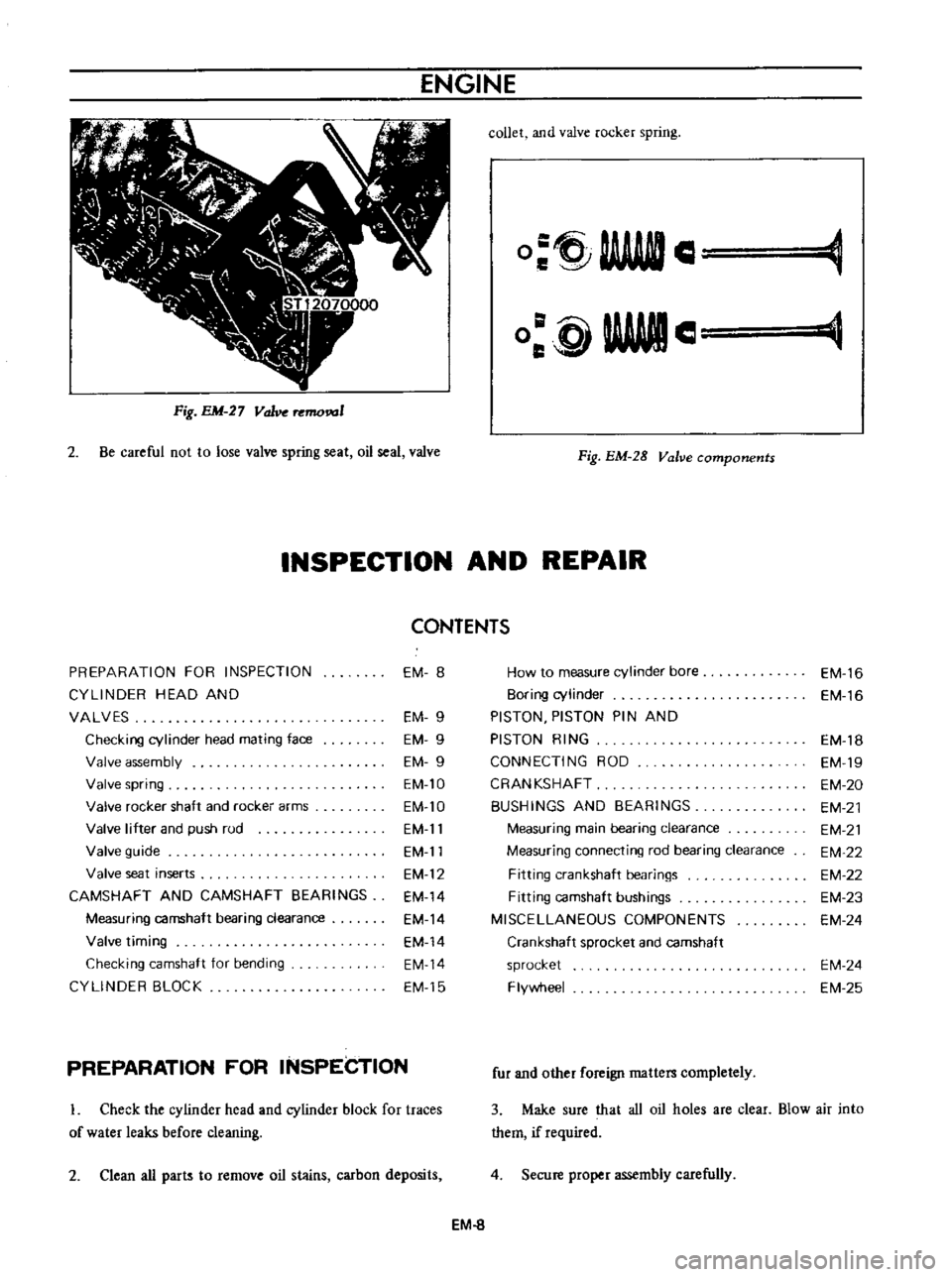
27
Valve
mo
1
2
Be
careful
not
to
lose
valve
spring
seat
oil
seal
valve
collet
and
valve
rocker
spring
O
tj
AAAftIl
C
e
WWII
o
glAWle
Fig
EM
28
Valve
components
INSPECTION
AND
REPAIR
CONTENTS
PREPARATION
FOR
INSPECTION
EM
8
How
to
measure
cylinder
bore
EM
16
CYLlNOER
HEAD
AND
80ring
cylinder
EM
16
VALVES
EM
9
PISTON
PISTON
PIN
AND
Checking
cylinder
head
mating
face
EM
9
PISTON
RING
EM
18
Valve
assembly
EM
9
CONNECTING
ROD
EM
19
Valve
spring
EM
10
CRANKSHAFT
EM
20
Valve
rocker
shaft
and
rockei
arms
EM
lO
BUSHINGS
AND
BEARINGS
EM
21
Valve
lifter
and
push
rud
EM
11
Measuring
main
bearing
clearance
EM
21
Valve
guide
EM
11
Measuring
connecting
rod
bearing
clearance
EM
22
Valve
seat
inserts
EM
12
Fitting
crankshaft
bearings
EM
22
CAMSHAFT
AND
CAMSHAFT
BEARINGS
EM
14
Fitting
camshaft
bushings
EM
23
Measuring
camshaft
bearing
clearance
EM
14
MISCELLANEOUS
COMPONENTS
EM
24
Valve
timing
EM
14
Crankshaft
sprocket
and
camshaft
Checking
camshaft
for
bending
EM
14
sprocket
EM
24
CYLlNOER
BLOCK
EM
15
Flywheel
EM
25
PREPARATION
FOR
INSPECTION
L
Check
the
cylinder
head
and
cylinder
block
for
traces
of
water
leaks
before
cleaning
2
Clean
all
parts
to
remove
oil
stains
carbon
deposits
fur
and
other
foreign
matters
completely
3
Make
sure
that
all
oil
holes
are
clear
Blow
air
into
them
if
required
4
Secure
proper
assembly
carefully
EM
8
Page 354 of 513
ENGINE
CAMSHAFT
AND
CAMSHAFT
BEARING
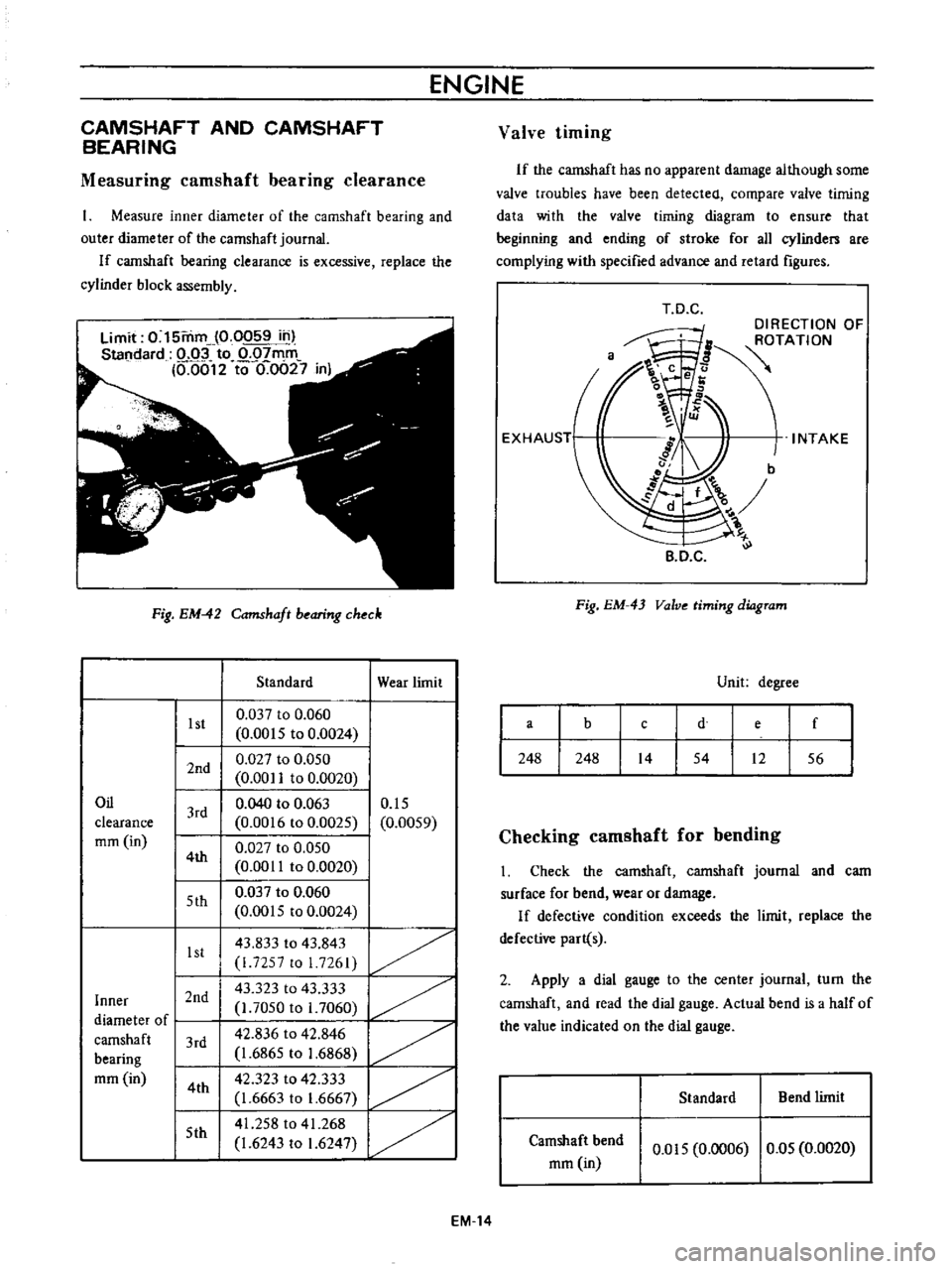
Measuring
camshaft
bearing
clearance
Measure
inner
diameter
of
the
camshaft
bearing
and
outer
diameter
of
the
camshaft
journaL
If
camshaft
bearing
clearance
is
excessive
replace
the
cylinder
block
assembly
Limit
0
15mm
0
0059
in
Standard
o
oi
to
0
07mm
M012
to
0
0627
in
Fig
EM
42
Camshaft
bearing
check
1st
2nd
Oil
clearance
mm
in
3rd
4th
5th
1st
Inner
I
2nd
I
diameter
of
I
I
camshaft
3rd
bearing
mm
in
14th
I
15th
I
Standard
0
037
to
0
060
0
0015
to
0
0024
0
027
to
0
050
0
00
to
0
0020
0
040
to
0
063
0
0016
to
0
0025
0
027
to
0
050
0
0011
to
0
0020
0
037
to
0
060
0
0015
to
0
0024
43
833
to
43
843
i
7257
to
I
7261
43
323
to
43
333
l
7050
to
1
7060
42
836
to
42
846
1
6865
to
1
6868
42
323
to
42
333
1
6663
to
1
6667
41
258
to
41
268
1
6243
to
1
6247
Wear
limit
0
15
0
0059
1
1
1
1
Valve
timing
If
the
camshaft
has
no
apparent
damage
although
some
valve
troubles
have
been
detected
compare
valve
timing
data
with
the
valve
timing
diagram
to
ensure
that
beginning
and
ending
of
stroke
for
all
cylinden
are
complying
with
specified
advance
and
retard
figures
T
D
C
DIRECTION
OF
ROTATION
INTAKE
B
D
C
Fig
EM
43
Valve
timing
diagram
Unit
degree
a
b
e
f
d
c
248
248
14
54
12
56
Checking
camshaft
for
bending
Check
the
camshaft
camshaft
journal
and
cam
surface
for
bend
wear
or
damage
If
defective
condition
exceeds
the
limit
replace
the
defective
part
s
2
Apply
a
dial
gauge
to
the
center
journal
turn
the
camshaft
and
read
the
dial
gauge
Actual
bend
is
a
half
of
the
value
indicated
on
the
dial
gauge
Standard
Bend
limit
Camshaft
bend
mm
in
0
015
0
0006
0
05
0
0020
EM
14
Page 369 of 513
ENGINE
MECHANICAL
o
Match
mark
Key
groove
Fig
EM
78
1
Setting
chain
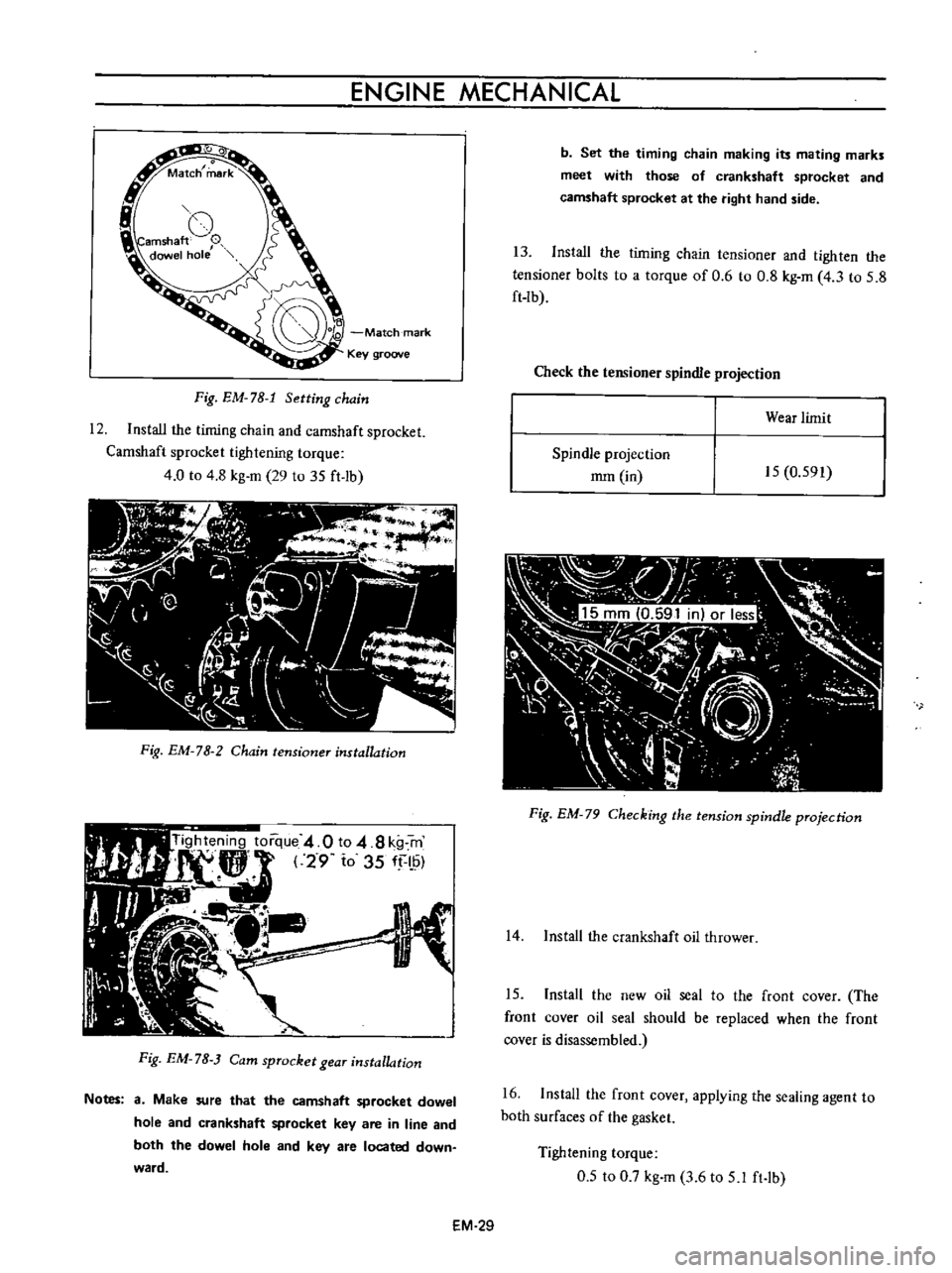
12
Install
the
timing
chain
and
camshaft
sprocket
Camshaft
sprocket
tightening
torque
4
0
to
4
8
kg
m
29
to
35
ft
lb
Fig
EM
78
2
Chain
tensioner
installation
Fig
EM
7B
Cam
sprocket
gear
installation
Notes
a
Make
sure
that
the
camshaft
sprocket
dowel
hole
and
crankshaft
sprocket
key
are
in
line
and
both
the
dowel
hole
and
key
are
located
down
ward
b
Set
the
timing
chain
making
its
mating
marks
meet
with
those
of
crankshaft
sprocket
and
camshaft
sprocket
at
the
right
hand
side
13
Install
the
timing
chain
tensioner
and
tighten
the
tensioner
bolts
to
a
torque
of
0
6
to
0
8
kg
m
4
3
to
5
8
ft
lb
Check
the
tensioner
spindle
projection
Wear
limit
Spindle
projection
mm
in
15
0
591
Fig
EM
79
Checking
the
tension
spindle
projection
14
Install
the
crankshaft
oil
thrower
15
Install
the
new
oil
seal
to
the
front
cover
The
front
cover
oil
seal
should
be
replaced
when
the
front
cover
is
disassembled
16
Install
the
front
cover
applying
the
sealing
agent
to
both
surfaces
of
the
gasket
Tightening
torque
0
5
to
0
7
kg
m
3
6
to
5
1
ft
lb
EM
29
Page 449 of 513
ENGINE
ElECTRICAL
SYSTEM
IGNITION
CIRCUIT
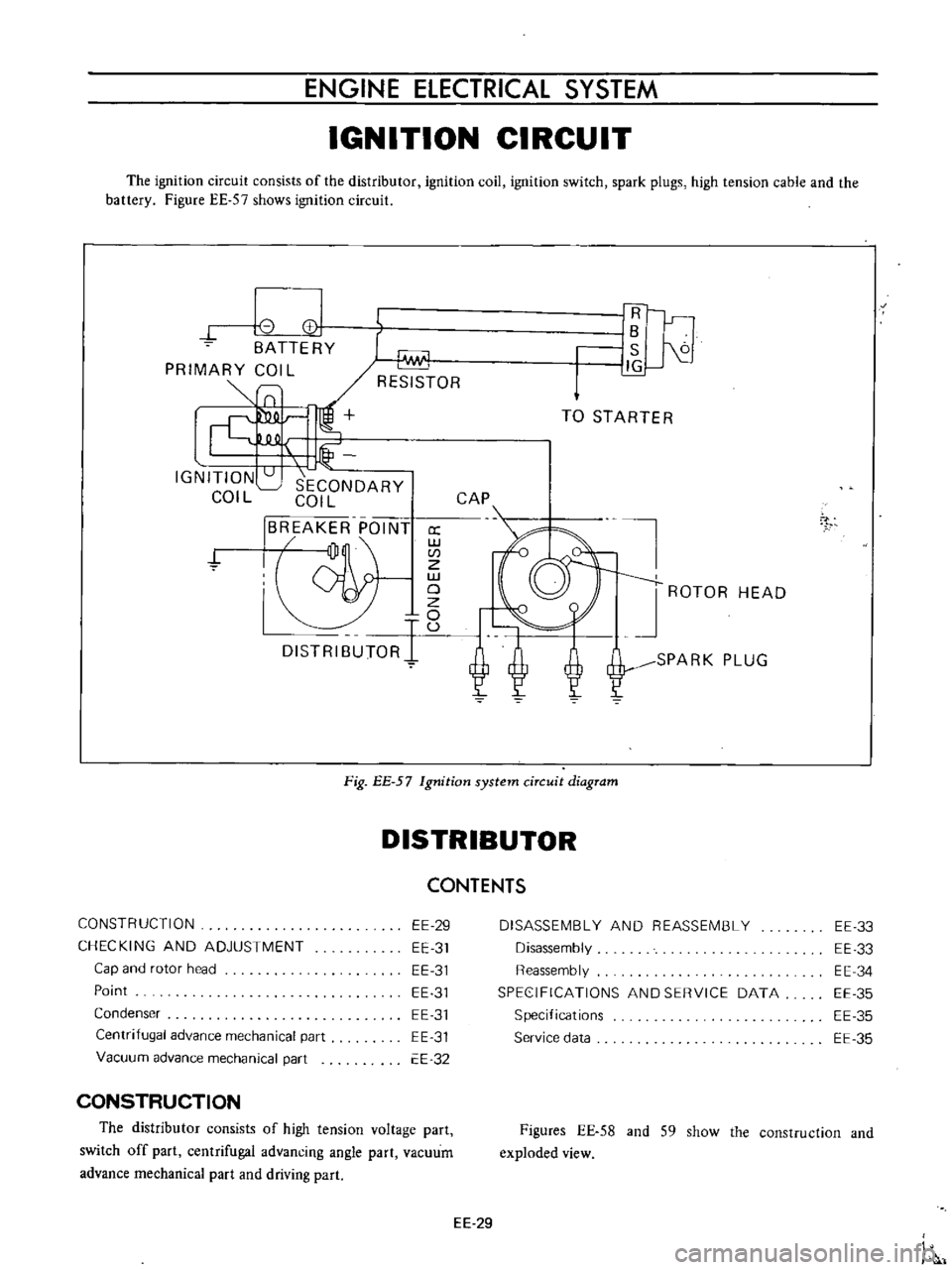
The
ignition
circuit
consists
of
the
distributor
ignition
coil
ignition
switch
spark
plugs
high
tension
cable
and
the
battery
Figure
EE
57
shows
ignition
circuit
8
I
CC
BATTERY
PRIMARY
COIL
SlO
Lf
IGNITION
SECONDARY
COIL
COIL
BREAKER
POINT
jJ
a
w
CI
Z
w
19
DISTRIBUTORI
U
1Fl
r
lB
S
J1G
TO
STARTER
CAP
ROTOR
HEAD
SPARK
PLUG
7
Fig
EE
57
Ignition
system
circuit
diagram
DISTRIBUTOR
CONSTRUCTION
CHECKING
AND
ADJUSTMENT
Cap
and
rotor
head
Point
Condenser
Centrifugal
advance
mechanical
part
Vacuum
advance
mechanical
part
EE
29
EE
31
EE
31
EE
31
EE
31
EE
31
EE
32
CONSTRUCTION
The
distributor
consists
of
high
tension
voltage
part
switch
off
part
centrifugal
advancing
angle
part
vacuum
advance
mechanical
part
and
driving
part
CONTENTS
DISASSEMBLY
AND
REASSEMBLY
Disassembly
Reassembly
SPEC
IFICATIONS
AND
SERVICE
DATA
Specifications
Service
data
EE
33
EE
33
EE
34
EE
35
EE
35
EE
35
Figures
EE
58
and
S9
show
the
construction
and
exploded
view
EE
29
Page 451 of 513
ENGINE
ElECTRICAL
SYSTEM
CHECKING
AND
ADJUSTMENT
Cap
and
rotor
head
Cap
and
rotor
head
must
always
be
kept
clean
to
maintain
good
insulation
durability
since
high
tension
voltage
from
ignition
coil
is
imposed
on
them
Sometimes
inside
of
the
cap
and
rotor
head
is
covered
with
fine
carbon
particles
and
dust
Whenever
crack
or
trace
of
leakage
is
found
on
the
cap
replace
with
a
new
one
Recommend
the
rotor
head
also
be
replaced
with
a
new
one
if
excessively
damaged
Point
When
point
surface
is
roughened
due
to
burning
polish
with
a
fine
emery
paper
No
500
or
600
or
oil
stone
When
the
point
is
worn
excessively
replace
When
the
point
is
replaced
with
a
new
one
apply
grease
to
the
arm
pivot
receiver
and
earn
surface
For
causes
of
damaged
burnt
point
improper
point
contact
insufficient
point
gap
and
defective
condenser
are
considered
The
standard
point
gap
is
0
45
to
0
55
mm
0
0177
to
0
0217
in
When
gap
is
deviated
from
the
standard
gap
adjust
Turn
the
shaft
to
a
position
where
the
breaker
arm
heel
rides
the
com
lug
a
position
where
point
gap
is
maximum
loosen
the
gap
adjusting
screw
apply
a
thickness
gauge
between
contacts
and
adjust
to
the
standard
point
gap
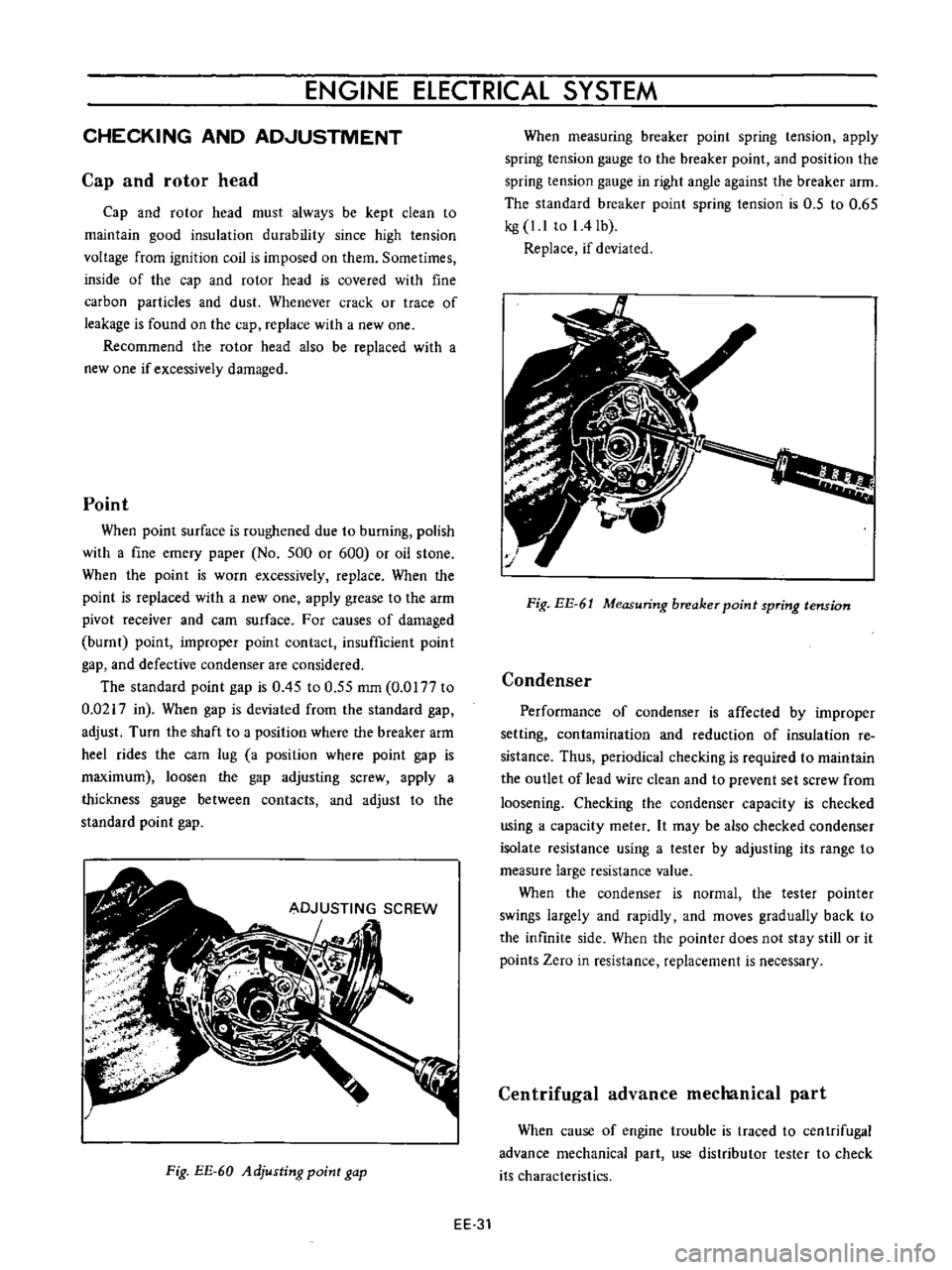
Fig
EE
60
Adjusting
point
gap
When
measuring
breaker
point
spring
tension
apply
spring
tension
gauge
to
the
breaker
point
and
position
the
spring
tension
gauge
in
right
angle
against
the
breaker
arm
The
standard
breaker
point
spring
tension
is
0
5
to
0
65
kg
1
1
to
I
4Ib
Replace
if
deviated
Fig
EE
61
Measuring
breaker
point
spring
tension
Condenser
Performance
of
condenser
is
affected
by
improper
setting
contamination
and
reduction
of
insulation
re
sistance
Thus
periodical
checking
is
required
to
maintain
the
outlet
of
lead
wire
clean
and
to
prevent
set
screw
from
loosening
Checking
the
condenser
capacity
is
checked
using
a
capacity
meter
It
may
be
also
checked
condenser
isolate
resistance
using
a
tester
by
adjusting
its
range
to
measure
large
resistance
value
When
the
condenser
is
normal
the
tester
pointer
swings
largely
and
rapidly
and
moves
gradually
back
to
the
infinite
side
When
the
pointer
does
not
stay
still
or
it
points
Zero
in
resistance
replacement
is
necessary
Centrifugal
advance
mechanical
part
When
cause
of
engine
trouble
is
traced
to
centrifugal
advance
mechanical
part
use
distributor
tester
to
check
its
characteristics
EE
31
Page 459 of 513

ENGINE
ELECTRICAL
SYSTEM
TROUBLE
DIAGNOSES
AND
CORRECTIONS
When
engine
does
not
start
If
there
is
no
trouble
in
fuel
system
ignition
system
should
be
checked
This
can
be
easily
done
by
detaching
a
high
tension
cable
from
spark
plug
starting
engine
and
observing
condition
of
spark
that
occurs
between
high
tension
cable
and
spark
plug
terminal
After
checking
this
repair
as
necessary
Length
of
Trouble
location
Cause
Remedies
spark
gap
No
sparks
at
all
Distributor
Defective
insulation
of
condenser
Replace
Breakage
of
lead
wire
on
low
tension
side
Repair
Defective
insulation
of
cap
and
rotor
head
Replace
Point
does
not
open
or
close
Repair
Ignition
coil
Wire
breakage
or
short
circuit
of
coil
Replace
with
new
one
High
tension
cable
Wire
coming
off
Repair
Defective
insulation
Replace
I
to
2
mm
0
0394
Distributor
Point
gap
too
wide
Correct
to
0
0787
in
or
Oil
sticking
on
point
Clean
irregular
Point
burnt
too
much
Replace
Less
than
6
mm
Spark
plugs
Electrode
gap
too
wide
Correct
or
replace
0
2362
in
Too
much
carbon
Clean
or
replace
Broken
neck
of
insulator
Replace
Expiry
of
plug
life
Replace
2
When
engine
rotates
but
does
not
run
smoothly
In
this
case
there
are
many
causes
resulting
from
the
ignition
system
and
other
engine
conditions
not
related
to
ignition
Therefore
first
complete
inspection
of
ignition
system
should
be
carried
out
EE
39