Page 2255 of 5267
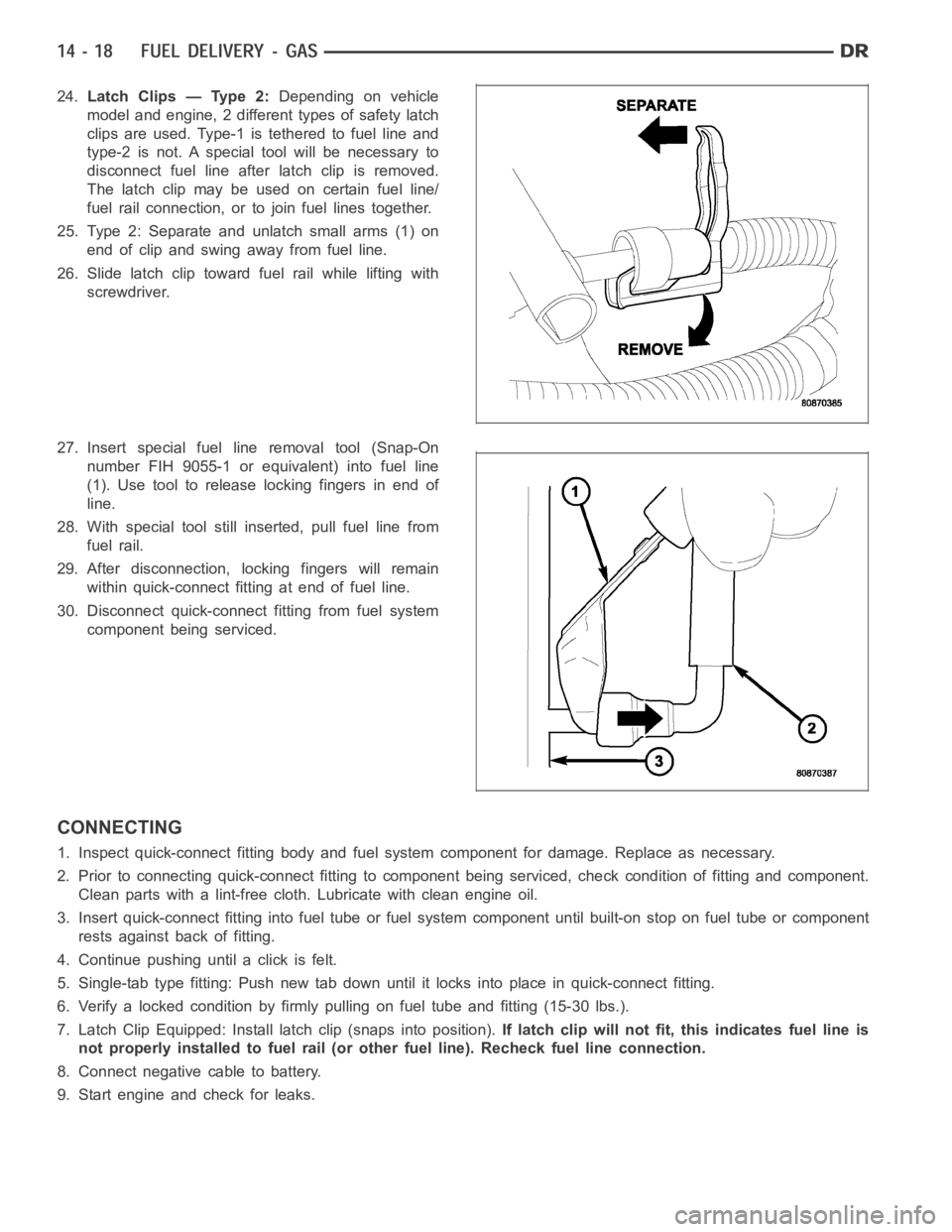
24.Latch Clips — Type 2:Depending on vehicle
model and engine, 2 different types of safety latch
clips are used. Type-1 is tethered to fuel line and
type-2 is not. A special tool will be necessary to
disconnect fuel line after latch clip is removed.
The latch clip may be used on certain fuel line/
fuel rail connection, or to join fuel lines together.
25. Type 2: Separate and unlatch small arms (1) on
end of clip and swing away from fuel line.
26. Slide latch clip toward fuel rail while lifting with
screwdriver.
27. Insert special fuel line removal tool (Snap-On
number FIH 9055-1 or equivalent) into fuel line
(1). Use tool to release locking fingers in end of
line.
28. With special tool still inserted, pull fuel line from
fuel rail.
29. After disconnection, locking fingers will remain
within quick-connect fitting at end of fuel line.
30. Disconnect quick-connect fitting from fuel system
component being serviced.
CONNECTING
1. Inspect quick-connect fitting body and fuel system component for damage. Replace as necessary.
2. Prior to connecting quick-connect fitting to component being serviced, check condition of fitting and component.
Clean parts with a lint-free cloth. Lubricate with clean engine oil.
3. Insert quick-connect fitting intofuel tube or fuel system component until built-on stop on fuel tube or component
rests against back of fitting.
4. Continue pushing until a click is felt.
5. Single-tab type fitting: Push new tab down until it locks into place in quick-connect fitting.
6. Verify a locked condition by firmly pulling on fuel tube and fitting (15-30 lbs.).
7. Latch Clip Equipped: Install latch clip (snaps into position).If latch clip will not fit, this indicates fuel line is
not properly installed to fuel rail (or other fuel line). Recheck fuel lineconnection.
8. Connect negative cable to battery.
9. Start engine and check for leaks.
Page 2256 of 5267
MODULE-FUEL PUMP
DESCRIPTION
The electric fuel pump is located inside of the fuel pump module. A 12 volt, permanent magnet, electric motor pow-
ers the fuel pump. The electric fuel pump is not a separate, serviceable component.
OPERATION
Voltage to operate the electric pump is supplied through the fuel pump relay.
Fuel is drawn in through a filter at the bottom of the module and pushed through the electric motor gearset to the
pump outlet.
Check Valve Operation:The bottom section of the fuel pump module contains a one-way check valve toprevent
fuel flow back into the tank and to maintain fuel supply line pressure (engine warm) when pump is not operational.
It is also used to keep the fuel supply line full of gasoline when pump is not operational. After the vehicle has cooled
down, fuel pressure may drop to 0 psi (cold fluid contracts), but liquid gasoline will remain in fuel supply line
between the check valve and fuel injectors.Fuel pressure that has dropped to 0 psi on a cooled down vehicle
(engine off) is a normal condition.
The electric fuel pump is not a separate, serviceable component.
Page 2267 of 5267
INSTALLATION
3.7L
1. If fuel injectors are to be installed, (Refer to 14 -
FUEL SYSTEM/FUEL INJECTION/FUEL INJEC-
TOR - INSTALLATION).
2. Clean out fuel injector machined bores in intake
manifold.
3. Apply a small amount of engine oil to each fuel
injector O-ring. This will helpin fuel rail installation.
4. Position fuel rail/fuel injector assembly to machined
injector openings in cylinder head.
5. Guide each injector into cylinder head. Be careful
not to tear injector O-rings.
6. Pushrightside of fuel rail down until fuel injectors
have bottomed on cylinder head shoulder. Push
leftfuel rail down until injectors have bottomed on
cylinder head shoulder.
7. Install 4 fuel rail mounting bolts and tighten. (Refer
to 14 - FUEL SYSTEM/FUEL DELIVERY - SPECI-
FICATIONS)
8. Install 6 ignition coils. (Refer to 8 - ELECTRICAL/
IGNITION CONTROL/IGNITION COIL - INSTALLA-
TION)
9. Connect electrical connectors to throttle body.
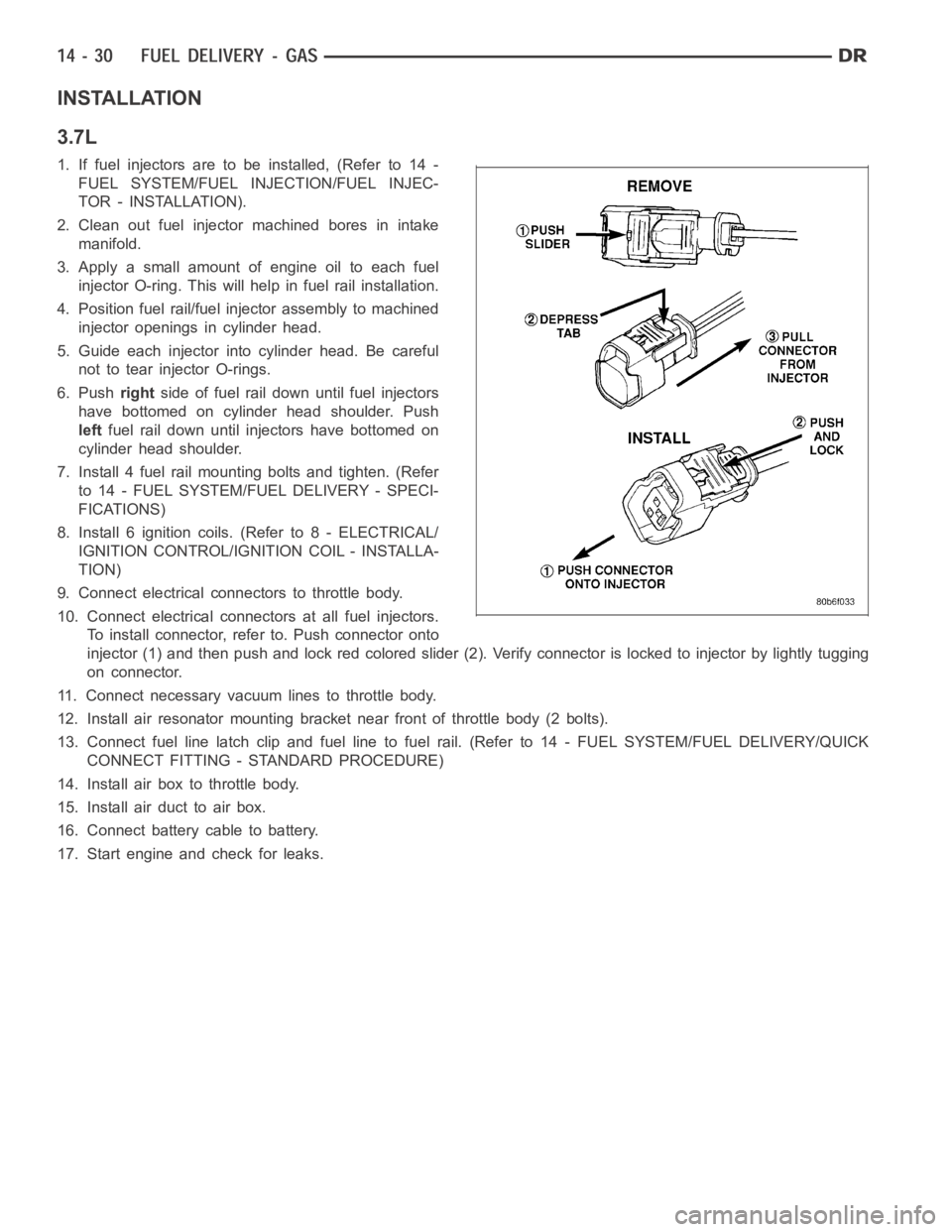
10. Connect electrical connectors at all fuel injectors.
To install connector, refer to. Push connector onto
injector (1) and then push and lock red colored slider (2). Verify connector is locked to injector by lightly tugging
on connector.
11. Connect necessary vacuum lines to throttle body.
12. Install air resonator mounting bracket near front of throttle body (2 bolts).
13. Connect fuel line latch clip and fuel line to fuel rail. (Refer to 14 - FUEL SYSTEM/FUEL DELIVERY/QUICK
CONNECT FITTING - STANDARD PROCEDURE)
14. Install air box to throttle body.
15. Install air duct to air box.
16. Connect battery cable to battery.
17. Start engine and check for leaks.
Page 2268 of 5267
4.7L
1. If fuel injectors are to be installed, (Refer to 14 -
FUEL SYSTEM/FUEL INJECTION/FUEL INJEC-
TOR - INSTALLATION).
2. Clean out fuel injector machined bores in intake
manifold.
3. Apply a small amount of engine oil to each fuel
injector O-ring. This will helpin fuel rail installation.
4. Position fuel rail/fuel injector assembly to machined
injector openings in cylinder head.
5. Guide each injector into cylinder head. Be careful
not to tear injector O-rings.
6. Pushrightside of fuel rail down until fuel injectors
have bottomed on cylinder head shoulder. Push
leftfuel rail down until injectors have bottomed on
cylinder head shoulder.
7. Install 4 fuel rail mounting bolts and tighten. (Refer
to 14 - FUEL SYSTEM/FUEL DELIVERY - SPECI-
FICATIONS)
8. Install 8 ignition coils. (Refer to 8 - ELECTRICAL/
IGNITION CONTROL/IGNITION COIL - INSTALLA-
TION)
9. Connect electrical connectors to throttle body.
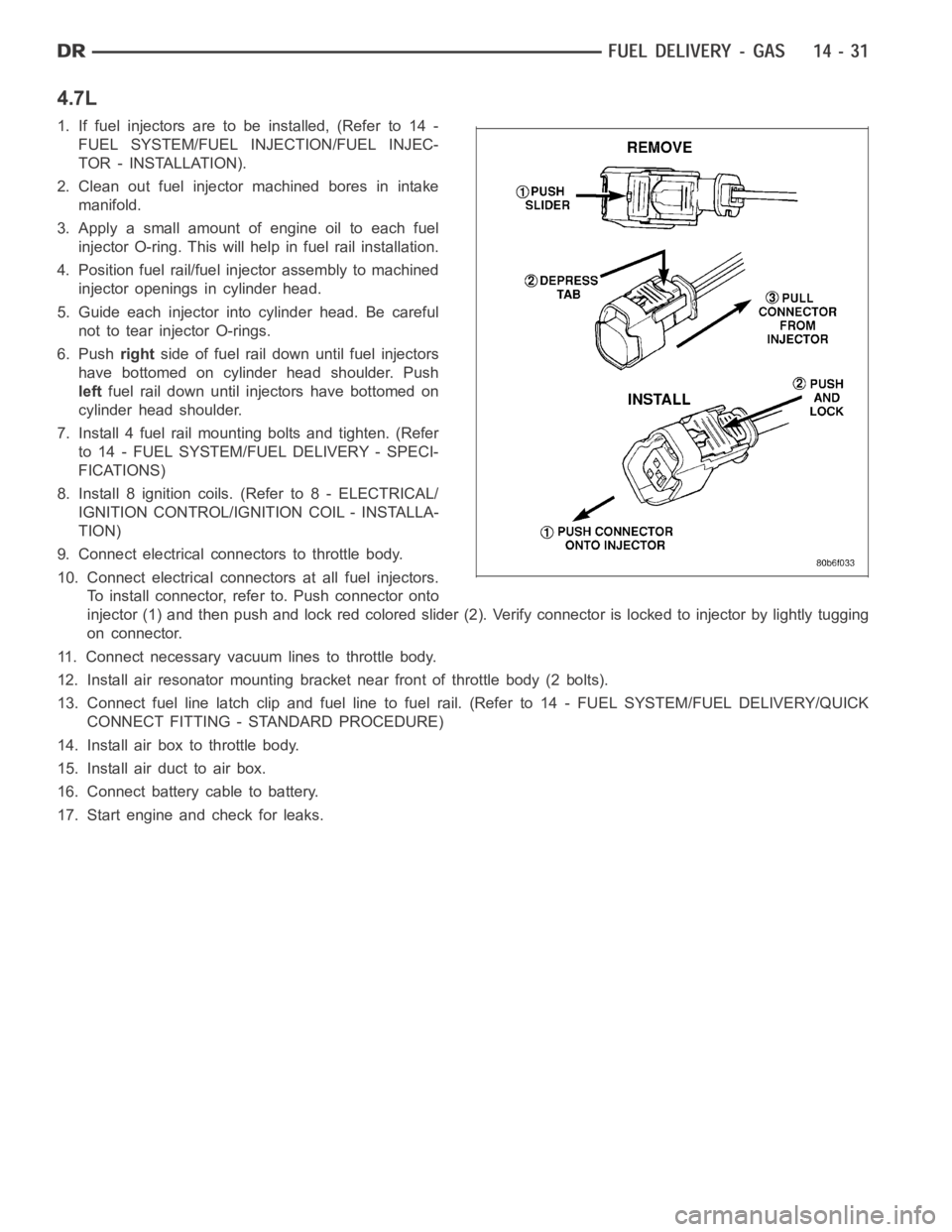
10. Connect electrical connectors at all fuel injectors.
To install connector, refer to. Push connector onto
injector (1) and then push and lock red colored slider (2). Verify connector is locked to injector by lightly tugging
on connector.
11. Connect necessary vacuum lines to throttle body.
12. Install air resonator mounting bracket near front of throttle body (2 bolts).
13. Connect fuel line latch clip and fuel line to fuel rail. (Refer to 14 - FUEL SYSTEM/FUEL DELIVERY/QUICK
CONNECT FITTING - STANDARD PROCEDURE)
14. Install air box to throttle body.
15. Install air duct to air box.
16. Connect battery cable to battery.
17. Start engine and check for leaks.
Page 2269 of 5267
5.7L
1. If fuel injectors are to be installed, (Refer to 14 -
FUEL SYSTEM/FUEL INJECTION/FUEL INJEC-
TOR - INSTALLATION).
2. Clean out fuel injector machined bores in intake
manifold.
3. Apply a small amount of engine oil to each fuel
injector O-ring. This will helpin fuel rail installation.
4. Position fuel rail/fuel injector assembly to machined
injector openings in intake manifold.
5. Guide each injector into intake manifold. Be careful
not to tear injector O-rings.
6. Pushrightside of fuel rail down until fuel injectors
have bottomed on shoulders. Pushleftfuel rail
down until injectors have bottomed on shoulders.
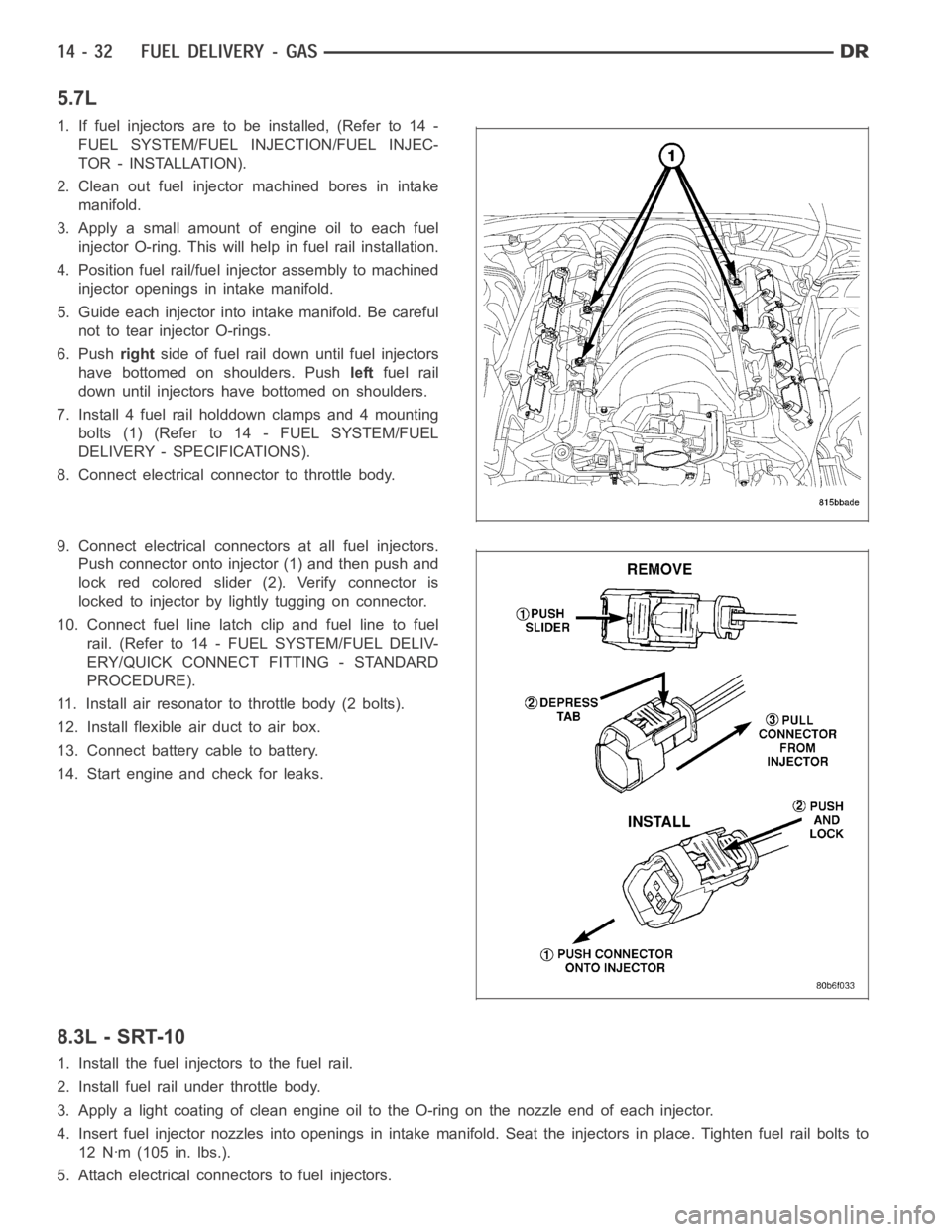
7. Install 4 fuel rail holddown clamps and 4 mounting
bolts (1) (Refer to 14 - FUEL SYSTEM/FUEL
DELIVERY - SPECIFICATIONS).
8. Connect electrical connector to throttle body.
9. Connect electrical connectors at all fuel injectors.
Push connector onto injector (1) and then push and
lock red colored slider (2). Verify connector is
locked to injector by lightly tugging on connector.
10. Connect fuel line latch clip and fuel line to fuel
rail. (Refer to 14 - FUEL SYSTEM/FUEL DELIV-
ERY/QUICK CONNECT FITTING - STANDARD
PROCEDURE).
11. Install air resonator to throttle body (2 bolts).
12. Install flexible air duct to air box.
13. Connect battery cable to battery.
14. Start engine and check for leaks.
8.3L - SRT-10
1. Install the fuel injectors to the fuel rail.
2. Install fuel rail under throttle body.
3. Apply a light coating of clean engine oiltotheO-ringonthenozzleendofeach injector.
4. Insert fuel injector nozzles into openings in intake manifold. Seat theinjectors in place. Tighten fuel rail bolts to
12 Nꞏm (105 in. lbs.).
5. Attach electrical connectors to fuel injectors.
Page 2270 of 5267
6. Connect the electrical connector to the MAP sensor and Coolant Temperature sensor.
7. Connect the electrical connector to the TPS and Idle Air Control.
8. Install the wiring harness to the wiring clips under the throttle body.
9. Connect fuel supply tube to fuel rail. Refer to Quick Connect Fittings inthe Fuel Delivery section.
10. Install the negative battery cable.
11. Install the air cleaner assembly, refer to the Engine/Air Intake System/Air Cleaner Housing for more information.
12. Use the DRBIII
scan tool ASD Fuel System Test to pressurize the fuel system. Check for leaks.
Page 2271 of 5267
TA N K - F U E L
DESCRIPTION
The fuel tank is constructed of a plastic material. Its main functions are for fuel storage and for placement of the fuel
pump module, and (if equipped) certain ORVR components.
OPERATION
All models pass a full 360 degree rollover test without fuel leakage. To accomplish this, fuel and vapor flow controls
are required for all fuel tank connections.
Two check (control) valves are mounted into the top of the fuel tank. Refer to Fuel Tank Check Valve for additional
information.
An evaporation control system is connected to the fuel tank to reduce emissions of fuel vapors into the atmosphere.
When fuel evaporates from the fuel tank, vapors pass through vent hoses or tubes to a charcoal canister where
they are temporarily held. When the engine is running, the vapors are drawninto the intake manifold. Certain mod-
els are also equipped with a self-diagnosing system using a Leak DetectionPump (LDP) or NVLD Pump, and/or an
On-Board Refueling Vapor Recovery (ORVR) system. Refer to Emission Control System for additional information.
REMOVAL- EXCEPT DIESEL
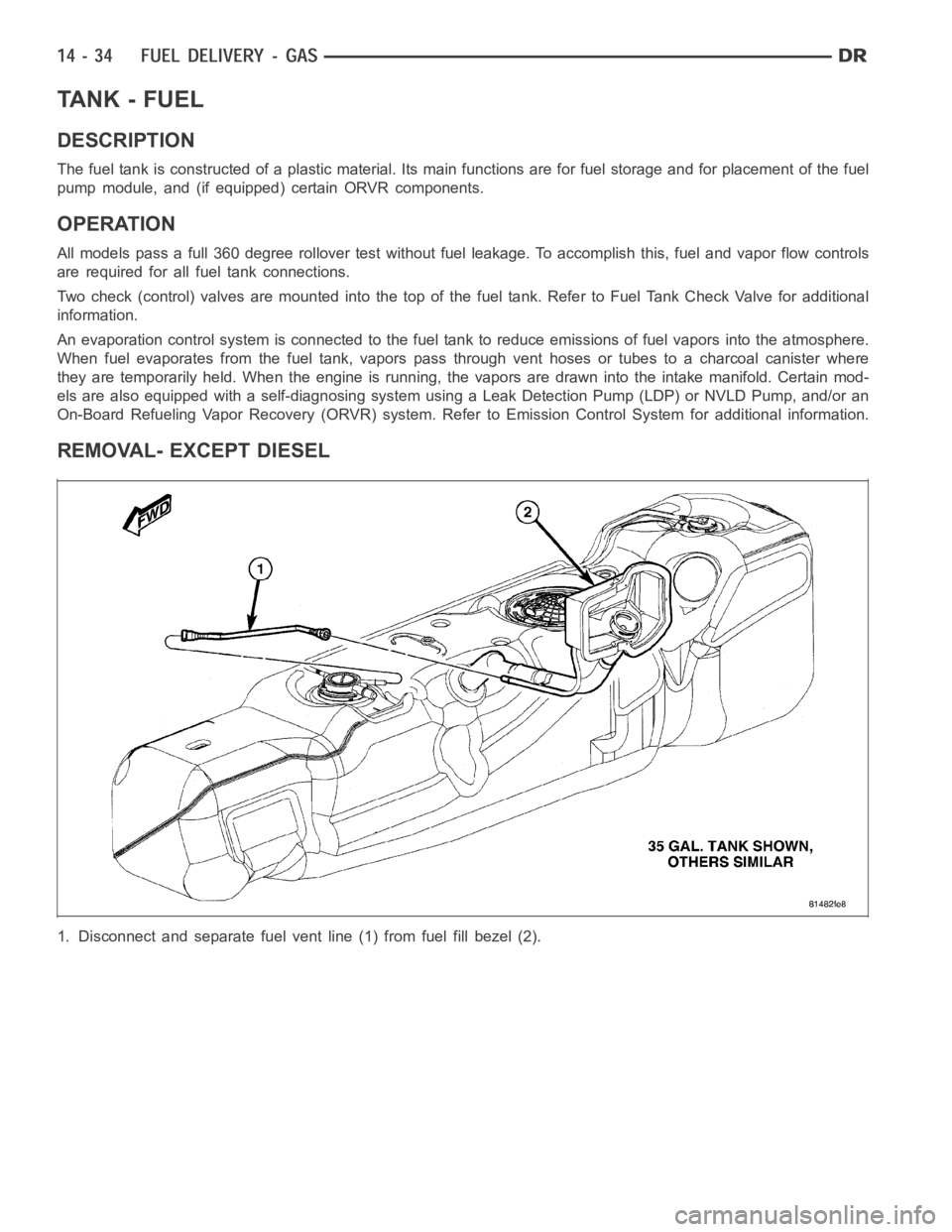
1. Disconnect and separate fuel vent line (1) from fuel fill bezel (2).
Page 2279 of 5267
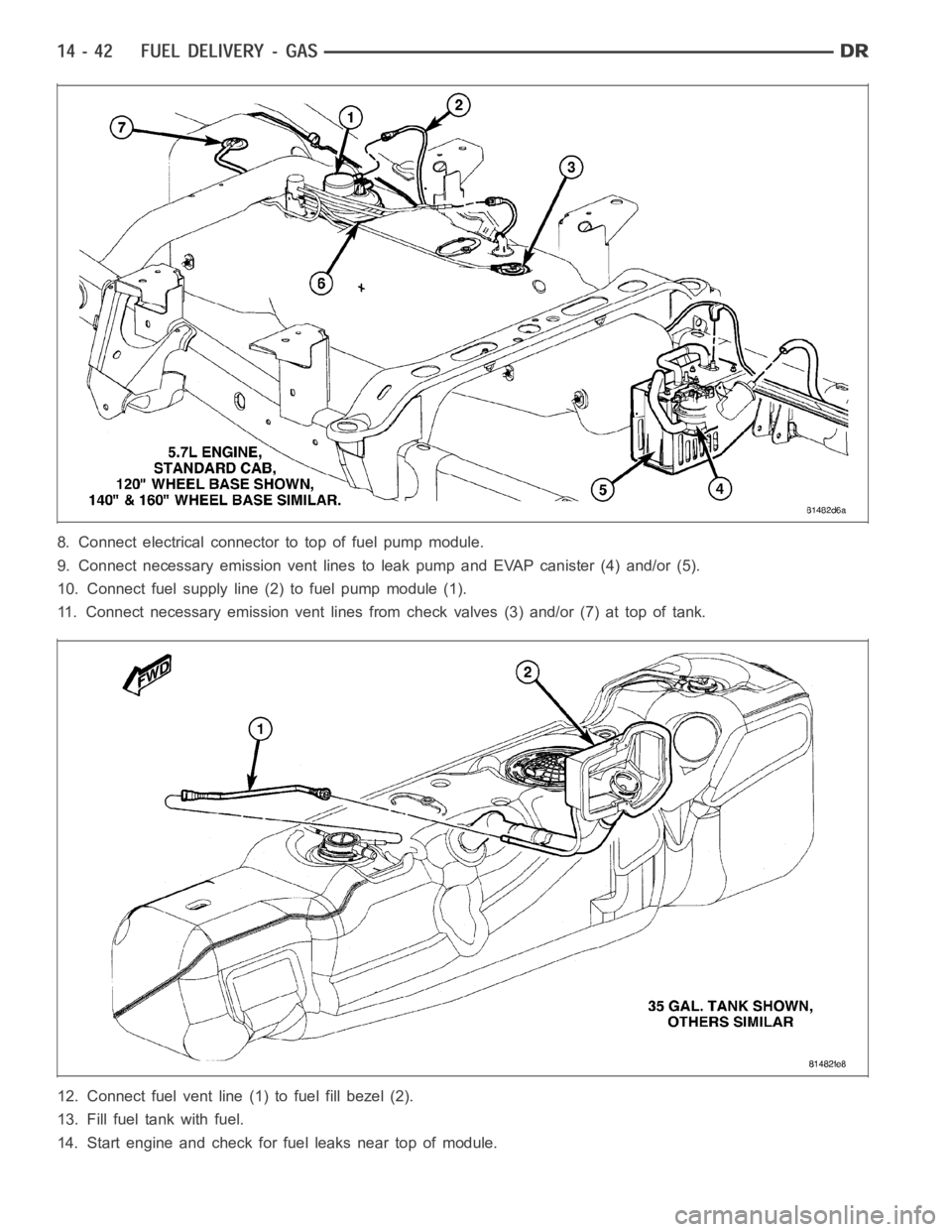
8. Connect electrical connector to top of fuel pump module.
9. Connect necessary emission vent lines to leak pump and EVAP canister (4)and/or (5).
10. Connect fuel supply line (2) to fuel pump module (1).
11. Connect necessary emission vent lines from check valves (3) and/or (7)at top of tank.
12. Connect fuel vent line (1) to fuel fill bezel (2).
13. Fill fuel tank with fuel.
14. Start engine and check for fuel leaks near top of module.