2006 LAND ROVER FRELANDER 2 engine overheat
[x] Cancel search: engine overheatPage 1773 of 3229
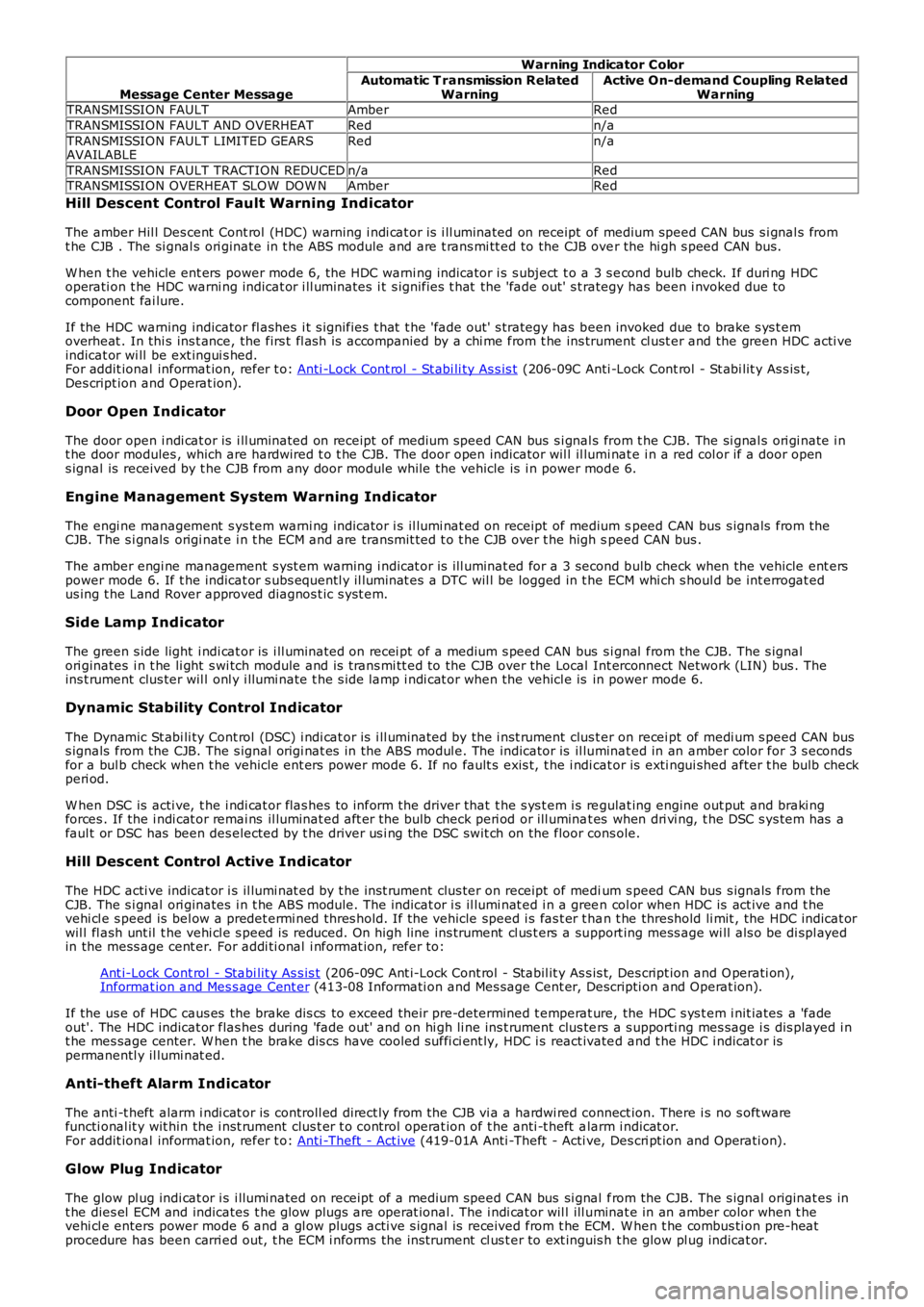
Message Center Message
Warning Indicator Color
Automatic T ransmission RelatedWarningActive On-demand Coupling RelatedWarningTRANSMISSION FAULTAmberRed
TRANSMISSION FAULT AND OVERHEATRedn/a
TRANSMISSION FAULT LIMITED GEARSAVAILABLERedn/a
TRANSMISSION FAULT TRACTION REDUCEDn/aRedTRANSMISSION OVERHEAT SLOW DOW NAmberRed
Hill Descent Control Fault Warning Ind icator
The amber Hil l Des cent Cont rol (HDC) warning i ndi cat or is i ll uminated on receipt of medium speed CAN bus s i gnal s fromt he CJB . The si gnal s ori ginate in t he ABS module and are t rans mi tt ed to the CJB over the hi gh s peed CAN bus.
W hen t he vehicle ent ers power mode 6, the HDC warni ng indicator i s s ubject t o a 3 s econd bulb check. If duri ng HDCoperati on t he HDC warni ng indicat or i ll uminates i t s ignifies t hat the 'fade out' s t rategy has been i nvoked due tocomponent fai lure.
If the HDC warning indicator fl ashes i t s ignifies t hat t he 'fade out' s trategy has been invoked due to brake s ys t emoverheat . In thi s ins t ance, the firs t fl as h is accompanied by a chi me from t he ins trument cl ust er and the green HDC acti veindicat or wi ll be ext ingui s hed.For addit ional informat ion, refer t o: Anti -Lock Cont rol - St abi li ty As s is t (206-09C Anti -Lock Cont rol - St abi lit y As s is t,Des cript ion and Operat ion).
Door Open Indicator
The door open i ndi cat or is i ll uminated on receipt of medium speed CAN bus s i gnal s from t he CJB. The si gnal s ori gi nate i nt he door modules , which are hardwired t o t he CJB. The door open indicator wil l il lumi nat e i n a red col or if a door opens ignal is received by t he CJB from any door module while the vehicle is i n power mode 6.
Engine Management System Warning Indicator
The engi ne management s ys tem warni ng indicator i s il lumi nat ed on receipt of medium speed CAN bus s ignals from theCJB. The s i gnals origi nat e i n t he ECM and are transmit ted t o t he CJB over t he high speed CAN bus .
The amber engi ne management s yst em warning i ndicat or is ill uminat ed for a 3 second bulb check when the vehicle ent erspower mode 6. If t he indicat or s ubs equentl y il lumi nat es a DTC wil l be logged in t he ECM whi ch s houl d be int errogat edus ing t he Land Rover approved diagnos t ic s yst em.
Side Lamp Indicator
The green s ide light i ndi cat or is i ll uminated on recei pt of a medium s peed CAN bus si gnal from the CJB. The s ignalori ginates i n t he li ght s wi tch module and is t rans mi tt ed to the CJB over the Local Int erconnect Network (LIN) bus . Theins t rument clus ter wil l onl y i llumi nate t he s ide lamp i ndi cat or when the vehicl e is in power mode 6.
Dynamic Stability Control Indicator
The Dynamic St abi li ty Cont rol (DSC) i ndi cat or is i ll uminated by the i nst rument clus ter on recei pt of medi um s peed CAN buss ignals from the CJB. The s ignal origi nat es in the ABS modul e. The indicator is il luminat ed in an amber color for 3 s econdsfor a bul b check when t he vehicle ent ers power mode 6. If no fault s exis t, t he i ndi cat or is exti ngui shed after t he bulb checkperi od.
W hen DSC is acti ve, t he i ndi cat or flas hes t o inform the driver that t he s ys t em i s regulat ing engine out put and braki ngforces . If the i ndi cat or remai ns il luminat ed aft er the bulb check peri od or ill uminat es when dri vi ng, t he DSC s ys tem has afaul t or DSC has been des elected by t he driver us i ng the DSC swit ch on the floor cons ole.
Hill Descent Control Active Indicator
The HDC acti ve indicat or i s il lumi nat ed by t he ins t rument clus ter on receipt of medium s peed CAN bus s ignals from theCJB. The s i gnal ori ginates i n t he ABS module. The indicat or i s il lumi nat ed i n a green col or when HDC is act ive and t hevehi cl e s peed is bel ow a predet ermi ned thres hold. If the vehicle speed i s fas t er t han t he threshold li mit , the HDC indicat orwil l fl ash unt il t he vehi cl e s peed is reduced. On high line ins trument cl us t ers a support ing mess age wi ll als o be di spl ayedin the mess age cent er. For addi ti onal i nformat ion, refer to:
Ant i-Lock Cont rol - Stabi lit y As s is t (206-09C Ant i-Lock Cont rol - Stabil it y As s is t, Des cript ion and O perati on),Informat ion and Mes s age Cent er (413-08 Informati on and Mes sage Cent er, Descripti on and Operat ion).
If the us e of HDC caus es the brake di s cs to exceed their pre-determined t emperat ure, the HDC s ys t em i nit iates a 'fadeout'. The HDC indicat or flas hes during 'fade out ' and on hi gh li ne ins t rument clus ters a s upporti ng mes sage i s dis played i nt he mes sage center. W hen t he brake dis cs have cooled suffi ci ent ly, HDC i s react ivated and t he HDC i ndicat or ispermanentl y il lumi nat ed.
Anti-theft Alarm Indicator
The anti -t heft alarm i ndi cat or is controll ed direct ly from the CJB vi a a hardwi red connect ion. There i s no s oft warefuncti onal it y wit hin the i nst rument clus t er t o control operat ion of t he anti -t heft alarm i ndicat or.For addit ional informat ion, refer t o: Anti -Theft - Act ive (419-01A Anti -Theft - Acti ve, Des cri pt ion and Operati on).
Glow Plug Indicator
The glow pl ug indi cat or i s i llumi nated on recei pt of a medium speed CAN bus si gnal from the CJB. The s ignal originat es int he dies el ECM and indicates t he glow plugs are operat ional. The i ndi cat or wil l ill uminat e in an amber color when t hevehi cl e enters power mode 6 and a gl ow plugs acti ve s ignal is received from t he ECM. W hen t he combus ti on pre-heatprocedure has been carri ed out, t he ECM i nforms the ins trument cl us t er to ext inguis h t he glow pl ug indicat or.
Page 2740 of 3229
20
Quick start
L
Tachometer
Indicates engine spee d in revolutions per
minute (x 1 000). In normal driving conditions
the engine is most fuel efficient between 2 000
and 3 000 rev/min.
Temperature gauge
At normal operating temperature, the pointer is
positioned midway between the red and blue
segments of the gauge (the precise position
will vary according to climatic conditions).
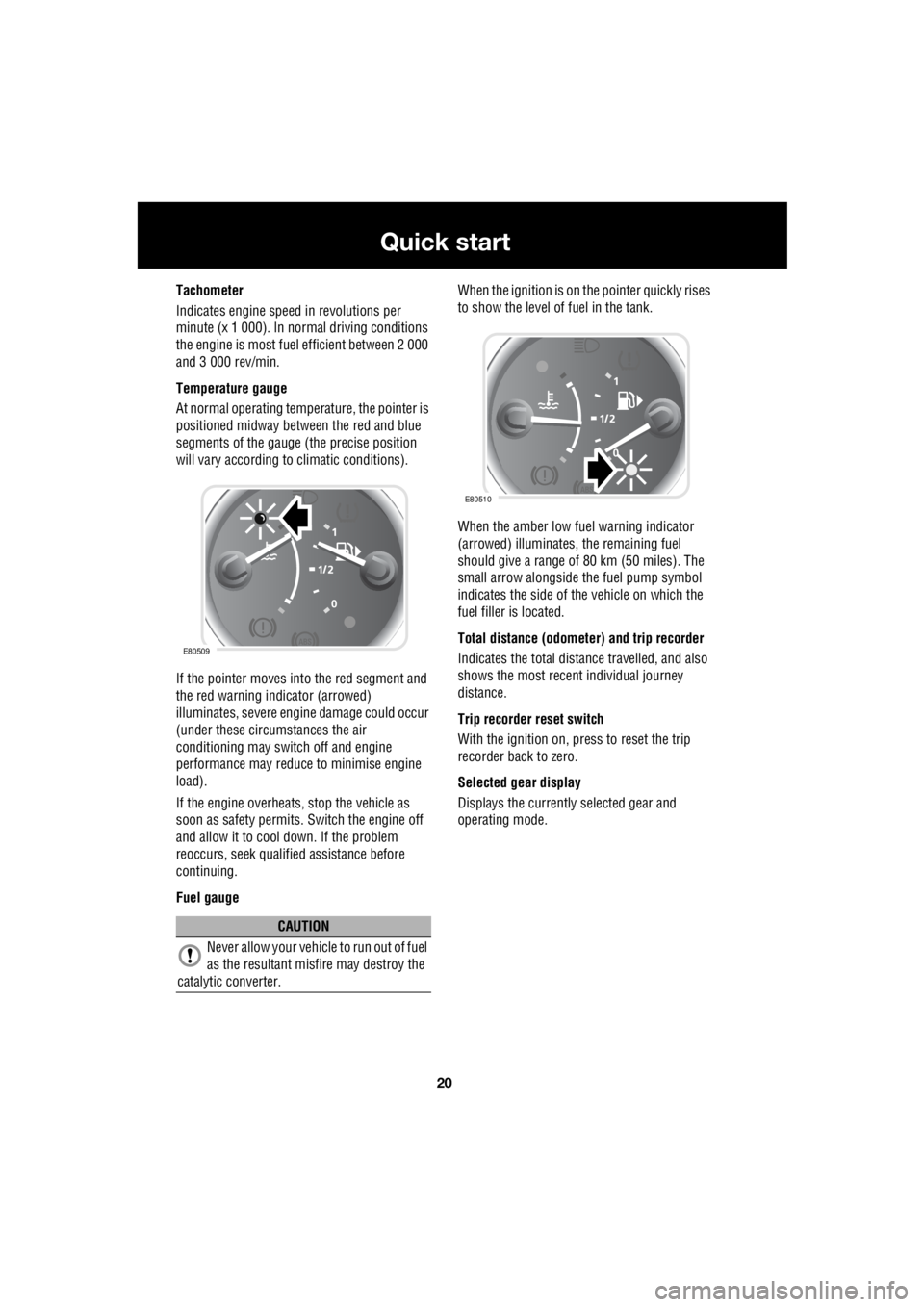
If the pointer moves into the red segment and
the red warning indicator (arrowed)
illuminates, severe engi ne damage could occur
(under these circumstances the air
conditioning may switch off and engine
performance may reduce to minimise engine
load).
If the engine overheats, stop the vehicle as
soon as safety pe rmits. Switch the engine off
and allow it to cool down. If the problem
reoccurs, seek qualified assistance before
continuing.
Fuel gauge When the ignition is on the pointer quickly rises
to show the level of fuel in the tank.
When the amber low fuel warning indicator
(arrowed) illuminates, the remaining fuel
should give a range of 80 km (50 miles). The
small arrow alongside th e fuel pump symbol
indicates the side of the vehicle on which the
fuel filler is located.
Total distance (odometer) and trip recorder
Indicates the total distance travelled, and also
shows the most recent individual journey
distance.
Trip recorder reset switch
With the ignition on, press to reset the trip
recorder back to zero.
Selected gear display
Displays the currently selected gear and
operating mode.
CAUTION
Never allow your vehicl e to run out of fuel
as the resultant misfire may destroy the
catalytic converter.
E80509
E80510
Page 2818 of 3229

Instruments
98
L
Tachometer
Indicates engine spee d in revolutions per
minute (RPM) x 1000.
Temperature gauge
If the pointer moves onto the red line and the
red warning indicator illu minates severe engine
damage can occur.
If the engine overheats, stop the vehicle as
soon as safety pe rmits. Switch the engine off
and allow it to cool down. If the problem
reoccurs, seek qualified assistance before
continuing.
Note: If engine temperatur e rises to the point
where overheating may occur, there may be a
noticeable reduction in engine power, and the
air conditioning may cease operation. This is a
normal operating strate gy to reduce load on
the engine and assist with cooling.
Fuel gauge
Once the fuel level has dropped to the point
where the range is approximately 80 km (50
miles) the low fuel warning indicator will
illuminate.
As a reminder for the location of the fuel filler,
there is an arrow next to the fuel pump symbol
which points to the releva nt side of the vehicle.
Speedometer
Indicates road speed. Odometer
Indicates the total distance which the vehicle
has travelled.
Trip recorder
Indicates the distance travelled since the last
reset, and can be used to measure the distance
of individual journeys.
Trip recorder reset button
Resets the distance shown on the trip recorder
to zero.
Note: Once the trip recorder has been reset to
zero, the previously recorded distance will be
lost.
Gear selector mode and positiondisplay
Displays the currently selected gear on
vehicle's fitted with automatic transmission.
Main message centre
Displays warning, and information messages.
See INFORMATION MESSAGES (page 99).
Warning indicator panel (fitted in place of
main message centre)
If a main message centre is not fitted, the
warning indicator pane l will provide system
status information.
Warning indicator panel
The warning indicator panel will provide
system status information.
CAUTION
Serious engine damage can occur if the
vehicle is driven whilst the engine is
overheating.
CAUTION
Never allow the vehicle to run out of
fuel. The resulting mis-fire may cause
serious damage to the catalytic
convertor.
Page 2843 of 3229
123
Brakes
R
BrakesPRINCIPLE OF OPERATION
Brake pads
Brake pads require a period of bedding in when
new. Drive with extra caution for the first 800
km (500 miles) to avoi d then need for heavy
braking.
Wet conditions
Driving through heavy rain or water can have
an adverse effect on braking efficiency. Under
those circumstances it is recommended that
you lightly apply the brak es intermittently to
dry the brakes.
HINTS ON DRIVING WITH ABS
ABS (Anti-Lock Braki ng System) allows
maximum brake pressure, and thus maximum
braking efficiency, to be applied, and prevents
the road wheels locking. This allows the driver
to retain steering control during heavy braking
under most road conditions.
During emergency brak ing conditions ABS
constantly monitors the speed of each wheel.
ABS varies the brake pressure to individual
wheels, according to the grip available. The
constant alteration of brake pressure can be
felt as a pulsing sensat ion through the brake
pedal. This is not a cause for concern, as it is
designed to demonstrate to the driver that ABS
is operating.
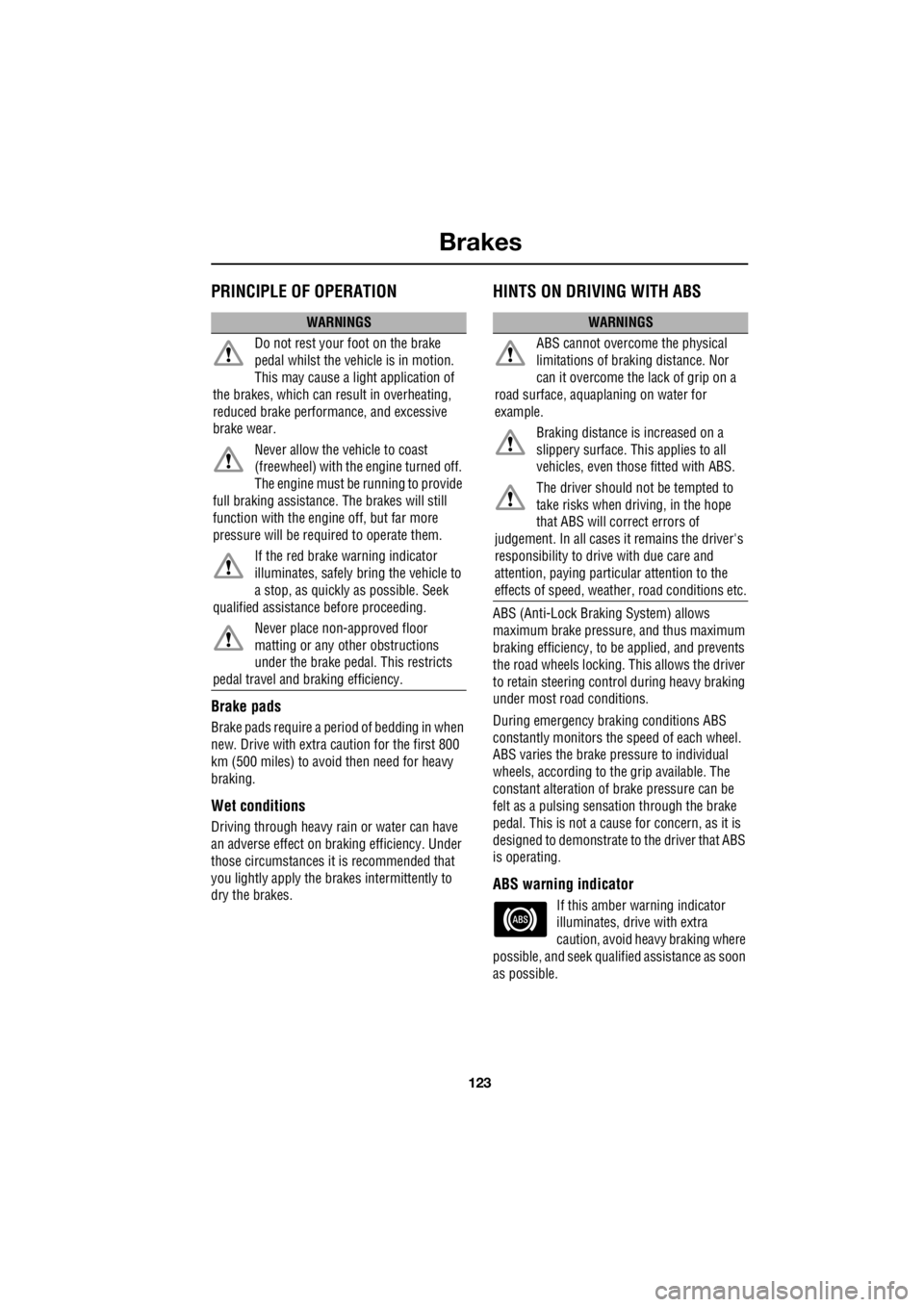
ABS warning indicator
If this amber warning indicator
illuminates, driv e with extra
caution, avoid heavy braking where
possible, and seek qualified assistance as soon
as possible.
WARNINGS
Do not rest your foot on the brake
pedal whilst the vehicle is in motion.
This may cause a light application of
the brakes, which can re sult in overheating,
reduced brake performance, and excessive
brake wear.
Never allow the vehicle to coast
(freewheel) with the engine turned off.
The engine must be running to provide
full braking assistance. The brakes will still
function with the engine off, but far more
pressure will be required to operate them.
If the red brake warning indicator
illuminates, safely bring the vehicle to
a stop, as quickly as possible. Seek
qualified assistance before proceeding.
Never place non-approved floor
matting or any ot her obstructions
under the brake pedal. This restricts
pedal travel and braking efficiency.WARNINGS
ABS cannot overcome the physical
limitations of brak ing distance. Nor
can it overcome the lack of grip on a
road surface, aquaplaning on water for
example.
Braking distance is increased on a
slippery surface. This applies to all
vehicles, even those fitted with ABS.
The driver should not be tempted to
take risks when driving, in the hope
that ABS will correct errors of
judgement. In all cases it remains the driver's
responsibility to driv e with due care and
attention, paying partic ular attention to the
effects of speed, weather, road conditions etc.
Page 2875 of 3229
155
Vehicle care
R
Underbody maintenance
Corrosive materials used on highways to
control snow and ice, as well as accumulations
from off-road driving or wading in salt water,
can collect on the vehi cle's underbody. If these
materials are not removed accelerated
corrosion can occur. Regularly flush the
underbody with plain wate r, and pay particular
attention to areas where mud and debris
collect.
If damage or corrosion are detected, have the
vehicle checked by a Land Rover
Dealer/Authorised Re pairer as soon as
possible.
Glass and mirrors
The rear screen, and mi rror glass' should only
be cleaned using soapy water and a soft cloth.
This will avoid damaging the reflective surface
of the mirror, and the heating elements and
antenna in the rear screen.
Never use abrasive cleaning products, or metal
ice scrapers on the mirrors or the front/rear
screens.
Cleaning after off-road driving
Ensure that the vehicle und erside is cleaned as
soon as possible after dr iving off-road. Further
information on cleaning af ter off-road use is
available in the off-road driving handbook. This
can be found on-line at
http://www.ownerinfo.landrover.com .
CLEANING THE INTERIOR
Plastic and cloth
Clean plastic or cloth faced surfaces with warm
water and non-detergent soap. Then wipe clean
with a soft cloth.
Leather
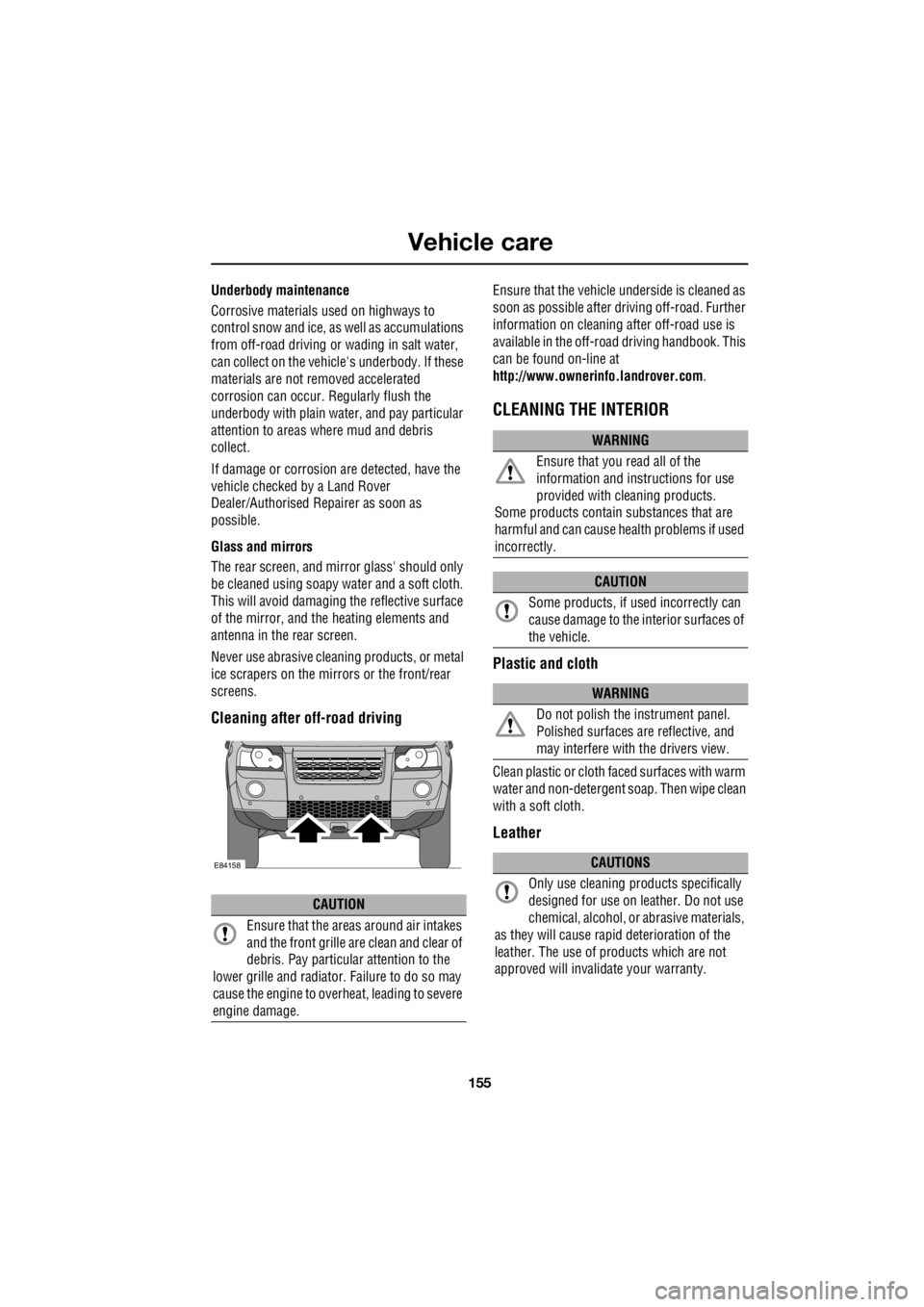
CAUTION
Ensure that the areas around air intakes
and the front grille ar e clean and clear of
debris. Pay particular attention to the
lower grille and radiator . Failure to do so may
cause the engine to overheat, leading to severe
engine damage.
E84158
WARNING
Ensure that you read all of the
information and inst ructions for use
provided with cleaning products.
Some products contain substances that are
harmful and can cause he alth problems if used
incorrectly.
CAUTION
Some products, if us ed incorrectly can
cause damage to the in terior surfaces of
the vehicle.
WARNING
Do not polish the instrument panel.
Polished surfaces are reflective, and
may interfere with the drivers view.
CAUTIONS
Only use cleaning pr oducts specifically
designed for use on le ather. Do not use
chemical, alcohol, or abrasive materials,
as they will cause rapi d deterioration of the
leather. The use of products which are not
approved will invalidate your warranty.
Page 2884 of 3229

Maintenance
164
L
If the level has fallen appreciably, suspect
leakage or overheatin g and arrange for the
vehicle to be exam ined by a qualified
technician.
Topping up the coolant
Top-up to the upper le vel indicator mark
located on the side of the expansion tank. Use
only a 50% mix of water and Texaco XLC
antifreeze.
Note: In an emergency - and only if the
approved antifreeze is unavailable - top-up the
cooling system with clea n water, but be aware
of the resultant reduction in frost protection.
Do not top-up or refill with conventional
antifreeze formulations. If in doubt consult a
qualified technician.
Ensure the cap is tightened fully after top-up is
completed by turning the cap until the ratchet
cap clicks. Antifreeze
Antifreeze contains important corrosion
inhibitors. The antifreeze content of the coolant
must be maintained at 50% ± 5% all year round
(not just in cold conditions). To ensure that the
anti-corrosion properties of the coolant are
retained, the antifreeze content should be
checked once a year and completely renewed
every ten years, regardless of distance
travelled. Failure to do so may cause corrosion
of the radiator and engine components.
The specific gravity of a 50% antifreeze
solution at 20°C (68°F) is 1.068 and protects
against frost down to -40°C (-40°F).
WARNINGS
Never remove the filler cap when the
engine is hot - escaping steam or
scalding water could ca use serious personal
injury.
Avoid spilling antifreeze onto a hot
engine - a fire may result.
Unscrew the filler cap slowly, allowing
the pressure to escape before removing
completely.
CAUTION
When travelling in territories where the
water supply contains salt, always
ensure you carry a supply of fresh (rain or
distilled) water. Topping up with salt water will
cause serious engine damage.
WARNINGS
Antifreeze is poisonous and can be fatal
if swallowed - keep containers sealed
and out of the reach of children. If accidental
consumption is suspec ted, seek medical
attention immediately.
If the fluid comes into contact with the
skin or eyes, rinse immediately with
plenty of water.
CAUTIONS
The use of non-approved antifreeze will
have an adverse ef fect on the engine
cooling system and therefore engine
durability.
Antifreeze will damage painted surfaces;
soak up any spillage with an absorbent
cloth immediately and wash the area with a
mixture of car shampoo and water.
Page 2910 of 3229

Wheels and tyres
190
L
Using the Land Rover tyre repair kit
Note: All vehicle drivers and occupants should
be made aware that a temporary repair has
been made to a tyre fitted to the vehicle. They
should also be made aware of the special
driving conditions im posed when using a
repaired tyre. Repair procedure
1. Open the tyre repair kit and peel off the
maximum speed label. Attach the label to
the facia in the driver's field of view. Take
care not to obstruct any of the instruments
or warning lights.
2. Uncoil the compressor power cable and
the inflation hose.
3. Unscrew the orange cap from the sealant
bottle receiver, and the sealant bottle cap.
4. Screw the sealant bottle into the receiver
(clockwise) until tight.
• Screwing the bottle onto the receiver will
pierce the bottle's se al. Do not unscrew
a full, or partly us ed bottle from the
receiver. Doing so will result in the
sealant leaking from the bottle.
5. Remove the valve cap from the damaged
tyre.
6. Remove the protective cap from the
inflation hose, and c onnect the inflation
hose to the tyre valve. Ensure that the hose
is screwed on firmly.
7. Ensure that the compressor switch is in
the off ( O) position.
8. Insert the power cable connector into an
auxiliary power socket. See AUXILIARY
POWER SOCKETS (page 110).
9. Unless the vehicle is in an enclosed or
poorly ventilated area , start the engine.
10. Set the compressor switch to the on ( l)
position.
11. Inflate the tyre to a minimum of 1.8 bar (26
lb/in²) and a maximum of 3.5 bar (51
lb/in²).
†
WARNINGS
Avoid skin contact with the sealant
which contains natu ral rubber latex.
Do not unscrew the sealant bottle from the
receiver until it is empty, as sealant will leak
out.
If the tyre inflation pressure does not
reach 1.8 bar (26 lb/in²) within seven
minutes, the tyre may have suffered excessive
damage. A temporary repair will not be
possible, and the vehicle should not be driven
until the tyre has been replaced.
CAUTIONS
Before attempting a tyre repair, ensure
that the vehicle is parked safely, as far
away from passing traffic as possible.
Ensure that the parki ng brake is applied,
and P is selected if an automatic
transmission is fitted.
Do not attempt to remove foreign objects
such as nails, screws, etc from the tyre.
Always run the engine when using the
compressor, unless the vehicle is in an
enclosed, or poorly ventilated space.
To prevent overheating do not operate
the compressor continuously for longer
than ten minutes.