2006 LAND ROVER FRELANDER 2 engine
[x] Cancel search: enginePage 2862 of 3229

Fuel and refuelling
142
L
Fuel and refuellingSAFETY PRECAUTIONS FUEL QUALITY
Petrol engined vehicles
Octane rating
The minimum octane rating for fuel used is 91
RON. The vehicle will run on lower ratings, but
it may cause pronounced engine knock or
pinking. If the pinking is severe it can cause
damage to the engine, fuel, and emission
control systems.
Note: Occasional, light , engine knock
experienced while accelera ting or climbing hills
is acceptable.
WARNINGS
Petroleum gasses are highly
flammable, have a low flash point, and
are explosive, especially in confined
spaces. Avoid exposing the gasses to any
potential sources of ignition as the resulting
fire and explosion may cause serious injuries
and/or death.
Only use containe rs specifically
designed for carrying fuel, and alway
remove them from the vehicle to fill
them. Failure to do so may result in spillage,
and cause a fire.
Switch off the engine when refuelling,
as it is both a source of extreme
temperatures, and electrical sparks.
The resulting fire a nd explosion may cause
serious injury and death.
Switch off any personal electronic
devices such as mobile phones, or
music players. They have the potential
to cause electrical sparks. The resulting fire
and explosion may caus e serious injury and
death.
Do not smoke, use a naked flame, or
cause sparks. The resulting fire and
explosion may caus e serious injury
and death.
Do not overfill the fuel tank. Overfilling
may cause spillage when the vehicle is
driven. Spillage may also occur if the
fuel expands in high ambient temperatures.
CAUTIONS
Do not use leaded fuels, lead
substitutes, or fuel additives. Doing so
can cause damage to the engine, fuel,
and emission control systems.
Only use high quality petrol, as using
lower quality fuels ca n cause damage to
the engine, fuel, and emission control
systems.
Fuel system cleaning agents should not
be used, unless approved by Land
Rover. Unapproved products may be
harmful to fuel system components on your
vehicle.
Page 2863 of 3229

143
Fuel and refuelling
R
Alternative fuels for petrol engines
Ethanol
Fuels containing up to 10% Ethanol (grain
alcohol) may be used. Ensure that the fuel has
octane ratings no lower than those
recommended for unleaded fuel. Most drivers
will not notice any opera ting difference with
fuel containing Ethanol . If a difference is
detected, the use of c onventional unleaded fuel
should be resumed.
Methanol
Some fuels contain Methanol (Methyl or wood
alcohol). If you use fuel s containing Methanol
the fuels must also contain co-solvents and
corrosion inhibitors for Methanol. Also, do not
use fuels which contain more than 3%
Methanol even if they contain co-solvents and
corrosion inhibitors. Fuel system damage or
vehicle performance problems resulting from
the use of such fuels is not the responsibility of
Land Rover, and may not be covered under the
warranty. Methyl Tertiary Butyl Ether (MTBE)
Unleaded fuel containing an oxygenate known
as MTBE can be used provided that the ratio of
MTBE to conventional fuel does not exceed
15%. MTBE is an Ether based compound
derived from Petroleum, which has been
specified by several refi ners as the substance
to enhance the Octane rating of fuel.
Reformulated gasoline
Several petroleum companies have announced
the availability of refo rmulated fuels. These
fuels are specially formulated to further reduce
vehicle emissi ons. Land Rover fully supports
all efforts to protect and maintain ambient air
quality, and encour ages the use of
reformulated gasoline where available.
Diesel engined vehicles
Note: Land Rover vehicle's are capable of
running with up to a 5% blend of bio-diesel in
accordance with European Standard EN590.
Sulphur content
The Sulphur content of diesel used in Land
Rover vehicles shoul d not exceed 0.3%.
In some countries dies el will contain higher
levers of Sulphur, whic h will require reduced
service intervals to reduce the effects on
engine components. If in doubt contact a local
Land Rover Dealer/Aut horised Repairer for
advice.
CAUTIONS
This vehicle is not suitable for use with
fuels containing more than 10%
Ethanol.
Do not use E85 fuels (85% Ethanol
content). Equipment necessary for the
use of fuels containing more than 10%
Ethanol is not fitted to this vehicle. If E85 fuels
are used, serious engine and fuels system
damage will occur.
CAUTION
Wherever possible avoid using fuel
containing Methanol.
Page 2864 of 3229
Fuel and refuelling
144
L
RUNNING OUT OF FUEL
Note: If the vehicle does run out of fuel, a
minimum of 4 litres (0 .8 gallons) will be
required to restart the engine. The vehicle will
need to be driven 1.6-5 km (1-3 miles) in order
to reset the engine management and
monitoring systems.
Note: If the vehicle does run out of fuel,
seeking qualified assistance is advisable.
FUEL CUT-OFF
The fuel system cut-off forms part of the
Supplementary Restraint System (SRS) fitted
to your vehicle. Following an impact, and
depending on the severity, the fuel pump may
be switched off.
Resetting the fuel cut-off
1. Switch the ignition off and wait for one
minute.
2. Turn the ignition on for 30 seconds.
3. Check the vehicle thor oughly for fuel leaks.
If a leak is detected switch the ignition off
immediately.
• Do not start the vehicle if a leak is
present. Seek qualifi ed advice, and have
the vehicle recovered.
4. If no leaks are detected, start the vehicle.
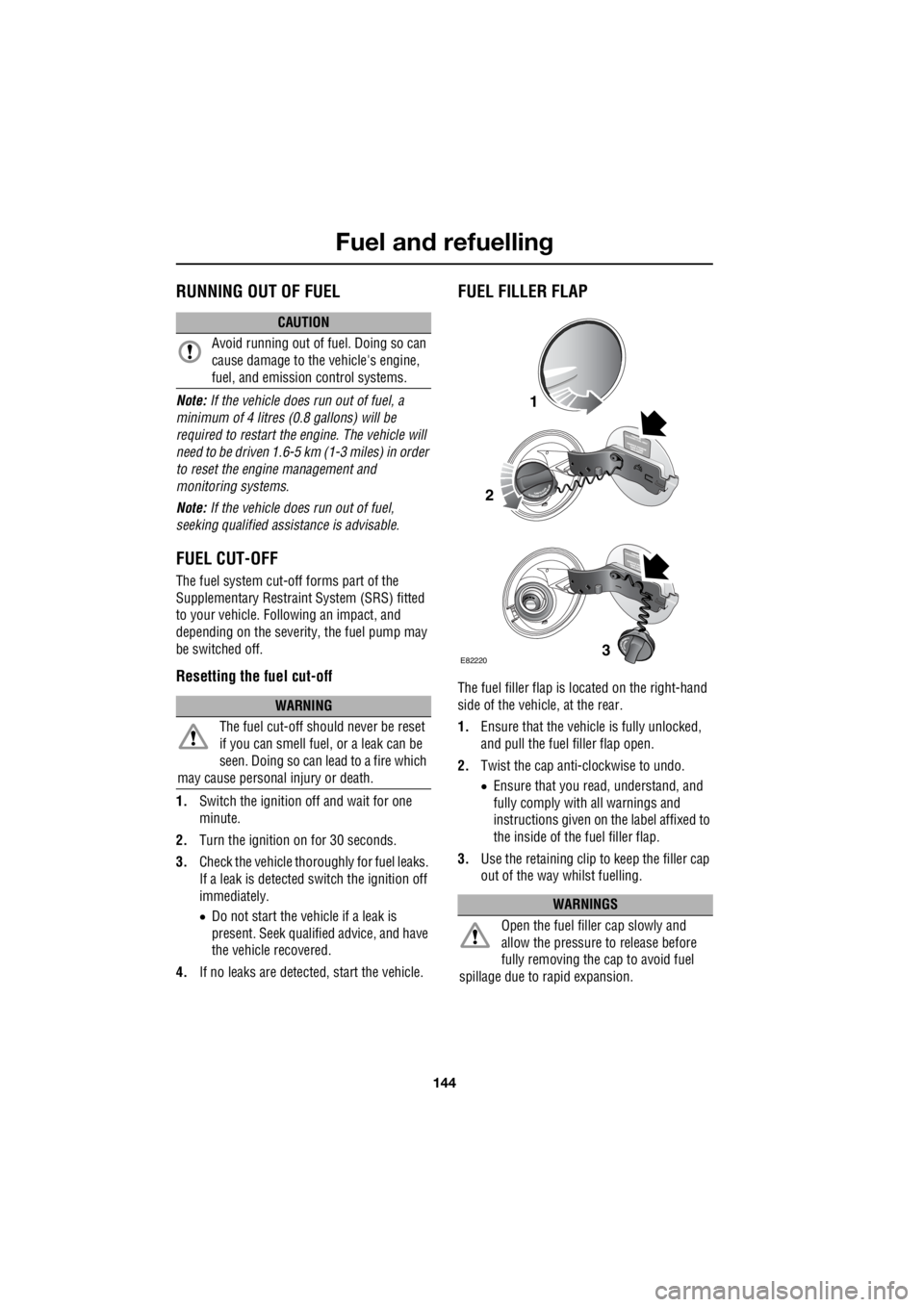
FUEL FILLER FLAP
The fuel filler flap is located on the right-hand
side of the vehicle, at the rear.
1. Ensure that the vehicle is fully unlocked,
and pull the fuel filler flap open.
2. Twist the cap anti-clockwise to undo.
• Ensure that you re ad, understand, and
fully comply with all warnings and
instructions given on the label affixed to
the inside of the fuel filler flap.
3. Use the retaining clip to keep the filler cap
out of the way whilst fuelling.
CAUTION
Avoid running out of fuel. Doing so can
cause damage to the vehicle's engine,
fuel, and emission control systems.
WARNING
The fuel cut-off s hould never be reset
if you can smell fuel , or a leak can be
seen. Doing so can lead to a fire which
may cause personal injury or death.
WARNINGS
Open the fuel filler cap slowly and
allow the pressure to release before
fully removing the cap to avoid fuel
spillage due to rapid expansion.
1
2
3E82220
Page 2865 of 3229
145
Fuel and refuelling
R
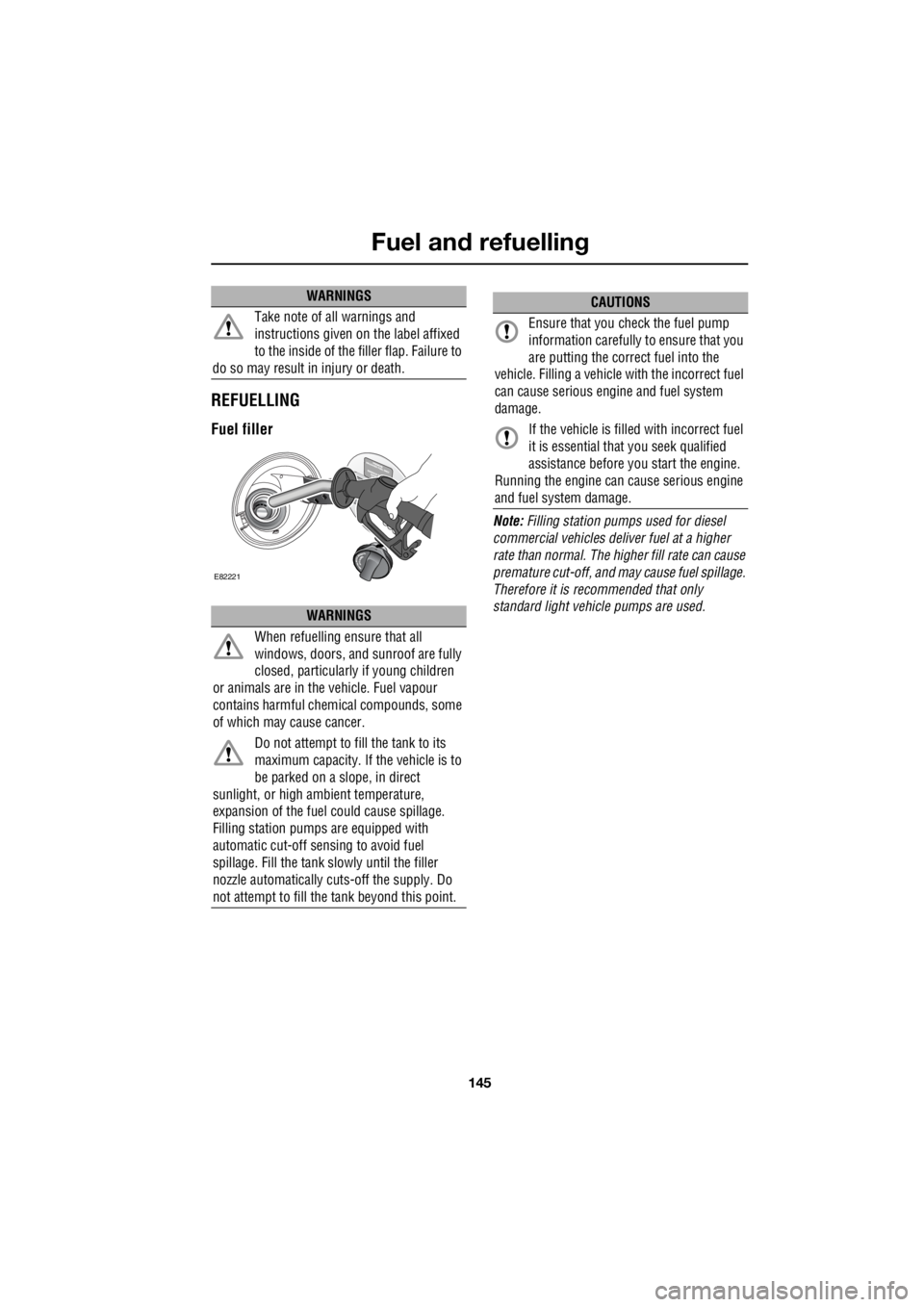
REFUELLING
Fuel filler
Note: Filling station pumps used for diesel
commercial vehicles deliver fuel at a higher
rate than normal. The hi gher fill rate can cause
premature cut-off, and may cause fuel spillage.
Therefore it is recommended that only
standard light vehicle pumps are used.
Take note of all warnings and
instructions given on the label affixed
to the inside of the filler flap. Failure to
do so may result in injury or death.
WARNINGS
When refuelling ensure that all
windows, doors, and sunroof are fully
closed, particularly if young children
or animals are in the vehicle. Fuel vapour
contains harmful chem ical compounds, some
of which may cause cancer.
Do not attempt to fill the tank to its
maximum capacity. If the vehicle is to
be parked on a slope, in direct
sunlight, or high ambient temperature,
expansion of the fuel could cause spillage.
Filling station pumps are equipped with
automatic cut-off sensing to avoid fuel
spillage. Fill the tank sl owly until the filler
nozzle automatically cuts -off the supply. Do
not attempt to fill the tank beyond this point.
WARNINGS
E82221
CAUTIONS
Ensure that you check the fuel pump
information carefully to ensure that you
are putting the correct fuel into the
vehicle. Filling a vehicle with the incorrect fuel
can cause serious engi ne and fuel system
damage.
If the vehicle is filled with incorrect fuel
it is essential that you seek qualified
assistance before you start the engine.
Running the engine can cause serious engine
and fuel system damage.
Page 2874 of 3229
Vehicle care
154
L
Vehicle careCLEANING THE ALLOY WHEELS
Wash the wheels with soap and water, this
should be done more frequently when the
wheels are exposed to he avy dirt deposits, salt,
clay etc. If you are unsure how often to clean
the wheels in particular conditions, seek advice
from your Land Rover Dealer/Authorised
Repairer.
Land Rover approved wheel cleaner should be
used to remove heavy soiling.
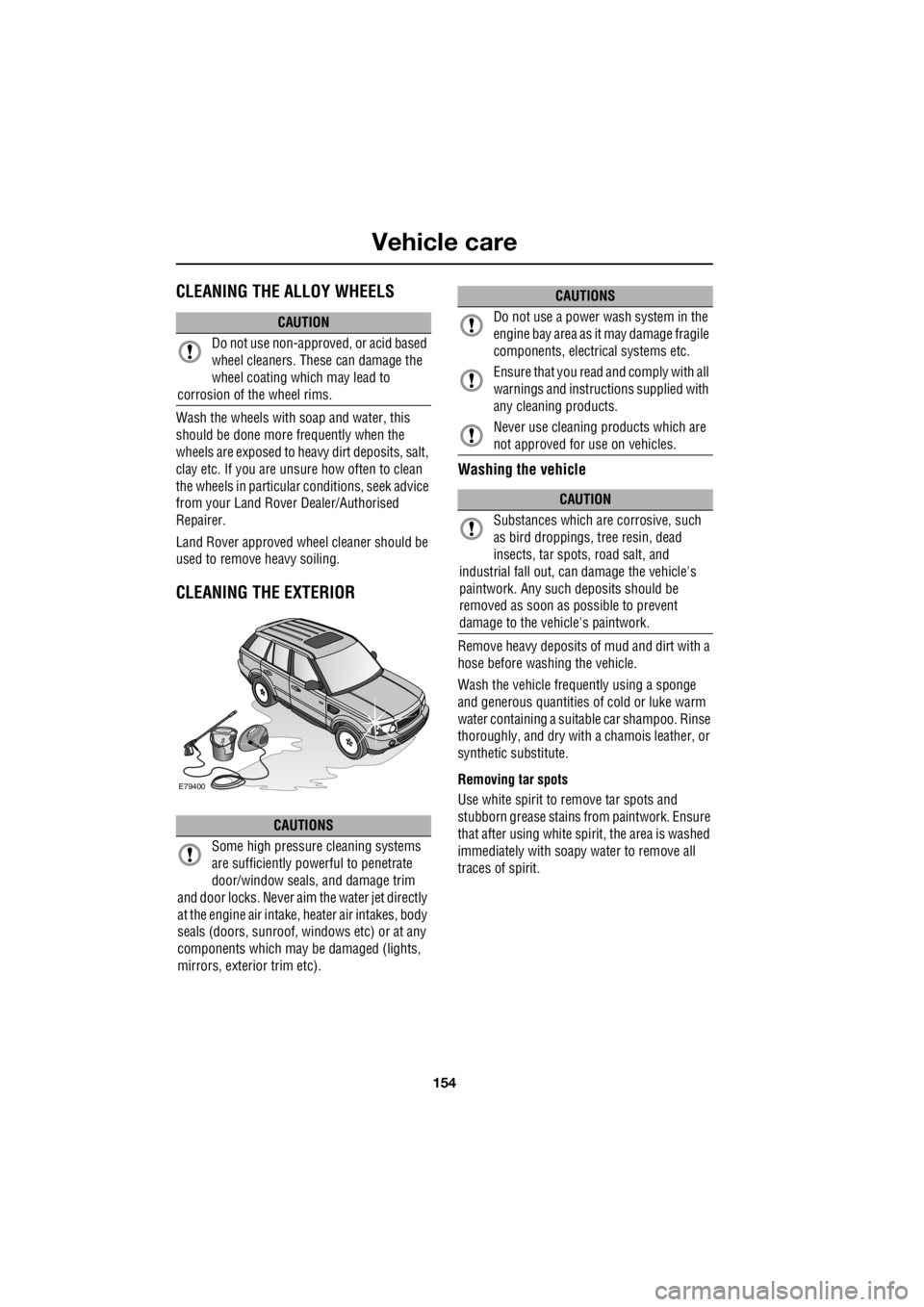
CLEANING THE EXTERIOR
Washing the vehicle
Remove heavy deposits of mud and dirt with a
hose before washing the vehicle.
Wash the vehicle frequently using a sponge
and generous quantities of cold or luke warm
water containing a suit able car shampoo. Rinse
thoroughly, and dry with a chamois leather, or
synthetic substitute.
Removing tar spots
Use white spirit to remove tar spots and
stubborn grease stains from paintwork. Ensure
that after using white spirit, the area is washed
immediately with soapy water to remove all
traces of spirit.
CAUTION
Do not use non-approved, or acid based
wheel cleaners. These can damage the
wheel coating which may lead to
corrosion of the wheel rims.
CAUTIONS
Some high pressure cleaning systems
are sufficiently pow erful to penetrate
door/window seals, and damage trim
and door locks. Never aim the water jet directly
at the engine air intake, heater air intakes, body
seals (doors, sunroof, windows etc) or at any
components which may be damaged (lights,
mirrors, exterior trim etc).
E79400
Do not use a power wash system in the
engine bay area as it may damage fragile
components, electrical systems etc.
Ensure that you read and comply with all
warnings and instruct ions supplied with
any cleaning products.
Never use cleaning products which are
not approved for use on vehicles.
CAUTION
Substances which are corrosive, such
as bird droppings, tr ee resin, dead
insects, tar spots, road salt, and
industrial fall out, can damage the vehicle's
paintwork. Any such deposits should be
removed as soon as possible to prevent
damage to the vehicle's paintwork.
CAUTIONS
Page 2875 of 3229
155
Vehicle care
R
Underbody maintenance
Corrosive materials used on highways to
control snow and ice, as well as accumulations
from off-road driving or wading in salt water,
can collect on the vehi cle's underbody. If these
materials are not removed accelerated
corrosion can occur. Regularly flush the
underbody with plain wate r, and pay particular
attention to areas where mud and debris
collect.
If damage or corrosion are detected, have the
vehicle checked by a Land Rover
Dealer/Authorised Re pairer as soon as
possible.
Glass and mirrors
The rear screen, and mi rror glass' should only
be cleaned using soapy water and a soft cloth.
This will avoid damaging the reflective surface
of the mirror, and the heating elements and
antenna in the rear screen.
Never use abrasive cleaning products, or metal
ice scrapers on the mirrors or the front/rear
screens.
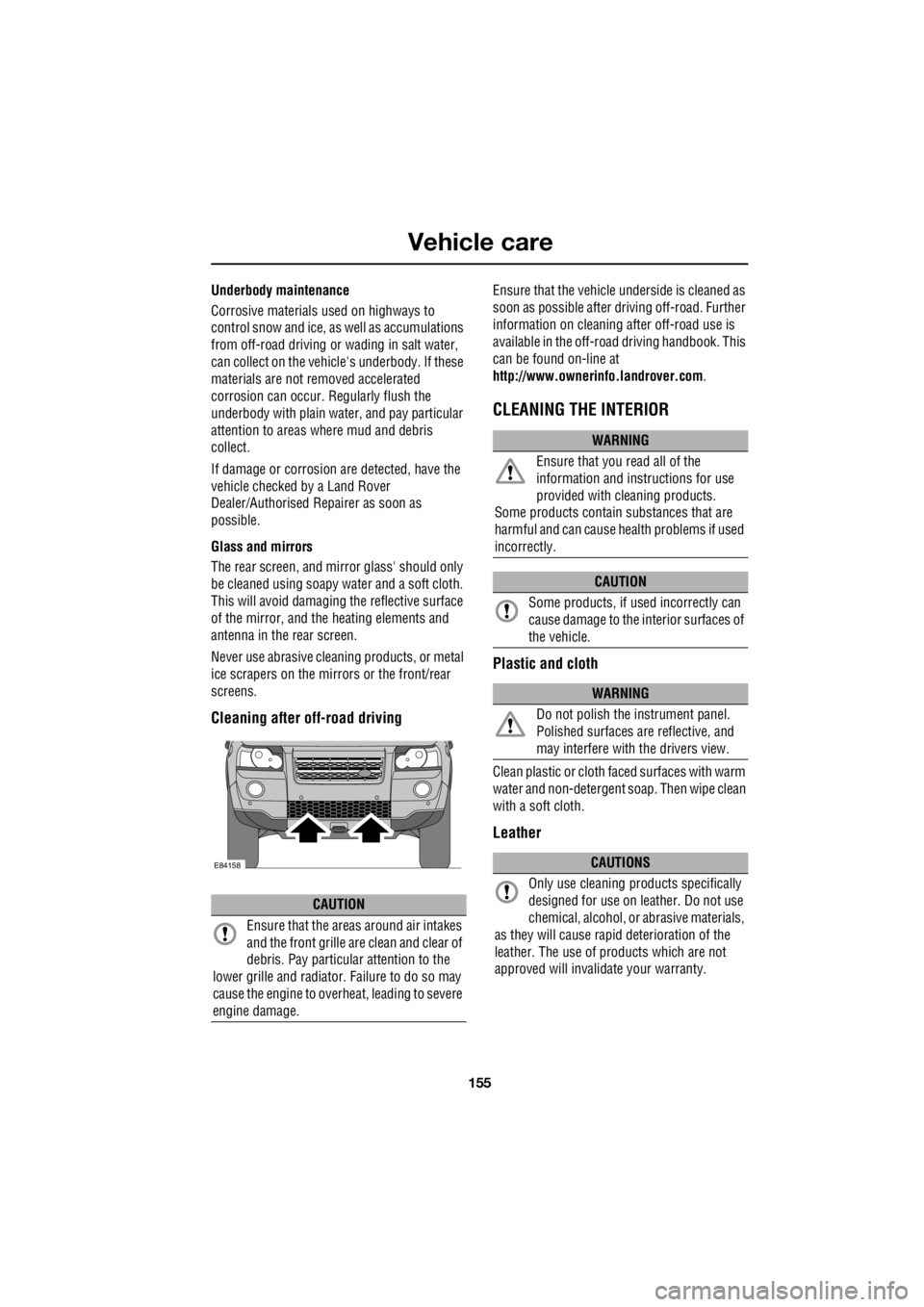
Cleaning after off-road driving
Ensure that the vehicle und erside is cleaned as
soon as possible after dr iving off-road. Further
information on cleaning af ter off-road use is
available in the off-road driving handbook. This
can be found on-line at
http://www.ownerinfo.landrover.com .
CLEANING THE INTERIOR
Plastic and cloth
Clean plastic or cloth faced surfaces with warm
water and non-detergent soap. Then wipe clean
with a soft cloth.
Leather
CAUTION
Ensure that the areas around air intakes
and the front grille ar e clean and clear of
debris. Pay particular attention to the
lower grille and radiator . Failure to do so may
cause the engine to overheat, leading to severe
engine damage.
E84158
WARNING
Ensure that you read all of the
information and inst ructions for use
provided with cleaning products.
Some products contain substances that are
harmful and can cause he alth problems if used
incorrectly.
CAUTION
Some products, if us ed incorrectly can
cause damage to the in terior surfaces of
the vehicle.
WARNING
Do not polish the instrument panel.
Polished surfaces are reflective, and
may interfere with the drivers view.
CAUTIONS
Only use cleaning pr oducts specifically
designed for use on le ather. Do not use
chemical, alcohol, or abrasive materials,
as they will cause rapi d deterioration of the
leather. The use of products which are not
approved will invalidate your warranty.
Page 2878 of 3229

Maintenance
158
L
One or both types of serv ice interval (distance
and time) may be displayed. For example, if an
engine oil service is du e based on mileage, and
a brake fluid change is due based on time, both
distance and time c ountdowns will display.
Service Portfolio
The Service Portfolio book includes a Service
Record section, which enables a record to be
kept of all the servicing and inspections that are
carried out on the vehicle. This section of the
book also has an area for brake fluid changes
to be recorded.
Ensure your service provider signs and stamps
the book after each se rvice and inspection.
Owner Maintenance
In addition to the routine maintenance, a
number of simple checks must be carried out
more frequently. Advice is given on the pages
that follow.
Daily checks
• Operation of lamps, horn, direction
indicators, wipers, washers and warning
indicators.
• Operation of seat belts and brakes.
• Look for fluid deposits underneath the
vehicle that might indicate a leak.
Weekly checks
• Engine oil level. See ENGINE OIL CHECK
(page 162).
• Engine coolant check. See ENGINE
COOLANT CHECK (page 163).
• Brake/clutch fluid level. See BRAKE AND
CLUTCH FLUID CHECK (page 165). •
Power steering fluid level. See POWER
STEERING FLUID CHECK (page 166).
• Screen washer fluid level. See WASHER
FLUID CHECK (page 167).
• Tyre pressure s and condition.
• Operate air conditioning.
Note: The engine oil leve l should be checked
more frequently if the vehicle is driven for
prolonged periods at high speeds.
Driving in arduous conditions
When a vehicle is operated in extremely
arduous conditions, more frequent attention
must be paid to servicing requirements.
For example, if your vehicle experiences deep
wading conditions, even daily servicing could
be necessary to ensure the continued safe and
reliable operation of the vehicle.
Arduous driving conditions include:
• Driving in dusty and/or sandy conditions.
• Driving on rough and/or muddy roads
and/or wading.
• Driving in extremely hot conditions.
• Towing a trailer or driving in mountainous
conditions.
Contact a Land Rover Dealer/Authorised
Repairer for advice.
Emission control
Your vehicle is fitted with various items of
emission and evaporative control equipment,
designed to meet sp ecific territorial
requirements. You should be aware that
unauthorised replacemen t, modification or
tampering with this equipment by an owner or
repair shop, may be unlawful and subject to
legal penalties.
CAUTION
Any significant or sudden drop in fluid
levels, or uneven tyre wear, should be
reported to a qualified technician without
delay.
Page 2879 of 3229
159
Maintenance
R
In addition, engine se ttings must not be
tampered with. These have been established to
ensure that your vehicle complies with
stringent exhaust em ission regulations.
Incorrect engine settings may adversely affect
exhaust emissions, engi ne performance and
fuel consumption. The y may also cause high
temperatures, which will result in damage to
the catalytic converter and the vehicle.
Road testing dynamometers (rolling
roads)
Because your vehicle is equipped with anti-lock
brakes and four wheel drive, it is essential that
any dynamometer testing is carried out only by
a qualified person, familiar with the
dynamometer testing an d safety procedures
practised by Land Rove r Dealers/Authorised
Repairers.
Safety in the garage
Fuel system
Poisonous fluids
Fluids used in motor vehicles are poisonous
and should not be consumed or brought into
contact with open wounds. These include;
battery acid, antifreeze, brake, clutch and
power steering fluid, petr ol, diesel, engine oil
and windscreen washer additives.
For your own safety, al ways read and obey all
instructions printed on labels and containers.
Used engine oil
Prolonged contact with engine oil may cause
serious skin disorders, including dermatitis
and cancer of the skin. Always wash
thoroughly after contact.
It is illegal to pollute drains, water
courses or soil. Use authorised
waste disposal sites to dispose of
used oil and toxic chemicals.
WARNINGS
If the vehicle has been driven recently,
do not touch exhaust and cooling
system components un til the engine has
cooled.
Never leave the engine running in an
unventilated area - exhaust gases are
poisonous and extremely dangerous.
Do not work beneath the vehicle with
the wheel changing jack as the only
means of support.
Keep your hands and clothing away
from drive belt s and pulleys.
Remove metal wr ist bands and
jewellery, before working in the engine
compartment.
Do not touch electrical leads or
components while the engine is
running, or with the starter switch turned on.
Do not allow tools or metal parts of the
vehicle to make contact with the battery
leads or terminals.
WARNINGS
Under no circumstances should any
part of the fuel system be dismantled or
replaced by anyone other than a suitably
qualified vehicle technician. Failure to comply
with this instruction, may result in fuel spillage
with a consequent serious risk of fire.
Ensure sparks and naked lights are kept
away from the engine compartment.
Wear protective cl othing, including,
where practicable, gloves made from
an impervious material.
WARNINGS