2006 LAND ROVER FRELANDER 2 engine
[x] Cancel search: enginePage 2841 of 3229

121
Transmission
R
High temperatures
In circumstances where engine and
transmission temperatures are raised to very
high levels, the gear change strategy will alter
to provide maximum cooling efficiency.
Transmission fault
In the unlikely event that a fault develops within
the transmission system, F will be displayed in
the gear position display and a warning
message will appear in the message centre. A
limited range of gears will be available, and you
should seek qualified as sistance immediately.
Page 2843 of 3229

123
Brakes
R
BrakesPRINCIPLE OF OPERATION
Brake pads
Brake pads require a period of bedding in when
new. Drive with extra caution for the first 800
km (500 miles) to avoi d then need for heavy
braking.
Wet conditions
Driving through heavy rain or water can have
an adverse effect on braking efficiency. Under
those circumstances it is recommended that
you lightly apply the brak es intermittently to
dry the brakes.
HINTS ON DRIVING WITH ABS
ABS (Anti-Lock Braki ng System) allows
maximum brake pressure, and thus maximum
braking efficiency, to be applied, and prevents
the road wheels locking. This allows the driver
to retain steering control during heavy braking
under most road conditions.
During emergency brak ing conditions ABS
constantly monitors the speed of each wheel.
ABS varies the brake pressure to individual
wheels, according to the grip available. The
constant alteration of brake pressure can be
felt as a pulsing sensat ion through the brake
pedal. This is not a cause for concern, as it is
designed to demonstrate to the driver that ABS
is operating.
ABS warning indicator
If this amber warning indicator
illuminates, driv e with extra
caution, avoid heavy braking where
possible, and seek qualified assistance as soon
as possible.
WARNINGS
Do not rest your foot on the brake
pedal whilst the vehicle is in motion.
This may cause a light application of
the brakes, which can re sult in overheating,
reduced brake performance, and excessive
brake wear.
Never allow the vehicle to coast
(freewheel) with the engine turned off.
The engine must be running to provide
full braking assistance. The brakes will still
function with the engine off, but far more
pressure will be required to operate them.
If the red brake warning indicator
illuminates, safely bring the vehicle to
a stop, as quickly as possible. Seek
qualified assistance before proceeding.
Never place non-approved floor
matting or any ot her obstructions
under the brake pedal. This restricts
pedal travel and braking efficiency.WARNINGS
ABS cannot overcome the physical
limitations of brak ing distance. Nor
can it overcome the lack of grip on a
road surface, aquaplaning on water for
example.
Braking distance is increased on a
slippery surface. This applies to all
vehicles, even those fitted with ABS.
The driver should not be tempted to
take risks when driving, in the hope
that ABS will correct errors of
judgement. In all cases it remains the driver's
responsibility to driv e with due care and
attention, paying partic ular attention to the
effects of speed, weather, road conditions etc.
Page 2848 of 3229

Driving hints
128
L
Driving hintsGENERAL DRIVING POINTS
Battery charging - red
Illuminates as a bulb check when
the ignition is turned on and
extinguishes once the engine is
running. If it remains on, or illuminates whilst
driving, a fault with the battery charging
system is indicated. Seek qualified assistance
urgently.
Low oil pressure - red
Illuminates as a bulb check when
the ignition is turned on and
extinguishes when the engine is
started. If the indicator remains on, flashes on
and off, or illuminates whilst driving, stop the
vehicle as soon as safety permits and switch
off the engine immediat ely. Seek qualified
assistance before driving. Always check the oil
level when this indicator illuminates.
REDUCED ENGINE PERFORMANCE
Engine management syst em (EMS) fault
Illuminates amber in the
instrument pack when the engine
management system detects a
serious fault - reduce d performance may be
experienced. Avoid high speeds and consult
your Land Rover Dealer/A uthorised Repairer as
soon as possible.
Check engine - petrol models only
Illuminates amber in the
instrument pack as a bulb and
system check when the starter
switch is turned on and extinguishes as soon
as the engine is starte d. Illumination at any
other time indicates that the emission
performance of the engine management
system is impaired - seek qualified assistance.
If the indicator flashes while driving,
immediately reduce e ngine power to avoid
catalytic converter damage.
RUNNING-IN
The engine, gearbox, tyre s, and brakes need
time to bed-in. During the first 800 km (500
miles) it is essential th at the vehicle is driven
with consideration for the running-in process.
During the running in period the following
advice should be followed.
• Limit the engine speed to a maximum of
3000 rpm, and the road speed to a
maximum of 110 km/h (68 mph).
• Do not use full accelerator pedal travel, and
use the gears to avoid over-revving or
labouring the engine.
• Do not use sport mode during the running
in period.
• Avoid rapid accelerati on or heavy braking
wherever possible.
• Ensure that servicing is carried out on
time, and follow any advice regarding use
in arduous conditions.
Note: The advice given for running in will aid
fuel economy, and s hould be adopted as
general driving practice even after the running
in period.
Page 2849 of 3229

129
Driving hints
R
ECONOMICAL DRIVING
There are two main factors which influence fuel
economy, the way the vehicle is driven, and
maintenance.
Driving tips for economy
• Avoid unnecessary jour neys, especially
short stop-start trips.
• Accelerate smoothly and gently from a
stand still.
• Use the gears to avoid labouring, or
over-revving the engine.
• Allow time to brake gently and smoothly.
• Be aware of traffic and road conditions
ahead, and take action in time to avoid
hard braking or acceleration.
• When stationary apply the park brake, and
select neutral.
• Turn off the air conditioning when not
needed.
Maintenance and fuel economy
Regular servicing by a Land Rover
Dealer/Approved repairer, along with regular
checks by the driver are essential for vehicle
longevity and fuel economy.
The condition of the engine (oils, filters, spark
plugs, settings etc) tyre pressures, and wheel
alignment, will all have a bearing on fuel
economy. For this reason it is essential that the
vehicle is checked regularly by the driver, and
serviced by an approved Land Rover
Dealer/Authorised Repairer at the correct
intervals.
Note: If you are in any doubt about the
maintenance requirement s, intervals, or
checks required, contact your Land Rover
Dealer/Authorised repairer for advice.
Page 2852 of 3229

Terrain response
132
L
Terrain responsePRINCIPLE OF OPERATION
The Terrain Response System provides an
opportunity for the driver to feed back terrain
information to the vehicle by choosing a
general setting or on e of three special
programs. It then uses that information to
optimise the vehicle's systems for improved
traction and driveability. It does this by
bringing together vehicle drive control systems
which usually opera te individually.
The drive systems optimised by the Terrain
Response Syst em are :-
• Engine management.
• Gearbox management.
• Intelligent coupling control.
• Dynamic stability, trac tion and Hill Descent
controls.
The system will provide a variable accelerator
pedal response, ranging fr om very cautious for
slippery conditions (w here a large pedal
movement has only a small effect on engine
power) to very respon sive (where engine
power is allowed to rise more quickly).
Note: Changing from one special program to
another will introduce noticeably different
responses. For example, the engine revs
produced by the current accelerator pedal
position, may increase or decrease in the new
program.
To familiarise y ourself and get the best from
the system you should try out the programs in
circumstances which are safe for you and other
road users.
Terrain response has been designed to benefit
the driver no matter what their level of off-road
driving experience. The system will aid those
with less experience, a nd enhance the skills of
those with more experience.
USING TERRAIN RESPONSE
Note: The Terrain Response System is
designed to be engaged before crossing
difficult terrain. Do not wait until control has
been lost before usi ng the special programs.
When the vehicle is started, the Terrain
Response System will be in its General
program. The General program will allow the
vehicle to operate capa bly in most conditions,
as some of the sub-systems will react to the
conditions where appropriate. When
conditions change, and more difficult
conditions are encountered, the appropriate
special program should be selected.
Before driving off-road
Before venturing off-road it is absolutely
essential that inexperi enced drivers become
fully familiar with the vehicle's controls. In
particular, CommandShift , Hill Descent Control
(HDC), and the Terra in Response system.
Basic information and off-road driving
techniques can be found in the off-road driving
handbook available on-line at
http://www.ownerinfo.landrover.com
Off-road driver traini ng should be undertaken
by anyone intending to drive off-road. Training
is available at your nearest Land Rover
Experience centre. More details can be found at
http://www.landroverexperience.com
Driver override options
All systems will be se t to their optimum
parameters for the condi tions reflected in the
choice of special program. However, if
required, Hill Descent c ontrol can be operated
independently. See USING HDC (page 137). If
it has not been automatically selected by the
special program, it may be engaged as
required. Converse ly, if it has been selected,
but is not required, it may be turned off.
Page 2856 of 3229

Hill descent control (HDC)
136
L
Hill descent control (HDC)PRINCIPLE OF OPERATION
HDC operates in conjunction with ABS to
provide greater control when off-road,
particularly when desc ending steep slopes.
HDC operation is fully automatic when
engaged.
During a hill descent when driving off-road,
engine braking is used to control the speed of
descent. If engine braki ng alone is insufficient
to control the vehicle's speed, HDC will slow
the vehicle using the braking system. HDC will
control the descent speed relative to the gear
selected and accelerator position.
If the vehicle is fitted with a manual
transmission, HDC should onl y be used in first,
or reverse gears. If the vehicle is fitted with an
automatic transmission, HDC should only be
used in D, R , or CommandShift 1. When in D
the vehicle will select the most appropriate
gear.
Note: HDC is automatically selected by some
of the Terrain response special programs.
Gradient release control (GRC)
With HDC activated, if the vehicle is stopped on
a slope using the footbrake, GRC will become
active. When the footbrake is released GRC will
automatically delay the brake release to allow
take up of drive, and build up of engine torque.
The brakes will then gradually release to allow
the vehicle to move smoothly away under the
control of HDC.
GRC operates in forwar d and reverse, and
requires no driver intervention.
Before driving off-road
Before venturing off-road it is absolutely
essential that inexperi enced drivers become
fully familiar with the vehicle's controls. In
particular, CommandShift , Hill Descent Control
(HDC), and the Terra in Response system.
Basic information and off-road driving
techniques can be found in the off-road driving
handbook available on-line at
http://www.ownerinfo.landrover.com
Off-road driver traini ng should be undertaken
by anyone intending to drive off-road. Training
is available at your nearest Land Rover
Experience centre. More details can be found at
http://www.landroverexperience.com
Page 2860 of 3229
Stability control
140
L
Stability controlPRINCIPLE OF OPERATION
Dynamic Stability Control (DSC)
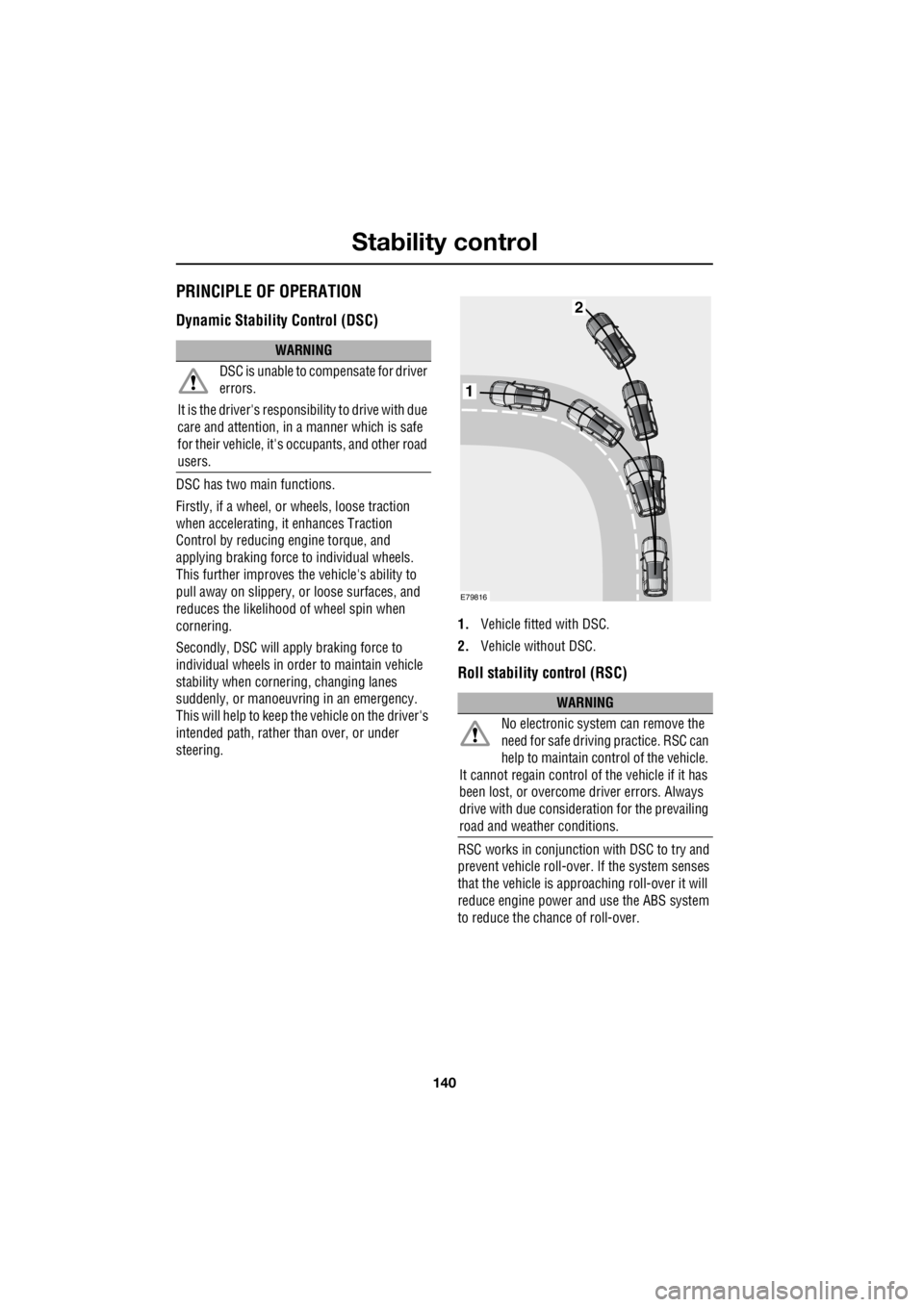
DSC has two main functions.
Firstly, if a wheel, or wheels, loose traction
when accelerating, it enhances Traction
Control by reducing engine torque, and
applying braking force to individual wheels.
This further improves the vehicle's ability to
pull away on slippery, or loose surfaces, and
reduces the likelihood of wheel spin when
cornering.
Secondly, DSC will apply braking force to
individual wheels in orde r to maintain vehicle
stability when cornering, changing lanes
suddenly, or manoeuvring in an emergency.
This will help to keep the vehicle on the driver's
intended path, rather than over, or under
steering. 1.
Vehicle fitted with DSC.
2. Vehicle without DSC.
Roll stability control (RSC)
RSC works in conjunction with DSC to try and
prevent vehicle roll-over. If the system senses
that the vehicle is approaching roll-over it will
reduce engine power and use the ABS system
to reduce the chance of roll-over.
WARNING
DSC is unable to compensate for driver
errors.
It is the driver's responsibility to drive with due
care and attention, in a manner which is safe
for their vehicle, it's oc cupants, and other road
users.
WARNING
No electronic system can remove the
need for safe drivin g practice. RSC can
help to maintain control of the vehicle.
It cannot regain control of the vehicle if it has
been lost, or overcome driver errors. Always
drive with due consideration for the prevailing
road and weather conditions.
1
2
E79816
Page 2861 of 3229
141
Stability control
R
USING STABILITY CONTROL
DSC
DSC is activated automatically each time the
engine is started, and is automatically selected
by some of the Terrain Response Special
programs.
Note: In the majority of dr iving situations, and
particularly on-road, it is recommended that
you do not turn DSC off.
Deactivating DSC
In some driving conditions it may prove helpful
to deactivate DSC to improve traction. These
conditions include :-
• Rocking the vehicle out of a hollow.
• Rocking the vehicle out when the wheels
have sunk into the surface.
• Pulling away in deep snow, or a loose
surface.
• Driving along deep ruts.
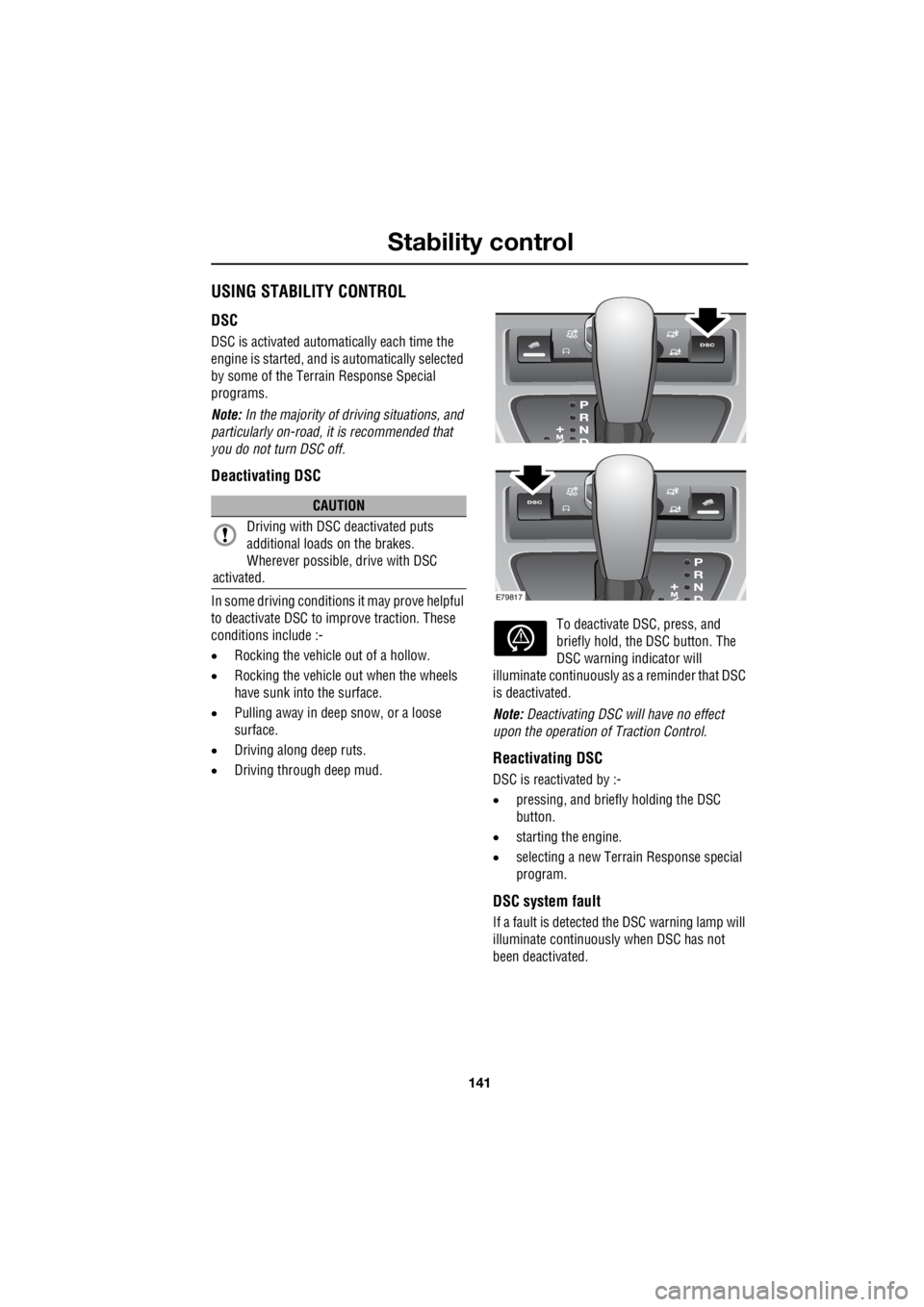
• Driving through deep mud. To deactivate DS
C, press, and
briefly hold, the DSC button. The
DSC warning indicator will
illuminate continuously as a reminder that DSC
is deactivated.
Note: Deactivating DSC will have no effect
upon the operation of Traction Control.
Reactivating DSC
DSC is reactivated by :-
• pressing, and briefly holding the DSC
button.
• starting the engine.
• selecting a new Terra in Response special
program.
DSC system fault
If a fault is detected the DSC warning lamp will
illuminate continuously when DSC has not
been deactivated.
CAUTION
Driving with DSC deactivated puts
additional loads on the brakes.
Wherever possible, drive with DSC
activated.
E79817