2006 LAND ROVER FRELANDER 2 engine
[x] Cancel search: enginePage 2893 of 3229
173
Vehicle battery
R
USING BOOSTER CABLES
Note: Before connecting boos ter cables ensure
that the battery connections on the disabled
vehicle are correct, and that all electrical
equipment has been switched off.
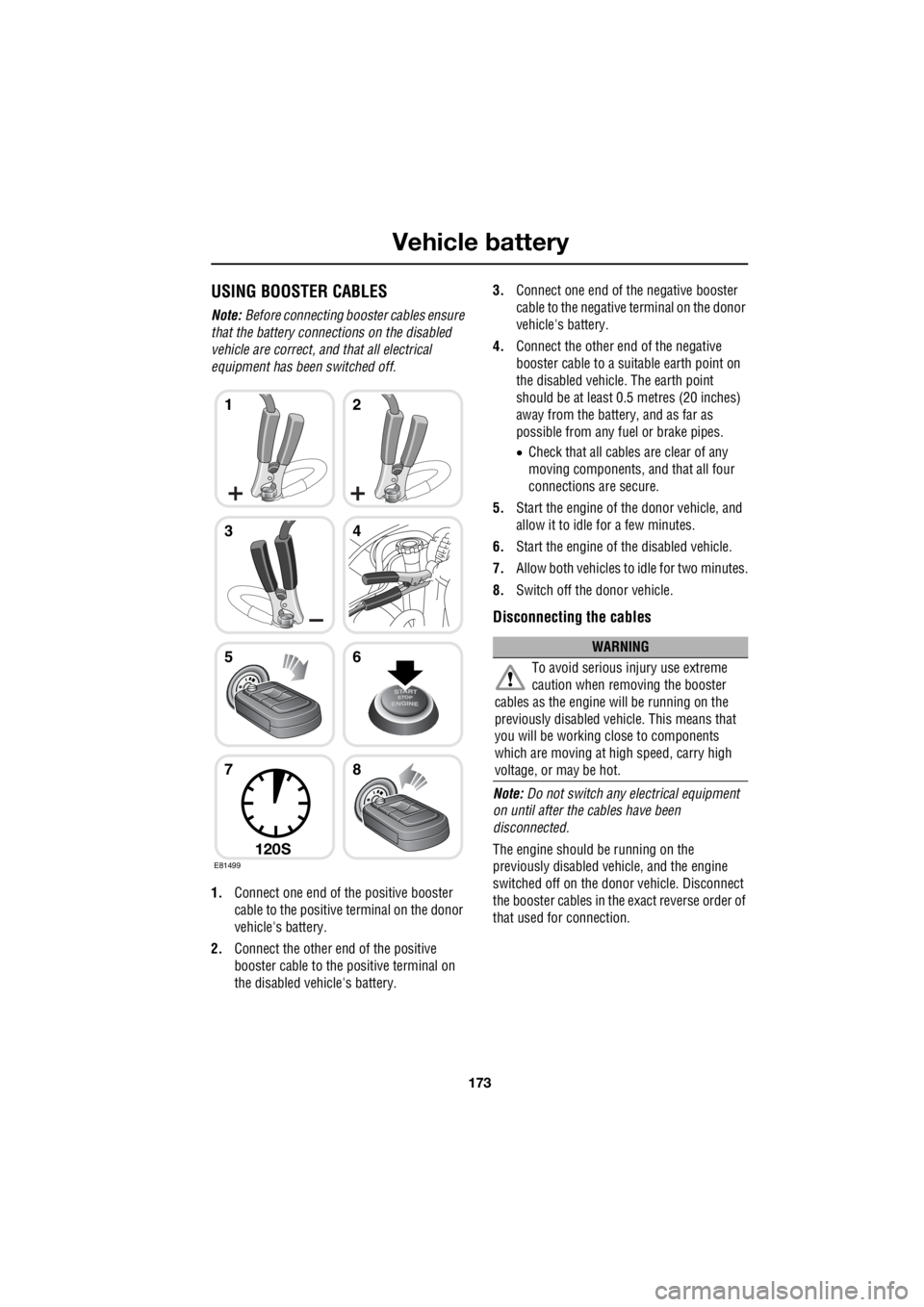
1. Connect one end of the positive booster
cable to the positive terminal on the donor
vehicle's battery.
2. Connect the other e nd of the positive
booster cable to the positive terminal on
the disabled vehicle's battery. 3.
Connect one end of the negative booster
cable to the negative terminal on the donor
vehicle's battery.
4. Connect the other en d of the negative
booster cable to a suit able earth point on
the disabled vehicle. The earth point
should be at least 0.5 metres (20 inches)
away from the battery, and as far as
possible from any fuel or brake pipes.
• Check that all cables are clear of any
moving components, and that all four
connections are secure.
5. Start the engine of the donor vehicle, and
allow it to idle for a few minutes.
6. Start the engine of the disabled vehicle.
7. Allow both vehicles to idle for two minutes.
8. Switch off the donor vehicle.
Disconnecting the cables
Note: Do not switch any electrical equipment
on until after the cables have been
disconnected.
The engine should be running on the
previously disabled ve hicle, and the engine
switched off on the donor vehicle. Disconnect
the booster cables in the exact reverse order of
that used for connection.
E81499
12
34
56
78
120S
WARNING
To avoid serious in jury use extreme
caution when removing the booster
cables as the engine will be running on the
previously disabled vehicle. This means that
you will be working close to components
which are moving at high speed, carry high
voltage, or may be hot.
Page 2894 of 3229
Vehicle battery
174
L
CHARGING THE VEHICLE BATTERY
1. Disconnect the battery and remove it from
the vehicle.
2. Connect the battery charger in accordance
with the charger manufacturer's
instructions.
3. Once the charge is complete switch off the
power to the charger.
4. Disconnect the charger cables from the
battery.
5. Allow the battery to stand for an hour
before connecting to the vehicle. This will
allow any explosive gasses to dissipate,
and reduce the risk of explosion.
CHANGING THE VEHICLE BATTERY
Disconnecting
1. Ensure that all electrical circuits are
switched off, all windows are closed, and
the alarm is disarmed.
2. Remove the remote control from the
vehicle and wait two minutes to allow the
systems to power down fully.
3. Undo the negative clam p, and lift the cable
and clamp clear of th e battery terminal.
4. Undo the positive clamp, and lift the cable
and clamp clear of th e battery terminal.
5. Undo the battery clamp and lift the battery
clear of the vehicle.
WARNINGS
Ensure that the charger used is of the
correct type and rating for the battery.
Using an unsuitable charger may damage the
battery, and could cause the battery to
explode.
Always charge the battery in a well
ventilated area away from any naked
flames, sparks or ot her ignition sources.
During charging the battery can produce a
highly explosive a nd flammable gas.
CAUTIONS
The battery must be disconnected and
removed from the vehicle before
charging. Failure to do so could result in
damage to the vehicle's electrical system.
Always follow the instructions supplied
with the battery charger. Failure to do so
may result in damage to the battery.
WARNINGS
Use caution when lifting the battery out
of, or into, the vehicl e. It is heavy, and
may cause injury when lifting, or if dropped.
Do not tip the battery when lifting or
moving as tilting the battery more than
45 degrees may damage the battery, and may
cause the electrolyte to leak out. Battery
electrolyte is highly corrosive, and toxic.
CAUTIONS
Do not rest the battery on any part of the
vehicle as it may ca use damage due to
it's weight.
Do not run the engine with the battery
disconnected. Doing so may damage the
charging system.
Page 2910 of 3229

Wheels and tyres
190
L
Using the Land Rover tyre repair kit
Note: All vehicle drivers and occupants should
be made aware that a temporary repair has
been made to a tyre fitted to the vehicle. They
should also be made aware of the special
driving conditions im posed when using a
repaired tyre. Repair procedure
1. Open the tyre repair kit and peel off the
maximum speed label. Attach the label to
the facia in the driver's field of view. Take
care not to obstruct any of the instruments
or warning lights.
2. Uncoil the compressor power cable and
the inflation hose.
3. Unscrew the orange cap from the sealant
bottle receiver, and the sealant bottle cap.
4. Screw the sealant bottle into the receiver
(clockwise) until tight.
• Screwing the bottle onto the receiver will
pierce the bottle's se al. Do not unscrew
a full, or partly us ed bottle from the
receiver. Doing so will result in the
sealant leaking from the bottle.
5. Remove the valve cap from the damaged
tyre.
6. Remove the protective cap from the
inflation hose, and c onnect the inflation
hose to the tyre valve. Ensure that the hose
is screwed on firmly.
7. Ensure that the compressor switch is in
the off ( O) position.
8. Insert the power cable connector into an
auxiliary power socket. See AUXILIARY
POWER SOCKETS (page 110).
9. Unless the vehicle is in an enclosed or
poorly ventilated area , start the engine.
10. Set the compressor switch to the on ( l)
position.
11. Inflate the tyre to a minimum of 1.8 bar (26
lb/in²) and a maximum of 3.5 bar (51
lb/in²).
†
WARNINGS
Avoid skin contact with the sealant
which contains natu ral rubber latex.
Do not unscrew the sealant bottle from the
receiver until it is empty, as sealant will leak
out.
If the tyre inflation pressure does not
reach 1.8 bar (26 lb/in²) within seven
minutes, the tyre may have suffered excessive
damage. A temporary repair will not be
possible, and the vehicle should not be driven
until the tyre has been replaced.
CAUTIONS
Before attempting a tyre repair, ensure
that the vehicle is parked safely, as far
away from passing traffic as possible.
Ensure that the parki ng brake is applied,
and P is selected if an automatic
transmission is fitted.
Do not attempt to remove foreign objects
such as nails, screws, etc from the tyre.
Always run the engine when using the
compressor, unless the vehicle is in an
enclosed, or poorly ventilated space.
To prevent overheating do not operate
the compressor continuously for longer
than ten minutes.
Page 2911 of 3229

191
Wheels and tyres
R
12. During the inflation, switch the
compressor off briefly to check the tyre
pressure using the gauge mounted on the
compressor.
• It should not take longer than seven
minutes to inflate the tyre. If after seven
minutes the tyre ha s not reached the
minimum pressure, the tyre should not
be used.
13. Once the tyre has been inflated switch off
the compressor. If desired the engine may
be turned off after the compressor has
been turned off.
14. Remove the power connector from the
auxiliary power socket.
15. Remove the inflation hose from the tyre
valve by unscrewing it as quickly as
possible (anti-clockwise).
16. Replace the inflation hose protective cap,
and the tyre valve cap.
17. Do not remove the sealant bottle from the
receiver.
18. Ensure that the tyre repair kit (including
the bottle, and receiver caps) are placed
securely in the vehicle. You will need to
use the kit to check the tyre pressure after
3km (2 miles) so ensure they are easily
accessible.
19. Immediately drive the vehicle for 3 km (2
miles) to allow the sealant to coat the inner
surface of the tyre and form a seal at the
puncture.
†When pumping the sealant through the tyre
valve, the pressure may rise up to 6 bar (87
lb/in²). The pressure will drop again after
approximately 30 seconds.
Checking the tyre pressure after a repair
1. Drive the vehicle for 3 km (2 miles) then
stop in a safe place. Carry out a visual
examination of the tyres condition.
2. Remove the protective cap from the
inflation hose.
3. Screw the inflation hos e connector firmly
onto the tyre valve.
4. Read the tyre pressure from the gauge.
5. If the pressure of the sealant filled tyre is
above 1.3 bar (19 lb/in²) adjust the
pressure to the correct value. See
TECHNICAL SPECIFICATIONS (page 194).
6. Ensure that the compressor switch is in
the off position ( O), and insert the power
cable connector into an auxiliary power
socket. See AUXILIARY POWER
SOCKETS (page 110).
7. If the vehicle is in a well ventilated area,
start the engine.
8. Switch on the compressor ( I), and inflate
the tyre to the correct pressure.
WARNINGS
When driving the vehicle, if you
experience vibr ations, abnormal
steering, or noises, re duce speed immediately.
Drive with extreme caution and reduced speed
to the first safe place to stop the vehicle.
Visually examine the tyre, and check it's
pressure. If there are any signs of damage or
deformity to the tyre, or the tyre pressure is
below 1.3 bar (19 lb/i n²) do not continue
driving.
Consult a tyre repair centre, or your
Land Rover Dealer/Authorised repairer
for advice concerning the replacement of a
tyre after using a tyre repair kit.
Page 2915 of 3229
195
Fuses
R
FusesFUSE BOX LOCATIONS
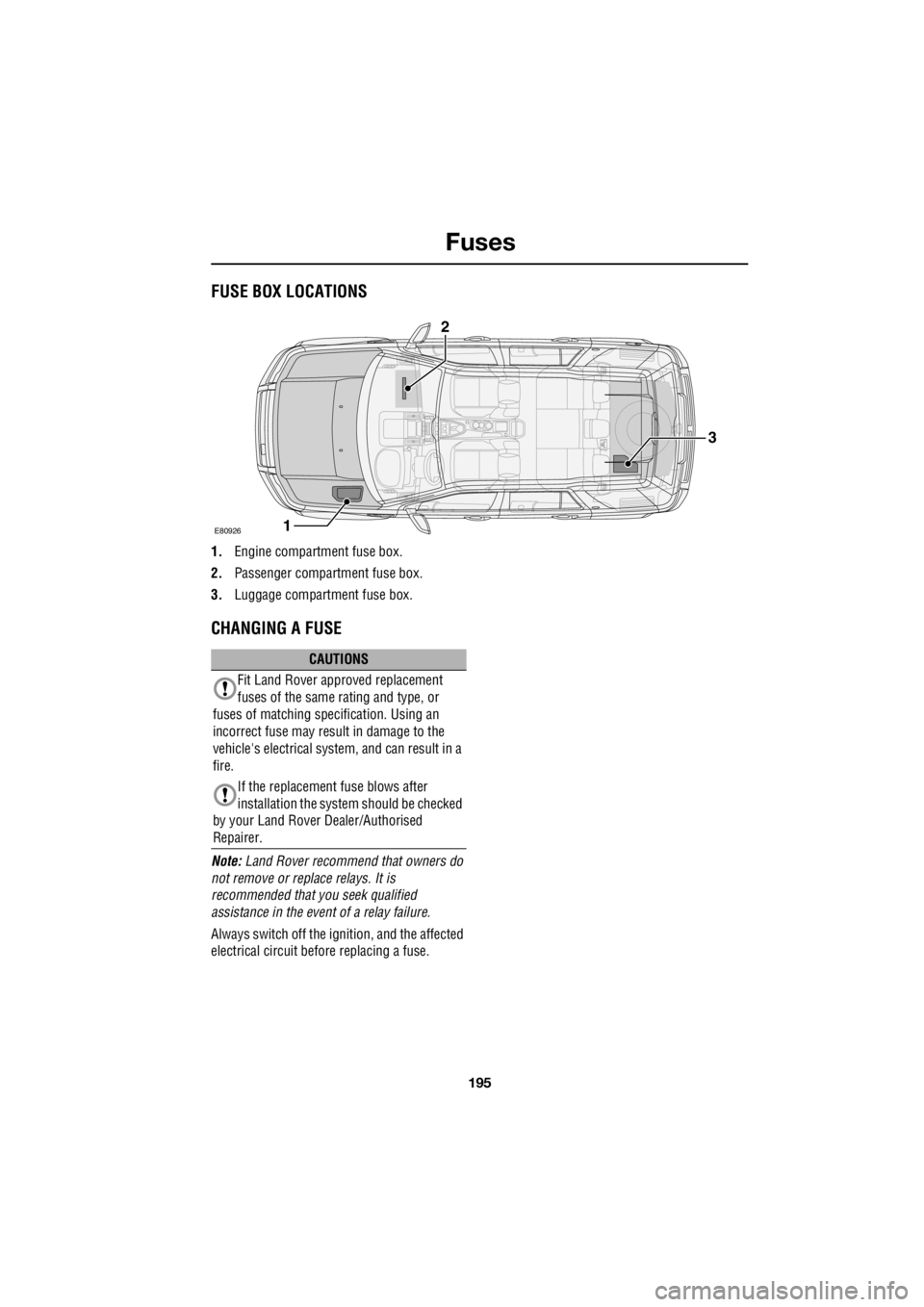
1. Engine compartment fuse box.
2. Passenger compartment fuse box.
3. Luggage compartment fuse box.
CHANGING A FUSE
Note: Land Rover recommend that owners do
not remove or repl ace relays. It is
recommended that you seek qualified
assistance in the event of a relay failure.
Always switch off the i gnition, and the affected
electrical circuit before replacing a fuse.
E80926
3
1
2
CAUTIONS
Fit Land Rover approved replacement
fuses of the same rating and type, or
fuses of matching spec ification. Using an
incorrect fuse may result in damage to the
vehicle's electrical system, and can result in a
fire.
If the replacement fuse blows after
installation the syst em should be checked
by your Land Rover Dealer/Authorised
Repairer.
Page 2916 of 3229
Fuses
196
L
FUSE SPECIFICATION CHART
Engine compartment fuse box
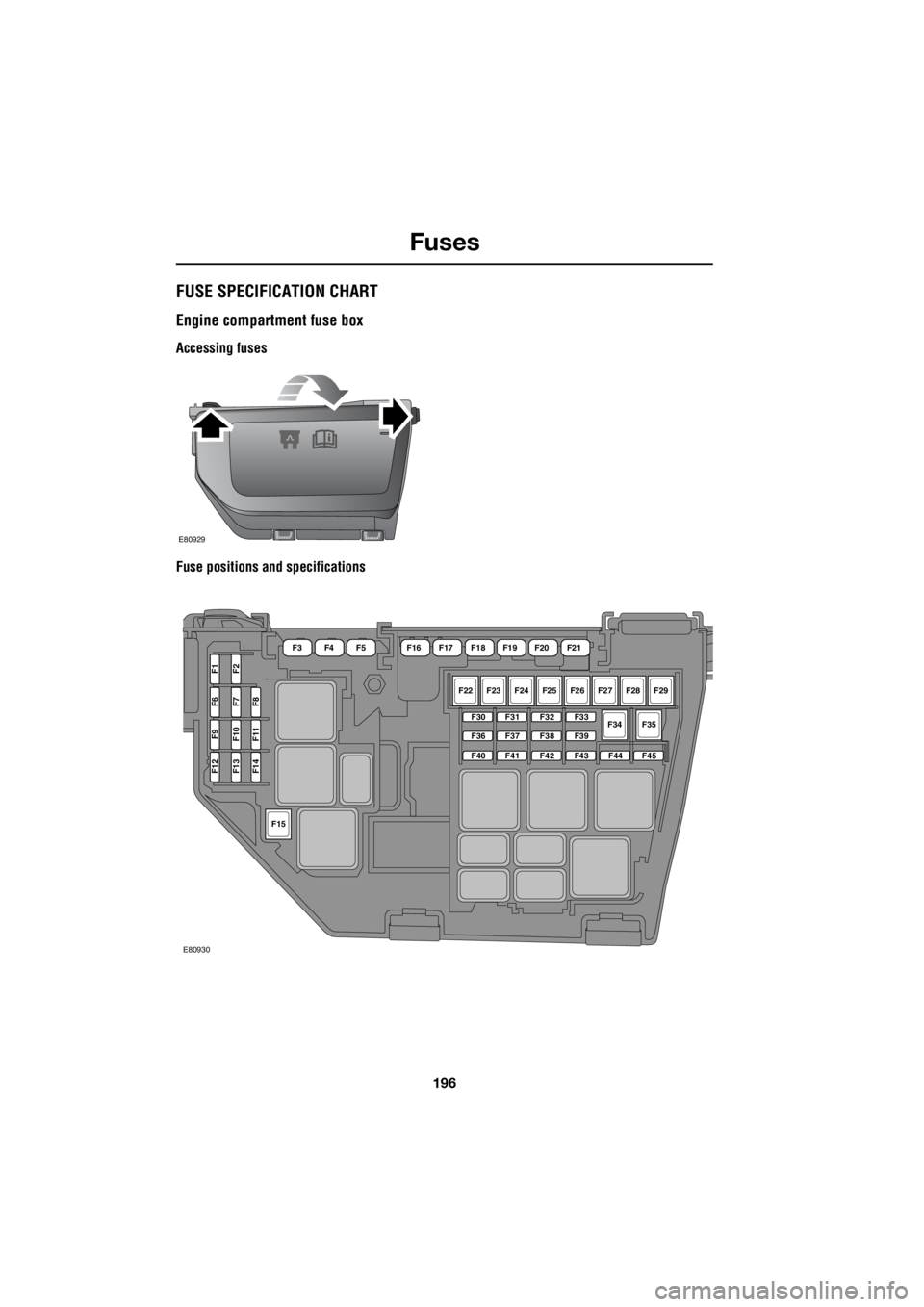
Accessing fuses
Fuse positions and specifications
E80929
F22F23F24F25F26F27F28F29
F34F35F30
F36
F40
F31
F37
F41
F32
F38
F42
F33
F39
F43F44F45
F15
F12F13F14
F9F10F11
F6F7F8
F1F2
F16F17F18F19F20F21F3F4F5
E80930
Page 2917 of 3229

197
Fuses
R
Fuse number Rating (Amps) Fuse colour Circuits protected F1 5 tan Glow plugs
F2 15 blue Automatic transmission
F3 80 - Cooling fans
F4 60 - Glow plugs
F5 - - -
F6 (Diesel) 10 red Engine management F6 (Petrol) 15 blue Engine management F7 5 tan Relays
F8 (Diesel) 10 red Engine management F8 (Petrol) 15 blue Engine management
F9 (Diesel) 10 red Engine management
F9 (Petrol) 15 blue Engine management
F10 (Petrol) 10 red Engine management
F11 (Diesel) 10 red Engine management
F11 (Petrol) 10 red Engine management
F12 (Diesel) 10 red Engine management
F12 (Petrol) 20 yell ow Engine management
F13 15 blue Air Conditioning
F14 (Diesel) 15 blue Engine management
F15 40 green Starter motor
F16 (Diesel) 100 - Diesel PTC heater F17 60 - Passenger compartment fuse box supply
F18 60 - Passenger compartment fuse box supply
F19 60 - Luggage compartment fuse box supply
F20 60 - Luggage compartment fuse box supply
F21 60 - Luggage compartment fuse box supply - Audio unit
F22 30 pink Windscreen wipers
F23 - - -
Page 2918 of 3229

Fuses
198
L
F24 30 pink Headlamp washers
F25 30 pink ABS
F26 40 green ABS
F27 - - -
F28 40 green Heater blower
F29 - - -
F30 - - -
F31 15 blue Horns
F32 20 yellow Diesel auxiliary heater
F33 5 tan Relays
F34 40 green Heated windscreen(LH)
F35 40 green Heated windscreen (RH)
F36 - - -
F37 10 red Heated washer jets
F38 10 red AFS (RH lamp motors)
F39 10 red Climate control
F40 - - -
F41 20 yellow Passenger compartment fuse box supply
F42 15 blue Engine management
F43 5 tan Headlamp levelling control - AFS
F44 10 red AFS (LH lamp motors)
F45 15 blue Cigar lighter
Fuse number Rating (Amps) Fuse colour Circuits protected