2006 DODGE RAM SRT-10 change time
[x] Cancel search: change timePage 5151 of 5267
CORE-HEATER
DESCRIPTION
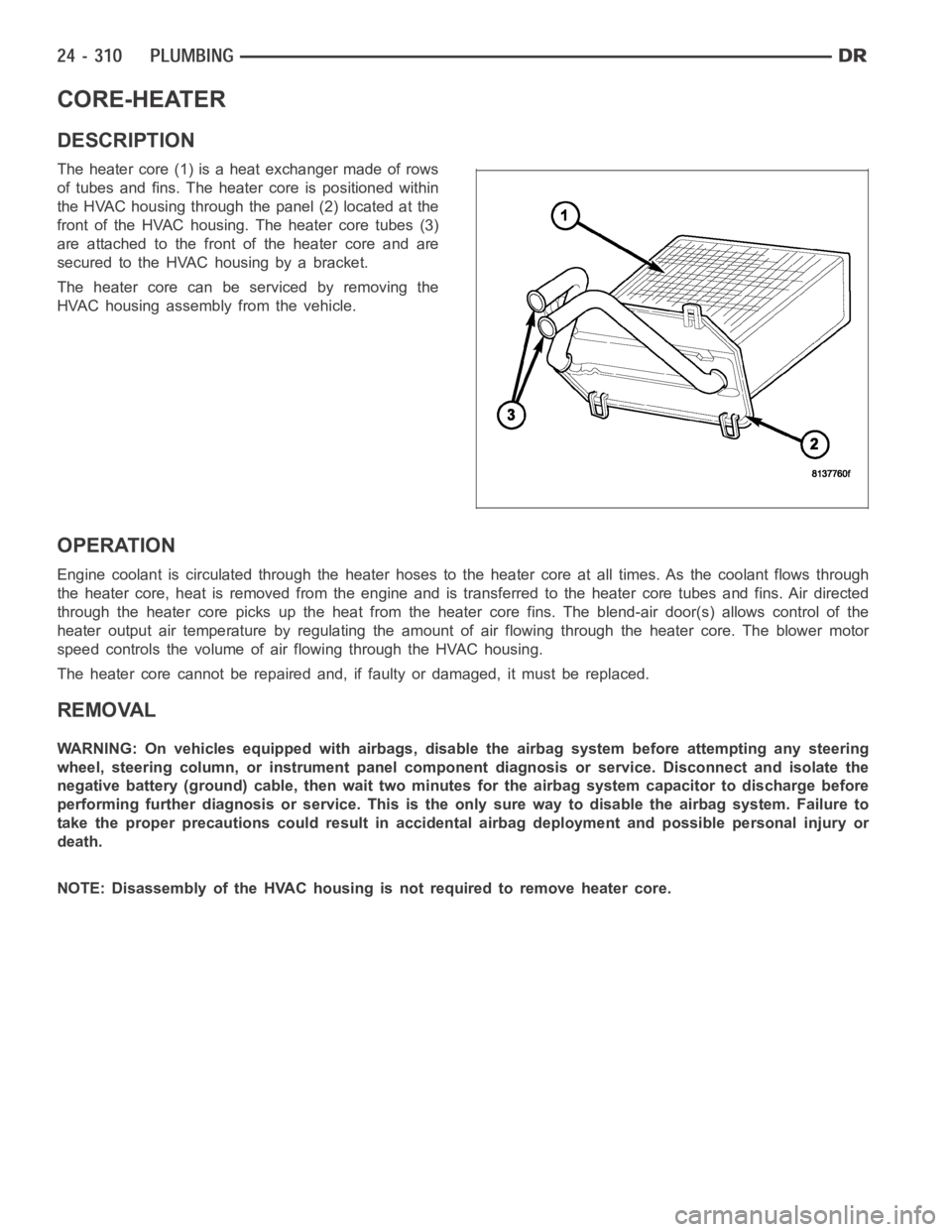
The heater core (1) is a heat exchanger made of rows
of tubes and fins. The heater core is positioned within
the HVAC housing through the panel (2) located at the
front of the HVAC housing. The heater core tubes (3)
are attached to the front of the heater core and are
secured to the HVAC housing by a bracket.
The heater core can be serviced by removing the
HVAC housing assembly from the vehicle.
OPERATION
Engine coolant is circulated through the heater hoses to the heater core atall times. As the coolant flows through
the heater core, heat is removed from the engine and is transferred to the heater core tubes and fins. Air directed
through the heater core picks up the heat from the heater core fins. The blend-air door(s) allows control of the
heater output air temperature by regulating the amount of air flowing through the heater core. The blower motor
speed controls the volume of air flowing through the HVAC housing.
The heater core cannot be repaired and, if faulty or damaged, it must be replaced.
REMOVAL
WARNING: On vehicles equipped with airbags, disable the airbag system before attempting any steering
wheel, steering column, or instrument panel component diagnosis or service. Disconnect and isolate the
negative battery (ground) cable, then wait two minutes for the airbag system capacitor to discharge before
performing further diagnosis or service. This is the only sure way to disable the airbag system. Failure to
take the proper precautions could result in accidental airbag deploymentand possible personal injury or
death.
NOTE: Disassembly of the HVAC housing is not required to remove heater core.
Page 5193 of 5267
EMISSIONS CONTROL
DESCRIPTION
STATE DISPLAY TEST MODE
The switch inputs to the Powertrain Control Module (PCM) have two recognized states; HIGH and LOW. For this
reason, the PCM cannot recognize the difference between a selected switchposition versus an open circuit, a short
circuit, or a defective switch. If the State Display screen shows the changefromHIGHtoLOWorLOWtoHIGH,
assume the entire switch circuit to the PCM functions properly. Connect the DRB scan tool to the data link con-
nector and access the state display screen. Then access either State Display Inputs and Outputs or State Display
Sensors.
CIRCUIT ACTUATION TEST MODE
The Circuit Actuation Test Mode checks for proper operation of output circuits or devices the Powertrain Control
Module (PCM) may not internally recognize. The PCM attempts to activate these outputs and allow an observer to
verify proper operation. Most of the tests provide an audible or visual indication of device operation (click of relay
contacts, fuel spray, etc.). Except for intermittent conditions, if a device functions properly during testing, assume the
device, its associated wiring, and driver circuit work correctly. Connect the DRB scan tool to the data link connector
and access the Actuators screen.
DIAGNOSTIC TROUBLE CODES
A Diagnostic Trouble Code (DTC) indicates the PCM has recognized an abnormal condition in the system.
Remember that DTC’s are the results of a system or circuit failure, but do not directly identify the failed
component or components.
BULB CHECK
Each time the ignition key is turned to the ON position, the malfunction indicator (check engine) lamp on the instru-
ment panel should illuminate for approximately 2 seconds then go out. Thisis done for a bulb check.
OBTAINING DTC’S USING DRB SCAN TOOL
1. Obtain the applicable Powertrain Diagnostic Manual.
2. Obtain the DRB Scan Tool.
3. Connect the DRB Scan Tool to the data link (diagnostic) connector. This connector is located in the passenger
compartment at the lower edge of instrument panel, and near the steering column.
4. Turn the ignition switch on and access the “Read Fault” screen.
5. Record all the DTC’s and “freeze frame” information shown on the DRB scantool.
6. To erase DTC’s, use the “Erase Trouble Code” data screen on the DRB scan tool.Do not erase any DTC’s
until problems have been investigated and repairs have been performed.
TA S K M A N A G E R
The PCM is responsible for efficiently coordinating the operation of all the emissions-related components. The PCM
is also responsible for determining if the diagnostic systems are operating properly. The software designed to carry
out these responsibilities is called the ’Task Manager’.
MONITORED SYSTEMS
There are new electronic circuit monitors that check fuel, emission, engine and ignition performance. These moni-
tors use information from various sensor circuits to indicate the overalloperation of the fuel, engine, ignition and
emission systems and thus the emissions performance of the vehicle.
The fuel, engine, ignition and emission systems monitors do not indicate aspecific component problem. They do
indicate that there is an implied problem within one of the systems and thata specific problem must be diagnosed.
If any of these monitors detect a problem affecting vehicle emissions, theMalfunction Indicator Lamp (MIL) will be
illuminated. These monitors generate Diagnostic Trouble Codes that can be displayed with the MIL or a scan tool.
Page 5194 of 5267
The following is a list of the system monitors:
Misfire Monitor
Fuel System Monitor
Oxygen Sensor Monitor
Oxygen Sensor Heater Monitor
Catalyst Monitor
Leak Detection Pump Monitor (if equipped)
All these system monitors require two consecutive trips with the malfunction present to set a fault.
Refer to the appropriate Powertrain Diagnostics Procedures manual for diagnostic procedures.
The following is an operation and description of each system monitor:
OXYGEN SENSOR (O2S) MONITOR
Effective control of exhaust emissions is achieved by an oxygen feedback system. The most important element of
the feedback system is the O2S. The O2S is located in the exhaust path. Once it reaches operating temperature
300° to 350°C (572° to 662°F), the sensor generates a voltage that is inversely proportional to the amount of oxy-
gen in the exhaust. The information obtained by the sensor is used to calculate the fuel injector pulse width. This
maintains a 14.7 to 1 Air Fuel (A/F) ratio. At this mixture ratio, the catalyst works best to remove hydrocarbons (HC),
carbon monoxide (CO) and nitrogen oxide (NOx) from the exhaust.
The O2S is also the main sensing element for the Catalyst and Fuel Monitors.
The O2S can fail in any or all of the following manners:
slow response rate
reduced output voltage
dynamic shift
shortedoropencircuits
Response rate is the time required for the sensor to switch from lean to richonce it is exposed to a richer than
optimum A/F mixture or vice versa. As the sensor starts malfunctioning, itcould take longer to detect the changes
in the oxygen content of the exhaust gas.
The output voltage of the O2S ranges from 0 to 1 volt. A good sensor can easilygenerate any output voltage in this
range as it is exposed to different concentrations of oxygen. To detect a shift in the A/F mixture (lean or rich), the
output voltage has to change beyond a threshold value. A malfunctioning sensor could have difficulty changing
beyond the threshold value.
OXYGEN SENSOR HEATER MONITOR
If there is an oxygen sensor (O2S) shorted to voltage DTC, as well as a O2S heater DTC, the O2S fault MUST be
repaired first. Before checking the O2S fault, verify that the heater circuit is operating correctly.
Effective control of exhaust emissions is achieved by an oxygen feedback system. The most important element of
the feedback system is the O2S. The O2S is located in the exhaust path. Once it reaches operating temperature
300°C to 350°C (572°F to 662°F), the sensor generates a voltage that is inversely proportional to the amount of
oxygen in the exhaust. The information obtained by the sensor is used to calculate the fuel injector pulse width. This
maintains a 14.7 to 1 Air Fuel (A/F) ratio. At this mixture ratio, the catalyst works best to remove hydrocarbons (HC),
carbon monoxide (CO) and nitrogen oxide (NOx) from the exhaust.
The voltage readings taken from the O2S sensor are very temperature sensitive. The readings are not accurate
below 572°F (300°C). Heating of the O2S sensor is done to allow the engine controllertoshifttoclosedloopcontrol
as soon as possible. The heating element used to heat the O2S sensor must be testedtoensurethatitisheating
the sensor properly.
The O2S sensor circuit is monitored for a drop in voltage. The sensor outputis used to test the heater by isolating
the effect of the heater element on the O2S sensor output voltage from the other effects.
LEAK DETECTION PUMP MONITOR (IF EQUIPPED)
The leak detection assembly incorporates two primary functions: it must detect a leak in the evaporative system and
seal the evaporative system so the leak detection test can be run.
Page 5198 of 5267
TA S K M A N A G E R
The Task Manager determines which tests happen when and which functions occur when. Many of the diagnostic
steps required by OBD II must be performed under specific operating conditions. The Task Manager software orga-
nizes and prioritizes the diagnostic procedures. The job of the Task Manager is to determine if conditions are appro-
priate for tests to be run, monitor theparameters for a trip for each test, and record the results of the test. Following
are the responsibilities of the Task Manager software:
Test Sequence
MIL Illumination
Diagnostic Trouble Codes (DTCs)
Trip Indicator
Freeze Frame Data Storage
Similar Conditions Window
Te s t S e q u e n c e
In many instances, emissions systems must fail diagnostic tests more thanonce before the PCM illuminates the
MIL. These tests are know as ’two trip monitors.’ Other tests that turn the MIL lamp on after a single failure are
known as ’one trip monitors.’ A trip is defined as ’start the vehicle and operate it to meet the criteria necessary to
run the given monitor.’
Many of the diagnostic tests must be performed under certain operating conditions. However, there are times when
tests cannot be run because another test is in progress (conflict), another test has failed (pending) or the Task
Manager has set a fault that may cause a failure of the test (suspend).
Pending
Under some situations the Task Manager will not run a monitor if the MIL is illuminated and a fault is stored
from another monitor. In these situations, the Task Manager postpones monitorspendingresolution of the
original fault. The Task Manager does not run the test until the problem is remedied.
For example, when the MIL is illuminated for an Oxygen Sensor fault, the Task Manager does not run the
Catalyst Monitor until the Oxygen Sensor fault is remedied. Since the Catalyst Monitor is based on signals
from the Oxygen Sensor, running the test would produce inaccurate results.
Conflict
There are situations when the Task Manager does not run a test if another monitor is in progress. In these
situations, the effects of another monitor running could result in an erroneous failure. If thisconflictis present,
themonitorisnotrununtiltheconflicting condition passes. Most likelythe monitor will run later after the con-
flicting monitor has passed.
For example, if the Fuel System Monitor is in progress, the Task Manager does not run the EGR Monitor.
Since both tests monitor changes in air/fuel ratio and adaptive fuel compensation, the monitors will conflict with
each other.
Suspend
Occasionally the Task Manager may not allow a two trip fault to mature. The Task Manager willsuspendthe
maturing of a fault if a condition exists that may induce an erroneous failure. This prevents illuminating the MIL
for the wrong fault and allows more precis diagnosis.
For example, if the PCM is storing a one trip fault for the Oxygen Sensor and the EGR monitor, the Task
Manager may still run the EGR Monitor but will suspend the results until theOxygen Sensor Monitor either
passes or fails. At that point the Task Manager can determine if the EGR system is actually failing or if an
Oxygen Sensor is failing.
MIL Illumination
The PCM Task Manager carries out the illumination of the MIL. The Task Manager triggers MIL illumination upon
test failure, depending on monitor failure criteria.
The Task Manager Screen shows both a Requested MIL state and an Actual MIL state. When the MIL is illuminated
upon completion of a test for a third trip, the Requested MIL state changes to OFF. However, the MIL remains
illuminated until the next key cycle. (On some vehicles, the MIL will actually turn OFF during the third key cycle)
During the key cycle for the third good trip, the Requested MIL state is OFF,while the Actual MIL state is ON. After
the next key cycle, the MIL is not illuminated and both MIL states read OFF.
Page 5209 of 5267
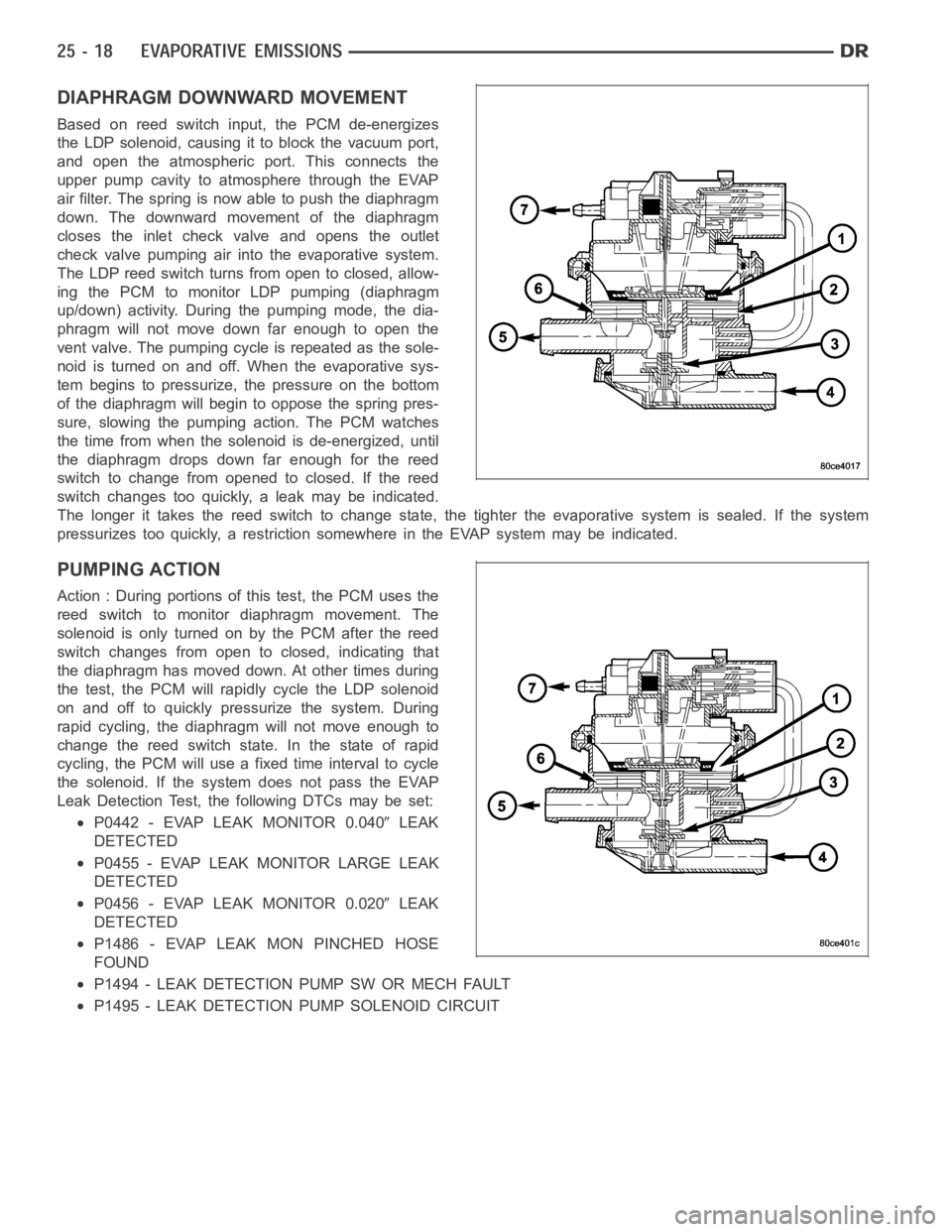
DIAPHRAGM DOWNWARD MOVEMENT
Based on reed switch input, the PCM de-energizes
the LDP solenoid, causing it to block the vacuum port,
and open the atmospheric port. This connects the
upper pump cavity to atmosphere through the EVAP
air filter. The spring is now able to push the diaphragm
down. The downward movement of the diaphragm
closes the inlet check valve and opens the outlet
check valve pumping air into the evaporative system.
The LDP reed switch turns from open to closed, allow-
ing the PCM to monitor LDP pumping (diaphragm
up/down) activity. During the pumping mode, the dia-
phragm will not move down far enough to open the
vent valve. The pumping cycle is repeated as the sole-
noid is turned on and off. When the evaporative sys-
tem begins to pressurize, the pressure on the bottom
of the diaphragm will begin to oppose the spring pres-
sure, slowing the pumping action. The PCM watches
the time from when the solenoid is de-energized, until
the diaphragm drops down far enough for the reed
switch to change from opened to closed. If the reed
switch changes too quickly, a leak may be indicated.
The longer it takes the reed switch to change state, the tighter the evaporative system is sealed. If the system
pressurizes too quickly, a restriction somewhere in the EVAP system may beindicated.
PUMPING ACTION
Action : During portions of this test, the PCM uses the
reed switch to monitor diaphragm movement. The
solenoid is only turned on by the PCM after the reed
switch changes from open to closed, indicating that
the diaphragm has moved down. At other times during
the test, the PCM will rapidly cycle the LDP solenoid
on and off to quickly pressurize the system. During
rapid cycling, the diaphragm will not move enough to
change the reed switch state. In the state of rapid
cycling, the PCM will use a fixed time interval to cycle
the solenoid. If the system does not pass the EVAP
Leak Detection Test, the following DTCs may be set:
P0442 - EVAP LEAK MONITOR 0.040LEAK
DETECTED
P0455 - EVAP LEAK MONITOR LARGE LEAK
DETECTED
P0456 - EVAP LEAK MONITOR 0.020LEAK
DETECTED
P1486 - EVAP LEAK MON PINCHED HOSE
FOUND
P1494 - LEAK DETECTION PUMP SW OR MECH FAULT
P1495 - LEAK DETECTION PUMP SOLENOID CIRCUIT