2006 DODGE RAM SRT-10 change time
[x] Cancel search: change timePage 4974 of 5267
Theory of Operation
The A/C Heater Control drives the Mode Door 1 (Panel to Floor) Actuator via the (C29) Mode Door 1 Driver circuit
and the (C34) Common Door Driver circuit. All of the door actuators share the (C34) Common Door Driver circuit.
Inside the A/C Heater Control, each door actuator has its own unique driver, but all share a single common door
driver circuit. Note that due to the shared circuitry similar DTCs can set at the same time for multiple actuators
depending upon the location of the open circuit and the direction the actuator is moving when the open is present.
When Monitored:
During actuator calibration.
Set Condition:
If the Mode Door 1 (Panel to Floor) Actuator’s electrical circuit is open. This DTC has a maturing time of 5
seconds and a de-maturing time of 10 seconds. If the DTC’s status changes from active to stored it will stay
in memory for 100 ignition cycles.
Possible Causes
(C29) MODE DOOR 1 DRIVER CIRCUIT OPEN
(C34) COMMON DOOR DRIVER CIRCUIT OPEN
MODE DOOR 1 (PANEL TO FLOOR) ACTUATOR
A/C HEATER CONTROL
NOTE: This DTC must be active for the results of this test to be valid. Do not perform this test if this DTC
is stored. Refer to HVAC System Test for stored DTC test procedures.
Diagnostic Test
1.CHECK FOR ACTIVE CONTROL CIRCUIT/PERFORMANCE DTCs
Turn the ignition on.
With the scan tool, read active HVAC DTCs.
Does the scan tool display any active: XXXX CONTROL CIRCUIT/PERFORMANCE DTCs?
Ye s>>
Diagnose and repair the DTC(s). Refer to the Table of Contents in this Section for a complete list of
HVAC related symptoms.
No>>
Go To 2
2.CHECK MODE DOOR 1 (PANEL TO FLOOR) ACTUATOR CIRCUIT RESISTANCE
Turn the ignition off.
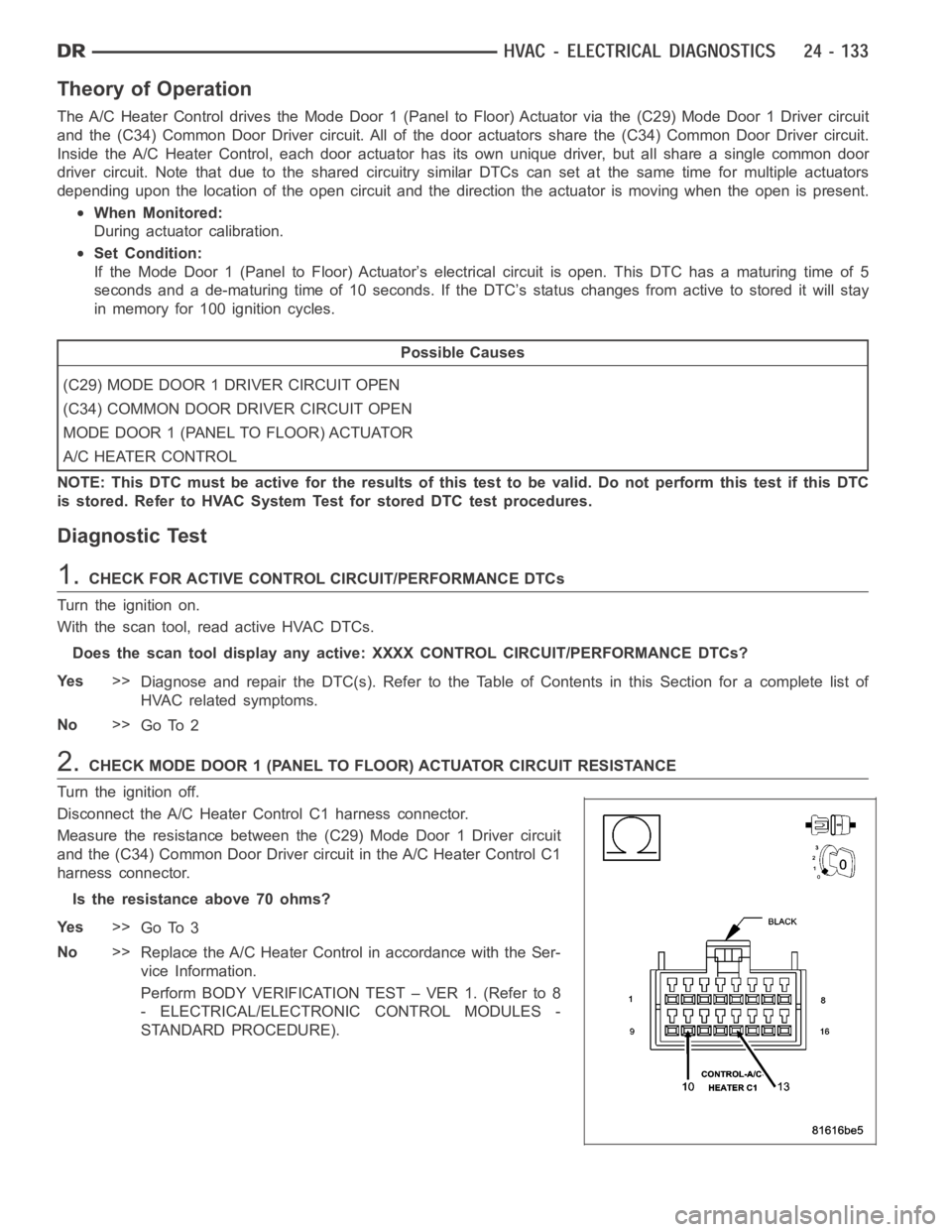
Disconnect the A/C Heater Control C1 harness connector.
Measure the resistance between the (C29) Mode Door 1 Driver circuit
and the (C34) Common Door Driver circuit in the A/C Heater Control C1
harness connector.
Is the resistance above 70 ohms?
Ye s>>
Go To 3
No>>
Replace the A/C Heater Control in accordance with the Ser-
vice Information.
Perform BODY VERIFICATION TEST – VER 1. (Refer to 8
- ELECTRICAL/ELECTRONIC CONTROL MODULES -
STANDARD PROCEDURE).
Page 4980 of 5267
B1046–FLOOR/DEFROST MODE DOORCONTROL CIRCUIT/PERFORMANCE
For a complete wiring diagramRefer to Section 8W.
Theory of Operation
The A/C Heater Control monitors the door driver circuits during actuator operation for shorts to ground, shorts to
battery, and shorts to other door driver circuits. If detected, the A/C Heater Control reports these types of faults as
Control Circuit/Performance DTCs. It is important to note that Control Circuit/Performance DTCs do not indicate
where or what type of short is present and that additional system testing isnecessary to provide more details about
the reported fault.
When Monitored:
When actuator movement is requested.
Set Condition:
If the A/C Heater Control detects an excessive current draw on any of the door driver circuits while attempting
to drive this actuator. This DTC has a maturing time of 5 seconds and a de-maturing time of 10 seconds. If the
DTC’s status changes from active to stored it will stay in memory for 100 ignition cycles.
Possible Causes
DOOR DRIVER CIRCUIT(S) SHORTED
NOTE:TheDTCmustbeactivefortheresultsofthistesttobevalid.Donotperform this test if the DTC is
stored. Refer to HVAC System Test for stored DTC test procedures.
Diagnostic Test
1.RUN THE ACTUATOR DTC DETECTION TEST
Turn the ignition on.
With the scan tool in HVAC, erase DTCs.
With the scan tool, select System Tests and then select Actuator DTC Detection. When the test is complete, select
View DTCs.
Repair, Dual-Zone System
Diagnose and repair the DTC(s). If multiple DTCs are present, beginning with the passenger blend door,
diagnose and repair all short high DTCs and then all short low DTCs. Refer tothe Table of Contents in
this Section for a complete list of HVAC related symptoms.
Repair, Single-Zone System
Diagnose and repair the DTC(s). If multiple DTCs are present, beginning with the common circuit, diag-
nose and repair all short high DTCs and then all short low DTCs. Refer to the Table of Contents in this
Section for a complete list of HVAC related symptoms.
Page 4996 of 5267
Theory of Operation
The A/C Heater Control drives the Mode Door 2 (Defrost to Floor) Actuator viathe(C801)ModeDoor2Driver
circuit and the (C34) Common Door Driver circuit. All of the door actuatorsshare the (C34) Common Door Driver
circuit. Inside the A/C Heater Control, each door actuator has its own unique driver, but all share a single common
door driver circuit. Due to the shared circuitry similar DTCs can set at thesame time for multiple actuators depend-
ing upon the location of the open circuit and the direction the actuator is moving when the open is present.
When Monitored:
During actuator calibration.
Set Condition:
If the Mode Door 2 (Defrost to Floor) Actuator’s electrical circuit is open. This DTC has a maturing time of 5
seconds and a de-maturing time of 10 seconds. If the DTC’s status changes from active to stored it will stay
in memory for 100 ignition cycles.
Possible Causes
(C801) MODE DOOR 2 DRIVER CIRCUIT OPEN
(C34) COMMON DOOR DRIVER CIRCUIT OPEN
MODE DOOR 2 (DEFROST TO FLOOR) ACTUATOR
A/C HEATER CONTROL
NOTE: This DTC must be active for the results of this test to be valid. Do not perform this test if this DTC
is stored. Refer to HVAC System Test for stored DTC test procedures.
Diagnostic Test
1.CHECK FOR ACTIVE CONTROL CIRCUIT/PERFORMANCE DTCs
Turn the ignition on.
With the scan tool, read active HVAC DTCs.
Does the scan tool display any active: XXXX CONTROL CIRCUIT/PERFORMANCE DTCs?
Ye s>>
Diagnose and repair the DTC(s). Refer to the Table of Contents in this Section for a complete list of
HVAC related symptoms.
No>>
Go To 2
2.CHECK MODE DOOR 2 (DEFROST TO FLOOR) ACTUATOR CIRCUIT RESISTANCE
Turn the ignition off.
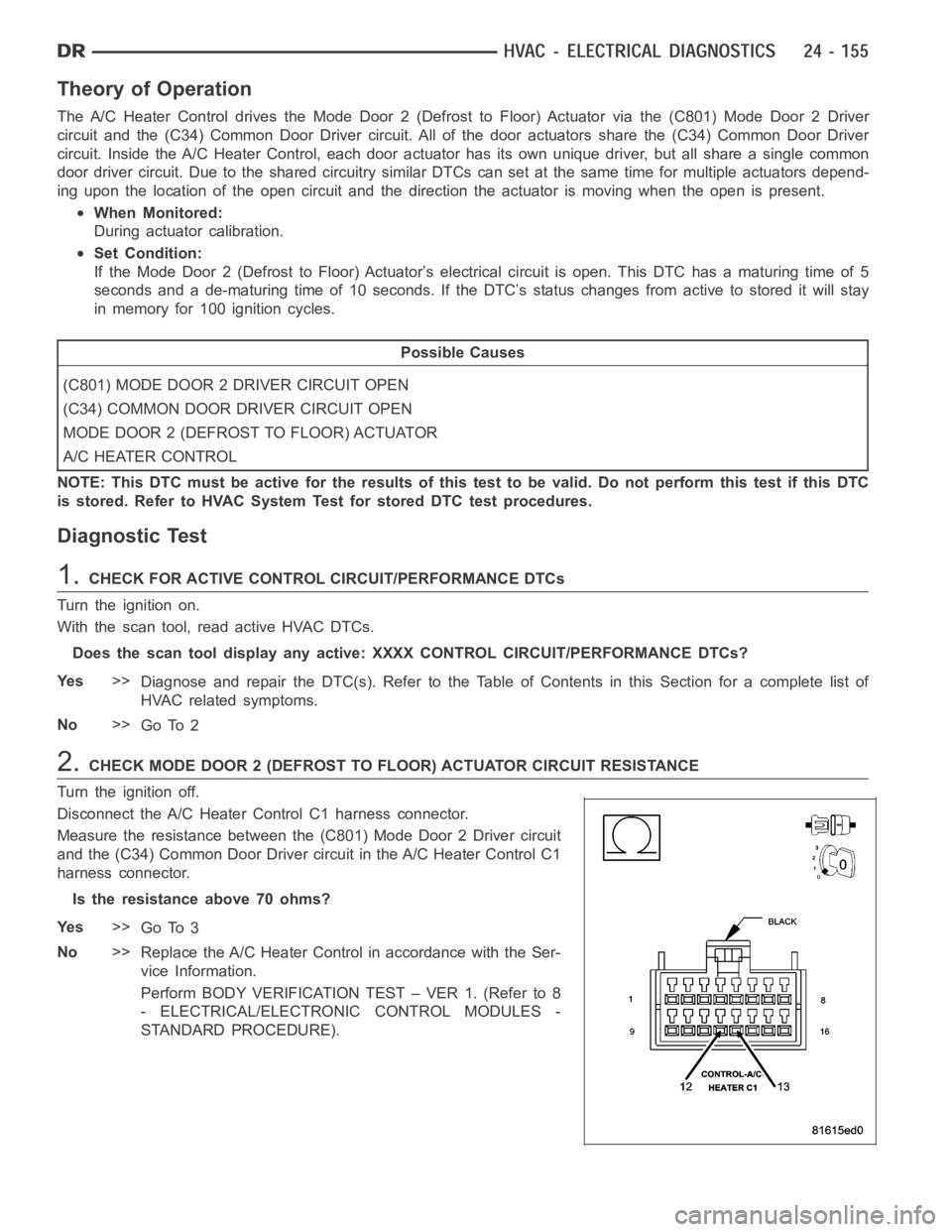
Disconnect the A/C Heater Control C1 harness connector.
Measure the resistance between the (C801) Mode Door 2 Driver circuit
and the (C34) Common Door Driver circuit in the A/C Heater Control C1
harness connector.
Is the resistance above 70 ohms?
Ye s>>
Go To 3
No>>
Replace the A/C Heater Control in accordance with the Ser-
vice Information.
Perform BODY VERIFICATION TEST – VER 1. (Refer to 8
- ELECTRICAL/ELECTRONIC CONTROL MODULES -
STANDARD PROCEDURE).
Page 4999 of 5267
Theory of Operation
The A/C Heater Control drives the Mode Door 2 (Defrost to Floor) Actuator viathe(C801)ModeDoor2Driver
circuit and the (C34) Common Door Driver circuit. All of the door actuatorsshare the (C34) Common Door Driver
circuit. Inside the A/C Heater Control, each door actuator has its own unique driver, but all share a single common
door driver circuit. Due to the shared circuitry similar DTCs can set at thesame time for multiple actuators depend-
ing upon the location of the open circuit and the direction the actuator is moving when the open is present.
When Monitored:
During actuator calibration.
Set Condition:
If the Mode Door 2 (Defrost to Floor) Actuator’s electrical circuit is open. This DTC has a maturing time of 5
seconds and a de-maturing time of 10 seconds. If the DTC’s status changes from active to stored it will stay
in memory for 100 ignition cycles.
Possible Causes
(C801) MODE DOOR 2 DRIVER CIRCUIT OPEN
(C34) COMMON DOOR DRIVER CIRCUIT OPEN
MODE DOOR 2 (DEFROST TO FLOOR) ACTUATOR
A/C HEATER CONTROL
NOTE: This DTC must be active for the results of this test to be valid. Do not perform this test if this DTC
is stored. Refer to HVAC System Test for stored DTC test procedures.
Diagnostic Test
1.CHECK FOR ACTIVE CONTROL CIRCUIT/PERFORMANCE DTCs
Turn the ignition on.
With the scan tool, read active HVAC DTCs.
Does the scan tool display any active: XXXX CONTROL CIRCUIT/PERFORMANCE DTCs?
Ye s>>
Diagnose and repair the DTC(s). Refer to the Table of Contents in this Section for a complete list of
HVAC related symptoms.
No>>
Go To 2
2.CHECK MODE DOOR 2 (DEFROST TO FLOOR) ACTUATOR CIRCUIT RESISTANCE
Turn the ignition off.
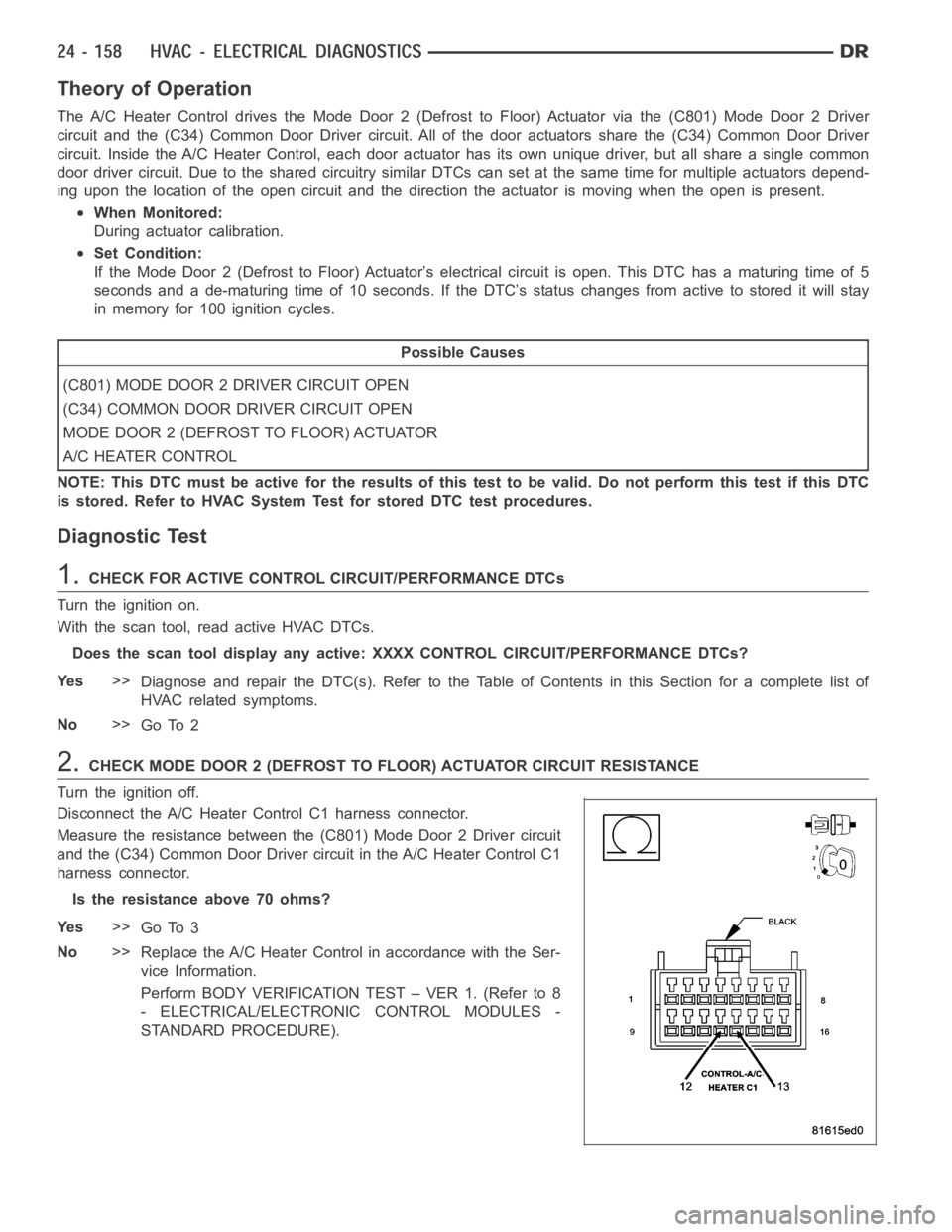
Disconnect the A/C Heater Control C1 harness connector.
Measure the resistance between the (C801) Mode Door 2 Driver circuit
and the (C34) Common Door Driver circuit in the A/C Heater Control C1
harness connector.
Is the resistance above 70 ohms?
Ye s>>
Go To 3
No>>
Replace the A/C Heater Control in accordance with the Ser-
vice Information.
Perform BODY VERIFICATION TEST – VER 1. (Refer to 8
- ELECTRICAL/ELECTRONIC CONTROL MODULES -
STANDARD PROCEDURE).
Page 5005 of 5267
B1058–RECIRCULATION DOOR CONTROL CIRCUIT/PERFORMANCE
For a complete wiring diagramRefer to Section 8W.
Theory of Operation
The A/C Heater Control monitors the door driver circuits during actuator operation for shorts to ground, shorts to
battery, and shorts to other door driver circuits. If detected, the A/C Heater Control reports these types of faults as
Control Circuit/Performance DTCs. It is important to note that Control Circuit/Performance DTCs do not indicate
where or what type of short is present and that additional system testing isnecessary to provide more details about
the reported fault.
When Monitored:
When actuator movement is requested.
Set Condition:
If the A/C Heater Control detects an excessive current draw on any of the door driver circuits while attempting
to drive this actuator. This DTC has a maturing time of 5 seconds and a de-maturing time of 10 seconds. If the
DTC’s status changes from active to stored it will stay in memory for 100 ignition cycles.
Possible Causes
DOOR DRIVER CIRCUIT(S) SHORTED
NOTE:TheDTCmustbeactivefortheresultsofthistesttobevalid.Donotperform this test if the DTC is
stored. Refer to HVAC System Test for stored DTC test procedures.
Diagnostic Test
1.RUN THE ACTUATOR DTC DETECTION TEST
Turn the ignition on.
With the scan tool in HVAC, erase DTCs.
With the scan tool, select System Tests and then select Actuator DTC Detection. When the test is complete, select
View DTCs.
Repair, Dual-Zone System
Diagnose and repair the DTC(s). If multiple DTCs are present, beginning with the passenger blend door,
diagnose and repair all short high DTCs and then all short low DTCs. Refer tothe Table of Contents in
this Section for a complete list of HVAC related symptoms.
Repair, Single-Zone System
Diagnose and repair the DTC(s). If multiple DTCs are present, beginning with the common circuit, diag-
nose and repair all short high DTCs and then all short low DTCs. Refer to the Table of Contents in this
Section for a complete list of HVAC related symptoms.
Page 5033 of 5267
B1079–CLIMATE CONTROL COOL DOWN TEST EXCESSIVE TIME (SINGLE-ZONE)
For a complete wiring diagramRefer to Section 8W.
Theory of Operation
The Cooldown Test checks A/C system performance based on Evaporator Temperature Sensor input. The main cri-
teria is to lower evaporator temperature 11.11°C (20°F) within one minute. Before starting the test, the evaporator
temperature must be above 13°C (55°F) and the front blower speed must be setto high speed. When the test is
running, A/C Select and A/C Request will be on and the A/C status indicator will flash. When the test is complete,
the scan tool will display one or more test status messages to indicate the outcome of the Cooldown Test. A Suc-
cessful Cooldown – Test Passed status message indicates that the main testcriteria was met. A DTC Set During
Routine – Test Not Passed status message indicates that the A/C system is unable to lower the evaporator tem-
perature 11.11°C (20°F) within one minute. A Conditions Too Cold – Test NotRun status message indicates that the
evaporator temperature was below 13°C (55°F) when starting the Cooldown Test. A Blowers Not On High – Test Not
Run status message indicates that either the front blower speed was not setto high speed prior to starting the
Cooldown Test or the front blower speed was changed from high speed to another setting after starting the
Cooldown test. A Refrigerant Temperature Sensor Error status message indicates that a fault occurred with the
Evaporator Temperature Sensor/sensor circuits. A No Results Stored/Test Not Complete status message indicates
that the power was cycled while the test was running.
When Monitored:
When the Cooldown Test is executed.
Set Condition:
If the A/C system is unable to lower the evaporator temperature 11.11°C (20°F) within one minute.
Possible Causes
OTHER HVAC SYSTEM FAULTS PRESENT
EVAPORATOR TEMPERATURE SENSOR CIRCUITS
EVAPORATOR TEMPERATURE SENSOR
TOTALLY INTEGRATED POWER MODULE (TIPM) FAULTS PRESENT
POWERTRAIN SYSTEM FAULTS PRESENT
Diagnostic Test
1.DIAGNOSE COOLDOWN TEST STATUS MESSAGES
WereanyofthefollowingstatusmessagespresentafterperformingtheCooldown Test?
Yes, Conditions Too Cold - Test Not Run
If running, turn the A/C compressor off. Verify that the work area ambient temperature is above 15.6°C
(60°F). If not, move the vehicle to a warmer work area. Verify that the evaporator temperature is above
13°C (55°F). If not, set the blower to high speed and allow the blower to run for five minutes. Then, run
the Cooldown Test again.
Yes, Blowers Not On High - Test Not Run
Set the blower speed to high speed and then run the Cooldown Test again.
Yes, No Results Stored/Test Not Complete
Verify that power is not interrupted while rerunning the Cooldown Test.
No>>
Go To 2
Page 5035 of 5267
B2214–(HVAC) CLIMATE CONTROL INTERNAL
For a complete wiring diagramRefer to Section 8W.
When Monitored:
With the ignition on.
Set Condition:
If the A/C Heater Control has an internal fault. This DTC has a maturing timeof 5 seconds and a de-maturing
time of 10 seconds. If the DTC’s status changes from active to stored it willstay in memory for 100 ignition
cycles.
Possible Causes
A/C HEATER CONTROL
NOTE: This DTC must be active for the results of this test to be valid. Do not perform this test if this DTC
is stored. Refer to either HVAC System Test (ATC) or to HVAC System Test (MTC) for stored DTC test pro-
cedures.
Diagnostic Test
1.REPLACE THE A/C HEATER CONTROL
Repair
Replace the A/C Heater Control in accordance with the Service Information.
Perform BODY VERIFICATION TEST – VER 1. (Refer to 8 - ELECTRICAL/ELECTRONIC CONTROL
MODULES - STANDARD PROCEDURE).
Page 5041 of 5267
When Monitored:
With the ignition on.
Set Condition:
If the A/C Heater Control looses communication with the Vehicle Entertainment System (VES).
(Refer to 8 - ELECTRICAL/ELECTRONIC CONTROL MODULES - DIAGNOSIS AND TESTING)for the diagnostic
test procedure.
U0197–LOST COMMUNICATION WITH HANDS FREE PHONE MODULE
For a complete wiring diagramRefer to Section 8W.
When Monitored:
With the ignition on.
Set Condition:
If the A/C Heater Control looses communication with the Hands Free Phone Module (HFM).
(Refer to 8 - ELECTRICAL/ELECTRONIC CONTROL MODULES - DIAGNOSIS AND TESTING)for the diagnostic
test procedure.
DTC SET DURING ROUTINE - TEST NOT PASSED
For a complete wiring diagramRefer to Section 8W.
When Monitored:
When the Cooldown Test is executed.
Set Condition:
If the A/C system is unable to lower the evaporator temperature 11.11°C (20°F) within one minute.
For dual-zone HVAC systems,refer to B10B2-A/C COOL DOWN TEST PERFORMANCEfor the diagnostic test
procedure. For single-zone HVAC systems,refer to B1079–CLIMATE CONTROL COOL DOWN TEST EXCESSIVE
TIMEfor the diagnostic test procedure.
BLOWERS NOT ON HIGH - TEST NOT RUN
For a complete wiring diagramRefer to Section 8W.
When Monitored:
When the Cooldown Test is executed.
Set Condition:
If either the blower speed was not set to high speed prior to starting the Cooldown Test or the blower speed
was changed from high speed to another setting after starting the Cooldowntest.
For dual-zone HVAC systems,refer to B10B2-A/C COOL DOWN TEST PERFORMANCEfor the diagnostic test
procedure. For single-zone HVAC systems,refer to B1079–CLIMATE CONTROL COOL DOWN TEST EXCESSIVE
TIMEfor the diagnostic test procedure.
REFRIGERANT TEMPERATURE SENSOR ERROR
For a complete wiring diagramRefer to Section 8W.
When Monitored:
When the Cooldown Test is executed.
Set Condition:
If a fault occurred with the Evaporator Temperature Sensor/sensor circuits.
For dual-zone HVAC systems,refer to B10B2-A/C COOL DOWN TEST PERFORMANCEfor the diagnostic test
procedure. For single-zone HVAC systems,refer to B1079–CLIMATE CONTROL COOL DOWN TEST EXCESSIVE
TIMEfor the diagnostic test procedure.