Page 1204 of 3502

CVT-198
SERVICE DATA AND SPECIFICATIONS (SDS)
SERVICE DATA AND SPECIFICATIONS (SDS)PFP:00030
General SpecificationsBCS001N1
*1: Refer to MA-14, "Fluids and Lubricants" .
Vehicle Speed at Which Gear Shifting OccursBCS001N2
Numerical value data are reference values.
CAUTION:
Lock-up clutch is engaged when vehicle speed is approximately 18 km/h (11 MPH) to 90 km/h (56 MPH).
Stall SpeedBCS001N3
Line PressureBCS001N4
*1 : Reference values
Solenoid ValvesBCS001N5
Applied modelVQ35DE engine
2WD
CVT modelRE0F09A
CVT assembly Model code number 1XD14
Transmission gear ratioD range Variable
Reverse 1.766
Final drive 5.173
Recommended fluid NISSAN CVT Fluid NS-2*1
Fluid capacity 10.2 liter (9 Imp qt)
CAUTION:
�Use only Genuine NISSAN CVT Fluid NS-2. Do not mix with other fluid.
�Using CVT fluid other than Genuine NISSAN CVT Fluid NS-2 will deteriorate in driveability and CVT durability, and may
damage the CVT, which is not covered by the warranty.
Engine type Throttle position Shift patternEngine speed (rpm)
At 40 km/h (25 MPH) At 60 km/h (37 MPH)
VQ35DE8/8 “D” position 3,100 - 4,200 4,200 - 5,300
2/8 “D” position 1,200 - 2,000 1,300 - 2,100
Stall speed 2,700 - 3,250 rpm
Engine Engine speedLine pressure kPa (bar, kg/cm2 , psi)
“R”, “D” positions
VQ35DEAt idle speed 750 (7.50, 7.65, 108.8)
At stall speed
5,700 (57.00, 58.14, 826.5)*
1
Name Resistance (Approx.) Terminal
Pressure control solenoid valve B (Secondary
pressure solenoid valve)
3 - 9 Ω3
Pressure control solenoid valve A (Line pressure
solenoid valve)2
Torque converter clutch solenoid valve12
Lock-up select solenoid valve 6 - 19 Ω13
Page 1231 of 3502
COMBINATION METERS
DI-25
C
D
E
F
G
H
I
J
L
MA
B
DI
Removal and Installation of Combination MeterBKS001SI
REMOVAL
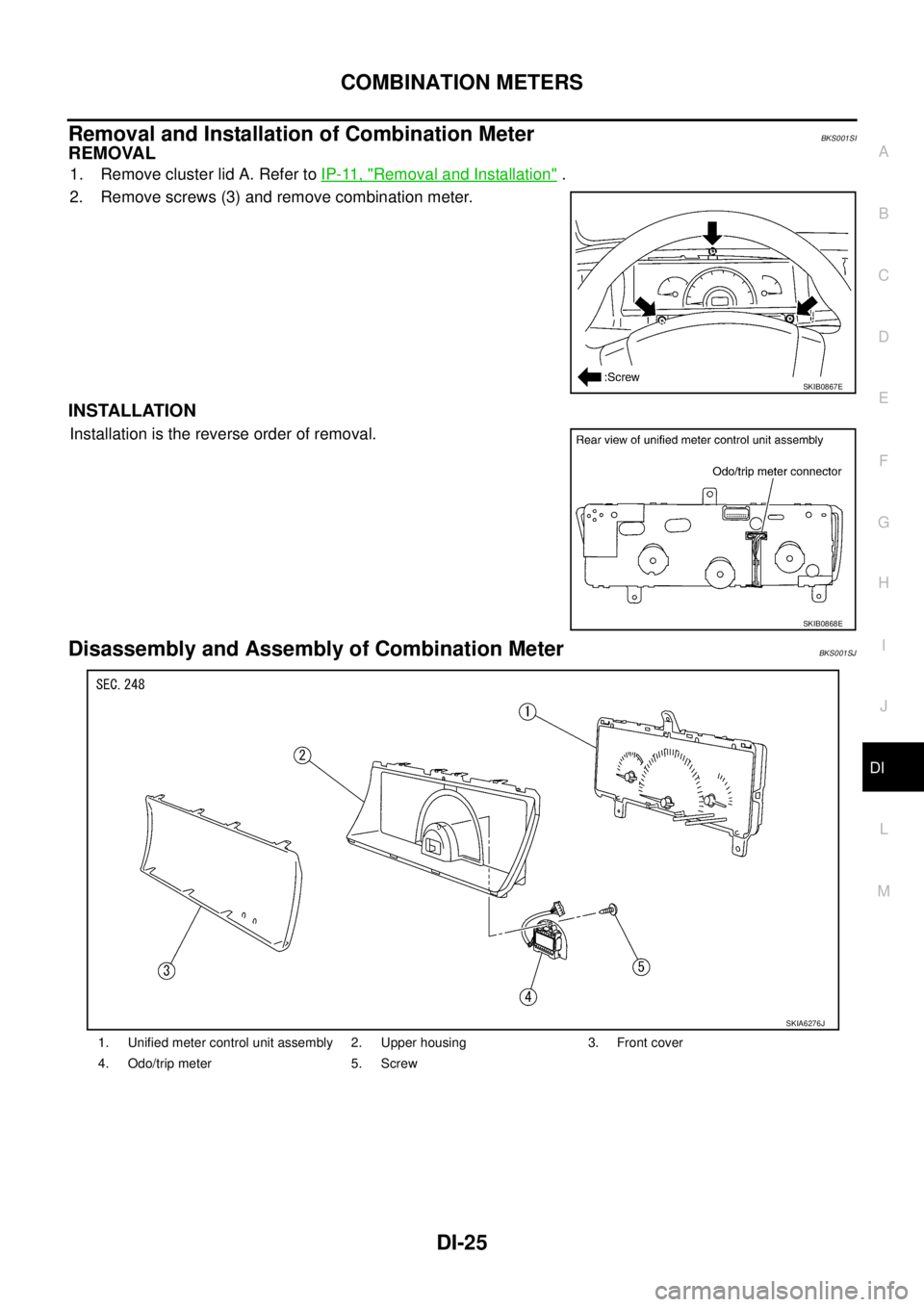
1. Remove cluster lid A. Refer to IP-11, "Removal and Installation" .
2. Remove screws (3) and remove combination meter.
INSTALLATION
Installation is the reverse order of removal.
Disassembly and Assembly of Combination MeterBKS001SJ
SKIB0867E
SKIB0868E
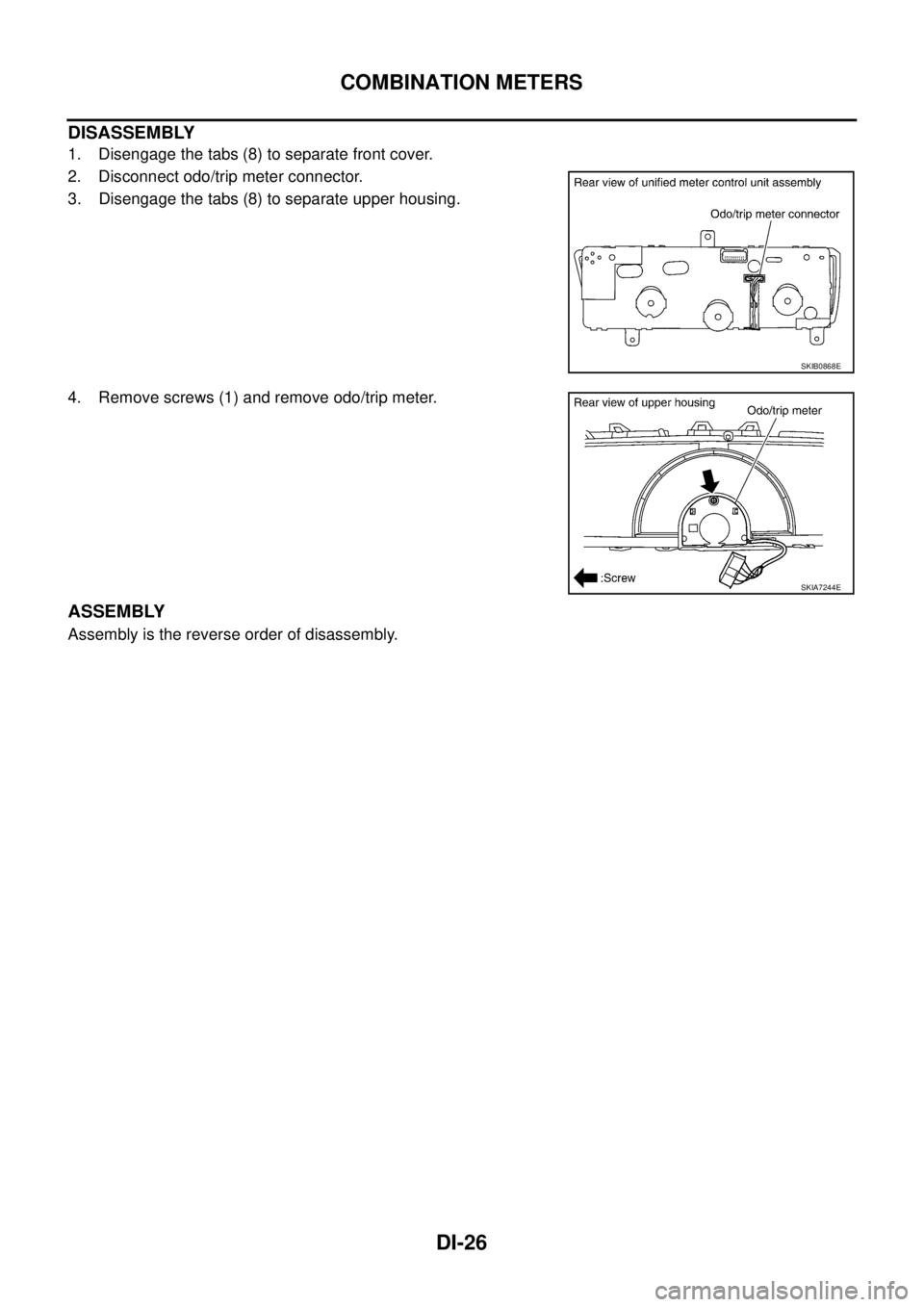
1. Unified meter control unit assembly 2. Upper housing 3. Front cover
4. Odo/trip meter 5. Screw
SKIA6276J
Page 1232 of 3502
DI-26
COMBINATION METERS
DISASSEMBLY
1. Disengage the tabs (8) to separate front cover.
2. Disconnect odo/trip meter connector.
3. Disengage the tabs (8) to separate upper housing.
4. Remove screws (1) and remove odo/trip meter.
ASSEMBLY
Assembly is the reverse order of disassembly.
SKIB0868E
SKIA7244E
Page 1240 of 3502
DI-34
UNIFIED METER AND A/C AMP
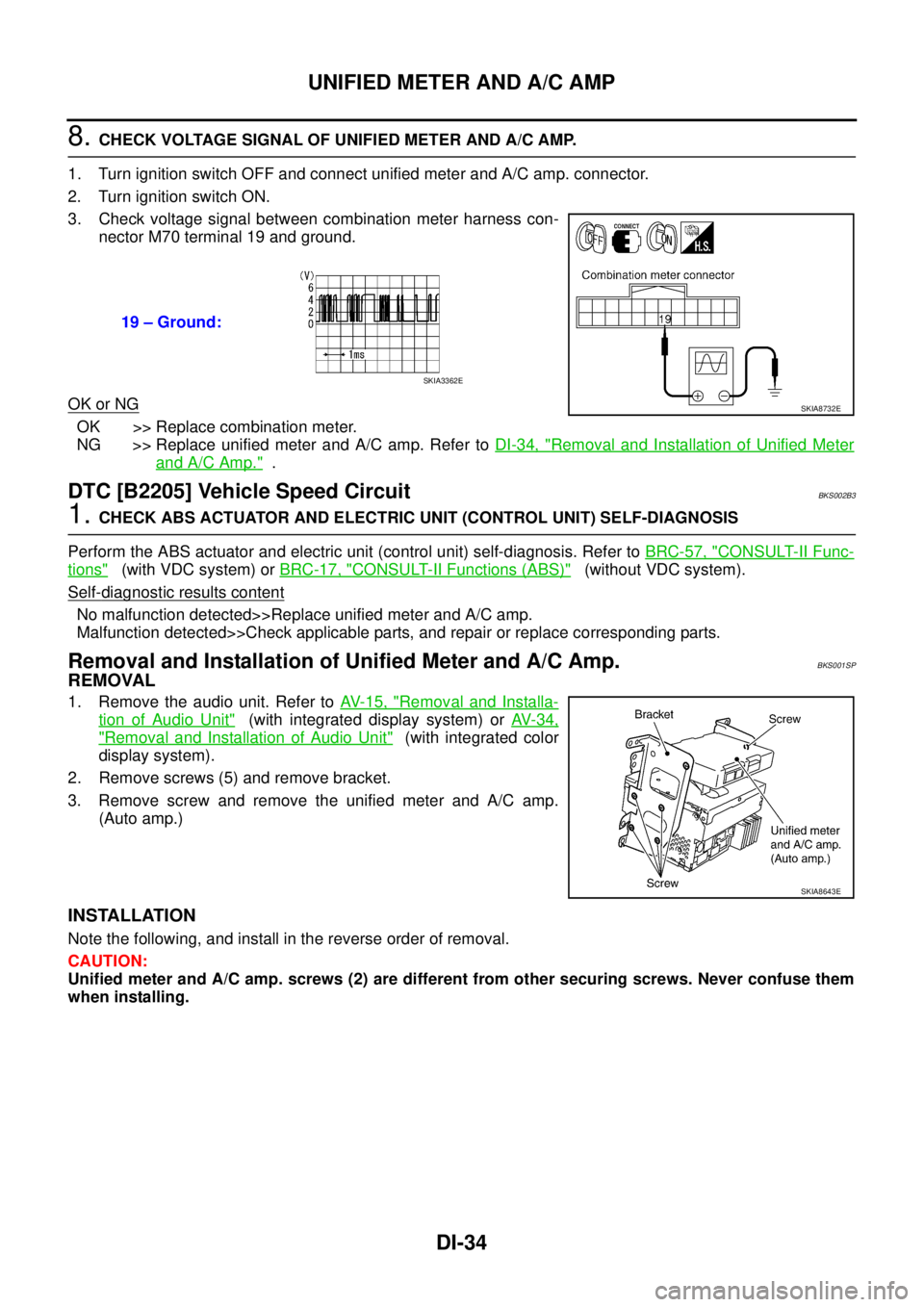
8. CHECK VOLTAGE SIGNAL OF UNIFIED METER AND A/C AMP.
1. Turn ignition switch OFF and connect unified meter and A/C amp. connector.
2. Turn ignition switch ON.
3. Check voltage signal between combination meter harness con-
nector M70 terminal 19 and ground.
OK or NG
OK >> Replace combination meter.
NG >> Replace unified meter and A/C amp. Refer to DI-34, "
Removal and Installation of Unified Meter
and A/C Amp." .
DTC [B2205] Vehicle Speed CircuitBKS002B3
1. CHECK ABS ACTUATOR AND ELECTRIC UNIT (CONTROL UNIT) SELF-DIAGNOSIS
Perform the ABS actuator and electric unit (control unit) self-diagnosis. Refer to BRC-57, "
CONSULT-II Func-
tions" (with VDC system) or BRC-17, "CONSULT-II Functions (ABS)" (without VDC system).
Self
-diagnostic results content
No malfunction detected>>Replace unified meter and A/C amp.
Malfunction detected>>Check applicable parts, and repair or replace corresponding parts.
Removal and Installation of Unified Meter and A/C Amp.BKS001SP
REMOVAL
1. Remove the audio unit. Refer to AV- 1 5 , "Removal and Installa-
tion of Audio Unit" (with integrated display system) or AV- 3 4 ,
"Removal and Installation of Audio Unit" (with integrated color
display system).
2. Remove screws (5) and remove bracket.
3. Remove screw and remove the unified meter and A/C amp.
(Auto amp.)
INSTALLATION
Note the following, and install in the reverse order of removal.
CAUTION:
Unified meter and A/C amp. screws (2) are different from other securing screws. Never confuse them
when installing.19 – Ground:
SKIA8732E
SKIA3362E
SKIA8643E
Page 1312 of 3502
![NISSAN TEANA 2003 Service Manual EC-30
[QR]
POSITIVE CRANKCASE VENTILATION
POSITIVE CRANKCASE VENTILATIONPFP:11810
DescriptionBBS005BM
SYSTEM DESCRIPTION
This system returns blow-by gas to the intake manifold.
The positive crankcas](/manual-img/5/57392/w960_57392-1311.png "NISSAN TEANA 2003 Service Manual EC-30
[QR]
POSITIVE CRANKCASE VENTILATION
POSITIVE CRANKCASE VENTILATIONPFP:11810
DescriptionBBS005BM
SYSTEM DESCRIPTION
This system returns blow-by gas to the intake manifold.
The positive crankcas")
EC-30
[QR]
POSITIVE CRANKCASE VENTILATION
POSITIVE CRANKCASE VENTILATIONPFP:11810
DescriptionBBS005BM
SYSTEM DESCRIPTION
This system returns blow-by gas to the intake manifold.
The positive crankcase ventilation (PCV) valve is provided to conduct crankcase blow-by gas to the intake
manifold. During partial throttle operation of the engine, the intake manifold sucks the blow-by gas through the
PCV valve. Normally, the capacity of the valve is sufficient to handle any blow-by and a small amount of venti-
lating air. The ventilating air is then drawn from the air inlet tubes into the crankcase. In this process the air
passes through the hose connecting air inlet tubes to rocker cover. Under full-throttle condition, the manifold
vacuum is insufficient to draw the blow-by flow through the valve. The flow goes through the hose connection
in the reverse direction.
On vehicles with an excessively high blow-by, the valve does not
meet the requirement. This is because some of the flow will go
through the hose connection to the air inlet tubes under all condi-
tions.
Component InspectionBBS005BN
PCV (POSITIVE CRANKCASE VENTILATION) VALVE
With engine running at idle, remove PCV valve from rocker cover. A
properly working valve makes a hissing noise as air passes through
it. A strong vacuum should be felt immediately when a finger is
placed over valve inlet.
PBIB0492E
PBIB1588E
PBIB1589E
Page 1652 of 3502
![NISSAN TEANA 2003 Service Manual EC-370
[VQ]
POSITIVE CRANKCASE VENTILATION
POSITIVE CRANKCASE VENTILATIONPFP:11810
DescriptionBBS004XT
SYSTEM DESCRIPTION
This system returns blow-by gas to the intake manifold.
The positive crankca](/manual-img/5/57392/w960_57392-1651.png "NISSAN TEANA 2003 Service Manual EC-370
[VQ]
POSITIVE CRANKCASE VENTILATION
POSITIVE CRANKCASE VENTILATIONPFP:11810
DescriptionBBS004XT
SYSTEM DESCRIPTION
This system returns blow-by gas to the intake manifold.
The positive crankca")
EC-370
[VQ]
POSITIVE CRANKCASE VENTILATION
POSITIVE CRANKCASE VENTILATIONPFP:11810
DescriptionBBS004XT
SYSTEM DESCRIPTION
This system returns blow-by gas to the intake manifold.
The positive crankcase ventilation (PCV) valve is provided to conduct crankcase blow-by gas to the intake
manifold. During partial throttle operation of the engine, the intake manifold sucks the blow-by gas through the
PCV valve. Normally, the capacity of the valve is sufficient to handle any blow-by and a small amount of venti-
lating air. The ventilating air is then drawn from the air inlet tubes into the crankcase. In this process the air
passes through the hose connecting air inlet tubes to rocker cover. Under full-throttle condition, the manifold
vacuum is insufficient to draw the blow-by flow through the valve. The flow goes through the hose connection
in the reverse direction.
On vehicles with an excessively high blow-by, the valve does not
meet the requirement. This is because some of the flow will go
through the hose connection to the air inlet tubes under all condi-
tions.
Component InspectionBBS004XU
PCV (POSITIVE CRANKCASE VENTILATION) VALVE
With engine running at idle, remove PCV valve from rocker cover. A
properly working valve makes a hissing noise as air passes through
it. A strong vacuum should be felt immediately when a finger is
placed over valve inlet.
SEC921C
PBIB1588E
PBIB1589E
Page 2063 of 3502
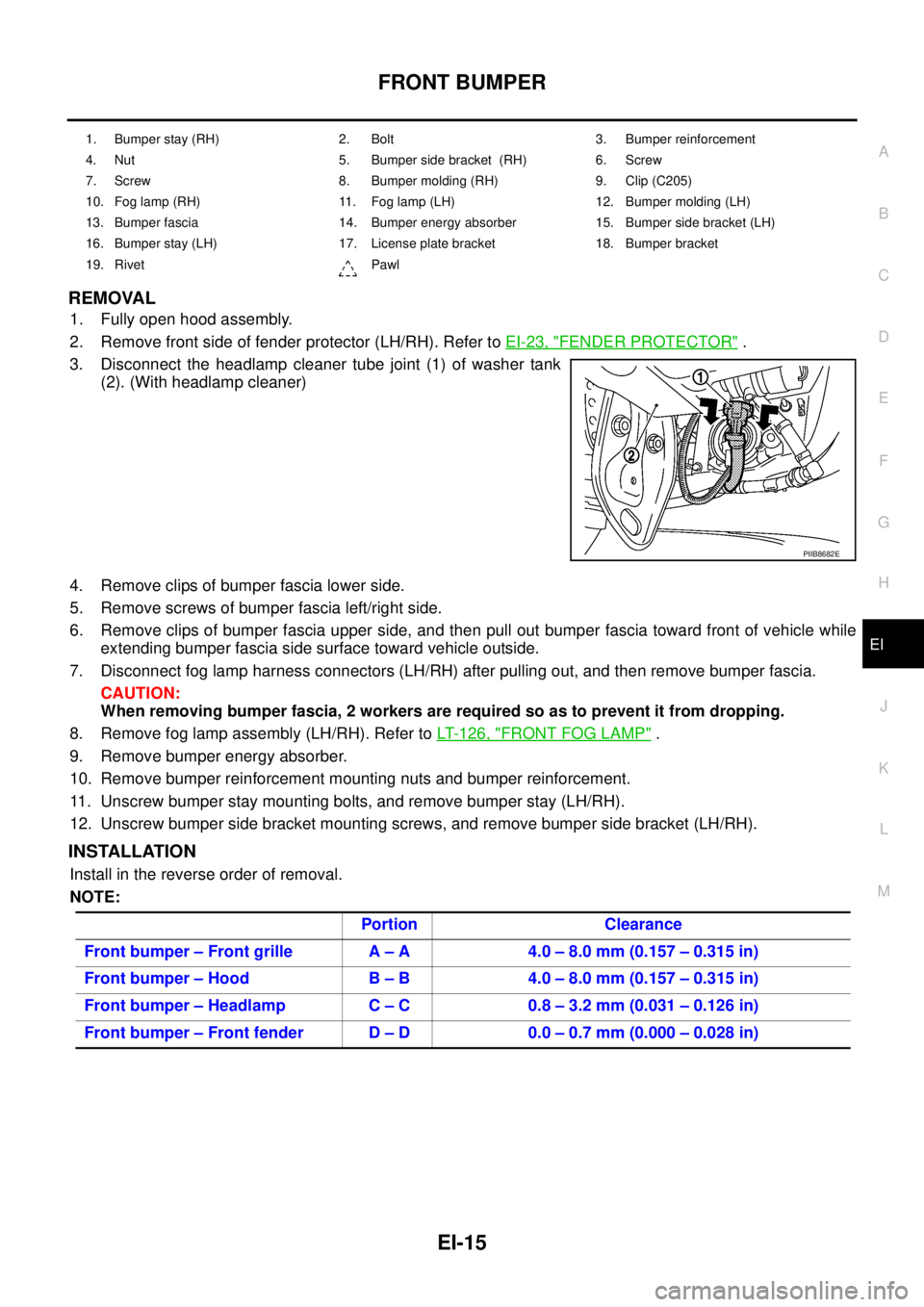
FRONT BUMPER
EI-15
C
D
E
F
G
H
J
K
L
MA
B
EI
REMOVAL
1. Fully open hood assembly.
2. Remove front side of fender protector (LH/RH). Refer to EI-23, "
FENDER PROTECTOR" .
3. Disconnect the headlamp cleaner tube joint (1) of washer tank
(2). (With headlamp cleaner)
4. Remove clips of bumper fascia lower side.
5. Remove screws of bumper fascia left/right side.
6. Remove clips of bumper fascia upper side, and then pull out bumper fascia toward front of vehicle while
extending bumper fascia side surface toward vehicle outside.
7. Disconnect fog lamp harness connectors (LH/RH) after pulling out, and then remove bumper fascia.
CAUTION:
When removing bumper fascia, 2 workers are required so as to prevent it from dropping.
8. Remove fog lamp assembly (LH/RH). Refer to LT- 1 2 6 , "
FRONT FOG LAMP" .
9. Remove bumper energy absorber.
10. Remove bumper reinforcement mounting nuts and bumper reinforcement.
11. Unscrew bumper stay mounting bolts, and remove bumper stay (LH/RH).
12. Unscrew bumper side bracket mounting screws, and remove bumper side bracket (LH/RH).
INSTALLATION
Install in the reverse order of removal.
NOTE:
1. Bumper stay (RH) 2. Bolt 3. Bumper reinforcement
4. Nut 5. Bumper side bracket (RH) 6. Screw
7. Screw 8. Bumper molding (RH) 9. Clip (C205)
10. Fog lamp (RH) 11. Fog lamp (LH) 12. Bumper molding (LH)
13. Bumper fascia 14. Bumper energy absorber 15. Bumper side bracket (LH)
16. Bumper stay (LH) 17. License plate bracket 18. Bumper bracket
19. Rivet Pawl
PIIB8682E
Portion Clearance
Front bumper – Front grille A – A 4.0 – 8.0 mm (0.157 – 0.315 in)
Front bumper – Hood B – B 4.0 – 8.0 mm (0.157 – 0.315 in)
Front bumper – Headlamp C – C 0.8 – 3.2 mm (0.031 – 0.126 in)
Front bumper – Front fender D – D 0.0 – 0.7 mm (0.000 – 0.028 in)
Page 2064 of 3502
EI-16
FRONT BUMPER
REMOVAL AND INSTALLATION OF FRONT BUMPER MOLDING
Removal
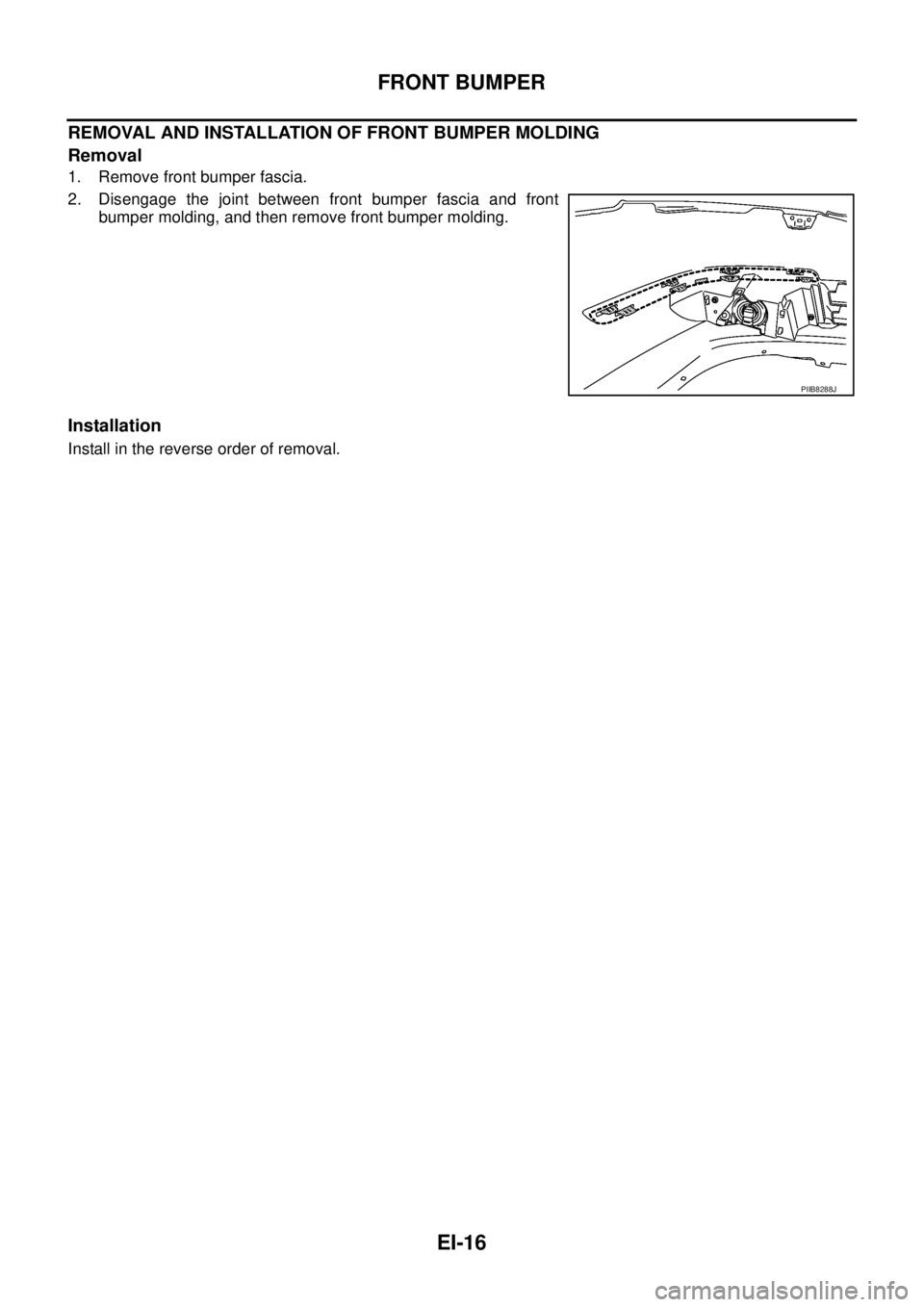
1. Remove front bumper fascia.
2. Disengage the joint between front bumper fascia and front
bumper molding, and then remove front bumper molding.
Installation
Install in the reverse order of removal.
PIIB8288J