FRONT DISC BRAKE
BR-27
C
D
E
G
H
I
J
K
L
MA
B
BR
�It is not necessary to remove bolts on torque member and brake hose except for disassembly or
replacement of caliper assembly. In this case, suspend cylinder body with wire so as not to stretch
brake hose.
�Do not damage piston boot.
�If any shim is subject to serious corrosion, replace it with a new one.
�Always replace shim and inner shim cover as a set when replacing brake pads.
�Keep rotor clean from brake fluid.
�Burnish brake contact surface after refinishing or replacing rotors, after replacing pads, or it a soft
pedal occurs at very low mileage. Refer toBR-32, "
BRAKE BURNISHING PROCEDURE" .
Removal and Installation of Brake PadBFS000BZ
REMOVAL
1. Remove tyres from vehicle.
2. Remove lower sliding pin bolt.
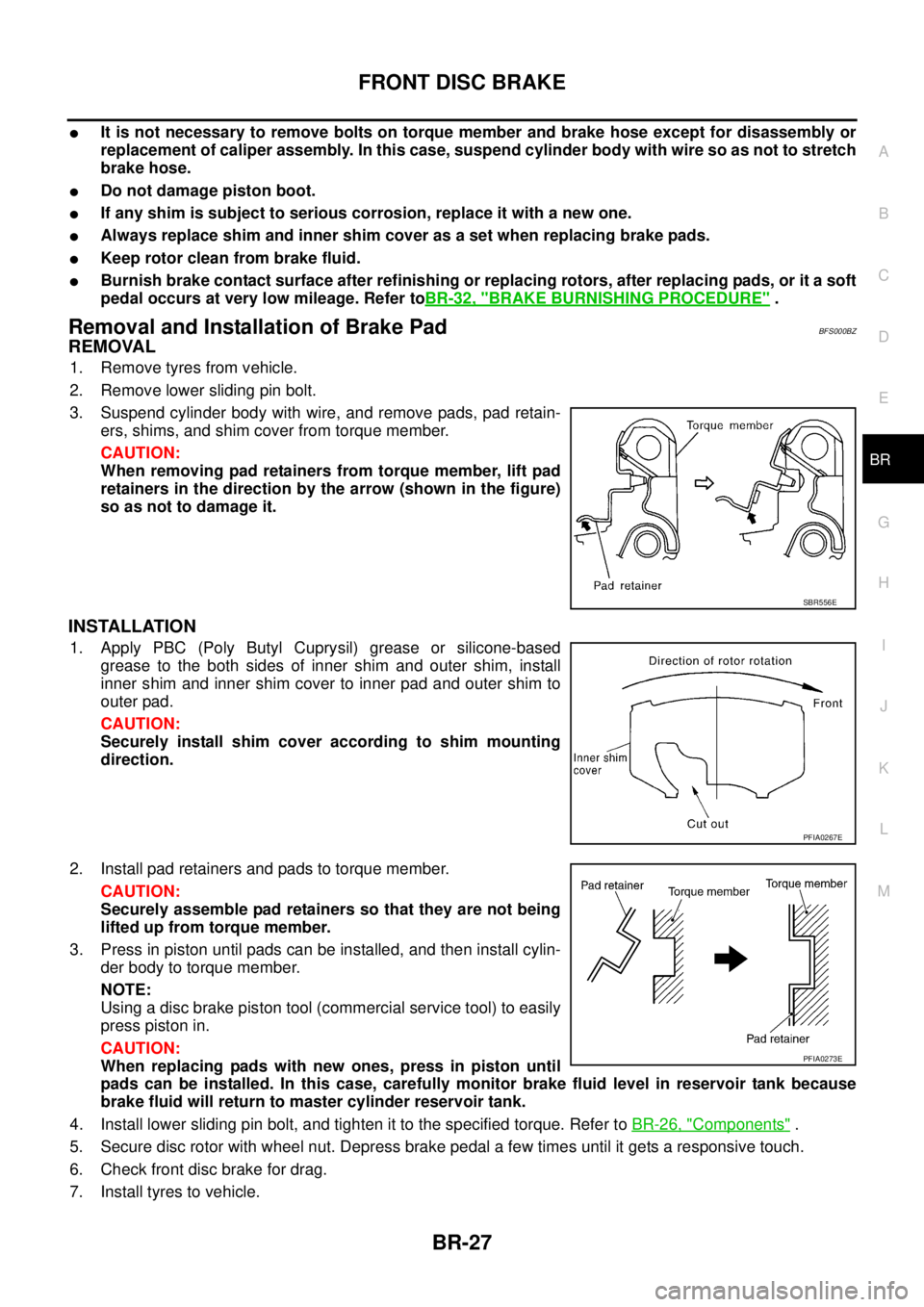
3. Suspend cylinder body with wire, and remove pads, pad retain-
ers, shims, and shim cover from torque member.
CAUTION:
When removing pad retainers from torque member, lift pad
retainers in the direction by the arrow (shown in the figure)
so as not to damage it.
INSTALLATION
1. Apply PBC (Poly Butyl Cuprysil) grease or silicone-based
grease to the both sides of inner shim and outer shim, install
inner shim and inner shim cover to inner pad and outer shim to
outer pad.
CAUTION:
Securely install shim cover according to shim mounting
direction.
2. Install pad retainers and pads to torque member.
CAUTION:
Securely assemble pad retainers so that they are not being
lifted up from torque member.
3. Press in piston until pads can be installed, and then install cylin-
der body to torque member.
NOTE:
Using a disc brake piston tool (commercial service tool) to easily
press piston in.
CAUTION:
When replacing pads with new ones, press in piston until
pads can be installed. In this case, carefully monitor brake fluid level in reservoir tank because
brake fluid will return to master cylinder reservoir tank.
4. Install lower sliding pin bolt, and tighten it to the specified torque. Refer to BR-26, "
Components" .
5. Secure disc rotor with wheel nut. Depress brake pedal a few times until it gets a responsive touch.
6. Check front disc brake for drag.
7. Install tyres to vehicle.
SBR556E
PFIA0267E
PFIA0273E
BR-34
REAR DISC BRAKE
WARNING:
Clean dust on caliper and brake pads with a vacuum dust collector to minimize the hazard of air borne
particles or other materials.
CAUTION:
�While removing cylinder body, do never depress brake pedal because piston will pop out.
�It is not necessary to remove bolts on torque member and brake hose except for disassembly or
replacement of caliper assembly. In this case, hang cylinder body with wire so as not to stretch
brake hose.
�Do not damage piston boot.
�If any shim is subject to serious corrosion, replace it with a new one.
�Always replace shims and shim covers as a set when replacing brake pads.
�Keep rotor clean from brake fluid.
�Burnish brake contact surface after refinishing or replacing rotors, after replacing pads, or if a soft
pedal occurs at very low mileage. Refer to BR-39, "
BRAKE BURNISHING PROCEDURE" .
Removal and Installation of Brake PadBFS000C4
REMOVAL
1. Remove tyres from vehicle.
2. Remove upper sliding pin bolt.
3. Suspend cylinder body with wire, and remove pads, pad retainers and shims, and shim covers from
torque member.
INSTALLATION
1. Apply PBC (Poly Butyl Cuprysil) grease or silicone-based grease to the bosh side of inner shim and outer
shin, install inner shim, inner shim cover to inner pad, and outer shim, outer shim cover to outer pad.
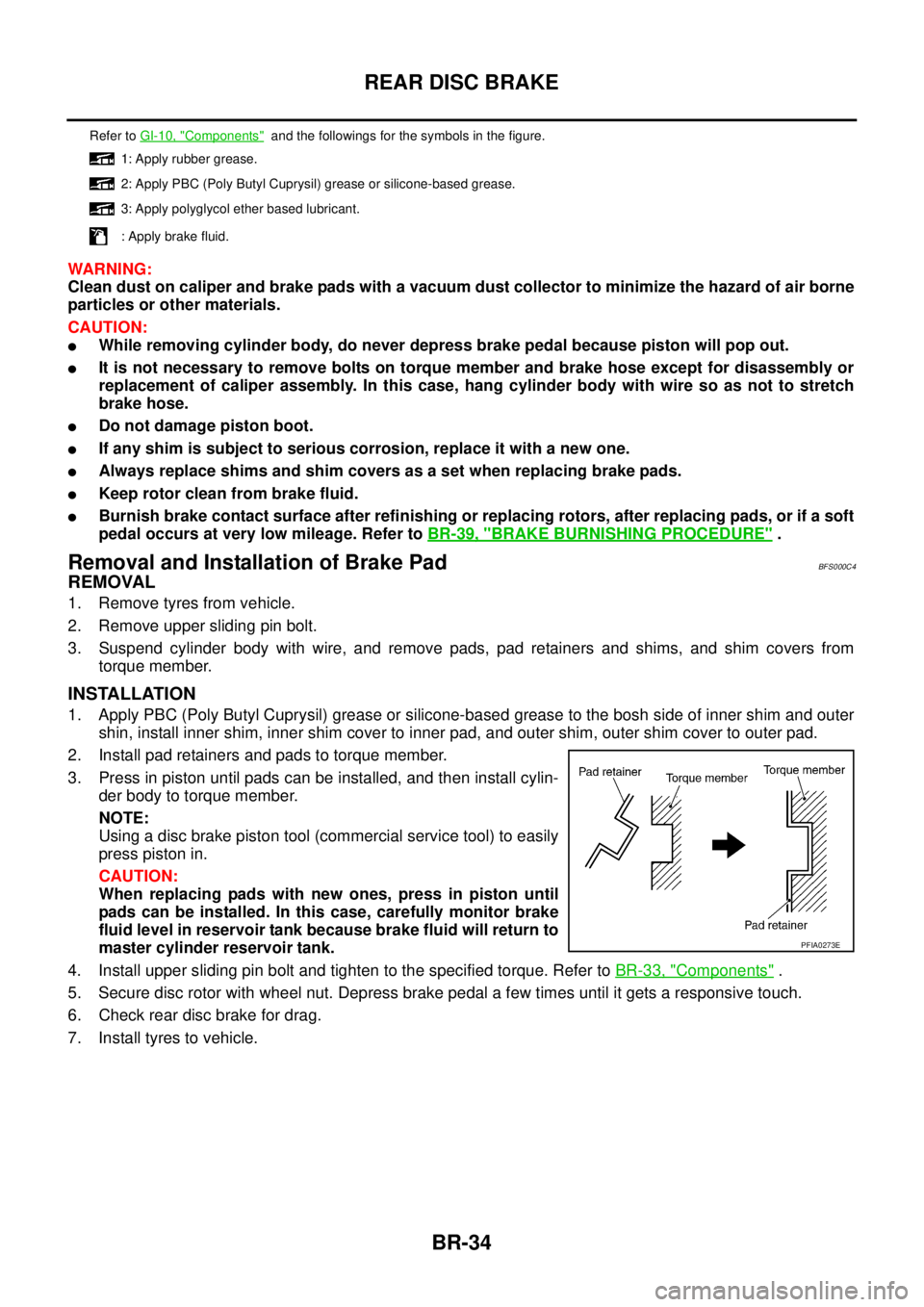
2. Install pad retainers and pads to torque member.
3. Press in piston until pads can be installed, and then install cylin-
der body to torque member.
NOTE:
Using a disc brake piston tool (commercial service tool) to easily
press piston in.
CAUTION:
When replacing pads with new ones, press in piston until
pads can be installed. In this case, carefully monitor brake
fluid level in reservoir tank because brake fluid will return to
master cylinder reservoir tank.
4. Install upper sliding pin bolt and tighten to the specified torque. Refer to BR-33, "
Components" .
5. Secure disc rotor with wheel nut. Depress brake pedal a few times until it gets a responsive touch.
6. Check rear disc brake for drag.
7. Install tyres to vehicle.
Refer to GI-10, "Components" and the followings for the symbols in the figure.
1: Apply rubber grease.
2: Apply PBC (Poly Butyl Cuprysil) grease or silicone-based grease.
3: Apply polyglycol ether based lubricant.
: Apply brake fluid.
PFIA0273E