Page 996 of 3502
![NISSAN TEANA 2003 Service Manual CO-44
[VQ]
COOLING FAN
COOLING FANPFP:21140
Removal and InstallationBBS004X4
REMOVAL
1. Drain engine coolant from radiator. Refer to CO-34, "Changing Engine Coolant" .
CAUTION:
�Perform this step wh](/manual-img/5/57392/w960_57392-995.png "NISSAN TEANA 2003 Service Manual CO-44
[VQ]
COOLING FAN
COOLING FANPFP:21140
Removal and InstallationBBS004X4
REMOVAL
1. Drain engine coolant from radiator. Refer to CO-34, \"Changing Engine Coolant\" .
CAUTION:
�Perform this step wh")
CO-44
[VQ]
COOLING FAN
COOLING FANPFP:21140
Removal and InstallationBBS004X4
REMOVAL
1. Drain engine coolant from radiator. Refer to CO-34, "Changing Engine Coolant" .
CAUTION:
�Perform this step when engine is cold.
�Do not spill engine coolant on drive belts.
2. Remove air duct (inlet). Refer to EM-131, "
AIR CLEANER AND AIR DUCT" .
3. Disconnect radiator hose (upper) at radiator side. Refer to CO-37, "
RADIATOR" .
4. Disconnect harness connector from fan motors, and move harness to aside.
5. Remove battery and battery tray, and move fuse and fusible link block to aside. Refer to SC-4, "
BAT-
TERY" .
6. Remove mounting bolts to lift up and remove radiator cooling fan assembly.
CAUTION:
Be careful not to damage or scratch on radiator core.
INSTALLATION
Installation is the reverse order of removal.
�Cooling fans are controlled by ECM. For details, refer to EC-575, "DTC P1217 ENGINE OVER TEMPER-
ATURE" .
1. Cooling fan (RH) 2. Cooling fan (LH) 3. Fan shroud
4. Fan motor
PBIC2514E
Page 997 of 3502
COOLING FAN
CO-45
[VQ]
C
D
E
F
G
H
I
J
K
L
MA
CO
Disassembly and Assembly BBS004X5
DISASSEMBLY
1. Remove cooling fans (RH and LH) from fan motors.
2. Remove fan motors from fan shroud.
INSPECTION AFTER DISASSEMBLY
Cooling Fan
Inspect cooling fan for crack or unusual bend.
�If anything is found, replace cooling fan.
ASSEMBLY
Assembly is the reverse order of disassembly.
CAUTION:
Cooling fans are different between RH and LH. Be careful not to misassemble them.
Page 1001 of 3502
![NISSAN TEANA 2003 Service Manual WATER PUMP
CO-49
[VQ]
C
D
E
F
G
H
I
J
K
L
MA
CO
e. Install timing chain tensioner (primary).
�Remove any dirt and foreign materials completely from the
back and the mounting surfaces of timing chain](/manual-img/5/57392/w960_57392-1000.png "NISSAN TEANA 2003 Service Manual WATER PUMP
CO-49
[VQ]
C
D
E
F
G
H
I
J
K
L
MA
CO
e. Install timing chain tensioner (primary).
�Remove any dirt and foreign materials completely from the
back and the mounting surfaces of timing chain")
WATER PUMP
CO-49
[VQ]
C
D
E
F
G
H
I
J
K
L
MA
CO
e. Install timing chain tensioner (primary).
�Remove any dirt and foreign materials completely from the
back and the mounting surfaces of timing chain tensioner (pri-
mary).
f. Pull out stopper pin after installing, and then release plunger.
g. Make sure again that timing chain and water pump sprocket are
engaged.
4. Install chain tensioner cover and water pump cover as follows:
a. Before installing, remove all traces of old liquid gasket from mat-
ing surface of water pump cover and chain tensioner cover
using scraper. Also remove traces of old liquid gasket from the
mating surface of front timing chain case.
b. Apply a continuous bead of liquid gasket with tube presser [SST:
WS39930000] to mating surface of chain tensioner cover and
water pump cover.
Use Genuine Liquid Gasket or equivalent.
CAUTION:
Attaching should be done within 5 minutes after coating.
c. Tighten mounting bolts.
5. Install water drain plug (front) on water pump side of cylinder block.
�Apply liquid gasket to the thread of water drain plug (front).
Use Genuine Liquid Gasket or equivalent.
6. Install in the reverse order of removal in this step.
NOTE:
If hydraulic pressure inside timing chain tensioner drops after removal/installation, slack in guide may gen-
erate a pounding noise during and just after engine start. However, this does not indicate an unusualness.
Noise will stop after hydraulic pressure rises.
INSPECTION AFTER INSTALLATION
�Check for leaks of engine coolant using radiator cap tester adapter [SST: EG17650301] and radiator cap
tester (commercial service tool). Refer to CO-34, "
LEAK CHECK" .
�Start and warm up engine. Visually check if there is no leaks of engine coolant.
PBIC3569E
SLC446B
PBIC2650E
Page 1003 of 3502
![NISSAN TEANA 2003 Service Manual WATER INLET AND THERMOSTAT ASSEMBLY
CO-51
[VQ]
C
D
E
F
G
H
I
J
K
L
MA
CO
INSPECTION AFTER REMOVAL
1. Check valve seating condition at ordinary room temperature. It should seat tightly.
2. Check valv](/manual-img/5/57392/w960_57392-1002.png "NISSAN TEANA 2003 Service Manual WATER INLET AND THERMOSTAT ASSEMBLY
CO-51
[VQ]
C
D
E
F
G
H
I
J
K
L
MA
CO
INSPECTION AFTER REMOVAL
1. Check valve seating condition at ordinary room temperature. It should seat tightly.
2. Check valv")
WATER INLET AND THERMOSTAT ASSEMBLY
CO-51
[VQ]
C
D
E
F
G
H
I
J
K
L
MA
CO
INSPECTION AFTER REMOVAL
1. Check valve seating condition at ordinary room temperature. It should seat tightly.
2. Check valve operation.
�If the malfunctioning condition, when valve seating at ordinary
room temperature, or measured values are out of the standard,
replace water inlet and thermostat assembly.
INSTALLATION
Note the following, and install in the reverse order of removal.
�Be careful not to spill engine coolant over engine room. Use rag to absorb engine coolant.
INSPECTION AFTER INSTALLATION
�Check for leaks of engine coolant using radiator cap tester adapter [SST: EG17650301] and radiator cap
tester (commercial service tool). Refer to CO-34, "
LEAK CHECK" .
�Start and warm up engine. Visually check if there is no leaks of engine coolant.
Thermostat Standard
Valve opening temperature 80.5 - 83.5°C (177 - 182°F)
Maximum valve lift 8.6 mm / 95°C (0.339 in / 203°F)
Valve closing temperature 77°C (171°F)
SLC949A
Page 1005 of 3502
WATER OUTLET AND WATER PIPING
CO-53
[VQ]
C
D
E
F
G
H
I
J
K
L
MA
CO
7. Remove engine coolant temperature sensor as necessary.
CAUTION:
Be careful not to damage engine coolant temperature sensor.
8. Remove water outlet, heater pipe, water bypass pipe and water connector.
INSTALLATION
Note the following, and install in the reverse order of removal.
�Securely insert each hose, and install clamp at a position where it does not interfere with the pipe bulge.
�When inserting water bypass pipe and heater pipe into water connector, apply neutral detergent to O-ring.
INSPECTION AFTER INSTALLATION
�Check for leaks of engine coolant using radiator cap tester adapter [SST: EG17650301] and radiator cap
tester (commercial service tool). Refer to CO-34, "
LEAK CHECK" .
�Start and warm up engine. Visually check if there is no leaks of engine coolant.
Page 1021 of 3502
CVT SYSTEM
CVT-15
D
E
F
G
H
I
J
K
L
MA
B
CVT
CVT SYSTEMPFP:31036
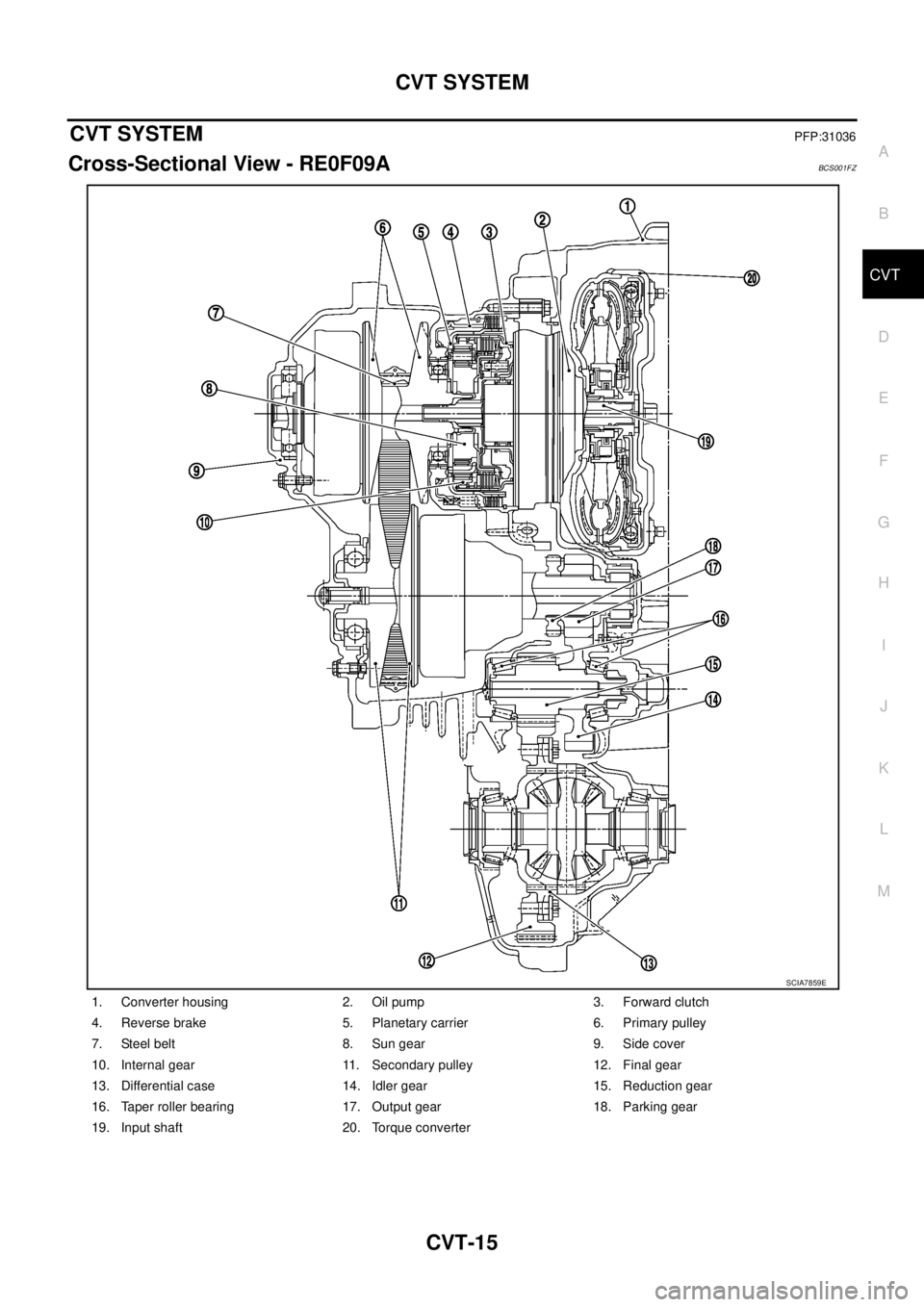
Cross-Sectional View - RE0F09ABCS001FZ
1. Converter housing 2. Oil pump 3. Forward clutch
4. Reverse brake 5. Planetary carrier 6. Primary pulley
7. Steel belt 8. Sun gear 9. Side cover
10. Internal gear 11. Secondary pulley 12. Final gear
13. Differential case 14. Idler gear 15. Reduction gear
16. Taper roller bearing 17. Output gear 18. Parking gear
19. Input shaft 20. Torque converter
SCIA7859E
Page 1027 of 3502
CVT SYSTEM
CVT-21
D
E
F
G
H
I
J
K
L
MA
B
CVT
NOTE:
The gear ratio is set for every position separately.
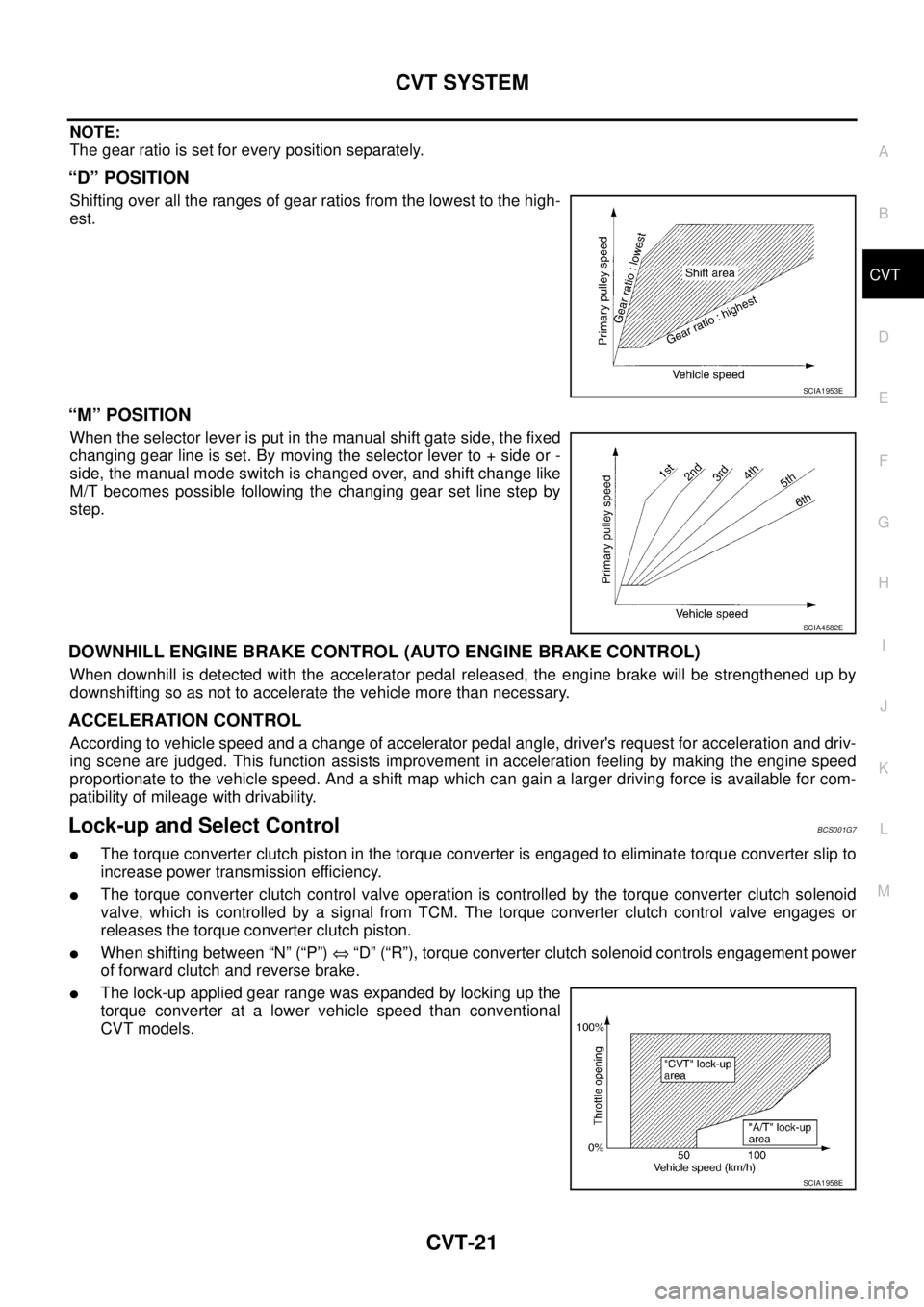
“D” POSITION
Shifting over all the ranges of gear ratios from the lowest to the high-
est.
“M” POSITION
When the selector lever is put in the manual shift gate side, the fixed
changing gear line is set. By moving the selector lever to + side or -
side, the manual mode switch is changed over, and shift change like
M/T becomes possible following the changing gear set line step by
step.
DOWNHILL ENGINE BRAKE CONTROL (AUTO ENGINE BRAKE CONTROL)
When downhill is detected with the accelerator pedal released, the engine brake will be strengthened up by
downshifting so as not to accelerate the vehicle more than necessary.
ACCELERATION CONTROL
According to vehicle speed and a change of accelerator pedal angle, driver's request for acceleration and driv-
ing scene are judged. This function assists improvement in acceleration feeling by making the engine speed
proportionate to the vehicle speed. And a shift map which can gain a larger driving force is available for com-
patibility of mileage with drivability.
Lock-up and Select ControlBCS001G7
�The torque converter clutch piston in the torque converter is engaged to eliminate torque converter slip to
increase power transmission efficiency.
�The torque converter clutch control valve operation is controlled by the torque converter clutch solenoid
valve, which is controlled by a signal from TCM. The torque converter clutch control valve engages or
releases the torque converter clutch piston.
�When shifting between “N” (“P”) ⇔ “D” (“R”), torque converter clutch solenoid controls engagement power
of forward clutch and reverse brake.
�The lock-up applied gear range was expanded by locking up the
torque converter at a lower vehicle speed than conventional
CVT models.
SCIA1953E
SCIA4582E
SCIA1958E
Page 1029 of 3502

CVT SYSTEM
CVT-23
D
E
F
G
H
I
J
K
L
MA
B
CVT
Control ValveBCS001G8
FUNCTION OF CONTROL VALVE
Name Function
Torque converter regulator valve Optimizes the supply pressure for the torque converter depending on driving conditions
Pressure regulator valve Optimizes the discharge pressure from the oil pump depending on driving conditions
TCC control valve
�Activates or deactivate the lock-up
�Lock-up smoothly by opening lock-up operation excessively
TCC solenoid valve Controls the TCC control valve or select control valve
Shift control valveControls flow-in/out of line pressure from the primary pulley depending on the stroke dif-
ference between the stepping motor and the primary pulley
Secondary valve Controls the line pressure from the secondary pulley depending on operating conditions
Clutch regulator valve Adjusts the clutch operating pressure depending on operating conditions
Secondary pressure solenoid valve Controls the secondary valve
Line pressure solenoid valve Controls the line pressure control valve
Step motor Controls the pulley ratio
Manual valveTransmits the clutch operating pressure to each circuit in accordance with the selected
position
Select control valve Engages forward clutch, reverse brake smoothly depending on select operation
Select switch valveSwitches torque converter clutch solenoid valve control pressure use to torque con-
verter clutch control valve or select control valve
Lock-up select solenoid valve Controls the select switch valve
![NISSAN TEANA 2003 Service Manual COOLING FAN
CO-45
[VQ]
C
D
E
F
G
H
I
J
K
L
MA
CO
Disassembly and Assembly BBS004X5
DISASSEMBLY
1. Remove cooling fans (RH and LH) from fan motors.
2. Remove fan motors from fan shroud.
INSPECTION AF](/manual-img/5/57392/w960_57392-996.png "NISSAN TEANA 2003 Service Manual COOLING FAN
CO-45
[VQ]
C
D
E
F
G
H
I
J
K
L
MA
CO
Disassembly and Assembly BBS004X5
DISASSEMBLY
1. Remove cooling fans (RH and LH) from fan motors.
2. Remove fan motors from fan shroud.
INSPECTION AF")
![NISSAN TEANA 2003 Service Manual WATER OUTLET AND WATER PIPING
CO-53
[VQ]
C
D
E
F
G
H
I
J
K
L
MA
CO
7. Remove engine coolant temperature sensor as necessary.
CAUTION:
Be careful not to damage engine coolant temperature sensor.
8. R](/manual-img/5/57392/w960_57392-1004.png "NISSAN TEANA 2003 Service Manual WATER OUTLET AND WATER PIPING
CO-53
[VQ]
C
D
E
F
G
H
I
J
K
L
MA
CO
7. Remove engine coolant temperature sensor as necessary.
CAUTION:
Be careful not to damage engine coolant temperature sensor.
8. R")