2001 CHRYSLER VOYAGER display
[x] Cancel search: displayPage 1297 of 4284
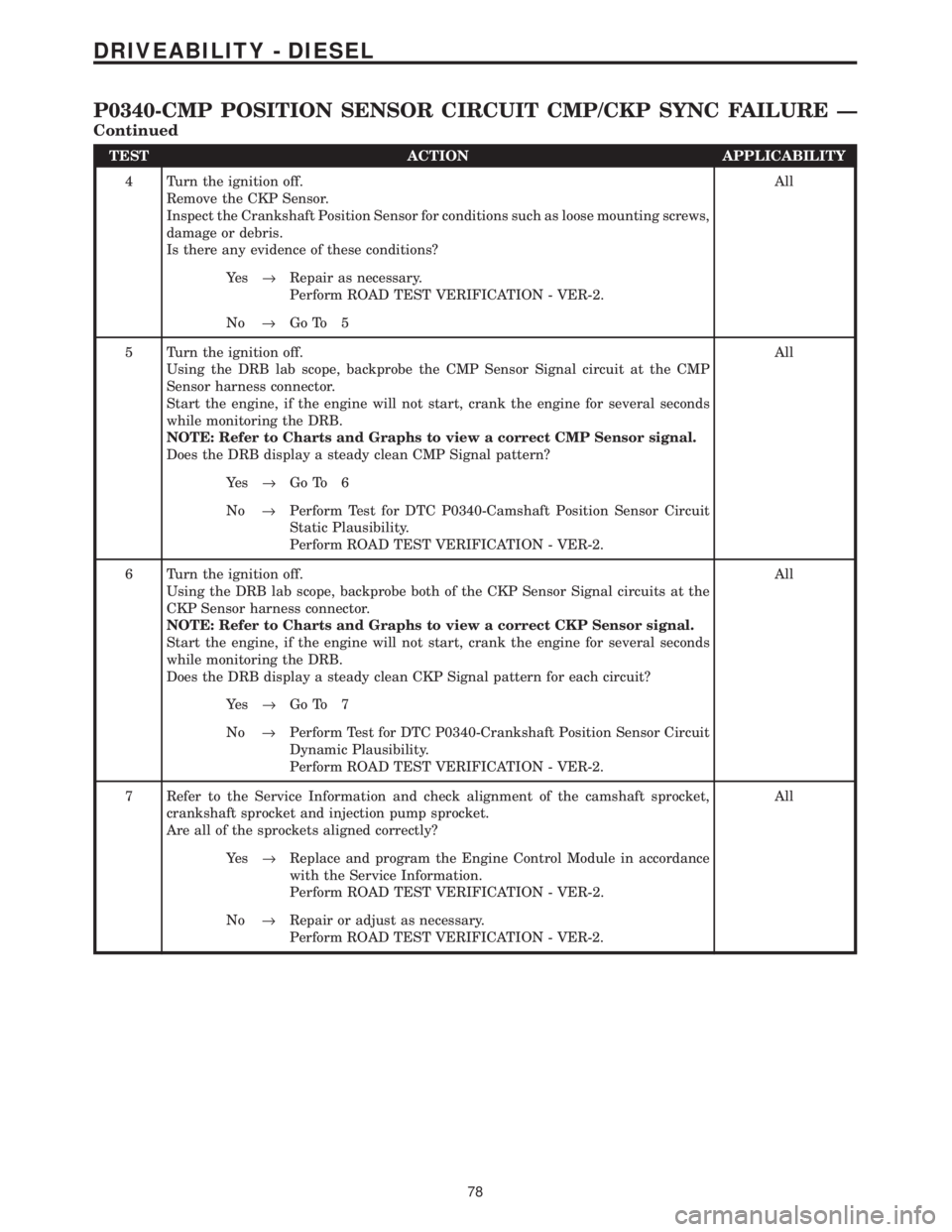
TEST ACTION APPLICABILITY
4 Turn the ignition off.
Remove the CKP Sensor.
Inspect the Crankshaft Position Sensor for conditions such as loose mounting screws,
damage or debris.
Is there any evidence of these conditions?All
Ye s®Repair as necessary.
Perform ROAD TEST VERIFICATION - VER-2.
No®Go To 5
5 Turn the ignition off.
Using the DRB lab scope, backprobe the CMP Sensor Signal circuit at the CMP
Sensor harness connector.
Start the engine, if the engine will not start, crank the engine for several seconds
while monitoring the DRB.
NOTE: Refer to Charts and Graphs to view a correct CMP Sensor signal.
Does the DRB display a steady clean CMP Signal pattern?All
Ye s®Go To 6
No®Perform Test for DTC P0340-Camshaft Position Sensor Circuit
Static Plausibility.
Perform ROAD TEST VERIFICATION - VER-2.
6 Turn the ignition off.
Using the DRB lab scope, backprobe both of the CKP Sensor Signal circuits at the
CKP Sensor harness connector.
NOTE: Refer to Charts and Graphs to view a correct CKP Sensor signal.
Start the engine, if the engine will not start, crank the engine for several seconds
while monitoring the DRB.
Does the DRB display a steady clean CKP Signal pattern for each circuit?All
Ye s®Go To 7
No®Perform Test for DTC P0340-Crankshaft Position Sensor Circuit
Dynamic Plausibility.
Perform ROAD TEST VERIFICATION - VER-2.
7 Refer to the Service Information and check alignment of the camshaft sprocket,
crankshaft sprocket and injection pump sprocket.
Are all of the sprockets aligned correctly?All
Ye s®Replace and program the Engine Control Module in accordance
with the Service Information.
Perform ROAD TEST VERIFICATION - VER-2.
No®Repair or adjust as necessary.
Perform ROAD TEST VERIFICATION - VER-2.
78
DRIVEABILITY - DIESEL
P0340-CMP POSITION SENSOR CIRCUIT CMP/CKP SYNC FAILURE Ð
Continued
Page 1299 of 4284
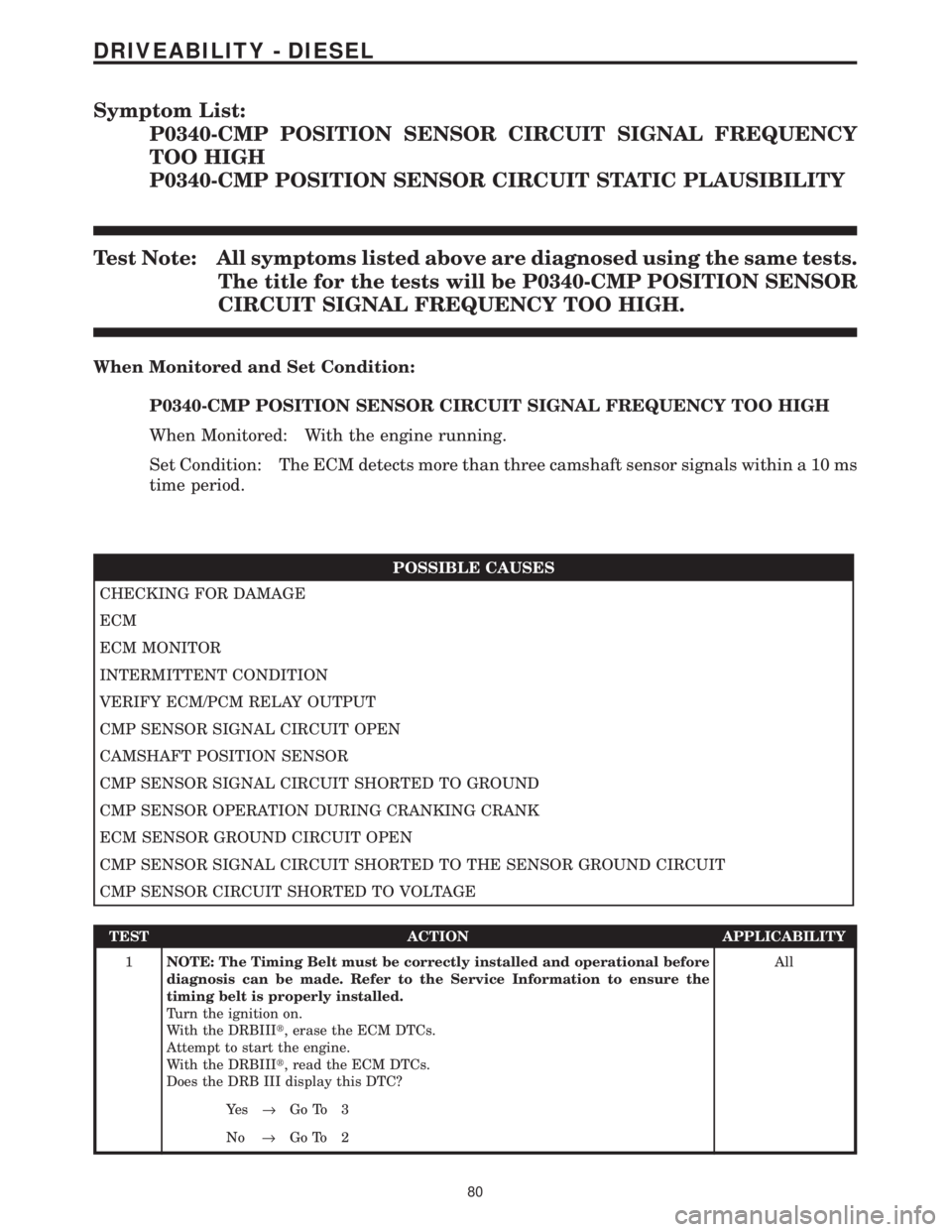
Symptom List:
P0340-CMP POSITION SENSOR CIRCUIT SIGNAL FREQUENCY
TOO HIGH
P0340-CMP POSITION SENSOR CIRCUIT STATIC PLAUSIBILITY
Test Note: All symptoms listed above are diagnosed using the same tests.
The title for the tests will be P0340-CMP POSITION SENSOR
CIRCUIT SIGNAL FREQUENCY TOO HIGH.
When Monitored and Set Condition:
P0340-CMP POSITION SENSOR CIRCUIT SIGNAL FREQUENCY TOO HIGH
When Monitored: With the engine running.
Set Condition: The ECM detects more than three camshaft sensor signals within a 10 ms
time period.
POSSIBLE CAUSES
CHECKING FOR DAMAGE
ECM
ECM MONITOR
INTERMITTENT CONDITION
VERIFY ECM/PCM RELAY OUTPUT
CMP SENSOR SIGNAL CIRCUIT OPEN
CAMSHAFT POSITION SENSOR
CMP SENSOR SIGNAL CIRCUIT SHORTED TO GROUND
CMP SENSOR OPERATION DURING CRANKING CRANK
ECM SENSOR GROUND CIRCUIT OPEN
CMP SENSOR SIGNAL CIRCUIT SHORTED TO THE SENSOR GROUND CIRCUIT
CMP SENSOR CIRCUIT SHORTED TO VOLTAGE
TEST ACTION APPLICABILITY
1NOTE: The Timing Belt must be correctly installed and operational before
diagnosis can be made. Refer to the Service Information to ensure the
timing belt is properly installed.
Turn the ignition on.
With the DRBIIIt, erase the ECM DTCs.
Attempt to start the engine.
With the DRBIIIt, read the ECM DTCs.
Does the DRB III display this DTC?All
Ye s®Go To 3
No®Go To 2
80
DRIVEABILITY - DIESEL
Page 1300 of 4284
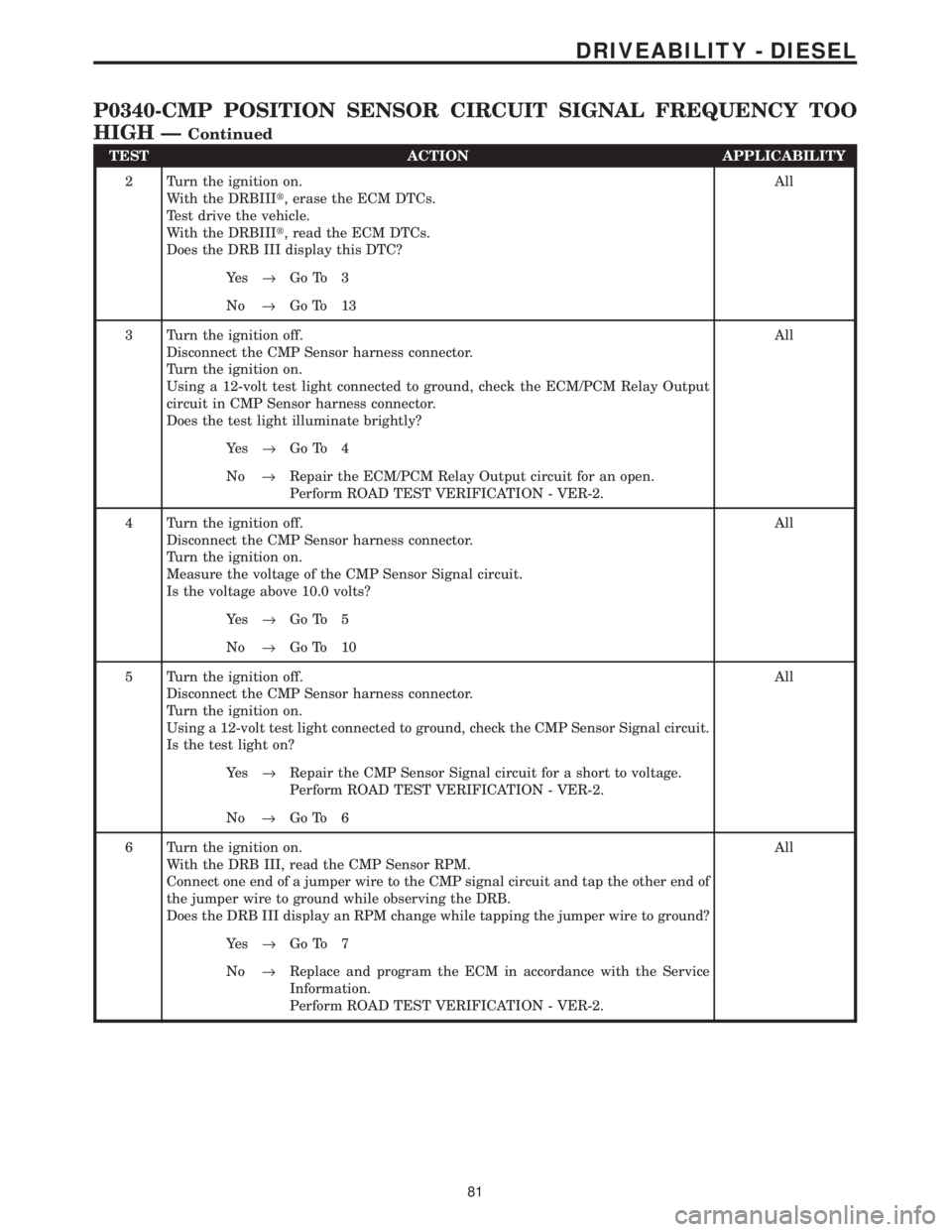
TEST ACTION APPLICABILITY
2 Turn the ignition on.
With the DRBIIIt, erase the ECM DTCs.
Test drive the vehicle.
With the DRBIIIt, read the ECM DTCs.
Does the DRB III display this DTC?All
Ye s®Go To 3
No®Go To 13
3 Turn the ignition off.
Disconnect the CMP Sensor harness connector.
Turn the ignition on.
Using a 12-volt test light connected to ground, check the ECM/PCM Relay Output
circuit in CMP Sensor harness connector.
Does the test light illuminate brightly?All
Ye s®Go To 4
No®Repair the ECM/PCM Relay Output circuit for an open.
Perform ROAD TEST VERIFICATION - VER-2.
4 Turn the ignition off.
Disconnect the CMP Sensor harness connector.
Turn the ignition on.
Measure the voltage of the CMP Sensor Signal circuit.
Is the voltage above 10.0 volts?All
Ye s®Go To 5
No®Go To 10
5 Turn the ignition off.
Disconnect the CMP Sensor harness connector.
Turn the ignition on.
Using a 12-volt test light connected to ground, check the CMP Sensor Signal circuit.
Is the test light on?All
Ye s®Repair the CMP Sensor Signal circuit for a short to voltage.
Perform ROAD TEST VERIFICATION - VER-2.
No®Go To 6
6 Turn the ignition on.
With the DRB III, read the CMP Sensor RPM.
Connect one end of a jumper wire to the CMP signal circuit and tap the other end of
the jumper wire to ground while observing the DRB.
Does the DRB III display an RPM change while tapping the jumper wire to ground?All
Ye s®Go To 7
No®Replace and program the ECM in accordance with the Service
Information.
Perform ROAD TEST VERIFICATION - VER-2.
81
DRIVEABILITY - DIESEL
P0340-CMP POSITION SENSOR CIRCUIT SIGNAL FREQUENCY TOO
HIGH Ð
Continued
Page 1301 of 4284
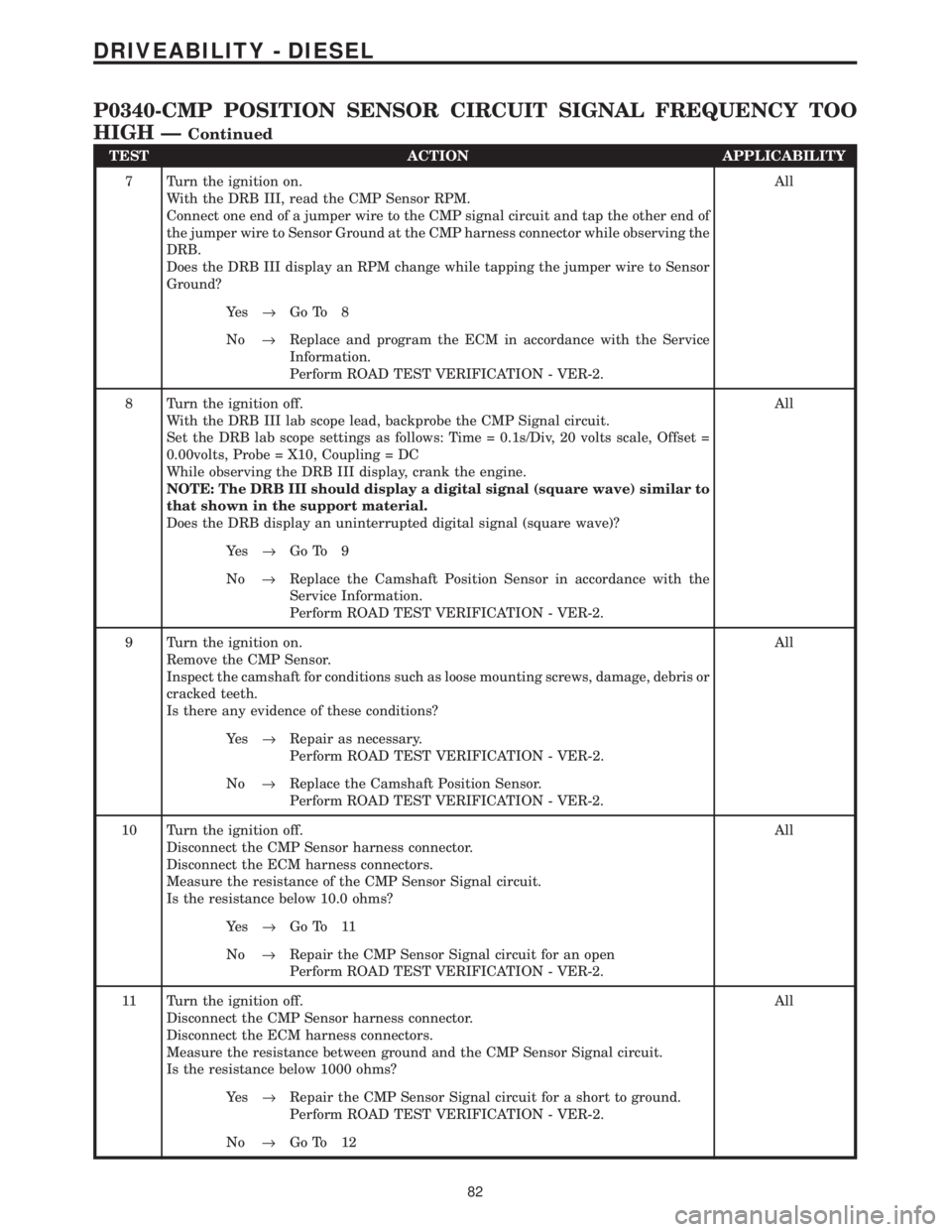
TEST ACTION APPLICABILITY
7 Turn the ignition on.
With the DRB III, read the CMP Sensor RPM.
Connect one end of a jumper wire to the CMP signal circuit and tap the other end of
the jumper wire to Sensor Ground at the CMP harness connector while observing the
DRB.
Does the DRB III display an RPM change while tapping the jumper wire to Sensor
Ground?All
Ye s®Go To 8
No®Replace and program the ECM in accordance with the Service
Information.
Perform ROAD TEST VERIFICATION - VER-2.
8 Turn the ignition off.
With the DRB III lab scope lead, backprobe the CMP Signal circuit.
Set the DRB lab scope settings as follows: Time = 0.1s/Div, 20 volts scale, Offset =
0.00volts, Probe = X10, Coupling = DC
While observing the DRB III display, crank the engine.
NOTE: The DRB III should display a digital signal (square wave) similar to
that shown in the support material.
Does the DRB display an uninterrupted digital signal (square wave)?All
Ye s®Go To 9
No®Replace the Camshaft Position Sensor in accordance with the
Service Information.
Perform ROAD TEST VERIFICATION - VER-2.
9 Turn the ignition on.
Remove the CMP Sensor.
Inspect the camshaft for conditions such as loose mounting screws, damage, debris or
cracked teeth.
Is there any evidence of these conditions?All
Ye s®Repair as necessary.
Perform ROAD TEST VERIFICATION - VER-2.
No®Replace the Camshaft Position Sensor.
Perform ROAD TEST VERIFICATION - VER-2.
10 Turn the ignition off.
Disconnect the CMP Sensor harness connector.
Disconnect the ECM harness connectors.
Measure the resistance of the CMP Sensor Signal circuit.
Is the resistance below 10.0 ohms?All
Ye s®Go To 11
No®Repair the CMP Sensor Signal circuit for an open
Perform ROAD TEST VERIFICATION - VER-2.
11 Turn the ignition off.
Disconnect the CMP Sensor harness connector.
Disconnect the ECM harness connectors.
Measure the resistance between ground and the CMP Sensor Signal circuit.
Is the resistance below 1000 ohms?All
Ye s®Repair the CMP Sensor Signal circuit for a short to ground.
Perform ROAD TEST VERIFICATION - VER-2.
No®Go To 12
82
DRIVEABILITY - DIESEL
P0340-CMP POSITION SENSOR CIRCUIT SIGNAL FREQUENCY TOO
HIGH Ð
Continued
Page 1309 of 4284
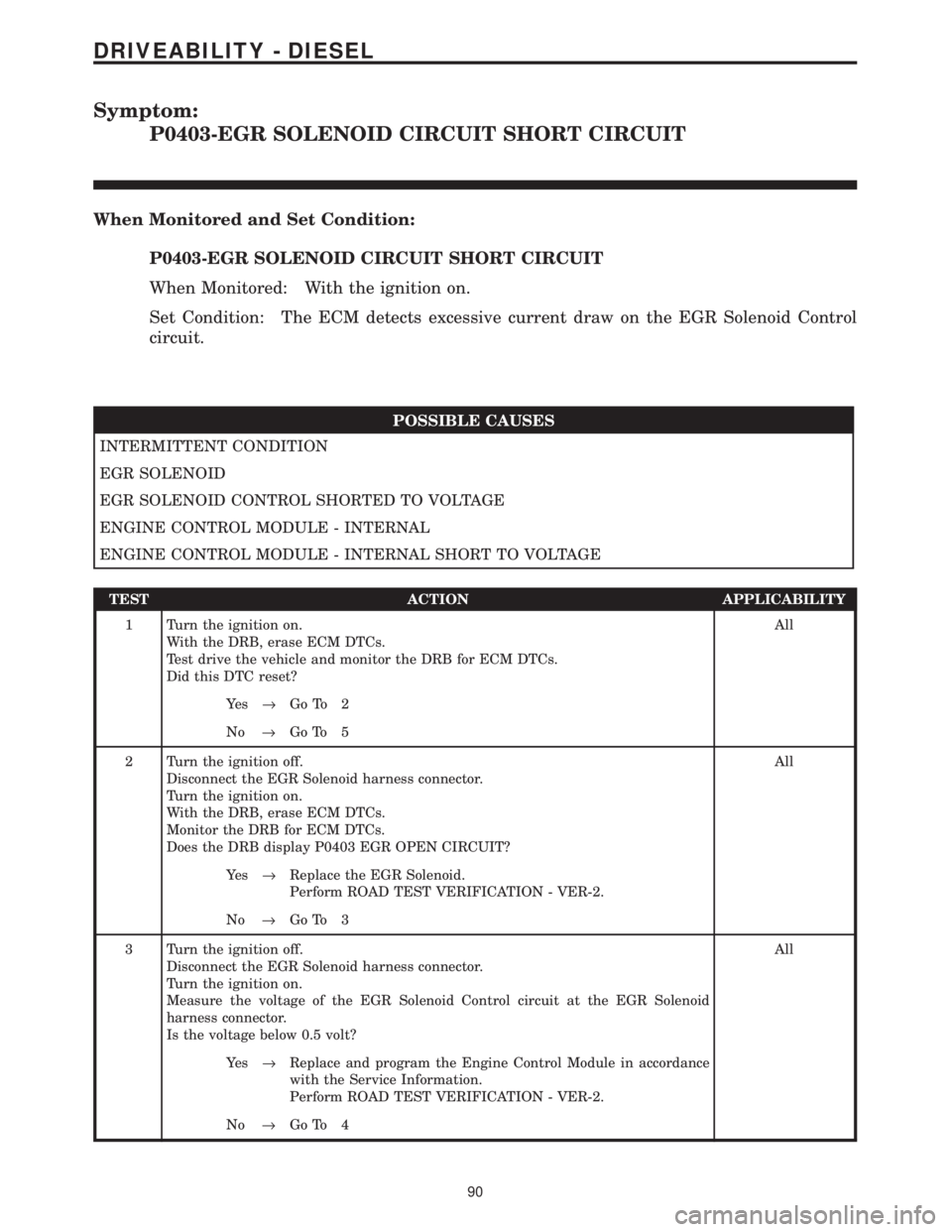
Symptom:
P0403-EGR SOLENOID CIRCUIT SHORT CIRCUIT
When Monitored and Set Condition:
P0403-EGR SOLENOID CIRCUIT SHORT CIRCUIT
When Monitored: With the ignition on.
Set Condition: The ECM detects excessive current draw on the EGR Solenoid Control
circuit.
POSSIBLE CAUSES
INTERMITTENT CONDITION
EGR SOLENOID
EGR SOLENOID CONTROL SHORTED TO VOLTAGE
ENGINE CONTROL MODULE - INTERNAL
ENGINE CONTROL MODULE - INTERNAL SHORT TO VOLTAGE
TEST ACTION APPLICABILITY
1 Turn the ignition on.
With the DRB, erase ECM DTCs.
Test drive the vehicle and monitor the DRB for ECM DTCs.
Did this DTC reset?All
Ye s®Go To 2
No®Go To 5
2 Turn the ignition off.
Disconnect the EGR Solenoid harness connector.
Turn the ignition on.
With the DRB, erase ECM DTCs.
Monitor the DRB for ECM DTCs.
Does the DRB display P0403 EGR OPEN CIRCUIT?All
Ye s®Replace the EGR Solenoid.
Perform ROAD TEST VERIFICATION - VER-2.
No®Go To 3
3 Turn the ignition off.
Disconnect the EGR Solenoid harness connector.
Turn the ignition on.
Measure the voltage of the EGR Solenoid Control circuit at the EGR Solenoid
harness connector.
Is the voltage below 0.5 volt?All
Ye s®Replace and program the Engine Control Module in accordance
with the Service Information.
Perform ROAD TEST VERIFICATION - VER-2.
No®Go To 4
90
DRIVEABILITY - DIESEL
Page 1320 of 4284
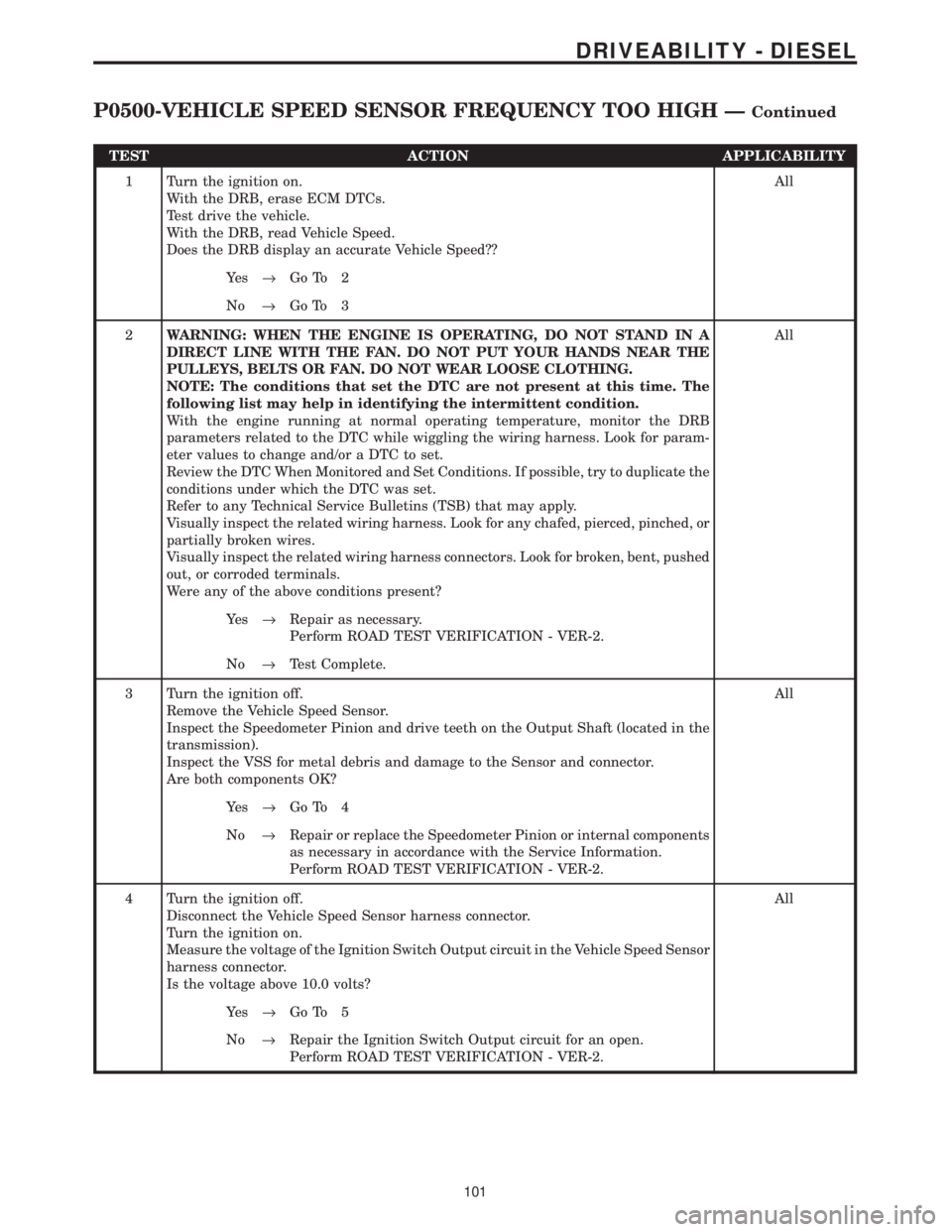
TEST ACTION APPLICABILITY
1 Turn the ignition on.
With the DRB, erase ECM DTCs.
Test drive the vehicle.
With the DRB, read Vehicle Speed.
Does the DRB display an accurate Vehicle Speed??All
Ye s®Go To 2
No®Go To 3
2WARNING: WHEN THE ENGINE IS OPERATING, DO NOT STAND IN A
DIRECT LINE WITH THE FAN. DO NOT PUT YOUR HANDS NEAR THE
PULLEYS, BELTS OR FAN. DO NOT WEAR LOOSE CLOTHING.
NOTE: The conditions that set the DTC are not present at this time. The
following list may help in identifying the intermittent condition.
With the engine running at normal operating temperature, monitor the DRB
parameters related to the DTC while wiggling the wiring harness. Look for param-
eter values to change and/or a DTC to set.
Review the DTC When Monitored and Set Conditions. If possible, try to duplicate the
conditions under which the DTC was set.
Refer to any Technical Service Bulletins (TSB) that may apply.
Visually inspect the related wiring harness. Look for any chafed, pierced, pinched, or
partially broken wires.
Visually inspect the related wiring harness connectors. Look for broken, bent, pushed
out, or corroded terminals.
Were any of the above conditions present?All
Ye s®Repair as necessary.
Perform ROAD TEST VERIFICATION - VER-2.
No®Test Complete.
3 Turn the ignition off.
Remove the Vehicle Speed Sensor.
Inspect the Speedometer Pinion and drive teeth on the Output Shaft (located in the
transmission).
Inspect the VSS for metal debris and damage to the Sensor and connector.
Are both components OK?All
Ye s®Go To 4
No®Repair or replace the Speedometer Pinion or internal components
as necessary in accordance with the Service Information.
Perform ROAD TEST VERIFICATION - VER-2.
4 Turn the ignition off.
Disconnect the Vehicle Speed Sensor harness connector.
Turn the ignition on.
Measure the voltage of the Ignition Switch Output circuit in the Vehicle Speed Sensor
harness connector.
Is the voltage above 10.0 volts?All
Ye s®Go To 5
No®Repair the Ignition Switch Output circuit for an open.
Perform ROAD TEST VERIFICATION - VER-2.
101
DRIVEABILITY - DIESEL
P0500-VEHICLE SPEED SENSOR FREQUENCY TOO HIGH ÐContinued
Page 1322 of 4284
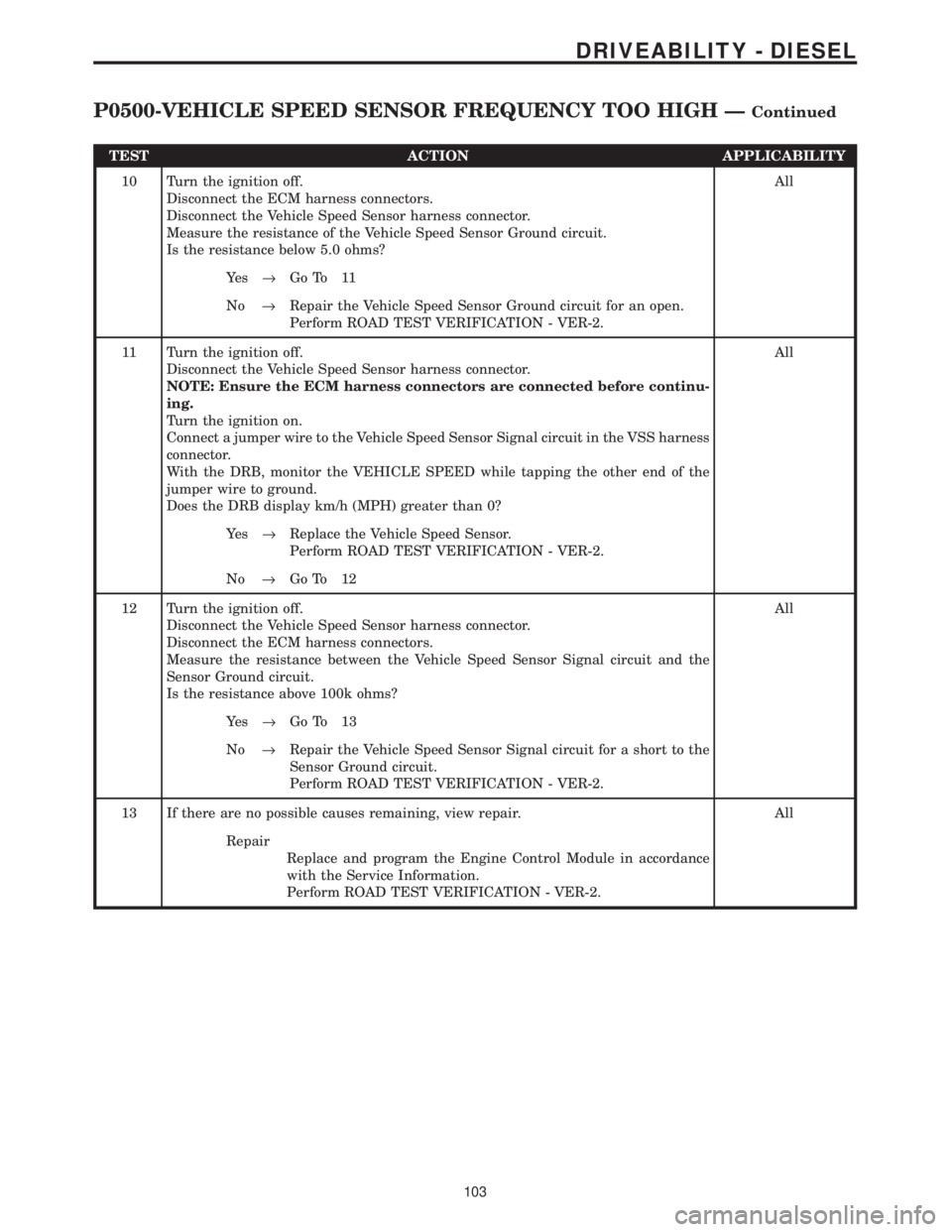
TEST ACTION APPLICABILITY
10 Turn the ignition off.
Disconnect the ECM harness connectors.
Disconnect the Vehicle Speed Sensor harness connector.
Measure the resistance of the Vehicle Speed Sensor Ground circuit.
Is the resistance below 5.0 ohms?All
Ye s®Go To 11
No®Repair the Vehicle Speed Sensor Ground circuit for an open.
Perform ROAD TEST VERIFICATION - VER-2.
11 Turn the ignition off.
Disconnect the Vehicle Speed Sensor harness connector.
NOTE: Ensure the ECM harness connectors are connected before continu-
ing.
Turn the ignition on.
Connect a jumper wire to the Vehicle Speed Sensor Signal circuit in the VSS harness
connector.
With the DRB, monitor the VEHICLE SPEED while tapping the other end of the
jumper wire to ground.
Does the DRB display km/h (MPH) greater than 0?All
Ye s®Replace the Vehicle Speed Sensor.
Perform ROAD TEST VERIFICATION - VER-2.
No®Go To 12
12 Turn the ignition off.
Disconnect the Vehicle Speed Sensor harness connector.
Disconnect the ECM harness connectors.
Measure the resistance between the Vehicle Speed Sensor Signal circuit and the
Sensor Ground circuit.
Is the resistance above 100k ohms?All
Ye s®Go To 13
No®Repair the Vehicle Speed Sensor Signal circuit for a short to the
Sensor Ground circuit.
Perform ROAD TEST VERIFICATION - VER-2.
13 If there are no possible causes remaining, view repair. All
Repair
Replace and program the Engine Control Module in accordance
with the Service Information.
Perform ROAD TEST VERIFICATION - VER-2.
103
DRIVEABILITY - DIESEL
P0500-VEHICLE SPEED SENSOR FREQUENCY TOO HIGH ÐContinued
Page 1369 of 4284
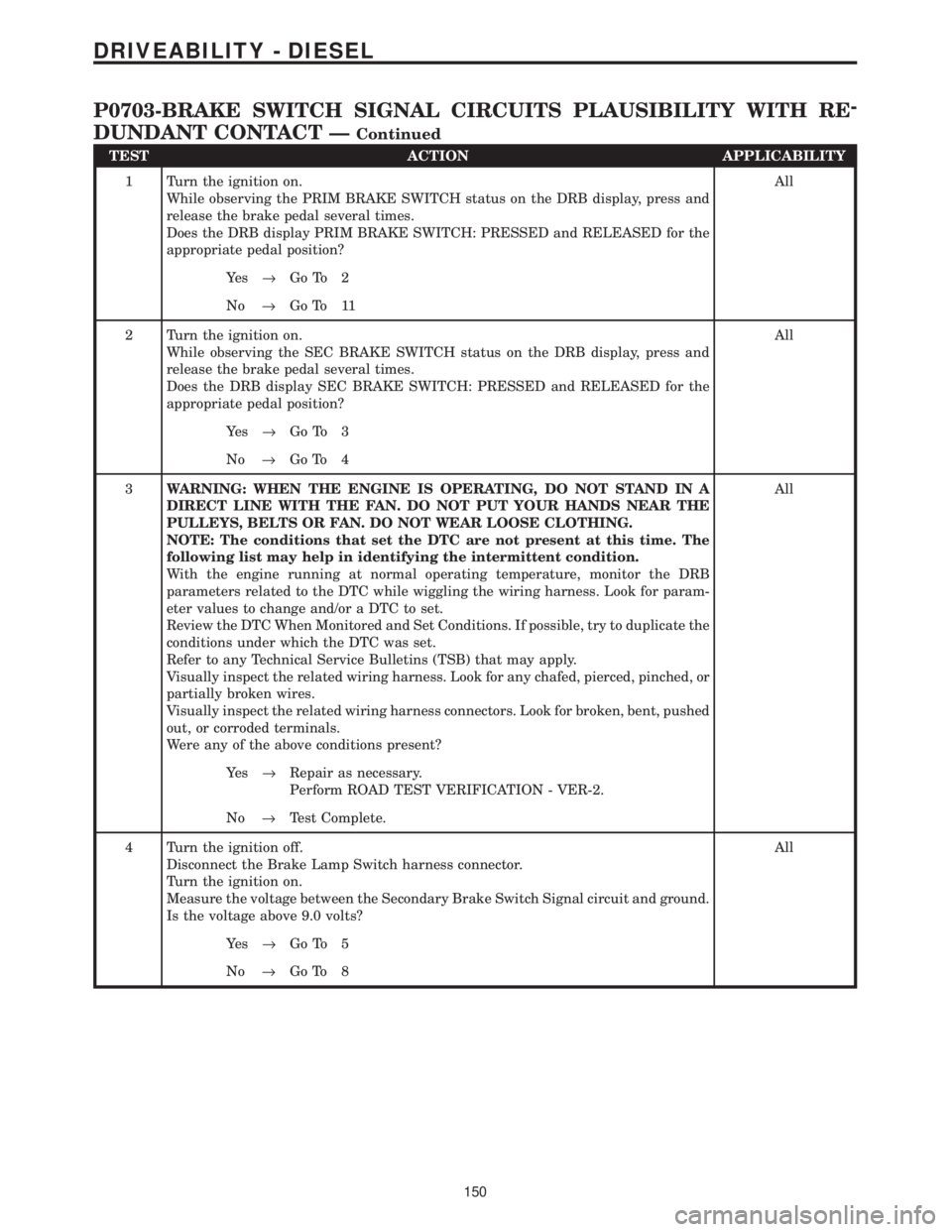
TEST ACTION APPLICABILITY
1 Turn the ignition on.
While observing the PRIM BRAKE SWITCH status on the DRB display, press and
release the brake pedal several times.
Does the DRB display PRIM BRAKE SWITCH: PRESSED and RELEASED for the
appropriate pedal position?All
Ye s®Go To 2
No®Go To 11
2 Turn the ignition on.
While observing the SEC BRAKE SWITCH status on the DRB display, press and
release the brake pedal several times.
Does the DRB display SEC BRAKE SWITCH: PRESSED and RELEASED for the
appropriate pedal position?All
Ye s®Go To 3
No®Go To 4
3WARNING: WHEN THE ENGINE IS OPERATING, DO NOT STAND IN A
DIRECT LINE WITH THE FAN. DO NOT PUT YOUR HANDS NEAR THE
PULLEYS, BELTS OR FAN. DO NOT WEAR LOOSE CLOTHING.
NOTE: The conditions that set the DTC are not present at this time. The
following list may help in identifying the intermittent condition.
With the engine running at normal operating temperature, monitor the DRB
parameters related to the DTC while wiggling the wiring harness. Look for param-
eter values to change and/or a DTC to set.
Review the DTC When Monitored and Set Conditions. If possible, try to duplicate the
conditions under which the DTC was set.
Refer to any Technical Service Bulletins (TSB) that may apply.
Visually inspect the related wiring harness. Look for any chafed, pierced, pinched, or
partially broken wires.
Visually inspect the related wiring harness connectors. Look for broken, bent, pushed
out, or corroded terminals.
Were any of the above conditions present?All
Ye s®Repair as necessary.
Perform ROAD TEST VERIFICATION - VER-2.
No®Test Complete.
4 Turn the ignition off.
Disconnect the Brake Lamp Switch harness connector.
Turn the ignition on.
Measure the voltage between the Secondary Brake Switch Signal circuit and ground.
Is the voltage above 9.0 volts?All
Ye s®Go To 5
No®Go To 8
150
DRIVEABILITY - DIESEL
P0703-BRAKE SWITCH SIGNAL CIRCUITS PLAUSIBILITY WITH RE-
DUNDANT CONTACT Ð
Continued