Page 1369 of 2248
OBD0145A
1CONNECT SUBARU SELECT MONITOR OR
THE OBD-II GENERAL SCAN TOOL, AND
READ DATA.
1) Turn ignition switch to OFF.
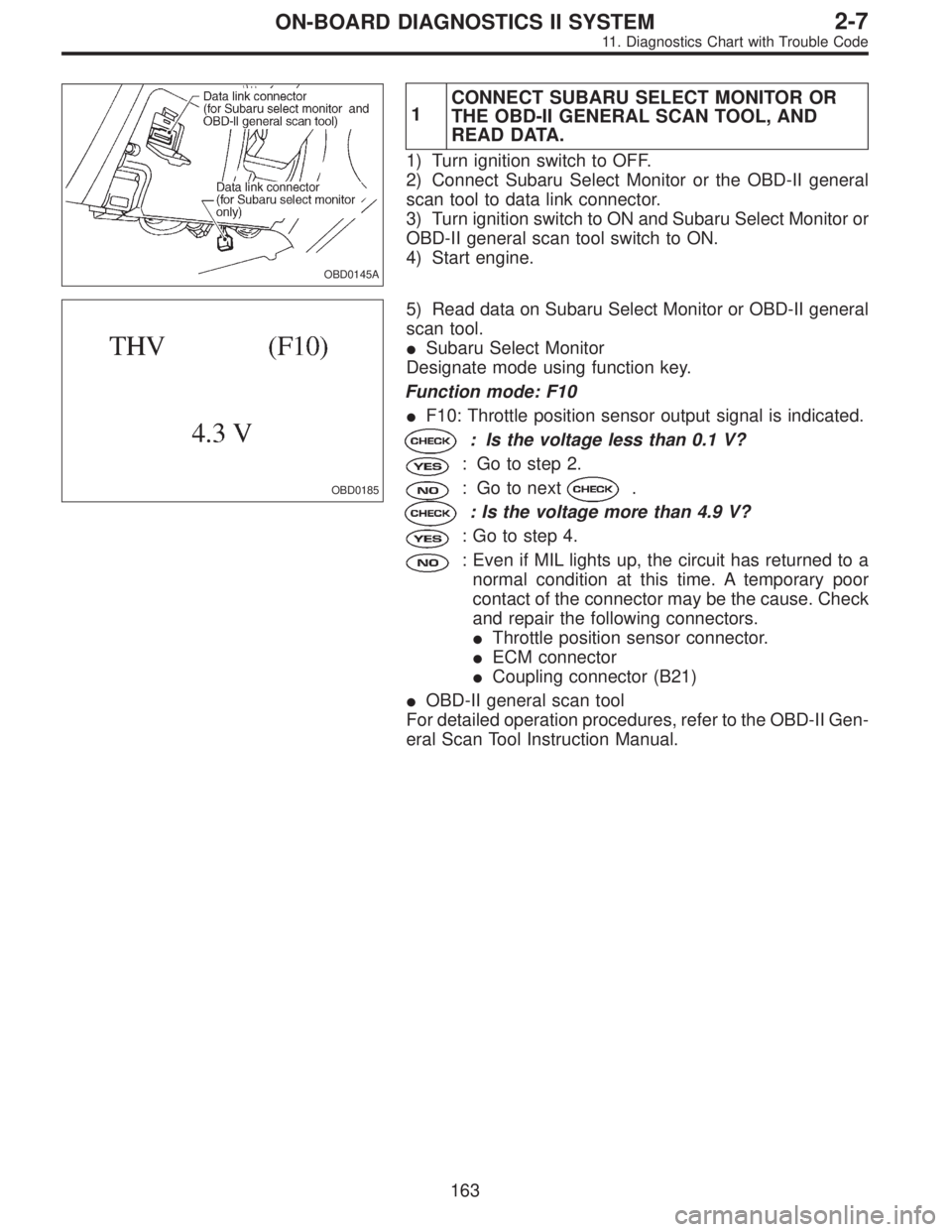
2) Connect Subaru Select Monitor or the OBD-II general
scan tool to data link connector.
3) Turn ignition switch to ON and Subaru Select Monitor or
OBD-II general scan tool switch to ON.
4) Start engine.
OBD0185
5) Read data on Subaru Select Monitor or OBD-II general
scan tool.
�Subaru Select Monitor
Designate mode using function key.
Function mode: F10
�F10: Throttle position sensor output signal is indicated.
: Is the voltage less than 0.1 V?
: Go to step 2.
: Go to next.
: Is the voltage more than 4.9 V?
: Go to step 4.
: Even if MIL lights up, the circuit has returned to a
normal condition at this time. A temporary poor
contact of the connector may be the cause. Check
and repair the following connectors.
�Throttle position sensor connector.
�ECM connector
�Coupling connector (B21)
�OBD-II general scan tool
For detailed operation procedures, refer to the OBD-II Gen-
eral Scan Tool Instruction Manual.
163
2-7ON-BOARD DIAGNOSTICS II SYSTEM
11. Diagnostics Chart with Trouble Code
Page 1375 of 2248
OBD0191
I: DTC P0125
—INSUFFICIENT COOLANT TEMPERATURE
FOR CLOSED LOOP FUEL CONTROL
(TW
—CL)—
DESCRIPTION:
Refer to“F: DTC P0115—ENGINE COOLANT TEM-
PERATURE SENSOR CIRCUIT MALFUNCTION—
[T11F0]”.
DTC DETECTING CONDITION:
�Two consecutive trips with fault
TROUBLE SYMPTOM:
�Engine would not return to idling.
169
2-7ON-BOARD DIAGNOSTICS II SYSTEM
11. Diagnostics Chart with Trouble Code
Page 1376 of 2248
1.Check DTC P0115 on display.
No
�Ye s
�Inspect DTC P0115 using“11. Diagnostics Chart
with Trouble Code [T1100]”.
�In this case, it is unnecessary to inspect DTC
P0125.
Replace engine coolant temperature sensor.
CAUTION:
After repair or replacement of faulty parts, conduct
CLEAR MEMORY and INSPECTION MODES.
[T3D0] and [T3E0].>
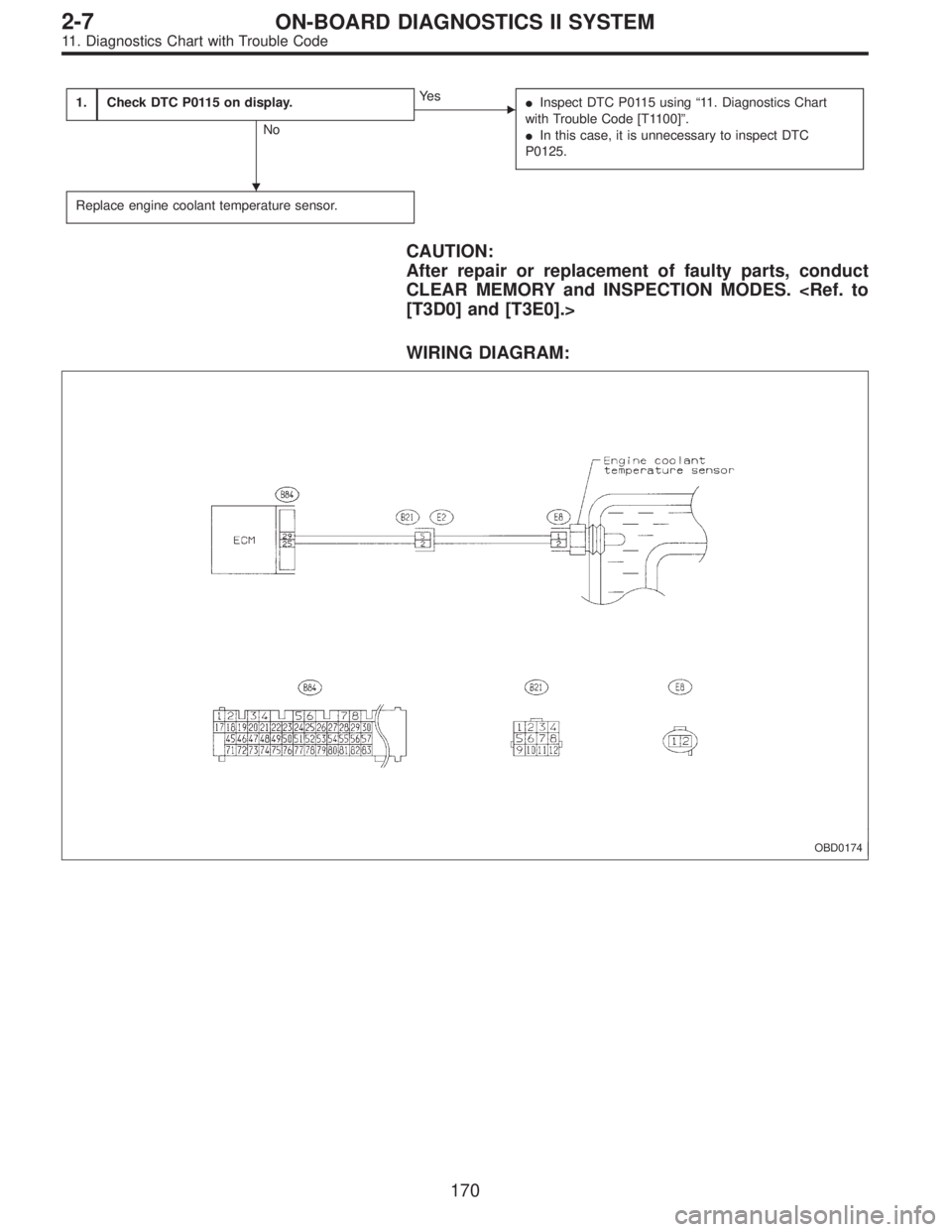
WIRING DIAGRAM:
OBD0174
�
170
2-7ON-BOARD DIAGNOSTICS II SYSTEM
11. Diagnostics Chart with Trouble Code
Page 1377 of 2248
OBD0199
J: DTC P0130
—FRONT OXYGEN SENSOR CIRCUIT
MALFUNCTION (FO2
—V)—
OBD0200A
DESCRIPTION:
�The oxygen sensor is used to sense oxygen concentra-
tion in the exhaust gas. If the fuel ratio is leaner than the
stoichiometric ratio in the mixture (i.e. excessive amount of
air), the exhaust gas contains more oxygen. To the
contrary, if the fuel ratio is richer than the stoichiometric
ratio, the exhaust gas contains hardly any oxygen.
�Therefore, examination of the oxygen concentration in
exhaust gas makes it possible to show whether the air/fuel
ratio is leaner or richer than the stoichiometric ratio.
�The oxygen sensor has a zirconia tube (ceramic) which
generates voltage if there is a difference in oxygen concen-
tration between the inside and outside of the tube. Platinum
is coated on the inside and outside of the zirconia tube for
the purpose of catalysis and electrode provision. The hexa-
gon screw on the outside is grounded to the exhaust pipe,
and the inside is connected to the ECM through the har-
ness.
�A ceramic heater is employed to improve performance at
low temperature.
�When rich air-fuel mixture is burnt in the cylinder, the
oxygen in the exhaust gases reacts almost completely
through the catalytic action of the platinum coating on the
surface of the zirconia tube. This result is a very large dif-
ference in the oxygen concentration between the inside
and outside, and the electromotive force generated is
large.
�When a lean air-fuel mixture is burnt in the cylinder,
oxygen remains in the exhaust gases even after the cata-
lytic action, and this results in a small difference in the
oxygen concentration. The electromotive force is very
small.
171
2-7ON-BOARD DIAGNOSTICS II SYSTEM
11. Diagnostics Chart with Trouble Code
Page 1378 of 2248
�The difference in oxygen concentration changes greatly
in the vicinity of the optimum air-fuel ratio, and hence the
change in the electromotive force is also large. By inputting
this information into the MFI control module, the air-fuel
ratio of the supplied mixture can be determined easily. The
oxygen sensor does not generate much electromotive
force when the temperature is low. The characteristics of
the electromotive force stabilize at temperature of approxi-
mately 300 to 400°C (572 to 752°F).
DTC DETECTING CONDITION:
�Two consecutive trips with fault
172
2-7ON-BOARD DIAGNOSTICS II SYSTEM
11. Diagnostics Chart with Trouble Code
Page 1381 of 2248
OBD0145A
2
CHECK FRONT OXYGEN SENSOR DATA.
1) Turn ignition switch to OFF.
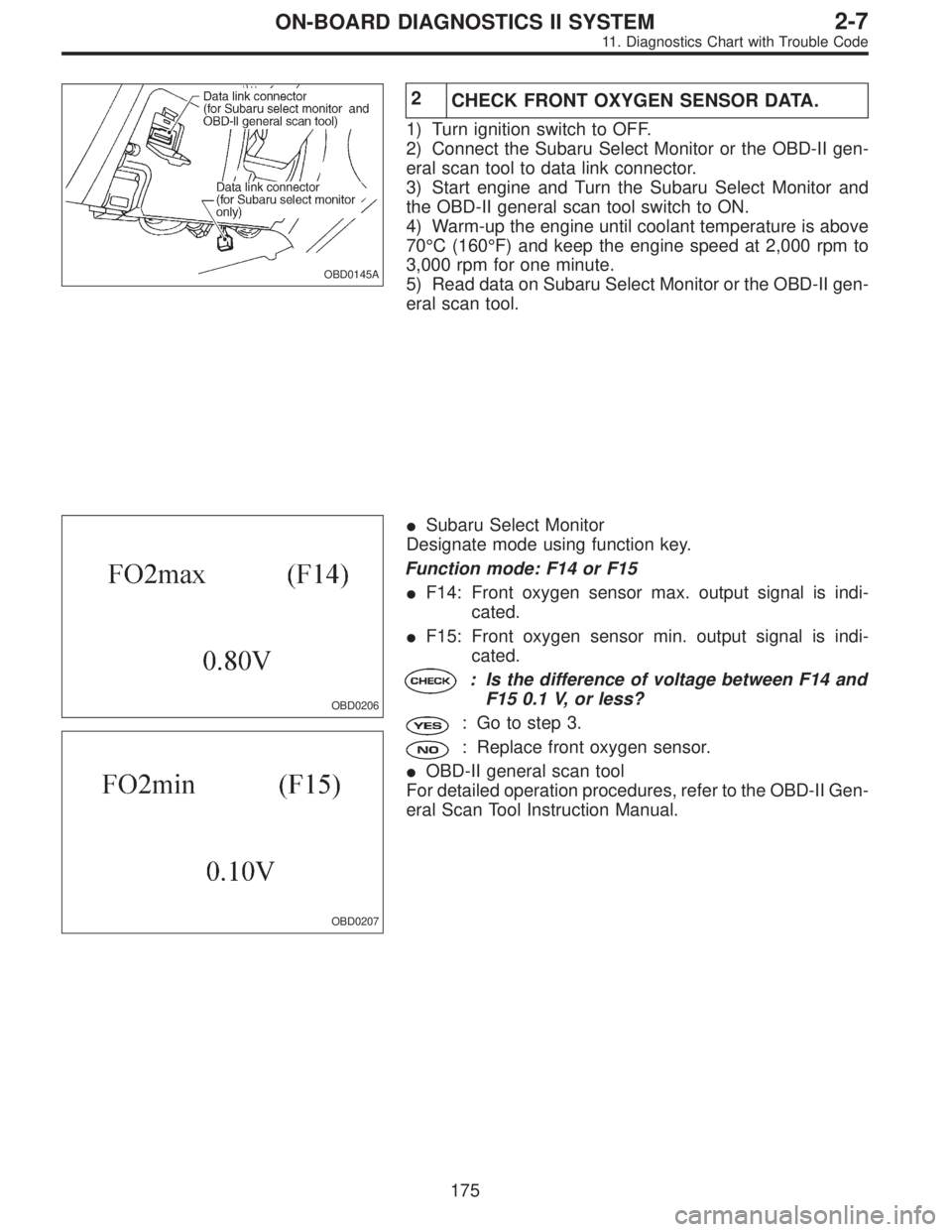
2) Connect the Subaru Select Monitor or the OBD-II gen-
eral scan tool to data link connector.
3) Start engine and Turn the Subaru Select Monitor and
the OBD-II general scan tool switch to ON.
4) Warm-up the engine until coolant temperature is above
70°C (160°F) and keep the engine speed at 2,000 rpm to
3,000 rpm for one minute.
5) Read data on Subaru Select Monitor or the OBD-II gen-
eral scan tool.
OBD0206
OBD0207
�Subaru Select Monitor
Designate mode using function key.
Function mode: F14 or F15
�F14: Front oxygen sensor max. output signal is indi-
cated.
�F15: Front oxygen sensor min. output signal is indi-
cated.
: Is the difference of voltage between F14 and
F15 0.1 V, or less?
: Go to step 3.
: Replace front oxygen sensor.
�OBD-II general scan tool
For detailed operation procedures, refer to the OBD-II Gen-
eral Scan Tool Instruction Manual.
175
2-7ON-BOARD DIAGNOSTICS II SYSTEM
11. Diagnostics Chart with Trouble Code
Page 1394 of 2248
1
CHECK DTC P0130 ON DISPLAY.
: Check that Subaru Select Monitor or the
OBD-II general scan tool shows P0130.
: Go to step 2.
: Go to step 3.
2
CHECK FAILURE CAUSE OF P0130.
Perform the step 1 of DTC P0130.
: Is the failure cause of P0130 in the fuel sys-
tem?
: Check fuel system. In this case, inspection of
P0136 is not necessary.
: Go to step 3.
OBD0145A
3
CHECK REAR OXYGEN SENSOR DATA.
1) Turn ignition switch to OFF.
2) Connect Subaru Select Monitor or OBD-II general scan
tool to data link connector.
3) Start the engine, and turn Subaru Select Monitor or
OBD-II general scan tool switch to ON.
4) Warm-up the engine until engine coolant temperature is
above 70°C (160°F), and keep the engine speed at 2,000
rpm to 3,000 rpm for two minutes.
OBD0225
5) Read data on Subaru Select Monitor or OBD-II general
scan tool.
�Subaru Select Monitor
Designate mode using function key.
Function mode: F16
�F16: Rear oxygen sensor output signal is indicated.
: Is the indicated data fluctuate?
: Go to step 5.
: Go to next.
: Is the indicated data fixed at 0.3±0.1 V?
: Go to step 4.
: Replace rear oxygen sensor.
�OBD-II general scan tool
For detailed operation procedures, refer to the OBD-II Gen-
eral Scan Tool Instruction Manual.
188
2-7ON-BOARD DIAGNOSTICS II SYSTEM
11. Diagnostics Chart with Trouble Code
Page 1404 of 2248
OBD0240
P: DTC P0170
—FUEL TRIM MALFUNCTION (FUEL)—
DTC DETECTING CONDITION:
�Two consecutive trips with fault
TROUBLE SYMPTOM:
�Erroneous idling
�Engine stalls.
�Poor driving performance
1.Check exhaust system.
2.Check air intake system.
3.Check fuel pressure.
4.Check engine coolant temperature sensor.
5.Check mass air flow sensor.
CAUTION:
After repair or replacement of faulty parts, conduct
CLEAR MEMORY and INSPECTION MODE.
[T3D0] and [T3E0].>
�
�
�
�
198
2-7ON-BOARD DIAGNOSTICS II SYSTEM
11. Diagnostics Chart with Trouble Code