1993 DODGE TRUCK engine
[x] Cancel search: enginePage 12 of 1502
•
INTRODUCTION
7
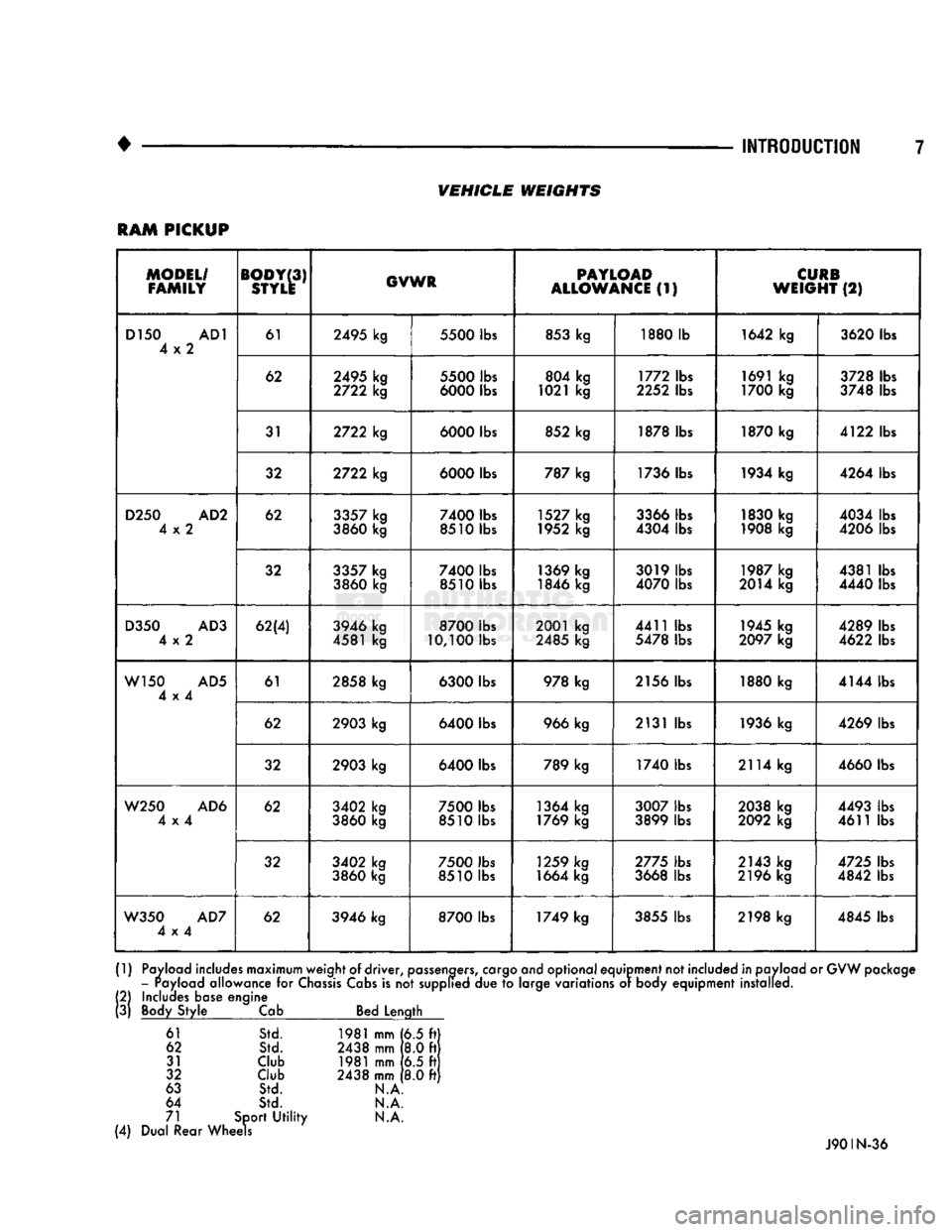
VEHICLE
WEIGHTS
RAM
PICKUP
MODEL/
FAMILY
BODY
(3)
STYLE
GVWR
PAYLOAD
ALLOWANCE
(1)
CURB
WEIGHT
(2)
D150
AD1
4x2
61
2495
kg
5500
lbs
853
kg 1880 lb
1642 kg
3620
lbs
D150
AD1
4x2
62
2495
kg
2722
kg
5500
lbs
6000
lbs 804 kg
1021 kg 1772 lbs
2252
lbs 1691 kg
1700 kg
3728 lbs
3748 lbs
D150
AD1
4x2
31
2722
kg
6000
lbs 852 kg
1878 lbs 1870 kg
4122 lbs
D150
AD1
4x2
32
2722
kg
6000
lbs
787 kg 1736 lbs 1934 kg
4264 lbs
D250
AD2
4x2
62
3357
kg
3860
kg
7400
lbs
8510 lbs 1527 kg
1952 kg
3366 lbs
4304 lbs 1830 kg
1908 kg
4034 lbs
4206 lbs
D250
AD2
4x2
32
3357
kg
3860
kg
7400
lbs
8510 lbs 1369 kg
1846 kg
3019 lbs
4070
lbs 1987 kg
2014 kg 4381 lbs
4440
lbs
D350
AD3
4x2
62(4)
3946 kg
4581 kg
8700
lbs
10,100
lbs 2001 kg
2485
kg 4411 lbs
5478 lbs
1945
kg
2097
kg 4289 lbs
4622
lbs
W150
AD5
4x4
61
2858 kg
6300
lbs
978
kg
2156
lbs
1880 kg
4144 lbs
W150
AD5
4x4
62
2903
kg
6400
lbs
966
kg
2131 lbs
1936 kg 4269 lbs
W150
AD5
4x4
32
2903
kg
6400
lbs 789 kg
1740 lbs 2114 kg
4660
lbs
W250
AD6
4x4
62
3402
kg
3860
kg
7500
lbs
8510 lbs 1364 kg
1769 kg
3007
lbs
3899 lbs 2038 kg
2092
kg
4493
lbs
4611 lbs
W250
AD6
4x4
32
3402
kg
3860
kg
7500
lbs
8510 lbs 1259 kg
1664 kg
2775
lbs
3668 lbs
2143
kg
2196 kg
4725
lbs
4842
lbs
W350
AD7
4x4
62
3946 kg
8700
lbs 1749 kg
3855
lbs 2198 kg
4845
lbs
(1)
Payload
includes
maximum
weight
of
driver,
passengers,
cargo
and
optional
equipment
not
included
in
pavload
or
GVW
package
-
rayload
allowance
for
Chassis
Cabs
is
not supplied due to
large
variations
or
body
equipment
installed.
(2)
Includes
base
engine
(3)
Body
Style
Cab
Bed
Length
61
Std. 1981
mm
(6.5 ft
62 Std. 2438
mm
8.0 ft
31
Club
1981 mm 6.5 ft
32
Club
2438
mm
8.0 ft
63
Std. N.A
64
Std. N.A.
71
Sport
Utility N.A.
(4)
Dual
Rear
Wheels
J90IN-36
Page 13 of 1502
8 INTRODUCTION
•
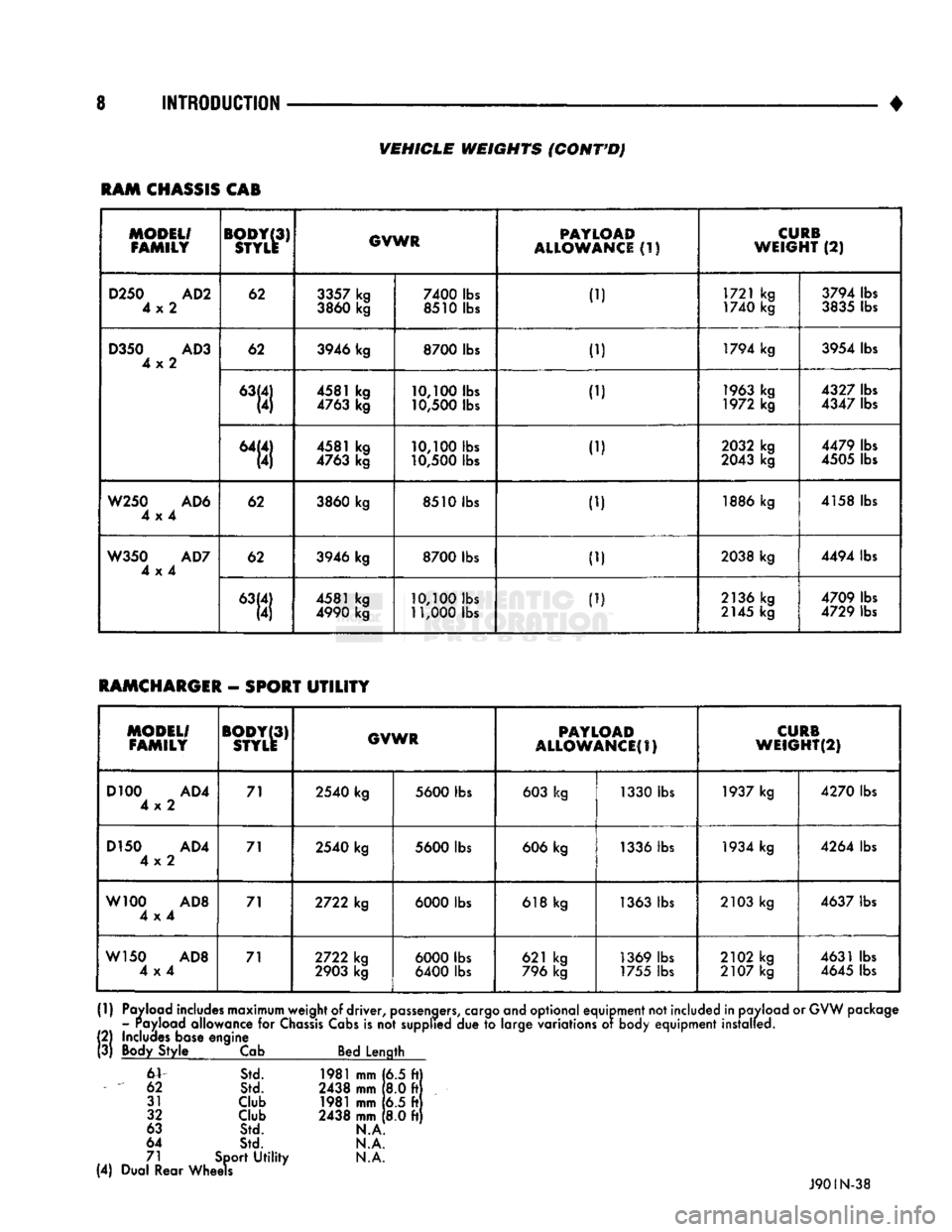
VEHICLE
WEIGHTS
(CONT'D)
RAM
CHASSIS
CAB
MODEL/
FAMILY
BODY(3)
STYLE
GVWR
PAYLOAD
ALLOWANCE
(1)
CURB
WEIGHT
(2)
D250
AD2
4x2
62
3357
kg
3860
kg
7400
lbs
8510 lbs 1721 kg
1740 kg
3794 lbs
3835
lbs
D350
AD3
4x2
62
3946 kg
8700
lbs
ID
1794 kg
3954 lbs
D350
AD3
4x2
4581 kg
4763
kg
10,100
lbs
10,500
lbs
..,
1963
kg
1972 kg
4327
lbs
4347
lbs
D350
AD3
4x2
"111 4581 kg
4763
kg
10,100
lbs
10,500
lbs
1.1
2032
kg
2043
kg 4479 lbs
4505
lbs
W250
AD6
4x4
62
3860
kg
8510 lbs
1.) 1886 kg
4158 lbs
W350
AD7
4x4
62
3946 kg
8700
lbs
ID
2038 kg
4494 lbs
W350
AD7
4x4
4581 kg
4990
kg
10,100
lbs
11,000
lbs
ID
2136 kg
2145
kg 4709 lbs
4729 lbs
RAMCHARGER
-
SPORT
UTILITY
MODEL/
FAMILY
BODY(3)
STYLE
GVWR
PAYLOAD
ALLOWANCES)
CURB
WEIGHT(2)
D100
AD4
4x2 71
2540
kg
5600
lbs
603
kg 1330 lbs
1937
kg
4270
lbs
D150
AD4
4x2 71
2540
kg
5600
lbs
606
kg
1336
lbs
1934
kg
4264
lbs
W100
AD8
4x4 71
2722
kg
6000
lbs
618
kg
1363
lbs
2103
kg
4637
lbs
W150
AD8
4x4 71
2722
kg
2903
kg
6000
lbs
6400
lbs 621 kg
796
kg
1369
lbs
1755
lbs
2102
kg
2107
kg
4631
lbs
4645
lbs
(1)
Payload includes maximum weight
of
driver,
passengers,
cargo and optional equipment not included in payload
or
GVW package - Payload allowance
for
Chassis
Cabs
is
not
supplied
due to
large variations
of
body equipment installed.
!
2)
Includes base engine
3)
Body Style
Cab
Bed Length
6V
Std.
1981
mm
[6.5 ft)
62
Std.
2438
mm
8.0 ft
31
Club
1981
mm
6.5 ft
32
Club
2438
mm
8.0 ft
63
Std.
N.A
64
Std.
N.A.
71 Sport
Utility N.A.
(4) Dual Rear Wheels
J90IN-38
Page 14 of 1502
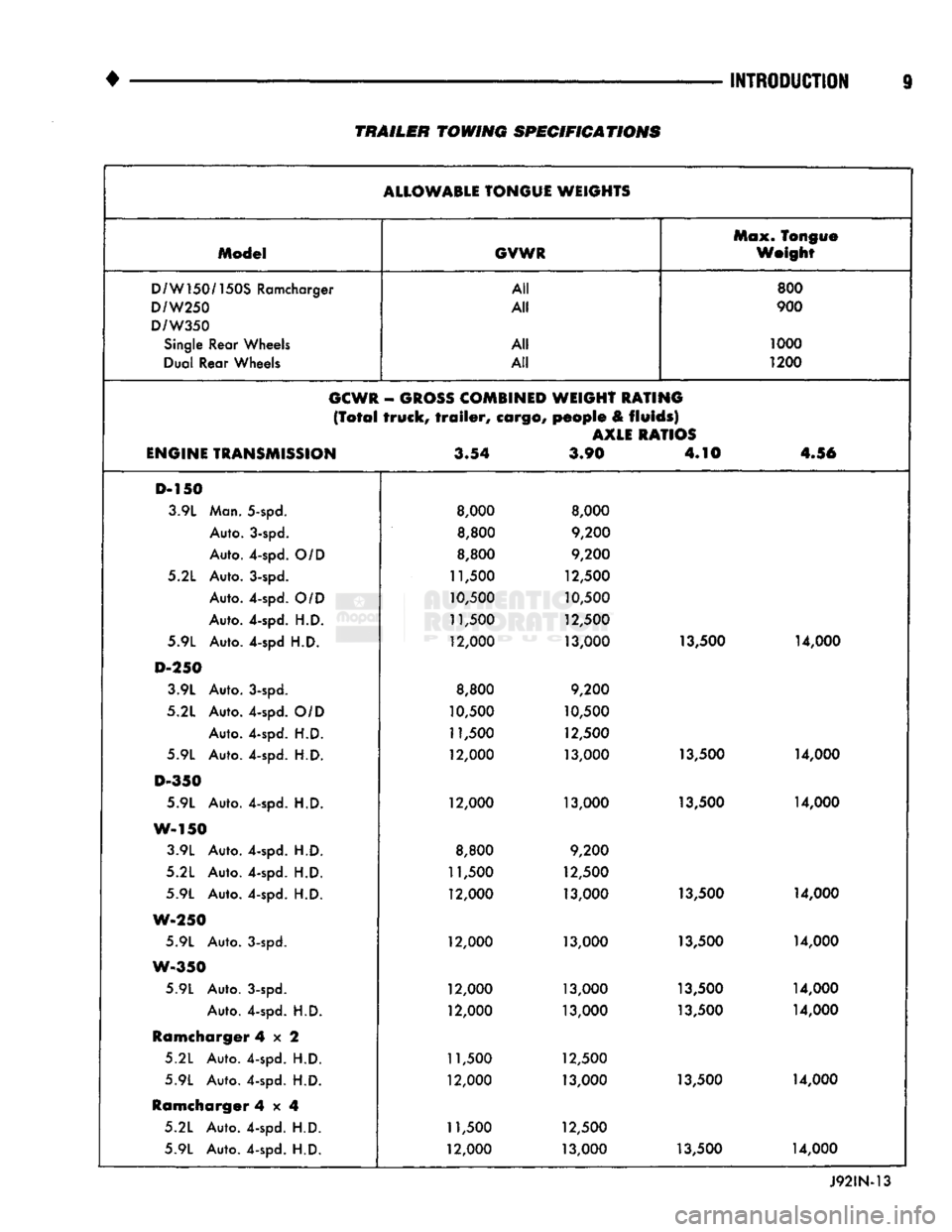
TRAILER TOWING
SPECIFICATIONS
ALLOWABLE
TONGUE WEIGHTS Max. Tongue
Model
GVWR
Weight
D/W150/150S
Ramcharger All
800
D/W250
All
900
D/W350
Single
Rear Wheels All
1000
Dual Rear Wheels All
1200
GCWR
-
GROSS
COMBINED
WEIGHT RATING
(Total
truck,
trailer,
cargo,
people
&
fluids)
AXLE
RATIOS
ENGINE
TRANSMISSION
3.54
3.90 4.10
4.56
D-150 3.9L Man. 5-spd.
8,000 8,000
Auto. 3-spd.
8,800
9,200
Auto. 4-spd.
O/D
8,800
9,200
5.2L Auto. 3-spd.
11,500
12,500
Auto. 4-spd.
O/D
10,500
10,500
Auto. 4-spd.
H.D.
11,500
12,500
5.9L Auto. 4-spd
H.D.
12,000
13,000 13,500
14,000
D-250
3.9L Auto. 3-spd.
8,800
9,200
5.2L Auto. 4-spd.
O/D
10,500 10,500
Auto. 4-spd.
H.D.
11,500
12,500
5.9L Auto. 4-spd.
H.D.
12,000
13,000 13,500
14,000
D-350
5.9L Auto. 4-spd.
H.D.
12,000
13,000 13,500 14,000
W-150 3.9L Auto. 4-spd.
H.D.
8,800
9,200
5.2L Auto. 4-spd.
H.D.
11,500
12,500
5.9L Auto. 4-spd.
H.D.
12,000
13,000 13,500
14,000
W-250
5.9L Auto. 3-spd.
12,000
13,000 13,500 14,000
W-350
5.9L Auto. 3-spd.
12,000 13,000 13,500 14,000
Auto. 4-spd.
H.D.
12,000
13,000 13,500 14,000
Ramcharger
4x2
5.2L Auto. 4-spd.
H.D.
11,500 12,500
5.9L Auto. 4-spd.
H.D.
12,000 13,000 13,500 14,000
Ramcharger
4x4
5.2L Auto. 4-spd.
H.D.
11,500 12,500
5.9L Auto. 4-spd.
H.D.
12,000
13,000 13,500 14,000
Page 15 of 1502
10 INTRODUCTION
•
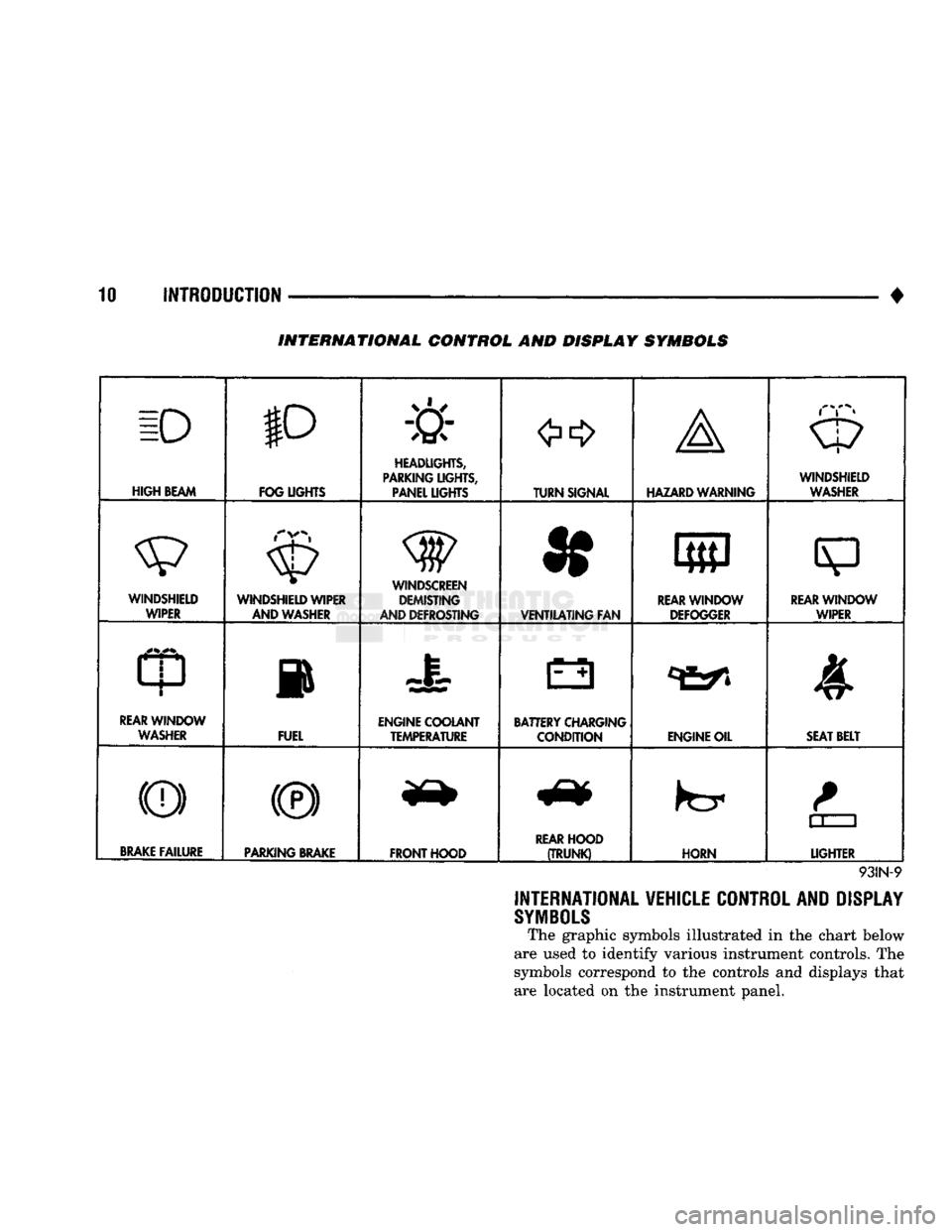
INTERNATIONAL CONTROL AND DISPLAY SYMBOLS
ID
HIGH
BEAM P
FOG UGHTS -&
HEADLIGHTS,
PARKING UGHTS, PANEL UGHTS TURN SIGNAL A
HAZARD WARNING WINDSHIELD
WASHER
WINDSHIELD WIPER WINDSHIELD WIPER
AND WASHER
AND DEFROSTING *
VENTILATING
FAN 8
M f
REAR
WINDOW DEFOGGER
sp
REARWINLX)W WIPER
CD
l
m
REAR
WINDOW WASHER FUEL ENGINE COOLANT
TEMPERATURE BATTERY CHARGING
CONDITION ENGINE OIL
SEAT
BELT
(©) (®) ky
11 J
LIGHTER
BRAKE
FAILURE
PARKING
BRAKE
FRONT HOOD
REAR
HOOD
(TRUNK)
HORN
11 J
LIGHTER
93IN-9
INTERNATIONAL VEHICLE CONTROL AND DISPLAY
SYMBOLS
The graphic symbols illustrated in the chart below
are used to identify various instrument controls. The
symbols correspond to the controls and displays that are located on the instrument panel.
Page 20 of 1502
•
• —
LUiRICATlON
AND
MAINTENANCE
0 - 1
CONTENTS
page
page
CHASSIS
AND
BODY
28
ENGINE MAINTENANCE
14
DRIVETRAIN
.,,, 22
GENERAL INFORMATION
1
GENERAL
INFORMATION INDEl
page
Classification
of
Lubricants
. 3
Components
Requiring
No
Lubrication
4
Fuel Requirements
. 2
Introduction
1
Lubrication
and
Replacement Parts Recommendation
3
page
Routine Maintenance
2
Starting
Assistance (Jump Starting)
9
Vehicle
Lifting
Recommendations
............ 10
Vehicle Noise
Control
2
Vehicle Towing Recommendations
11
INTRODUCTION
Lubrication and maintenance is divided into re
quired and recommended service tasks. The required service tasks must be completed to verify the emis
sion controls function correctly. The recommended
service tasks should be completed to maintain safety
and durability. This information will assist the service personnel
in providing maximum protection for each owner's
vehicle. Conditions can vary with individual driving habits.
It is necessary to schedule maintenance as a time in
terval as well as a distance interval. It is the owner's responsibility to determine the ap
plicable driving condition. Also to have the vehicle serviced according to the maintenance schedule, and
to pay for the necessary parts and labor. Vehicles with a Gross Vehicle Weight Rating
(GVWR) of 3 855 kg (8,500 lbs.) or less must conform
to light duty emission standards. Vehicles with a Gross Vehicle Weight Rating (GVWR) of 3 856 kg
(8,501 lbs.) or more must conform to heavy duty
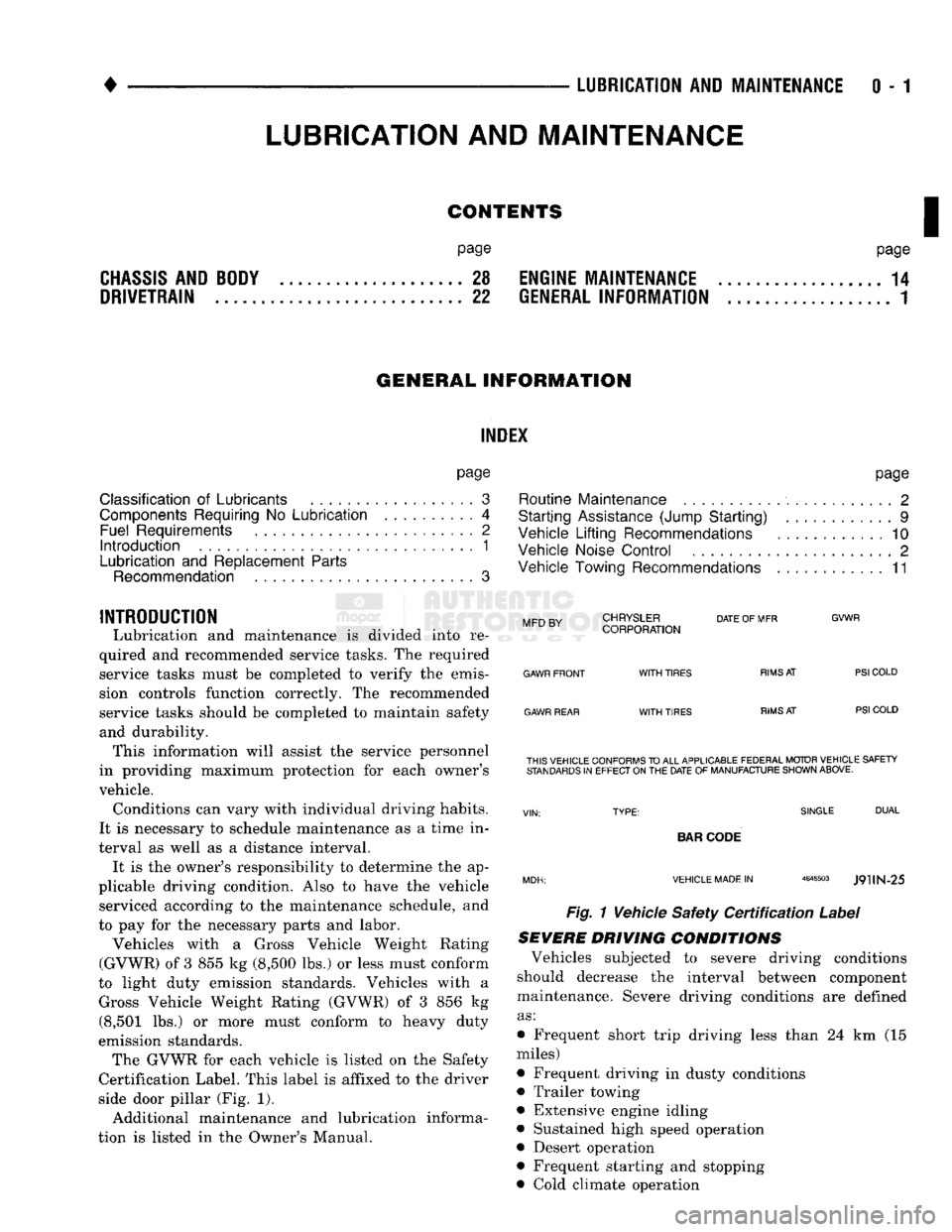
emission standards. The GVWR for each vehicle is listed on the Safety
Certification Label. This label is affixed to the driver
side door pillar (Fig. 1).
Additional maintenance and lubrication informa
tion is listed in the Owner's Manual.
Mm
rv
CHRYSLER
DATE
OF MFR
MFD BY CORPORATION
GVWR
GAWR FRONT
GAWR REAR
WITH
TIRES
WITH
TIRES
RIMS
AT
RIMS
AT
PSI
COLD
PSI
COLD THIS VEHICLE CONFORMS
TO
ALL APPLICABLE FEDERAL MOTOR VEHICLE SAFETY
STANDARDS
IN
EFFECT ON
THE
DATE
OF
MANUFACTURE SHOWN ABOVE.
SINGLE
DUAL
BAR
CODE
VEHICLE MADE
IN
4648503
J9UN-25
Fig. 1 Vehicle Safety
Certification
Label
SEVERE DRIVING
CONDITIONS
Vehicles subjected to severe driving conditions
should decrease the interval between component
maintenance. Severe driving conditions are defined
as:
• Frequent short trip driving less than 24 km (15
miles)
• Frequent driving in dusty conditions
• Trailer towing
• Extensive engine idling
• Sustained high speed operation
• Desert operation
• Frequent starting and stopping
• Cold climate operation
LUBRICATION
AND
MAINTENANCE
Page 21 of 1502
0 - 2
LUBRICATION
AND
MAINTENANCE
• Commercial service
When a vehicle is continuously subjected to severe
driving conditions, lubricate:
• Body components
• All the driveline coupling joints
• Steering linkage More often than normal driving conditions
DUSTY
AREAS
With this type of severe driving condition, special
care should be given to the:
• Engine air cleaner filter
• PCV filter
• Crankcase ventilation system
• Brake booster control valve air filter. Verify that the filters and the associated compo
nents are clean. Also verify that they are functioning
effectively. This will minimize the amount of abra sive particles that enter the engine.
OFF-ROAD
(4WD)
OPERATION
After off-road (4WD) operation, inspect the under
side of the vehicle. Inspect the:
• Tires
• Body structure
• Steering components
• Suspension components • Exhaust system
• Threaded fasteners
HARSH
SURFACE ENVIRONMENTS
After extended operation in harsh environments,
the brake drums, brake linings, and rear wheel bear ings should be inspected and cleaned. This will pre
vent wear and erratic brake action.
ROUTINE MAINTENANCE
The following routine maintenance is recommended
on a monthly basis: TIRES—Inspect the tires for unusual wear/damage.
Determine if the inflation pressure is adequate for
the vehicle load. BATTERY—Inspect and clean the terminals.
Tighten the terminals if necessary. FLUIDS—Determine if the component fluid levels
are acceptable. Add fluid, if necessary. LIGHTS/ELECTRICAL—Test all the electrical sys
tems in the vehicle for proper operation. It is also recommended that the engine oil and the
washer fluid level be determined at each fuel fill-up.
VEHICLE
NOISE CONTROL
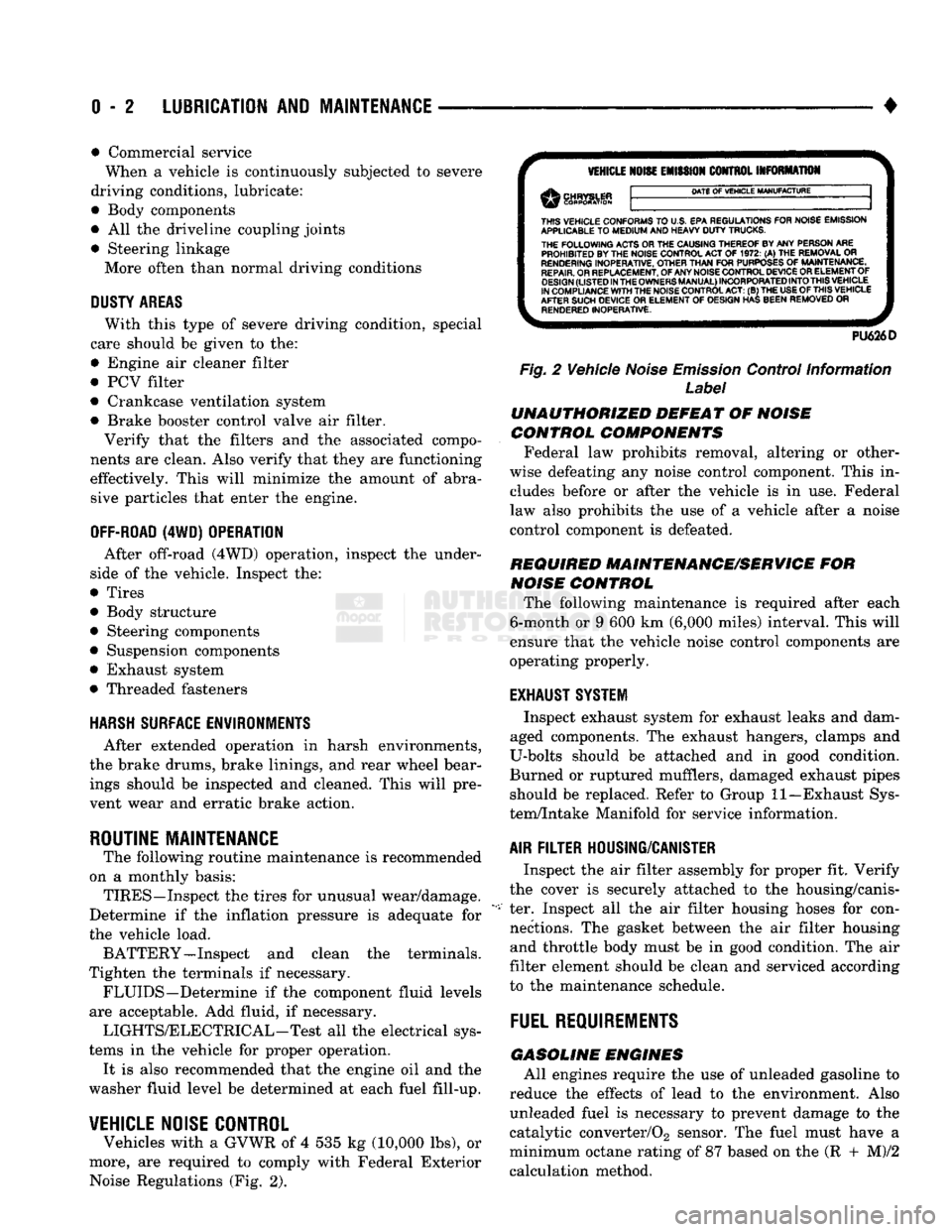
Vehicles with a GVWR of 4 535 kg (10,000 lbs), or
more, are required to comply with Federal Exterior Noise Regulations (Fig. 2).
VEHICLE
NOISE
EMISSION
CONTROL INFORMATION
DATE
OF
VEHICLE
MANUFACTURE
THIS
VEHICLE CONFORMS
TO
U.S. EPA REGULATIONS FOR NOISE EMISSION
APPLICABLE
TO
MEDIUM
AND HEAVY
DUTY
TRUCKS. THE
FOLLOWING
ACTS OR THE CAUSING THEREOF BY ANY PERSON ARE PROHIBITED BY THE NOISE CONTROL ACT
OF 1972. (A) THE
REMOVAL
OR
RENDERING
INOPERATIVE, OTHER
THAN
FOR
PURPOSES
OF
MAINTENANCE,
REPAIR.
OR REPLACEMENT, OF ANY NOISE CONTROL DEVICE OR ELEMENT OF
DESIGN
(LISTED
IN
THE
OWNERS
MANUAL)
INCORPORATED
INTO
THIS
VEHICLE
IN COMPLIANCE
WITH
THE NOISE CONTROL
ACT:
(B) THE
USE
OF
THIS
VEHICLE
AFTER SUCH DEVICE
OR
ELEMENT
OF
DESIGN HAS BEEN REMOVED
OR
RENDERED
INOPERATIVE.
PU626D
Fig.
2 Vehicle
Noise
Emission
Control Information
Label
UNAUTHORIZED
DEFEAT
OF
NOISE
CONTROL COMPONENTS
Federal law prohibits removal, altering or other
wise defeating any noise control component. This in
cludes before or after the vehicle is in use. Federal
law also prohibits the use of a vehicle after a noise
control component is defeated.
REQUIRED MAINTENANCE/SERVICE
FOR
NOISE
CONTROL
The following maintenance is required after each
6-month or 9 600 km (6,000 miles) interval. This will
ensure that the vehicle noise control components are
operating properly.
EXHAUST SYSTEM
Inspect exhaust system for exhaust leaks and dam
aged components. The exhaust hangers, clamps and
U-bolts should be attached and in good condition.
Burned or ruptured mufflers, damaged exhaust pipes should be replaced. Refer to Group 11—Exhaust Sys
tem/Intake Manifold for service information.
AIR
FILTER
HOUSING/CANISTER
Inspect the air filter assembly for proper fit. Verify
the cover is securely attached to the housing/canis
ter. Inspect all the air filter housing hoses for con nections. The gasket between the air filter housing and throttle body must be in good condition. The air
filter element should be clean and serviced according
to the maintenance schedule.
FUEL
REQUIREMENTS
GASOLINE
ENGINES
All engines require the use of unleaded gasoline to
reduce the effects of lead to the environment. Also unleaded fuel is necessary to prevent damage to the
catalytic converter/02 sensor. The fuel must have a
minimum octane rating of 87 based on the (R + M)/2
calculation method.
Page 22 of 1502

•
LUBRICATION AND MAINTENANCE
0 - 3
CAUTION: UNLEADED FUEL ONLY must
be
used
in
vehicles equipped
with
a
catalyst emission
control
system.
All
vehicles have reminders
printed
on the
instrument
panel below
the
fuel
gauge
and on the
fuel
filler
door.
The
vehicles also have
fuel
filler
tubes
that
are
specially designed
to
accept only
the
small-diameter nozzles.
It is
illegal
to
bypass
the
design
of an
unleaded
fuel
filler
tube.
DIESEL ENGINES All
Ram
Truck
and Ram
Cab/Chassis Diesel
en
gines normally
can use
number
2D
Diesel fuel
for
most year-round operations.
A
fuel conforming
to
ASTM Specification D-975
is
recommended.
For ex
treme cold-weather, number
ID
Diesel fuel
is
recom mended.
CLASSIFICATION
OF
LUBRICANTS
Lubricating fluids
and
chassis lubricants
are
clas
sified according
to
standards recommended
by the:
• Society
of
Automotive Engineers
(SAE)
• American Petroleum Institute
(API)
• National Lubricating Grease Institute (NLGI)
ENGINE
OIL
SAE
VISCOSITY
GRADE
An
SAE
viscosity grade
is
used
to
specify
the
vis
cosity
of
engine
oil. SAE 30
specifies
a
single viscos
ity engine
oil.
Engine oils also have multiple viscosities. These
are specified with
a
dual
SAE
viscosity grade which
indicates
the
cold-to-hot temperature viscosity range (Fig.
3).
API
SERVICE
GRADE
The
API
Service Grade specifies
the
type
of
perfor
mance
the
engine
oil is
intended
to
provide.
The API
Service Grade specifications also apply
to
energy con
serving engine oils
(Fig. 3).
For maximum gasoline engine protection,
use API
Service Grade
SG,
SG/CD
or
SG/CE engine
oil.
For maximum Diesel engine protection,
use
API Service
CE or
SG/CE engine
oil.
GEAR LUBRICANTS A dual grade
is
also used
to
specify
the
viscosity
of
multi-purpose gear lubricants.
The
API
grade designation identifies gear lubri
cants
in
terms
of
recommended usage.
OIL
QUALITY
SAE
VISCOSITY
GRADE
FUEL
ECONOMY
NOTATION
J91004
Fig.
3 SAE Oil
Viscosity Grade
& API
Service
Grade
CHASSIS COMPONENT
AND
WHEEL BEARING
LUBRICANTS The chassis
and
wheel bearing lubricants
are
iden
tified
by the
NLGI Certification Symbol.
The
symbol
contains
a
coded designation. This identifies
the us
age
and
quality
of the
lubricant.
The letter
G
within
the
symbol designates wheel
bearing lubricant.
The
letter
L
designates chassis
lu
bricant. When
the
letters
are
combined,
the
lubricant can
be
used
for
dual applications.
Use
only lubricants
that display
the
NLGI Certification Symbol.
NATIONAL LUBRICATING
GREASE
INSTITUTE
NLGI
AUTOMOTIVE
WHEEL BEARING
&
CHASSIS LUBRICANT
GC-LB
-CERTIFICATION
SYMBOL
—
USAGE
AND
QUALITY
DESIGNATION
J920W7
Fig.
4
NLGI
Lubricant Container
Certification/
Identification
Symbol
LUBRICATION
AND
REPLACEMENT
PARTS
RECOMMENDATION
Ram Trucks
are
engineered
to
provide many years
of dependable operation. However, lubrication service
and maintenance
are
required
for
each vehicle. When
necessary, MOPAR®brand lubricants
and
genuine
re
placement parts
are
recommended.
Page 24 of 1502
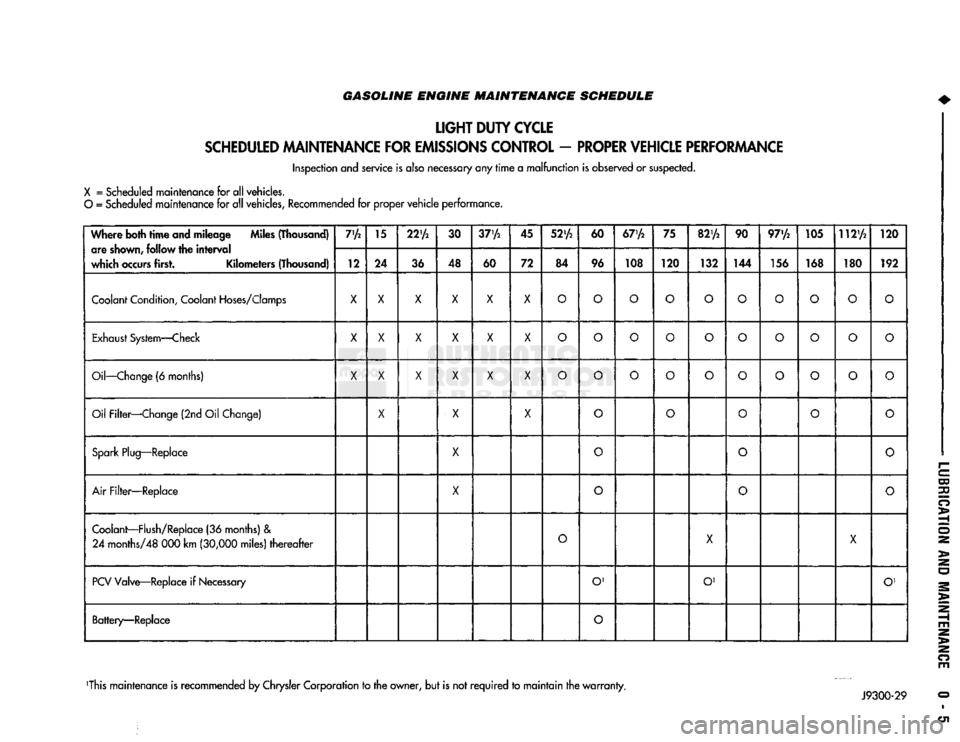
GASOLINE ENGINE MAINTENANCE SCHEDULE
LIGHT
DUTY
CYCLE
SCHEDULED
MAINTENANCE
FOR
EMISSIONS
CONTROL
-
PROPER
VEHICLE
PERFORMANCE
Inspection and service is also necessary any
rime
a
malfunction
is observed or suspected.
X
= Scheduled maintenance for all vehicles.
O
= Scheduled maintenance for all vehicles, Recommended for proper
vehicle
performance.
Where both
time
and mileage Miles (Thousand) are
shown,
follow the
interval
which
occurs
first. Kilometers (Thousand) 7'A
15
22'A
30
37'A
45
52'A
60
67'A
75
82'A
90 97'/2 105 112'A
120
Where both
time
and mileage Miles (Thousand)
are
shown,
follow the
interval
which
occurs
first. Kilometers (Thousand) 12 24
36 48
60 72 84 96 108 120
132 144 156 168 180 192
Coolant
Condition,
Coolant
Hoses/Clomps
X X X X X X
O O O O O
O O O
o
O
Exhaust
System—Check
X
X X X X
X
O O O
o
O
O O
o o o
Oil—Change
(6 months)
X X X X X X
O O O
o o
O O
o o
o
Oil Filter—Change (2nd Oil Change)
X
X X
o o
O
o
o
Spark
Plug—Replace
X
0
o o
Air
Filter—Replace
X
o
O
o
Coolant—Flush/Replace
(36 months) &
24
months/48 000 km
(30,000
miles)
thereafter
O
X
X
PCV
Valve—Replace if
Necessary
O'
O' O'
Battery—Replace
O
This maintenance is recommended by Chrysler Corporation to the owner, but is not
required
to
maintain
the
warranty.