1993 DODGE TRUCK tire type
[x] Cancel search: tire typePage 6 of 1502
INTRODUCTION
INTRODUCTION
DESIGNATIONS,
LABELS/PLATES/DECALS,
CODES
AND DIMENSIONS/WEIGHTS .
CONTENTS
page
MEASUREMENT
AND TORQUE
... 1 SPECIFICATIONS
page
. 11
DESIGNATIONS, LABELS/PLATES/DECALS, CODES
AND
DIMENSIONS/WEIGHTS
INDEX
page
Engine
and
Transmission/Transfer
Case
Identification
2
Engine/Transmission/GVWR
4
Equipment
Identification
Plate
3
International
Vehicle Control
and
Display
Symbols
10
Major Component
Identification 3
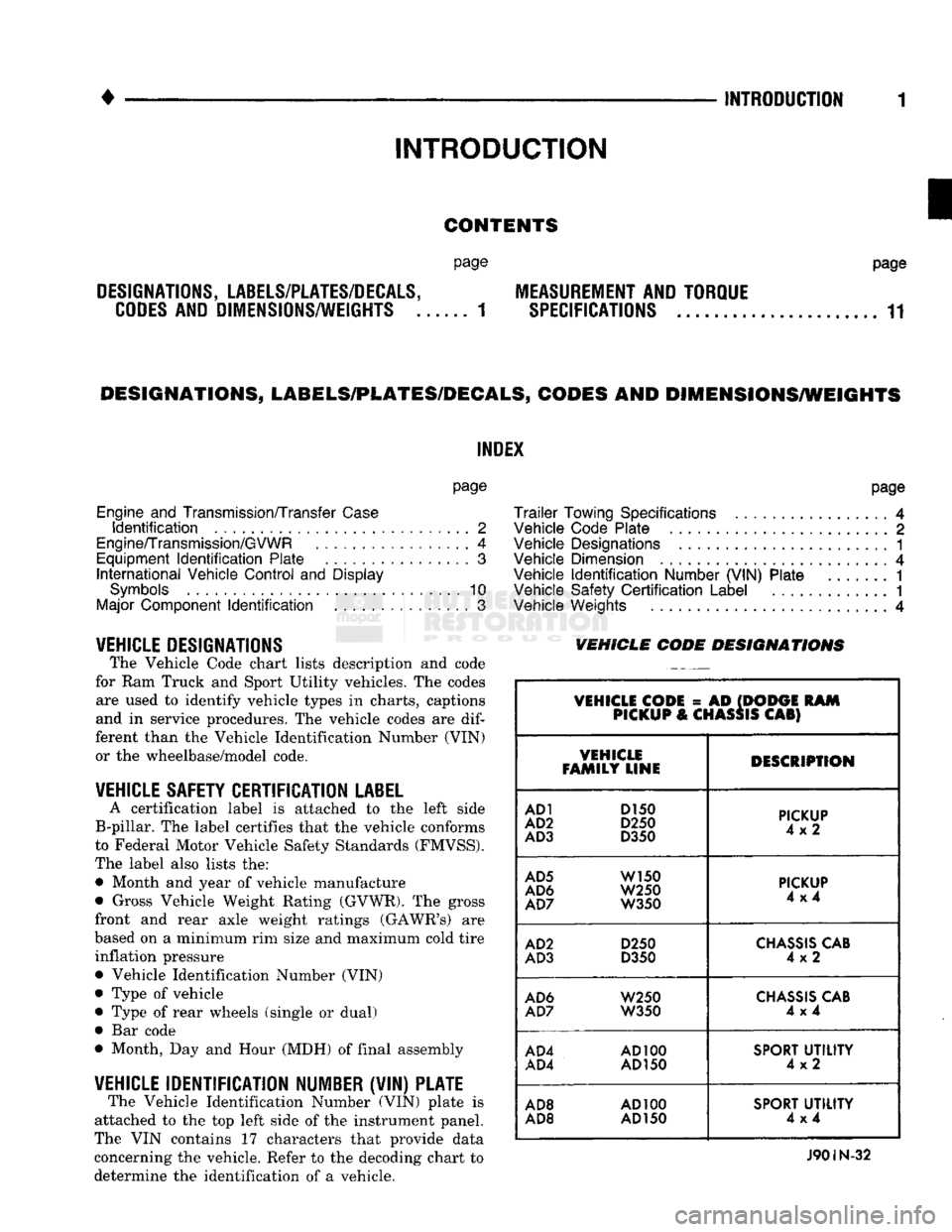
VEHICLE DESIGNATIONS The Vehicle Code chart lists description and code
for Ram Truck and Sport Utility vehicles. The codes are used to identify vehicle types in charts, captions
and in service procedures. The vehicle codes are
dif
ferent than the Vehicle Identification Number (VIN) or the wheelbase/model code.
VEHICLE SAFETY CERTIFICATION
LABEL
A certification label is attached to the left side
B-pillar. The label certifies that the vehicle conforms
to Federal Motor Vehicle Safety Standards (FMVSS).
The label also lists the: • Month and year of vehicle manufacture
• Gross Vehicle Weight Rating (GVWR). The gross
front and rear axle weight ratings (GAWR's) are
based on a minimum rim size and maximum cold tire inflation pressure Vehicle Identification Number (VIN)
Type of vehicle
Type of rear wheels (single or dual) Bar code
Month, Day and Hour (MDH) of final assembly
VEHICLE IDENTIFICATION NUMBER (VIN) PLATE The Vehicle Identification Number (VIN) plate is
attached to the top left side of the instrument panel.
The VIN contains 17 characters that provide data
concerning the vehicle. Refer to the decoding chart to
determine the identification of a vehicle.
page
Trailer
Towing Specifications
4
Vehicle Code Plate
2
Vehicle Designations
1
Vehicle Dimension
4
Vehicle
Identification
Number (VIN) Plate
1
Vehicle Safety
Certification
Label
............. 1
Vehicle Weights
4
VEHICLE CODE
DESIGNATIONS
VEHICLE CODE
= AD
(DODGE
RAM
PICKUP
&
CHASSIS
CAB)
VEHICLE
FAMILY LINE DESCRIPTION
AD1
D150
AD2
D250
AD3
D350
PICKUP
4x2
AD5
W150
AD6
W250
AD7
W350
PICKUP
4x4
AD2
D250
AD3
D350
CHASSIS
CAB
4x2
AD6
W250
AD7
W350
CHASSIS
CAB
4x4
AD4
AD100
AD4
AD150
SPORT
UTILITY
4x2
AD8
AD100
AD8 AD
150
SPORT
UTILITY
4x4
J90IN-32
Page 7 of 1502
2 INTRODUCTION
•
MFD
BY
GAWR
FRONT
GAWR REAR
CHRYSLER
CORPORATION
DATE
OF MFR
GVWR
WITH
TIRES
WITH
TIRES
RIMS
AT
RIMS
AT
PSI
COLD
PSI
COLD
THIS
VEHICLE CONFORMS
TO
ALL APPLICABLE FEDERAL MOTOR VEHICLE SAFETY
STANDARDS
IN
EFFECT ON
THE
DATE
OF
MANUFACTURE SHOWN ABOVE.
SINGLE
DUAL
MDH:
BAR
CODE
VEHICLE MADE
IN
4648503
J9HN-25
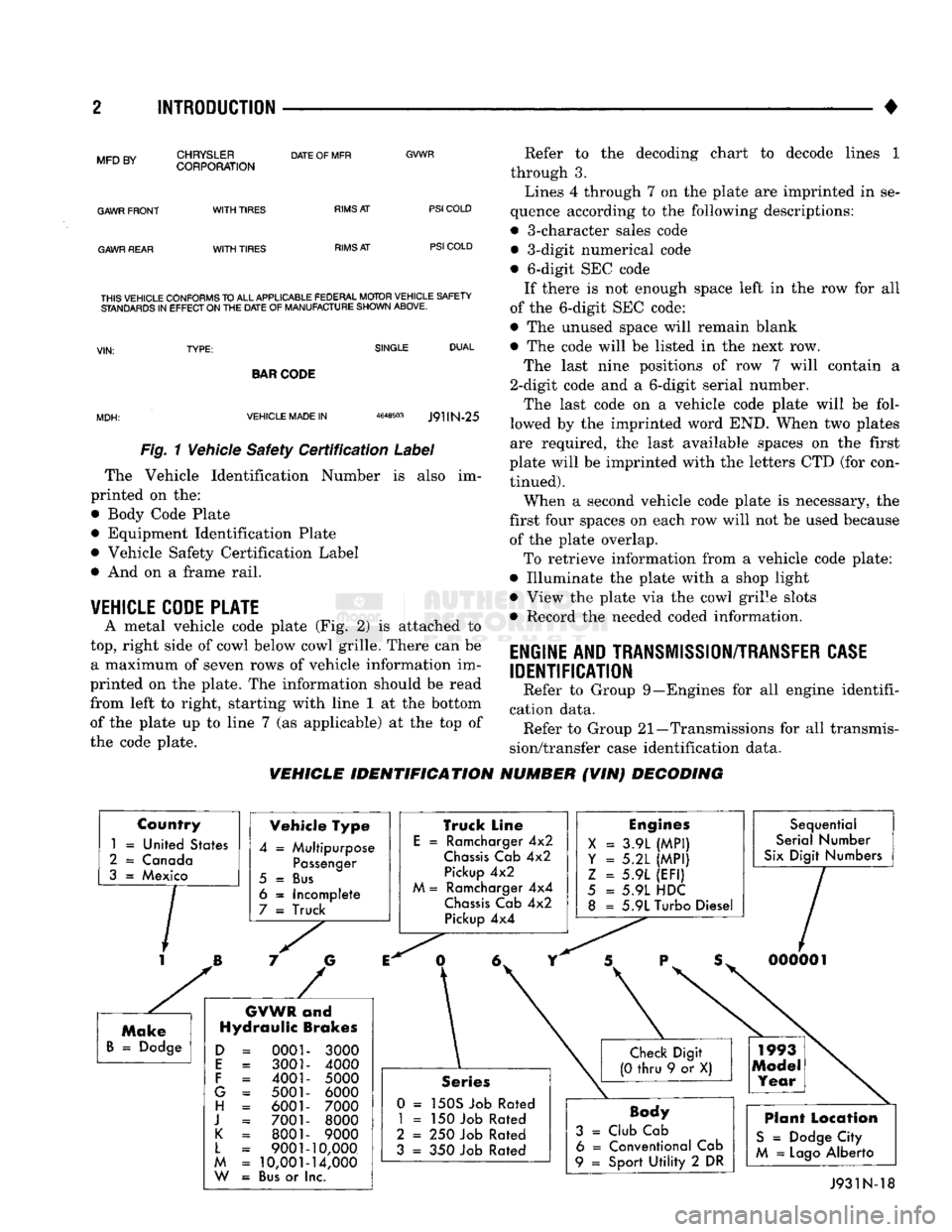
Fig. 1 Vehicle Safety Certification Label
The Vehicle Identification Number is also im
printed on the:
• Body Code Plate
• Equipment Identification Plate
• Vehicle Safety Certification Label
• And on a frame rail.
VEHICLE CODE PLATE
A metal vehicle code plate (Fig. 2) is attached to
top,
right side of cowl below cowl grille. There can be a maximum of seven rows of vehicle information im
printed on the plate. The information should be read
from left to right, starting with line 1 at the bottom
of the plate up to line 7 (as applicable) at the top of
the code plate. Refer to the decoding chart to decode lines 1
through 3.
Lines 4 through 7 on the plate are imprinted in se
quence according to the following descriptions:
• 3-character sales code • 3-digit numerical code
• 6-digit SEC code If there is not enough space left in the row for all
of the 6-digit SEC code:
• The unused space will remain blank
• The code will be listed in the next row.
The last nine positions of row 7 will contain a
2-digit code and a 6-digit serial number.
The last code on a vehicle code plate will be fol
lowed by the imprinted word END. When two plates
are required, the last available spaces on the first
plate will be imprinted with the letters CTD (for con tinued).
When a second vehicle code plate is necessary, the
first four spaces on each row will not be used because of the plate overlap.
To retrieve information from a vehicle code plate:
• Illuminate the plate with a shop light
• View the plate via the cowl grille slots
• Record the needed coded information.
ENGINE AND TRANSMISSION/TRANSFER CASE
IDENTIFICATION
Refer to Group 9—Engines for all engine identifi
cation data. Refer to Group 21—Transmissions for all transmis
sion/transfer case identification data.
VEHICLE IDENTIFICATION NUMBER (VIN) DECODING
Country
1
=
United States
2
=
Canada
3
=
Mexico Vehicle Type
4
=
Multipurpose
Passenger
5
=
Bus
6
=
Incomplete
7
=
Truck
GVWR
and
Hydraulic Brakes
0001 3001
4001
5001 6001
7001 8001
9001
10,001
Bus
or I
3000
4000
5000 6000
7000 8000
9000
10,000
14,000
nc.
Truck Line
E
=
Ramcharger
4x2
Chassis
Cab
4x2
Pickup
4x2
M
=
Ramcharger
4x4
Chassis
Cab
4x2
Pickup
4x4
Engines
X
=
3.9L
(MPI)
Y = 5.2L
(MPI)
Z
=
5.9L
(EFI)
5
=
5.9L HDC
8
=
5.9L Turbo Diesel Sequential
Serial Number
Six
Digit Numbers
Series
0 =
150S Job Rated
1
= 150
Job Rated
2
= 250
Job Rated
3
= 350
Job Rated
Body
3
=
Club Cab 6
=
Conventional Cab
9
=
Sport
Utility
2 DR
Plant Location
S
=
Dodge City
M
=
Lago
Alberto J931N-18
Page 21 of 1502
0 - 2
LUBRICATION
AND
MAINTENANCE
• Commercial service
When a vehicle is continuously subjected to severe
driving conditions, lubricate:
• Body components
• All the driveline coupling joints
• Steering linkage More often than normal driving conditions
DUSTY
AREAS
With this type of severe driving condition, special
care should be given to the:
• Engine air cleaner filter
• PCV filter
• Crankcase ventilation system
• Brake booster control valve air filter. Verify that the filters and the associated compo
nents are clean. Also verify that they are functioning
effectively. This will minimize the amount of abra sive particles that enter the engine.
OFF-ROAD
(4WD)
OPERATION
After off-road (4WD) operation, inspect the under
side of the vehicle. Inspect the:
• Tires
• Body structure
• Steering components
• Suspension components • Exhaust system
• Threaded fasteners
HARSH
SURFACE ENVIRONMENTS
After extended operation in harsh environments,
the brake drums, brake linings, and rear wheel bear ings should be inspected and cleaned. This will pre
vent wear and erratic brake action.
ROUTINE MAINTENANCE
The following routine maintenance is recommended
on a monthly basis: TIRES—Inspect the tires for unusual wear/damage.
Determine if the inflation pressure is adequate for
the vehicle load. BATTERY—Inspect and clean the terminals.
Tighten the terminals if necessary. FLUIDS—Determine if the component fluid levels
are acceptable. Add fluid, if necessary. LIGHTS/ELECTRICAL—Test all the electrical sys
tems in the vehicle for proper operation. It is also recommended that the engine oil and the
washer fluid level be determined at each fuel fill-up.
VEHICLE
NOISE CONTROL
Vehicles with a GVWR of 4 535 kg (10,000 lbs), or
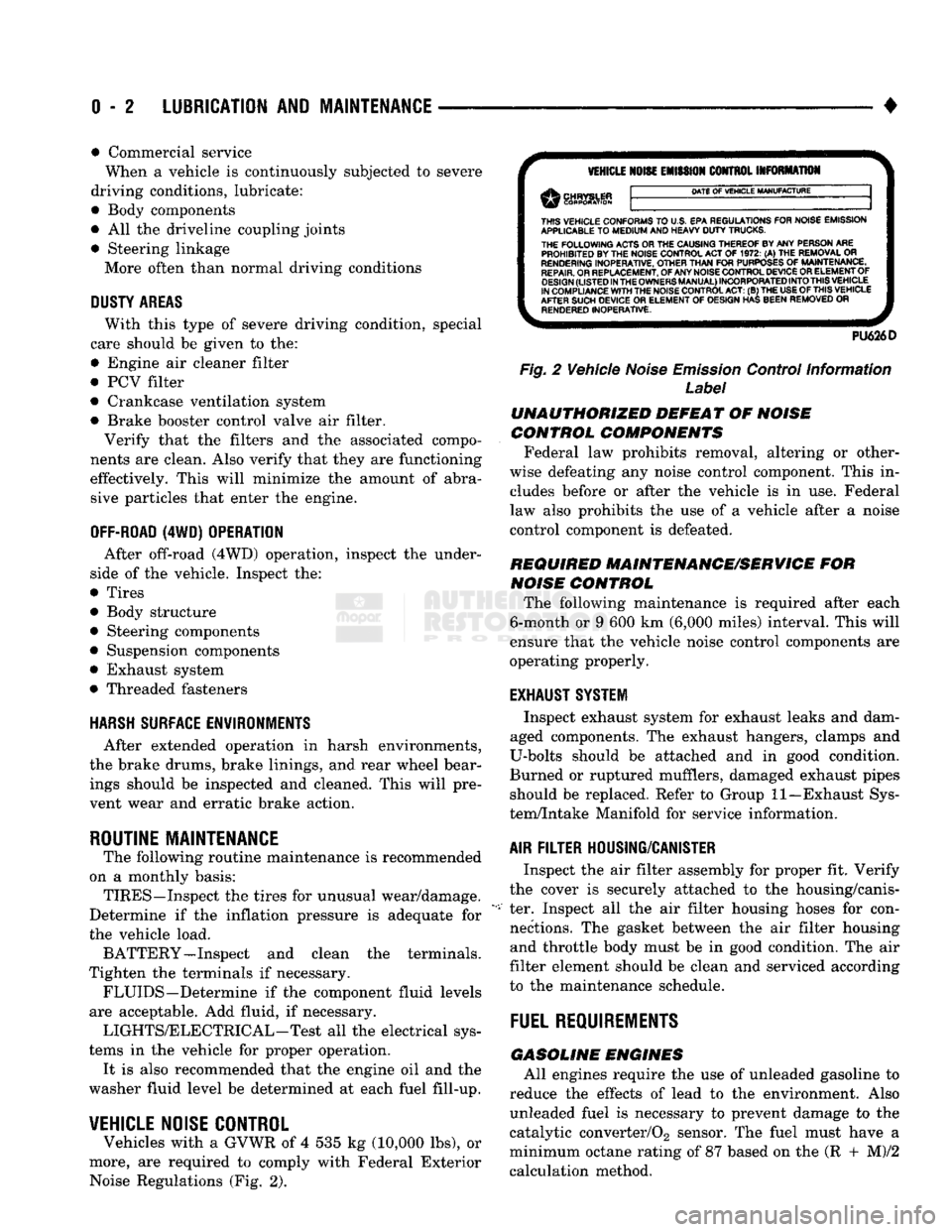
more, are required to comply with Federal Exterior Noise Regulations (Fig. 2).
VEHICLE
NOISE
EMISSION
CONTROL INFORMATION
DATE
OF
VEHICLE
MANUFACTURE
THIS
VEHICLE CONFORMS
TO
U.S. EPA REGULATIONS FOR NOISE EMISSION
APPLICABLE
TO
MEDIUM
AND HEAVY
DUTY
TRUCKS. THE
FOLLOWING
ACTS OR THE CAUSING THEREOF BY ANY PERSON ARE PROHIBITED BY THE NOISE CONTROL ACT
OF 1972. (A) THE
REMOVAL
OR
RENDERING
INOPERATIVE, OTHER
THAN
FOR
PURPOSES
OF
MAINTENANCE,
REPAIR.
OR REPLACEMENT, OF ANY NOISE CONTROL DEVICE OR ELEMENT OF
DESIGN
(LISTED
IN
THE
OWNERS
MANUAL)
INCORPORATED
INTO
THIS
VEHICLE
IN COMPLIANCE
WITH
THE NOISE CONTROL
ACT:
(B) THE
USE
OF
THIS
VEHICLE
AFTER SUCH DEVICE
OR
ELEMENT
OF
DESIGN HAS BEEN REMOVED
OR
RENDERED
INOPERATIVE.
PU626D
Fig.
2 Vehicle
Noise
Emission
Control Information
Label
UNAUTHORIZED
DEFEAT
OF
NOISE
CONTROL COMPONENTS
Federal law prohibits removal, altering or other
wise defeating any noise control component. This in
cludes before or after the vehicle is in use. Federal
law also prohibits the use of a vehicle after a noise
control component is defeated.
REQUIRED MAINTENANCE/SERVICE
FOR
NOISE
CONTROL
The following maintenance is required after each
6-month or 9 600 km (6,000 miles) interval. This will
ensure that the vehicle noise control components are
operating properly.
EXHAUST SYSTEM
Inspect exhaust system for exhaust leaks and dam
aged components. The exhaust hangers, clamps and
U-bolts should be attached and in good condition.
Burned or ruptured mufflers, damaged exhaust pipes should be replaced. Refer to Group 11—Exhaust Sys
tem/Intake Manifold for service information.
AIR
FILTER
HOUSING/CANISTER
Inspect the air filter assembly for proper fit. Verify
the cover is securely attached to the housing/canis
ter. Inspect all the air filter housing hoses for con nections. The gasket between the air filter housing and throttle body must be in good condition. The air
filter element should be clean and serviced according
to the maintenance schedule.
FUEL
REQUIREMENTS
GASOLINE
ENGINES
All engines require the use of unleaded gasoline to
reduce the effects of lead to the environment. Also unleaded fuel is necessary to prevent damage to the
catalytic converter/02 sensor. The fuel must have a
minimum octane rating of 87 based on the (R + M)/2
calculation method.
Page 30 of 1502

LUBRICATION
AND
MAINTENANCE
0-11
J
DRIVE-ON
HOIST
I
FRAME
CONTACT
HOIST
TWIN
POST
CHASSIS
HOIST
FLOOR
JACK
RROOD30
Fig.
8 Correct Vehicle Lifting
Locations
An axle tube
A body side sill
A steering linkage component
A drive shaft
The engine or transmission oil pan
The fuel tank
• A front suspension arm Use the correct frame rail lifting locations only
(Fig. 8).
HOIST A vehicle can be lifted with:
• A single-post, frame-contact hoist
• A twin-post, chassis hoist
• A ramp-type, drive-on hoist
When a frame-contact type hoist is used, verify
that the lifting pads are positioned properly (Fig. 8).
WARNING:
WHEN
A
SERVICE
PROCEDURE
RE
QUIRES
THE
REMOVAL
OF
THE
REAR
AXLE,
FUEL
TANK,
OR
SPARE
TIRE,
EITHER:
• PLACE ADDITIONAL WEIGHT ON THE REAR
END OF THE VEHICLE
« ATTACH THE VEHICLE TO THE HOIST
« PLACE JACK STANDS UNDER THE VEHICLE
FOR SUPPORT TO PREVENT TIPPING WHEN
THE CENTER OF BALANCE CHANGES
4WD VEHICLES A standard hoist can be used to lift a 4WD vehicle.
The hoist should be inspected for adequate clearance. The lift arms, pads or ramps should be adjusted to
ensure that there is adequate clearance (Fig. 9).
ADJUSTMENT
PAD
ii 7
MAINTAIN
CLEARANCE
HOIST
ARM
RK44
Fig.
9 Lifting 4WD Vehicle
With
Single-Post
Hoist—
Typical
When a twin-post hoist is used, a 4 x 4 x 12-inch
wood spacer also could be required. Place the wood spacer under the front axle (opposite the differential
housing). This will maintain balance and level lift ing.
CAUTION:
The
block
that
is
used must
be
secured in
a
safe manner. This
will
ensure
that
it
will
not un
balance
the
vehicle.
VEHICLE
TOWING
RECOMMENDATIONS
When it is necessary to tow a Ram Truck, the rec
ommended method is either:
• the sling-type, rear-end raised towing method; or
• the wheel-lift towing method with a tow dolly lo
cated under the front wheels. A vehicle with flat-bed hauling equipment can also
be used to transport a disabled vehicle.
SLING-TYPE
FLAT
BED
RR0OD29
Fig.
10 Tow Vehicles
With
Approved
Equipment
Page 47 of 1502
0
- 28
LUBRICATION
AND
MAINTENANCE
•
CHASSIS AND BODY
page
Body
Component Mechanisms
32
Front
Suspension
Ball
Joints
28
Front
Wheel Bearings
29
Headlamps
32
Lower
and
Upper Suspension
Arm
Bushings
.... 30
Manual
Steering Gear
28
STEERING
LINKAGE
INSPECTION When
a
vehicle
is
raised
for
maintenance under
the vehicle,
all
steering components should
be
checked.
LUBRICATION SCHEDULE The steering linkage
is
lubricated with
a
chassis
lubricant. However,
it is
recommended that
the
link
age
be
inspected
and
lubricated after each:
•
24 000 km
(15,000 miles) interval
or
every
6
months,
for 2WD
vehicles subject
to the
LIGHT
DUTY CYCLE Maintenance Schedule
•
9 600 km
(6,000 miles) interval
or
every
6
months,
for
2WD
vehicles subject
to the
HEAVY DUTY
CY
CLE Maintenance Schedule
•
12 000 km
(7,500 miles) interval
or
every
6
months,
for 4WD
vehicles subject
to the
LIGHT DUTY CYCLE Maintenance Schedule
•
9 600 km
(6,000 miles) interval
or
every
6
months,
for
4WD
vehicles subject
to the
HEAVY DUTY
CY
CLE Maintenance Schedule.
LUBRICATION (1) Inspect
the
steering linkage
for
looseness
and
excessive wear. (2) Replace,
all
ruptured seals
and
damaged steer
ing linkage components. Damaged seals should
be re
placed
to
prevent leakage
and
contamination
of the
lubricant.
CAUTION:
Use
care
to
prevent lubricant from
con
tacting
the
brake rotors.
(3) Lubricate
the
steering linkage:
• Clean
the
Zerk type lubrication fittings
on the tie-
rod
and
center link ball-stud ends
• Lubricate
the
ball studs with MOPAR®Multi-Mile- age Lubricant
• Wipe
the
excess lubricant from
the
exterior sur
faces
of the
ball joints
page
Power
Brake System
30
Power
Steering System
. . 29
Rear
Wheel Bearings
30
Speedometer Cable
33
Steering Linkage
28
Tires
32
FRONT
SUSPENSION
BALL JOINTS
INSPECTION When
a
vehicle
is
raised
for
lubrication/general
maintenance,
the
ball joints should
be
inspected.
LUBRICATION SCHEDULE The front suspension ball joints
are
lubricated dur
ing manufacture with
a
long-life chassis lubricant.
However,
it is
recommended that
the
ball joints
be
inspected
and the
studs lubricated:
•
At
each
36 000 km
(22,500 miles) interval
or
every
2 years,
for
vehicles subject
to the
LIGHT DUTY
CY
CLE Maintenance Schedule
•
At
each
9 600 km
(6,000 miles) interval
or
every
2
years,
for
vehicles subject
to the
HEAVY DUTY
CY
CLE Maintenance Schedule.
4WD vehicles that
are
frequently driven
off-
road should
be
lubricated
at
every engine
oil
change.
LUBRICATION (1) Inspect
the
front suspension. Examine
the
ball
studs
for
looseness
and
excessive wear. (2) Replace
all
torn ball-stud seals
and
damaged
ball joints. Damaged seals should
be
replaced
to
pre vent leakage
and
contamination.
CAUTION:
Use
care
to
prevent lubricant from
con
tacting
the
brake rotors.
(3) Lubricate
the
ball studs:
• Clean
the
Zerk type lubrication fittings
on the
ball-stud ends
• Lubricate
the
ball studs with MOPAR®Multi-Mile-age Lubricant
• Wipe
the
excess lubricant from
the
exterior sur
faces
of the
ball joints
MANUAL
STEERING
GEAR
LUBRICATION Manual steering gears
are
permanently lubricated
during manufacture. Periodic lubrication
is not
nec
essary.
Page 61 of 1502
2
- 8
FRONT SUSPENSION
AND
AXLE
• INSTALLATION
(1) If a bearing and cup must be replaced, remove
the cup from the wheel hub/rotor bore (Fig. 1). Use a
brass drift or an appropriate removal tool to tap out
the cup.
(2) Install the replacement bearing cup(s) with an
appropriate installation tool. (3) Apply lubricant to surface area of the wheel
hub/rotor bore. Install the inner wheel bearing in the
hub/rotor. Install a replacement bearing seal with an appropriate seal installation tool. (4) Inspect the bearing and seal contact surfaces on
the steering knuckle spindle for burrs and/or rough ness (Fig. 1).
(5) Remove all the rough contact surfaces from the
spindle. Apply a coating of multi-purpose NLGI,
grade 2, EP-type lubricant to the spindle surface.
CAUTION: Us© care to prevent the inner
wheel
bear
ing
and bearing
seal
from contacting the steering
knuckle
spindle
threads during removal (Fig. 1).
Otherwise,
the threads, bearing, and
seal
could
be
damaged.
(6) Carefully slide the wheel hub/rotor onto the
spindle.
Install the outer wheel bearing, the washer and
nut.
(7) Tighten the nut to 41 to 54 Nnn (30 to 40 ft.
lbs.) torque while rotating the wheel hub/rotor. Stop
the hub/rotor and loosen the nut to completely re
lease the bearing preload torque. Next, tighten the
nut finger-tight, install the nut lock. Install a re
placement cotter pin.
(8) The wheel bearing adjustment (above) should
have 0.001 to 0.003 inch (0.254 to 0.0762 mm) end
play.
(9) Clean the dust cap. Apply a coating of multi
purpose NLGI, grade 2, EP-type lubricant to internal surface. Install the cap. Do not fill the dust cap with lubricant. (10) Install the brake caliper, refer to Group 5,
Brakes. (11) Install the wheel and tire, refer to Wheel and
Tire Installation in this section. Lower the vehicle.
LOWER SUSPENSION ARM STRUT
REMOVAL (1) Raise and support the vehicle.
(2) Use a small drift and a hammer to drive the
spring pin from the front of the strut. Remove the
spring pin, nut, retainer and bushing from the end of
the strut (Fig. 2).
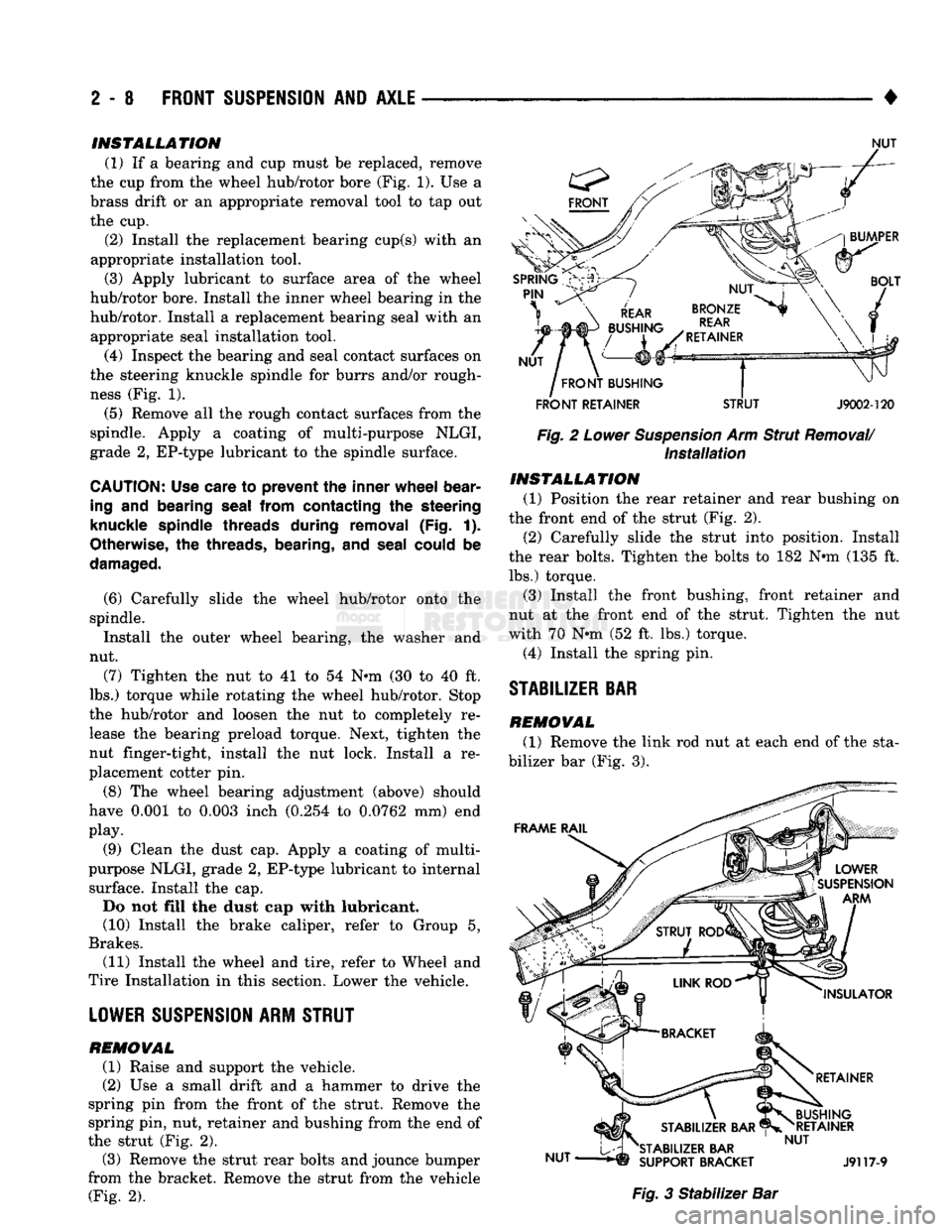
(3) Remove the strut rear bolts and jounce bumper
from the bracket. Remove the strut from the vehicle (Fig. 2).
NUT
FRONT
RETAINER
STRUT
J9002-120
Fig. 2 Lower Suspension Arm Strut Removal/ Installation INSTALLATION
(1) Position the rear retainer and rear bushing on
the front end of the strut (Fig. 2).
(2) Carefully slide the strut into position. Install
the rear bolts. Tighten the bolts to 182 Nnn (135 ft. lbs.) torque.
(3) Install the front bushing, front retainer and
nut at the front end of the strut. Tighten the nut
with 70 Nnn (52 ft. lbs.) torque.
(4) Install the spring pin.
STABILIZER
BAR
REMOVAL
(1) Remove the link rod nut at each end of the sta
bilizer bar (Fig. 3). Fig. 3 Stabilizer Bar
Page 132 of 1502
•
REAR
SUSPENSION
AND
AXLE
3 - 3
REAR SUSPENSION—2WD
and 4WD
VEHICLES
SPRING
AND
SHOCK DIAGNOSIS
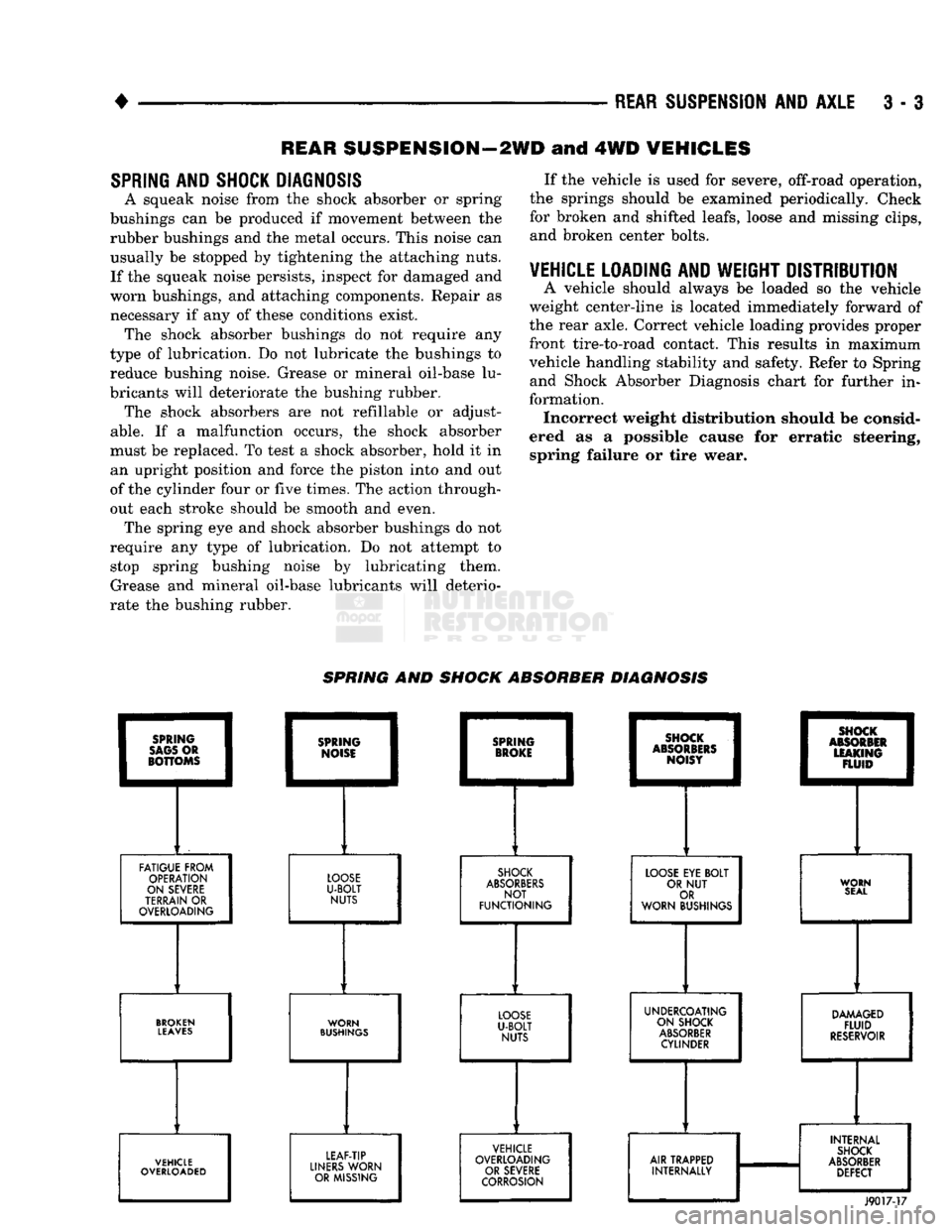
A squeak noise from the shock absorber or spring
bushings can be produced if movement between the
rubber bushings and the metal occurs. This noise can usually be stopped by tightening the attaching nuts.
If the squeak noise persists, inspect for damaged and
worn bushings, and attaching components. Repair as
necessary if any of these conditions exist. The shock absorber bushings do not require any
type of lubrication. Do not lubricate the bushings to reduce bushing noise. Grease or mineral oil-base lu
bricants will deteriorate the bushing rubber. The shock absorbers are not reflllable or adjust
able.
If a malfunction occurs, the shock absorber
must be replaced. To test a shock absorber, hold it in an upright position and force the piston into and out
of the cylinder four or five times. The action through
out each stroke should be smooth and even. The spring eye and shock absorber bushings do not
require any type of lubrication. Do not attempt to stop spring bushing noise by lubricating them.
Grease and mineral oil-base lubricants will deterio
rate the bushing rubber. If the vehicle is used for severe, off-road operation,
the springs should be examined periodically. Check for broken and shifted leafs, loose and missing clips, and broken center bolts.
VEHICLE LOADING
AND
WEIGHT DISTRIBUTION
A vehicle should always be loaded so the vehicle
weight center-line is located immediately forward of
the rear axle. Correct vehicle loading provides proper
front tire-to-road contact. This results in maximum
vehicle handling stability and safety. Refer to Spring and Shock Absorber Diagnosis chart for further in
formation. Incorrect weight distribution should be consid
ered as a possible cause for erratic steering, spring failure or tire wear. SPRING AND SHOCK ABSORBER DIAGNOSIS
FATIGUE FROM
OPERATION
ON SEVERE
TERRAIN
OR
OVERLOADING
LOOSE
U-BOLT
NUTS
SHOCK
ABSORBERS
NOT
FUNCTIONING
LOOSE
EYE
BOLT
OR
NUT
OR
WORN BUSHINGS WORN
SEAL
BROKEN
LEAVES
WORN
BUSHINGS
UNDERCOATING
ON SHOCK
ABSORBER
CYLINDER
DAMAGED
FLUID
RESERVOIR
VEHICLE
OVERLOADED LEAF-TIP
LINERS
WORN OR MISSING VEHICLE
OVERLOADING OR SEVERE
CORROSION
AIR TRAPPED
INTERNALLY INTERNAL
SHOCK
ABSORBER
DEFECT
J9017-17
Page 136 of 1502
•
RfAR SUSPENSION
AND
AXLE
3 - 7 failure occurs. If a mis-adjustment condition is not
corrected, component failure can result.
REAR
AXLE ALIGNMENT
MEASUREMENT The following procedure can be used to determine
if abnormal rear tire tread wear is the result of a
bent or deformed rear axle shaft.
(1) Raise both rear wheels off the surface with a
frame contact hoist. (2) Attach a one-inch long piece of masking tape at
the center of each tire tread for use as reference marks.
(3) Rotate the rear wheels until both reference
marks face the front of the vehicle. Measure the dis
tance between the outside edges of the two pieces of
tape.
Record this measurement as the front of tire (FTR) measurement.
(4) Rotate the rear wheels until both reference
marks face the rear of the vehicle. Measure the dis
tance between the outside edges of the two pieces of
tape.
Record this measurement as the rear of tire (RTR) measurement.
(5) Subtract the (RTR) measurement from the
(FTR) measurement to obtain the amount of wheel
toe.
The acceptable rear wheel toe-in position is 1/16 inch (1.6 mm) to 3/16 inch (4.8 mm) toe-out.
(6) Rotate the rear wheels until the reference
marks are facing downward. Measure the distance
between the outside edges of the two pieces of tape. Record this measurement as the bottom of tire (BTR)
measurement.
(7) Average the (FTR) and the (RTR) distance
measurements. Subtract the (BTR) measurement
from this average distance to obtain the camber. The acceptable amount of camber is 1/16 inch to 3/32 inch
(1.6 to 2.4 mm).
(FTR + RTR) DIVIDED BY 2 (TWO) MINUS
BTR EQUALS CAMBER
If the (BTR) distance measurement is less than
the average FTR and RTR distance measure
ment, the camber will be positive ( + ). If the (BTR) distance measurement is greater than the average FTR and RTR distance, the camber will
be negative ( - ).
If the toe position or camber is not acceptable, a
bent or deformed rear axle shaft is most likely the cause.
TIRE
NOISE
Check tires that are damaged, unbalanced, incor
rectly inflated. Tires that have deep treads can emit sounds like axle noise. Differentiate between tire and
axle noise during a road test. Tire noise will usually vary with different road
conditions. Tire noise is sensitive to inflation pres
sure.
The pitch of tire noise changes when the vehi
cle speed is varied.
Drive the vehicle over different road surfaces. Note
the changes in the noise. If the noise changes, the
tires are the source of the noise.
Refer to Group 22, Wheels and Tires for additional
information.
GEAR
AND BEARING NOISE
GEAR
NOISE
Axle gear noise can be caused by insufficient lubri
cant. Incorrect backlash, tooth contact, or worn/dam aged gears can cause noise.
Gear noise usually happens at a specific speed
range. The range is 30 to 40 mph, or above 50 mph.
The noise can also occur during a specific type of driving condition. These conditions are, acceleration,
deceleration, coast, or constant load.
When road testing, accelerate the vehicle to the
speed range where the noise is the greatest. Shift
out-of-gear and coast through the peak-noise range.
If the noise stops or changes greatly, check for
insuf
ficient lubricant. Incorrect ring gear backlash, or gear damage can cause noise changes.
Differential side and pinion gears can be checked
by turning the vehicle. They usually do not cause noise in straight-ahead driving. These gears are
loaded during vehicle turns. If noise does occur dur
ing vehicle turns, the side or pinion gears could be
worn or damaged. A worn pinion gear mate shaft can also cause a snapping or a knocking noise.
BEARING NOISE
The axle shaft, differential and pinion gear bear
ings can all produce noise when worn or damaged.
Bearing noise can be either a whining, or a growling sound.
Pinion gear bearings have a constant-pitch noise.
This noise changes only with vehicle speed. Pinion
bearing noise will be higher because it rotates at a faster rate. Drive the vehicle and load the differen
tial.
If bearing noise occurs the pinion rear bearing is the source of the noise. If the bearing noise is heard during a coast, front bearing is the source.
Worn, damaged differential bearings usually pro
duce a low pitch noise. Differential bearing noise is
similar to pinion bearing. The pitch of differential
bearing noise is also constant and varies only with vehicle speed.
Axle shaft bearings produce noise and vibration
when worn or damaged. The noise generally changes
when the bearings are loaded. Road test the vehicle. Turn the vehicle sharply to the left and to the right.
This will load the bearings and change the noise