1973 DATSUN B110 engine
[x] Cancel search: enginePage 60 of 513
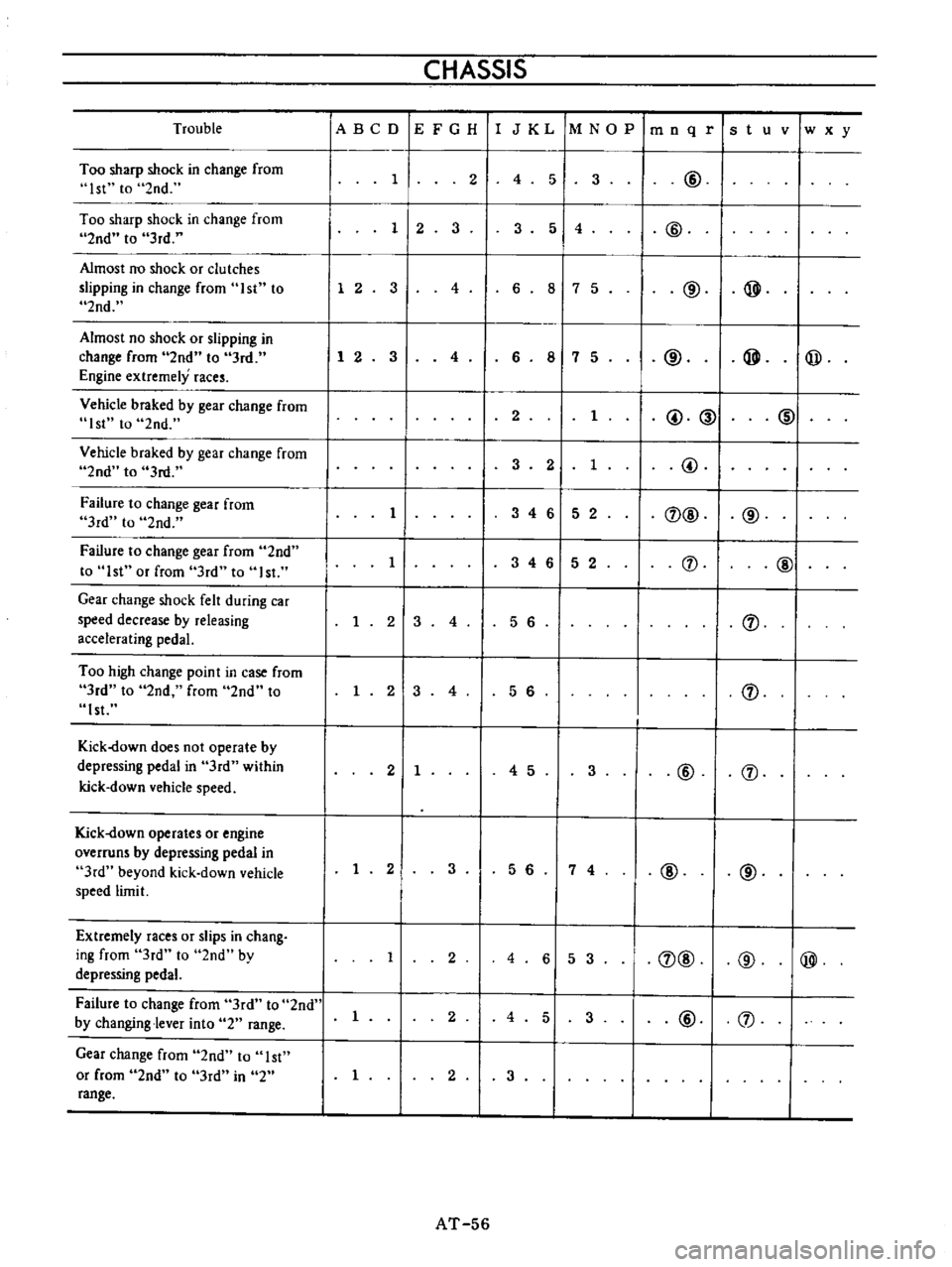
CHASSIS
Trouble
IA
BCD
EFGH
I
J
K
L
1M
N
0
p
1m
n
q
r
s
t
u
v
Iw
x
y
Too
sharp
shock
in
change
from
1
2
4
5
3
@
1st
to
2nd
Too
sharp
shock
in
change
from
1
2
3
3
5
4
@
2ndu
to
3rd
Almost
no
shock
or
clutches
slipping
in
change
from
1st
to
1
2
3
4
6
8
7
5
@
@
2nd
Almost
no
shock
or
slipping
in
@
@
@
change
from
2nd
to
3rd
1
2
3
4
6
8
7
5
Engine
extremely
races
Vehicle
braked
by
gear
change
from
2
1
@
@
I
@I
1st
to
2nd
Vehicle
braked
by
gear
change
from
3
2
1
@
I
I
2nd
to
3rd
Failure
to
change
gear
from
1
346
5
2
1
@
@
3rd
to
2nd
Failure
to
change
gear
from
2nd
I
3
4
6
5
2
1
@I
to
Ist
or
from
3rd
to
1st
Gear
change
shock
felt
during
car
I
speed
decrease
by
releasing
2
3
4
5
6
j
I
accelerating
pedaL
Too
high
change
point
in
case
from
j
3rd
to
2nd
from
2nd
to
1
2
3
4
5
6
1st
Kick
down
does
not
operate
by
depressing
pedal
in
3rd
within
2
1
4
5
3
@
1
kick
down
vehicle
speed
Kick
down
operates
or
engine
overruns
by
depressing
pedal
in
@
@
3rd
beyond
kick
down
vehicle
1
2
3
5
6
7
4
speed
limi
t
Extremely
races
or
slips
in
chang
ing
from
3rd
to
2nd
by
1
2
4
6
5
3
j
@
@
@I
depressing
pedaL
Failure
to
change
from
3rd
to
2nd
j
1
2
4
51
3
@
I
j
by
changing
lever
into
2
range
Gear
change
from
2nd
to
1st
or
from
2nd
to
3rd
in
2
1
2
3
range
AT
56
Page 61 of 513
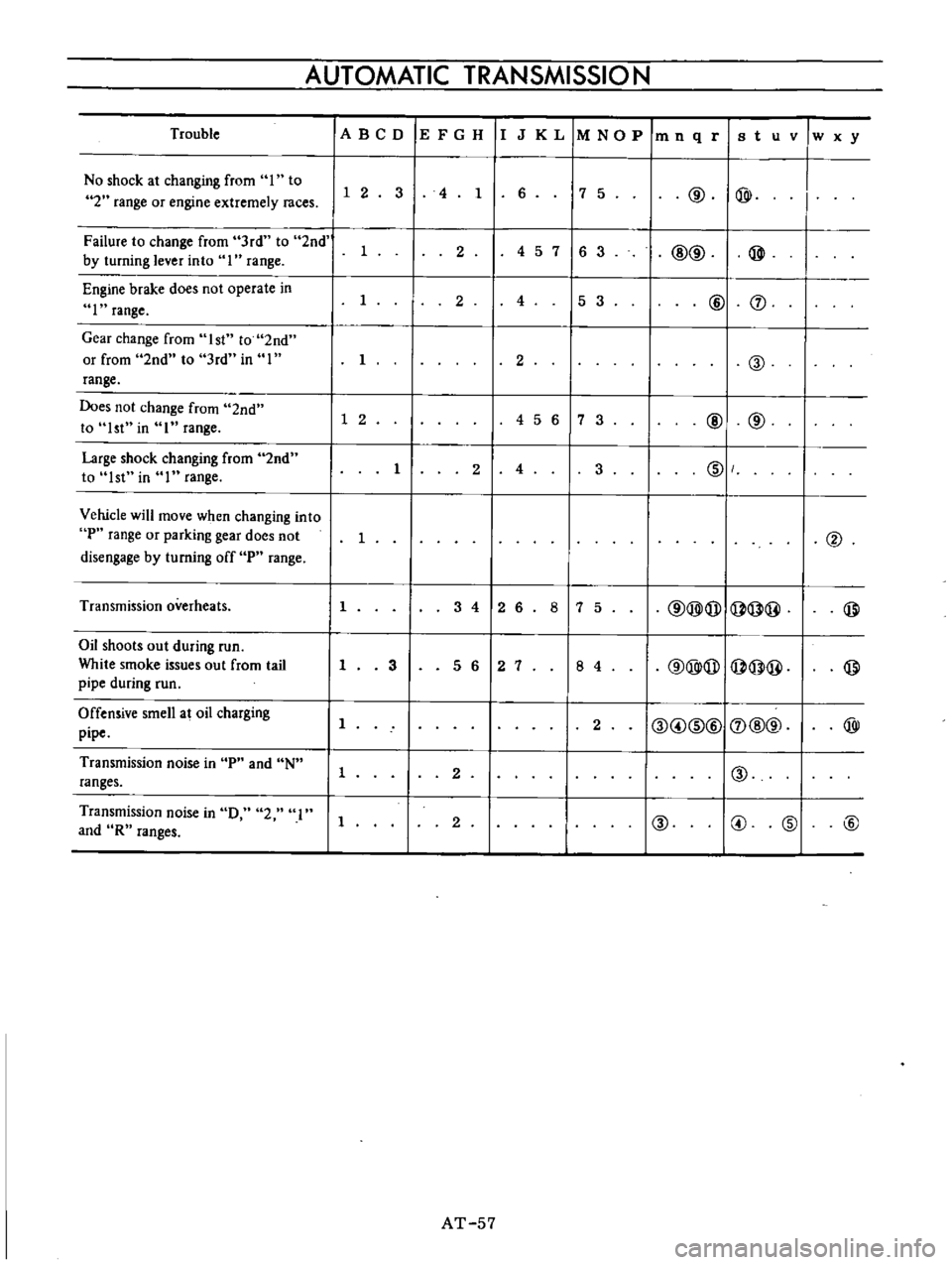
AUTOMATIC
TRANSMISSIO
N
Trouble
IA
BCD
IE
F
G
H
IIJ
K
L
1M
NO
P
1m
n
q
riB
t
u
v
w
x
y
No
shock
at
changing
from
I
to
7
5
@
@
I
1
2
3
4
1
6
I
2
range
or
engine
extremely
races
Failure
to
change
from
3rd
to
2nd
1
2
4
5
7
16
3
I
@@
@
by
turning
lever
into
I
range
Engine
brake
does
not
operate
in
I
2
4
5
3
@
J
I
range
Gear
change
from
1st
to
2nd
or
from
2nd
to
3rd
in
I
I
2
@
range
Does
not
change
from
2nd
1
2
456
7
3
@
@
to
1st
in
I
range
Large
shock
changing
from
2nd
1
2
4
3
IDI
to
1st
in
I
range
Vehicle
will
move
when
changing
into
P
range
or
parking
gear
does
not
1
@
disengage
by
turning
off
P
range
Transmission
overheats
1
3
4
12
6
8
7
5
@@@I@@
@
Oil
shoots
out
during
run
@@@
@@
@
White
smoke
issues
out
from
tail
1
3
5
6
2
7
8
4
pipe
during
run
Offensive
smell
at
oil
charging
11
2
I@
@
ID@I
J
@@
@
pipe
Transmission
noise
in
P
and
N
1
2
I
I@
ranges
Transmission
noise
in
0
2
I
1
2
@
@
@
@
and
R
ranges
AT
57
Page 62 of 513
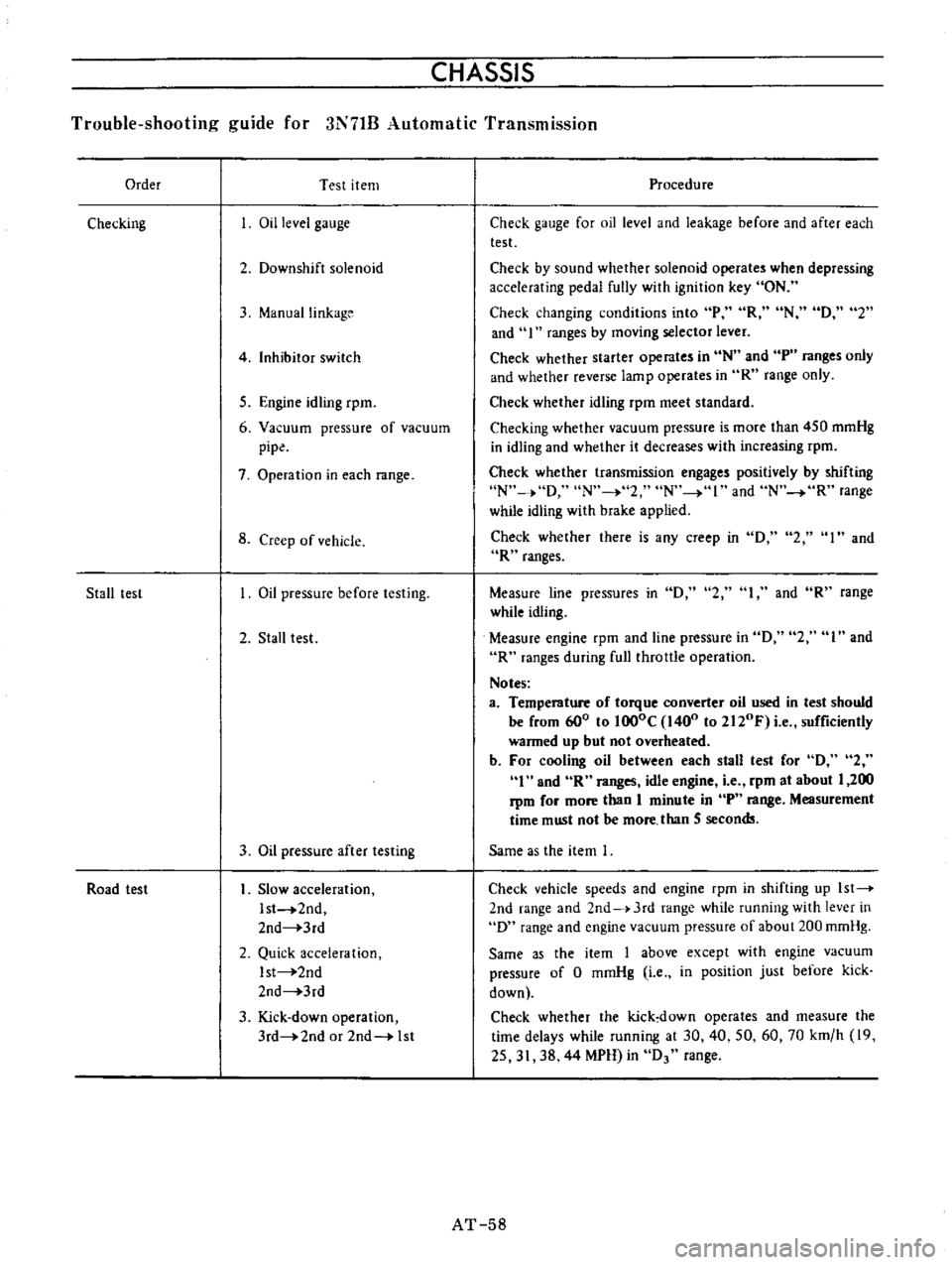
CHASSIS
Trouble
shooting
guide
for
3N71B
Automatic
Transmission
Order
Test
item
Checking
Oil
level
gauge
2
Downshift
solenoid
3
ManuaIlinkage
4
Inhibitor
switch
5
Engine
idling
rpm
6
Vacuum
pressure
of
vacuum
pipe
7
Operation
in
each
range
8
Creep
of
vehicle
Stall
lest
Oil
pressure
before
testing
2
Stall
test
3
Oil
pressure
after
testing
Road
test
Slow
acceleration
Ist
2nd
2nd
3rd
2
Quick
acceleration
Ist
2nd
2nd
3rd
3
Kick
down
operation
3rd
2nd
or
2nd
1st
Procedure
Check
gauge
for
oil
level
and
leakage
before
and
after
each
test
Check
by
sound
whether
solenoid
operates
when
depressing
accelerating
pedal
fully
with
ignition
key
ON
Check
changing
conditions
into
P
R
N
D
2
and
I
ranges
by
moving
selector
lever
Check
whether
starter
operates
in
N
and
tp
ranges
only
and
whether
reverse
lamp
operates
in
R
range
only
Check
whether
idling
rpm
meet
standard
Checking
whether
vacuum
pressure
is
more
than
450
mmHg
in
idling
and
whether
it
decreases
with
increasing
rpm
Check
whether
transmission
engages
positively
by
shifting
N
o
D
N
2
N
I
and
N
R
range
while
idling
with
brake
applied
Check
whether
there
is
any
creep
in
D
2
I
and
R
ranges
2
1
and
R
range
Measure
line
pressures
in
D
while
idling
Measure
engine
rpm
and
line
pressure
in
D
2
I
and
R
ranges
during
fullthrallIe
operation
Notes
a
Temperature
of
torque
converter
oil
used
in
test
should
be
from
600
to
lOOoC
1400
to
2120F
i
e
sufficiently
warmed
up
but
not
overheated
b
For
cooling
oil
between
each
stall
test
for
D
2
1
and
R
ranges
idle
engine
i
e
rpm
at
about
1
200
rpm
for
more
than
1
minute
in
P
range
Measurement
time
must
not
be
more
than
5
secon
Same
as
the
item
I
Check
vehicle
speeds
and
engine
rpm
in
shifting
up
1st
2nd
range
and
2nd
J
3rd
range
while
running
with
lever
in
D
range
and
engine
vacuum
pressure
of
about
200
mmHg
Same
as
the
item
1
above
except
with
engine
vacuum
pressure
of
0
mmHg
i
e
in
position
just
before
kick
down
Check
whether
the
kick
down
operates
and
measure
the
time
delays
while
running
at
30
40
50
60
70
km
h
19
25
31
38
44
MPH
in
D
range
AT
58
Page 63 of 513
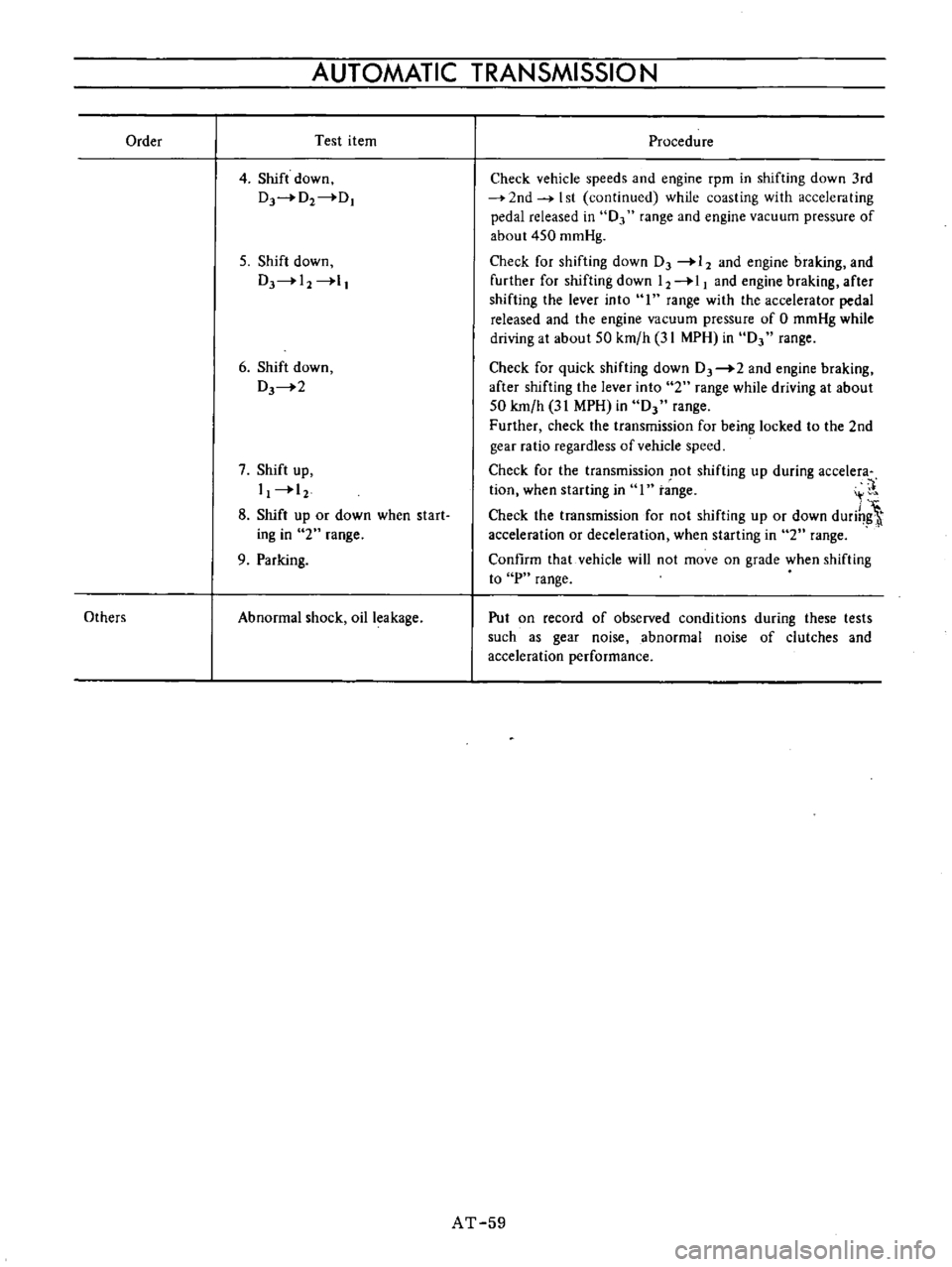
Order
Others
AUTOMATIC
TRANSMISSION
Test
item
4
Shift
down
Dr4D2
DI
5
Shift
down
DJ
I2
l
6
Shift
down
DJ
2
7
Shift
up
I
12
8
Shift
up
or
down
when
start
ing
in
2
range
9
Parking
Abnormal
shock
oil
leakage
Procedure
Check
vehicle
speeds
and
engine
rpm
in
shifting
down
3rd
2nd
I
st
continued
while
coasting
with
acceleraling
pedal
released
in
0
range
and
engine
vacuum
pressure
of
about
450
mmHg
Check
for
shifting
down
DJ
12
and
engine
braking
and
further
for
shifting
down
12
11
and
engine
braking
after
shifting
the
lever
into
I
range
with
the
accelerator
pedal
released
and
the
engine
vacuum
pressure
of
0
mmHg
while
driving
at
about
SO
km
h
31
MPH
in
DJ
range
Check
for
quick
shifting
down
DJ
2
and
engine
braking
after
shifting
the
lever
into
2
range
while
driving
at
about
50
km
h
31
MPH
in
DJ
range
Further
check
the
transmission
for
being
locked
to
the
2nd
gear
ratio
regardless
of
vehicle
speed
Check
for
the
transmission
not
shifting
up
during
acceIera
tion
when
starting
in
1
t
nge
It
Check
the
transmission
for
not
shifting
up
or
down
durih
t
acceleration
or
deceleration
when
starting
in
2
range
Confirm
that
vehicle
will
not
move
on
grade
when
shifting
to
P
range
Put
on
record
of
observed
conditions
during
these
tests
such
as
gear
noise
abnormal
noise
of
clutches
and
acceleration
performance
AT
59
Page 64 of 513

CHASSIS
SERVICE
DATA
AND
SPECIFICATIONS
General
specifications
Torque
converter
Type
Stall
torque
ratio
Transmission
Type
Control
elements
Gear
ratio
Selector
positions
Oil
pump
Type
Number
of
pump
Oil
Capacity
Hydraulic
control
system
Lubrication
system
Cooling
system
Multiple
disc
clutch
Band
brake
Multiple
disc
brake
One
way
clutch
1st
lnd
3rd
Reverse
P
Park
R
Reverse
N
Neutral
D
Drive
1
lnd
lock
I
Lock
up
AT
60
Symmetrical3
element
I
stage
l
phase
torque
converter
coupling
2
0
I
3
speed
forward
and
one
speed
reverse
with
planetary
gear
train
1
I
I
I
2
458
1
458
1
000
2
182
The
transmission
is
placed
in
neutral
The
output
shaft
is
fixed
The
engine
can
be
started
Backward
running
The
transmission
is
in
neutral
The
engine
can
be
started
Up
or
downshifts
automatically
to
and
from
1st
lnd
and
top
Fixed
at
2nd
Fixed
at
low
or
downshifts
from
2nd
Internally
intermeslting
involute
gear
pump
Automatic
transmission
fluid
Dexron
type
5
5
liters
57
8
U
S
qts
47
8
Imp
qts
Approximately
1
7
liters
27
8
U
S
qts
2
3
8
Imp
qts
in
torque
converter
Controlled
by
detecting
the
negative
pressure
of
intake
manifold
and
the
revolution
speed
of
output
shaft
Forced
lubrication
by
an
oil
pwnp
Air
cooled
Page 66 of 513
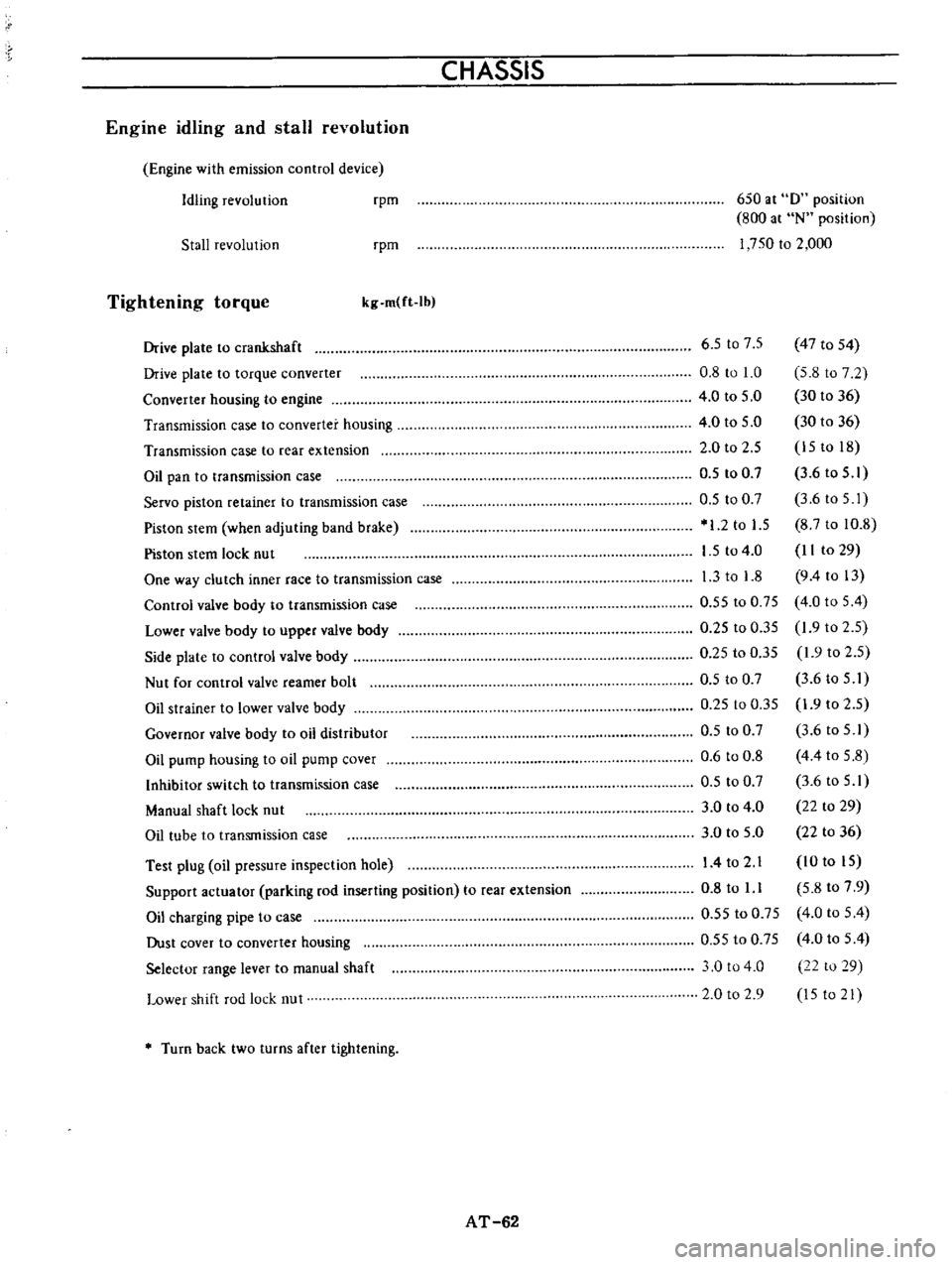
CHASSIS
Engine
idling
and
stall
revolution
Engine
with
emission
control
device
Idling
revolution
rpm
650
at
0
position
800
at
N
position
1
750
to
2
000
Stall
revolution
rpm
Tightening
torque
kg
m
ft
Ib
Test
plug
oil
pressure
inspection
hole
Support
actuator
parking
rod
inserting
position
to
rear
extension
Oil
charging
pipe
to
case
Dust
cover
to
converter
housing
Selector
range
lever
to
manual
shaft
Lower
shift
rod
lock
nut
6
5
t07
5
47
to
54
0
8
to
1
0
5
8
to
7
2
4
0
to
5
0
30
to
36
4
0
to
5
0
30
to
36
2
0
to
2
5
15
to
18
0
5
to
0
7
3
6
to
5
1
0
5
to
0
7
3
6toS
I
1
2
to
1
5
8
7
to
10
8
1
5
to
4
0
II
to
29
1
3
to
1
8
9
4
to
13
0
55
to
0
75
4
0
to
5
4
0
25
to
0
35
1
9
to
2
5
0
25
to
0
35
1
9
to
2
5
0
5
to
0
7
3
6
to
5
I
0
25
to
0
35
1
9
to
2
5
0
5
to
0
7
3
6
to
5
1
0
6
to
0
8
4
4
to
5
8
0
5
to
0
7
3
6
to
5
1
3
0
to
4
0
22
to
29
3
0
to
5
0
22
to
36
14
to
2
1
10
to
15
0
8
to
l
l
5
8
to
7
9
0
55
to
0
75
4
0
to
5
4
0
55
to
0
75
4
0
to
5
4
3
0
to
4
0
22
to
29
2
0
to
2
9
15
to
21
Drive
plate
to
crankshaft
Drive
plate
to
torque
converter
Converter
housing
to
engine
Transmission
case
to
converter
housing
Transmission
case
to
rear
extension
Oil
pan
to
transmission
case
Servo
piston
retainer
to
transmission
case
Piston
stem
when
adjuting
band
brake
Piston
stem
lock
nut
One
way
clutch
inner
race
to
transmission
case
Control
valve
body
to
transmission
case
Lower
valve
body
to
upper
valve
body
Side
plate
to
control
valve
body
Nut
for
control
valve
reamer
bolt
Oil
strainer
to
lower
valve
body
Governor
valve
body
to
oil
distributor
Oil
pump
housing
to
oil
pump
cover
Inhibitor
switch
to
transmh
sion
case
Manual
shaft
lock
nut
Oil
tube
to
transmission
case
Turn
back
two
turns
after
tightening
AT
62
Page 90 of 513
CHASSIS
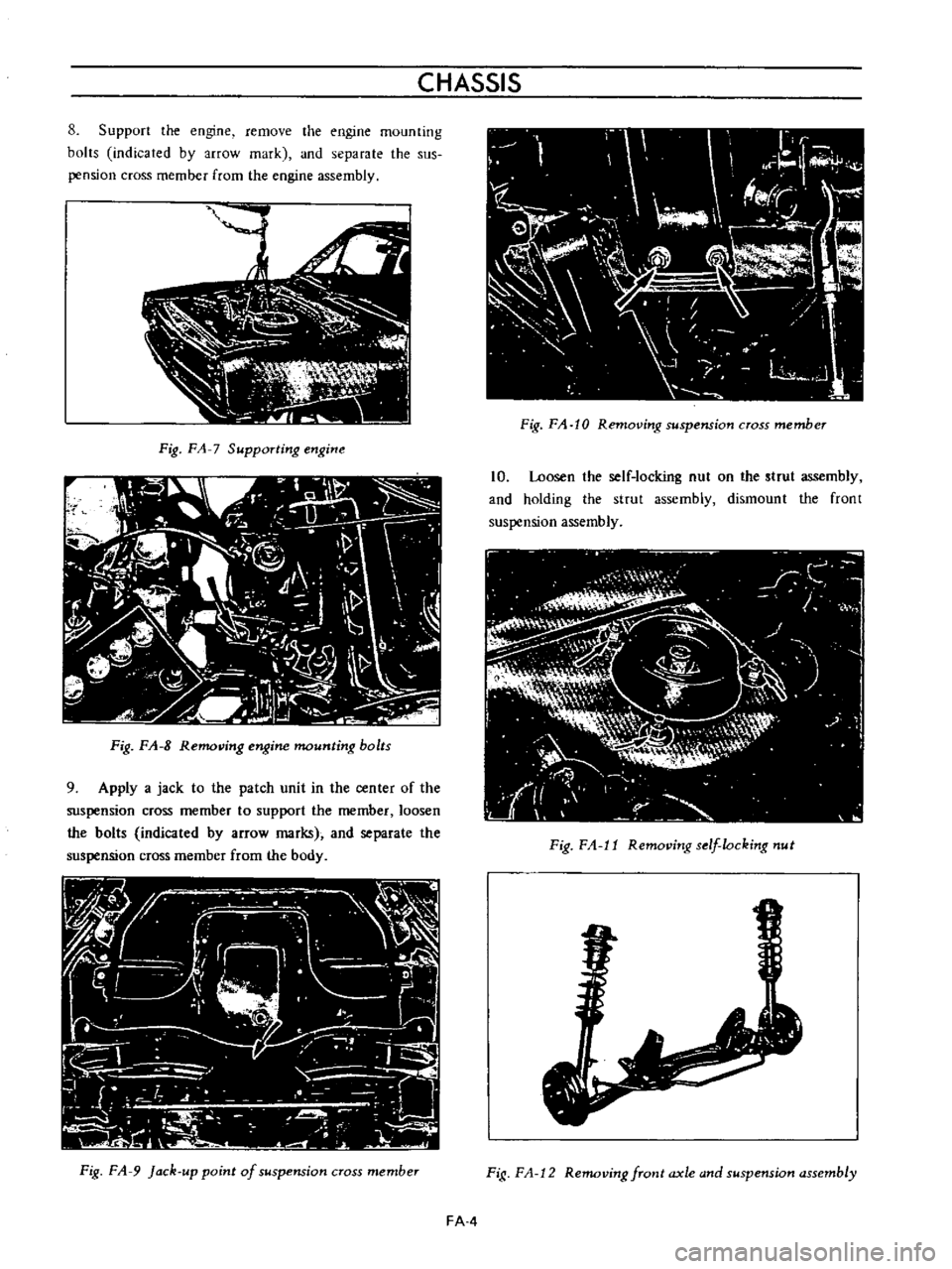
8
Support
the
engine
remove
the
engine
mounting
bolts
indicated
by
arrow
mark
and
separate
the
sus
pension
cross
member
from
the
engine
assembly
Ij
i
1
C
w
ii
lJ
c
l
I
N
r
1
a
n
h
JI
Fig
FA
7
Supporting
engine
I
IV
U
II
G
11J
r
j
F
l
I
IV
I
iL
I
0
I
l
tt
I
i
L
I
It
v
i
1
0
b
c
Ii
irti
J
I
I
1
1
Zi
J
l
ll
c
h
f
J
f
C
Fig
FA
8
Removing
engine
mounting
bolts
9
Apply
a
jack
to
the
patch
unit
in
the
center
of
the
suspension
cross
member
to
support
the
member
loosen
the
bolts
indicated
by
arrow
marks
and
separate
the
suspension
cross
member
from
the
body
Fig
FA
9
Jack
up
point
of
suspension
cross
member
Fig
FA
10
Removing
suspension
cross
member
10
Loosen
the
self
locking
nut
on
the
strut
assembly
and
holding
the
strut
assembly
dismount
the
front
suspension
assembly
Fig
F
1
11
Removing
s
flocking
nut
Fig
F
A
12
Removing
front
axle
and
suspension
assembly
FAA
Page 131 of 513
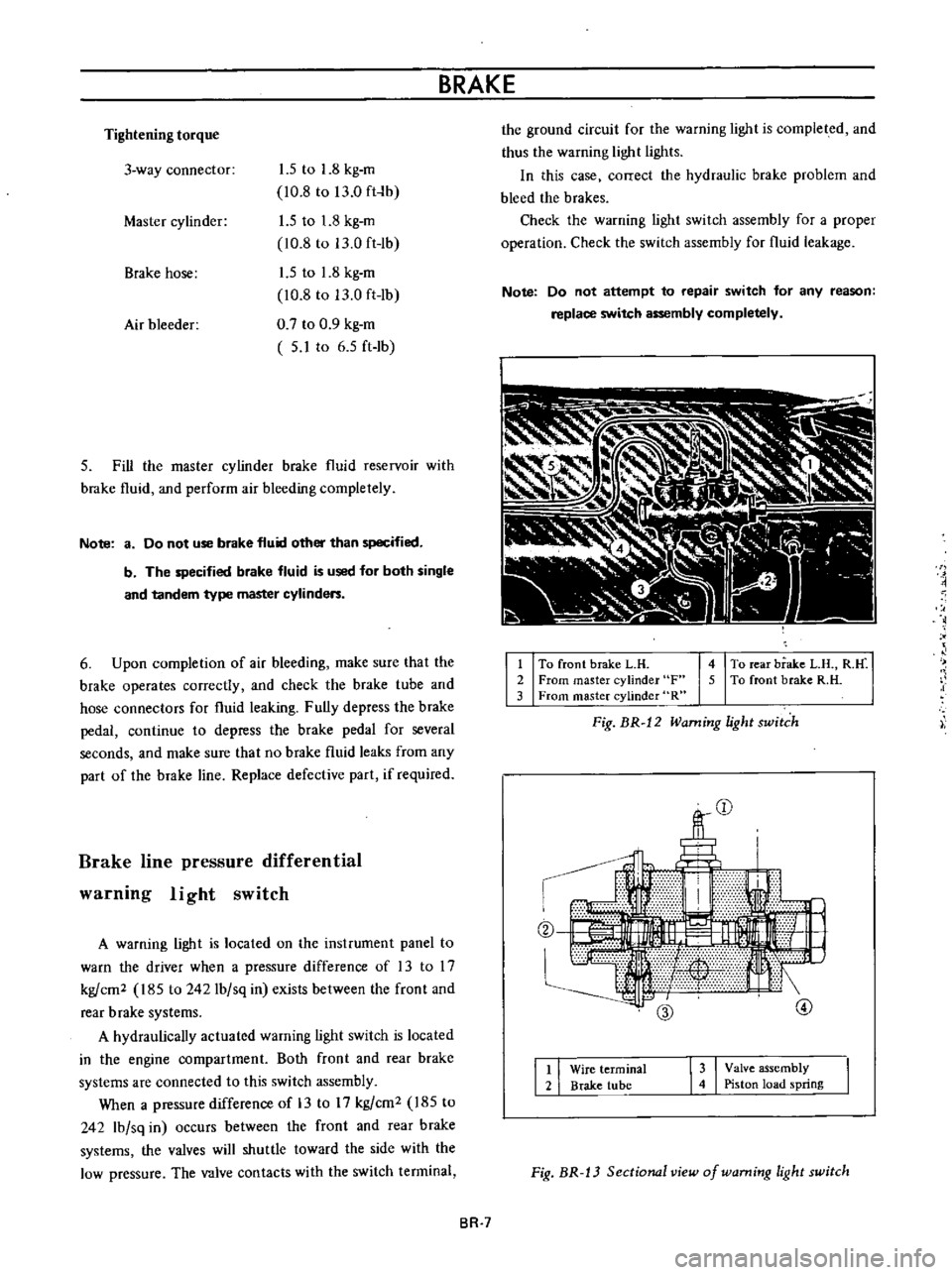
Tightening
torque
3
way
connector
1
5
to
1
8
kg
m
10
8
to
13
0
ft
lh
1
5
to
1
8
kg
m
10
8
to
13
0
ft
lh
1
5
to
1
8
kg
m
10
8
to
13
0
ft
lb
0
7
to
0
9
kg
m
5
1
to
6
5
ft
1b
Master
cylinder
Brake
hose
Air
bleeder
5
Fill
the
master
cylinder
brake
fluid
reservoir
with
brake
fluid
and
perform
air
bleeding
complele1y
Note
a
Do
not
use
brake
fluid
other
than
specified
b
The
specified
brake
fluid
is
used
for
both
single
and
tandem
type
master
cylinders
6
Upon
completion
of
air
bleeding
make
sure
that
the
brake
operates
correctly
and
check
the
brake
tube
and
hose
connectors
for
fluid
leaking
Fully
depress
the
brake
pedal
continue
to
depress
the
brake
pedal
for
several
seconds
and
make
sure
that
no
brake
fluid
leaks
from
any
part
of
the
brake
line
Replace
defective
part
if
required
Brake
line
pressure
differential
warning
light
switch
A
warning
light
is
located
on
the
instrument
panel
to
warn
the
driver
when
a
pressure
difference
of
13
to
17
kg
cm2
185
to
2421bJsq
in
exists
between
the
front
and
rear
b
rake
systems
A
hydraulically
actuated
warning
light
switch
is
located
in
the
engine
compartment
Both
front
and
rear
brake
systems
are
connected
to
this
switch
assembly
When
a
pressure
difference
of
13
to
17
kgJcm2
185
to
242
lbJsq
in
occurs
between
the
front
and
rear
brake
systems
the
valves
will
shuttle
toward
the
side
with
the
low
pressure
The
valve
contacts
with
the
switch
terminal
BRAKE
the
ground
circuit
for
the
warning
light
is
completed
and
thus
the
warning
light
lights
In
this
case
correct
the
hydraulic
brake
problem
and
bleed
the
brakes
Check
the
warning
light
switch
assembly
for
a
proper
operation
Check
the
switch
assembly
for
fluid
leakage
Note
Do
not
attempt
to
repair
switch
for
any
reason
replace
switch
assembly
completely
1
To
front
brake
L
H
2
From
master
cylinder
F
3
From
master
cylinder
R
4
To
rear
brake
L
B
R
M
5
To
front
brake
R
H
Fig
BR
12
Warning
light
switch
r
I
@
I
I
3
I
Valve
assembly
4
Piston
load
spring
Wire
terminal
Brake
tube
Fig
BR
13
Sectional
view
of
warning
light
switch
BR
7