Page 490 of 513
TRANSMISSION
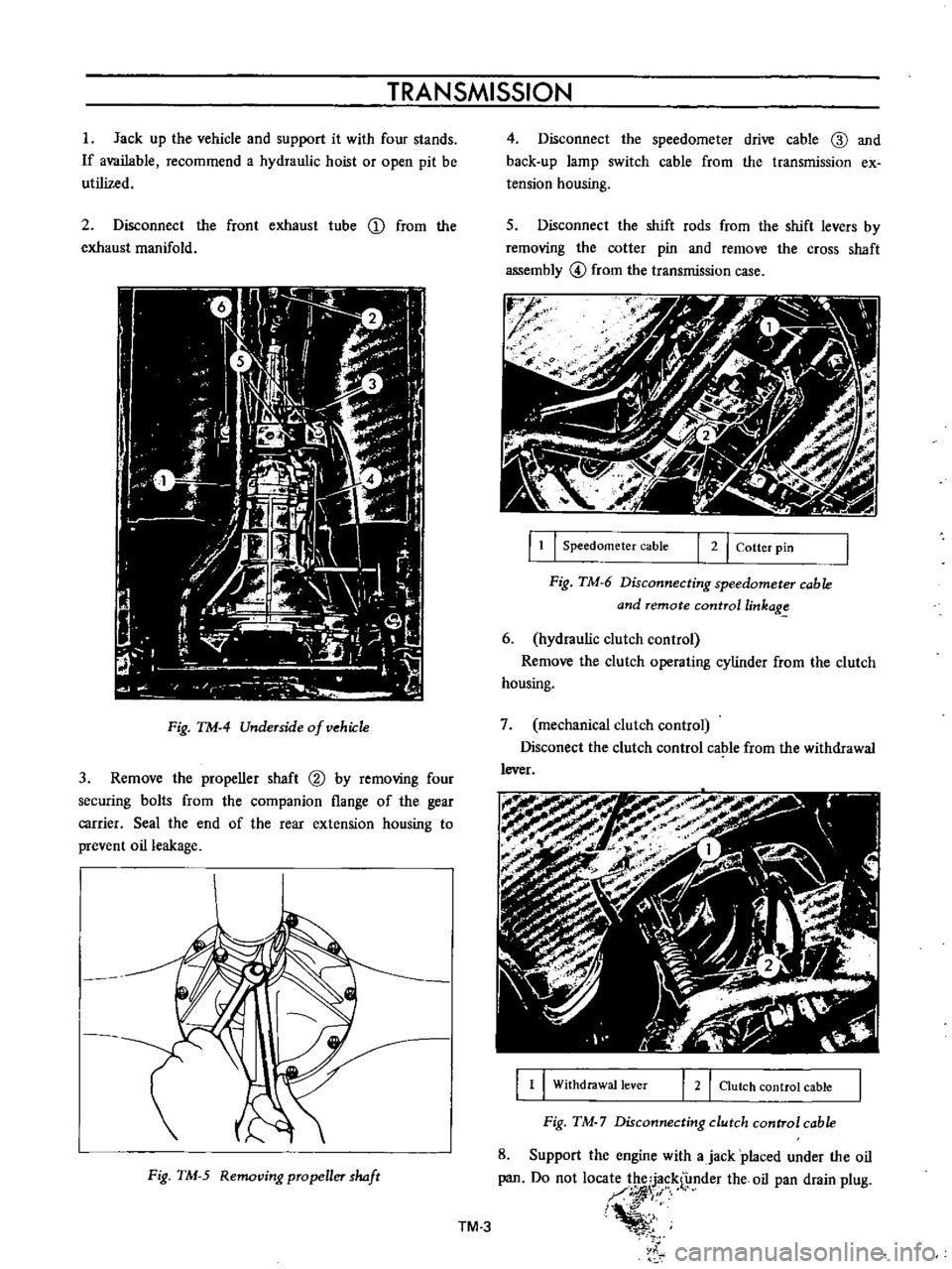
I
Jack
up
the
vehicle
and
support
it
with
four
stands
If
available
recommend
a
hydraulic
hoist
or
open
pit
be
utilized
2
Disconnect
the
front
exhaust
tube
D
from
the
exhaust
manifold
Fig
TM
4
Underside
of
vehiJ
1e
3
Remove
the
propeller
shaft
@
by
removing
four
securing
bolts
from
the
companion
flange
of
the
gear
carrier
Seal
the
end
of
the
rear
extension
housing
to
prevent
oil
leakage
Fig
TM
5
Removing
propeller
haft
4
Disconnect
the
speedometer
drive
cable
ID
and
back
up
lamp
switch
cable
from
the
transmission
ex
tension
housing
s
Disconnect
the
shift
rods
from
the
shift
levers
by
removing
the
cotter
pin
and
remove
the
cross
shaft
assembly
@
from
the
transmission
case
r
J
f
f
1
I
Speedometer
cable
I
2
I
Cotter
pin
Fig
TM
6
Disconnecting
speedometer
cable
and
remote
controllinkag
6
hydraulic
clutch
control
Remove
the
clutch
operating
cylinder
from
the
clutch
housing
7
mechanical
clutch
control
Disconect
the
clutch
control
cable
from
the
withdrawal
lever
1
1
Withdrawal
lever
2
I
Clutch
control
cable
Fig
TM
7
Disconnecting
clutch
control
cable
8
Support
the
engine
with
ajack
placed
under
the
oil
pan
Do
not
loca
1
f
nder
the
oil
pan
drain
plug
I
i
l
TM
3
Page 491 of 513
CHASSIS
To
prevent
the
oil
pan
from
damaging
insert
a
wooden
block
between
the
pan
and
jack
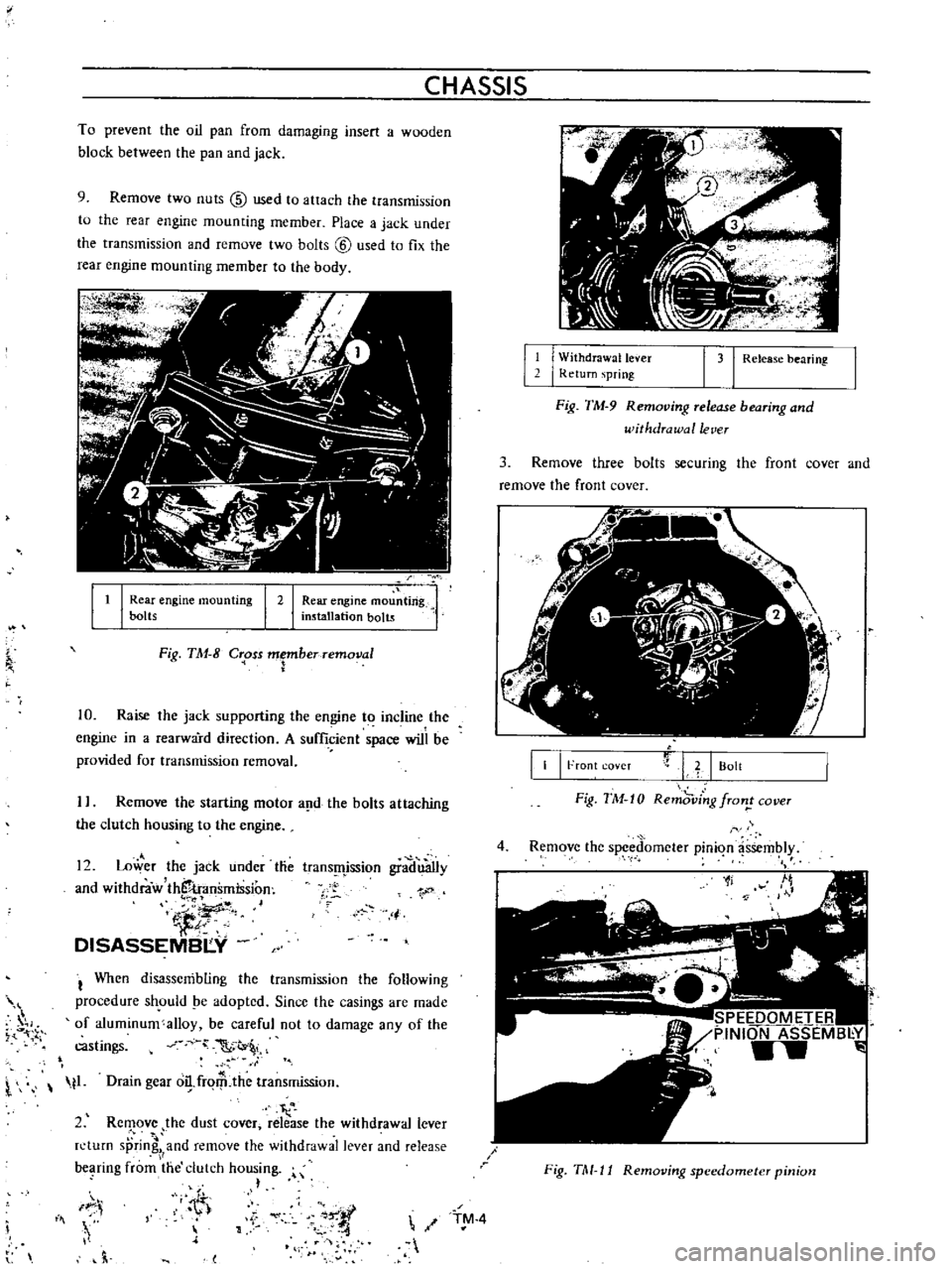
9
Remove
two
nuts
@
used
to
attach
the
transmission
to
the
rear
engine
mounting
member
Place
a
jack
under
the
transmission
and
remove
two
bolts
@
used
to
fix
the
rear
engine
mounting
member
to
the
body
It
I
Rear
engine
mou
ting
installation
bolts
I
Rear
engine
mounting
bolts
I
2
Fig
TM
8
C
oss
Fberremoval
10
Raise
the
jack
supporting
the
engine
to
incline
the
engine
in
a
rearward
direction
A
sufficient
space
will
be
provided
for
transmission
removal
I
Remove
the
starting
motor
a
d
the
bolts
attaching
the
clutch
housing
to
the
engine
12
Lower
the
jack
under
tlie
and
withdraw
thS
transmission
iJ
DISASSEMBI
Y
trans
fljssion
gradu3Ily
1
j
I
When
disassembling
the
transmission
the
following
procedure
sh
ould
pe
adopted
Since
the
casings
are
made
of
aluminum
alloy
be
careful
not
to
damage
any
of
the
castings
C
t
l
t1
Drain
gear
o
frqrP
the
transmission
I
2
Rc
ove
the
dust
cover
release
the
withdrawal
lever
n
turn
sprin
and
remove
the
withdrawal
lever
and
release
bC
lring
from
the
clutch
housing
h
IF
i
Iii
h
l
11
I
W
ithdrawallever
I
Return
spring
1
31
Release
bearing
Fig
TM
9
Removing
release
bearing
and
withdrawal
lever
3
Remove
three
bolts
securing
the
front
cover
and
remove
the
front
cover
II
I
Front
coveT
L
I
Bolt
Fig
TM
10
Remd
ving
fron
cover
4
Remove
the
spced
omcter
pinion
assembly
1f
SPEEDOMETER
PINION
ASSEMB
Y
w
Fig
TM
11
Removing
speedometer
pinion
TM
4
Page 496 of 513
TR
ANSMISSION
Baulk
ring
I
Check
the
baulk
rings
for
wear
pitting
chips
or
burrs
If
any
abnormal
conditions
are
detected
they
must
be
replaced
with
new
ones
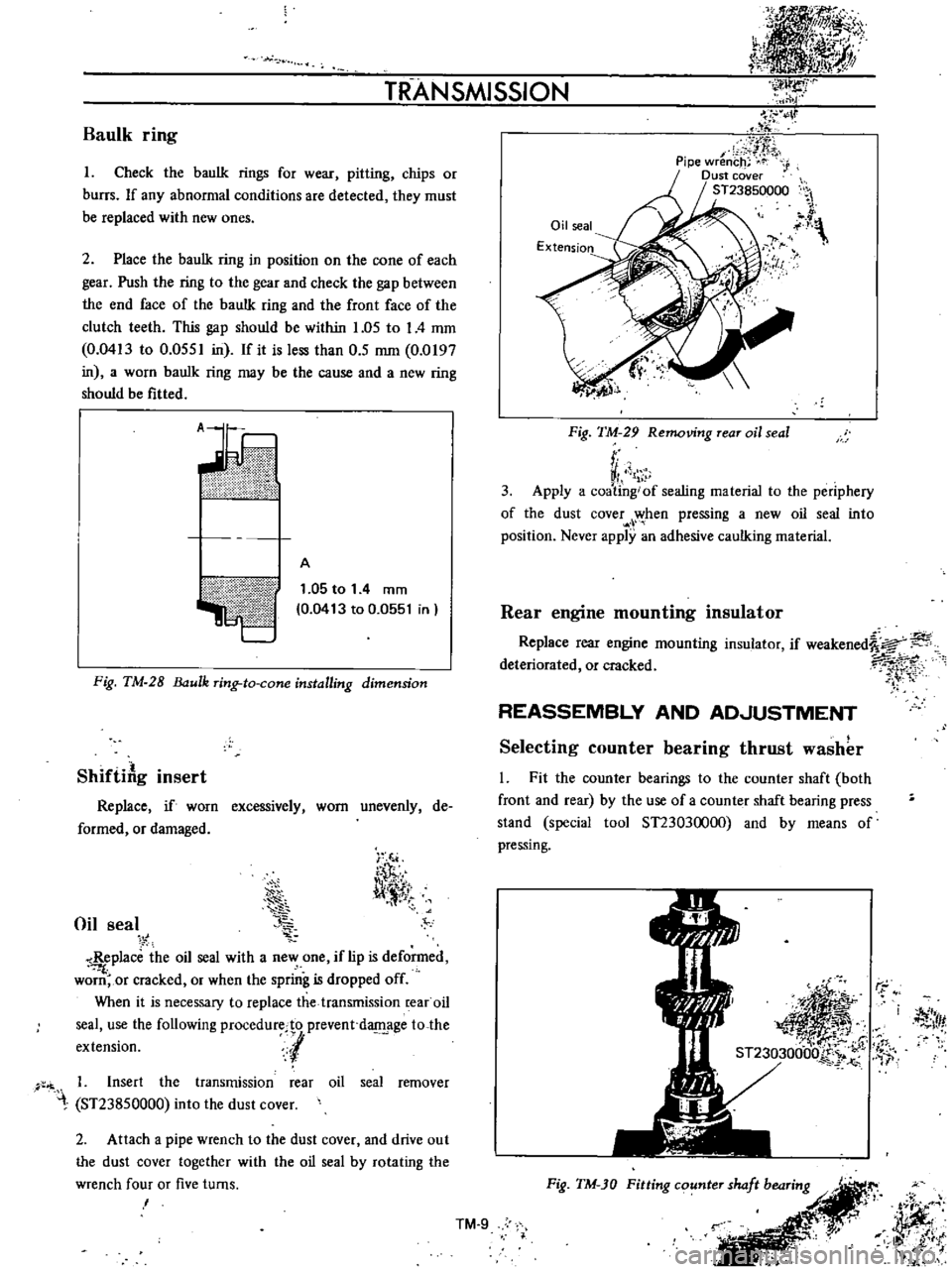
2
Place
the
baulk
ring
in
position
on
the
cone
of
each
gear
Push
the
ring
to
the
gear
and
check
the
gap
between
the
end
face
of
the
bauIk
ring
and
the
front
face
of
the
clutch
teeth
This
gap
should
be
within
1
05
to
I
4
mm
0
0413
to
0
0551
in
If
it
is
less
than
0
5
mm
0
0197
in
a
worn
bauIk
ring
may
be
the
cause
and
a
new
ring
should
be
fitted
ii
V
ilillltII
l
A
1
05
to
1
4
mm
0
0413
to
0
0551
in
Fig
TM
28
ulk
ring
to
cone
installing
dimension
ShiftiAg
insert
Replace
if
worn
excessively
worn
unevenly
de
formed
or
damaged
Oil
seal
i
T
l
l
11
tT
Replace
the
oil
seal
with
a
new
one
if
lip
is
deformed
f
worn
or
cracked
or
when
the
spring
is
dropped
off
When
it
is
necessary
to
replace
the
transmission
rear
oil
seal
use
the
following
procedurecto
prevent
d
age
to
the
extension
l
1
Insert
the
transmission
rear
oil
seal
remover
ST23850000
into
the
dust
cover
2
Attach
a
pipe
wrench
to
the
dust
cover
and
drive
out
the
dust
cover
together
with
the
oil
seal
by
rotating
the
wrench
four
or
five
turns
I
Oil
seal
Extension
IJ
y
Fig
TM
29
Removing
rear
oil
seal
r
VI
1
3
Apply
a
coating
of
sealing
material
to
the
periphery
of
the
dust
cover
when
pressing
a
new
oil
seal
into
position
Never
apply
an
adhesive
caulking
material
Rear
engine
mounting
insulator
Replace
rear
engine
mounting
insulator
if
weakened
a
deteriorated
or
cracked
7i
1
rt
REASSEMBLY
AND
AD
JUSTMENT
Selecting
counter
bearing
thrust
washer
l
Fit
the
counter
bearings
to
the
counter
shaft
both
front
and
rear
by
the
use
of
a
counter
shaft
bearing
press
stand
special
tool
ST23030000
and
by
means
of
pressing
r
j
Itf
Fig
TM
JO
Fitting
counter
shaft
bearing
r
JJff
i
it
l
t
i
j
IlK
Ji
t
l
k
TM
9
Page 507 of 513
CHASSIS
SERVICE
DATA
AND
SPECIFICATIONS
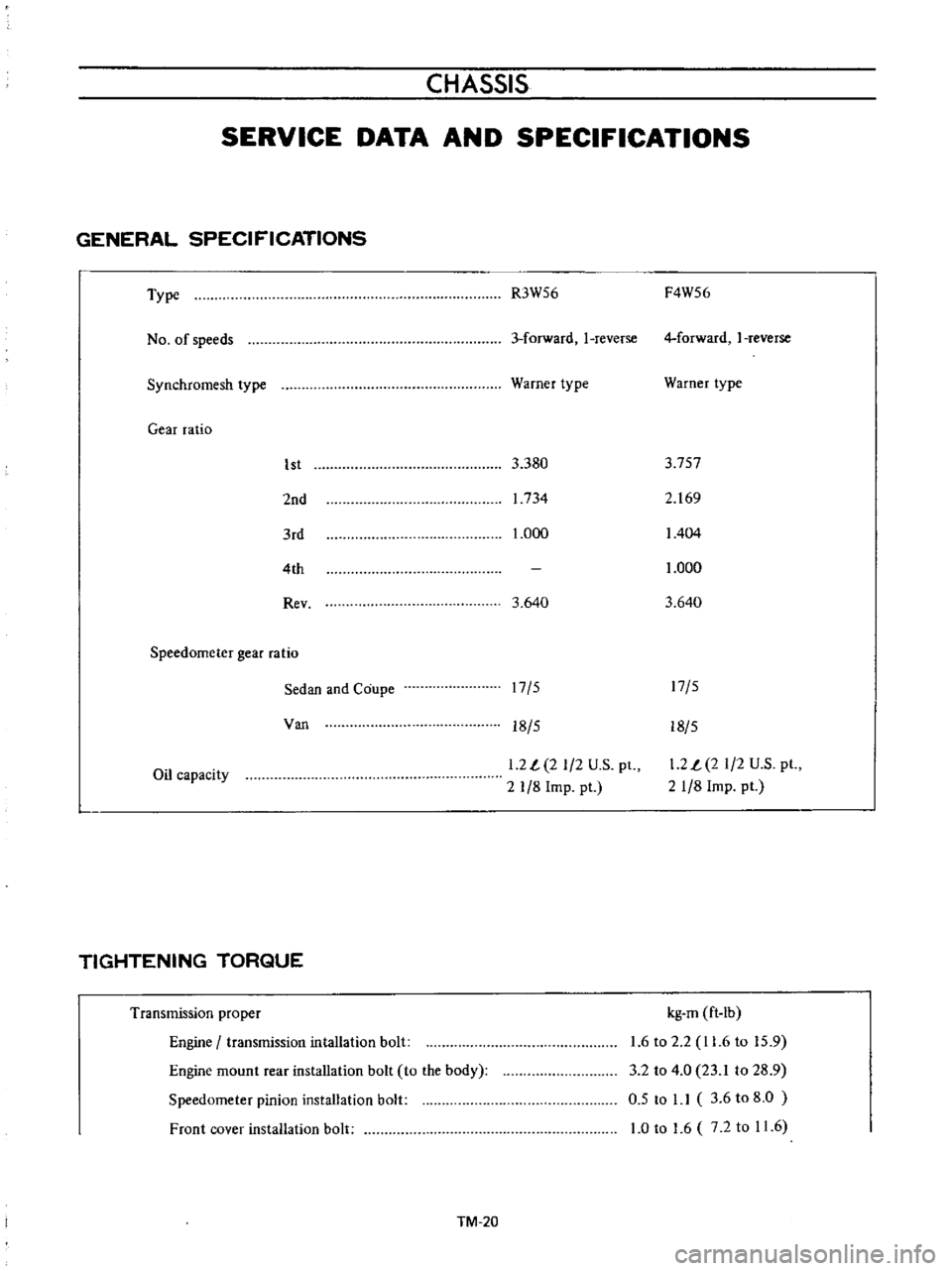
GENERAL
SPECIFICATIONS
Type
No
of
speeds
Synchromesh
type
Gear
ratio
1st
2nd
3rd
4th
Rev
Speedometer
gear
ratio
Sedan
and
Coupe
Van
Oil
capacity
TIGHTENING
TORQUE
Transmission
proper
Engine
transmission
intallation
bolt
Engine
mount
rear
installation
bolt
to
the
body
Speedometer
pinion
installation
bolt
Front
cover
installation
bolt
TM
20
R3W56
F4W56
3
forward
I
reverse
4
forward
I
reverse
Warner
type
Warner
type
3
380
3
757
1734
2
169
1
000
1404
1
000
3
640
3
640
17
5
17
5
18
5
18
5
1
2
L
2
1
2
U
S
pt
2
1
8
Imp
pt
1
2
L
2
1
2
U
S
pt
21
8
Imp
pt
kg
m
ft
Ib
1
6
to
2
2
11
6
to
15
9
3
2
to
4
0
23
1
to
28
9
0
5
to
1
1
3
6
to
8
0
1
0
to
1
6
7
2
to
11
6
Page 509 of 513
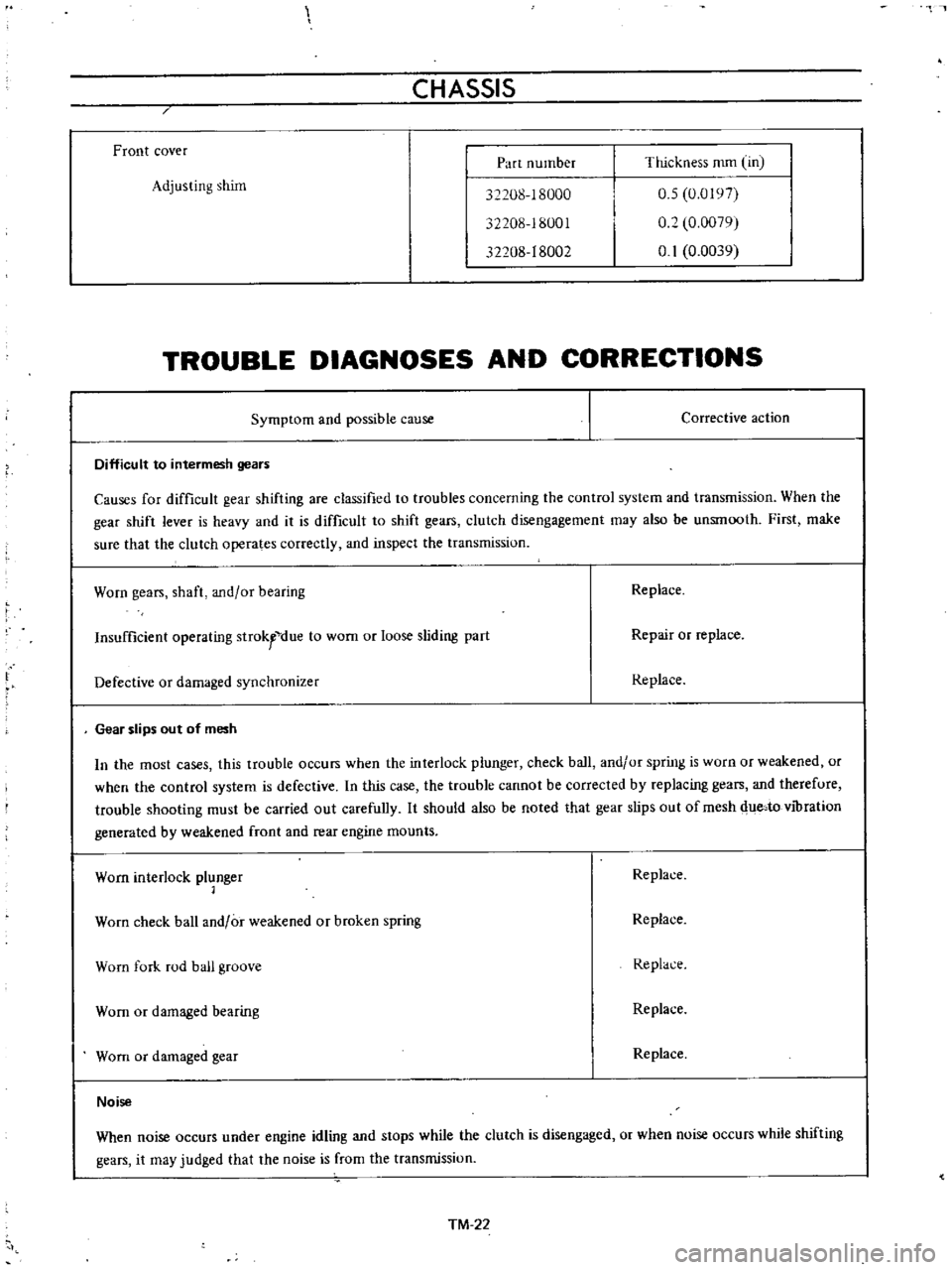
CHASSIS
Front
cover
Part
number
Thickness
mm
Un
Adjusting
shim
32208
18000
32208
18001
32208
18002
0
5
0
0197
0
2
0
0079
0
1
0
0039
TROUBLE
DIAGNOSES
AND
CORRECTIONS
Symptom
and
possible
cause
Corrective
action
Difficult
to
intermesh
gears
Causes
for
difficult
gear
shifting
are
classified
to
troubles
concerning
the
control
system
and
transmission
When
the
gear
shift
lever
is
heavy
and
it
is
difficult
to
shift
gears
clutch
disengagement
may
also
be
unsmooth
First
make
sure
that
the
clutch
operates
correctly
and
inspect
the
transmission
Worn
gears
shaft
and
or
bearing
Replace
Insufficient
operating
strokfdue
to
wom
or
loose
sliding
part
Repair
or
replace
Defective
or
damaged
synchronizer
Replace
Gear
slips
out
of
mesh
In
the
most
cases
this
trouble
occurs
when
the
interlock
plunger
check
ball
and
or
spring
is
wuro
or
weakened
or
when
the
control
system
is
defective
In
this
case
the
trouble
cannot
be
corrected
by
replacing
gears
and
therefure
trouble
shooting
must
be
carried
out
carefully
It
should
also
be
noted
that
gear
slips
out
of
mesh
due
to
vibration
generated
by
weakened
front
and
rear
engine
mounts
Worn
interlock
plunger
1
Replace
Worn
check
ball
and
or
weakened
or
broken
spring
Replace
Worn
fork
rod
ball
groove
Replace
Worn
or
damaged
bearing
Replace
Worn
or
damaged
gear
Replace
Noise
When
noise
occurs
under
engine
idling
and
stops
while
the
clutch
is
disengaged
or
when
noise
occurs
while
shifting
gears
it
may
judged
that
the
noise
is
from
the
transmissiun
TM
22