2005 MERCEDES-BENZ SPRINTER engine coolant
[x] Cancel search: engine coolantPage 660 of 1232
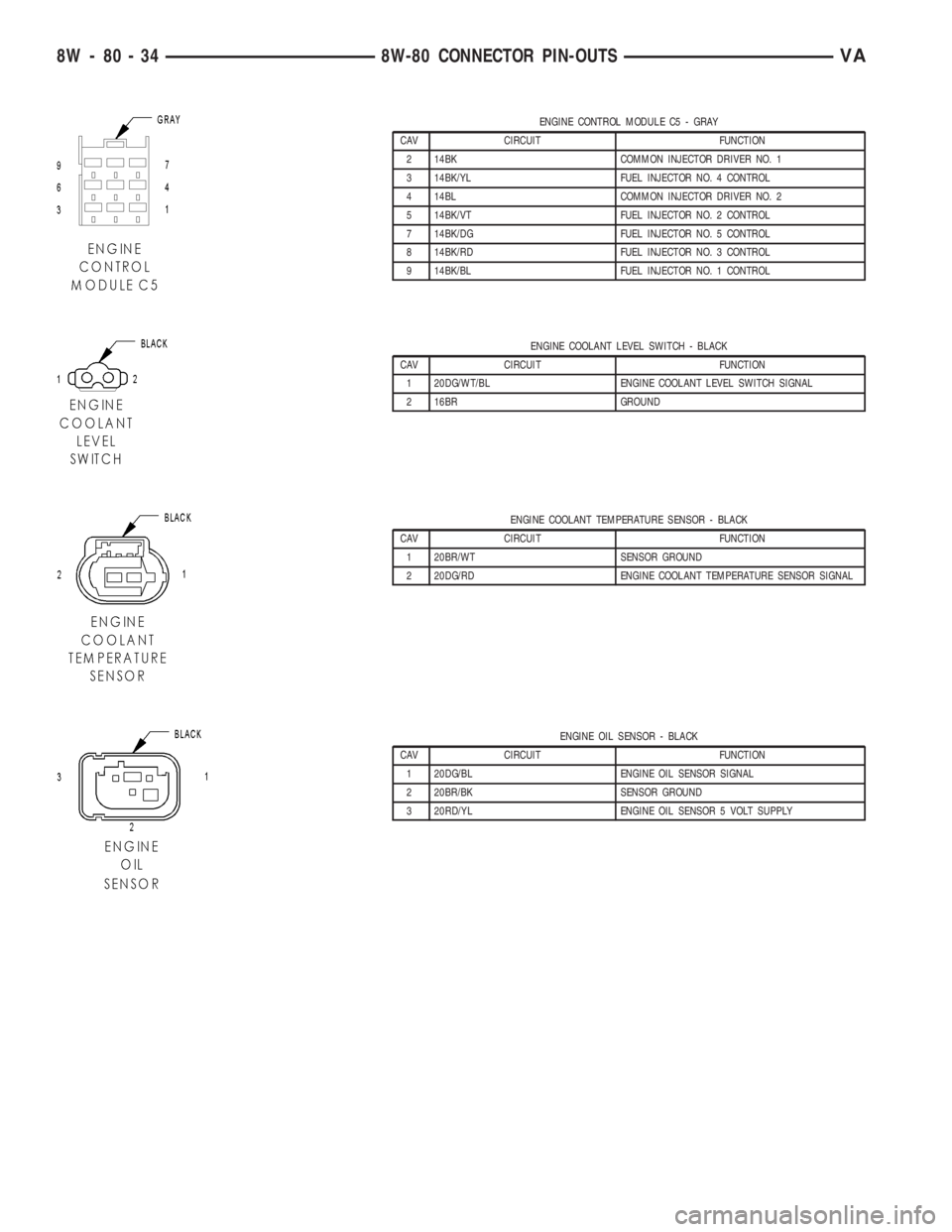
ENGINE CONTROL MODULE C5 - GRAY
CAV CIRCUIT FUNCTION
2 14BK COMMON INJECTOR DRIVER NO. 1
3 14BK/YL FUEL INJECTOR NO. 4 CONTROL
4 14BL COMMON INJECTOR DRIVER NO. 2
5 14BK/VT FUEL INJECTOR NO. 2 CONTROL
7 14BK/DG FUEL INJECTOR NO. 5 CONTROL
8 14BK/RD FUEL INJECTOR NO. 3 CONTROL
9 14BK/BL FUEL INJECTOR NO. 1 CONTROL
ENGINE COOLANT LEVEL SWITCH - BLACK
CAV CIRCUIT FUNCTION
1 20DG/WT/BL ENGINE COOLANT LEVEL SWITCH SIGNAL
2 16BR GROUND
ENGINE COOLANT TEMPERATURE SENSOR - BLACK
CAV CIRCUIT FUNCTION
1 20BR/WT SENSOR GROUND
2 20DG/RD ENGINE COOLANT TEMPERATURE SENSOR SIGNAL
ENGINE OIL SENSOR - BLACK
CAV CIRCUIT FUNCTION
1 20DG/BL ENGINE OIL SENSOR SIGNAL
2 20BR/BK SENSOR GROUND
3 20RD/YL ENGINE OIL SENSOR 5 VOLT SUPPLY
8W - 80 - 34 8W-80 CONNECTOR PIN-OUTSVA
Page 669 of 1232
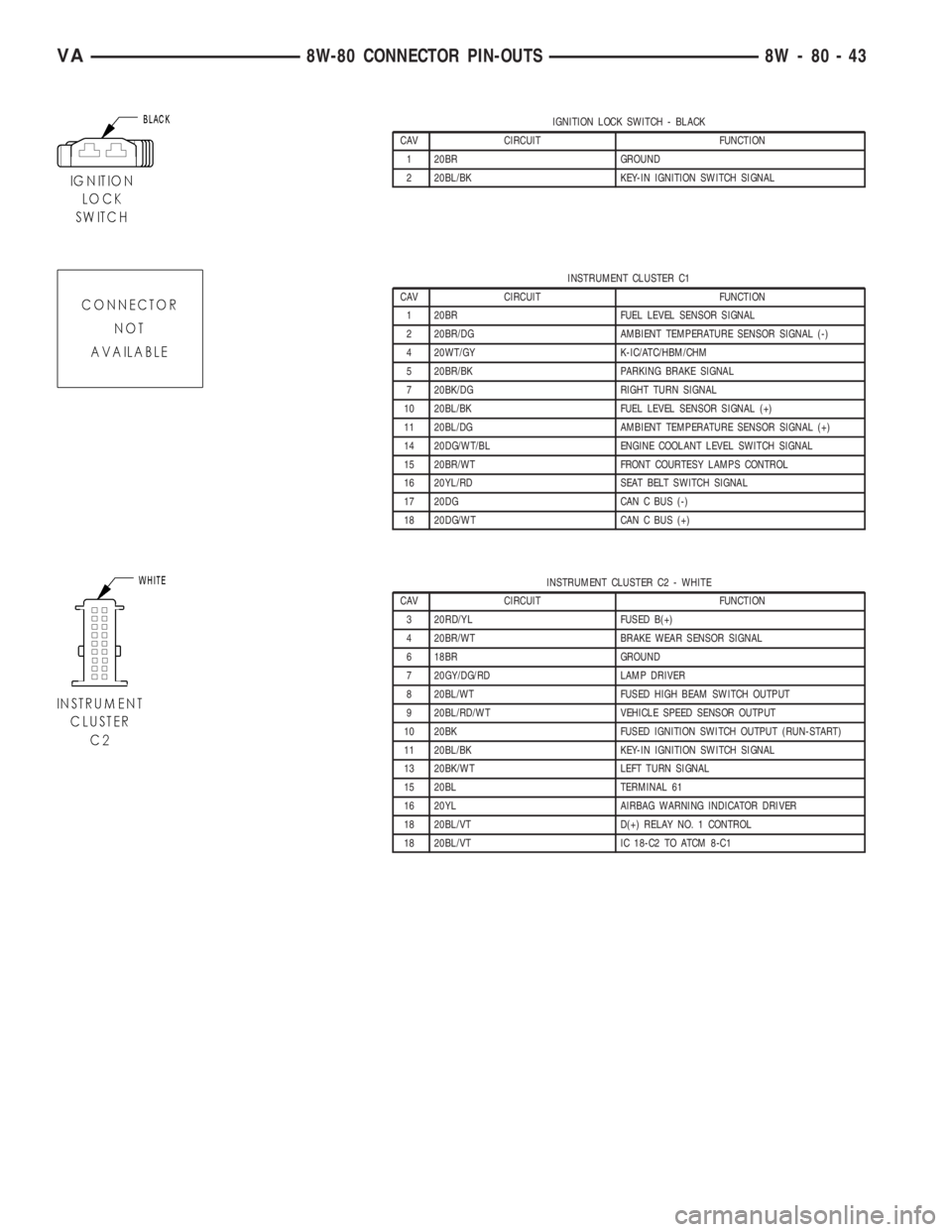
IGNITION LOCK SWITCH - BLACK
CAV CIRCUIT FUNCTION
1 20BR GROUND
2 20BL/BK KEY-IN IGNITION SWITCH SIGNAL
INSTRUMENT CLUSTER C1
CAV CIRCUIT FUNCTION
1 20BR FUEL LEVEL SENSOR SIGNAL
2 20BR/DG AMBIENT TEMPERATURE SENSOR SIGNAL (-)
4 20WT/GY K-IC/ATC/HBM/CHM
5 20BR/BK PARKING BRAKE SIGNAL
7 20BK/DG RIGHT TURN SIGNAL
10 20BL/BK FUEL LEVEL SENSOR SIGNAL (+)
11 20BL/DG AMBIENT TEMPERATURE SENSOR SIGNAL (+)
14 20DG/WT/BL ENGINE COOLANT LEVEL SWITCH SIGNAL
15 20BR/WT FRONT COURTESY LAMPS CONTROL
16 20YL/RD SEAT BELT SWITCH SIGNAL
17 20DG CAN C BUS (-)
18 20DG/WT CAN C BUS (+)
INSTRUMENT CLUSTER C2 - WHITE
CAV CIRCUIT FUNCTION
3 20RD/YL FUSED B(+)
4 20BR/WT BRAKE WEAR SENSOR SIGNAL
6 18BR GROUND
7 20GY/DG/RD LAMP DRIVER
8 20BL/WT FUSED HIGH BEAM SWITCH OUTPUT
9 20BL/RD/WT VEHICLE SPEED SENSOR OUTPUT
10 20BK FUSED IGNITION SWITCH OUTPUT (RUN-START)
11 20BL/BK KEY-IN IGNITION SWITCH SIGNAL
13 20BK/WT LEFT TURN SIGNAL
15 20BL TERMINAL 61
16 20YL AIRBAG WARNING INDICATOR DRIVER
18 20BL/VT D(+) RELAY NO. 1 CONTROL
18 20BL/VT IC 18-C2 TO ATCM 8-C1
VA8W-80 CONNECTOR PIN-OUTS 8W - 80 - 43
Page 698 of 1232
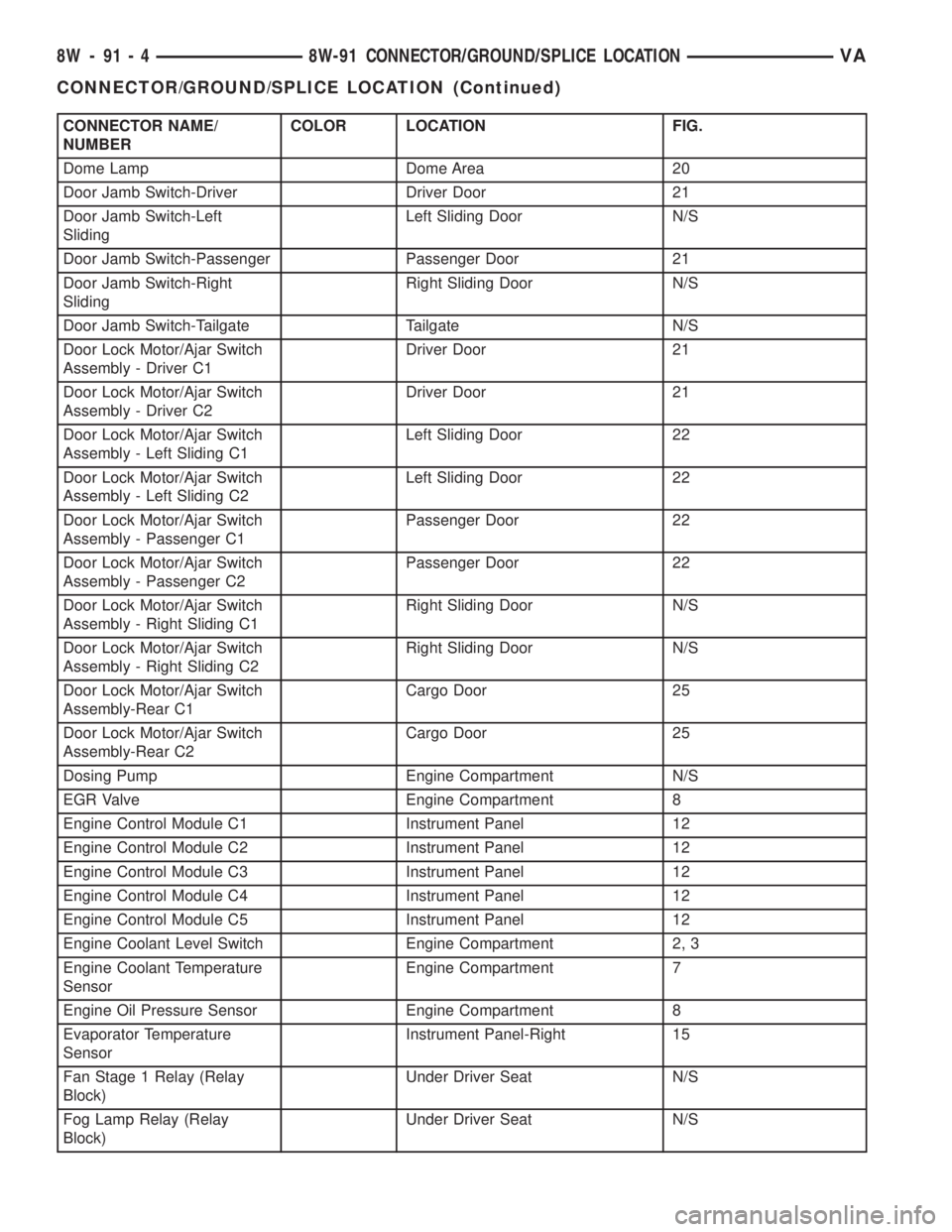
CONNECTOR NAME/
NUMBERCOLOR LOCATION FIG.
Dome Lamp Dome Area 20
Door Jamb Switch-Driver Driver Door 21
Door Jamb Switch-Left
SlidingLeft Sliding Door N/S
Door Jamb Switch-Passenger Passenger Door 21
Door Jamb Switch-Right
SlidingRight Sliding Door N/S
Door Jamb Switch-Tailgate Tailgate N/S
Door Lock Motor/Ajar Switch
Assembly - Driver C1Driver Door 21
Door Lock Motor/Ajar Switch
Assembly - Driver C2Driver Door 21
Door Lock Motor/Ajar Switch
Assembly - Left Sliding C1Left Sliding Door 22
Door Lock Motor/Ajar Switch
Assembly - Left Sliding C2Left Sliding Door 22
Door Lock Motor/Ajar Switch
Assembly - Passenger C1Passenger Door 22
Door Lock Motor/Ajar Switch
Assembly - Passenger C2Passenger Door 22
Door Lock Motor/Ajar Switch
Assembly - Right Sliding C1Right Sliding Door N/S
Door Lock Motor/Ajar Switch
Assembly - Right Sliding C2Right Sliding Door N/S
Door Lock Motor/Ajar Switch
Assembly-Rear C1Cargo Door 25
Door Lock Motor/Ajar Switch
Assembly-Rear C2Cargo Door 25
Dosing Pump Engine Compartment N/S
EGR Valve Engine Compartment 8
Engine Control Module C1 Instrument Panel 12
Engine Control Module C2 Instrument Panel 12
Engine Control Module C3 Instrument Panel 12
Engine Control Module C4 Instrument Panel 12
Engine Control Module C5 Instrument Panel 12
Engine Coolant Level Switch Engine Compartment 2, 3
Engine Coolant Temperature
SensorEngine Compartment 7
Engine Oil Pressure Sensor Engine Compartment 8
Evaporator Temperature
SensorInstrument Panel-Right 15
Fan Stage 1 Relay (Relay
Block)Under Driver Seat N/S
Fog Lamp Relay (Relay
Block)Under Driver Seat N/S
8W - 91 - 4 8W-91 CONNECTOR/GROUND/SPLICE LOCATIONVA
CONNECTOR/GROUND/SPLICE LOCATION (Continued)
Page 741 of 1232
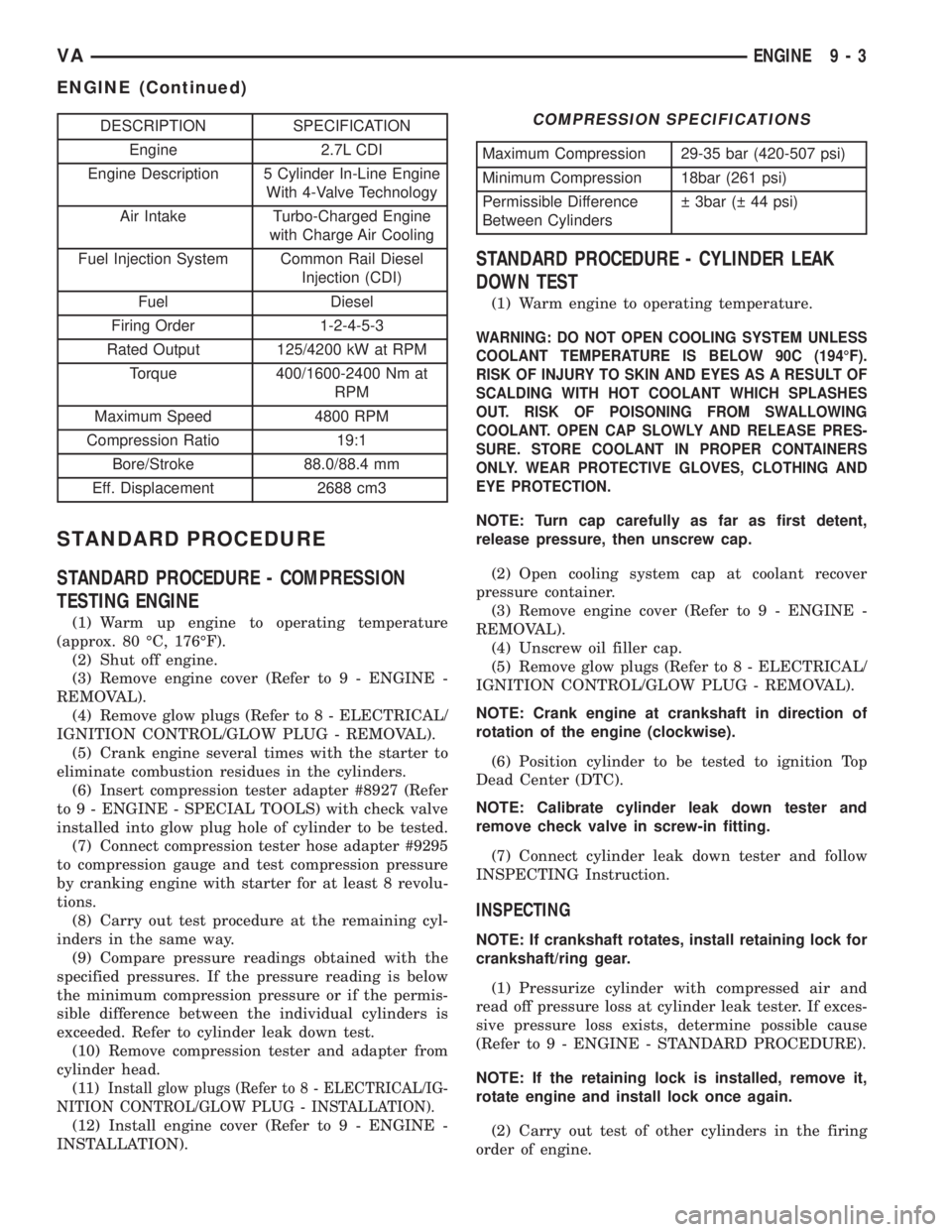
DESCRIPTION SPECIFICATION
Engine 2.7L CDI
Engine Description 5 Cylinder In-Line Engine
With 4-Valve Technology
Air Intake Turbo-Charged Engine
with Charge Air Cooling
Fuel Injection System Common Rail Diesel
Injection (CDI)
Fuel Diesel
Firing Order 1-2-4-5-3
Rated Output 125/4200 kW at RPM
Torque 400/1600-2400 Nm at
RPM
Maximum Speed 4800 RPM
Compression Ratio 19:1
Bore/Stroke 88.0/88.4 mm
Eff. Displacement 2688 cm3
STANDARD PROCEDURE
STANDARD PROCEDURE - COMPRESSION
TESTING ENGINE
(1) Warm up engine to operating temperature
(approx. 80 ÉC, 176ÉF).
(2) Shut off engine.
(3) Remove engine cover (Refer to 9 - ENGINE -
REMOVAL).
(4) Remove glow plugs (Refer to 8 - ELECTRICAL/
IGNITION CONTROL/GLOW PLUG - REMOVAL).
(5) Crank engine several times with the starter to
eliminate combustion residues in the cylinders.
(6) Insert compression tester adapter #8927 (Refer
to 9 - ENGINE - SPECIAL TOOLS) with check valve
installed into glow plug hole of cylinder to be tested.
(7) Connect compression tester hose adapter #9295
to compression gauge and test compression pressure
by cranking engine with starter for at least 8 revolu-
tions.
(8) Carry out test procedure at the remaining cyl-
inders in the same way.
(9) Compare pressure readings obtained with the
specified pressures. If the pressure reading is below
the minimum compression pressure or if the permis-
sible difference between the individual cylinders is
exceeded. Refer to cylinder leak down test.
(10) Remove compression tester and adapter from
cylinder head.
(11)
Install glow plugs (Refer to 8 - ELECTRICAL/IG-
NITION CONTROL/GLOW PLUG - INSTALLATION).
(12) Install engine cover (Refer to 9 - ENGINE -
INSTALLATION).
COMPRESSION SPECIFICATIONS
Maximum Compression 29-35 bar (420-507 psi)
Minimum Compression 18bar (261 psi)
Permissible Difference
Between Cylinders 3bar ( 44 psi)
STANDARD PROCEDURE - CYLINDER LEAK
DOWN TEST
(1) Warm engine to operating temperature.
WARNING: DO NOT OPEN COOLING SYSTEM UNLESS
COOLANT TEMPERATURE IS BELOW 90C (194ÉF).
RISK OF INJURY TO SKIN AND EYES AS A RESULT OF
SCALDING WITH HOT COOLANT WHICH SPLASHES
OUT. RISK OF POISONING FROM SWALLOWING
COOLANT. OPEN CAP SLOWLY AND RELEASE PRES-
SURE. STORE COOLANT IN PROPER CONTAINERS
ONLY. WEAR PROTECTIVE GLOVES, CLOTHING AND
EYE PROTECTION.
NOTE: Turn cap carefully as far as first detent,
release pressure, then unscrew cap.
(2) Open cooling system cap at coolant recover
pressure container.
(3) Remove engine cover (Refer to 9 - ENGINE -
REMOVAL).
(4) Unscrew oil filler cap.
(5) Remove glow plugs (Refer to 8 - ELECTRICAL/
IGNITION CONTROL/GLOW PLUG - REMOVAL).
NOTE: Crank engine at crankshaft in direction of
rotation of the engine (clockwise).
(6) Position cylinder to be tested to ignition Top
Dead Center (DTC).
NOTE: Calibrate cylinder leak down tester and
remove check valve in screw-in fitting.
(7) Connect cylinder leak down tester and follow
INSPECTING Instruction.
INSPECTING
NOTE: If crankshaft rotates, install retaining lock for
crankshaft/ring gear.
(1) Pressurize cylinder with compressed air and
read off pressure loss at cylinder leak tester. If exces-
sive pressure loss exists, determine possible cause
(Refer to 9 - ENGINE - STANDARD PROCEDURE).
NOTE: If the retaining lock is installed, remove it,
rotate engine and install lock once again.
(2) Carry out test of other cylinders in the firing
order of engine.
VAENGINE 9 - 3
ENGINE (Continued)
Page 742 of 1232
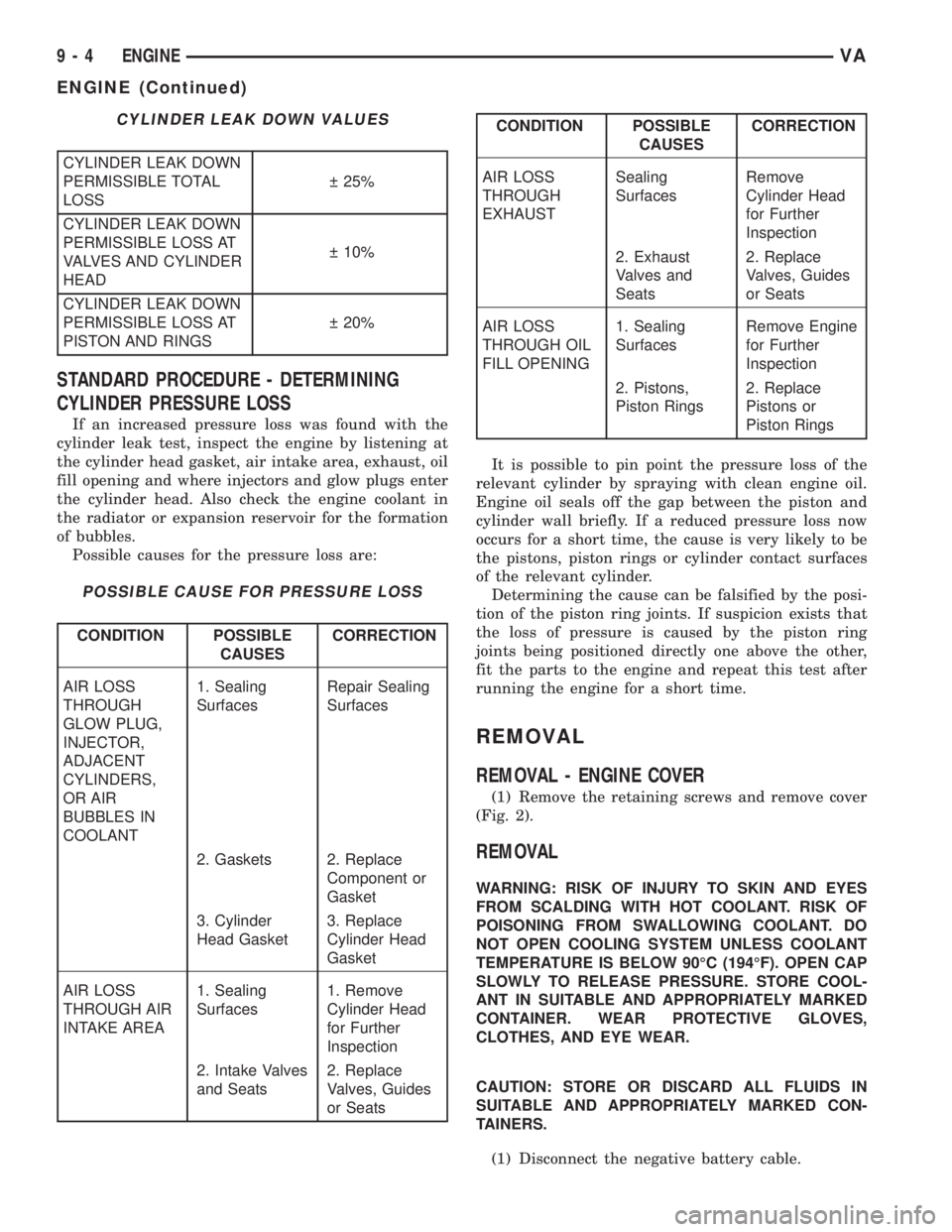
CYLINDER LEAK DOWN VALUES
CYLINDER LEAK DOWN
PERMISSIBLE TOTAL
LOSS 25%
CYLINDER LEAK DOWN
PERMISSIBLE LOSS AT
VALVES AND CYLINDER
HEAD 10%
CYLINDER LEAK DOWN
PERMISSIBLE LOSS AT
PISTON AND RINGS 20%
STANDARD PROCEDURE - DETERMINING
CYLINDER PRESSURE LOSS
If an increased pressure loss was found with the
cylinder leak test, inspect the engine by listening at
the cylinder head gasket, air intake area, exhaust, oil
fill opening and where injectors and glow plugs enter
the cylinder head. Also check the engine coolant in
the radiator or expansion reservoir for the formation
of bubbles.
Possible causes for the pressure loss are:
POSSIBLE CAUSE FOR PRESSURE LOSS
CONDITION POSSIBLE
CAUSESCORRECTION
AIR LOSS
THROUGH
GLOW PLUG,
INJECTOR,
ADJACENT
CYLINDERS,
OR AIR
BUBBLES IN
COOLANT1. Sealing
SurfacesRepair Sealing
Surfaces
2. Gaskets 2. Replace
Component or
Gasket
3. Cylinder
Head Gasket3. Replace
Cylinder Head
Gasket
AIR LOSS
THROUGH AIR
INTAKE AREA1. Sealing
Surfaces1. Remove
Cylinder Head
for Further
Inspection
2. Intake Valves
and Seats2. Replace
Valves, Guides
or Seats
CONDITION POSSIBLE
CAUSESCORRECTION
AIR LOSS
THROUGH
EXHAUSTSealing
SurfacesRemove
Cylinder Head
for Further
Inspection
2. Exhaust
Valves and
Seats2. Replace
Valves, Guides
or Seats
AIR LOSS
THROUGH OIL
FILL OPENING1. Sealing
SurfacesRemove Engine
for Further
Inspection
2. Pistons,
Piston Rings2. Replace
Pistons or
Piston Rings
It is possible to pin point the pressure loss of the
relevant cylinder by spraying with clean engine oil.
Engine oil seals off the gap between the piston and
cylinder wall briefly. If a reduced pressure loss now
occurs for a short time, the cause is very likely to be
the pistons, piston rings or cylinder contact surfaces
of the relevant cylinder.
Determining the cause can be falsified by the posi-
tion of the piston ring joints. If suspicion exists that
the loss of pressure is caused by the piston ring
joints being positioned directly one above the other,
fit the parts to the engine and repeat this test after
running the engine for a short time.
REMOVAL
REMOVAL - ENGINE COVER
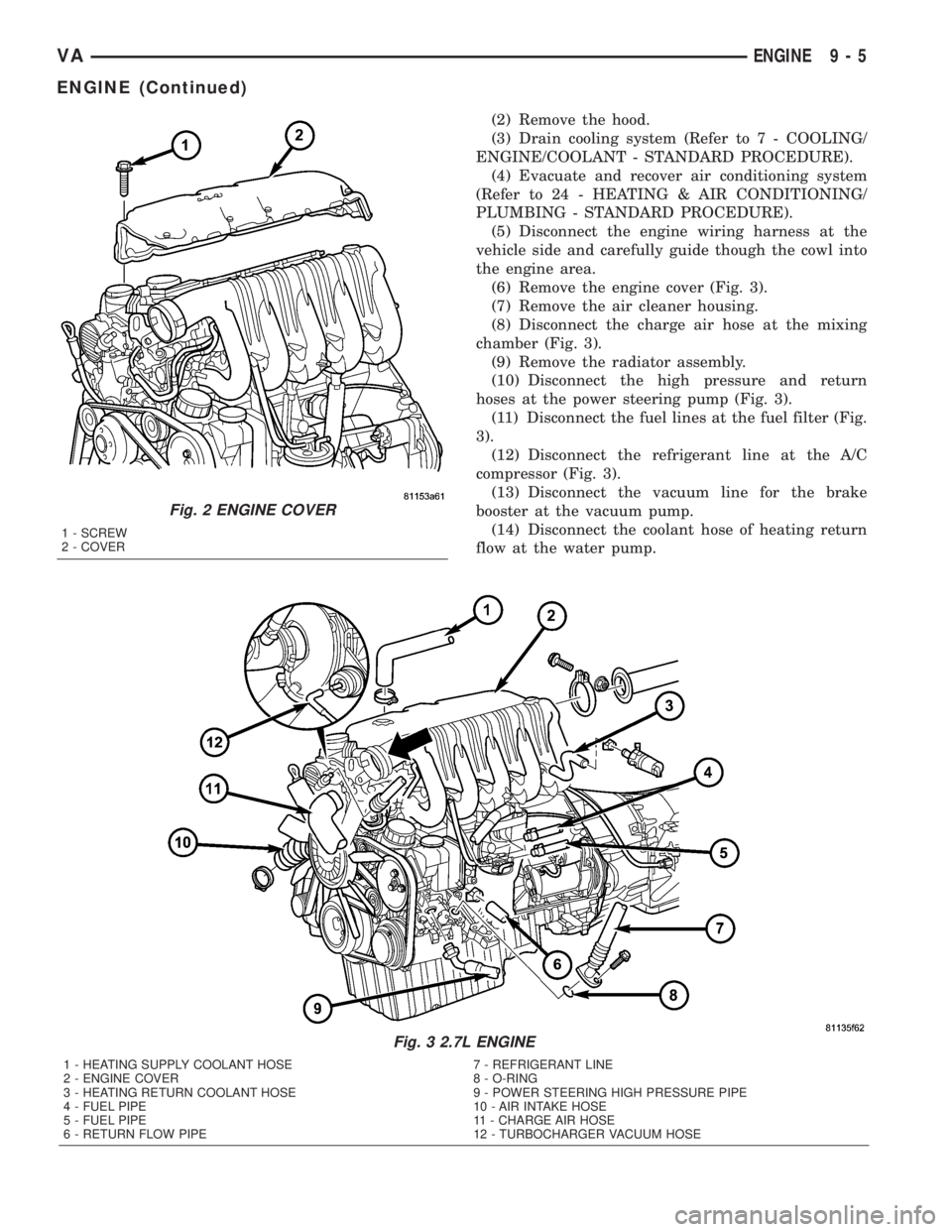
(1) Remove the retaining screws and remove cover
(Fig. 2).
REMOVAL
WARNING: RISK OF INJURY TO SKIN AND EYES
FROM SCALDING WITH HOT COOLANT. RISK OF
POISONING FROM SWALLOWING COOLANT. DO
NOT OPEN COOLING SYSTEM UNLESS COOLANT
TEMPERATURE IS BELOW 90ÉC (194ÉF). OPEN CAP
SLOWLY TO RELEASE PRESSURE. STORE COOL-
ANT IN SUITABLE AND APPROPRIATELY MARKED
CONTAINER. WEAR PROTECTIVE GLOVES,
CLOTHES, AND EYE WEAR.
CAUTION: STORE OR DISCARD ALL FLUIDS IN
SUITABLE AND APPROPRIATELY MARKED CON-
TAINERS.
(1) Disconnect the negative battery cable.
9 - 4 ENGINEVA
ENGINE (Continued)
Page 743 of 1232
(2) Remove the hood.
(3) Drain cooling system (Refer to 7 - COOLING/
ENGINE/COOLANT - STANDARD PROCEDURE).
(4) Evacuate and recover air conditioning system
(Refer to 24 - HEATING & AIR CONDITIONING/
PLUMBING - STANDARD PROCEDURE).
(5) Disconnect the engine wiring harness at the
vehicle side and carefully guide though the cowl into
the engine area.
(6) Remove the engine cover (Fig. 3).
(7) Remove the air cleaner housing.
(8) Disconnect the charge air hose at the mixing
chamber (Fig. 3).
(9) Remove the radiator assembly.
(10) Disconnect the high pressure and return
hoses at the power steering pump (Fig. 3).
(11) Disconnect the fuel lines at the fuel filter (Fig.
3).
(12) Disconnect the refrigerant line at the A/C
compressor (Fig. 3).
(13) Disconnect the vacuum line for the brake
booster at the vacuum pump.
(14) Disconnect the coolant hose of heating return
flow at the water pump.
Fig. 3 2.7L ENGINE
1 - HEATING SUPPLY COOLANT HOSE 7 - REFRIGERANT LINE
2 - ENGINE COVER 8 - O-RING
3 - HEATING RETURN COOLANT HOSE 9 - POWER STEERING HIGH PRESSURE PIPE
4 - FUEL PIPE 10 - AIR INTAKE HOSE
5 - FUEL PIPE 11 - CHARGE AIR HOSE
6 - RETURN FLOW PIPE 12 - TURBOCHARGER VACUUM HOSE
Fig. 2 ENGINE COVER
1 - SCREW
2 - COVER
VAENGINE 9 - 5
ENGINE (Continued)
Page 744 of 1232
(15) Disconnect the coolant hose of the heater sup-
ply at the coolant pipe at the side of the cylinder
head (Fig. 3).
(16) Disconnect the vacuum hose at the turbo-
charger (Fig. 3).
(17) Disconnect the air inlet hose at the turbo-
charger (Fig. 3).
(18) Raise and support the vehicle.
(19) Disconnect the front exhaust at the turbo-
charger.
(20) Disconnect the electrical connector at the
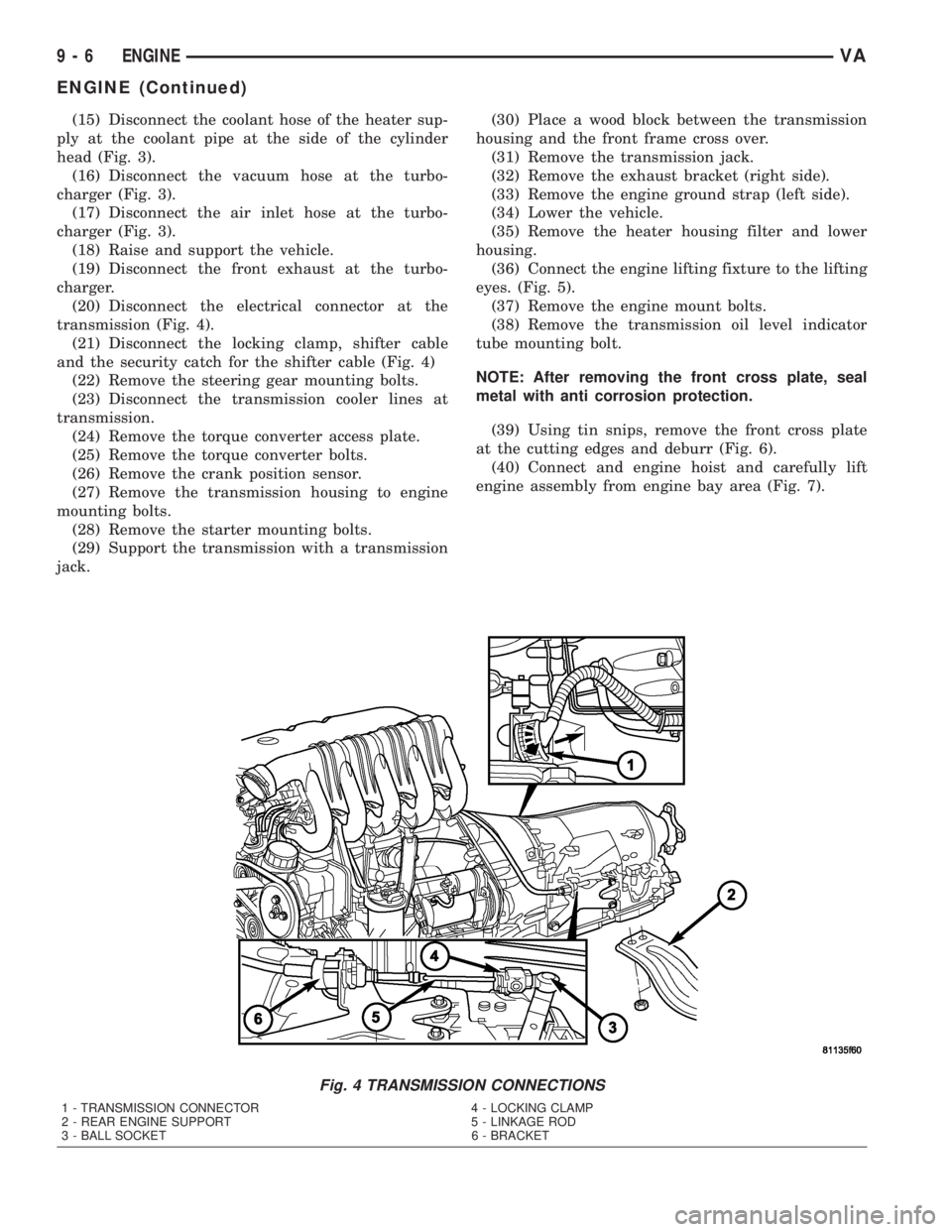
transmission (Fig. 4).
(21) Disconnect the locking clamp, shifter cable
and the security catch for the shifter cable (Fig. 4)
(22) Remove the steering gear mounting bolts.
(23) Disconnect the transmission cooler lines at
transmission.
(24) Remove the torque converter access plate.
(25) Remove the torque converter bolts.
(26) Remove the crank position sensor.
(27) Remove the transmission housing to engine
mounting bolts.
(28) Remove the starter mounting bolts.
(29) Support the transmission with a transmission
jack.(30) Place a wood block between the transmission
housing and the front frame cross over.
(31) Remove the transmission jack.
(32) Remove the exhaust bracket (right side).
(33) Remove the engine ground strap (left side).
(34) Lower the vehicle.
(35) Remove the heater housing filter and lower
housing.
(36) Connect the engine lifting fixture to the lifting
eyes. (Fig. 5).
(37) Remove the engine mount bolts.
(38) Remove the transmission oil level indicator
tube mounting bolt.
NOTE: After removing the front cross plate, seal
metal with anti corrosion protection.
(39) Using tin snips, remove the front cross plate
at the cutting edges and deburr (Fig. 6).
(40) Connect and engine hoist and carefully lift
engine assembly from engine bay area (Fig. 7).
Fig. 4 TRANSMISSION CONNECTIONS
1 - TRANSMISSION CONNECTOR 4 - LOCKING CLAMP
2 - REAR ENGINE SUPPORT 5 - LINKAGE ROD
3 - BALL SOCKET 6 - BRACKET
9 - 6 ENGINEVA
ENGINE (Continued)
Page 746 of 1232
(11) Install the transmission cooler lines to trans-
mission.(Refer to 21 - TRANSMISSION/TRANS-
AXLE/AUTOMATIC - NAG1 - INSTALLATION) for
correct sequence and torque specification.
(12) Install transmission electrical connector and
shifter hardware.Refer to (Refer to 21 - TRANSMIS-
SION/TRANSAXLE/AUTOMATIC - NAG1 - INSTAL-
LATION) for correct sequence and torque
specification.
(13) Install the steering gear and tighten in two
stages. 25 N´m (18.5 lbs. ft.), then 45 N´m (33 lbs. ft.)
plus 90É.
(14) Install the crank sensor.
(15) Install the starter.
(16) Connect the ground strap (left side).
(17) Align and install the exhaust and bracket
(Refer to 11 - EXHAUST SYSTEM/EXHAUST PIPE -
INSTALLATION).
(18) Lower the vehicle.
(19) Install the air inlet hose at the turbocharger
(Fig. 3).
(20) Connect the vacuum hose at the turbocharger
(Fig. 3).
(21) Connect the coolant supply and return hoses
(Fig. 3).(22) Connect the brake booster vacuum hose at the
vacuum pump (Fig. 3).
(23) Connect the refrigerant lines (Fig. 3).
(24) Connect the fuel lines at the filter assembly
(Fig. 3).
(25) Connect the power steering hoses (Fig. 3).
(26) Install the radiator/charge air cooler and
hose(s) assemblies (Refer to 7 - COOLING/ENGINE/
RADIATOR - INSTALLATION).
(27) Install A/C condenser.
(28) Install air cleaner housing, sensors, and hoses
(Refer to 9 - ENGINE/AIR INTAKE SYSTEM/AIR
CLEANER HOUSING - INSTALLATION).
(29) Route the engine wiring harness inside the
vehicle and connect.
(30) Install the front grill assembly.
(31) Install and align the hood.
(32) Connect the negative battery cable.
(33) Check and fill engine oil.
(34) Fill cooling system to proper level with the
appropriate coolant.
(35) Evacuate and recharge air conditioning.
(36) Check and refill all ancillary system fluid lev-
els.
(37) Start engine and inspect for leaks.
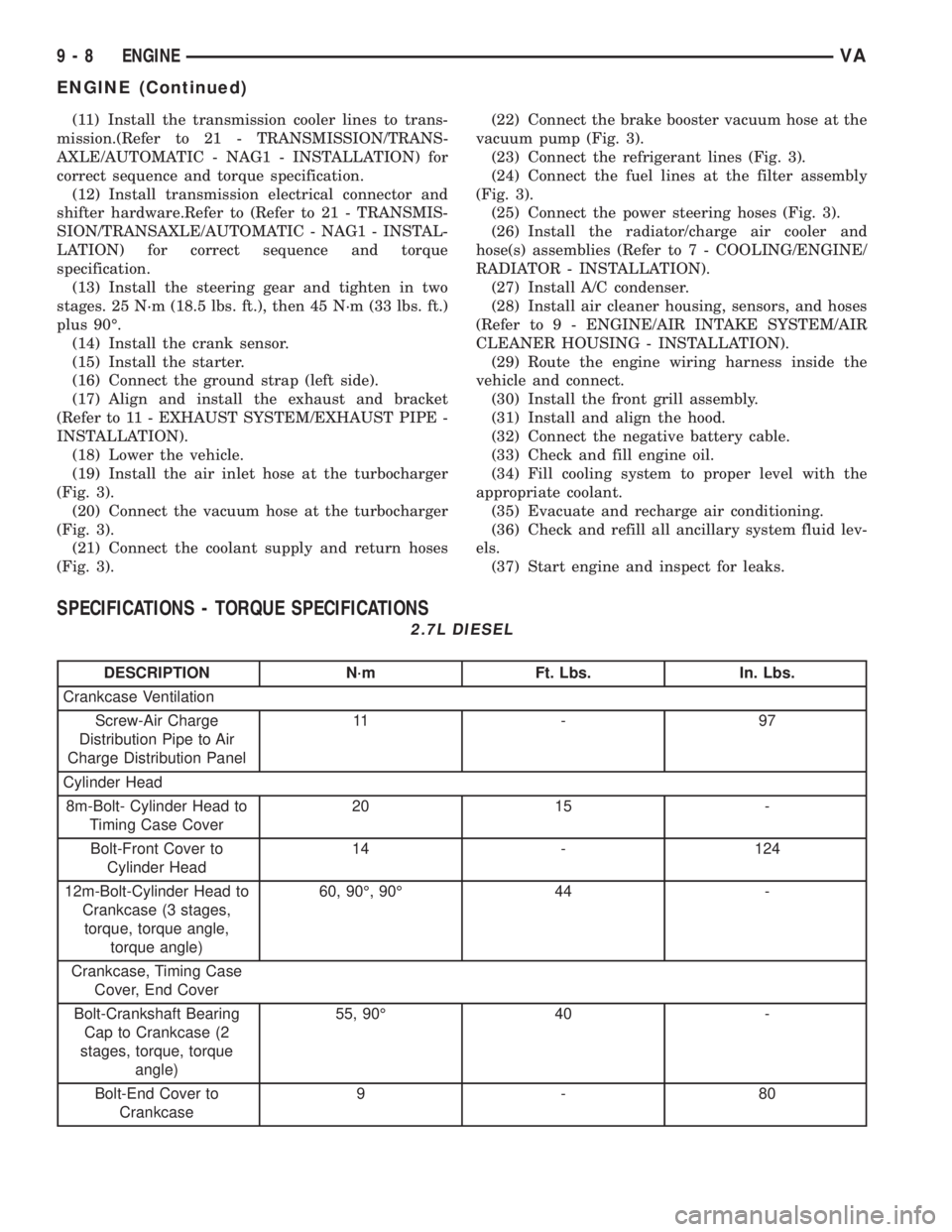
SPECIFICATIONS - TORQUE SPECIFICATIONS
2.7L DIESEL
DESCRIPTION N´m Ft. Lbs. In. Lbs.
Crankcase Ventilation
Screw-Air Charge
Distribution Pipe to Air
Charge Distribution Panel11 - 9 7
Cylinder Head
8m-Bolt- Cylinder Head to
Timing Case Cover20 15 -
Bolt-Front Cover to
Cylinder Head14 - 124
12m-Bolt-Cylinder Head to
Crankcase (3 stages,
torque, torque angle,
torque angle)60, 90É, 90É 44 -
Crankcase, Timing Case
Cover, End Cover
Bolt-Crankshaft Bearing
Cap to Crankcase (2
stages, torque, torque
angle)55, 90É 40 -
Bolt-End Cover to
Crankcase9-80
9 - 8 ENGINEVA
ENGINE (Continued)