2000 AUDI ALLROAD warning
[x] Cancel search: warningPage 77 of 306

CONTROLS ANDEOUWMENT-----------------------------------------
Front seats
The correct positioning of the seats is im
porta nt:
so that you can reach all the controls on
the vehicle quickly and safely;
so that you can drive or ride relaxed and
help reduce fatigue;
and for maximum protection of
fered by the safety belts and air
bag system.
Therefore, always adjust the position of the
seat as described on the following pages.
Remember to adjust the seats before fas
tening the safety belts and before driving
off. Always be sure to follow these general
guidelines:
76 m
WARNING
• Always sit as far away from the
stee ring wheel and the instrument
panel as possible.
• Never sit less than 10 inches
(25 em.) from the steering wheel
and the instrument panel.
• Do not adjust seats while the ve
hicle is moving. Your seat may
move unexpectedly, causing sud·
den loss of vehicle control and
personal injury.
• Passengers must always keep
their feet on the floor whenever
the vehicle is moving. Never place
feet on the dashboard or on top of
the seats. In an accident, serious
personal injury can result from an
improper seating position. BSN-163
Driver's seat
To avoid contact with the airbag while it is
unfolding, the driver must not sit any closer
to the steering wheel than necessary and al
ways properly wear available three point
belts.
Page 86 of 306
---------------------CONTROLS AND
EQUIPMENT
Center armrest
�WARNING
When folded down, the armrest
can restrict the driver's move
ment. When driving in conditions
that may call for quick maneuvers,
fold up the armrest. This will allow
you to react more quickly to avoid
an accident.
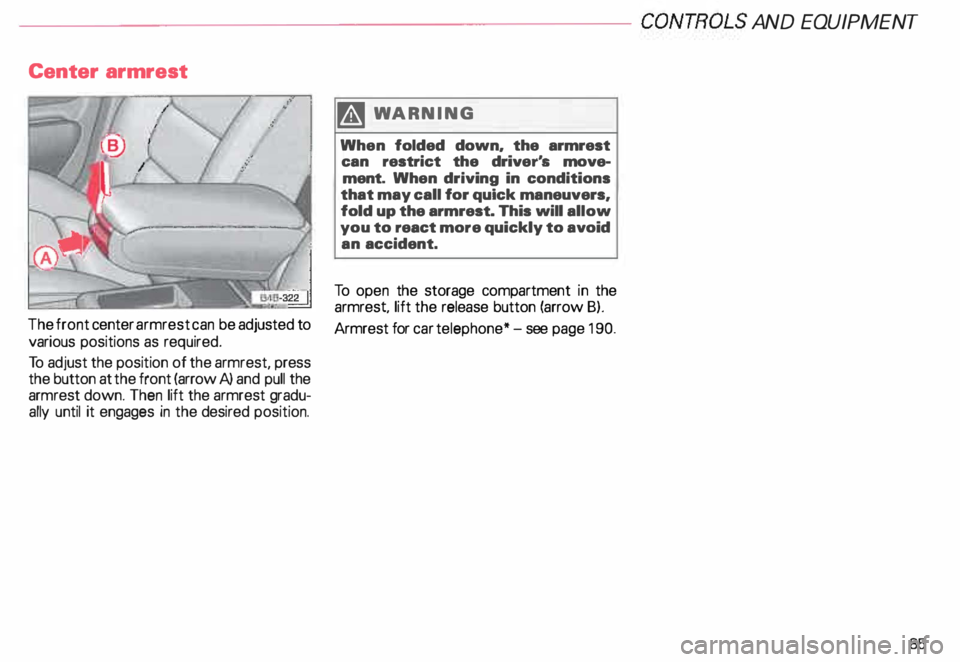
To open the storage compartment in the
armrest lift the release button (arrow B).
The front center armrest can be adjusted to
Armrest for car telephone* -see page 190.
various positions as required.
To adjust the position of the armrest, press
the button at the front (arrow A) and pull the
armrest down. Then lift the armrest gradu
ally until it engages in the desired position.
85
Page 87 of 306
CONT
ROLS AND
EQUIPMENT---------------------
Rear seats
General hints
� WARNING
• Do not allow passengers to
occupy the rear load surface while
the vehicle is in motion. Vehicle
occupants must always be proper
ly restrained.
• Do not let anyone ride in the ve
hicle without the head restraints
provided. Head restraints help re
duce injuries.
• Loose items inside the passen
ger compartment. can fly forward
in an accident or sudden maneuver
and injure occupants. Always
store articles in the luggage
compartment and use the fasten
ing eyes. espec ially when the rear
seat backs have been folded down.
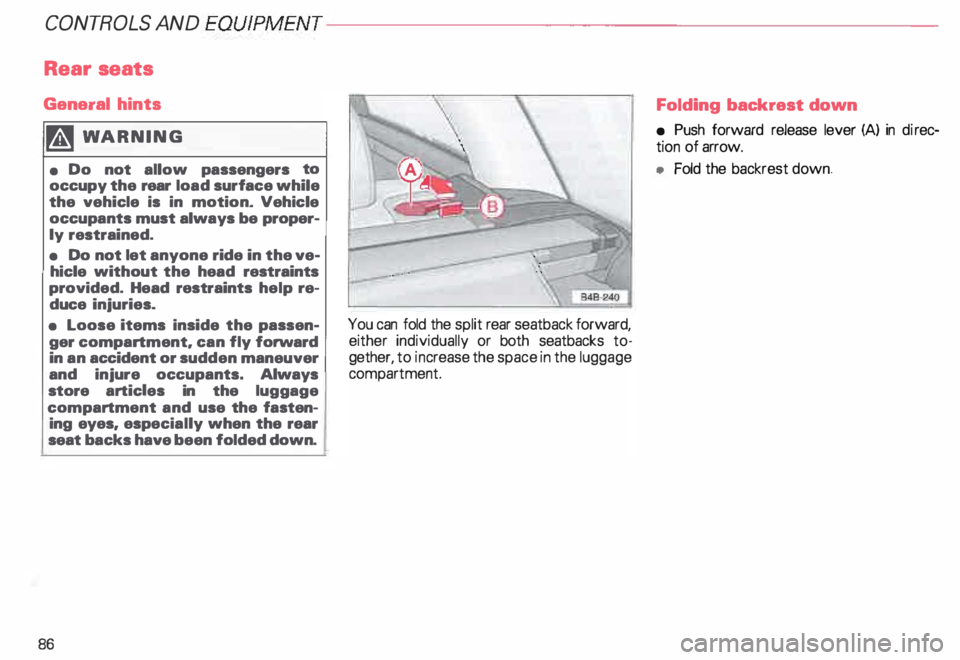
86 You can fold the
split rear seatback forward,
either individually or both seatbacks to
gether, to increase the space in the luggage
compartment. Folding
backrest down
• Push forward release lever (A) in direc
tion of arrow.
• Fold the backrest down.
Page 88 of 306
Returning
backrest to
upright position
Push rear seat backrest up until it engages.
The red marking next to the release lever (B)
should no longer be visible.
When folding the backrest back into
place, make sure the safety belt
doesn't get caught, because It can
be damaged and weakened. �
WARNING
• The backrest must always be se
curely latched so that the safety
belts can work properly to help
protect all back seat passengers.
• Objects stored in the luggage
compartment will not fly forward
during sudden braking.
• Never allow safety belts to be
come damaged by being caught in
door or seat hardware.
• To rn or frayed safety belts can
tear and damaged belt hardware
can break in an accident. Inspect
belts periodically.
If belts show damage to webbing.
bindings, buckles, or retractors,
have them replaced. CONT
ROLS AND EQUIPMENT
87
Page 89 of 306
CONTROLS
AND EQUIPMENT---------------------
Luggage
compartment
Increasing size of the luggage
compartment
Yo u can fold the backrest forward to in
crease the size of the luggage compart
ment.
Tr ansporting heavy objects
Tra nsporting heavy objects can change the
way your vehicle behaves. For best han
dling under these conditions, distribute
loads evenly.
Always place heavy cargo as far forward as
possible in the luggage compartment.
When transporting heavy objects, drive
slowly and avoid sudden maneuvers.
�W ARNING
• Never exceed the Gross Axle
Weight Rating or the Gross Vehicle
Weight Rat�ng specified on the
safety compliance sticker on the
left door jamb. Exceed ing permis
sible weight ratings can change
the way the vehicle handles and
could result in accidents, personal
injur y, and vehicle damage.
88 M
WARNING continued
• Do not allow passengers to
occupy the rear load surface while
the vehicle Is in motion. Vehicle
occupants must always be prop
erly restrained.
• Loose items inside the passen
ger compartment, can fly forward
in an accident or sudden maneuver
and injure occupants. Always
store articles in the luggage
compartment and use the fasten
ing eyes, especially when the rear
seat backs have been folded down.
In particular, when traveling on
rough roads or rugged terrain, ma
ke cert ain that all luggage and
other items are stowed in the lug
gage compartment and that they
are secured in such a way that they
cannot shift. M
WARNING continued
• To help prevent poisonous ex
haust gas from being drawn into
the vehicle, always keep the rear
lid closed while driving. Never
transport objects larger than
those fitting completely into the
luggage area, because the rear lid
cannot be fully closed.
• If you must drive with the rear
lid open under exceptional circum
stances always take the following
precautions to help reduce the risk
of deadly carbon monoxide (CO)
from the exhaust system from be
ing drawn into the passengers
compartment:
open all of the windows
turn off the air recirculation
switch
- select maximum fan speed.
Page 100 of 306
---------------------CONTROLS
AND EQUIPMEN T
U WARNING continued
• The front seats must not be
pushed too close to the steering
wheel or to the instrument panel.
Never sit closer than 10 inches
(25 em) to the steering wheel.
• If you cannot sit more than
1 0 inches (26 em) from the steer
ing wheel, we recommend that
you investigate whether adaptive
equipment may be available to
help you reach the pedals and in
crease your seating distance from
the stee ring wheel.
• Pointing the stee ring wheel to
ward your face decreases the abil
ity of the supplemental driver's air
bag to protect you in an accident. �
WARNING continued
• Always hold the steering wheel
on the outside of the steering
wheel rim with your hands at the
9 o'clock and 3 o'clock positions
to help reduce the risk of personal
injury if the driver's airbag in
flates.
• Never hold the steering wheel at
the 12 o'clock position or with
your hands at other positions in·
side the steering wheel rim or on
the stee ring wheel hub.
• Holding the steering wheel the
wrong way can cause serious inju
ries to the hands. arms and head if
the driver's airbag inflates. Electrically
adjusted steering
wheel*
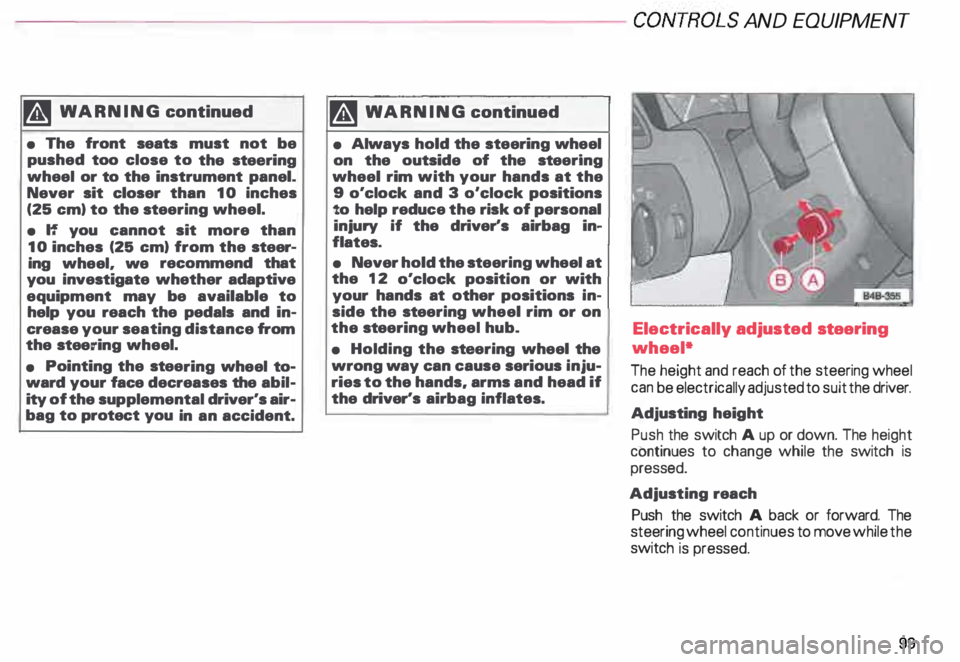
The height and reach of the steering wheel
can be electrically adjusted to suit the driver.
Adjusting height
Push the switch A up or down. The height
continues to change while the switch is
pressed.
Adjusting reach
Push the switch A back or forward. The
steering wheel continues to move while the
switch is pressed.
99
Page 101 of 306
CONT
ROLS AND
EQUIPMEN T---------------------
BBN-163 I
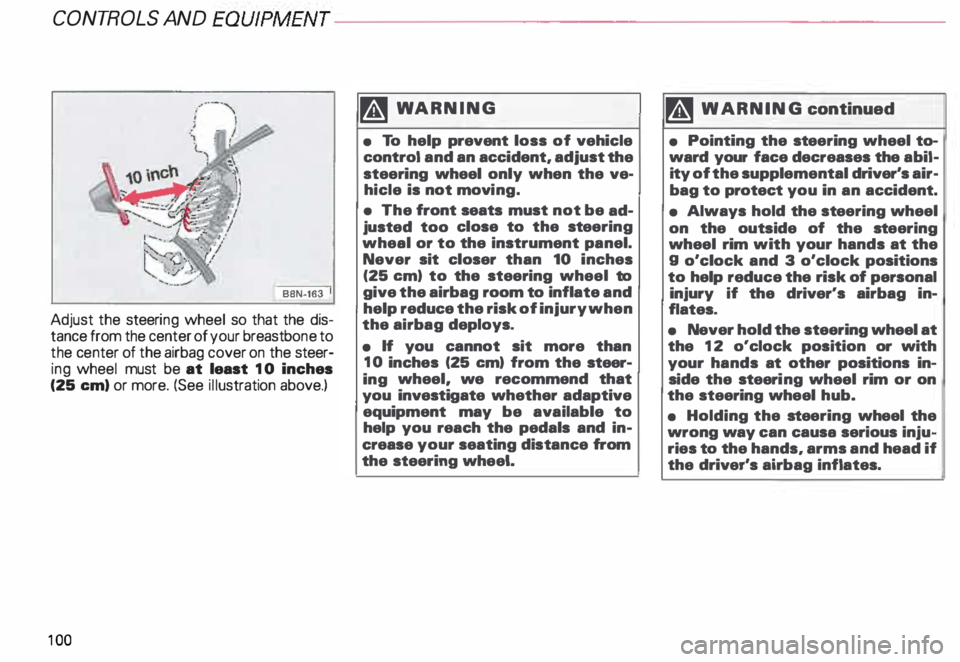
Adjust the steeri ng wheel so that the dis
tance from the center of your breastb one to
the center of the airbag cover on the steer
ing wheel must be at least 10 inches
(25 em) or more. (See illustration above.)
10 0 �W
ARNING
• To help prevent loss of vehicle
control and an accident, adjust the
steering wheel only when the ve
hicle is not movi ng.
• The front seats must not be ad
justed too close to the steering
wheal or to the instrument panel.
Never sit closer than 10 inches
(25 em) to the steering wheel to
give the airbag room to inflate and
help reduce the risk of injury when
the airbag deploys.
• If you cannot sit more than
10 inches (25 em) from the steer
ing wheel, we recommend that
you investigate whether adaptive
equipment may be available to
help you reach the pedals and in
crease your seating distance from
the steering wheel. '4
WARNING continued
• Pointing the stee ring wheel to
ward your face decreases the abil
ity of the supplemental driver's air
bag to protect you in an accident.
• Always hold the st eering wheel
on the outside of the steering
wheel rim with your hands at the
g o'clock and 3 o'clock positions
to help reduce the risk of personal
injury if the driver's airbag in
flates.
• Never hold the steering wheel at
the 12 o'clock position or with
your hands at other positions in
side the steeri ng wheel rim or on
the steering wheel hub.
• Holding the steering wheel the
wrong way can causa serious inju
ries to the hands, arms and head if
the driver's airbag inflates.
Page 104 of 306
Parking
brake lever
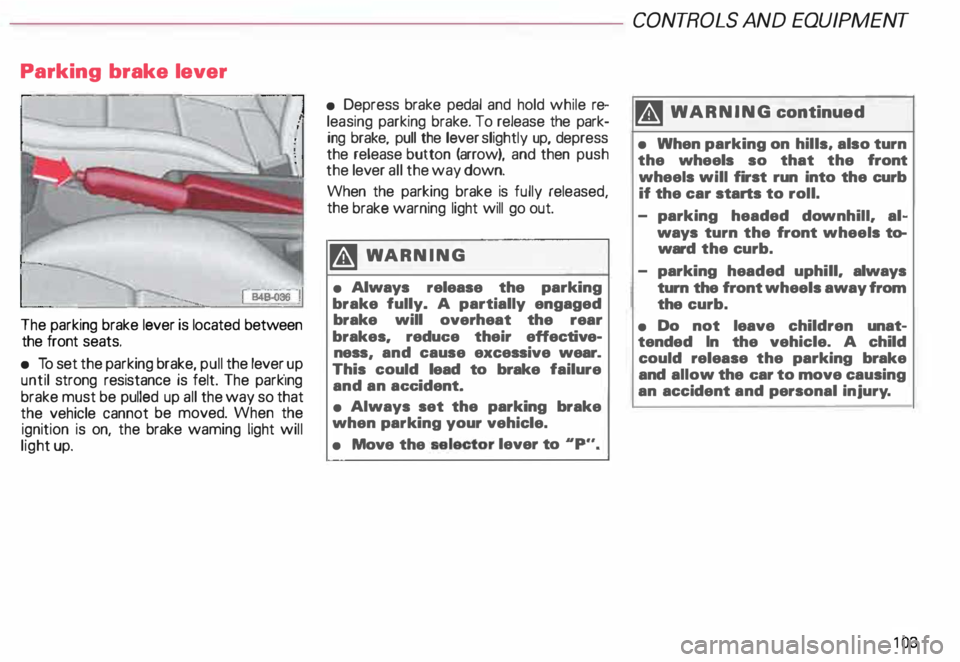
The parking brake lever is located between
the front seats.
• To set the parking brake, pull the lever _up
until strong resistance is felt. The park1ng
brake must be pulled up all the way so that
the vehicle cannot be moved. When the
ignition is on, the brake waming light will
light up. •
Depress brake pedal and hold while re
leasing parking brake. To release the park
ing brake, pull the lever slightly up, depress
the release button (arrow), and then push
the lever all the way down.
When the parking brake is fully released,
the brake warning light will go out.
�W ARNING
• Always release the parking
brake fully. A partially engaged
brake will overheat the rear
brakes. reduc:e their effective
ness and cause excessive wear.
This • could lead to brake failure
and an ac:c:ident.
• Always set the parking brake
when parking your vehicle.
• Move the selector
lever to .. p.,. CONT
ROLS AND EQUIPMENT
II WARNING continued
• When parking on hills, also turn
the wheels so that the front
wheels will first run into the curb
if the car starts to roll.
- parking headed downhill. al
ways turn the front wheels to
ward the curb.
- parking headed uphill. always
turn the front wheels away from
the curb.
• Do not leave children unat
tended In the vehicle. A child
could release the parking brake
and allow the c:ar to move causing
an accident and personal injury.
10 3