2000 AUDI ALLROAD warning
[x] Cancel search: warningPage 33 of 306

SAF
ETY RRST---------------------------------------------------
. � WARNING
• Objects between you and the
airbag can increase the risk of in
jury in an accident by interfering
with the way the airbag unfolds or
by being pushed into you as the
airbag inflates.
• Never hold things in your hands
or on your lap when the vehicle is
in use.
• Never place or attach accesso
ries or other objects (such as cup
holders, telephone brackets or
even large and bulky objects) on
the doors, over or near the area
marked ,. Airbag" on the steering
wheel, instrument panel, seat
backrests or between those areas
and yourself. These objects could
cause injury in a crash especially
when the airbags inflate.
32 �,
WARNING continued
• Never transport items on or in
the area of the front passenger
seat. Objects could move into the
area of the front alrbags during
braking or other sudden maneuver
and become dangerous projectiles
that can cause serious personal in
jury if the airbags inflate.
• Never recline the front passen
ger's seat to transport objects.
Items can also move into the area
of the side airbags or the front air
bag during braking or sudden ma
neuver. Objects near the airbags
can become projectiles and cause
injury particularly when the seat is
reclined. Child
restraints on the front seat -
important things to know
All children, especially 12 years old and
younger should always ride in the back seat
properly restrained for their age and size.
The ai rbag on the passenger side makes the
front seat a potentially dangerous place for
a child to ride. The front seat is not the saf
est place for a child in a forward-facing child
seat. It is a very dangerous place for an in
fant or a larger child in a rearward-facing
seat.
• Never install rear-facing child
seats or infant carriers on the front
passenger seat. A child will be se
riously injured and can be killed
when the passenger airbag in
flates.
Page 34 of 306

M
WARNING continued
• The inflating airbag will hit the
child seat or infant carrier with
great force and will smash the
child seat and child against the
backrest, center arm rest, or door.
• Always install rear-fac ing child
seats or infant carriers on the rear
seat.
A child seat or infant carrier installed on the
front seat may be struck and knocked out of
position by the rapidly inflating passenger's
airbag in a frontal collision. The airbag could
greatly reduce the effectiveness of the child
restraint and even seriously injure the child
during inflation. For
this reason, and because children are
generally better protected -when properly
restrained according to their age and size
in a rear seating position, we strongly rec
ommend that children always sit in the back
seat. See "Child Safety" on page 44.
�W ARNING
Forward-fa cing
child seats
installed on the front passenger's
seat may interfere with the deploy
ment of the airbag and cause seri
ous injury to the child. Install for
ward-fa cing child seats on the rear
seat. SA
FETY FIRST
If exceptional circumstances require the
use of a forward-facing child seat on the
front seat, the child's safety and well-being
require that the following special precau
tions be taken:
�W ARNING
If, in exceptional circumstances,
you must install a forward-f acing
child restraint on the front passen
ger's seat:
make sure the forward-fa cing
seat has been designed and cer
tified by its man ufacturer for
usa on a front seat with a pas
senger front and side airbag.
Always follow the manuf actur
er's instructions provided with
the child seat or carrier.
Always heed all WA RNINGS
on next page.
33
Page 35 of 306
SAFETYRRST-----------------------------------------------------
'4 WARNING continued
- Always move the passenger
seat into its rearmost position,
as far away from the airbag as
possible before installing the
child restraint. The backrest
must be adjusted to an upright
position.
- For more important information
on the use of child restraints in
your Audl, see ""child seats"",
page 44.
34 Supplemental
side airbags
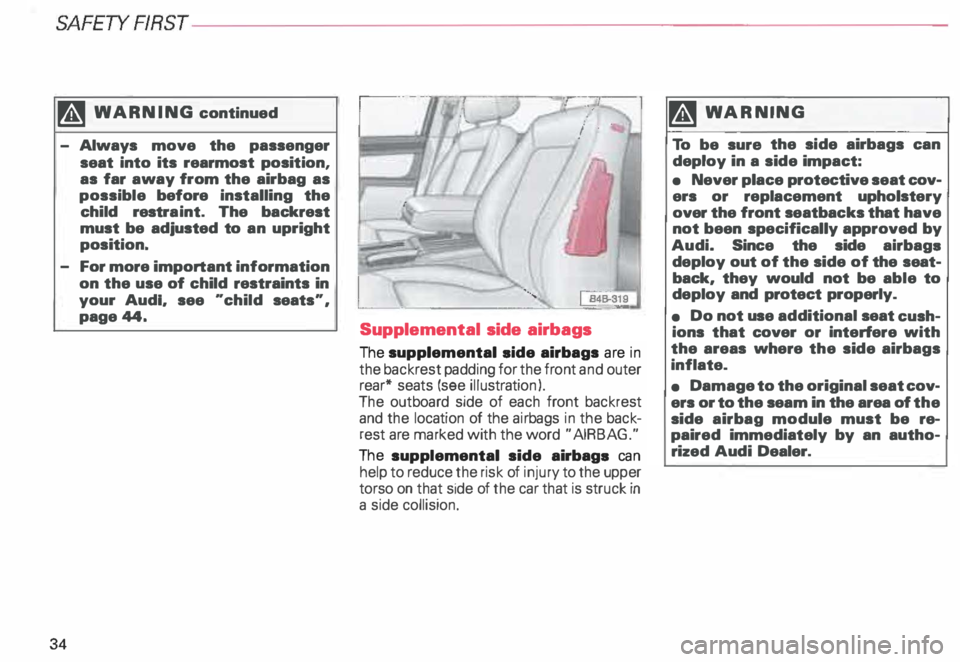
The supplemental aide airbags are in
the backrest padding for the front and outer
rear* seats (see illustration).
The outboard side of each front backrest
and the location of the airbags in the back
rest are marked with the word "AIRBAG."
The supplemental side airbaga can
help to reduce the risk of injury to the upper
torso on that side of the car that is struck in
a side collision. �W
ARNING
To be sure the side airbags can
deploy in a side impact:
• Never place protective seat cov
ers or replacement upholstery
over the front seatbacks that have
not been specifically approved by
Audi. Since the side airbaga
deploy out of the side of the seat
back, they would not be able to
deploy and protect properly.
• Do not use additional seat cush
ions that cover or interfere with
the areas where the side airbags
inflate.
• Damage to the original seat cov
ers or to the seam in the area of the
side airbag module must be re
paired immediately by an autho
rized Audi Dealer.
Page 38 of 306
-----------------------------------------------------SAFETYRRST
M WARNING continued
• Be careful not to get the dust
into your eyes or into any cuts or
scratc hes.
• If the residue should get into
your eyes, flush them with water.
Importance of proper seating
position
In a collision supplemental side airbags
must inflate within a fraction of a second
and with considerable force. In order to help
the airbag to do its job, it is important, both
as a driver and as a passenger to sit properly
at all times. By keeping room between your
body and the side of the passenger
compartment, the airbag can inflate fully
and completely and provide supplemental
protection in certain side collisions. �W
ARNING
Failure to maintain an upright and
proper seating position will in�
crease the risk of personal injury
when the supplemental side air�
bag inflates. To reduce the risk of
injury that can be caused by an in�
flating supplemental side airbag:
Never lean against the door and
over the area where the side ai�
bag is located.
- Navar let anyone to place their
hand, lag or face near the sup�
plemental side airbag.
- Do not let anyone sitting in the
front seat put their hand out of
the window or lean against the
door.
- Never let anyone sitting in the
rear seat hold onto the sides of
the front seat backrest. Some
other important points to
know
Because airbags inflate in the blink of an eye
with great force, things you have on your lap
or have placed on the seat could become
dangerous projectiles and be pushed into
you if the airbag inflates.
�W ARNING
• Objects between you and the
airbag can increase the risk of in�
jury in an accident by interfering
with the way the airbag unfolds or
by baing pushed into you as the
airbag inflates.
• Never hold things in your hands
or on your lap when the vehicle is
in use.
Always heed all WAR NINGS
on next page.
37
Page 39 of 306

SA
FETY FIRST
1\1 WARNING continued
• Never place or attach accesso
ries or other objects (such as cup
holders. telephone brackets. or
even large. bulky objects) on the
doors. over or near the area
marked ., Airbag" on the seat back
rests or between those areas and
yourself (an umbrella. bag. etc.}.
Such objects can become danger
ous projec tiles and cause injury if
the supplemental side airbag in
flates.
• Always prevent heavy objects
from knocking against or hitting
the sides of the seatbacks. This
could damage the side airbag sys
tems and they would not deploy in
case of an accident!
38 ��
WARNING continued
• Use the built-in coat hooks only
for lightweight clothing. Do not
leave any heavy or sharp-edged ob
jects in the pockets which may in
terfere with side airbag deploy
ment and can cause personal inju
ry in an accident.
• Never recline the front passen
ger's seat to transport objects.
Items can also move into the area
of the side airbags during braking
or sudden maneuvers. Objects
near the supplemental side airbag
can become projectiles and cause
injury particularly when the seat is
reclined. Child
restraints on the front seat
important things to know
The airbag on the passen gers ide makes the
front seat a potentially dangerous place for
a child to ride. The front seat is not the saf
est place for a child in a forward-facing child
seat. It is a very dangerous place for an in
fant or a larger child in a rearward-facing
seat. For additional important information
and WARNINGS please see chapters
"Front airbags" and "Child Safety," begin
ning on page 44.
Page 43 of 306
SA
FETY RRST-----------------------------------------------------
�WARNING continued
• Do not cover, obstruct, or
change the steering wheel horn
pad or airbag cover or the instru
ment panel, particularly in the area
of the passenger side airbag mod
ule.
• For cleaning the horn pad or in
strument panel, use only a soft,
dry cloth or one moistened with
plain water. Solvents or cleaners
could damage the airbag cover. Do
not make any repairs, adjust
ments, or modifications to any
parts of the airbag system.
• Do not modify the front bumper
or vehicle body structure.
42 ftl
WARNING continued
• Never place protective seat cov
ers or replacement upholstery
over the front and rear seatbacks
that have not been specifically ap
proved by Audi. Since the side air
bags deploy out of the side of the
seatback, it would not be able to
deploy and protect properly.
• Do not use additional seat cush
ions that cover or interfere with
the areas where the side airbags
inflate.
• Damage to the original seat cov
ers or to the seam in the area of the
side airbag module must be re
paired immediately by an autho
rized Audi Dealer.
• The airbag system must be re
placed by your authorized Audi
Dealer no later than 14 years after
the manu facture date of your ve
hicle. �,
WARNING continued
• The manufacture date can be
found on the Safety Compliance
Sticker located on the left door
jamb as well as on the Vehicle
Identification Label in your
Maintenance booklet. It is abso
lutely essential to observe this
date in order to assure that the sy
stem is in good working order.
• If components of the airbag sys
tem must be discarded, or ifthe ve
hicle must be scrapped, certain
safety precautions must be ob
served. Your authorized Audi
Dealer knows these precautions
and can give you the necessary in
forma tion. Failure to follow these
precautions and procedures could
increase the risk of personal in
jury.
Page 44 of 306

-------------------------------------------------SAFETY RRST
'4 WARNING continued
• Any work on the airbag system.
such as removing/insta lling, re
pairing . or any work on the steer
ing wheel. instrument panel. front
seats or electrical system (Includ
ing the installation of audio equip
ment. mobile telephones and CB
radios. etc.) must be performed by
a qualified technician who has the
. training and special equipment
necessary. Improper handling may
result in injury.
• For any work on the airbag sys
tem. we strongly recommend that
you see your Audi Dealer.
• The alrbag system can be acti
vated only once. After an alrbag
has inflated. it must be replaced. Please
be sure that this manual al
ways remains with your Audi when
ever you lend your vehicle to
another person or if you sell it so
that this and other important infor
mation will always be available to
the driver and passengers.
43
Page 45 of 306

SAFET YRRST---------------------------------------
Child safety
The physical principles of what happens
when your car is in an accident, illustrated
on pages 14-17 , apply also to children. But
unlike adults and teenagers. their muscles
and bones a.re not fully developed. In many
respects chrldren are at greater risk of seri
ous injury in accidents than are adults.
Because children's bodies are not fully de
veloped, they require restraint systems es
pecially designed for their size. weight, and
body structure. Many countries and all
states of the United States and provinces of
Canada have laws requiring the use of ap
proved child restraint systems for infants
and small children.
Child restraints, like adult safety belts, must
be used properly to be effective. Used im
properly, they can increase the risk of seri
ous injury in an accident.
44 �W
ARNING
• Accident statistics have shown
that children are generally safer in
the rear seat area than in the front
seating position. Always restrain
any child age 12 and under in the
rear.
• . All ve�icle occupants and espe
Cially children must be restra ined
properly whenever riding in a ve
hicle. An unrestrained or improp
erly restra ined child could be in
jur
_ed b
y stri king the interior or by
bemg eJected from the vehicle dur
ing a sudden maneuver or impact. J'A1
WARNING
continued
An unrestrained or improperly re
strained child is also at greater
risk of injury or death through con
ta c:t with �n inflating airbag. A
su1table child restraint properly
installed and used at one of the
rear seating positions provides the
highest degree of protec tion for
infants and small children in most
accidents.
Consult the child seat manufacturer's in
structions to be sure the seat is right for
your child's size.