2000 AUDI ALLROAD warning
[x] Cancel search: warningPage 46 of 306
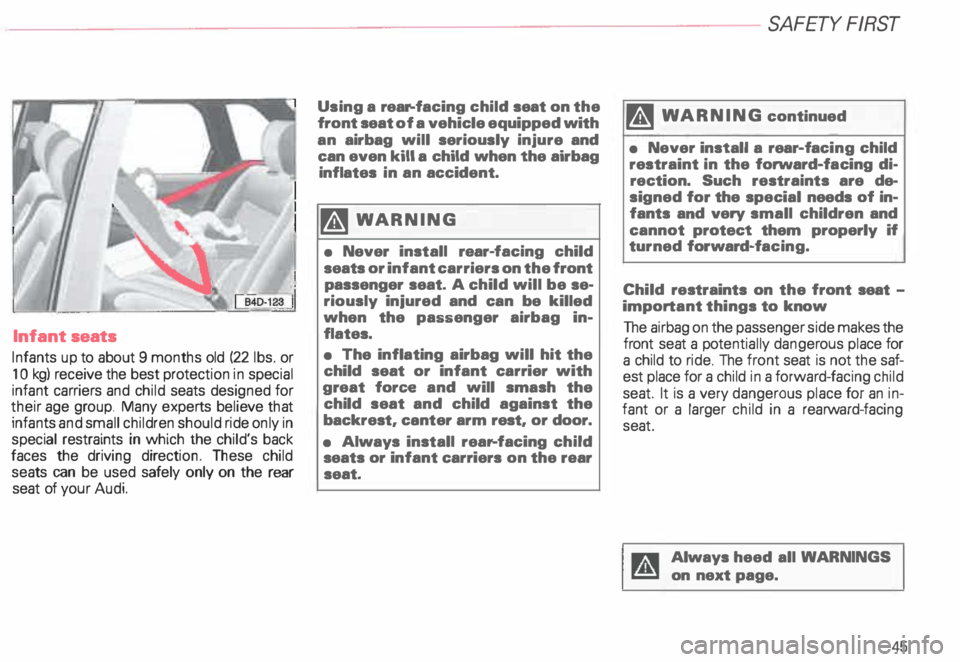
Infant
seats
Infants up to about 9 months old (22 lbs. or
1 0 kg) receive the best protection in special
infant carriers and child seats designed for
their age group. Many experts believe that
infants and small children should ride only in
special restraints in which the child's back
faces the driving direction. These child
seats can be used safely only on the rear
seat of your Audi. Using
a rear-fa cing child seat on the
front seat of a vehicle equipped with
an airbag will seriously injure and
can even kill a child when the airbag
inflates in an accident.
� WARNING
• Never install rear-facing child
seats or infant carriers on the front
passenger seat. A child will be se
riously iniured and can be killed
when the passenger airbag in
flates.
• The inflating airbag will hit the
child seat or infant carrier with
great force and will smash the
child seat and child against the
backrest, canter arm rest, or door.
• Always install rear--facing child
seats or infant carriers on the rear
seat. SA
FETY FIRST
ftl WARNING continued
• Never install a rear-fac ing child
restraint in the forward-fa cing di
rection. Such restraints are de
signed for the special needs of in
fants and very small children and
cannot protect them properly if
turned forward-fa cing.
Child restraints on the front seat -
important things to know
The airbag on the passenger side makes the
front seat a potentially dangerous place for
a child to ride. The front seat is not the saf
est place for a child in a forward-facing child
seat. It is a very dangerous place for an in
fant or a larger child in a rearward-facing
seat.
Always heed all WARNINGS
on next page.
45
Page 47 of 306
SA
FETY FI
RST------------------------
�W ARNING
If, in exceptio nal circumstances
you have no alternative but to
install a rear facing child seat or in
fant canier an the front passenger
seat, deactivate the front passen
ger airbag prior to installing the
child restra int.
Please note, that the side airbag
for the front passenger seat will
remain functional even if the front
passenger alrbag is switched off.
Make sure the child restraint has
been designed and certified by its
manufacturer for use on a front
seat with a side airbag.
Always move the passenger seat
into its raarmost position, as far
away from the airbag as possible
before installing the child re
straint. The backrest must be ad
justed to an upright position.
46
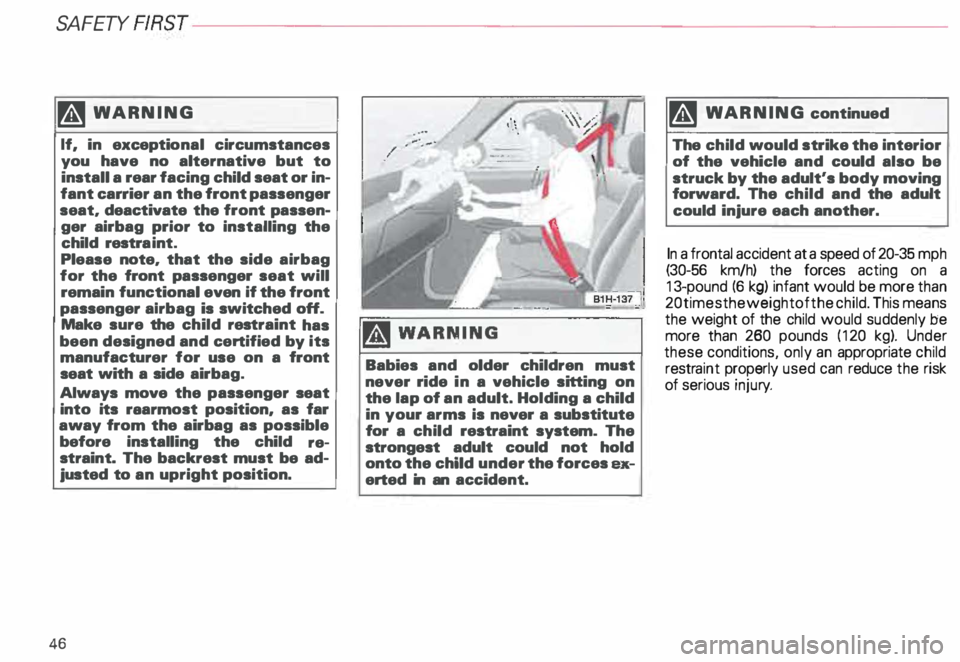
Babies and older children must
never ride in a vehicle sitting on
the lap of an adult. Holding a child
in your arms is never a substitute
for a child restraint system. The
strongest adult could not hold
onto the child under the forces ex
erted in an accident. 1ft
WARNING continued
The child would strike the interior
of the vehicle and could also be
struck by the adult's body moving
forwa rd. The child and the adult
could injure each another.
In a frontal accident at a speed of 20-35 mph
(30-56 km/h) the forces acting on a
13 -pound (6 kg) infant would be more than
20timestheweightofthe child. This means
the weight of the child would suddenly be
more than 260 pounds (120 kg). Under
these conditions, only an appropriate child
restr aint properly used can reduce the risk
of serious injury.
Page 48 of 306
--------------------------SAFETY FIRST
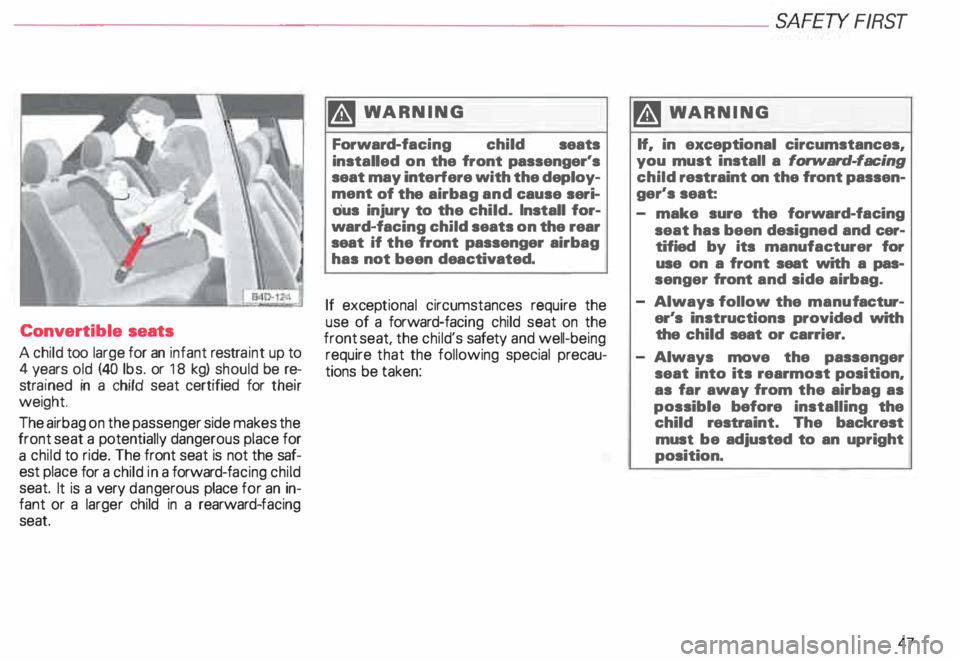
Converti
ble seats
A child too large for an infant restraint up to
4 years old (40 lbs. or 18 kg) should be re
stra ined in a child seat certified for their
weight.
The airbag on the passenger side makes the
front seat a potentially dangerous place for
a child to ride. The front seat is not the saf
est place for a child in a forward-f acing child
seat. It is a very dangerous place for an in
fant or a larger child in a rearward-facing
seat. m
WARNING
Forward-fa cing
child seats
installed on the front passenger's
seat may interfere with the deploy
ment of the airbag and cause seri
ous injury to the child. Install for
ward·fac ing child seats on the rear
seat if the front passenger airbag
has not been deactivated.
If excep tional circumstances require the
use of a forward-fac ing child seat on the
front seat. the child's safety and well-b eing
require that the following special precau
tions be taken: �W
ARNING
If, in exceptional circumstances,
you must install a forward-facing
child restraint on the front passen
ger's seat:
make sure the forward-facing
seat has been designed and cer
tified by its manufacturer for
use on a front seat with a pas
senger front and side airbag.
Always follow the manuf actur
er's instructions provided with
the child seat or carrier.
Always move the passenger
seat into its rearmost position,
as far away from the airbag as
possible before installing the
child restraint. The backrest
must be adjusted to an upright
position.
47
Page 51 of 306
SAFETYRRST-----------------------------------------------------
�W ARNING
Failure to properly route safety
balta over a childs body will cause
severe injuries in an accident.
The lap belt portion of the three
point belt as wall as any lap belt
alone must always pass as low as
possible across the pelvis, never
over the stomach or abdomen.
Yo unger children should use a lap belt only
in very exceptio nal situations and only if no
child restraint system for the child' s size and
weight or safer alternative means of trans
portation of the child is available. In these
excep tional situations, the use of a lap belt
is better than permitting the child to remain
totally unrestrained. But remember: a lap
belt cannot provide the same level of
protect ion as a proper child restra int.
50 �W
ARNING
• An improperly worn safety belt
will not provide the best protec
tion in an accident and may causa
serious personal injury. Always
make sure that children and other
vehicle occupants properly wear
available restraint systems. Care
fully follow the Instructions pro
vided by the manufacturers of
child restra ints.
• Commercially available child
seats are required to comply with
U. S. Federal Motor Vehicle Safety
Standard (FMVSS) 213 (in Canada
CMVSS 213).
• These standards include instal
lation requirements for using the
lap portion of a combination lap
shoulder belt such as those
installed in your vehicle. fA,
WARNING continued
• When buying a child restraint,
select one that fits your child and
vehicle.
• Only use child restraint systems
that fully contact the flat portion
of the seat cushion. The child seat
must not tip or lean to either side.
Audi does not recommend using
child seats that rest on legs or
tube-like frames. They do not pro
vida adequate contact with the
seat.
• Improperly or inadequately
installed child restraint systems
can increase the risk of injury to
children in accidents. Therefore,
always carefully read and follow
all instructions on installation and
use that come with the system.
Page 65 of 306
CONT
ROLS AND
EQUIPMENT------
L-----------------------�[_��� B-�3;�
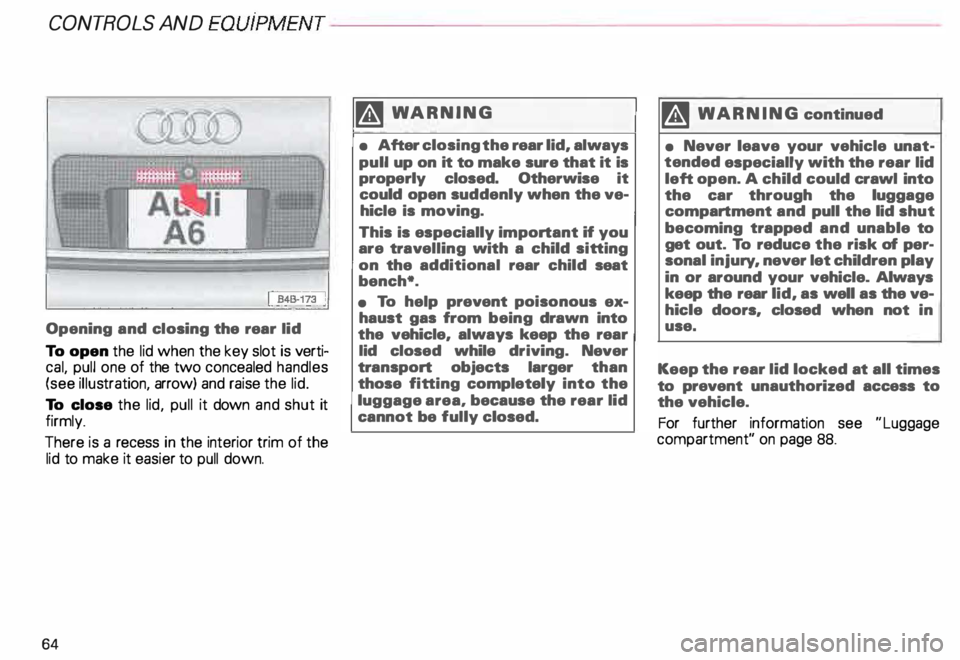
Opening and closing the rear lid
To open the lid when the key slot is verti
cal, pull one of the two concealed handles
(see illustration, arrow) and raise the lid.
To close the lid, pull it down and shut it
firmly_
There is a recess in the interior trim of the
lid to make it easier to pull down.
64 �W
ARNING
• After closing the rear lid, always
pull up on it to make sure that it is
properly closed. Otherwise it
could open suddenly when the ve
hicle is moving.
This is especially important if you
are trav elling with a child sitting
on the additional rear child seat
bench*.
• To help prevent poisonous ex
haust gas from being drawn into
the vehicle, always keep the rear
lid closed while driving. Never
tra nsport objects larger than
those fitting completely into the
luggage area, because the rear lid
cannot be fully closed. �,
WARNING continued
• Never leave your vehicle unat
tended especially with the rear lid
left open. A child could crawl into
the car through the luggage
compartment and pull the lid shut
becoming trapped and unable to
get out. To reduce the risk of per
sonal injury, never let children play
in or around your vehicle. Always
keep the rear lid, as well as the ve
hicle doors, closed when not in
use.
Keep the rear lid locked at all times
to prevent unauthorized access to
the vehicle.
For further information see "Luggage
compartment" on page 88.
Page 69 of 306

CONT
ROLS AND
EQUIPMENT---------------------
If the alarm has sounded one time, and then
the vehicle is forced open again (for exam
ple, someone tries to forcibly open a door,
and then tries to force open the rear lid), the
signal will sound once again.
You can also trigger the alarm by pressing
the PANIC switch on your remote control
to alert other people in case of emergency
or when in another difficult situation. The
alarm can be switched off by pressing the
PA NIC switch again.
Warn ing lights
After you lock the vehicle, the warning light
on the window sills will blink quickly first for
30 seconds and will then blink slowly. This
is to let you know that the anti-theft alarm
system is activated, including the interior
move ment sensors.
If the warning lights come on continuously
for about 30 seconds instead of flashing
when the vehicle is locked, this indicates
that the interior movement sensor is defec
tive.
68 Swit
ching off the interior
movement sensors l
Yo u should switch off the interior move
ment sensors if there is the possibility that
the alarm system could be set off, for exam
ple by a pet left in the vehicle. •
Press the switch in the door pillar (see il
lustration). The indicator light in the switch
will come on. The indicator light on the win
dow sills will come on for approx imately
3 seconds. This verifies that the interior
movement sensors have been deactivat ed.
The sensors will be reactivated when you
unlo ck and lock the vehicle again.
• Lock the vehicle.
The indi cator lights in the doorpillarwill blink
quickly for approximately 3 seconds at first.
Then, after approximately 30 seconds, the
light will flash slowly.
Page 70 of 306

·--------------------CONT
ROLS AND EQUIPMENT
Power windows
The switches are located in the driver's
door. Also, the front passenger's door and
each rear door has its own power window
switch.
If the respective switch is pushed or pulled
the window will open or close.
• Switches A and B operate the front door
win dows.
• Switches C and D operate the rear win
dows.
• Safety switch S The
safety switch {S) in the armrest on the
driver's door can turn off the rear power win
dows. This feature has been provided for
the safety of small children riding in the rear
of the vehicle.
A symbol lights up in the safety switch
when the switches in the rear doors are de
activated.
Normally , the power windows can be
opened and closed only with the ignition on.
However, when the ignition is off the win
dows can still be operated by means of the
control switches as long as the driver's and
front passenger's doors are closed. yvhen
either door is opened, the power w1ndow
operation will be deactivated.
�W ARNING
• Do not leave children unat
tended In the vehicle, especially
with access to vehicle keys. Unsu
pervised use of the keys can result
in sta rting of the engine and use of
vehicle systems such as power
windows, etc. which could result
in serious injury. m
WARNING continued
• Remember also that the power
windows will continue to operate
until the ignition key has been re
moved and one of the front doors
has been opened.
• Be careful when closing the win
dows. Check to see that no one is
in the way, or serious injury could
result I
• Switch off the power to the rear
windows -if necessary -using the
safety switch S.
• Always remove the ignition key
whenever you leave your vehicle.
• If you lock your vehicle from the
outside, no one especially children
should remain in the vehicle. The
windows will not open in case of
an emergency.
• Do not stick anything on the
windows or the windshield that
may Interfere with the driver's vi
sion.
69
Page 76 of 306
Head
restra ints
Position the head restra ints accor ding to the
occupant's height. Properly positioned head
restra ints, together with the use of safety
belts offer effective protection in most acci
dent situations.
g WARNING
Head restraints are designed to
help reduce injuries in an accident.
Do not drive the vehicle without
the head restraints in place and
properly adjusted.
For maximum protection, the upper edge of
the head restra ints should be at least at
eye level, or high er. ' 848·181
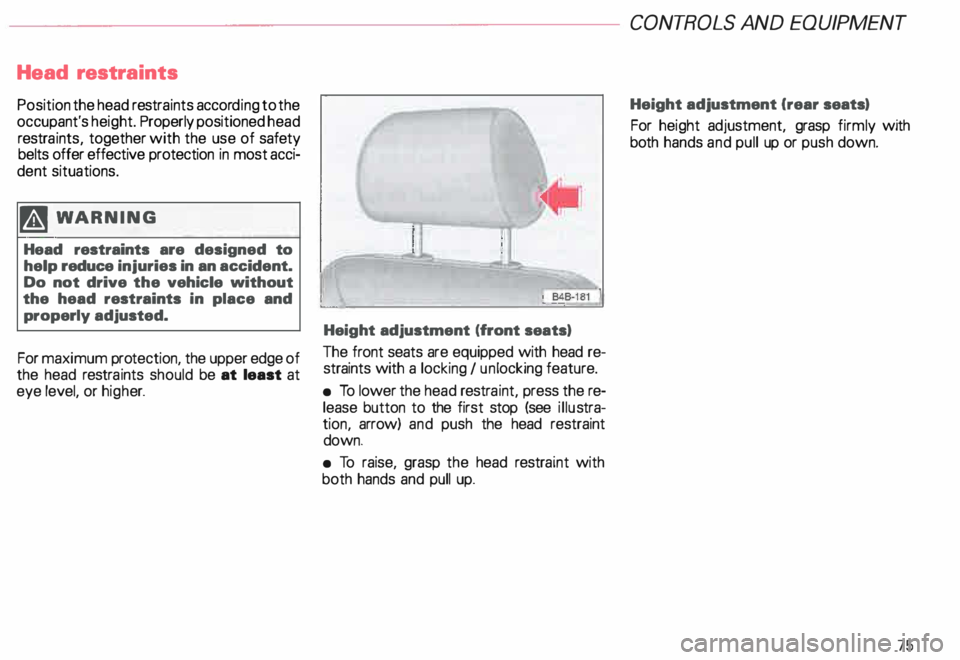
Height adjustment (front seats)
The front seats are equipped with head re
straints with a locking I un locking feature.
• To lower the head restra int, press the re
lease button to the first stop (see illustra
tion, arrow) and push the head restraint
down.
• To raise, grasp the head restraint with
both hands and pull up. CONT
ROLS AND EQUIPMEN T
Height adjustment Crear seats)
For height adjustment, grasp firmly with
both hands and pull up or push down.
75