2000 AUDI ALLROAD warning
[x] Cancel search: warningPage 18 of 306
--------------------------SAFETY FIRST
Although
these examples are based on a
frontal collision, safety belts can also sub
stantially reduce the risk of injury in other
types of accidents. So, whether you are on
a long trip or just going to the corner store,
always buckle up and make sure others do,
too.
Accident statistics show that vehicle occu
pants properly wearing safety belts have a
lower risk of being injured and a much bet
ter chance of surviving an accident. Prop
erly using safety belts also greatly increases
the ability of the suppleme ntal airbags to do
their job in an accident. For this reason,
wearing a safety belt is legally required in
most countries including much of the
United States and Canada.
The following pages provide important in
structions to enable you to use safety belts
properly. Be aura to read and follow
the instructions carefully. Heed all
WA RNINGS. To
further increase the safety for the front
passengers, the vehicle is equipped with a
supplemen tal airbag system. See page 25.
The safety belts provided must neverthe
less be worn because the front airbags are
activated only in some frontal collisions. The
front airbags are not activated by minor fron
tal collisions, side and rear collisions, in roll
overs or in some cases where there is not
enough deceleration through impact to the
front of the vehicle.
I B1H-124 I
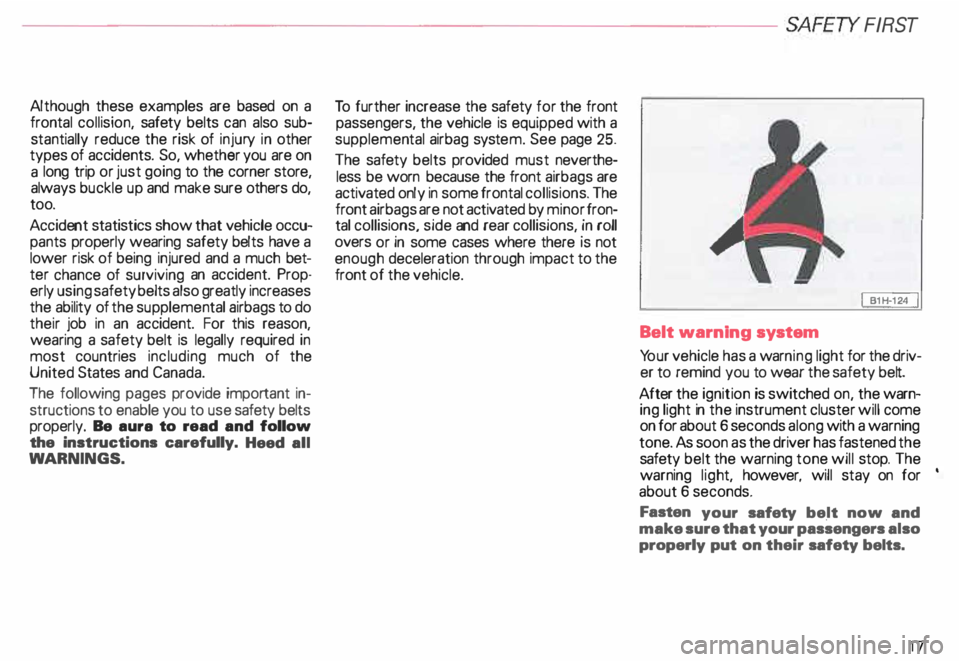
Belt warning system
Yo ur vehicle has a warn ing light for the driv-
er to remind you to wear the safety belt
After the ignition is switched on, the warn
ing light in the instrument cluster will come
on for about 6 seconds along with a warning
tone. As soon as the driver has fastened the
safety belt the warning tone will stop. The
warning light, however, will stay on for '
about 6 seconds.
Fasten your safety be.lt now and
make sure that your passengers also
properly put on their safety belts.
17
Page 19 of 306

SAFETY RRST---------------------------------------------------
How to wear safety belts
properly
Safety belts must always be prop
erly positioned across the strongest
bones of your body.
�W ARNING
Always fasten your safety belts
before driving off. Always make
sure your passengers are properly
restra ined -even those sitting in
the rear.
Safety belts can work only when
used properly. Never wear safety
belts in any other way than illus
trated and described in this sec
tion. Always observe the follow
ing precautions:
• Never wear belts twisted.
18 '41
WARNING continued
• Never strap more than one par
son, including small children, into
any belt. It is especially dangerous
to place a safety belt over a child
sitting on your lap.
• Never place your feet on the in
strument panel or on the seat.
Always keep both feet on the floor
in front of the seat.
• Never wear belts over rigid or
breakable objects in or on your
clothing, such as eye glasses,
pens, keys, etc., as these may
cause injury.
• Do not wear the shoulder part of
the belt under your arm or other
wise out of position.
• Several layers of heavy clothing
may interfere with proper posi
tioning of belts and reduce the
overall effectiveness of the sys
tem. �
WARNING continued
• Never allow safety belts to be
come damaged by being caught in
door or seat hardware. Always
keep belt buckles free of any ob
struction that may prevent secure
locking.
• Never use comfort clips or de
vices that create slack in the
shoulder belt portion. However,
clips may be required for the
proper use of some child restraint
systems.
• To rn or frayed safety belts can
tear and damaged belt hardware
can break in an accident. Inspect
belts periodically.
If belts show damage to webbing,
bindings, buckles. or retractors,
have them replaced.
Page 20 of 306

fh1
WARNING continued
• Keep the belts clean.
Dirty belts may not work properly
- see also .. Cleaning and protec
tion .. page 218.
• Safety belts that have been
worn and loaded in an accident
must be replaced with the correct
replacement safety belt by an au
thorized Audi Dealer. Replace
ment may be necessary even if
damage cannot be clearly seen.
• Safety belt anchorages that
have been loaded in an accident
must be inspected by a qualified
workshop or an authorized Audi
Dealer.
• Never modify. disassemble, or
try to repair your safety belts. Seating capacity
Your Audi has 5 seating positions, 2 in the
front and 3 in the rear. Each seating position
has a safety belt.
�W ARNING
Never let more people ride in the
vehicle than there are seat belts
available. Be sure everyone riding
in the vehicle is correctly re
strained with a separate seat belt. SA
FETY FIRST
Lap- shoulder belt
The front and rear seats are equipped with
three-point safety belts.
The three-point belts in the front passenger
and rear positions each have a convertible
locking feature in addition to the emergency
locking feature. The convertible locking fea
ture is used when a child seat is installed,
see page 51.
The retractors in the combination lap-shoul
der belts allow the system to adjust to your
size and movements as long as the pull on
the belt is slow.
Hard braking or a collision locks the belt. The
belt will a I so lock when you drive up or down
a steep hill or in a sharp curve.
19
Page 21 of 306

SA
FETY RRST-----------------------------------------------------
Fastening the safety belt
• Adjust your seat before fastening
the safety belt. See page 76.
� WARN ING
Safety belts offer optimum protec
tion only when the seat back is up
right and belts are properly posi
tioned on the body. Improperly
positioned safety belts can cause
serious personal injury in an acci
dent.
20 •
To fasten, grasp belt tongue and pull the
belt in a continuous slow motion across
your chest and lap.
• Insert the belt tongue into the buckle on
the inboard side of the seat. Push down un
til it is securely locked with an audible click.
Pull belt to check!
� WARNING
• Always make sure the safety
belt tongue is inserted into the
buckle for the same seating posi
tion.
• Att aching the safety belt to the
buckle for another seat could re
duce safety belt effectiveness and
cause injury. Adjusting
shoulder seat belt
Belt height adjustment front seats
Safety belt height adjustors for the
front seats can be used to adjust the
height of the shoulder portion of the safety
belt. This feature will help you properly posi
tion the shoulder portion of the safety belt
across your shoulder.
• Press the handle slowly up or down so
that the shoulder portion of the safety belt
is positioned nearly midway over the shoul
der.
• Pull on the shoulder belt to check
whether the belt anchor is securely locked
in place.
Page 26 of 306

---------------------------------------------------SAFETY RRST
Airbag system
Your vehicle has two front and four
side airbags, one front and one side air
bag for each front seat occupant, one side
airbag" for each rear seat occupant sitting
on the left and right rear seat.
In addition, your vehicle is equipped with
head airbags* on the left and right sides to
protect occupants seated next to the front
and rear doors. System
components
The airbag system consists of the following:
• electronic control module,
• an inflatable airbag with gas generator in
side the steering wheel,
• an inflatable airbag with gas generator in
side the instrument panel tor the front pas
senger,
• supplemental side airbags in the back
rest padding of the front and rear seats*,
• an inflatable curtain head airbag above
the doors on each side,
• an AIRB AG indicator light in the
instrument cluster ( see "Warning I Indica
tor lights" page 125).
The indicator light in the instrument cluster
(readiness light) will light up for a few sec
onds each time the ignition is switched on.
The light monitors the electronic control
module, sensor circuits, and system wiring. The
system must be inspected
if the indicator light:
• does not come on when the ignition is
switched on,
• does not go out after a few seconds after
the ignition is switched on, or
• comes on while driving.
In the event of a system malfunction, the in
dicator light will stay on continuously to
serve as a constant reminder to have the
system repaired.
�W ARNING
If any of these conditions occur,
have the alrbag system inspected
immediately by your Audi Dealer.
Otherwise, the airbags in your ve
hicle may not work properly in
case of a frontal collision or a side
impact.
25
Page 30 of 306
--------------------------SAFETY FIRST
Importance
of proper seating
position
In a collision airbags must inflate within a
blink of an eye and with considerable force.
The supplemental airbags could injure you
if you are not seated properly. Therefore in
order to help the airbag to do its job, it is im
portant, both as a driver and as a passenger
to sit properly at all times. By keeping room
between your body and the front of the pas
senger compartment, the airbag can inflate
fully and completely and provide supple
mental protection in certain frontal colli
sions. See page 76 for information on the
adjustment of the front seats and also
"Front seats" page 78, for details on the op
eration of the seat adjustment controls. It's
especially importantthat children be proper
ly restrained. See chapter "Child safety",
page 44. �W
ARNING
• Sitting too close to the stee ring
wheel or instrument panel will de
crease the effe ctiveness of the air
bags and will increase the risk of
personal injury in an accident.
• If you are unrestrained, leaning
forward, sitting sideways or out of
position in any way. your risk of in
jury is much higher. You will also
receive serious or fatal injuries
from the airbag if you are up
against it or too close to it when it
inflates.
• To reduce the risk of injury
when an alrbag inflates, always
wear safety belts properly.
See "How to wear the safety belts
properly" on page 18. '4
WARNING continued
• Children age 12 or younger
should always ride in the rear seat.
If children are not properly re
strained, they may be severely in
jured or killed when an airbag
inflates. Never let children ride un
restr ained or improperly re
strained in the vehicle.
• Adjust the front seats properly.
- Never ride with the backrest re-
clined.
- Always sit as far as possible
from the the stee ring wheel or
the instrument panel.
Always heed all WA RNINGS
on next page.
29
Page 31 of 306
SAFETY FIRST--------------------------
�
WARNING continued
- Always sit upright with your
back against the backrest of
your seat.
. 30 Never
place your feet on the in
strument panel or on the seat.
Always keep both feet on the
floor in front of the seat to help
prevent serious injuries to the
legs and hips if the airbag in
flates. BBN-163
There is a lot that you and your passengers
can do to help the individual safety features
installed in your Audi work together as a
system. Adjusting
the driver's seat
For detailed steps for adjusting the driver's
seat please see "Front Seats" on page 76.
We recommend that you adjust the driver's
seat as follows:
- adjust the seat in fore and aft direction so
that you can easily push the pedals all the
way while keeping your knee slightly
bent.
- adjust the seatback so that when you sit
with your back against the seatback, you
can still grasp the top of the steering
wheel.
adjust the steering wheel -see chapter
"Adjustable steering column" page 98.
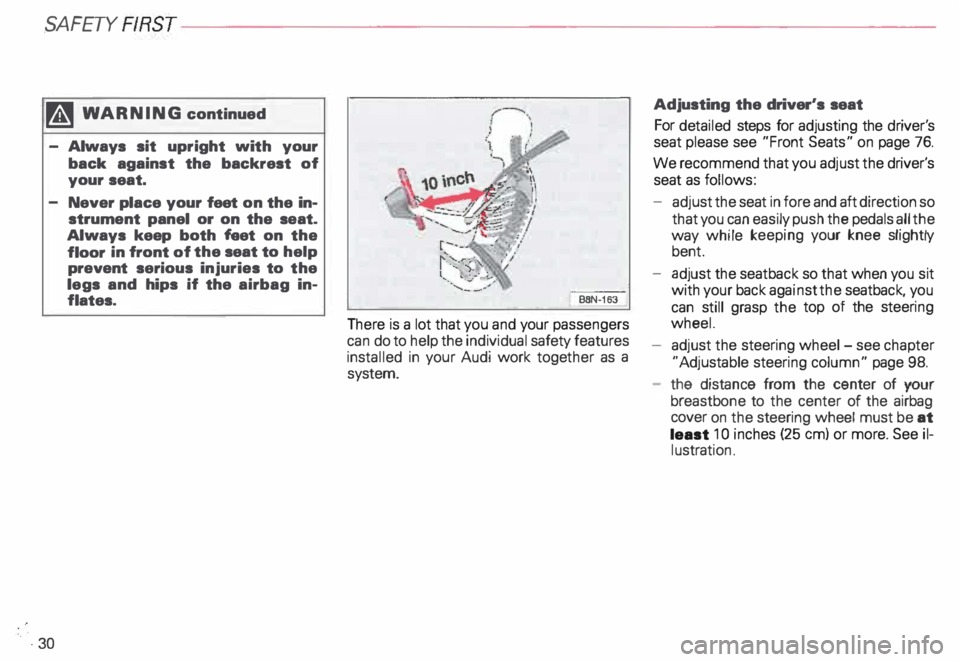
- the distance from the center of your
breastbone to the center of the airbag
cover on the steering wheel must be at
least 1 0 inches (25 em) or more. See il
lustration .
Page 32 of 306
-----------------------------------------------------SAFETY RRST
�W ARNING
• Never sit closer than 10 inches
(25 em) to the stee ring wheel.
• If you cannot sit more than
10 inches (25 em) from the steer
ing wheel, we recommend that
you investigate whether adaptive
equipment may be available to
help you reach the pedals and in
crease your seating distance from
the steering wheel.
Adjusting the steering wheel
For detailed steps for adjusting the steering
wheel please see "Adjustable steering col
umn" page 98.
Adjust the steering wheel so that the steer
ing wheel and airbag cover points at your
chest and not at your face. The steer ing
wheel should be adjusted so that you can
hold the outer rim of the steering wheel
comfortably with your hands at the 3 o'clock
and 9 o'clock positions. �W
ARNING
• Pointing the steering wheel to
ward your face decreases the abil
ity of the supplementa l driver's air
bag to protect you in an accident.
• Holding the steering wheel the
wrong way can cause serious inju
ries to the hands, arms and head if
the driver's airbag inflates.
• Never hold the steering wheel at
the 12 o'clock position or with
your hands at other positions in
side the steering wheel rim or on
the steering wheel hub.
Adjusting the passenger's seat
For detailed steps for adjusting the pas
senger's seat please see "Front Seats" on
page 76.
We recommend that you adjust the passen
ger's seat as follows:
- backrest upright (never reclined)
place your feet on the floor in front of the
passenger's seat adjust
the passenger's seat as far as pos
sible to the rear of the fore and aft adjust-
1)1ent range.
�W ARNING
• Always keep both feet on the
floor in front of the seat.
• Never place your feet on the in
strument panel or on the seat. If
the airbag inflates and your feet
are on the instrument panel or on
the seat, your could receive seri
ous personal injuries.
Some other important points to
know
Because airbags inflate in the blink of an eye
with great force, things you have on your lap
or have placed on the seat could become
dangerous projectiles and be pushed into
you if the airbag inflates.
Always head all WARNINGS
on next page.
31