2000 AUDI ALLROAD oil filter
[x] Cancel search: oil filterPage 214 of 306
Washing
The best protection against environmental
influences is frequent washing and waxing.
How often this is required depends on how
much the vehicle is used, where it is parked
(garage, in the open under trees, etc.), the
seasonal and weather conditions as well as
env ironmental influences. The longer bird
droppings, insects, tree resin, road and in
dustrial grime, tar, soot, road salt and other
materials remain on the vehicle paint, the
more lasting their destructive effect will be.
High temperatures, as from strong sunlight,
intensify the corrosive effect.
Under certain circumstances, weekly
washing may be necessary. Under other
conditions. a monthly washing and waxing
may be adequate.
After the winter, the underside of the ve
hicle should be thoroughly washed. Automatic
car wash
The vehicle paint is so durable that the ve
hicle can normally be washed without prob
lems in an automatic car wash. However,
the effect on the paint depends to a large
extent on the design of the facil ity, the filter
ing of the wash water, the type of wash and
care material, etc. If the paint has a dull ap
pearance after going through the car wash
or is scratched, bring this to the atte ntion of
the operator immediately. If necessary use
a different car wash.
Notes
• Before going through a car wash, be sure
to take the usual precautions such as clos
ing the windows and sunroof*.
• You don't have to remove the factory
installed radio antenna. However, if your ve
hicle is equipped with the Navigation Sys
tem*, then you must remove the antenna.
• If you have installed additional accesso
ries on the vehicle -such as spoilers, roof
rack, etc. -it is best to ask the car wash op
erator if these should be remov ed. VE
HICLE CARE
Washing the vehicle by hand
� In the intsi'Sst of the environ
� msnt, the vehicle should only be
washed in special wash bays.
First soften the dirt with plenty of water and
rinse off as well as possible.
Then clean the vehicle with a soft sponge,
glove or brush starting on the roof and work
ing down using only slight pressure. Special
car wash soap should only be used for very
persistent dirt.
Rinse the sponge or glove thoroughly and
oft en.
Clean wheels .and sill panels last, using a dif
ferent sponge if pos sible.
After washing the vehicle, rinse thoroughly
with water and wipe it off.
213
Page 221 of 306

VEHICL E
CA RE-------------------------
If the engine compartment is cleaned at any
time with grease removing solutions 1 ), or if
you have the engine washed, the antK:orr
as well. It is therefore essential to ask: for a
long-lasting corrosion protection of all sur
faces, seams, joints and components in the
engine compartment.
c£> If you must rinse off gasoline, oil
residue or grease while you are
washing your engine, then tha dirty
water should be run through an oil
separator filter. We recommend that
you have your engine washed at a
qualified workshop or service sta
ti on.
11 Use only
the correct cleaning solutions.
Never use gasoline or Diesel.
220 Chassis
The lower body shell of your Audi is also
thoroughly protected against corrosion.
Any damage to the undercoat ing caused by
road hazards should be repaired promptly.
g WARNING
Do not apply additional undercoat
ing or rustproofing on or near the
exhaust manifold, exhaust pipes.
catalytic converter or heat shields.
During driving, the substance
used for undercoating could over
heat and cause a fire. Body
cavity sealing
All body cavities which could be affected by
corro sion have been given thorough protec
tion at the factory.
This sealing does not require any inspection
or additional treatments. If any wax should
seep out of the cavity when the ambient
temperature is high, it can be removed with
a plastic scraper and a suitable solvent.
c£> If you use benzine for removing
the wax, keep sparks, flame and
ligh ted cigara ttas away. Nsver
dump benzine on the ground, into
open streams or down sewage
dr ains.
Be sure to observe all safety and en
vi ronmental regulations.
Page 229 of 306

VEHICLE
CARE---------------------------------------------------
Maintenance
Yo ur vehicle has been designed to help
keep maintenance requirements to a mini
mum.
However. a certa in amount of regular main
tenance is still necessary to assure your ve
hic le's safety, economy and reliabili ty.
c£> By regularly maintaining your
vehicle, you help make sure that
emission standards are maintai ned,
thus minimizing adverse effects on
the envir onment.
For detailed vehicle maintenance consult
your Maintenance booklet.
Under difficult operating condi
tions, for example at extremely low out
side temperatures, in very dusty regions,
when towing a trailer very frequently, etc.,
some service work should be performed
between the intervals specified.
This applies particularly to:
• oil changes, and
• cleaning or replacing the air filter.
228 Important
considerations for
you and your vehicle:
The increasing use of electr onics, sophisti
cated fuel injection and emission control
systems, and the generally increasing tech
nical complexity of today's automobiles,
have steadily reduced the scope of mainte
nance and repairs which can be carried out
by vehicle owners. Also, safety and en
vironmental concerns place very strict
limi ts on the nature of repairs and adjust
ments to engine and transmission parts
which an owner can perform . Main
tenance, adjustments and repairs usu
ally require special tools, testing devices
and other equipment available to specially
trained workshop personnel in order to as
sure proper performance, reliability and
safety of the vehicle and its many systems.
Impr oper maintenan ce, adjustments and
repairs can impair the operation and reliabil
ity of your vehicle and even void your ve
hicle warranty. Therefore, proof of servicing
in accordance with the maintenance
schedule may be a condition for upholding
a possible warranty claim made within the
warranty period.
Above all, operational safety can be ad
versely affected, creating unnecessary
risks for you and your passengers.
Page 288 of 306
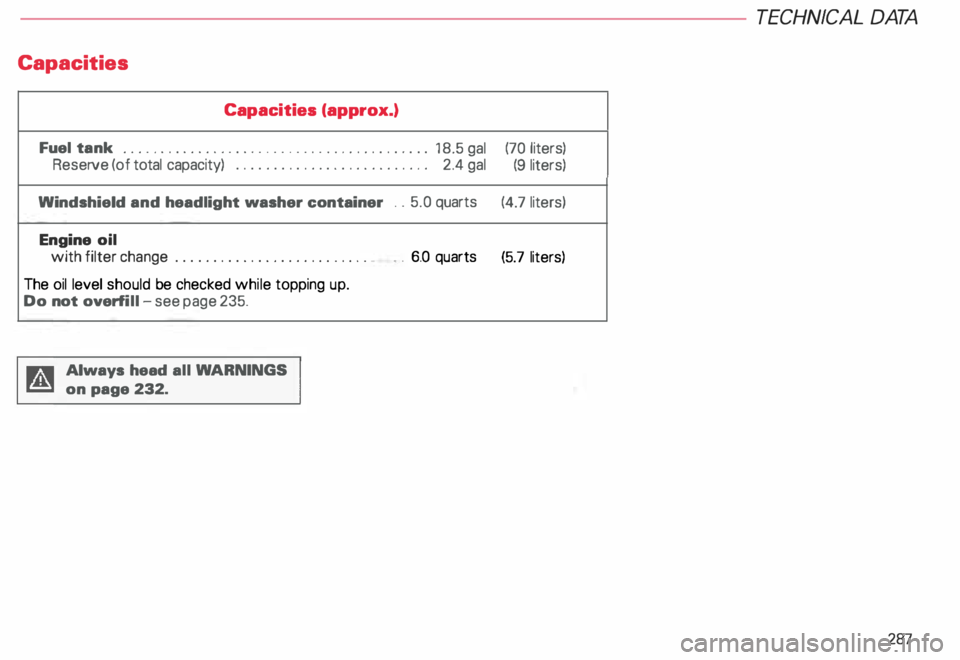
Capacities
Capacities (approx.)
Fuel tank
••••••• •••••••••• ••••••••••••••••• 0 ••• 0 ••
18.5 gal
Reserve (of total capacity) ............
..............
2.4 gal
Windshield and headlight washer container ..
5.0 quarts
Engine oil
with filter change .......................... •
The oil level should be checked while topping up.
Do not overf ill -see page 235.
Always head all WA RNINGS
on page 232. .
. 6.0 quarts TECHNICA
L DAT A
(70 liters)
(9 liters)
(4.7 liters)
(5.7 liters)
287
Page 299 of 306

AL
PHABET ICAL INDEX----------------
Dust filter . . . . . . . . . . . . . . . . . . . 167
Dynamic headlight dimmer
control .
144
E
Electric adjustable seats . . . . . . . . . 78
Electrical socket....... . 181
Electrical socket in the luggage
compartment . . . . . . . . . . . . . . 181
Electrically heated seats. . . . . . . 150
Electromagnetic interference
compliance . . . . . . . . . . . . . . . . 291
Electronic differential lock . . . . . . 204
Electronic immobilizer . . . . . 57, 124
Electronic speed limiter . . . . . . . . 129
Electronic Stability Program
(ESP) . . . . .
. . 124, 152, 205
Emergency
· - Flasher
-K ey ... 12
5, 152
. 56
- Starting . _. • • • • . . . • • ... .
-T owing . . . . _ .... .. _ .. ... .
- Unlocking fuel tank flap .... .
298 278
281
224 -W
arning triangle ....... .... 263
Emission control system . . . . . . . 197
- Malfunction Indicator Lamp 125
Engine
- Compartment .
. . . • • • • . 232
- Cooling . . . .
. . . . • . • . • . . 238
-D ata .......•• •.... ..•. ... 286
-H ood .... .. ... ... .. •... ... 231
-O il .... ..•• .... . , • 234
- Oil level . . . . . . . . . . . • . . . . . 144
- Oil pressure . . . . . . . 143
-O il sensor defective . . . . . . . 14 4
.E ngine oil
- Adding . . . . . . . . . . . . . . . . . . • . 236
- Additives . . • • • • • . . . . • • 234
- Changing . • • . . . . 236
- Checking ... _ . _ ... ... _ .. _ . . 235
- Grades . .
234
- Te mperature gauge 117
Entering selections into the
menu . . . . . . . . . . . . . . . . . . . . .
132
c£' Envir onment
- Brake fluid . . . . . . . . . . . • . . . 243
-C leaning and protection .... . 212 -C
oolant ...... .... ... ... ... 240
- Driving to minimi ze pollution
and noise . . . .
195
- Engine oil . . . . . . . . . . . . . .
237
-F uel. ............ . •. . . . 223
- Mai ntenance . . . . . . . . . . . . 228
-S tarting procedures .... :. . . 114
- Tire pressure . . . . 253
- Unleaded fuel . . . . . • • . . . . . . 225
-W ashing .. . ... ... ...... . _ 213
Exhaust system .. , .. , • . • • . . 19
7
Expansion tank
. . • . . .. • . . .
239
F
Fan speed ...... ...... ....... . 164
Fastening eyes ...... .....•.. •. _ 89
Fas tening the safety belt 20
Filler cap . . . . . . . . . . . 223
First aid kit . . . . . . . . . . • .
263
Floor jack . . . . . . . . . . . . • 283
Floor mat fasteners . . . • 1 02
Fluid
- Brake
242