Page 354 of 2267
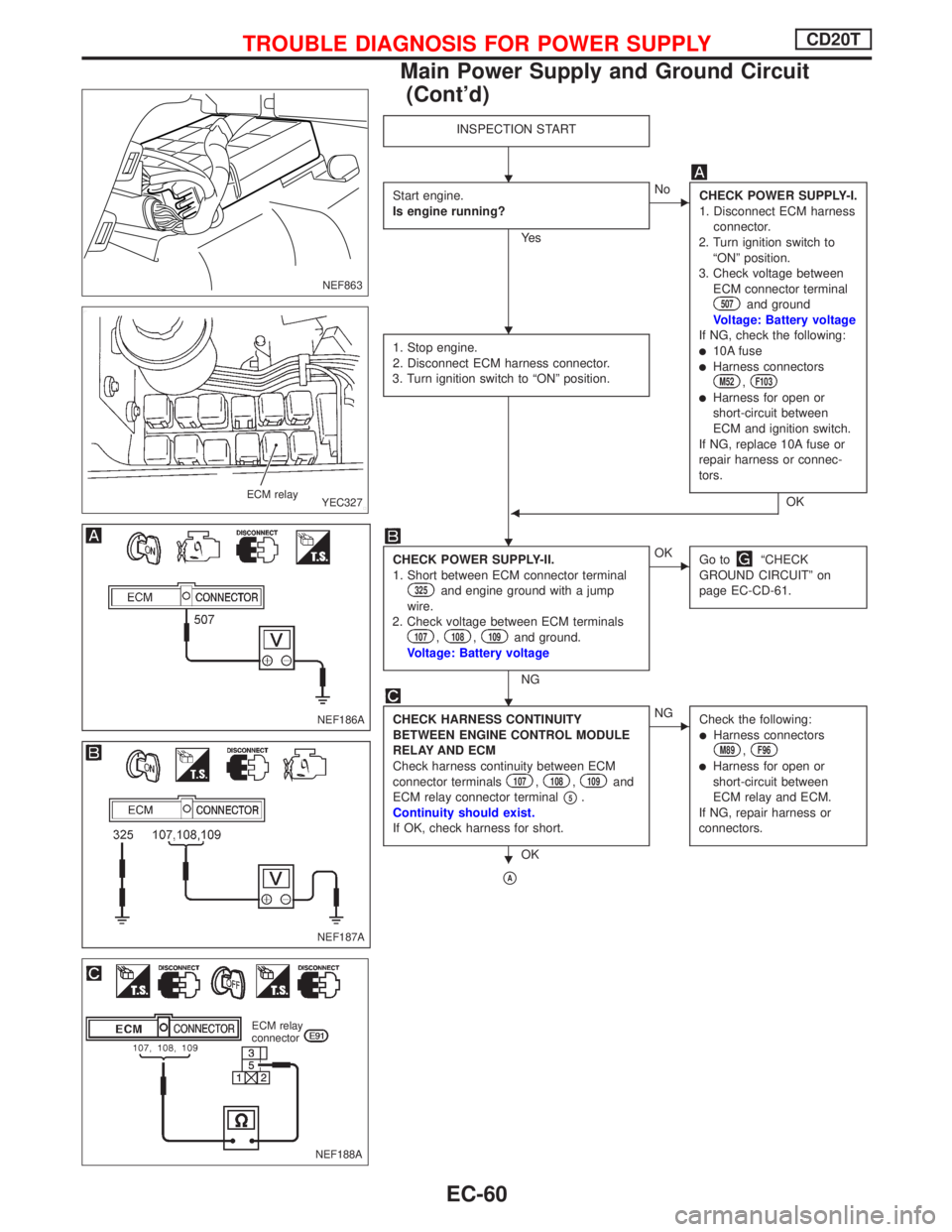
INSPECTION START
Start engine.
Is engine running?
Ye s
ENo
CHECK POWER SUPPLY-I.
1. Disconnect ECM harness
connector.
2. Turn ignition switch to
ªONº position.
3. Check voltage between
ECM connector terminal
507and ground
Voltage: Battery voltage
If NG, check the following:
l10A fuselHarness connectorsM52,F103
lHarness for open or
short-circuit between
ECM and ignition switch.
If NG, replace 10A fuse or
repair harness or connec-
tors.
OK 1. Stop engine.
2. Disconnect ECM harness connector.
3. Turn ignition switch to ªONº position.F
CHECK POWER SUPPLY-II.
1. Short between ECM connector terminal
325and engine ground with a jump
wire.
2. Check voltage between ECM terminals
107,108,109and ground.
Voltage: Battery voltage
NG
EOK
Go toªCHECK
GROUND CIRCUITº on
page EC-CD-61.
CHECK HARNESS CONTINUITY
BETWEEN ENGINE CONTROL MODULE
RELAY AND ECM
Check harness continuity between ECM
connector terminals
107,108,109and
ECM relay connector terminal
p5.
Continuity should exist.
If OK, check harness for short.
OK
ENG
Check the following:
lHarness connectorsM89,F96
lHarness for open or
short-circuit between
ECM relay and ECM.
If NG, repair harness or
connectors.
pA
NEF863
YEC327 ECM relay
NEF186A
NEF187A
NEF188A
ECM relay
connector
H
H
H
H
H
TROUBLE DIAGNOSIS FOR POWER SUPPLYCD20T
Main Power Supply and Ground Circuit
(Cont'd)
EC-60
Page 1161 of 2267
CAUTION:
�If it becomes necessary to start the engine with a
booster battery and jumper cables, use a 12-volt booster
battery.
�After connecting battery cables, ensure that they are
tightly clamped to battery terminals for good contact.
�Never add distilled water through the hole used to check
specific gravity.
How to Handle Battery
METHODS OF PREVENTING OVER-DISCHARGE
The following precautions must be taken to prevent over-dis-
charging a battery.
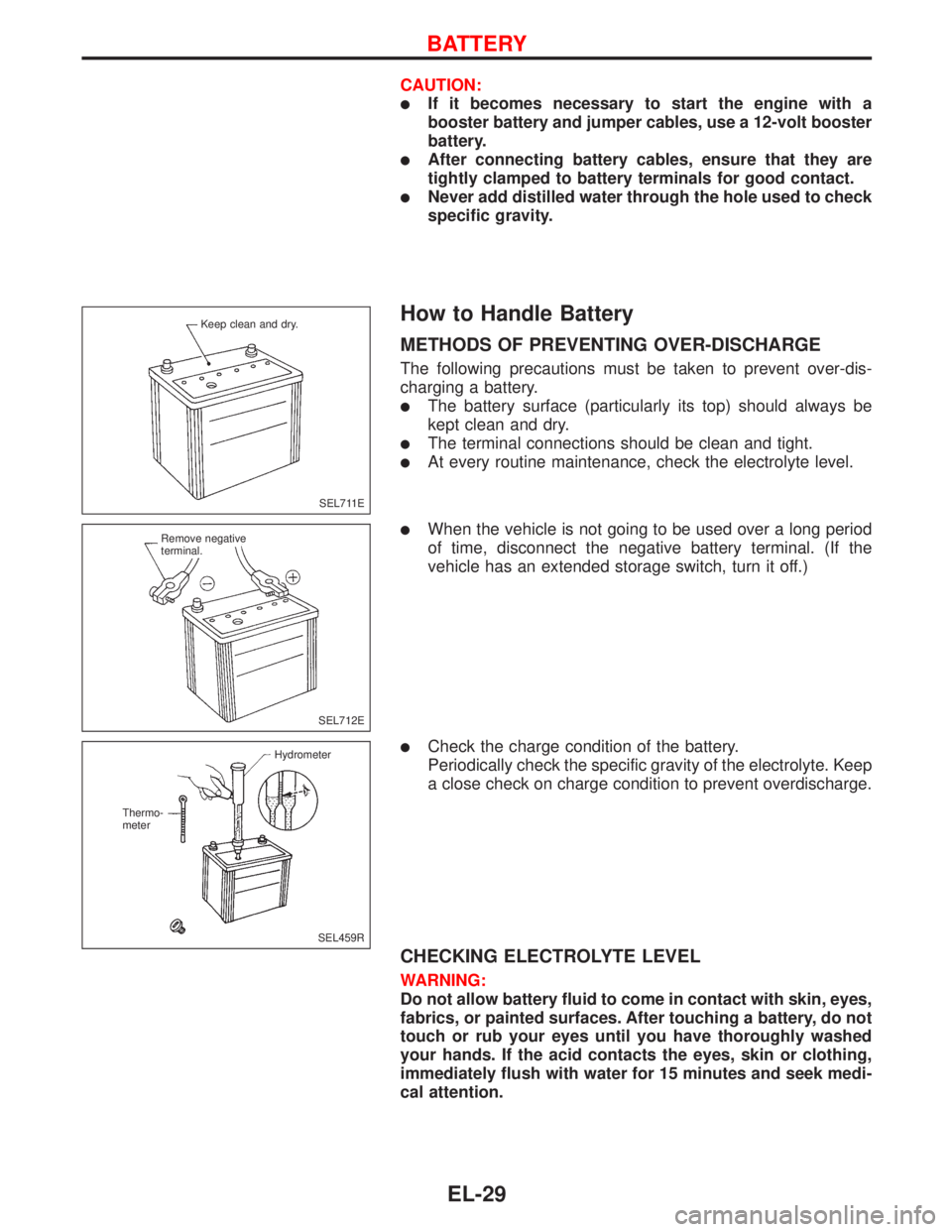
�The battery surface (particularly its top) should always be
kept clean and dry.
�The terminal connections should be clean and tight.
�At every routine maintenance, check the electrolyte level.
�When the vehicle is not going to be used over a long period
of time, disconnect the negative battery terminal. (If the
vehicle has an extended storage switch, turn it off.)
�Check the charge condition of the battery.
Periodically check the specific gravity of the electrolyte. Keep
a close check on charge condition to prevent overdischarge.
CHECKING ELECTROLYTE LEVEL
WARNING:
Do not allow battery fluid to come in contact with skin, eyes,
fabrics, or painted surfaces. After touching a battery, do not
touch or rub your eyes until you have thoroughly washed
your hands. If the acid contacts the eyes, skin or clothing,
immediately flush with water for 15 minutes and seek medi-
cal attention.
SEL711E Keep clean and dry.
SEL712E Remove negative
terminal.
SEL459R Hydrometer
Thermo-
meter
BATTERY
EL-29
Page 1826 of 2267
Voltage check method
1. Remove the blown fuse and disconnect all loads (i.e. SW1 open, relay disconnected and solenoid dis-
connected) powered through the fuse.
2. Turn the ignition key to the ON or START position. Verify battery voltage at the B
+side of the fuse ter-
minal (one lead on the B
+terminal side of the fuse block and one lead on a known good ground).
3. With SW1 open and the DMM leads across both fuse terminals, check for voltage.
voltage; short is between fuse block and SW1 (point A).
no voltage; short is further down the circuit than SW1.
4. With SW1 closed, relay and solenoid disconnected and the DMM leads across both fuse terminals, check
for voltage.
voltage; short is between SW1 and the relay (point B).
no voltage; short is further down the circuit than the relay.
5. With SW1 closed, relay contacts jumped with fused jumper wire check for voltage.
voltage; short is down the circuit of the relay or between the relay and the disconnected solenoid
(point C).
no voltage; retrace steps and check power to fuse block.
GROUND INSPECTION
Ground connections are very important to the proper operation of electrical and electronic circuits. Ground
connections are often exposed to moisture, dirt and other corrosive elements. The corrosion (rust) can
become an unwanted resistance. This unwanted resistance can change the way a circuit works.
Electronically controlled circuits are very sensitive to proper grounding. A loose or corroded ground can
drastically affect an electronically controlled circuit. A poor or corroded ground can easily affect the circuit.
Even when the ground connection looks clean, there can be a thin film of rust on the surface.
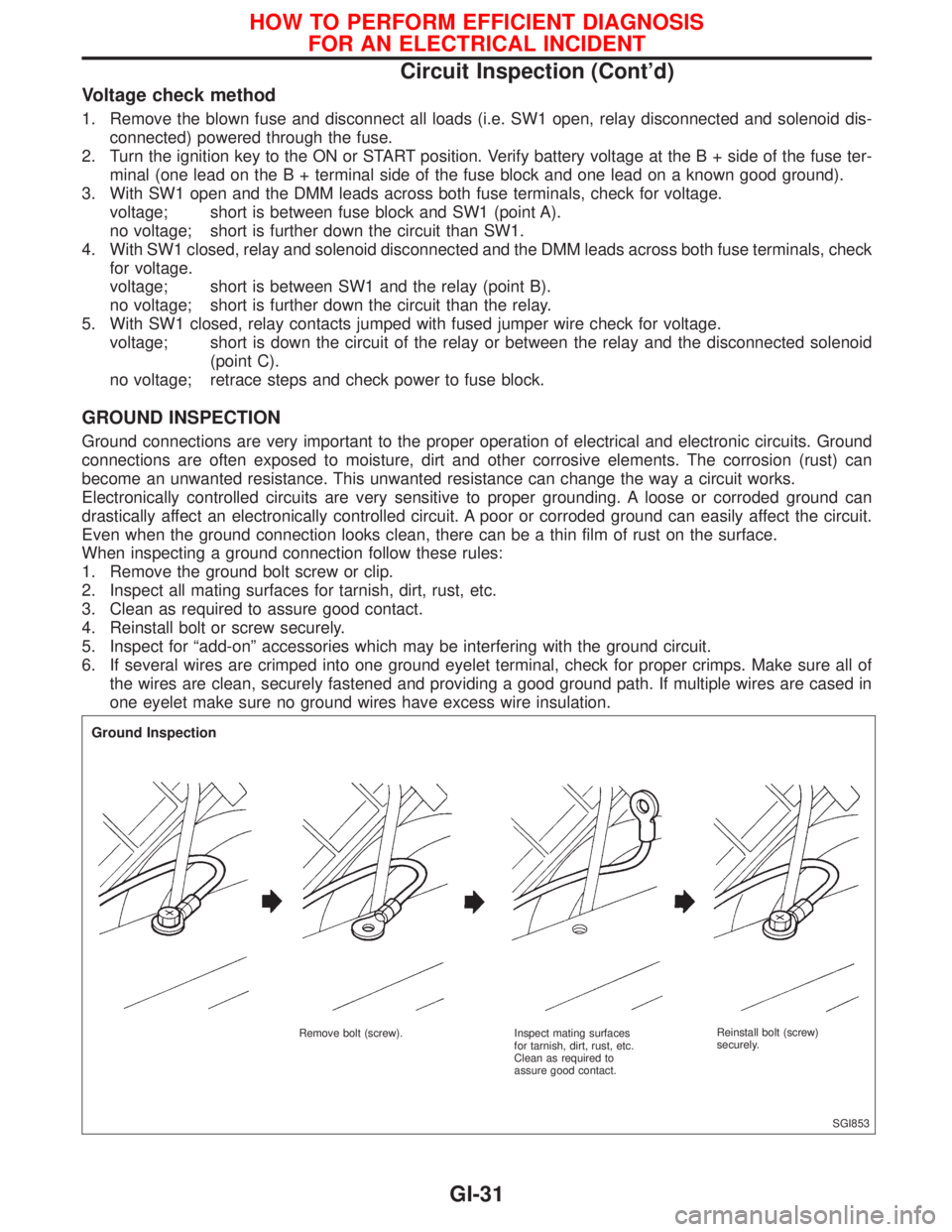
When inspecting a ground connection follow these rules:
1. Remove the ground bolt screw or clip.
2. Inspect all mating surfaces for tarnish, dirt, rust, etc.
3. Clean as required to assure good contact.
4. Reinstall bolt or screw securely.
5. Inspect for ªadd-onº accessories which may be interfering with the ground circuit.
6. If several wires are crimped into one ground eyelet terminal, check for proper crimps. Make sure all of
the wires are clean, securely fastened and providing a good ground path. If multiple wires are cased in
one eyelet make sure no ground wires have excess wire insulation.
SGI853
Ground Inspection
Remove bolt (screw). Inspect mating surfaces
for tarnish, dirt, rust, etc.
Clean as required to
assure good contact.Reinstall bolt (screw)
securely.
HOW TO PERFORM EFFICIENT DIAGNOSIS
FOR AN ELECTRICAL INCIDENT
Circuit Inspection (Cont'd)
GI-31