1989 MITSUBISHI GALANT sensor
[x] Cancel search: sensorPage 228 of 1273
13-86 FUEL SYSTEM
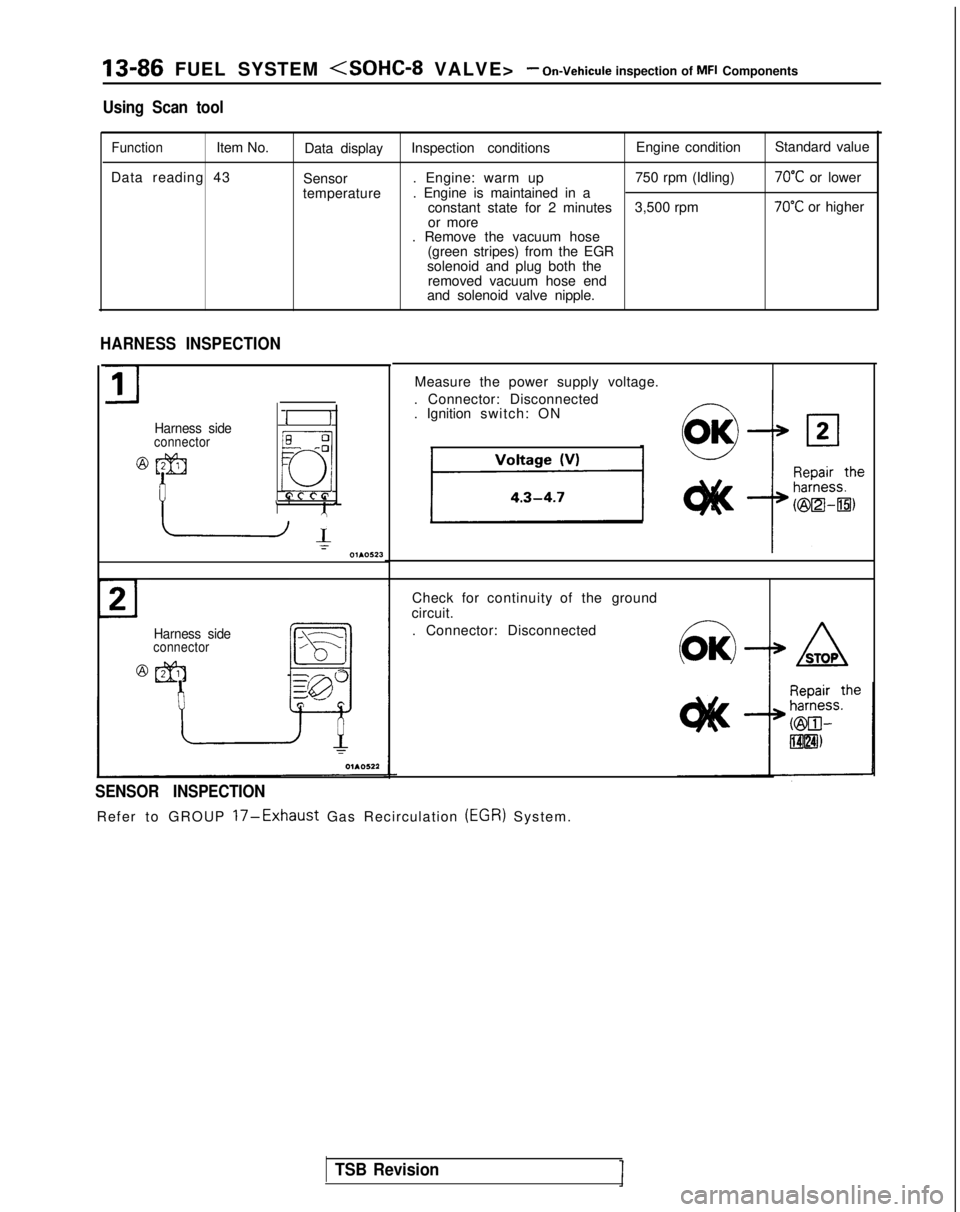
Using Scan tool
FunctionItem No.Data display Inspection conditions Engine condition
Standard value
Data reading 43 Sensor. Engine: warm up
750 rpm (Idling)
70°C or lower
temperature . Engine is maintained in a
constant state for 2 minutes 3,500 rpm
70°C or higher
or more
. Remove the vacuum hose
(green stripes) from the EGR
solenoid and plug both the removed vacuum hose end
and solenoid valve nipple.
HARNESS INSPECTION
Harness sideconnector
@qqJ
I
II
EL -:
f7
Q,
L *A’
-1I01.0523
Measure the power supply voltage.
. Connector: Disconnected
. Ignition switch: ON
Harness sideconnector
Check for continuity of the ground
circuit.
. Connector: Disconnected
SENSOR INSPECTION
Refer to GROUP 17-Exhaust Gas Recirculation (EGR)
System.
-w
STOP
TSB Revision
Page 229 of 1273
FUEL SYSTEM
OXYGEN SENSORM13VSAa
/
Oxygen sensor
)G/’ ‘;‘@
i b\A
-
I6FUO659
Theoretical A/F
Component side
Component sideconnectorconnectorIn case of FEDIn case of CALIFI r
Oxygensensor
i klJ
I
-
11 2
Enginecontrol
module
6FU1452
NOTE01 Lo836
l 1 :
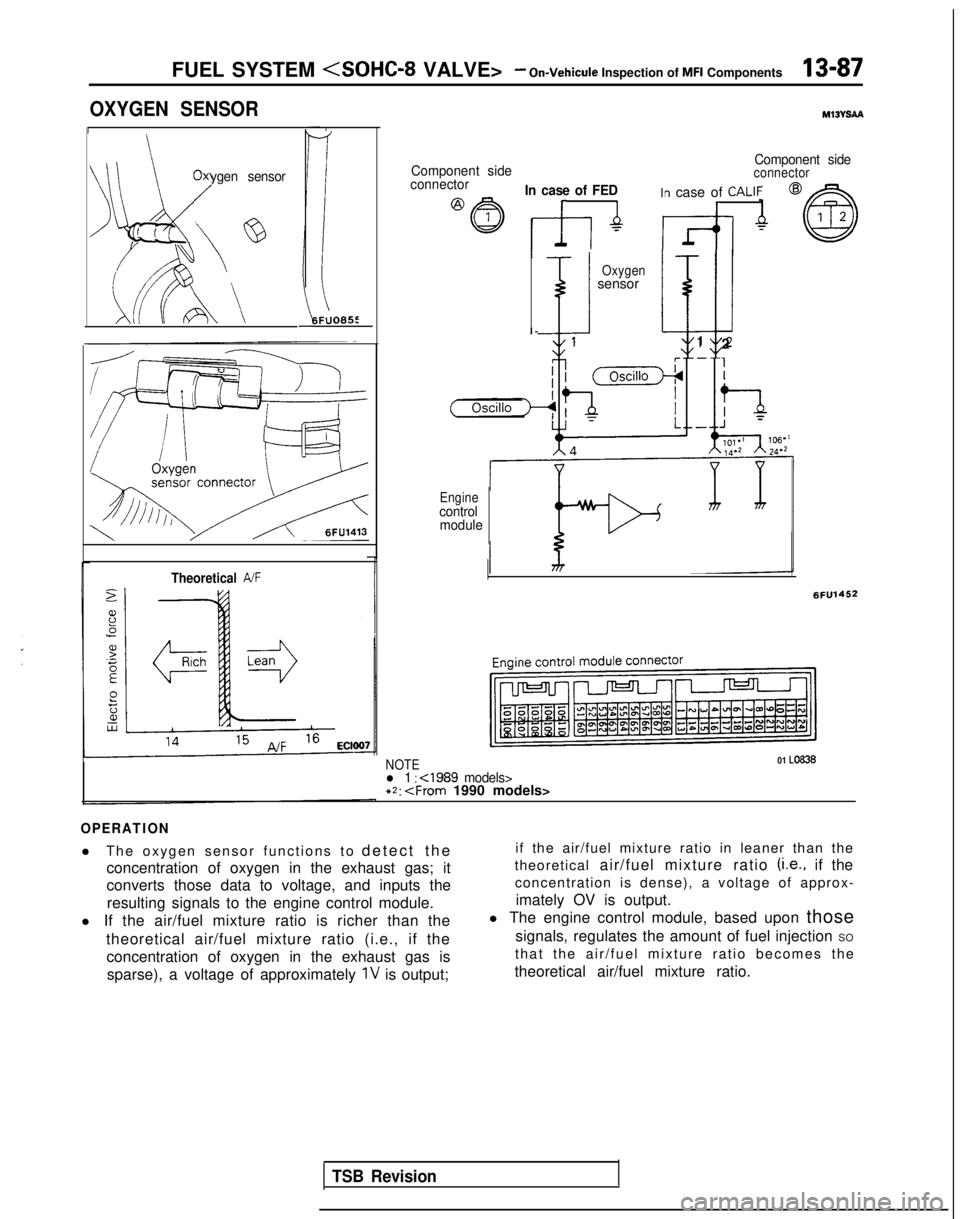
OPERATION
l The oxygen sensor functions to
detect th
e
concentration of oxygen in the exhaust gas; it
converts those data to voltage, and inputs the
resulting signals to the engine control module.
l If the air/fuel mixture ratio is richer than the
theoretical air/fuel mixture ratio (i.e., if theconcentration of oxygen in the exhaust gas issparse), a voltage of approximately
1V is output; if the air/fuel mixture ratio in leaner than the
theoretical air/fuel mixture ratio
(Le., if the
concentration is dense), a voltage of approx-
imately OV is output.
l The engine control module, based upon those
signals, regulates the amount of fuel injection SO
that the air/fuel mixture ratio becomes th
e
theoretical air/fuel mixture ratio.
TSB Revision
Page 230 of 1273
13-88 FUEL SYSTEM
TROUBLESHOOTING HINTS
Hint I’
The exhaust gas purification performance will
Examples:
(1) Malfunction of an injector.
worsen if there is a malfunction of the oxygen sensor. Hint 2:
If the oxygen sensor output voltage deviates from
the standard value even though the results of the
checking of the oxygen sensor are normal, the
cause is probably a malfunction of a component related to mixture control. (2) Air leakage into the intake manifold from a
leaking gasket.
(3) Malfunction of the volume air flow sensor, the intake air temperature sensor, the barometric-
pressure sensor, or the engine coolant tempera-
ture sensor.
Data reading
INSPECTION
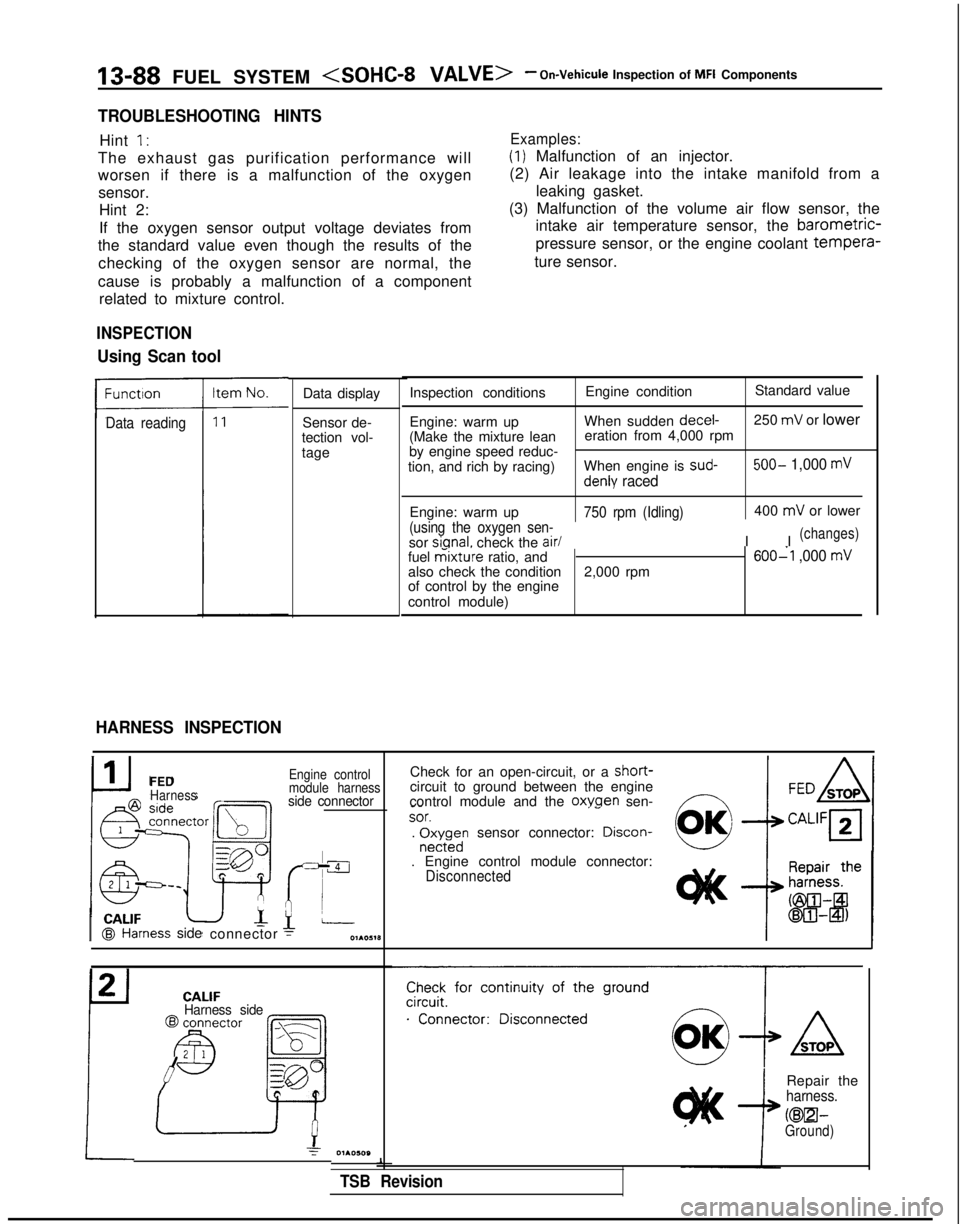
Using Scan tool
HARNESS INSPECTION
Data display
Sensor de-
tection vol-
tage Inspection conditions
Engine conditionStandard value
Engine: warm up When sudden decel-
250
mV or lower
(Make the mixture lean eration from 4,000 rpm
by engine speed reduc-
tion, and rich by racing) When engine is sud-
500- 1,000 mV
denly raced
Engine: warm up750 rpm (Idling)
(using the oxygen sen-
sor sianal.
check the air/
400
mV or lower
I I
(changes)
fuel mixture ratio, and600-l ,000 mValso check the condition 2,000 rpm
of control by the engine
control module)
I CALIF@I Hal
FEDHarness
ness
side
connector
Engine control
module harness
side connector
Check for an open-circuit, or a short-circuit to ground between the engine
control module and the oxwen sen-f7 _-
~~SOT.‘-. r$;rdn sensor connector: Drscon-
. Engine control module connector:Disconnected CALIF
Harness side
Check for continuity of the ground
.“‘..“...;;”
Repair theharness.
KEEI-Ground)
1
TSB Revision
Page 231 of 1273
FUEL SYSTEM
:Federab
:California>
Ea
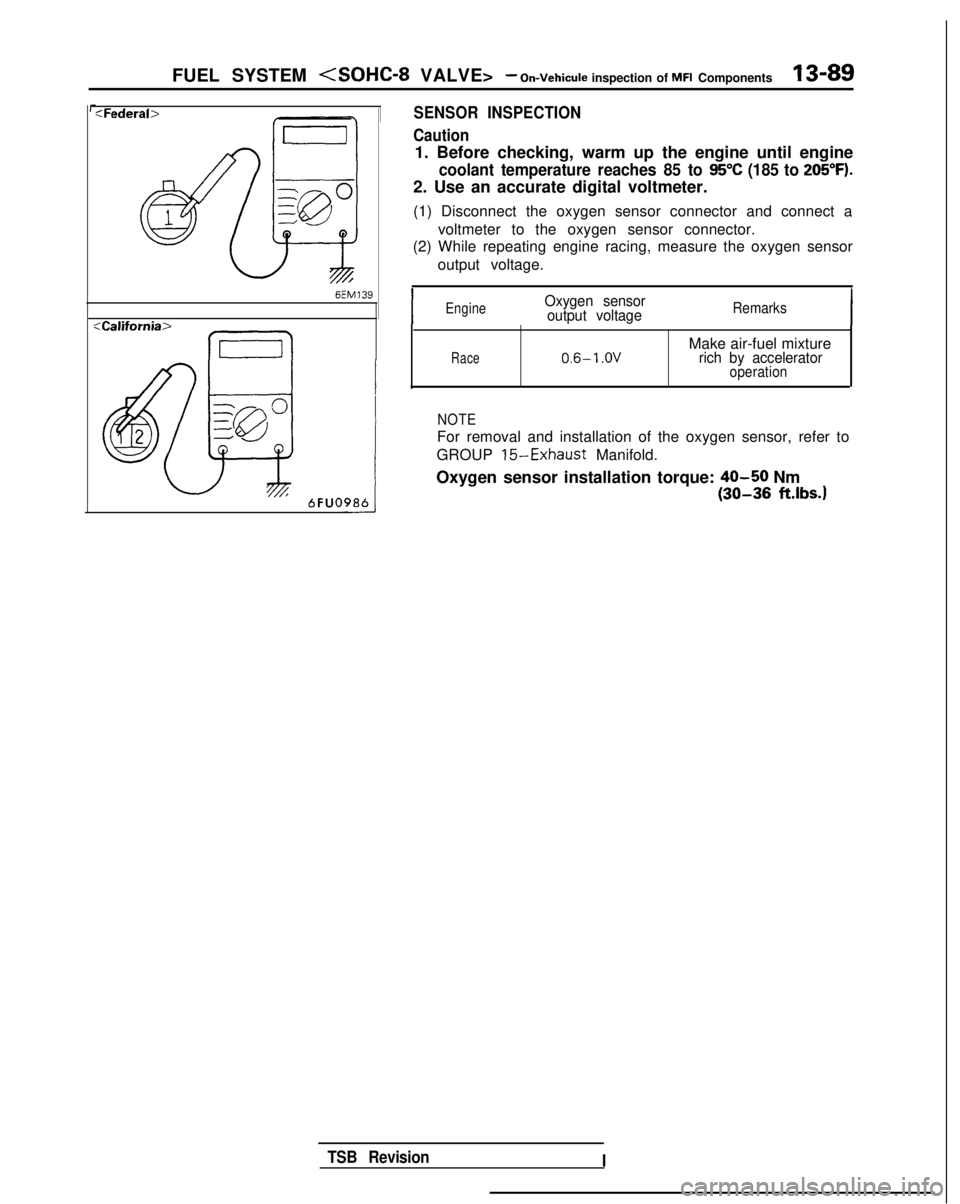
SENSOR INSPECTION
Caution
1. Before checking, warm up the engine until engine
coolant temperature reaches 85 to 95°C (185 to 205°F).
2. Use an accurate digital voltmeter.
(1) Disconnect the oxygen sensor connector and connect a voltmeter to the oxygen sensor connector.
(2) While repeating engine racing, measure the oxygen sensor
output voltage.
,
IEngineOxygen sensoroutput voltageRemarks
Race0.6-l .OVMake air-fuel mixturerich by acceleratoroperation
NOTE
For removal and installation of the oxygen sensor, refer to
GROUP
15-Exhaust Manifold.
Oxygen sensor installation torque:
40-50 Nm
(30-36 ft.lbs.1
TSB Revision I
Page 232 of 1273
13-90 FUEL SYSTEM
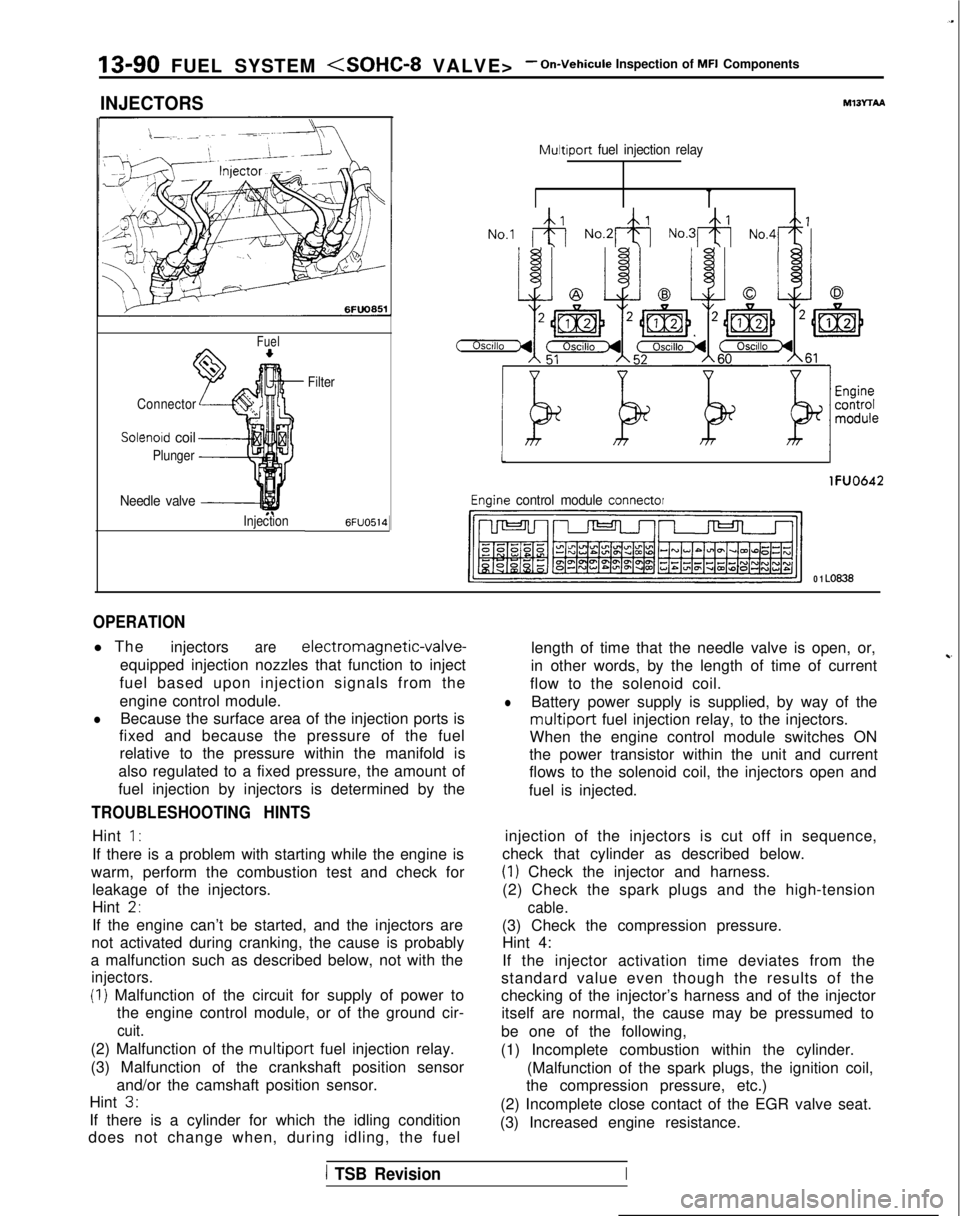
INJECTORS
Fuel
Connector
Solenoid coil
Plunger
Needle valve -----I
InjectionFilter6FUO514
M13rrAA
Multiport
fuel injection relay
No.1 &j No.2& No.3& No,4+
tI
lFUO642
Engine control module connector
CJ=JW=U-I
0 1 LO636
OPERATION
l The
injectorsare electromagnetic-valve-
equipped injection nozzles that function to inject
fuel based upon injection signals from the
engine control module.
lBecause the surface area of the injection ports is
fixed and because the pressure of the fuel
relative to the pressure within the manifold is
also regulated to a fixed pressure, the amount of
fuel injection by injectors is determined by the
TROUBLESHOOTING HINTS
Hint 1:
If there is a problem with starting while the engine is
warm, perform the combustion test and check for leakage of the injectors.
Hint
2,
If the engine can’t be started, and the injectors are
not activated during cranking, the cause is probably
a malfunction such as described below, not with the
injectors.
(I) Malfunction of the circuit for supply of power to the engine control module, or of the ground cir-
cuit.
(2) Malfunction of the multiport fuel injection relay.
(3) Malfunction of the crankshaft position sensor and/or the camshaft position sensor.
Hint
3.
If there is a cylinder for which the idling condition
does not change when, during idling, the fuel length of time that the needle valve is open, or,
in other words, by the length of time of current
~-
flow to the solenoid coil.
lBattery power supply is supplied, by way of the
multiport fuel injection relay, to the injectors.
When the engine control module switches ON
the power transistor within the unit and current
flows to the solenoid coil, the injectors open and
fuel is injected.
injection of the injectors is cut off in sequence,
check that cylinder as described below.
(1) Check the injector and harness.
(2) Check the spark plugs and the high-tension
cable.
(3) Check the compression pressure. Hint 4:
If the injector activation time deviates from the
standard value even though the results of the
checking of the injector’s harness and of the injector itself are normal, the cause may be pressumed to
be one of the following,
(1) Incomplete combustion within the cylinder. (Malfunction of the spark plugs, the ignition coil,
the compression pressure, etc.)
(2) Incomplete close contact of the EGR valve seat.
(3) Increased engine resistance.
1 TSB RevisionI
Page 247 of 1273
FUEL SYSTEM
fine probe7FU1264 1
(15) Reduce the internal pressure of the fuel pipes and hoses.
(Refer to
P.13-102.)
(16) Disconnect the fuel pressure gauge and the special toolsfrom the fuel rail.
Caution
Because there will be some residual pressure in the fuel
pipe line, use a shop towel to cover so that fuel doesn’t
splatter.
(17)Replace the O-ring at the end of the fuel high-pressure
hose with a new one. (18)After
connecting the fuel high-pressure hose to the fuel
rail, tighten the installation bolt.
(19)Check to be sure that there is no fuel leakage.
@ Apply battery voltage to the terminal for activation of the fuel pump so as to activate the fuel pump.
@ With fuel pressure applied, check for leakage of the fuel
line.
INSPECTION OF ENGINE CONTROL MODULE
TERMINAL VOLTAGEMl 3ZALBa
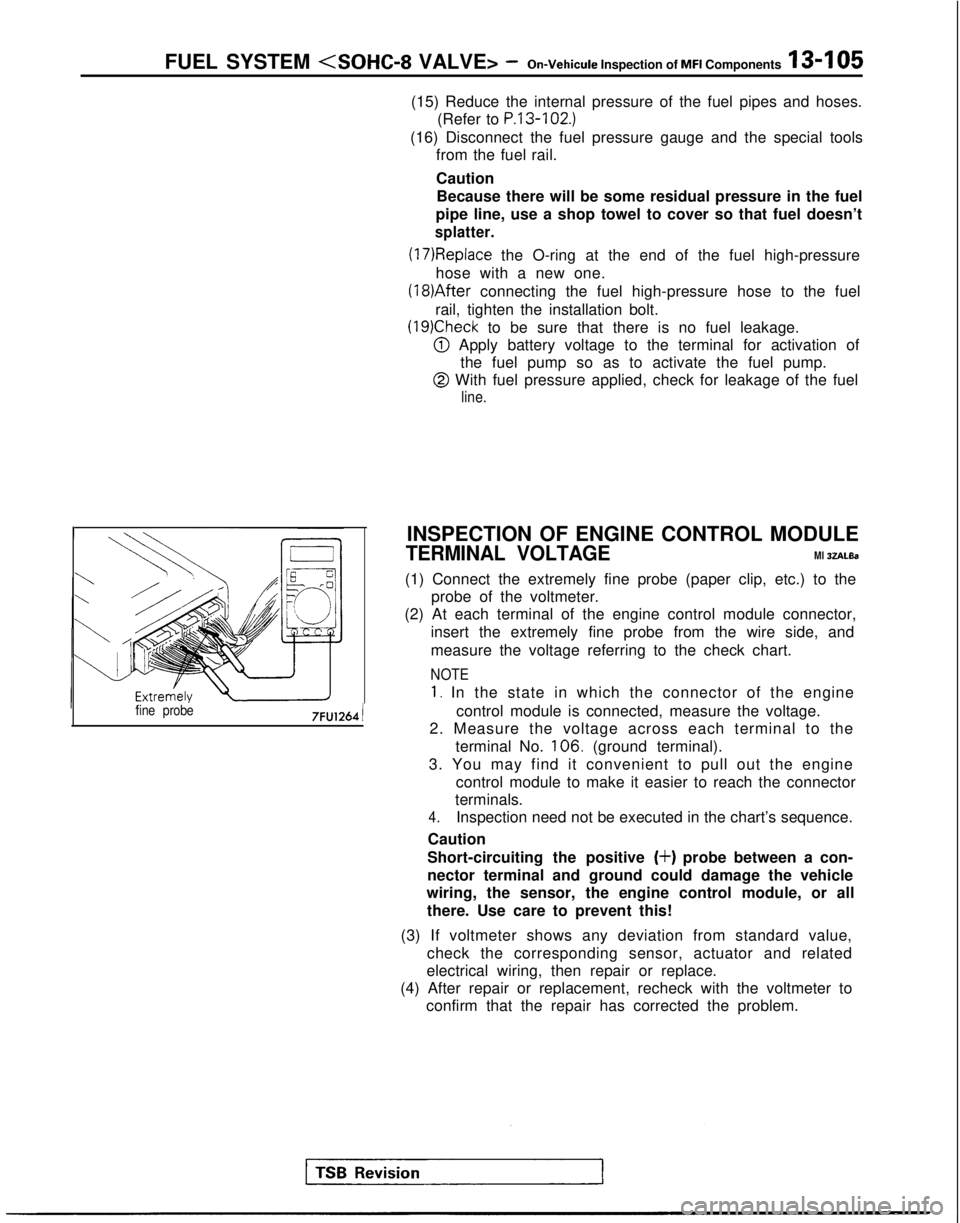
(1) Connect the extremely fine probe (paper clip, etc.) to the probe of the voltmeter.
(2) At each terminal of the engine control module connector,
insert the extremely fine probe from the wire side, and
measure the voltage referring to the check chart.
NOTE
1. In the state in which the connector of the engine
control module is connected, measure the voltage.
2. Measure the voltage across each terminal to the
terminal No. 106.
(ground terminal).
3. You may find it convenient to pull out the engine control module to make it easier to reach the connector
terminals.
4.Inspection need not be executed in the chart’s sequence.
Caution
Short-circuiting the positive
(+) probe between a con-
nector terminal and ground could damage the vehicle
wiring, the sensor, the engine control module, or all
there. Use care to prevent this!
(3) If voltmeter shows any deviation from standard value, check the corresponding sensor, actuator and related
electrical wiring, then repair or replace.
(4) After repair or replacement, recheck with the voltmeter to confirm that the repair has corrected the problem.
Page 248 of 1273
13-106
FUEL SYSTEM
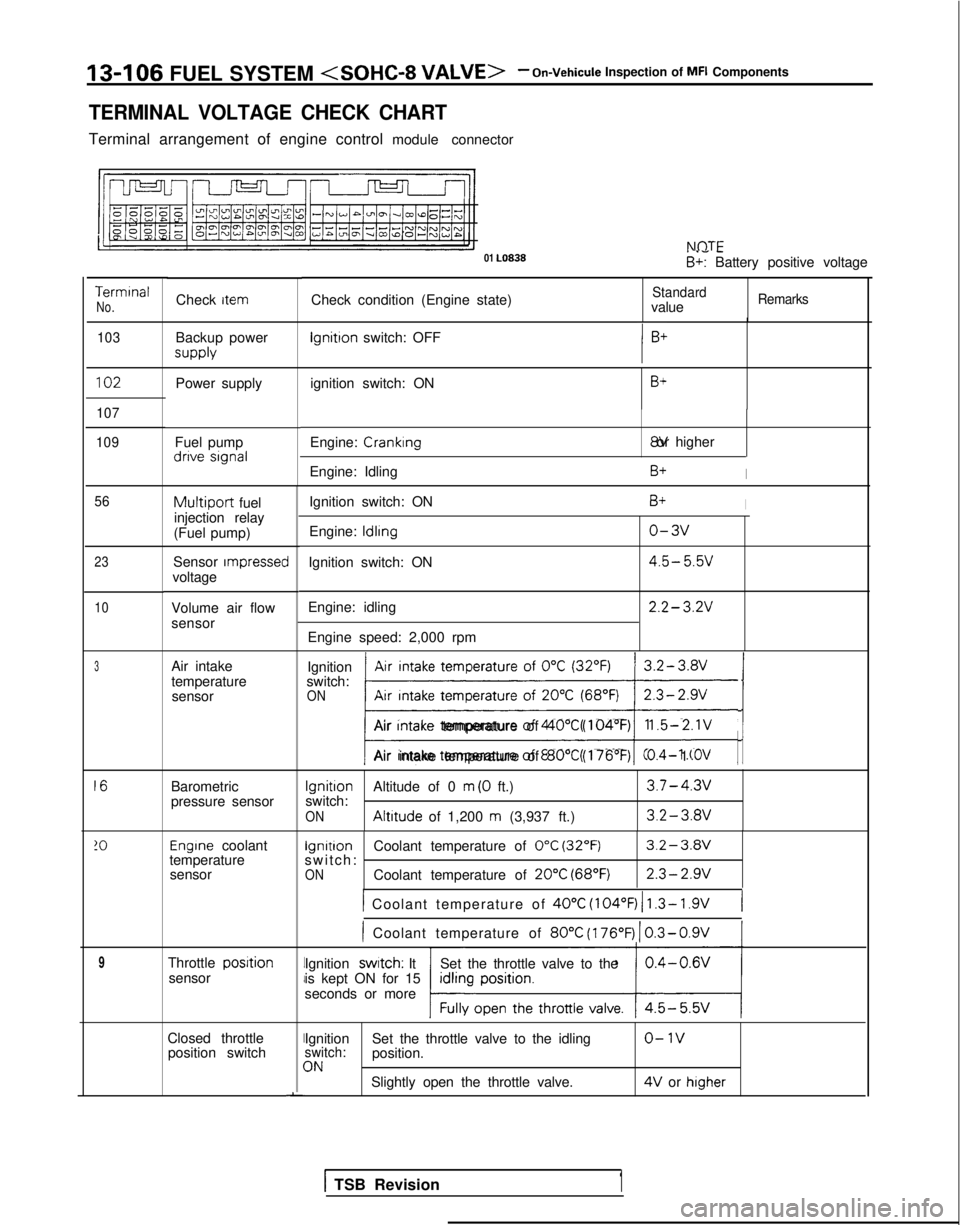
TERMINAL VOLTAGE CHECK CHART
Terminal arrangement of engine control module connector NflTF
01 LO838
. .- -B+: Battery positive voltage
Terminal
No.Check condition (Engine state)StandardvalueRemarksCheck item
103
Backup power supply lgnitron
switch: OFF
102Power supply ignition switch: ONB+
107
109
Fuel pump dnve signal
Engine: Cranking 8V or higher
Engine: Idling
B+I
Ignition switch: ON
Engine:
ldlrng
Ignition switch: ON
Engine: idling
Engine speed: 2,000 rpm
B+I
o-3v
4.5- 5.5v
2.2- 3.2V
56
23
10
Multiport fuel
injection relay
(Fuel pump)
Sensor
rmpressecvoltage
Volume air flow
sensor
Air intake
temperature sensor Ignition
Air intake temperature of
0°C (32°F)switch:ONAir Intake temperature of 20°C (68°F); ji/
Air Intake temperature of 40°C (104°F)1.5-2.1V
Air intake temperature of 80°C (176’F)0.4- 1 .OV
Barometric
pressure sensor
Ignition
Altitude of 0 m (0 ft.)3.7-4.3vswitch:ON Altitude
of 1,200 m (3,937 ft.)3.2-3.av
Engrne coolant lgnitron
Coolant temperature of 0°C (32°F)3.2-3.Wtemperature switch: -sensorONCoolant temperature of 20°C (68°F)2.3-2.9v
1 Coolant temperature of 40°C
(104°F) 1 1.3- 1.9V(
) Coolant temperature of 80°C
(176’F)
1 0.3-0.9V
Throttle posrtionsensor Ignition swatch: It
Set the throttle valve to the
is kept ON for 15
seconds or more
Closed throttle position switchII
I
I
-
Ignition Set the throttle valve to the idlingo-1vswitch:position.3NSlightly open the throttle valve. 4V
or higher
3
16
!O
9
1 TSB Revision1
Page 249 of 1273
FUEL SYSTEM
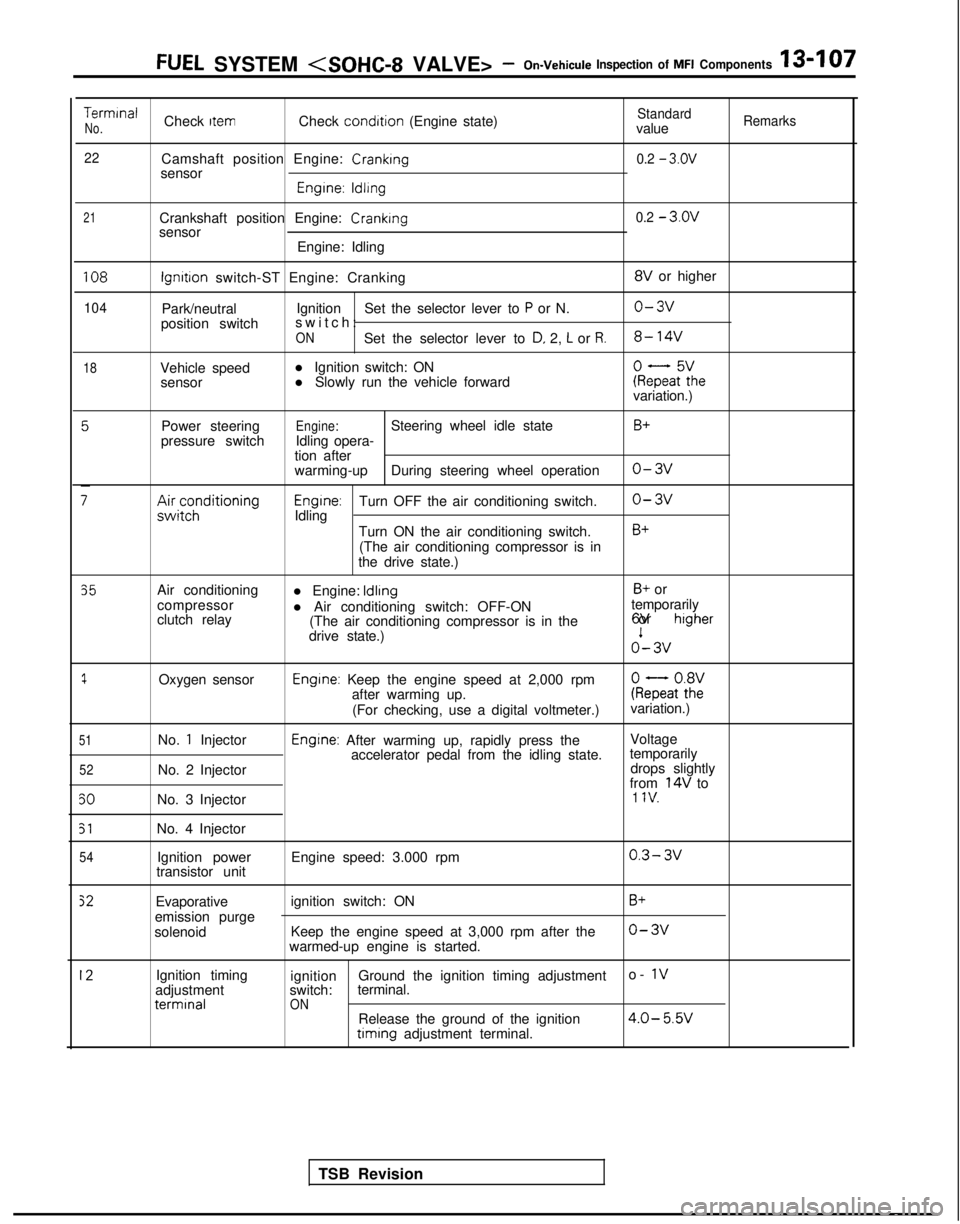
TerminalCheck ItemCheck condition
(Engine state)StandardNo.valueRemarks
22
Camshaft position Engine: Cranking0.2 - 3.ov
sensor
Engrne: ldllng
21Crankshaft position Engine: Crankingsensor
Engine: Idling0.2 - 3.ov
108
104
18
lgnrtron switch-ST Engine: Cranking 8V
or higher
Park/neutral Ignition
Set the selector lever to
P or N.o-3v
position switch switch
:
ONSet the selector lever to D, 2, L or R.8- 14V
Vehicle speed
l Ignition switch: ON
sensor l Slowly run the vehicle forwardkeFaF:hevariation.)
Power steering
pressure switch
;;ir;z;ditioning
Engine:Steering wheel idle state
Idling opera-
tion after
warming-up During steering wheel operation
Engrne:Turn OFF the air conditioning switch.
Idling
Turn ON the air conditioning switch.(The air conditioning compressor is in
the drive state.)
B+
o-3v
o-3v
B+
35
1
51
52
50
51
54
Air conditioning
compressor
clutch relay
Oxygen sensor
No.
1 Injector
No. 2 Injector
No. 3 Injector
No. 4 Injector Ignition power
transistor unit l Engine: Idling
B+ or
l Air conditioning switch: OFF-ON temporarily
(The air conditioning compressor is in the 6V or
higher
drive state.)o’- 3v
Engine: Keep the engine speed at 2,000 rpm
after warming up. kQatot8h2:
(For checking, use a digital voltmeter.) variation.)
Engine: After warming up, rapidly press the
Voltage
accelerator pedal from the idling state. temporarily
drops slightly
from
14V to1 IV.
Engine speed: 3.000 rpm0.3- 3v
Evaporative
emission purge
solenoid ignition switch: ON
Keep the engine speed at 3,000 rpm after the
warmed-up engine is started.B+
o-3v
12Ignition timing
adjustment terminal
ignition
Ground the ignition timing adjustment o- 1vswitch:
terminal.ONRelease the ground of the ignition4.0- 5.W timing
adjustment terminal.
TSB Revision