Page 105 of 281

Downloaded from www.Manualslib.com manuals search engine GWFLORID Maintenance Manual98
Brake Pedal
Components
Areas of Importance
1. During removal, all components should be gently handled to avoid knocking, especially the junction
surface. All components should be placed in order to avoid losing or taking the w\
rong parts.
2. Keep all parts clean and free of dust, scuffs, rust, corrosion, oil build-up, or any other contaminants.
3. All rubbing surfaces in a relative motion must be coated with lubricant\
.
4. During installation, strictly adhere to the standard torque for installi\
ng nuts.
5. While installing the return spring, be careful to avoid operator injury \
from it bouncing back.
Troubleshooting
SymptomsPossible causesEliminating methods
Brake pedal cannot return
to the original position
Return spring is brokenReplace the spring
Return spring's fixed end comes offCheck, secure in place
Feels slippery when
stepping on the pedal
Pedal pad is worn outReplace
Pedal pad comes offReinstall
Stepping on the pedal
produces abnormal noise
The plastic bushing is seriously worn outReplace
Spring brokenReplace
Spring's fixed end comes offCheck, re-fix
Pedal pad
Cotter pin
Return spring
Pedal shaft
Brake pedal bracket
welding assembly
Brake pedal lever welding assembly
Bushing
Nut
Limiting stopper
Center pin
Page 106 of 281
Downloaded from www.Manualslib.com manuals search engine 99Brake System
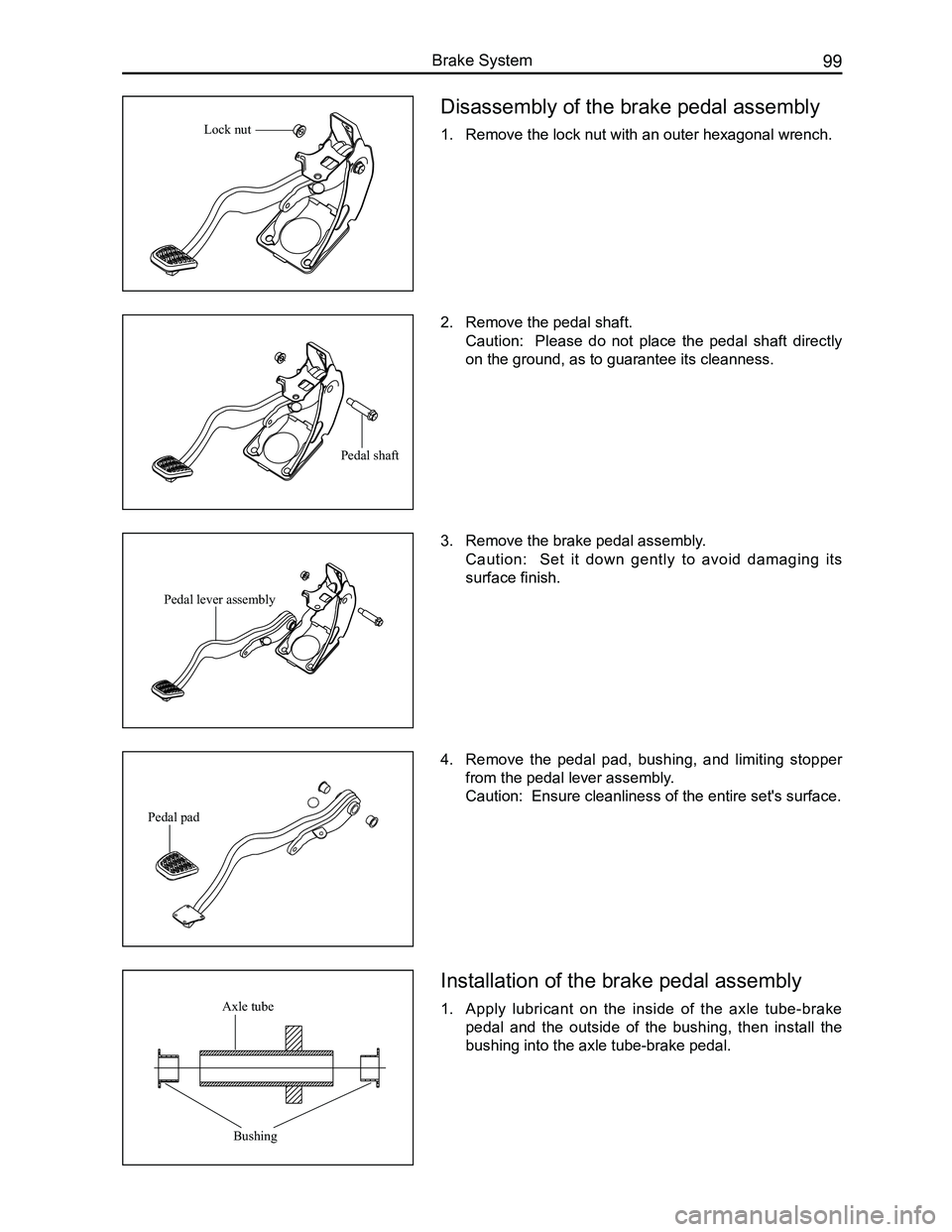
Disassembly of the brake pedal assembly
1. Remove the lock nut with an outer hexagonal wrench.
2. Remove the pedal shaft.
Caution: Please do not place the pedal shaft directly
on the ground, as to guarantee its cleanness.
3. Remove the brake pedal assembly.
Caution: Set it down gently to avoid damaging its
surface finish.
4. Remove the pedal pad, bushing, and limiting stopper
from the pedal lever assembly.
Caution: Ensure cleanliness of the entire set's surface.
Installation of the brake pedal assembly
1. Apply lubricant on the inside of the axle tube-brake
pedal and the outside of the bushing, then install the
bushing into the axle tube-brake pedal.
Lock nut
Pedal shaft
Pedal lever assembly
Pedal pad
Axle tube
Bushing
Page 107 of 281

Downloaded from www.Manualslib.com manuals search engine GWFLORID Maintenance Manual100
2. Install the pedal pad and limiting stopper to the pedal
lever.
3. Apply lubricant on the inner bushing and the outer
pedal shaft. Install the pedal lever assembly, pedal
shaft, and brake pedal bracket welding assembly.
4. Put on a nut, and tighten the nut and spring washer
using a 30 N·m torque.
Brake pedal examination and adjustment
1. Check if the pedal height is correct.
Height between pedal and the lower cowl panel: 109 mm
Pedal push rod's working empty stroke: 2 mm
2. Adjust pedal height if necessary.
(a) Disconnect the brake lamp's switch wire connector,
loosen the lock nuts, rotate the brake switch and
unscrew it until no contact with the brake pedal's
limiting stopper.
(b) Loosen the control rod lock nut and use combination
pliers to rotate the control rod and adjust the brake
pedal height to its standard value. After arriving at the
standard value, tighten the lock nut, and make sure the
working empty stroke of the pedal push rod is 2 mm.
(c) Rotate the brake lamp's switch and push it in until it
barely contacts with the brake pedal limiting stopper,
continue rotating 1/2-1 circle, then tighten the lock nut.
(d) Connect the brake lamp's switch wire connector.
(e) When the brake pedal is loose, the brake lamp should
be off.
Pedal height
Pedal padLimiting stopper
Page 108 of 281

Downloaded from www.Manualslib.com manuals search engine 101Brake System
3. Inspect the pedal free play.
When the engine is off, step on the brake pedal two to three
times, after the brake booster's influence is removed, push
the brake pedal by hand until resistance is felt, then measure
its movement (free play). Should satisfy standard value
regulation.
Pedal free play: 6-9 mm
4. Adjust pedal free play if necessary.
(a) If the stroke value is incorrect, rotate the pedal push
rod to adjust the free play.
(b) Start the engine to confirm the pedal free play.
(c) After adjusting the pedal free play, check the pedal
height.
(d) The relative height gap between the brake pedal and
the clutch pedal is 0-8 mm.
(e) The relative height gap between the brake pedal and
the accelerator pedal is 45±5 mm.
5. When the clearance between the brake pedal shaft
and the bushing is too big, one should remove and re-
place the pedal.
6. As shown, check if the pedal's remaining distance is
correct.
Pedal free play
Pedal’s remaining distance
Page 109 of 281

Downloaded from www.Manualslib.com manuals search engine GWFLORID Maintenance Manual102
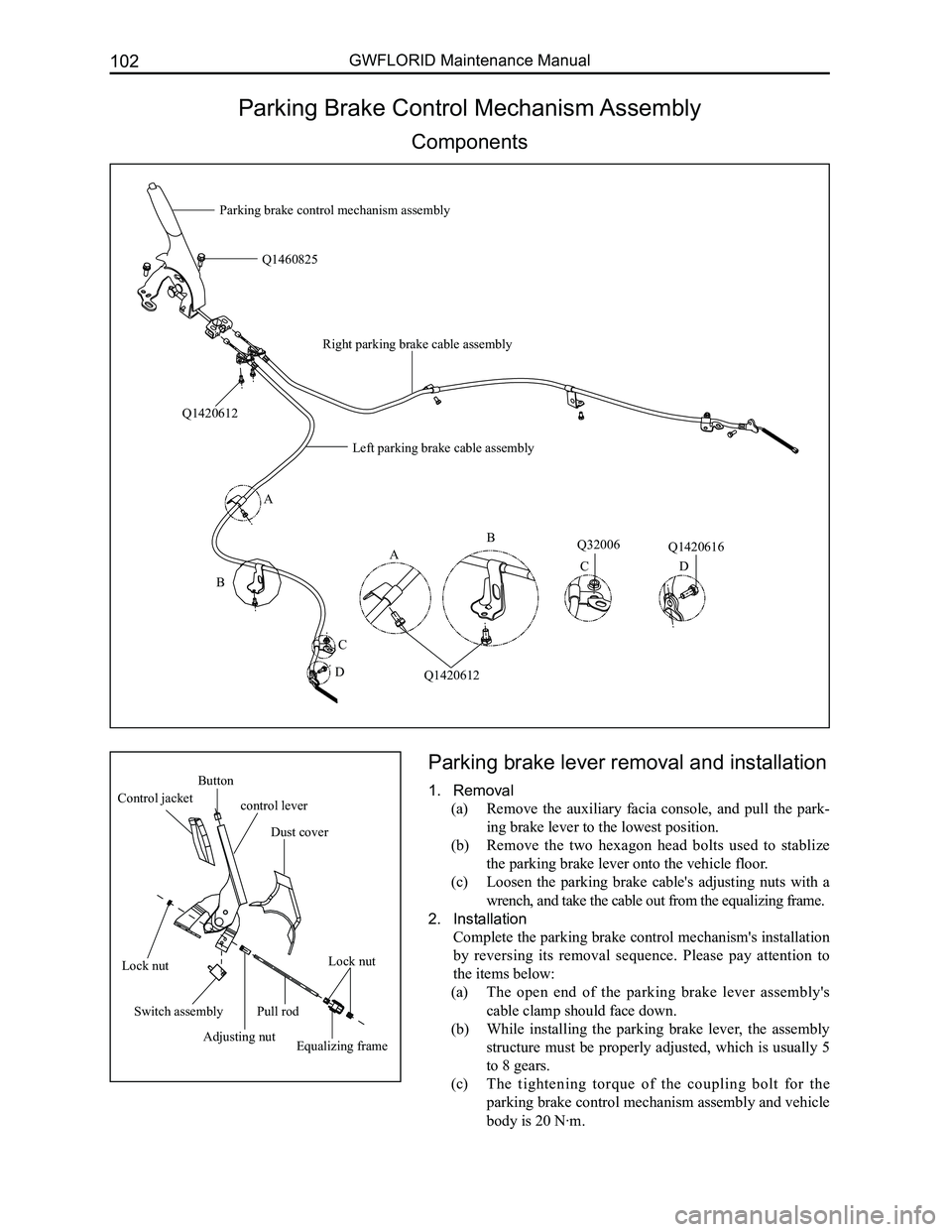
Parking Brake Control Mechanism Assembly
Components
Parking brake lever removal and installation
1. Removal
(a) Remove the auxiliary facia console, and pull the park-
ing brake lever to the lowest position.
(b) Remove the two hexagon head bolts used to stablize
the parking brake lever onto the vehicle floor.
(c) Loosen the parking brake cable's adjusting nuts with a
wrench, and take the cable out from the equalizing frame.
2. Installation
Complete the parking brake control mechanism's installation
by reversing its removal sequence. Please pay attention to
the items below:
(a) The open end of the parking brake lever assembly's
cable clamp should face down.
(b) While installing the parking brake lever, the assembly
structure must be properly adjusted, which is usually 5
to 8 gears.
(c) The tightening torque of the coupling bolt for the
parking brake control mechanism assembly and vehicle
body is 20 N·m.
A
B
C
D
Q1420612
Q1460825
Q32006Q1420616
Parking brake control mechanism assembly
Q1420612
A
B
CD
Left parking brake cable assembly
Right parking brake cable assembly
Button
control lever Control jacket
Dust cover
Lock nutLock nut
Switch assembly
Adjusting nutEqualizing frame
Pull rod
Page 110 of 281

Downloaded from www.Manualslib.com manuals search engine 103Brake System
Vacuum Booster with Brake Cylinder Assembly
Components
Areas of Importance
1. The vacuum booster with brake cylinder assembly is tightly connected with the brake pedal assembly on
the cowl panel using four nuts. It is also connected with the brake pedal push rod via an center pin and
lock pin. Thus before removal of the assembly, first loosen the rigid pipe fitting with an open-end wrench,
disconnect the lock pin and center pin using pliers, loosen the four nuts, and then proceed with the booster.
2. Tighten the lock nuts on brake master cylinder and vacuum booster according to the specified torque,
and coat with signal paint.
3. Dimensions between the rear housing head face and the adjusting fork hole center is adjusted to
standard before it leaves factory. Please do not adjust it again.
4. The vacuum booster valve rod on the vehicle must be in a free state.
5. The brake master cylinder's working agent is DOT4 brake fluid. It must not be mixed with any other
brake fluid.
Problems and symptomsCausesEliminating methods
M a s t e r c y l i n d e r ' s o i l r e s e r v o i r i s severely leakingThe master cylinder, slave cylinder, or hydraulic line is leaking.Eliminate the areas with leaks (in general, it may be that the pipe fitting's tightening torque is not enough, check one by one and tighten as necessary)
1. Vacuum booster not sufficient2. No boost when the engine is off3. May lead to unsteady engine idling when severe
1. Under non-operating conditions, the vacuum booster leaks air.2. Front and rear housing connection are not sealed.3. Booster's front and rear gas seal sealing failure.4. Vacuum check valve leaks.
1. Replace the front and back gas seal and control valve assembly.2. Replace the vacuum booster.3. Replace the vacuum check valve assembly.
Brake pedal is heavy with no boost effect1. Under non-operating conditions, the vacuum booster leaks air.2. Booster diaphragm worn and damaged.3. Control valve ring cup worn and damaged.
1. Replace the front, back gas seal and booster diaphragm.2. Replace the vacuum booster.3. Replace the control valve assembly.
Spongy pedal when braking1. There is air in the brake fluid.2. Cylinder or slave cylinder leaks oil.3. There is brake line seepage.
1. Eliminate the air in the system.2. Inspect the cylinder and sub-pump cup and replace with new parts.3. Inspect the pipeline and eliminate the seepage.
When continuously step on the brake pedal, the pedal will gradually change and expand till the highest extend.
Pump valve opening blockage.Brake fluid cleanliness is insufficient, please replace the brake fluid.
Troubleshooting
Oil cup cover
Oil cup body
Check valve
Check valve seat
Vacuum booster
Pad
Lock nut
Rod clevisCoupling nut
Rectangular sealing ringCylinder body
Fluid supply sealing ring
Page 111 of 281

Downloaded from www.Manualslib.com manuals search engine GWFLORID Maintenance Manual104
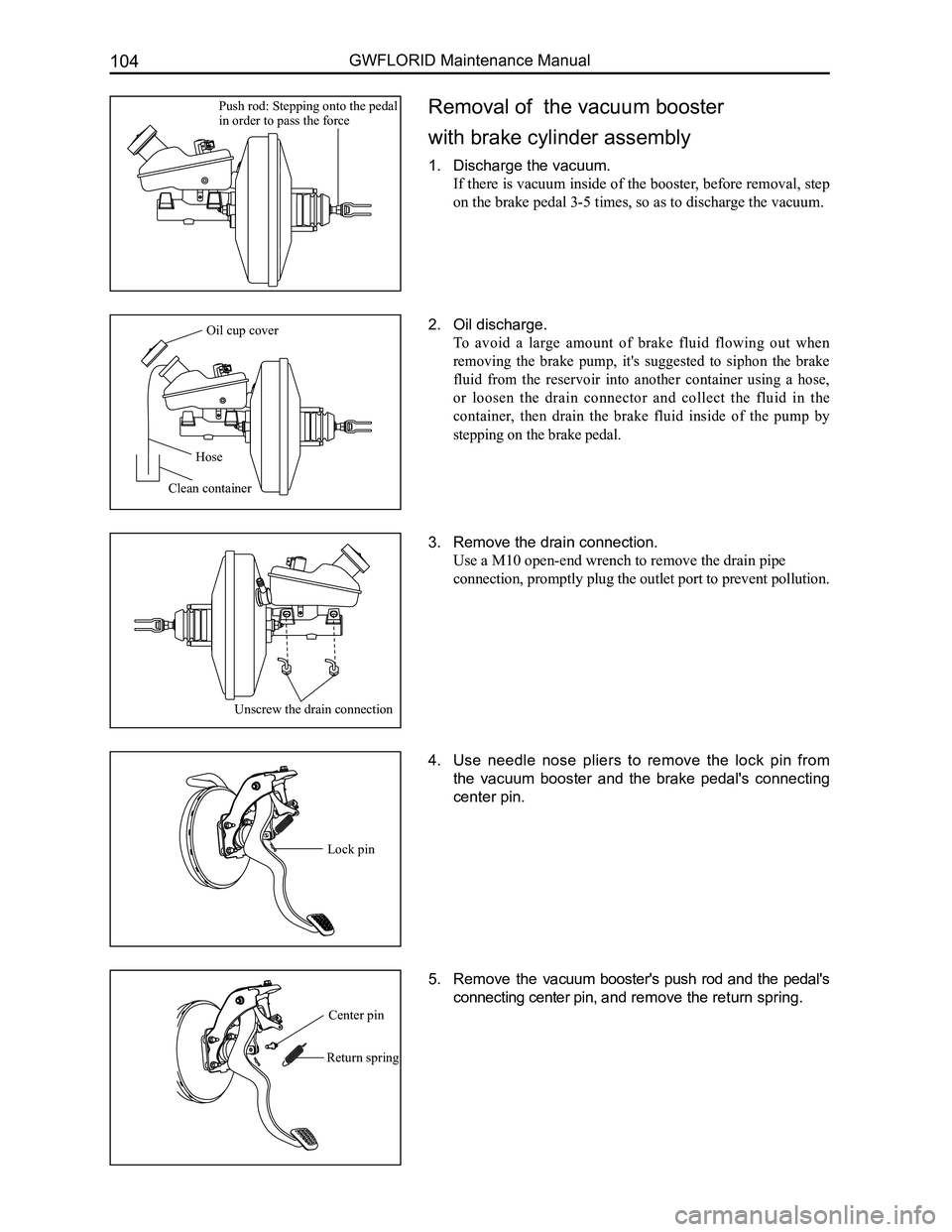
Removal of the vacuum booster
with brake cylinder assembly
1. Discharge the vacuum.
If there is vacuum inside of the booster, before removal, step
on the brake pedal 3-5 times, so as to discharge the vacuum.
2. Oil discharge.
To avoid a large amount of brake fluid flowing out when
removing the brake pump, it's suggested to siphon the brake
fluid from the reservoir into another container using a hose,
or loosen the drain connector and collect the fluid in the
container, then drain the brake fluid inside of the pump by
stepping on the brake pedal.
3. Remove the drain connection.
Use a M10 open-end wrench to remove the drain pipe
connection, promptly plug the outlet port to prevent pollution.
4. Use needle nose pliers to remove the lock pin from
the vacuum booster and the brake pedal's connecting
center pin.
5. Remove the vacuum booster's push rod and the pedal's
connecting center pin, and remove the return spring.
Push rod: Stepping onto the pedal in order to pass the force
Oil cup cover
Hose
Clean container
Unscrew the drain connection
Lock pin
Return spring
Center pin
Page 112 of 281

Downloaded from www.Manualslib.com manuals search engine 105Brake System
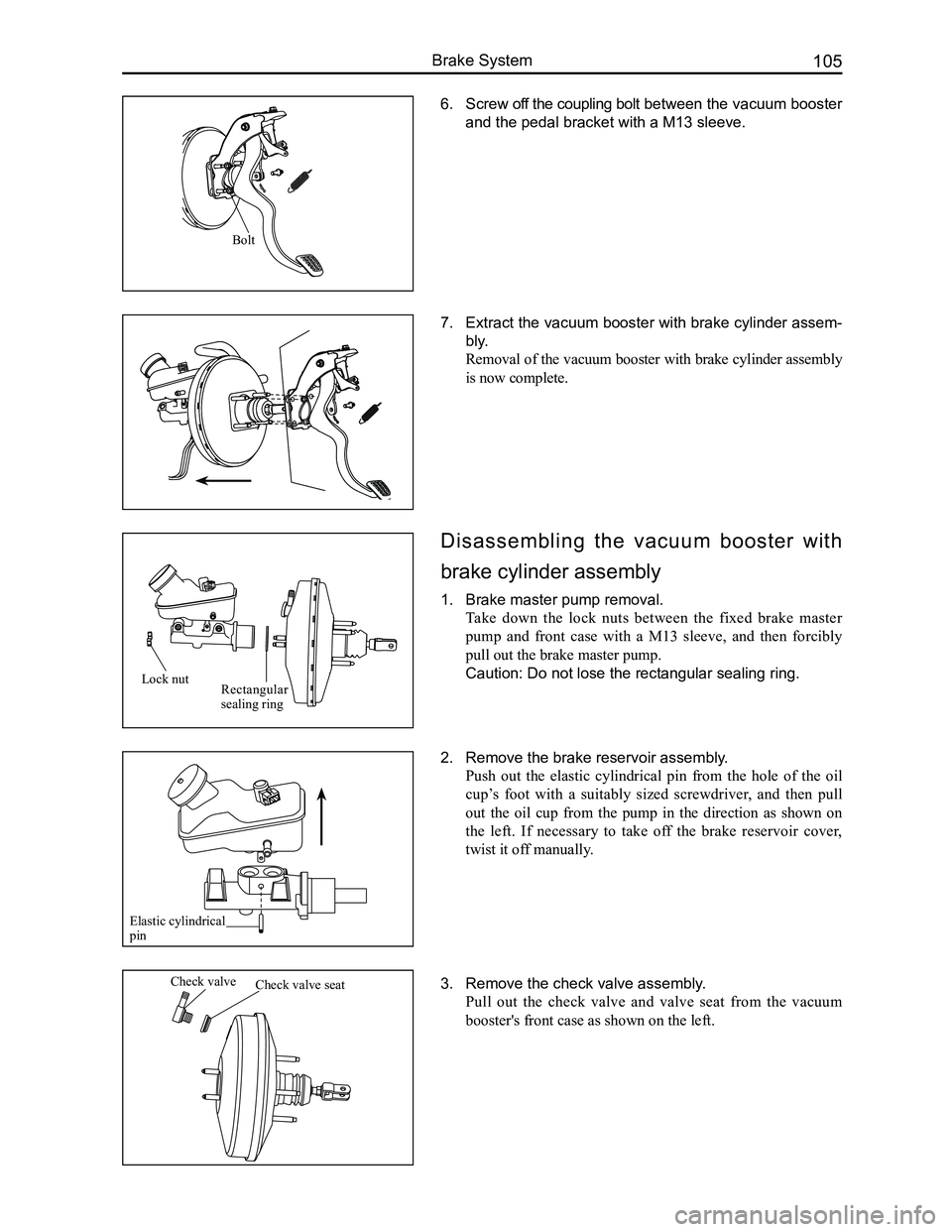
3. Remove the check valve assembly.
Pull out the check valve and valve seat from the vacuum
booster's front case as shown on the left.
Disassembling the vacuum booster with
brake cylinder assembly
1. Brake master pump removal.
Take down the lock nuts between the fixed brake master
pump and front case with a M13 sleeve, and then forcibly
pull out the brake master pump.
Caution: Do not lose the rectangular sealing ring.
2. Remove the brake reservoir assembly.
Push out the elastic cylindrical pin from the hole of the oil
cup’s foot with a suitably sized screwdriver, and then pull
out the oil cup from the pump in the direction as shown on
the left. If necessary to take off the brake reservoir cover,
twist it off manually.
6. Screw off the coupling bolt between the vacuum booster
and the pedal bracket with a M13 sleeve.
7. Extract the vacuum booster with brake cylinder assem-
bly.
Removal of the vacuum booster with brake cylinder assembly
is now complete.
Check valveCheck valve seat
Lock nutRectangular sealing ring
Elastic cylindrical pin
Bolt