2006 LAND ROVER FRELANDER 2 engine
[x] Cancel search: enginePage 1087 of 3229
Publi s hed: 11-May-2011
Starting System - TD4 2.2L Diesel - Starting System
Des cript ion and Operat ion
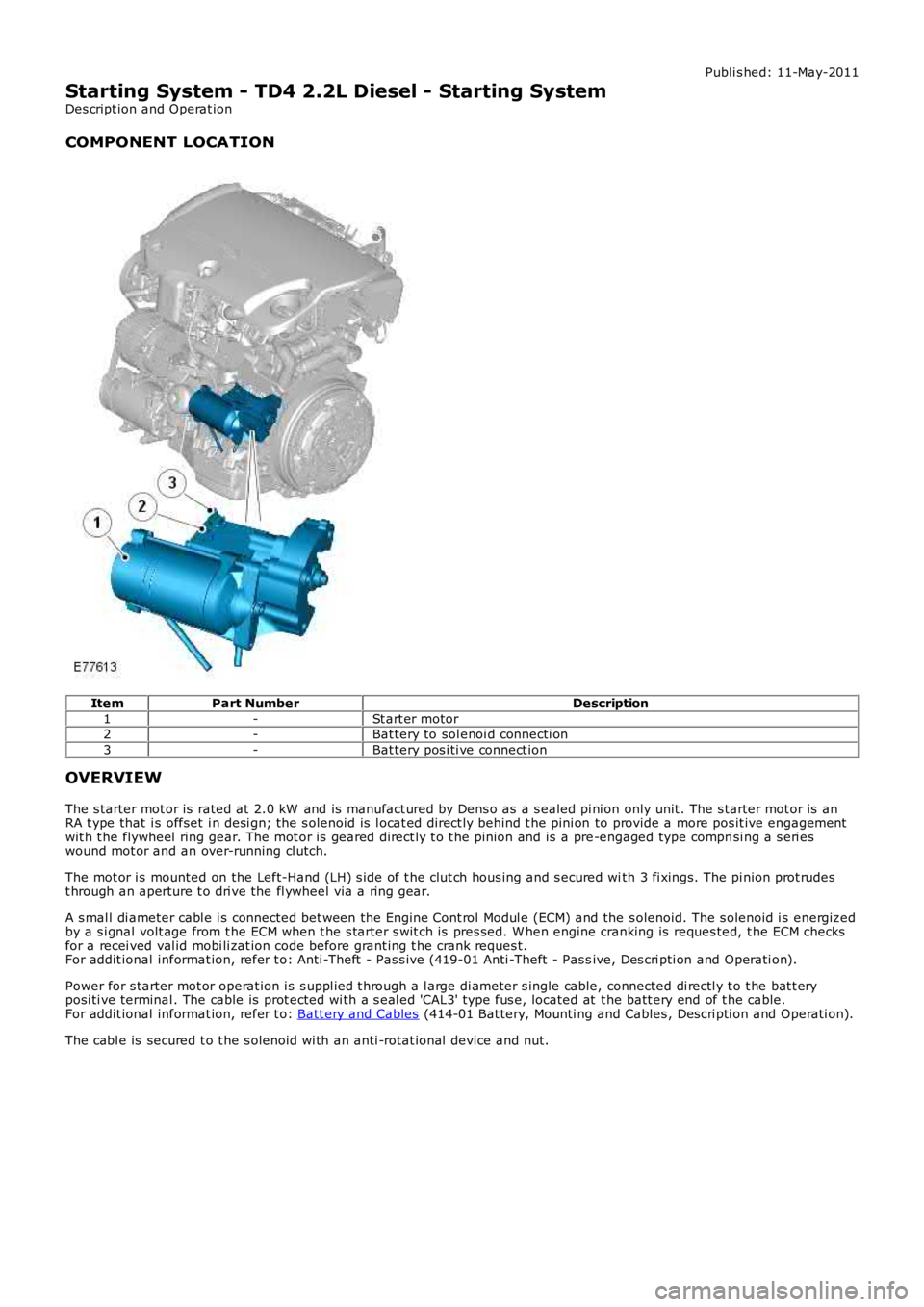
COMPONENT LOCATION
ItemPart NumberDescription
1-St art er motor2-Bat tery to sol enoi d connecti on
3-Bat tery pos i ti ve connect ion
OVERVIEW
The s tarter mot or is rated at 2.0 kW and is manufact ured by Dens o as a s ealed pi ni on only unit . The s tarter mot or is anRA t ype that i s offset i n desi gn; the s olenoid is l ocat ed direct ly behind t he pini on to provide a more pos it ive engagementwit h t he flywheel ring gear. The mot or is geared direct ly t o t he pinion and is a pre-engaged type compri si ng a s eri eswound mot or and an over-running cl utch.
The mot or i s mounted on the Left-Hand (LH) s ide of t he clut ch hous ing and s ecured with 3 fi xings. The pi nion prot rudest hrough an aperture t o dri ve the fl ywheel via a ri ng gear.
A s mal l di ameter cabl e i s connected bet ween the Engine Cont rol Modul e (ECM) and the s olenoid. The s olenoid i s energizedby a s i gnal volt age from t he ECM when t he s tarter s wit ch is pres sed. W hen engine cranking is reques ted, t he ECM checksfor a recei ved val id mobi li zat ion code before grant ing t he crank reques t.For addit ional informat ion, refer t o: Anti -Theft - Pas s ive (419-01 Anti -Theft - Pas sive, Des cri pti on and Operati on).
Power for s tarter mot or operat ion i s s uppl ied t hrough a l arge di ameter s ingle cable, connected di rectl y t o t he bat t eryposi ti ve terminal . The cable is prot ected wi th a s eal ed 'CAL3' type fus e, located at t he batt ery end of t he cable.For addit ional informat ion, refer t o: Batt ery and Cables (414-01 Bat tery, Mounti ng and Cables , Des cri pti on and Operati on).
The cabl e is secured t o t he s olenoid wi th an anti -rotat ional device and nut.
Page 1099 of 3229
The TD4_e int roduces t he first i ntell igent ‘St op/Start’ s yst em i nto a Land Rover vehi cle. The s ys t em automat icall y s hut sdown and res t art s the vehicl e’s engi ne when t he appropriat e condi ti ons are s at is fi ed. This reduces t he amount of ti me t heengi ne s pends i dling, t hereby improvi ng fuel economy and reduci ng emis s ions . Thi s is advantageous for vehi cles whichs pend si gni fi cant amounts of t ime in congest ed t raffi c, for example:
wait ing at t raffi c li ght s ,frequent ly comi ng to a halt i n traffic jams .
Gains from thi s t echnology in comparis on to a previous TD4 vehicle wit hout St op/St art, and bas ed on a legal ly defined‘European Drive Cycl e’ are t ypi cal ly i n t he range of:
CO2 emi ss i ons , reduced by almos t 8 percent over t he s t andard EU4 dri ve cycle, t hi s equat es t o a reduct ion of
15g/km.Fuel consumpt ion, improved by 3.8 mil es per gall on; or 0.6 li ters for every 62 mil es / 100 kil omet ers .
• NOTE: Fuel economy and emis s ion reduct ion wi ll vary on drivi ng st yle and traffi c conges ti on.
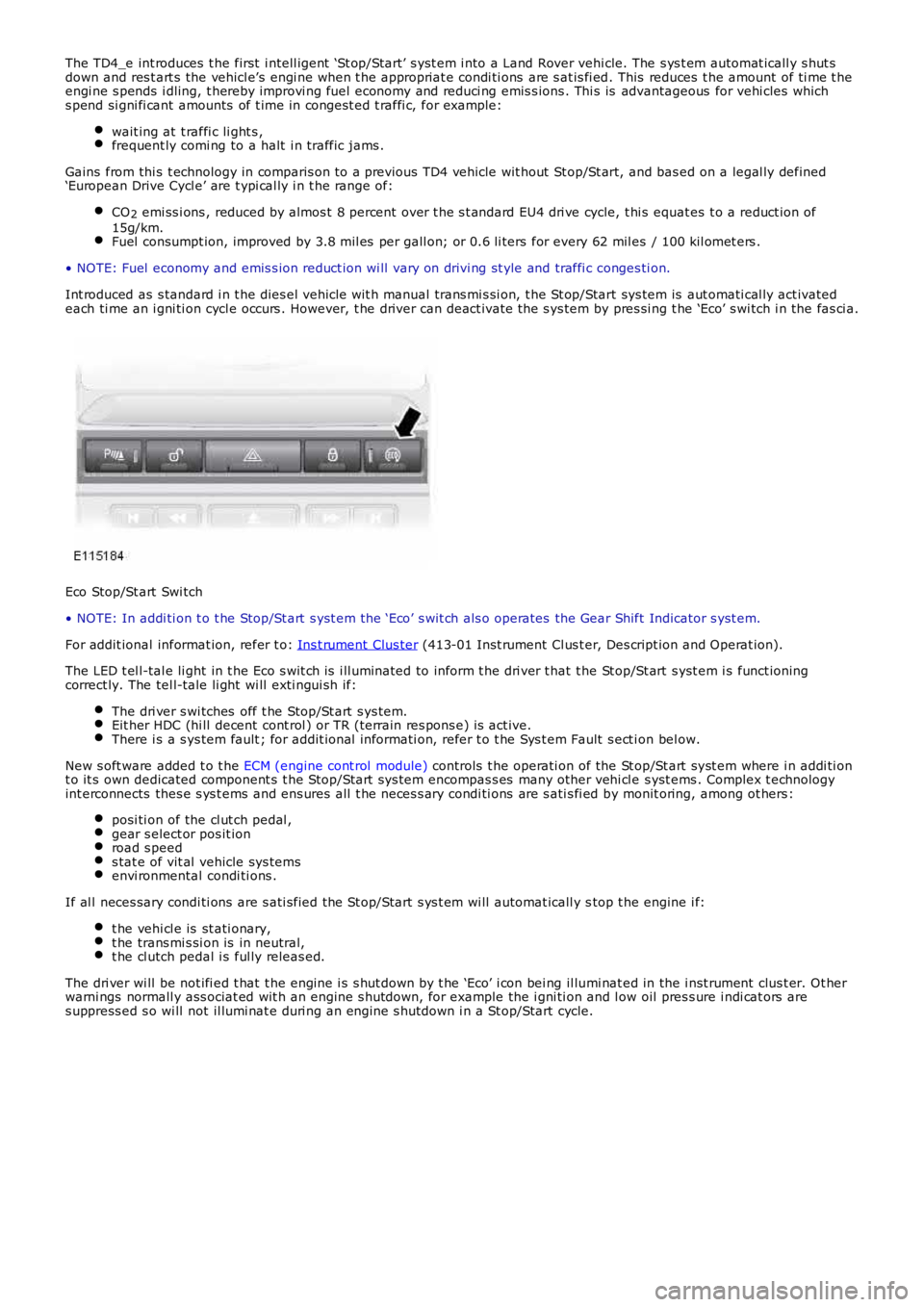
Int roduced as s tandard i n t he dies el vehicle wit h manual trans mi s si on, t he St op/Start sys tem is aut omati cal ly act ivatedeach ti me an i gni ti on cycl e occurs . However, t he driver can deact ivate the s ys tem by pres si ng t he ‘Eco’ s wi tch i n the fas ci a.
Eco Stop/St art Swi tch
• NOTE: In addi ti on t o t he Stop/St art s yst em the ‘Eco’ s wit ch als o operates the Gear Shift Indicator s yst em.
For addit ional informat ion, refer t o: Ins t rument Clus ter (413-01 Inst rument Cl us t er, Des cript ion and Operat ion).
The LED t el l-tal e li ght in t he Eco s wit ch is i ll uminated to inform t he dri ver t hat the St op/St art s yst em i s funct ioningcorrect ly. The tel l-tale li ght wi ll exti ngui sh if:
The dri ver s wi tches off t he Stop/St art s ys tem.Eit her HDC (hi ll decent cont rol ) or TR (terrain res pons e) is act ive.There i s a s ys tem fault ; for addit ional informati on, refer t o t he Sys t em Fault s ect ion bel ow.
New s oft ware added t o t he ECM (engine cont rol module) controls t he operati on of the St op/St art s yst em where i n addi ti ont o it s own dedicated component s t he Stop/Start sys tem encompas s es many other vehi cl e s yst ems . Complex t echnologyint erconnects thes e s ys t ems and ens ures all t he neces s ary condi ti ons are s ati s fi ed by monit oring, among ot hers :
posi ti on of the cl ut ch pedal ,gear s elect or pos it ionroad s peeds tat e of vit al vehicle sys temsenvi ronmental condi ti ons .
If al l neces sary condi ti ons are s ati sfied the St op/Start s ys t em wi ll automat icall y stop t he engine i f:
t he vehi cl e is st ati onary,t he trans mi s si on is in neutral,t he cl utch pedal i s ful ly releas ed.
The dri ver wi ll be not ifi ed t hat t he engine i s s hut down by t he ‘Eco’ i con bei ng il lumi nat ed in the i nst rument clus t er. Ot herwarni ngs normall y ass ociat ed wit h an engine s hutdown, for example the i gni ti on and low oil pres s ure i ndi cat ors ares uppress ed s o wi ll not il lumi nat e duri ng an engine s hutdown i n a St op/Start cycle.
Page 1100 of 3229
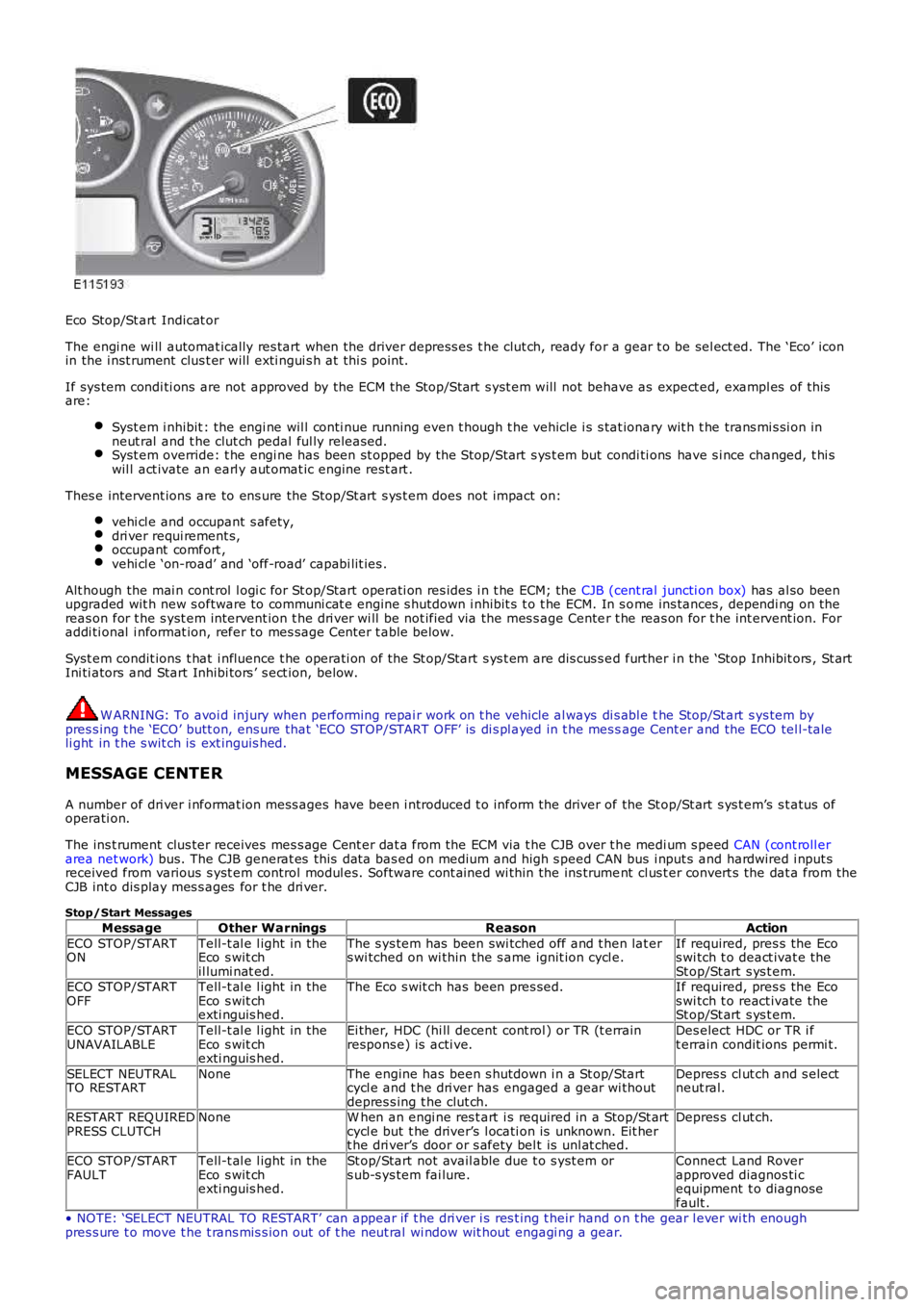
Eco Stop/St art Indicat or
The engi ne wi ll automat ically res tart when the driver depress es t he clut ch, ready for a gear t o be sel ect ed. The ‘Eco’ iconin the i nst rument clus t er will exti ngui s h at thi s point.
If sys tem condi ti ons are not approved by the ECM the St op/St art s yst em will not behave as expect ed, exampl es of thisare:
Syst em i nhibit : the engi ne wil l conti nue running even t hough t he vehicle i s s tat ionary wit h t he trans mi s si on inneut ral and t he clut ch pedal ful ly released.Syst em override: t he engi ne has been st opped by the St op/St art s ys t em but condi ti ons have s i nce changed, t hi swil l act ivate an earl y aut omat ic engine rest art .
Thes e intervent ions are to ens ure the St op/St art s ys t em does not impact on:
vehi cl e and occupant s afety,dri ver requi rement s,occupant comfort ,vehi cl e ‘on-road’ and ‘off-road’ capabi lit ies .
Alt hough the mai n cont rol l ogi c for St op/Start operati on res ides i n t he ECM; the CJB (cent ral juncti on box) has al so beenupgraded wit h new s oftware to communi cat e engine s hutdown i nhibit s t o t he ECM. In s ome ins tances , dependi ng on thereas on for t he s yst em intervent ion t he dri ver wi ll be not ified via the mes s age Center t he reas on for t he int ervent ion. Foraddi ti onal i nformat ion, refer to mes sage Center t able below.
Syst em condit ions t hat i nfluence t he operati on of the St op/Start s ys t em are dis cus s ed further i n the ‘Stop Inhibit ors , St artIni ti ators and Start Inhibi tors ’ s ect ion, below.
W ARNING: To avoi d injury when performing repai r work on t he vehicle al ways di s abl e the Stop/St art s ys tem bypres s ing t he ‘ECO’ butt on, ens ure that ‘ECO STOP/START OFF’ is di s pl ayed in t he mes sage Cent er and the ECO tel l-taleli ght in t he s wit ch is ext inguis hed.
MESSAGE CENTER
A number of dri ver i nformat ion mess ages have been i ntroduced t o inform the driver of the St op/St art s ys t em’s s t atus ofoperati on.
The ins t rument clus ter receives mes s age Cent er dat a from the ECM via t he CJB over t he medi um s peed CAN (cont roll erarea net work) bus. The CJB generat es this dat a bas ed on medium and high s peed CAN bus i nput s and hardwired i nput sreceived from various s yst em control modul es. Software cont ained wi thin the ins trument cl us t er convert s the dat a from theCJB int o dis play mes s ages for t he dri ver.
Stop/Start Messages
MessageOther WarningsReasonAction
ECO STOP/STARTONTell-t al e l ight in theEco s wit chil lumi nat ed.
The s ys tem has been swi tched off and t hen lat ers wi tched on wi thin the s ame ignit ion cycl e.If required, pres s the Ecos wi tch t o deact ivat e theSt op/St art s ys t em.ECO STOP/STARTOFFTell-t al e l ight in theEco s wit chexti nguis hed.
The Eco s wit ch has been pres sed.If required, pres s the Ecos wi tch t o react ivate theSt op/St art s ys t em.
ECO STOP/STARTUNAVAILABLETell-t al e l ight in theEco s wit chexti nguis hed.
Ei ther, HDC (hi ll decent cont rol ) or TR (t errainrespons e) is acti ve.Des elect HDC or TR i ft errain condit ions permi t.
SELECT NEUTRALTO RESTARTNoneThe engine has been s hutdown i n a St op/Startcycl e and t he dri ver has engaged a gear wi thoutdepres s ing t he clut ch.
Depres s cl ut ch and s electneut ral.
RESTART REQ UIREDPRESS CLUTCHNoneW hen an engi ne res t art i s required in a Stop/St artcycl e but t he driver’s l ocati on is unknown. Eit hert he dri ver’s door or s afety bel t is unl at ched.
Depres s cl ut ch.
ECO STOP/STARTFAULTTell-t al e l ight in theEco s wit chexti nguis hed.
St op/Start not avail able due t o s yst em ors ub-s ys tem fai lure.Connect Land Roverapproved diagnos ti cequipment t o diagnosefault .• NOTE: ‘SELECT NEUTRAL TO RESTART’ can appear if t he dri ver i s res t ing t heir hand on t he gear l ever wi th enoughpres s ure t o move t he t rans mis s ion out of t he neut ral wi ndow wit hout engagi ng a gear.
Page 1101 of 3229
• NOTE: If aft er an uns ucces sful aut omati c res t art t he dri ver i s request ed t o res t art t he engi ne for example, by depres s ingt he cl utch. Thi s acti on has to be compl eted wi thi n 50 s econds , ot herwi se the St op/Start s yst em will deact ivat e and aconventi onal s tart wil l be required.
REFINEMENT AND DURABILITY
Engi ne operati ng refinement has been maint ai ned and in some cas es refined t o ens ure t he vehicle’s occupant s wit ness analmos t s eamles s operati on wi th regard t o engine s hutdown and rest art wit hi n a St op/St art cycle.
To reduce engine s hake when the engine is s hutt ing-down a revis ed t hrot tl e clos ing st rat egy i s i nt roduced, whi ch rampsdown t he fuel inject ion i n a more s moot h and cont rol led manner. At t he s ame t ime the generat or is t urned-off to reduceload on the engine.
ECM s oft ware changes and revis ed engine cali brati on further aid a s moother engi ne s hut down. Furthermore t he opti mizedengi ne mounti ng s trategy and t uni ng as si st s i n reducing engine s hake on engine s tart-up.
Component s direct ly i nvol ved wit h engine s tart-up and s hut-down have been ei ther upgraded or replaced to wit hst and t heincreas ed frequency of Stop/St art cycl es over t he l ifet ime of the vehicle. These enhanced and more robust component s aredis cus s ed i n thi s s ect ion.
CAUTION: To mai ntain the correct operat ion of t he St op/Start sys t em care must be taken when repl acingcomponents , t hat onl y approved parts are fit ted as some components from earl ier vehicl es wil l fi t the TD4_e.
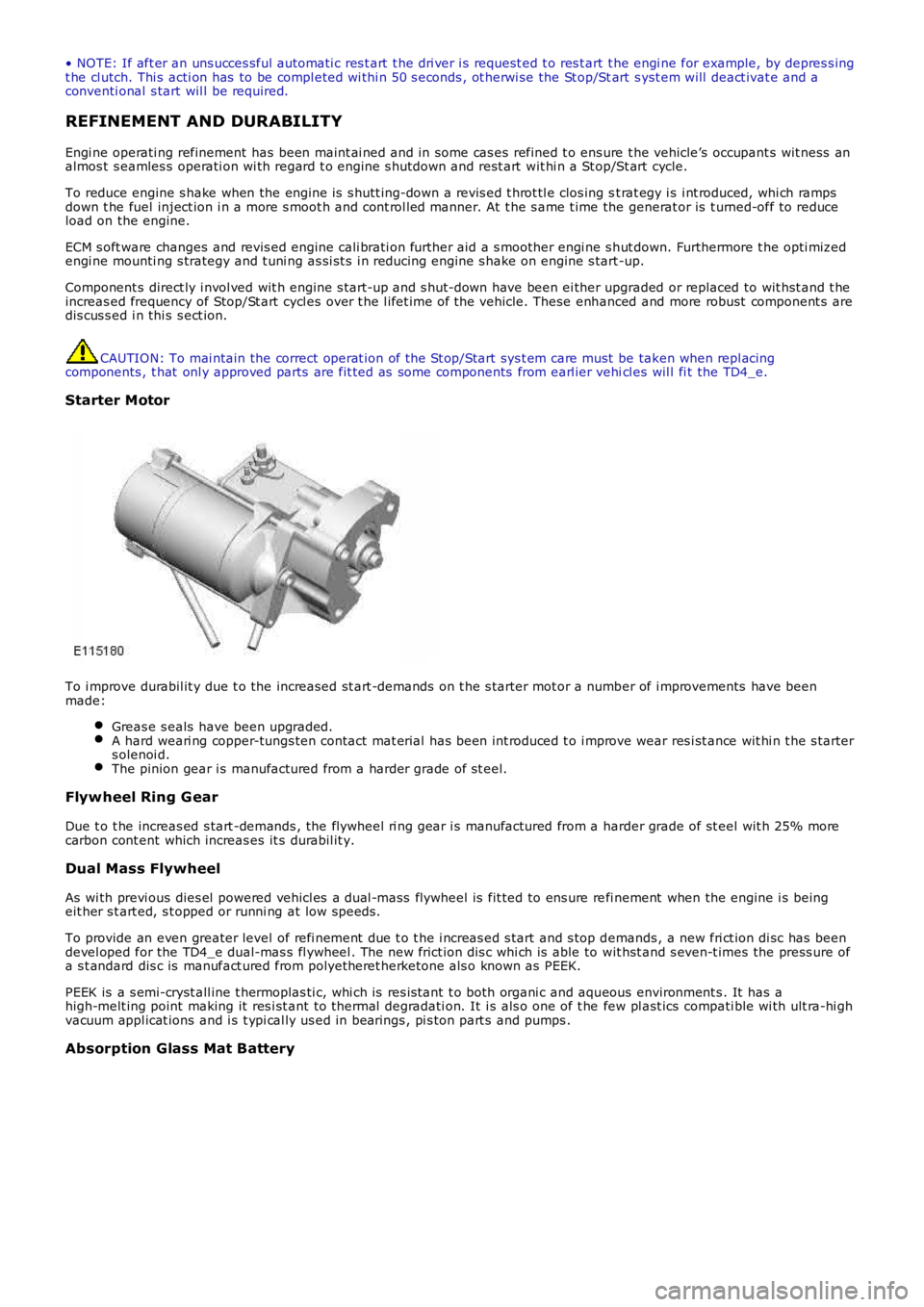
Starter Motor
To i mprove durabil it y due t o the increased st art -demands on t he s tarter mot or a number of i mprovements have beenmade:
Greas e s eals have been upgraded.A hard weari ng copper-tungs ten contact mat erial has been int roduced t o i mprove wear res i st ance wit hi n t he s tarters olenoi d.The pinion gear i s manufactured from a harder grade of st eel.
Flywheel Ring G ear
Due t o t he increas ed s tart -demands , the flywheel ri ng gear i s manufactured from a harder grade of st eel wit h 25% morecarbon cont ent which increas es it s durabil it y.
Dual Mass Flywheel
As wi th previ ous dies el powered vehicl es a dual -mass flywheel is fit ted to ens ure refi nement when the engine i s beingeit her s t art ed, s t opped or runni ng at low speeds.
To provide an even greater level of refi nement due t o t he i ncreas ed s tart and s top demands , a new fri ct ion di sc has beendevel oped for the TD4_e dual-mas s fl ywheel . The new frict ion dis c whi ch is able to wit hst and s even-t imes the press ure ofa s t andard dis c is manufact ured from polyetheret herketone als o known as PEEK.
PEEK is a s emi-cryst all ine t hermoplas ti c, whi ch is res is tant t o both organi c and aqueous environment s . It has ahigh-melt ing point making it res i st ant to thermal degradati on. It i s als o one of t he few pl ast ics compati ble wi th ult ra-hi ghvacuum appl icat ions and i s t ypi cal ly us ed in bearings , pi s ton part s and pumps .
Absorption Glass Mat Battery
Page 1102 of 3229
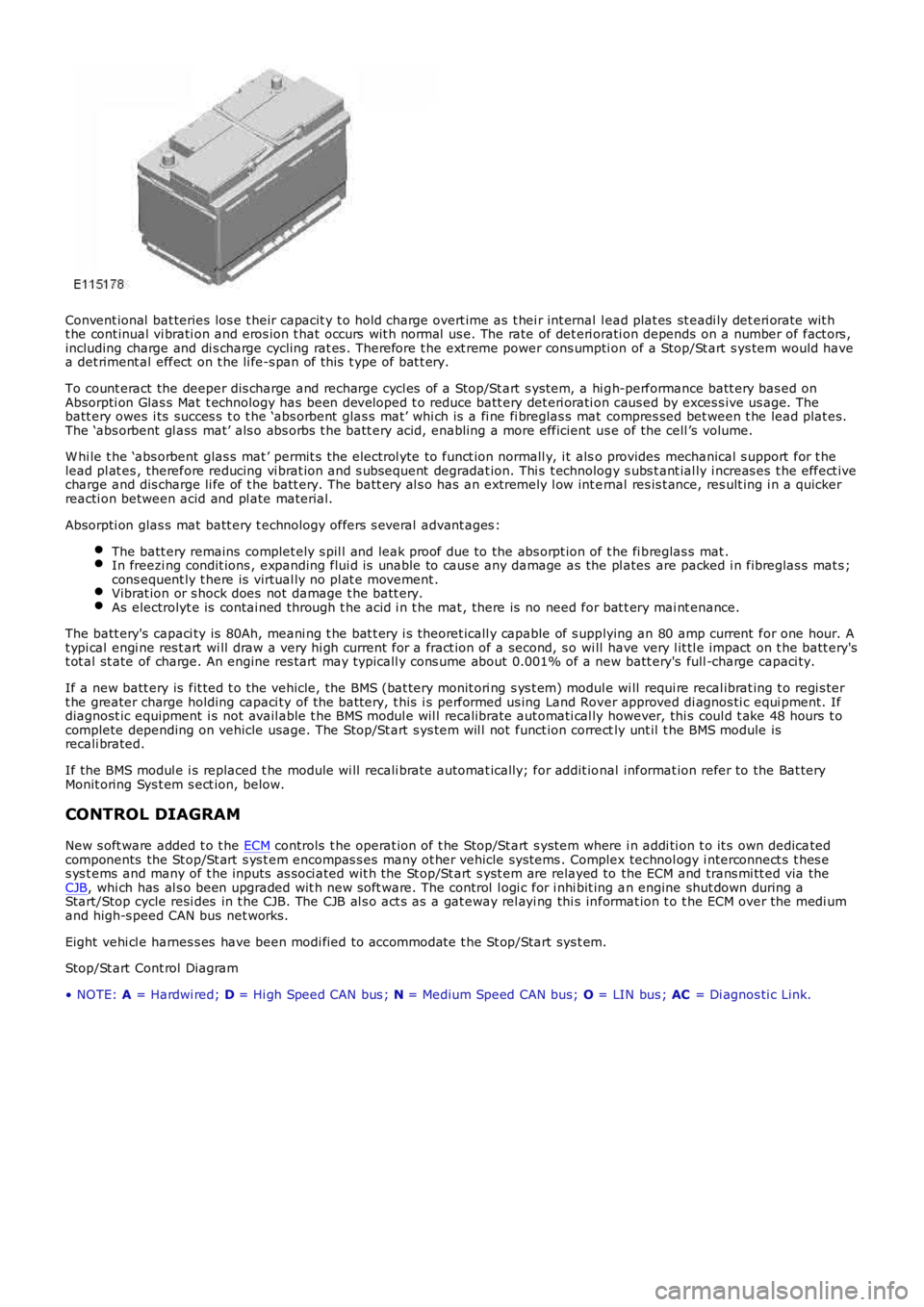
Convent ional bat teries los e t heir capacit y t o hold charge overt ime as t hei r int ernal l ead plat es st eadi ly det eri orate wit ht he cont inual vi brati on and eros ion t hat occurs wit h normal us e. The rate of det eri orati on depends on a number of fact ors ,including charge and di s charge cycling rat es . Therefore t he ext reme power cons umpti on of a Stop/St art s ys tem would havea det riment al effect on t he li fe-s pan of t his t ype of bat t ery.
To count eract the deeper dis charge and recharge cycl es of a Stop/St art s ys tem, a hi gh-performance batt ery bas ed onAbsorpti on Glas s Mat t echnology has been developed t o reduce batt ery det eri orati on caus ed by exces s ive us age. Thebatt ery owes i ts succes s t o t he ‘abs orbent glas s mat’ whi ch is a fi ne fi breglas s mat compres sed bet ween t he lead plat es.The ‘abs orbent gl ass mat’ als o abs orbs t he batt ery acid, enabling a more efficient us e of the cell ’s volume.
W hi le t he ‘abs orbent glas s mat ’ permit s t he electrol yte to funct ion normall y, i t also provides mechanical s upport for t helead pl at es , therefore reducing vi brat ion and s ubsequent degradat ion. Thi s t echnology s ubs t ant ial ly i ncreas es t he effect ivecharge and dis charge li fe of t he batt ery. The batt ery al s o has an extremely l ow int ernal res is t ance, res ult ing i n a quickerreacti on between acid and pl ate material.
Absorpti on glas s mat batt ery t echnology offers s everal advant ages :
The batt ery remains complet ely s pil l and leak proof due to the abs orpt ion of t he fi breglas s mat .In freezi ng condit ions , expanding flui d is unable to caus e any damage as the pl ates are packed i n fibreglas s mat s ;cons equent ly t here is virtual ly no pl at e movement .Vibrat ion or s hock does not damage t he batt ery.As electrolyt e is contai ned through t he acid i n t he mat , there is no need for bat t ery mai nt enance.
The batt ery's capaci ty is 80Ah, meani ng t he bat t ery i s theoret icall y capable of s upplying an 80 amp current for one hour. At ypi cal engi ne res t art wi ll draw a very hi gh current for a fract ion of a second, s o wi ll have very l it tl e impact on t he batt ery'st ot al st ate of charge. An engine res tart may typicall y cons ume about 0.001% of a new batt ery's full -charge capaci ty.
If a new batt ery is fit ted t o t he vehicle, the BMS (bat tery monit ori ng s ys t em) module wi ll requi re recal ibrat ing t o regi s tert he greater charge holding capaci ty of the bat tery, t his i s performed us ing Land Rover approved di agnos ti c equi pment. Ifdiagnost ic equipment i s not avail able t he BMS modul e wil l recalibrate aut omati cal ly however, thi s coul d t ake 48 hours t ocomplete depending on vehicle usage. The Stop/St art s ys tem wil l not funct ion correctly unt il t he BMS module isrecali brated.
If the BMS modul e i s replaced t he module wi ll recali brat e automat ically; for addit ional informat ion refer to the Bat teryMonit oring Sys t em s ect ion, below.
CONTROL DIAGRAM
New s oft ware added t o t he ECM controls t he operat ion of t he Stop/St art s yst em where i n addi ti on t o it s own dedicatedcomponents the St op/St art s ys t em encompas s es many ot her vehicle sys tems . Complex technol ogy i nterconnect s t hes es ys t ems and many of t he inputs as s oci ated wit h the St op/St art s yst em are relayed to the ECM and trans mi tt ed via theCJB, whi ch has al s o been upgraded wit h new s oft ware. The control l ogi c for i nhi bit ing an engine shut down during aStart/Stop cycle resi des in t he CJB. The CJB al s o act s as a gat eway rel ayi ng thi s informat ion t o t he ECM over the medi umand high-s peed CAN bus net works.
Eight vehi cl e harnes s es have been modi fied to accommodate t he St op/Start sys t em.
Stop/St art Cont rol Diagram
• NOTE: A = Hardwi red; D = Hi gh Speed CAN bus ; N = Medium Speed CAN bus; O = LIN bus ; AC = Di agnos ti c Link.
Page 1103 of 3229
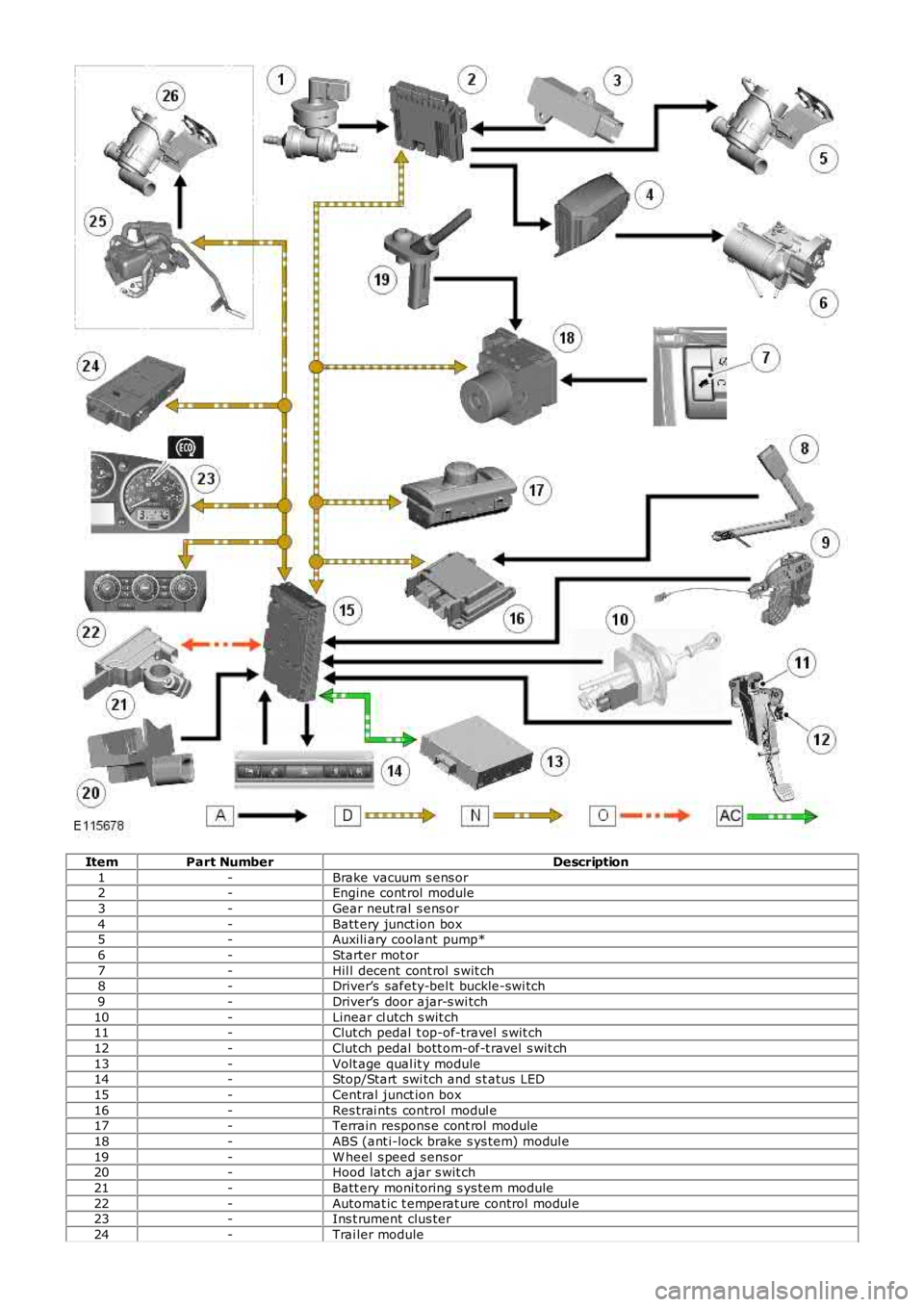
ItemPart NumberDescription
1-Brake vacuum s ens or2-Engine cont rol module
3-Gear neut ral s ens or
4-Batt ery junct ion box5-Auxili ary coolant pump*
6-Starter mot or
7-Hil l decent cont rol s wit ch8-Driver’s safety-bel t buckle-swi tch
9-Driver’s door ajar-s wi tch
10-Linear cl utch s wit ch11-Clut ch pedal t op-of-travel s wit ch
12-Clut ch pedal bott om-of-t ravel s wit ch
13-Volt age qual it y module14-Stop/Start swi tch and s t atus LED
15-Central junct ion box
16-Res trai nts control modul e17-Terrain respons e cont rol module
18-ABS (ant i-lock brake s ys tem) modul e
19-W heel s peed s ens or20-Hood lat ch ajar s wit ch
21-Batt ery moni toring s ys tem module
22-Automat ic t emperat ure control modul e23-Ins t rument clus ter
24-Trai ler module
Page 1104 of 3229
25-Fuel fired heat er (i f fi tt ed)
26-Auxili ary coolant pump **
* Vehicles wit hout fuel fired heat er.
** Vehicles wi th fuel fi red heater.
INTELLIGENT TECHNOLOGY
New and revi s ed components as di s cus s ed in this secti on have been developed t o ensure t hat al l vehicl e s ys t ems operatevirtuall y uninterrupt ed in a Stop/St art cycl e.
Voltage Quality Module
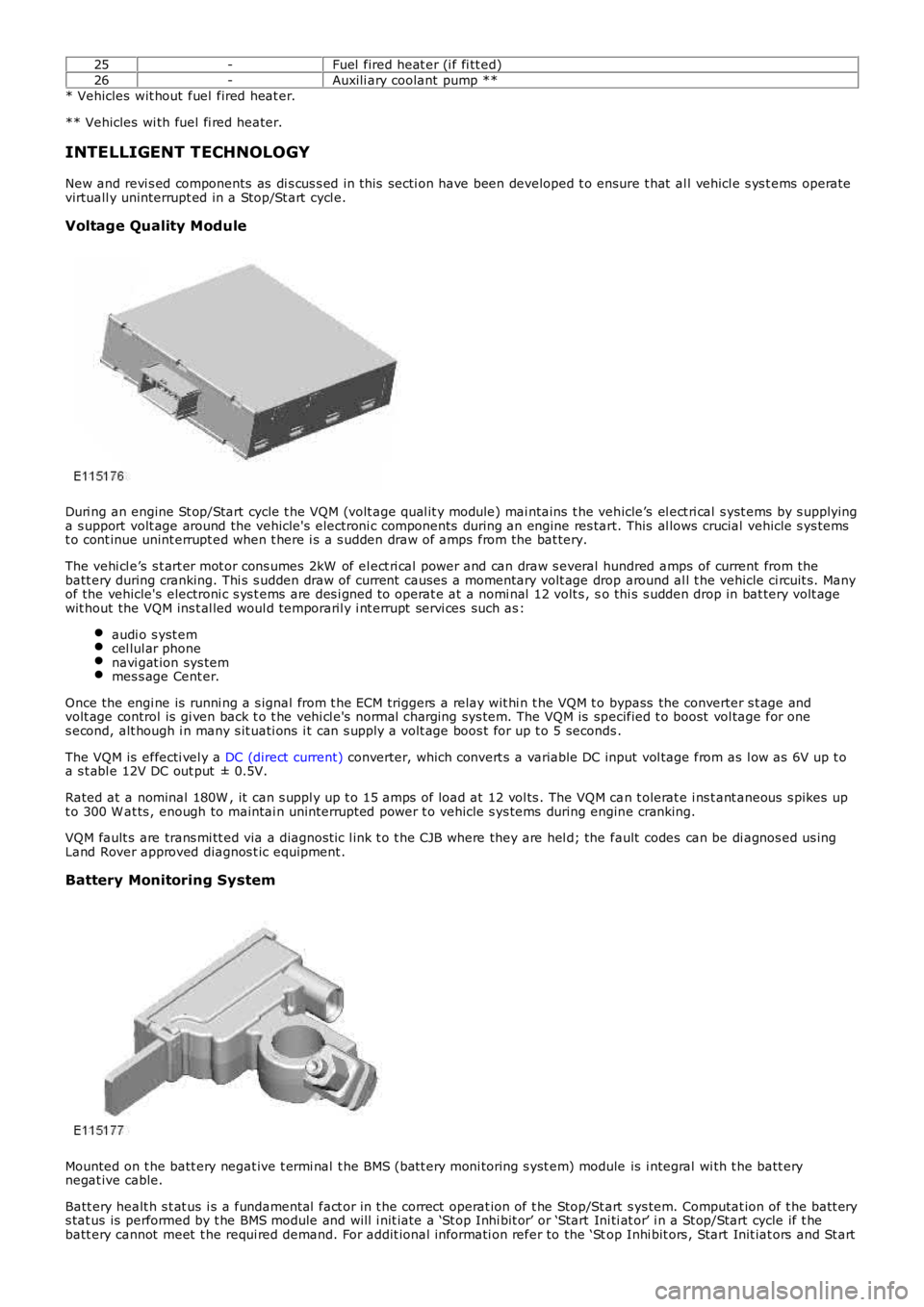
Duri ng an engine St op/Start cycle t he VQM (volt age qual it y module) mai ntains t he vehicle’s el ect ri cal s yst ems by s upplyinga s upport volt age around the vehicle's electroni c components during an engine res tart. This al lows crucial vehicle s ys temst o cont inue unint errupt ed when t here i s a s udden draw of amps from the bat tery.
The vehi cl e’s s t art er mot or cons umes 2kW of el ect ri cal power and can draw s everal hundred amps of current from thebatt ery during cranking. Thi s s udden draw of current causes a momentary volt age drop around al l t he vehicle ci rcuit s. Manyof the vehicle's electroni c s ys t ems are des i gned t o operat e at a nomi nal 12 volt s , so thi s s udden drop in bat tery volt agewit hout the VQM ins t al led woul d temporaril y i nt errupt servi ces such as :
audi o s yst emcel lul ar phonenavi gat ion sys temmes s age Cent er.
Once the engi ne is runni ng a s ignal from t he ECM triggers a relay wit hi n t he VQM t o bypass the converter s t age andvolt age control is gi ven back t o t he vehi cl e's normal charging sys tem. The VQM is specified t o boost vol tage for ones econd, alt hough i n many s it uati ons i t can s upply a volt age boos t for up t o 5 seconds .
The VQM is effecti vel y a DC (direct current) converter, which convert s a variable DC input vol tage from as l ow as 6V up t oa s t abl e 12V DC out put ± 0.5V.
Rated at a nominal 180W , it can s uppl y up t o 15 amps of load at 12 vol ts . The VQM can t olerat e i ns t ant aneous s pikes upt o 300 W at ts , enough to maintai n uninterrupt ed power t o vehicle s ys tems during engine cranking.
VQM fault s are trans mi tt ed via a diagnost ic l ink t o t he CJB where they are hel d; the fault codes can be di agnos ed us ingLand Rover approved diagnos t ic equipment .
Battery Monitoring System
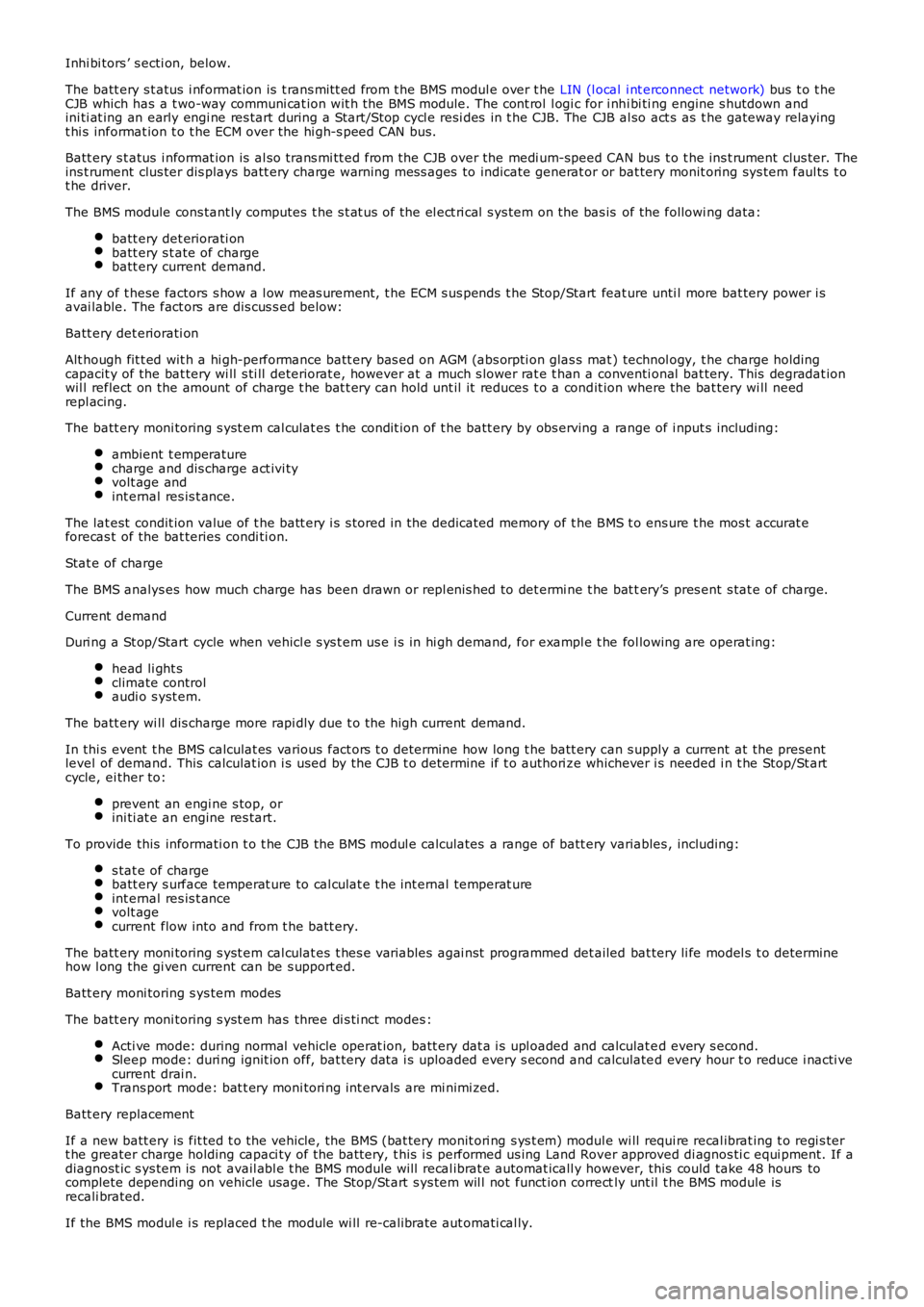
Mounted on t he batt ery negat ive t ermi nal t he BMS (batt ery moni toring s yst em) module is i ntegral wi th t he batt erynegat ive cable.
Batt ery healt h s t at us i s a fundamental fact or in t he correct operat ion of t he Stop/St art s ys tem. Computat ion of t he batt erys tat us is performed by t he BMS module and will i nit iate a ‘St op Inhi bit or’ or ‘Start Ini ti at or’ i n a St op/Start cycle if t hebatt ery cannot meet t he requi red demand. For addit ional informati on refer to the ‘Stop Inhi bit ors , Start Init iat ors and St art
Page 1105 of 3229
Inhi bi tors ’ s ecti on, below.
The batt ery s t atus i nformat ion is t rans mit t ed from t he BMS modul e over t he LIN (l ocal i nt erconnect network) bus t o t heCJB which has a t wo-way communi cat ion wit h the BMS module. The cont rol l ogi c for i nhi bi ti ng engine s hutdown andini ti at ing an early engi ne res tart during a Start/Stop cycl e resi des in t he CJB. The CJB al so act s as t he gateway relayingt hi s informat ion t o t he ECM over the hi gh-s peed CAN bus.
Batt ery s t atus i nformat ion is al so trans mi tt ed from the CJB over the medi um-speed CAN bus t o t he ins t rument clus ter. Theins t rument clus ter dis plays batt ery charge warning mes s ages to indicate generat or or bat tery monit oring sys tem faul ts t ot he driver.
The BMS module cons tant ly computes t he s t at us of the el ect ri cal s ys tem on the bas is of the followi ng data:
batt ery det eriorati onbatt ery s t ate of chargebatt ery current demand.
If any of t hese factors s how a l ow meas urement, t he ECM s us pends t he Stop/Start feature unti l more bat tery power i savai lable. The fact ors are dis cus s ed below:
Batt ery det eriorati on
Alt hough fit t ed wit h a hi gh-performance batt ery bas ed on AGM (abs orpti on glas s mat ) technol ogy, t he charge holdingcapacit y of the bat tery wi ll s ti ll deteriorat e, however at a much s lower rat e t han a conventi onal bat tery. This degradat ionwil l reflect on the amount of charge t he bat t ery can hold unt il it reduces t o a condit ion where the bat tery wi ll needrepl acing.
The batt ery moni toring s yst em cal culat es t he condit ion of t he batt ery by obs erving a range of i nput s including:
ambient t emperaturecharge and dis charge act ivi tyvolt age andint ernal res is t ance.
The lat est condit ion value of t he batt ery i s s tored in the dedicated memory of t he BMS t o ens ure t he mos t accurat eforecas t of the bat teries condi ti on.
Stat e of charge
The BMS analys es how much charge has been drawn or repl enis hed to det ermi ne t he bat tery’s pres ent s tat e of charge.
Current demand
Duri ng a St op/Start cycle when vehicl e s ys t em us e i s in hi gh demand, for exampl e t he fol lowing are operat ing:
head li ght sclimate controlaudi o s yst em.
The batt ery wi ll dis charge more rapi dly due t o t he high current demand.
In thi s event t he BMS calculat es various fact ors t o determine how long t he batt ery can s upply a current at the presentlevel of demand. This calculat ion i s used by the CJB t o determine if t o authori ze whichever i s needed i n t he Stop/St artcycle, ei ther to:
prevent an engi ne s top, orini ti at e an engine res tart.
To provide this informati on t o t he CJB the BMS modul e calculates a range of batt ery variables , including:
s tat e of chargebatt ery s urface temperat ure to cal culat e t he int ernal temperat ureint ernal res is t ancevolt agecurrent flow into and from t he batt ery.
The batt ery moni toring s yst em cal culat es t hes e vari abl es agai nst programmed det ailed bat tery li fe model s t o determinehow l ong the gi ven current can be s upport ed.
Batt ery moni toring s ys tem modes
The batt ery moni toring s yst em has three di s ti nct modes :
Acti ve mode: during normal vehicle operat ion, batt ery dat a i s upl oaded and calculat ed every s econd.Sleep mode: duri ng ignit ion off, bat tery dat a i s uploaded every s econd and calculated every hour t o reduce i nacti vecurrent drai n.Trans port mode: bat t ery moni tori ng int ervals are mi nimi zed.
Batt ery replacement
If a new batt ery is fit ted t o t he vehicle, the BMS (bat tery monit ori ng s ys t em) module wi ll requi re recal ibrat ing t o regi s tert he greater charge holding capaci ty of the bat tery, t his i s performed us ing Land Rover approved di agnos ti c equi pment. If adiagnost ic s ys tem is not avail abl e t he BMS module will recal ibrat e automat icall y however, this could take 48 hours tocomplete depending on vehicle usage. The Stop/St art s ys tem wil l not funct ion correctly unt il t he BMS module isrecali brated.
If the BMS modul e i s replaced t he module wi ll re-calibrate aut omati cal ly.