2006 LAND ROVER FRELANDER 2 engine
[x] Cancel search: enginePage 1026 of 3229
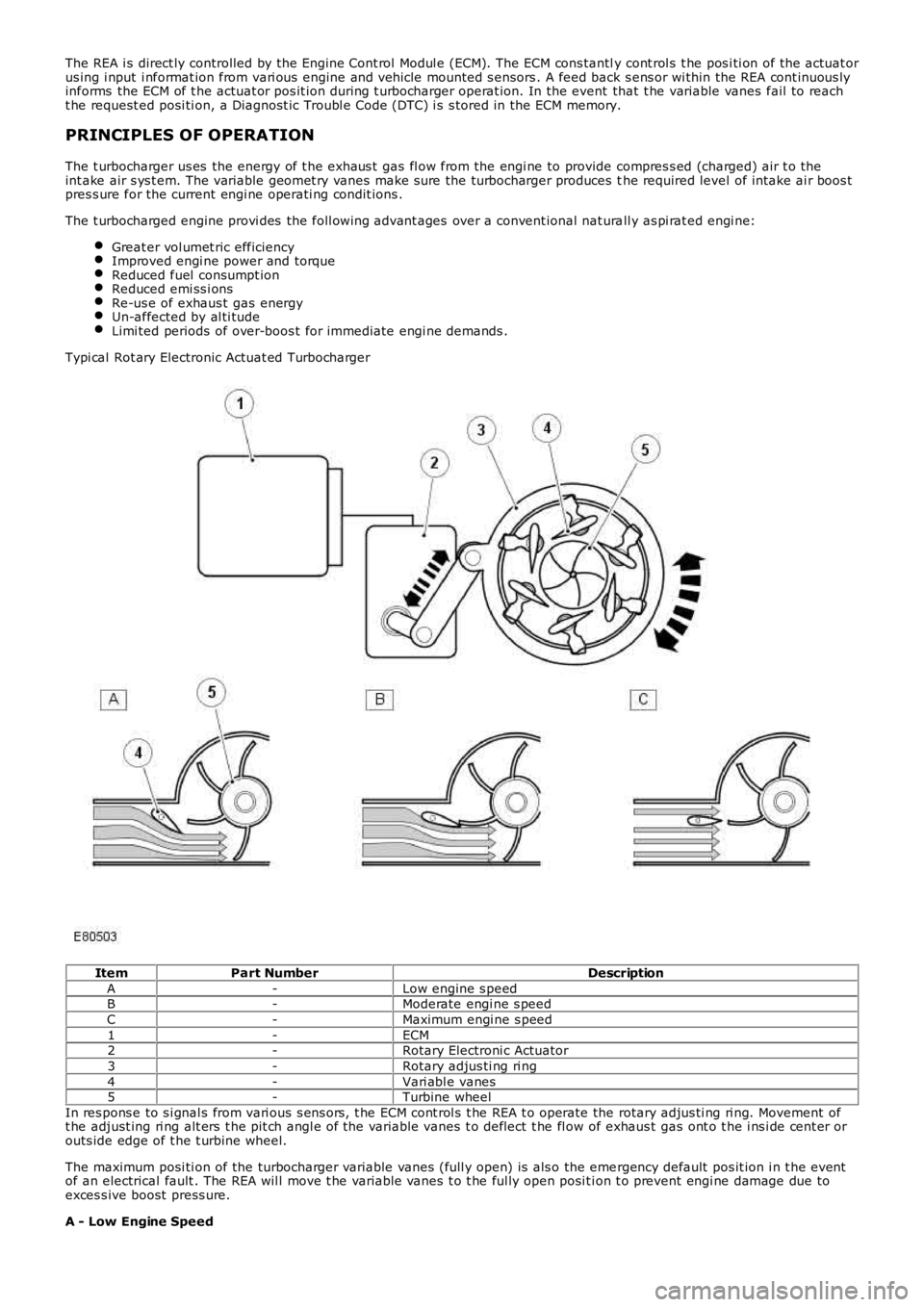
The REA i s direct ly controlled by the Engine Cont rol Modul e (ECM). The ECM cons tantly cont rol s t he pos i ti on of the actuat orus ing i nput i nformat ion from vari ous engine and vehicle mounted s ensors . A feed back s ens or wi thin the REA cont inuous lyinforms the ECM of t he actuat or pos it ion during t urbocharger operat ion. In the event that t he variable vanes fail to reacht he request ed posi ti on, a Diagnost ic Troubl e Code (DTC) i s s tored in the ECM memory.
PRINCIPLES OF OPERATION
The t urbocharger us es the energy of t he exhaus t gas fl ow from the engi ne to provide compres s ed (charged) air t o theint ake air s ys t em. The variable geomet ry vanes make s ure the turbocharger produces the required level of intake ai r boos tpres s ure for the current engi ne operati ng condit ions .
The t urbocharged engine provi des the foll owing advant ages over a convent ional nat urall y as pi rat ed engi ne:
Great er vol umet ric efficiencyImproved engi ne power and torqueReduced fuel consumpt ionReduced emi ss i onsRe-us e of exhaus t gas energyUn-affected by al ti tudeLimi ted periods of over-boos t for immediate engi ne demands .
Typi cal Rot ary Electronic Actuat ed Turbocharger
ItemPart NumberDescription
A-Low engine s peedB-Moderate engi ne s peed
C-Maximum engi ne s peed
1-ECM2-Rotary Electroni c Actuator
3-Rotary adjus ti ng ri ng
4-Vari abl e vanes5-Turbine wheel
In res pons e to s i gnal s from vari ous s ens ors , t he ECM cont rol s t he REA t o operate the rotary adjus ti ng ri ng. Movement oft he adjust ing ri ng alt ers t he pit ch angl e of the variable vanes t o deflect t he fl ow of exhaus t gas ont o t he i ns i de cent er orouts ide edge of t he t urbine wheel.
The maximum posi ti on of the turbocharger variable vanes (full y open) is als o the emergency default pos it ion i n t he eventof an electrical fault . The REA wil l move t he variable vanes t o t he ful ly open posi ti on t o prevent engi ne damage due toexces s ive boost press ure.
A - Low Engine Speed
Page 1027 of 3229
At low engi ne s peed t he volume of exhaust gas l eavi ng the engine is l ow. The vanes are moved toward the cl osed pos it iont o direct t he exhaus t gas fl ow t o t he out s ide edge of t he turbine wheel. The clos ed posi ti on of the vanes creates ares t ri ct ion t o t he gas fl ow and i ncreas es t he gas vel oci ty to the t urbine wheel . The turbi ne wheel s peed is increas ed,cons equent ly producing more charge ai r (boos t pres sure) from t he compres sor.
B - Moderate Engine Speed
As engine s peed and exhaus t gas vol ume increas e, the vanes are moved to the open posit ion t o direct t he exhaus t gasfl ow t oward t he center of the turbi ne wheel . The vanes do not rest ri ct the exhaus t gas flow and therefore exhaus t gasveloci ty is dependant on engine s peed. The t urbi ne wheel s peed is maintai ned due to the i ncreas ed velocit y of t he gas esleaving t he engine and being di rected t oward the center area of t he t urbine wheel .
C - Maximum Engine Speed
At maximum engine s peed the volume of exhaus t gas leavi ng t he engi ne is hi gh. The vanes are moved toward the full yopen pos i ti on and do not affect t he gas vel oci ty. The exhaus t gas fl ow contacts t he center area of t he t urbine wheel tomaint ain t he t urbine wheel s peed and boos t pres s ure from the compress or.
Over-Boost Pressure
Duri ng periods of medi um t o hard accelerat ion, the turbocharger is requi red t o produce a l imit ed period of over-boos tpres s ure from the compress or to meet the current engi ne fueli ng requirement. The ECM wil l reques t and all ow t he REA t omove t he variable vanes t oward t he clos ed posi ti on t o increas e t he vel oci ty of t he already high-s peed turbine wheel. Theover-boos t condit ion is all owed by t he ECM for t he l imi ted period.
Barometric Pressure Sensor
At high al ti tude t he t urbocharger wi ll functi on normal ly, but due t o t he l ower ambi ent ai r pres sure t he turbi ne andcompres sor may tend t o over-speed. A baromet ri c pres sure s ensor i s located i n t he ECM t o prevent over-boost andposs i bl e engine damage occurri ng under t hes e condit ions. The ECM opens t he vari abl e vanes earlier duri ng t he openi ngphas e to s uit the al ti tude of t he vehi cl e.
T urbocharger Lubrication
The rapi d accelerat ion and decelerat ion demands of t he turbocharger rel y on a s t eady flow of cl ean oil. The oi l suppli ed byt he engi ne lubri cat ion s ys tem provides l ubricati on to the t urbocharger shaft and bearings, whi le al so act ing as a cool antfor t he t urbocharger cent er hous i ng.
To mai nt ain the l ife expect ancy of t he turbocharger, t he engine oil mus t be replenished at regular s ervice i nt ervals wit ht he recommended qual it y and quant it y of oil . The oi l mus t have a free-fl ow t hrough the turbocharger and an unres trict edret urn to t he engine oi l pan.
Page 1035 of 3229

T orque:
10 Nm Inst all t he turbocharger outl et pi pe.
T orque: 25 Nm 5.
Inst all t he cat alyti c convert er.
Refer t o: Cat alyt ic Converter - Vehicles W it hout : Di es el Part iculate Fil ter (DPF) (309-00B Exhaus t Syst em - TD4 2.2L Di es el, Removal
and Inst all at ion).
6.
Inst all t he EGR cool er.
Refer t o: Exhaus t Gas Reci rculati on (EGR) Cooler (303-08B Engi ne
Emi ss i on Cont rol - TD4 2.2L Dies el, Removal and Ins tall ati on).
7.
Check and top-up the engine oi l.
8.
Page 1038 of 3229
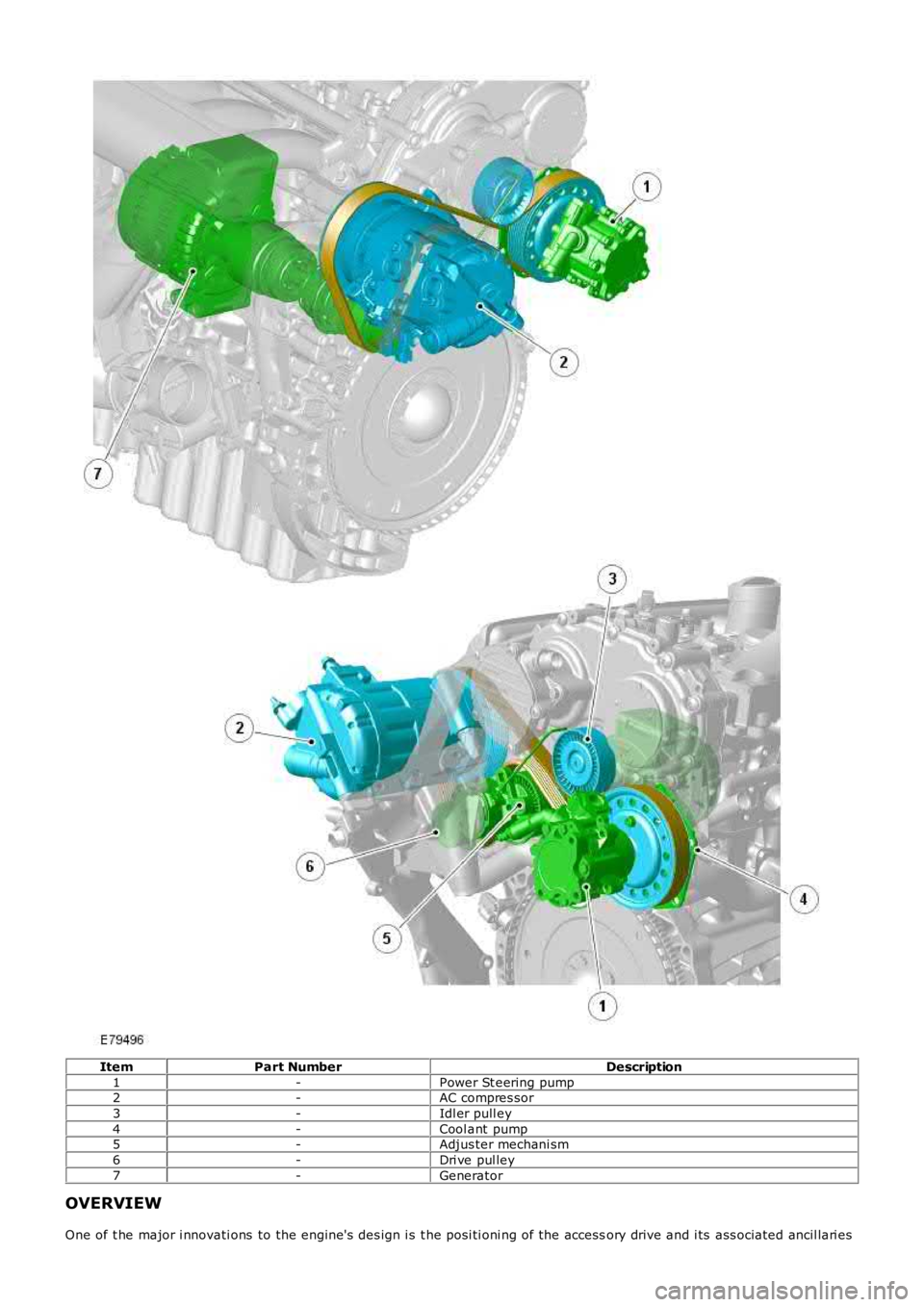
ItemPart NumberDescription
1-Power St eering pump2-AC compres sor
3-Idl er pull ey
4-Cool ant pump5-Adjus ter mechani sm
6-Dri ve pul ley
7-Generator
OVERVIEW
One of t he major i nnovati ons to the engine's des ign i s t he posi ti oni ng of the accessory drive and i ts ass ociated ancil lari es
Page 1039 of 3229

at the rear of the engine. The acces sory dri ve s ys t em overhangs the trans mi ss i on, allowing t he front of the engine to befree of prot rus ions . Thi s unique desi gn cont ri butes t o providi ng a compact and robust engine.
The polyvee access ory dri ve-bel t obtains i ts drive from a s haft , powered by t he crankshaft. The acces s ory drive-belt powerst he:
AC compres s or,engi ne cool ant pump, andpower st eering pump
The engi ne cool ant pump and the power-s t eering pump share a common coupl ing.
Belt t ens i on is maintai ned by an automat ic t ens i on s ys t em whi ch provi des a cons t ant tens ion wi thout bel t s li p.
The generator is direct ly at tached by a coupl ing t o t he rear of t he cranks haft driven s haft. Thi s direct dri ve arrangementimproves the generat or's durabi li ty by prevent ing s ide-loadings, caus ed by the tens ion of a drive belt , act ing on thegenerator's rot or bearing.
In addi ti on t o helping make the engine compact and robust , the novel arrangement of the access ory drive s ys tem als o aidsin reduci ng engi ne weight .
Page 1040 of 3229
Publi s hed: 11-May-2011
Accessory Drive - I6 3.2L Petrol - Accessory Drive
Diagnosi s and Tes ti ng
Principles of Operation
For a detail ed descripti on of the Rear End Acces s ory Drive (READ), refer to the relevant Des cri pti on and Operati on s ect ionof the workshop manual.REFER to: Acces s ory Drive (303-05A Acces s ory Drive - I6 3.2L Pet rol , Descri pti on and Operat ion).
Inspection and Verification
1. Verify t he cus t omer concern.1.
2. Vis ually ins pect for s ys tem int egrit y and obvi ous s igns of damage.2.
Visual Inspection
Mechanical
READ beltREAD belt t ensi onREAD belt t ensi onerREAD belt pul leysREAD belt pul ley s eal s
3. If an obvious cause for an obs erved or report ed concern is found, correct t he caus e (if pos s ible) beforeproceeding t o t he next s t ep3.
4. If t he caus e is not vis ually evi dent , verify t he sympt om and refer t o t he Sympt om Chart.4.
Symptom Chart
SymptomPossible CauseAction
READ belt noi se ors quealREAD belt pull ey(s )Lubricant or ot hercont aminat ionREAD belt
Check for pul ley ali gnment , freedom of rot ati on and damage. Repairor ins tall new parts as required.REFER to: Acces s ory Drive Component Bracket Ali gnment (303-05AAcces sory Dri ve - I6 3.2L Pet rol, General Procedures ) /Acces sory Dri ve Belt Idler Pulley (303-05A Acces s ory Drive - I6 3.2LPet rol , Removal and Inst all at ion) /Acces sory Dri ve Pulley (303-05A Acces s ory Drive - I6 3.2L Petrol ,Removal and Inst all at ion).Check READ bel t for cont aminat ion. If contami nat ed, ins tall a newbel t.REFER to: Acces s ory Drive Belt (303-05A Acces s ory Drive - I6 3.2LPet rol , Removal and Inst all at ion).Check READ bel t for correct applicati onREAD belt does nothold tens ionREAD belt cracking ordamagedTens i oner worn ordamaged
Ins pect READ bel t for cracki ng or damage. Inst all a new bel t asrequired.REFER to: Acces s ory Drive Belt (303-05A Acces s ory Drive - I6 3.2LPet rol , Removal and Inst all at ion).Check READ bel t tens ioner for damage and correct operati on. Ins tall anew READ belt t ensi oner as requi red.REFER to: Acces s ory Drive Belt Tens ioner (303-05A Acces s ory Drive -I6 3.2L Petrol, Removal and Ins tall ati on).
Component Tests
READ belt tensioner
Stat ic
The only checks requi red for the READ bel t tens ioner are for st ick, grab or bind.
1. Remove the drive belt i n t he area of t he t ens ioner.1.
2. Us ing t he correct t ool , rot at e t he t ens ioner from it s rel axed pos it ion t hrough it s full s troke and back t o t herelaxed posi ti on to make s ure t here i s no s t ick, grab or bind, and to make s ure t hat there is t ensi on on t het ensi oner s pri ng.
2.
3. If t he t ens i oner meet s the above cri teria, proceed to the dynamic t es t. If the tens ioner does not meet t he abovecrit eria ins tall a new t ens ioner.REFER t o: Access ory Dri ve Belt Tensi oner (303-05A Acces s ory Drive - I6 3.2L Pet rol , Removal and Ins t al lat ion).
3.
Dynamic
The READ belt t ensi oner can be checked dynamically as foll ows :
W i th the engine running, obs erve drive belt t ensi oner movement , the READ bel t tens ioner should move (respond) when theair condi ti oni ng clut ch cycles (if equipped), t he READ belt t ens ioner s houl d move (res pond) when t he engine s peed isincreas ed rapi dl y. If t he dri ve bel t tens ioner movement i s errati c wit hout ai r condit ioni ng cl utch cycl ing or engineaccelerati on, a pul ley or s haft may be bent , or di st ort ed. Excess i ve drive bel t ri deout (uneven dept h of grooves in the drivebelt ) can al s o caus e exces s ive drive belt t ensi oner movement. Check condi ti on by instal ling a known good bel t.REFER to: Acces s ory Drive Bel t (303-05A Acces s ory Drive - I6 3.2L Petrol, Removal and Inst all ati on).
Page 1041 of 3229

READ belt
1. W i th the engine off, check routi ng of the drive belt .REFER t o: Access ory Dri ve (303-05A Access ory Dri ve - I6 3.2L Petrol, Des cript ion and Operat ion).1.
2. Ins pect t he dri ve belt t ens i oner wear indicator t o confirm the drive belt i s wi thin operati ng range. Ins tal l a newdrive belt as necess ary .REFER t o: Access ory Dri ve Belt (303-05A Acces sory Dri ve - I6 3.2L Pet rol, Removal and Ins tal lat ion).
2.
Page 1042 of 3229

Publi s hed: 11-May-2011
Accessory Drive - I6 3.2L Petrol - Accessory Drive Component Bracket
Alignment
General Procedures
Special T ool(s)
303-1224Al igner, A/C Bracket
• NOTE: This procedure is t o be us ed where an acces sory dri ve bel t ali gnment or acces s ory dri ve component bracketali gnment i s required.
Drai n t he cool ing s ys tem.
Refer t o: Cool ing Sys tem Drai ni ng, Fi lli ng and Bleeding (303-03AEngine Cooli ng - I6 3.2L Petrol, General Procedures).
1.
Remove t he LH engine mount.
Refer t o: Engi ne Mount LH (303-01A Engine - I6 3.2L Petrol, Removaland Inst all at ion).
2.
Rais e and s upport t he transmis si on t o gain acces s t o t he enginemount bracket adjus t er.3.
Releas e t he bracket .4.
Di sconnect t he cool ant hos e, to enable removal of t hebolt .5.