2005 NISSAN NAVARA check engine
[x] Cancel search: check enginePage 1013 of 3171
TROUBLE DIAGNOSIS
EC-33
C
D
E
F
G
H
I
J
K
L
MA
EC
TROUBLE DIAGNOSISPFP:00004
Trouble Diagnosis IntroductionEBS01KCT
INTRODUCTION
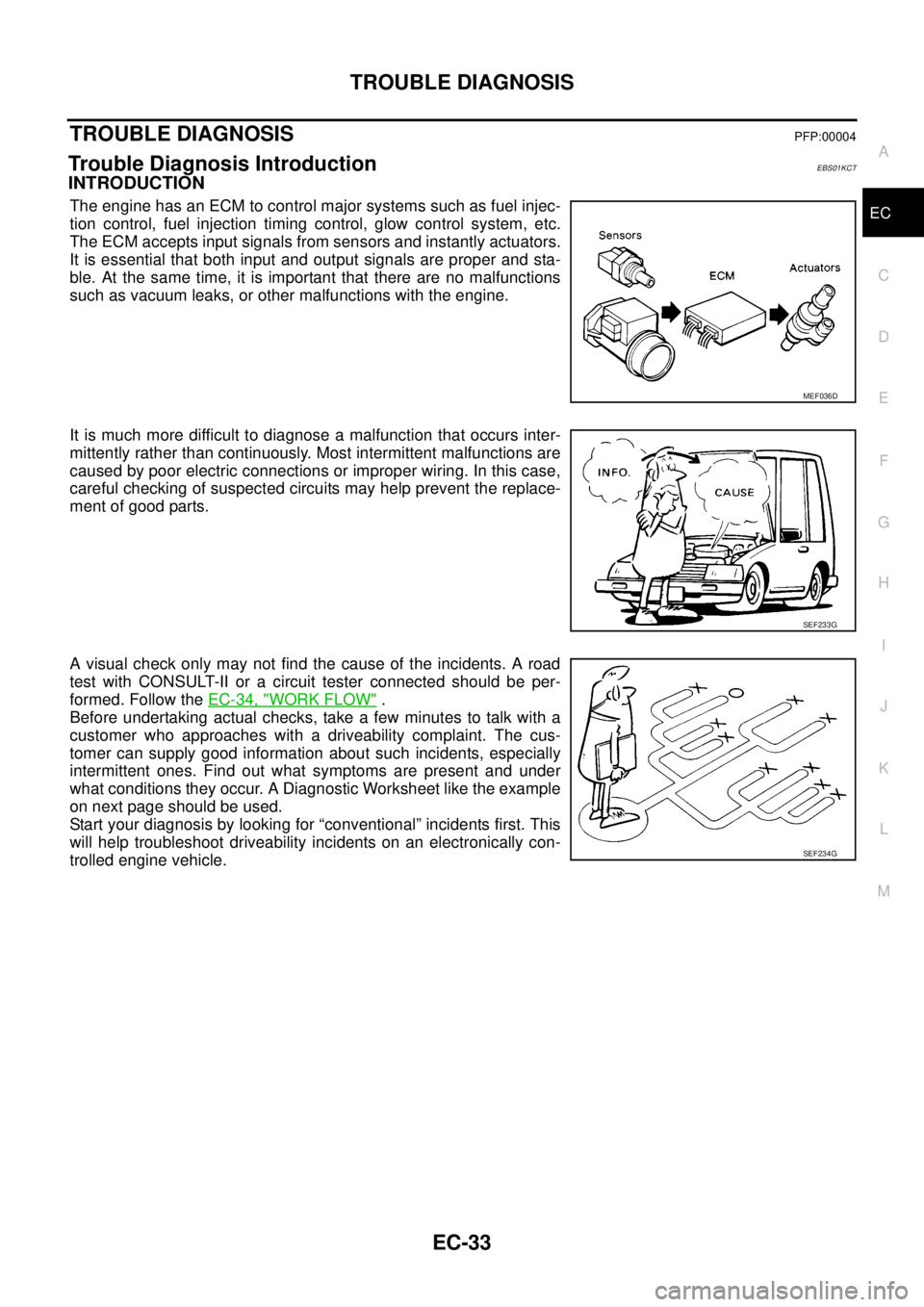
The engine has an ECM to control major systems such as fuel injec-
tion control, fuel injection timing control, glow control system, etc.
The ECM accepts input signals from sensors and instantly actuators.
It is essential that both input and output signals are proper and sta-
ble. At the same time, it is important that there are no malfunctions
such as vacuum leaks, or other malfunctions with the engine.
It is much more difficult to diagnose a malfunction that occurs inter-
mittently rather than continuously. Most intermittent malfunctions are
caused by poor electric connections or improper wiring. In this case,
careful checking of suspected circuits may help prevent the replace-
ment of good parts.
A visual check only may not find the cause of the incidents. A road
test with CONSULT-II or a circuit tester connected should be per-
formed. Follow theEC-34, "
WORK FLOW".
Before undertaking actual checks, take a few minutes to talk with a
customer who approaches with a driveability complaint. The cus-
tomer can supply good information about such incidents, especially
intermittent ones. Find out what symptoms are present and under
what conditions they occur. A Diagnostic Worksheet like the example
on next page should be used.
Start your diagnosis by looking for “conventional” incidents first. This
will help troubleshoot driveability incidents on an electronically con-
trolled engine vehicle.
MEF036D
SEF233G
SEF234G
Page 1015 of 3171
TROUBLE DIAGNOSIS
EC-35
C
D
E
F
G
H
I
J
K
L
MA
EC
Description for Work Flow
DIAGNOSTIC WORK SHEET
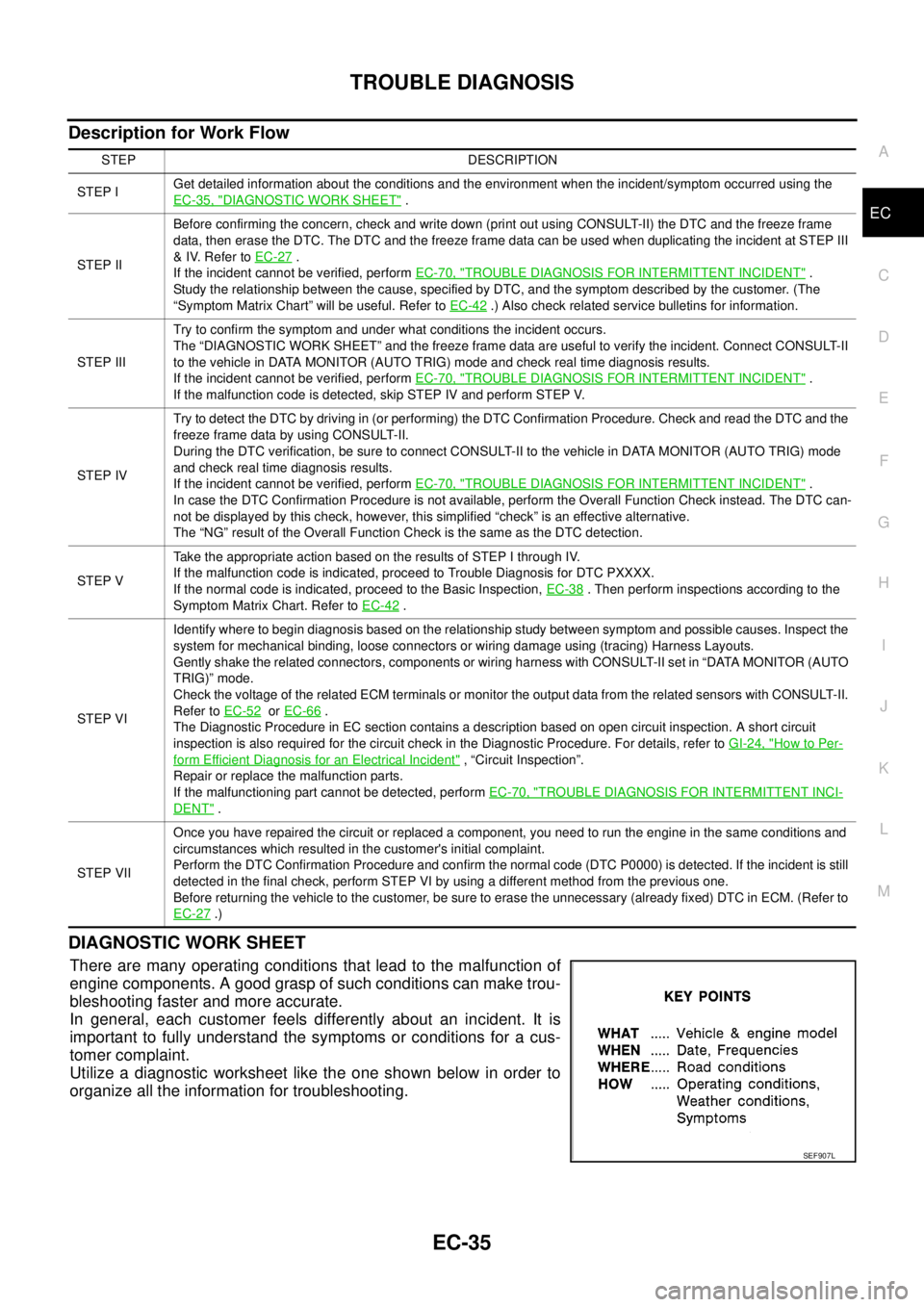
There are many operating conditions that lead to the malfunction of
engine components. A good grasp of such conditions can make trou-
bleshooting faster and more accurate.
In general, each customer feels differently about an incident. It is
important to fully understand the symptoms or conditions for a cus-
tomer complaint.
Utilize a diagnostic worksheet like the one shown below in order to
organize all the information for troubleshooting.
STEP DESCRIPTION
STEP IGet detailed information about the conditions and the environment when the incident/symptom occurred using the
EC-35, "
DIAGNOSTIC WORK SHEET".
STEP IIBefore confirming the concern, check and write down (print out using CONSULT-II) the DTC and the freeze frame
data, then erase the DTC. The DTC and the freeze frame data can be used when duplicating the incident at STEP III
&IV.RefertoEC-27
.
If the incident cannot be verified, performEC-70, "
TROUBLE DIAGNOSIS FOR INTERMITTENT INCIDENT".
Study the relationship between the cause, specified by DTC, and the symptom described by the customer. (The
“Symptom Matrix Chart” will be useful. Refer toEC-42
.) Also check related service bulletins for information.
STEP IIITry to confirm the symptom and under what conditions the incident occurs.
The “DIAGNOSTIC WORK SHEET” and the freeze frame data are useful to verify the incident. Connect CONSULT-II
to the vehicle in DATA MONITOR (AUTO TRIG) mode and check real time diagnosis results.
If the incident cannot be verified, performEC-70, "
TROUBLE DIAGNOSIS FOR INTERMITTENT INCIDENT".
If the malfunction code is detected, skip STEP IV and perform STEP V.
STEP IVTry to detect the DTC by driving in (or performing) the DTC Confirmation Procedure. Check and read the DTC and the
freeze frame data by using CONSULT-II.
During the DTC verification, be sure to connect CONSULT-II to the vehicle in DATA MONITOR (AUTO TRIG) mode
and check real time diagnosis results.
If the incident cannot be verified, performEC-70, "
TROUBLE DIAGNOSIS FOR INTERMITTENT INCIDENT".
In case the DTC Confirmation Procedure is not available, perform the Overall Function Check instead. The DTC can-
not be displayed by this check, however, this simplified “check” is an effective alternative.
The “NG” result of the Overall Function Check is the same as the DTC detection.
STEP VTake the appropriate action based on the results of STEP I through IV.
If the malfunction code is indicated, proceed to Trouble Diagnosis for DTC PXXXX.
If the normal code is indicated, proceed to the Basic Inspection,EC-38
. Then perform inspections according to the
Symptom Matrix Chart. Refer toEC-42
.
STEP VIIdentify where to begin diagnosis based on the relationship study between symptom and possible causes. Inspect the
system for mechanical binding, loose connectors or wiring damage using (tracing) Harness Layouts.
Gently shake the related connectors, components or wiring harness with CONSULT-II set in “DATA MONITOR (AUTO
TRIG)” mode.
Check the voltage of the related ECM terminals or monitor the output data from the related sensors with CONSULT-II.
Refer toEC-52
orEC-66.
The Diagnostic Procedure in EC section contains a description based on open circuit inspection. A short circuit
inspection is also required for the circuit check in the Diagnostic Procedure. For details, refer toGI-24, "
How to Per-
form Efficient Diagnosis for an Electrical Incident", “Circuit Inspection”.
Repair or replace the malfunction parts.
If the malfunctioning part cannot be detected, performEC-70, "
TROUBLE DIAGNOSIS FOR INTERMITTENT INCI-
DENT".
STEP VIIOnce you have repaired the circuit or replaced a component, you need to run the engine in the same conditions and
circumstances which resulted in the customer's initial complaint.
Perform the DTC Confirmation Procedure and confirm the normal code (DTC P0000) is detected. If the incident is still
detected in the final check, perform STEP VI by using a different method from the previous one.
Before returning the vehicle to the customer, be sure to erase the unnecessary (already fixed) DTC in ECM. (Refer to
EC-27
.)
SEF907L
Page 1018 of 3171
EC-38
TROUBLE DIAGNOSIS
Basic Inspection
EBS01KCV
Precaution:
Perform Basic Inspection without electrical or mechanical loads applied;
lHeadlamp switch is OFF.
lOn vehicles equipped with daytime light systems, set lighting switch to the 1st position to light
only small lamps.
lAir conditioner switch is OFF.
lHeater fan switch is OFF.
lRear defogger switch is OFF.
lHeat up switch is OFF.
lSteering wheel is in the straight-ahead position, etc.
1.INSPECTION START
1. Check service records for any recent repairs that may indicate a related incident.
2. Check the current need for scheduled maintenance, especially for fuel filter and air cleaner filter. Refer to
MA-8, "
PERIODIC MAINTENANCE".
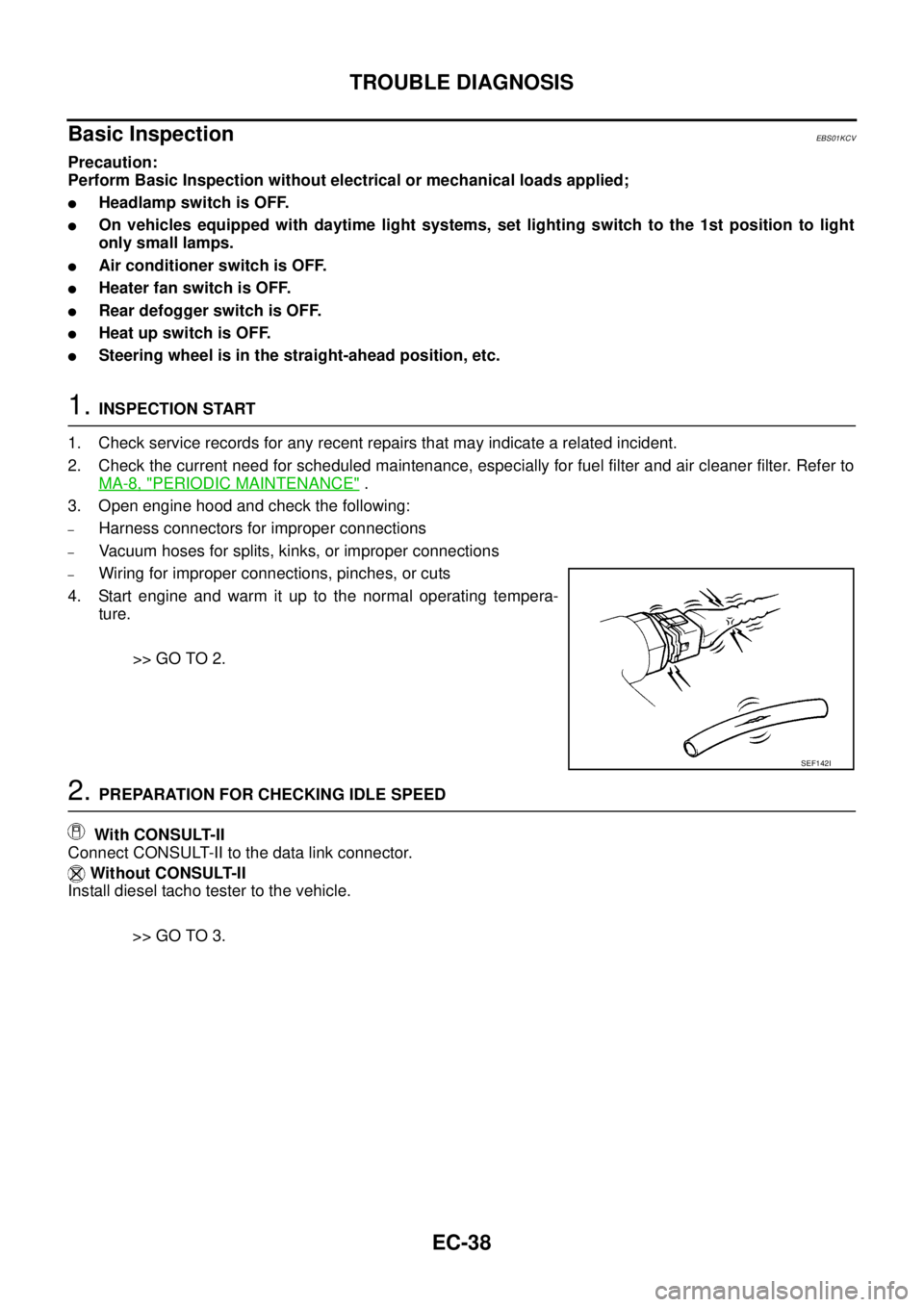
3. Open engine hood and check the following:
–Harness connectors for improper connections
–Vacuum hoses for splits, kinks, or improper connections
–Wiring for improper connections, pinches, or cuts
4. Start engine and warm it up to the normal operating tempera-
ture.
>> GO TO 2.
2.PREPARATION FOR CHECKING IDLE SPEED
With CONSULT-II
Connect CONSULT-II to the data link connector.
Without CONSULT-II
Install diesel tacho tester to the vehicle.
>> GO TO 3.
SEF142I
Page 1019 of 3171
TROUBLE DIAGNOSIS
EC-39
C
D
E
F
G
H
I
J
K
L
MA
EC
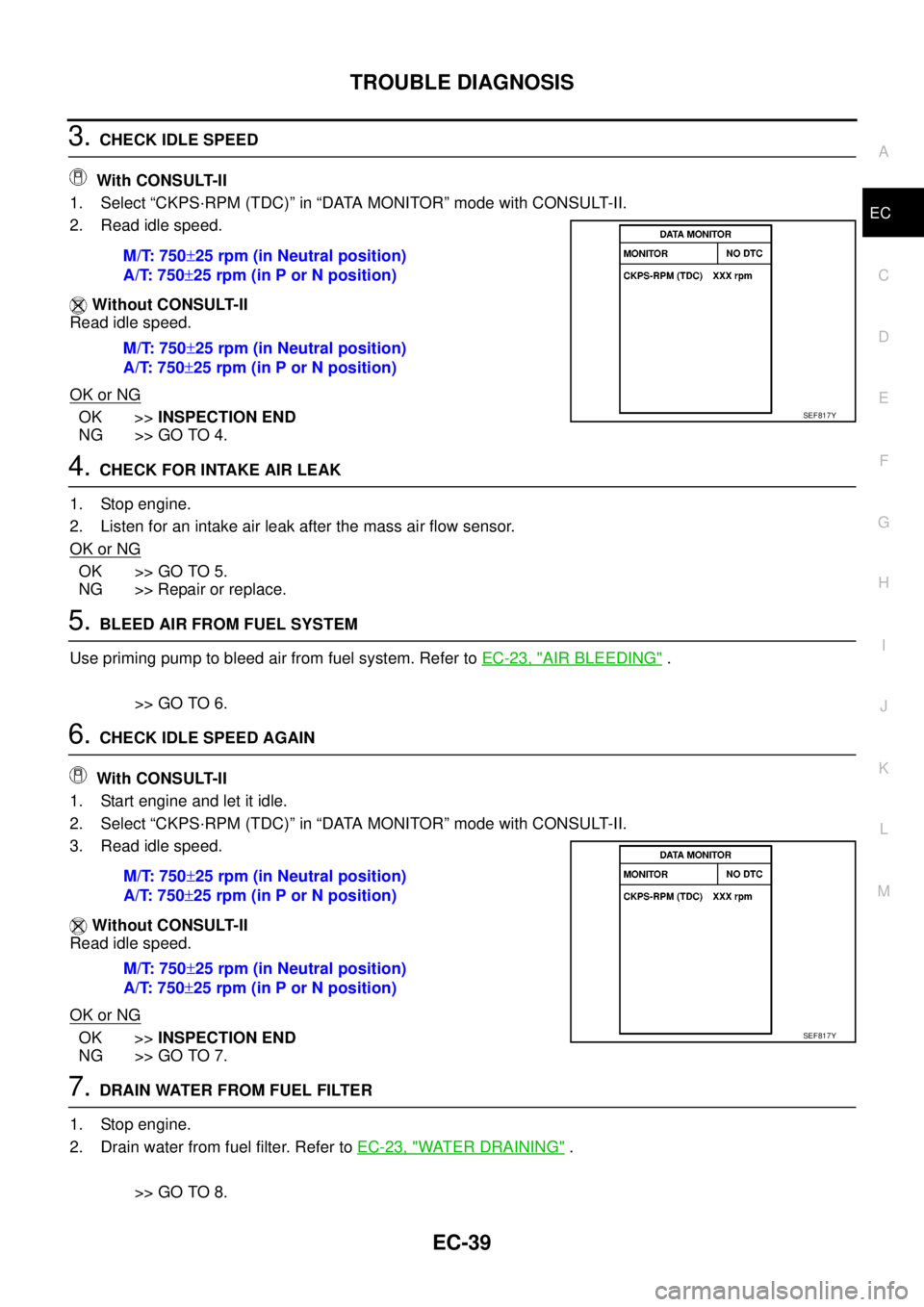
3.CHECK IDLE SPEED
With CONSULT-II
1. Select “CKPS·RPM (TDC)” in “DATA MONITOR” mode with CONSULT-II.
2. Read idle speed.
Without CONSULT-II
Read idle speed.
OK or NG
OK >>INSPECTION END
NG >> GO TO 4.
4.CHECK FOR INTAKE AIR LEAK
1. Stop engine.
2. Listen for an intake air leak after the mass air flow sensor.
OK or NG
OK >> GO TO 5.
NG >> Repair or replace.
5.BLEED AIR FROM FUEL SYSTEM
Use priming pump to bleed air from fuel system. Refer toEC-23, "
AIR BLEEDING".
>> GO TO 6.
6.CHECK IDLE SPEED AGAIN
With CONSULT-II
1. Start engine and let it idle.
2. Select “CKPS·RPM (TDC)” in “DATA MONITOR” mode with CONSULT-II.
3. Read idle speed.
Without CONSULT-II
Read idle speed.
OK or NG
OK >>INSPECTION END
NG >> GO TO 7.
7.DRAIN WATER FROM FUEL FILTER
1. Stop engine.
2. Drain water from fuel filter. Refer toEC-23, "
WATER DRAINING".
>> GO TO 8. M/T: 750±25 rpm (in Neutral position)
A/T: 750±25 rpm (in P or N position)
M/T: 750±25 rpm (in Neutral position)
A/T: 750±25 rpm (in P or N position)
SEF817Y
M/T: 750±25 rpm (in Neutral position)
A/T: 750±25 rpm (in P or N position)
M/T: 750±25 rpm (in Neutral position)
A/T: 750±25 rpm (in P or N position)
SEF817Y
Page 1020 of 3171
EC-40
TROUBLE DIAGNOSIS
8.CHECK IDLE SPEED AGAIN
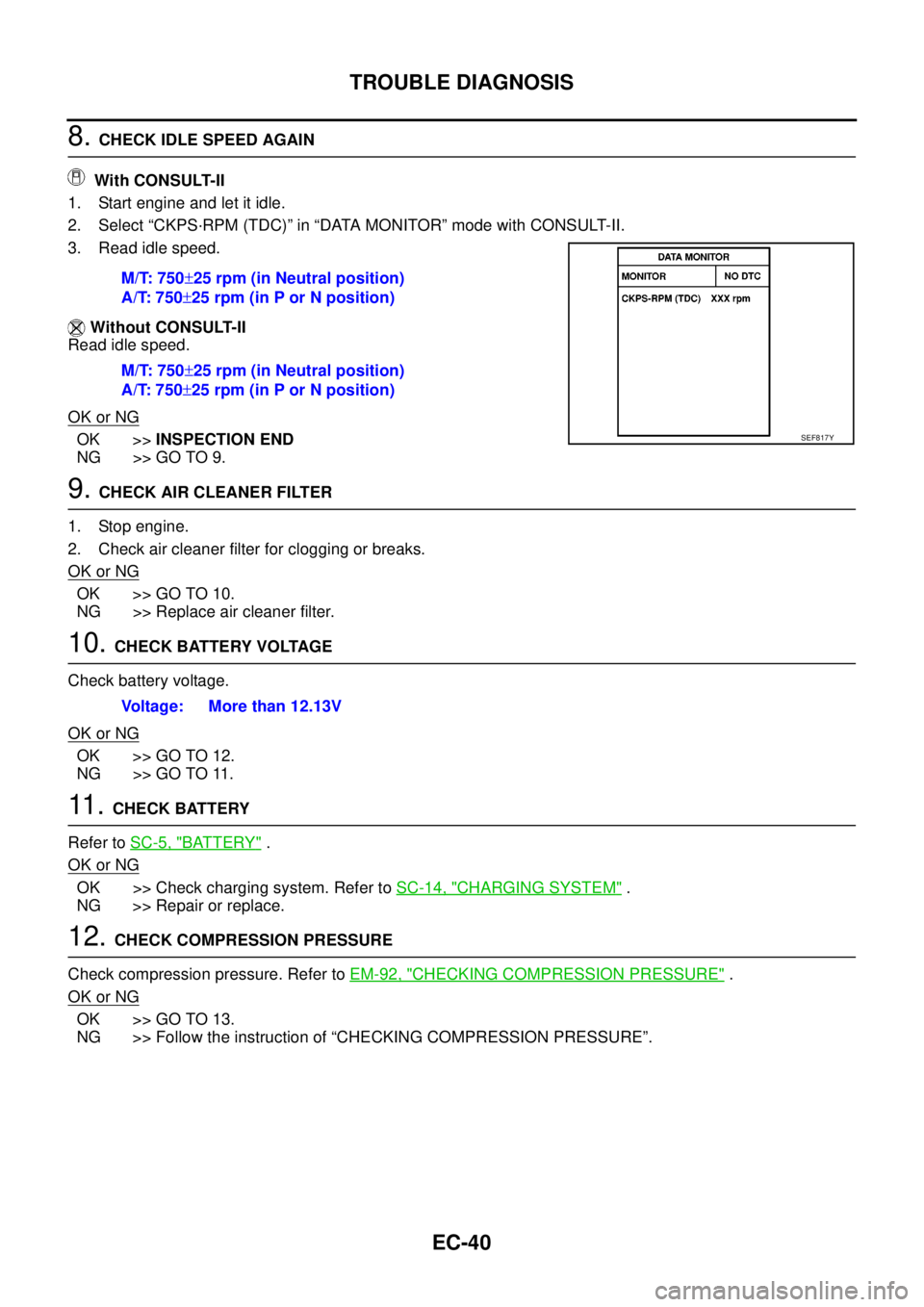
With CONSULT-II
1. Start engine and let it idle.
2. Select “CKPS·RPM (TDC)” in “DATA MONITOR” mode with CONSULT-II.
3. Read idle speed.
Without CONSULT-II
Read idle speed.
OK or NG
OK >>INSPECTION END
NG >> GO TO 9.
9.CHECK AIR CLEANER FILTER
1. Stop engine.
2. Check air cleaner filter for clogging or breaks.
OK or NG
OK >> GO TO 10.
NG >> Replace air cleaner filter.
10.CHECK BATTERY VOLTAGE
Check battery voltage.
OK or NG
OK >> GO TO 12.
NG >> GO TO 11.
11 .CHECK BATTERY
Refer toSC-5, "
BATTERY".
OK or NG
OK >> Check charging system. Refer toSC-14, "CHARGING SYSTEM".
NG >> Repair or replace.
12.CHECK COMPRESSION PRESSURE
Check compression pressure. Refer toEM-92, "
CHECKING COMPRESSION PRESSURE".
OK or NG
OK >> GO TO 13.
NG >> Follow the instruction of “CHECKING COMPRESSION PRESSURE”.M/T: 750±25 rpm (in Neutral position)
A/T: 750±25 rpm (in P or N position)
M/T: 750±25 rpm (in Neutral position)
A/T: 750±25 rpm (in P or N position)
SEF817Y
Voltage: More than 12.13V
Page 1021 of 3171
TROUBLE DIAGNOSIS
EC-41
C
D
E
F
G
H
I
J
K
L
MA
EC
13.CHECK IDLE SPEED AGAIN
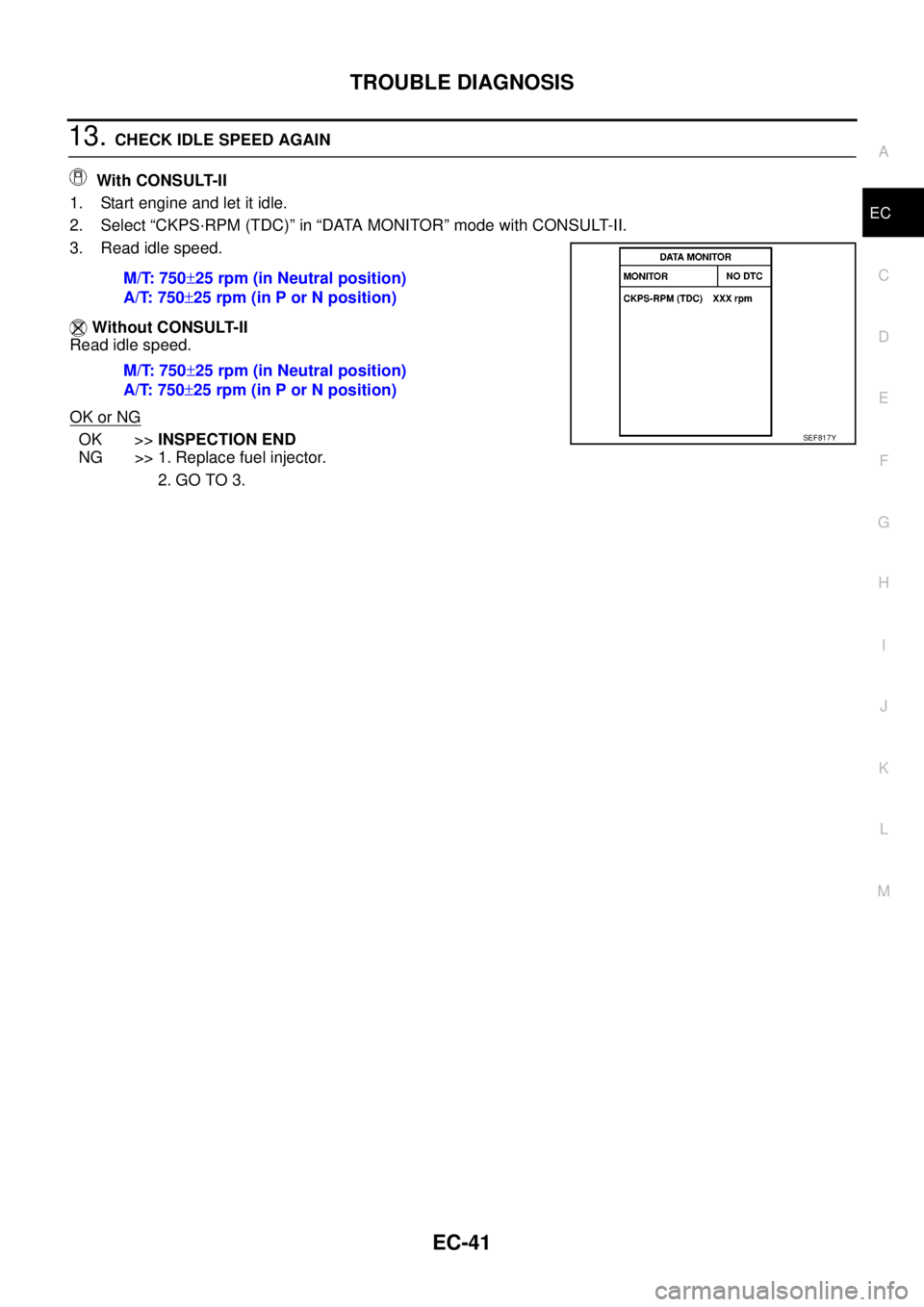
With CONSULT-II
1. Start engine and let it idle.
2. Select “CKPS·RPM (TDC)” in “DATA MONITOR” mode with CONSULT-II.
3. Read idle speed.
Without CONSULT-II
Read idle speed.
OK or NG
OK >>INSPECTION END
NG >> 1. Replace fuel injector.
2. GO TO 3. M/T: 750±25 rpm (in Neutral position)
A/T: 750±25 rpm (in P or N position)
M/T: 750±25 rpm (in Neutral position)
A/T: 750±25 rpm (in P or N position)SEF817Y
Page 1036 of 3171
![NISSAN NAVARA 2005 Repair Workshop Manual EC-56
TROUBLE DIAGNOSIS
48
49L
BFuel rail pressure sensor[Engine is running]
lWarm-up condition
lIdle speed1.7 - 2.0V
[Engine is running]
lWarm-up condition
lEngine speed: 2,000 rpm2.0 - 2.3V
50 YFuel](/manual-img/5/57362/w960_57362-1035.png "NISSAN NAVARA 2005 Repair Workshop Manual EC-56
TROUBLE DIAGNOSIS
48
49L
BFuel rail pressure sensor[Engine is running]
lWarm-up condition
lIdle speed1.7 - 2.0V
[Engine is running]
lWarm-up condition
lEngine speed: 2,000 rpm2.0 - 2.3V
50 YFuel")
EC-56
TROUBLE DIAGNOSIS
48
49L
BFuel rail pressure sensor[Engine is running]
lWarm-up condition
lIdle speed1.7 - 2.0V
[Engine is running]
lWarm-up condition
lEngine speed: 2,000 rpm2.0 - 2.3V
50 YFuel pump temperature sen-
sor[Engine is running]
lWarm-up conditionApproximately 0.3 - 5.3V
Output voltage varies with fuel
pump temperature
51 SBEngine coolant temperature
sensor[Engine is running]
lWarm-up conditionApproximately 0.3 - 5.3V
Output voltage varies with engine
coolant temperature
52 BR Turbocharger boost sensor[Engine is running]
lWarm-up condition
lIdle speed2.1 - 2.4V
[Engine is running]
lWarm-up condition
lEngine speed: 2,000 rpm2.3 - 2.6V
53 W Refrigerant pressure sensor[Engine is running]
lWarm-up condition
lBoth A/C switch and blower switch: ON
(Compressor operates)1.0 - 4.0V
54 G Mass air flow sensor[Ignition switch: ON]Approximately 0.7V
[Engine is running]
lWarm-up condition
lIdle speed1.6 - 2.0V
[Engine is running]
lWarm-up condition
lEngine is revving from idle to about 4,000
rpm.1.6 - 2.0V to Approximately 4.3V
(Check for liner voltage rise in
response to engine being
increased to about 4,000 rpm)
55 WIntake air temperature sen-
sor[Engine is running]
lWarm-up conditionApproximately 0.3 - 5.2V
Output voltage varies with intake
air temperature
63 RFuel rail pressure sensor
power supply[Ignition switch ON]Approximately 5.3V
64 VSensor power supply
(Turbocharger boost sensor /
Refrigerant pressure sensor)[Ignition switch ON]Approximately 5.3V
65 BCrankshaft position sensor
ground[Ignition switch ON]Approximately 0.3V
66 BCamshaft position sensor
ground[Ignition switch ON]Approximately 0.3V
67 —Sensor ground
(Sensor shield circuit)[Ignition switch ON]Approximately 0.3V
68 WFuel rail pressure sensor
ground[Ignition switch ON]Approximately 0.3V
69 BFuel pump temperature sen-
sor ground[Ignition switch ON]Approximately 0.3V
70 LGEngine coolant temperature
sensor ground[Ignition switch ON]Approximately 0.3V TERMI-
NAL
NO.WIRE
COLORITEM CONDITIONDATA
(DC Voltage and Pulse Signal)
Page 1044 of 3171
![NISSAN NAVARA 2005 Repair Workshop Manual EC-64
TROUBLE DIAGNOSIS
NOTE:
Any monitored item that does not match the vehicle being diagnosed is deleted from the display automatically.
ACTIVE TEST MODE
INT/M PRES SE [kPa]
lTurbocharger boost (de](/manual-img/5/57362/w960_57362-1043.png "NISSAN NAVARA 2005 Repair Workshop Manual EC-64
TROUBLE DIAGNOSIS
NOTE:
Any monitored item that does not match the vehicle being diagnosed is deleted from the display automatically.
ACTIVE TEST MODE
INT/M PRES SE [kPa]
lTurbocharger boost (de")
EC-64
TROUBLE DIAGNOSIS
NOTE:
Any monitored item that does not match the vehicle being diagnosed is deleted from the display automatically.
ACTIVE TEST MODE
INT/M PRES SE [kPa]
lTurbocharger boost (determined by
the signal voltage from the turbo-
charger boost sensor) is displayed.
CYL COUNT [1/2/3/4]
lThe cylinder being injected is dis-
played.
1 ... Cylinder No.1 is injected.
2 ... Cylinder No.2 is injected.
3 ... Cylinder No.3 is injected.
4 ... Cylinder No.4 is injected.
SET SW
[ON/OFF]´
lIndicates [ON/OFF] condition from
SET/COAST switch signal.
RESUME/ACC SW
[ON/OFF]´
lIndicates [ON/OFF] condition from
RESUME/ACCEL switch signal.
CANCEL SW
[ON/OFF]´
lIndicates [ON/OFF] condition from
CANCEL switch signal.
MAIN SW
[ON/OFF]´
lIndicates [ON/OFF] condition from
MAIN switch signal.
ASCD APPLY [YES/NO]
lDisplaying ASCD application status
stored in ECM.
VDC APPLY [YES/NO]
lDisplaying ESP application status
stored in ECM.
AC PRESS SEN [V]
lThe signal voltage from the refrigerant
pressure sensor is displayed.
Voltage [V]
Voltage, frequency, duty cycle or pulse
width measured by the probe.Only “#” is displayed if item is unable to
be measured.
Figures with “#”s are temporary ones.
They are the same figures as an actual
piece of data which was just previously
measured. [Hz] or [%] Frequency
[msec],[Hz]or[%]
DUTY-HI
DUTY-LOW
PLS WIDTH-HI
PLS WIDTH-LOWMONITOR ITEMECM
INPUT
SIG-
NALMAIN
SIG-
NALSCONDITION SPECIFICATION
TEST ITEM CONDITION JUDGEMENT CHECK ITEM (REMEDY)
POWER BAL-
ANCE
lEngine: After warming up, idle the
engine.
lA/C switch: OFF
lShift lever: P or N (A/T), Neutral
(M/T)
lCut off each injector signal one at
a time using CONSULT-IIEngine runs rough or dies.
lHarness and connectors
lCompression
lFuel injector
COOLING FAN *
lIgnition switch: ON
lOperate the cooling fan at LOW,
HI speed and turn OFF using
CONSULT-II.Cooling fan moves at LOW, HI
speed and stops.lHarness and connector
lCooling fan motor
lCooling fan relay
ENG COOLANT
TEMP
lEngine: Return to the original
trouble condition
lChange the engine coolant tem-
perature using CONSULT-II.If trouble symptom disappears, see
CHECK ITEM.
lHarness and connectors
lEngine coolant temperature sen-
sor
lFuel injector