Page 25 of 4500
HINT:
<003a004b0048005100030057004b00480003005300440055004e004c0051004a0003004500550044004e00480003004c00560003004400530053004f004c0048004700030052005500030057004b00480003004f004800590048004f000300520049000300
57004b00480003004500550044004e004800030049004f0058[id is low, the BRAKE warning light
comes on.
b. When the ignition switch is turned to the ON position, check that the ABS warning light, TRAC
OFF indicator light, BRAKE warning light and SLIP indicator light come on for approximately 3
seconds.
HINT:
If the ECU was any stored DTCs, the ABS warning light, "VSC" is displayed on the multi-
information display and TRAC OFF indicator light come on.
If the indicator does not come on, inspect it the bulb is blown out, and also the wire harness
between the skid control ECU and the combination meter.
Page 29 of 4500
Fig. 21: ABS Warning Light Blinking Pattern
Courtesy of TOYOTA MOTOR SALES, U.S.A., INC.
5. Check that the ABS warning light blinking TEST MODE and "VSC Test" is displayed on the
multi-information display.
HINT:
If the ABS warning light and VSC information do not blink, inspect the ABS warning light
circuit and VSC warning information circuit.
TROUBLE AREA REFERENCE
6. Start the engine.
b. DECELERATION SENSOR CHECK
1. Check that the ABS warning lamp is blinking in TEST MODE.
2. Keep the vehicle in the stationar
y<00030046005200510047004c0057004c00520051000300520051000300440003004f004800590048004f0003005600580055004900440046004800030049005200550003001400030056004800460052005100470003005200550003005000520055004800
110003[
Trouble areaSee Procedure
ABS warning light circuitABS WARNING LIGHT CIRCUIT (DOES NOT
LIGHT UP)
VSC warning information
circuitVSC WARNING LIGHT CIRCUIT (DOES NOT
LIGHT UP)
Page 30 of 4500
HINT:
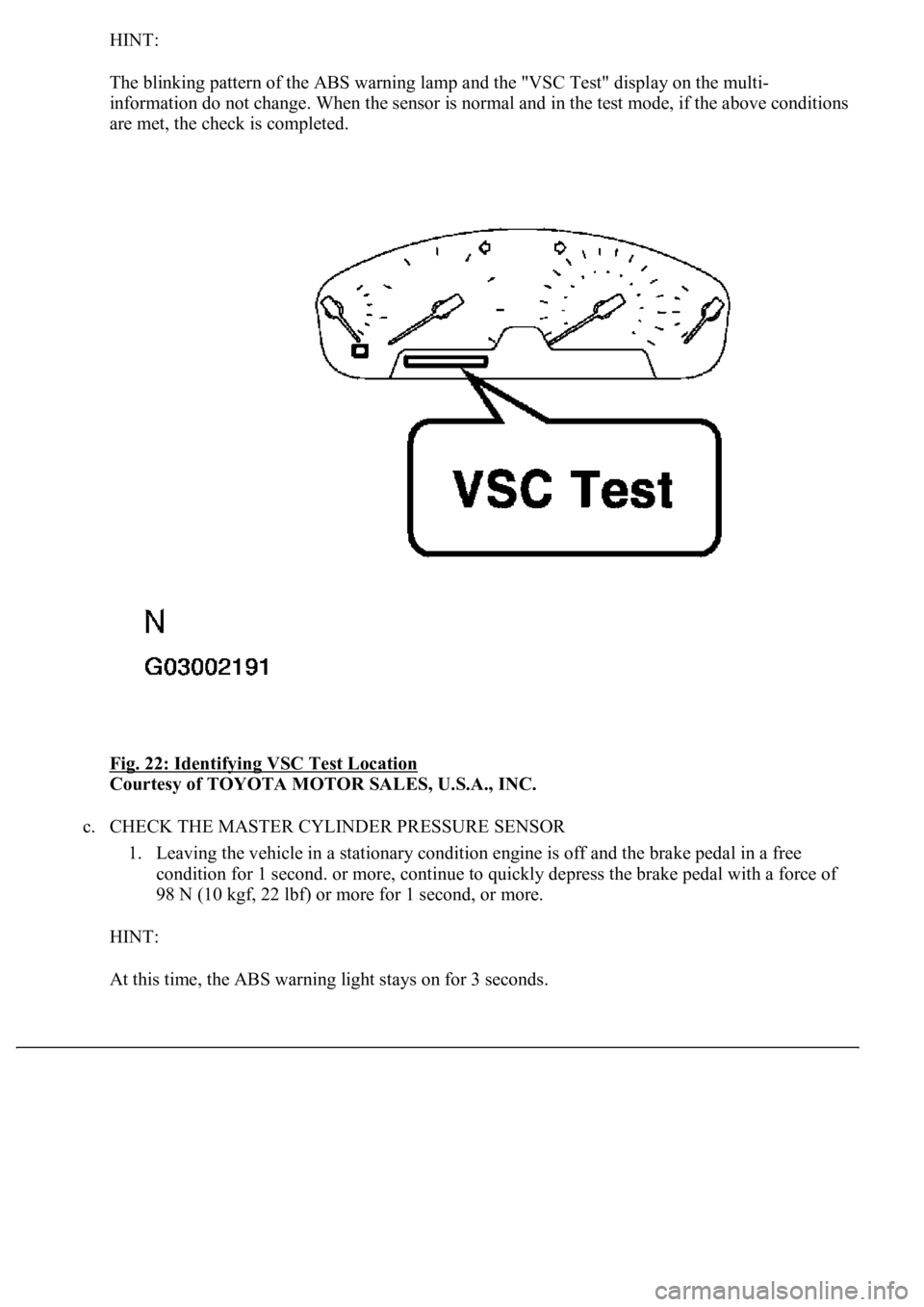
The blinking pattern of the ABS warning lamp and the "VSC Test" display on the multi-
information do not change. When the sensor is normal and in the test mode, if the above conditions
are met, the check is completed.
Fig. 22: Identifying VSC Test Location
Courtesy of TOYOTA MOTOR SALES, U.S.A., INC.
c. CHECK THE MASTER CYLINDER PRESSURE SENSOR
1. Leaving the vehicle in a stationary condition engine is off and the brake pedal in a free
condition for 1 second. or more, continue to quickly depress the brake pedal with a force of
98 N (10 kgf, 22 lbf) or more for 1 second, or more.
HINT:
At this time, the ABS warnin
g light stays on for 3 seconds.
Page 32 of 4500
HINT:
The turning direction is not important.
Turning should be completed within 20 seconds. However, it is possible to change the
vehicle speed, stop or move backward.
2. Stop the vehicle and shift the shift lever to the P position, check that the skid control buzzer
sounds for 3 sec.
HINT:
If the skid control buzzer sounds, the sensor check is completed normally.
If the skid control buzzer does not sound, check the skid control buzzer circuit (see SKID
CONTROL BUZZER CIRCUIT ), then perform the sensor check again.
If the skid control buzzer still does not sound, there is a malfunction in the VSC sensor, so
check the DTC.
Drive the vehicle in a 180° circle. At the end of the turn, the direction of the vehicle should
be within 180° +/- 5° of its start position.
Do not spin the wheels.
Even if the VSC sensor check is completed normally, the multi-information displays "VSC
Test" (test mode).
Page 35 of 4500
If the speed sensor check is completed, the ABS warning lamp does not come on while driving and
blinks at test mode when the vehicle stops.
g. END OF SENSOR CHECK
1. If the sensor check is completed, the ABS warning lamp blinks (test mode) when the vehicle
stops and the ABS warning lamp is off when the vehicle is driving.
h. READ TEST MODE CODE
1. Using hand-held tester, check the DTCs in the test mode. (Refer to the step i)
HINT:
The test mode codes and DTCs are displayed.
If the ABS is normal, the ABS warning lamp comes on for 0.25 seconds and goes off for
0.25 seconds repeatedly.
If the VSC system is normal, the multi-information displays "VSC OK".
Page 41 of 4500
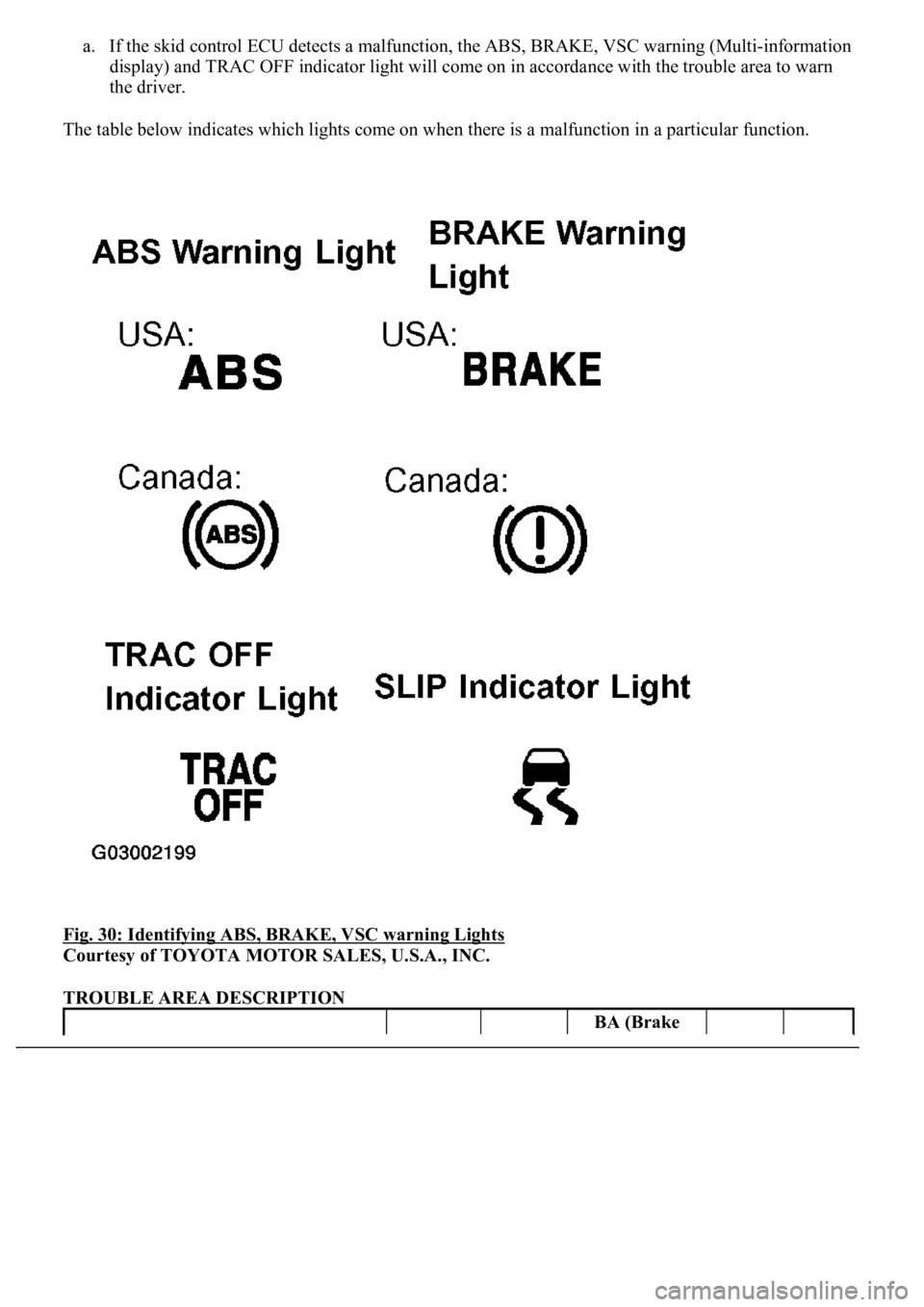
a. If the skid control ECU detects a malfunction, the ABS, BRAKE, VSC warning (Multi-information
display) and TRAC OFF indicator light will come on in accordance with the trouble area to warn
the driver.
The table below indicates which lights come on when there is a malfunction in a particular function.
Fig. 30: Identifying ABS, BRAKE, VSC warning Lights
Courtesy of TOYOTA MOTOR SALES, U.S.A., INC.
TROUBLE AREA DESCRIPTION
BA (Brake
Page 42 of 4500
xcirc: Light ON
-: Light OFF
The DTCs are simultaneously stored in memory. The DTCs can be read by connecting the hand-
held tester.
This system has a sensor signal check function (Test Mode).
The DTC can be read by connecting the SST between terminals TS and CG of DLC3 and observing the
blinking of the ABS warning light and VSC information, or by connecting the hand-held tester.
1.DTC CHECK (USING HAND-HELD TESTER)
Item / Trouble AreaABSEBDAssist)TRACVSC
ABS Warning Light000--
Brake Warning Light-0---
TRAC OFF Indicator Light00000
VSC Warning (Multi Information
Display)00000
Page 44 of 4500
HINT:
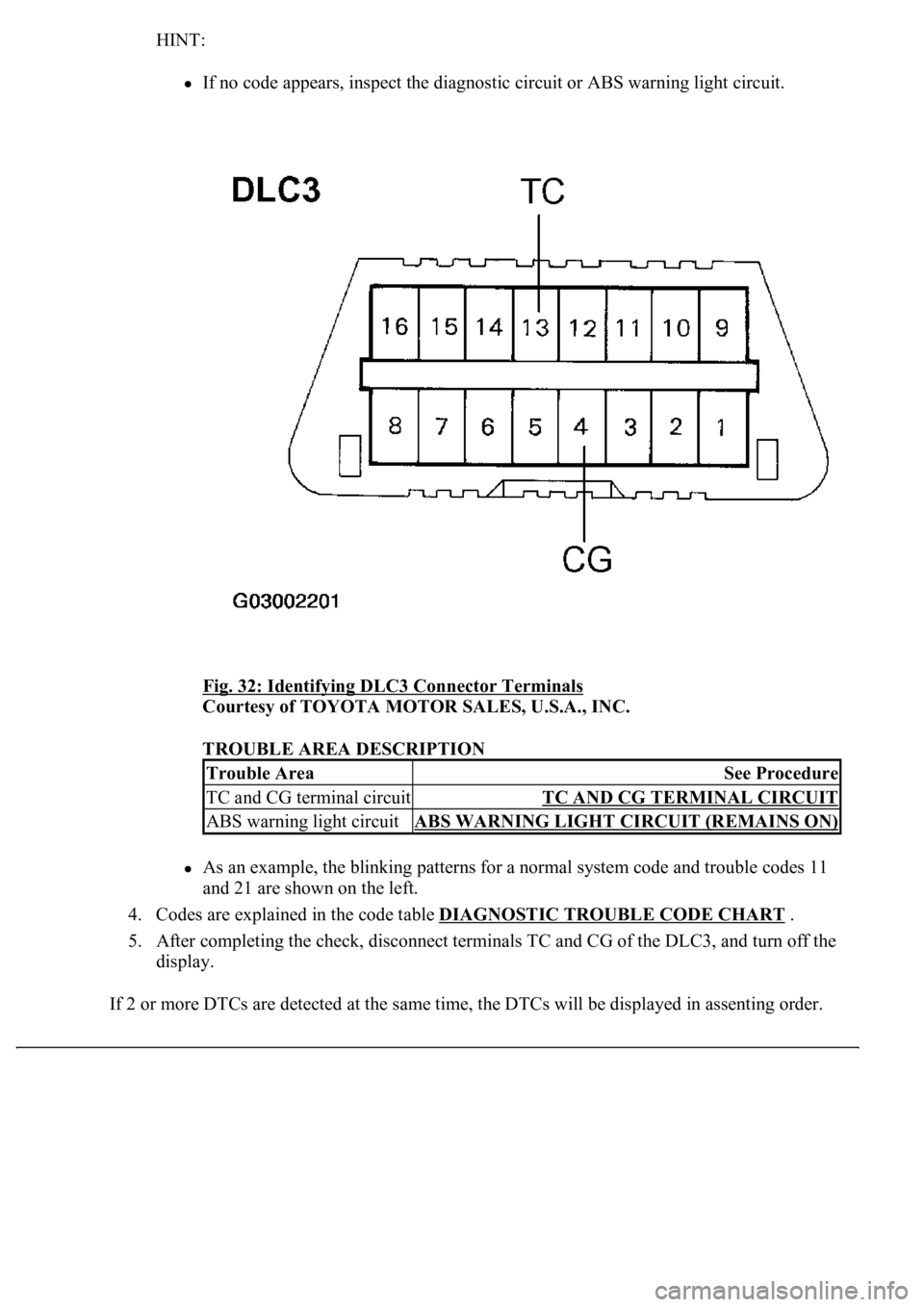
If no code appears, inspect the diagnostic circuit or ABS warning light circuit.
Fig. 32: Identifying DLC3 Connector Terminals
Courtesy of TOYOTA MOTOR SALES, U.S.A., INC.
TROUBLE AREA DESCRIPTION
As an example, the blinking patterns for a normal system code and trouble codes 11
and 21 are shown on the left.
4. Codes are explained in the code table DIAGNOSTIC TROUBLE CODE CHART
.
5. After completing the check, disconnect terminals TC and CG of the DLC3, and turn off the
display.
If 2 or more DTCs are detected at the same time, the DTCs will be displayed in assenting order.
Trouble AreaSee Procedure
TC and CG terminal circuitTC AND CG TERMINAL CIRCUIT
ABS warning light circuitABS WARNING LIGHT CIRCUIT (REMAINS ON)