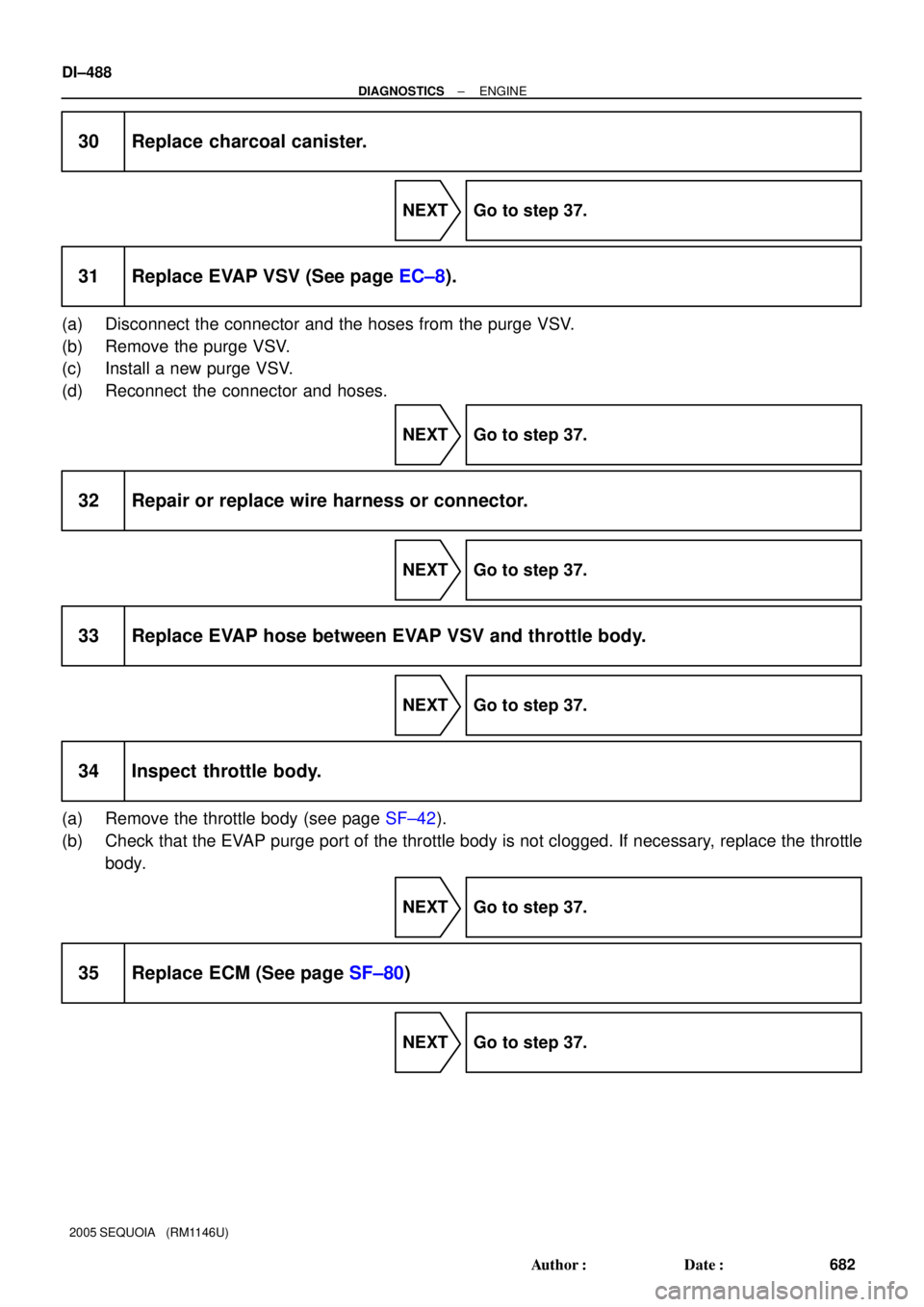
Page 683 of 4323
B17412PRG
E8
B17440
Wire Harness Side:
Purge VSV Connector
V4
Front View
B17411VPMP
E4
± DIAGNOSTICSENGINE
DI±481
675 Author�: Date�:
2005 SEQUOIA (RM1146U)
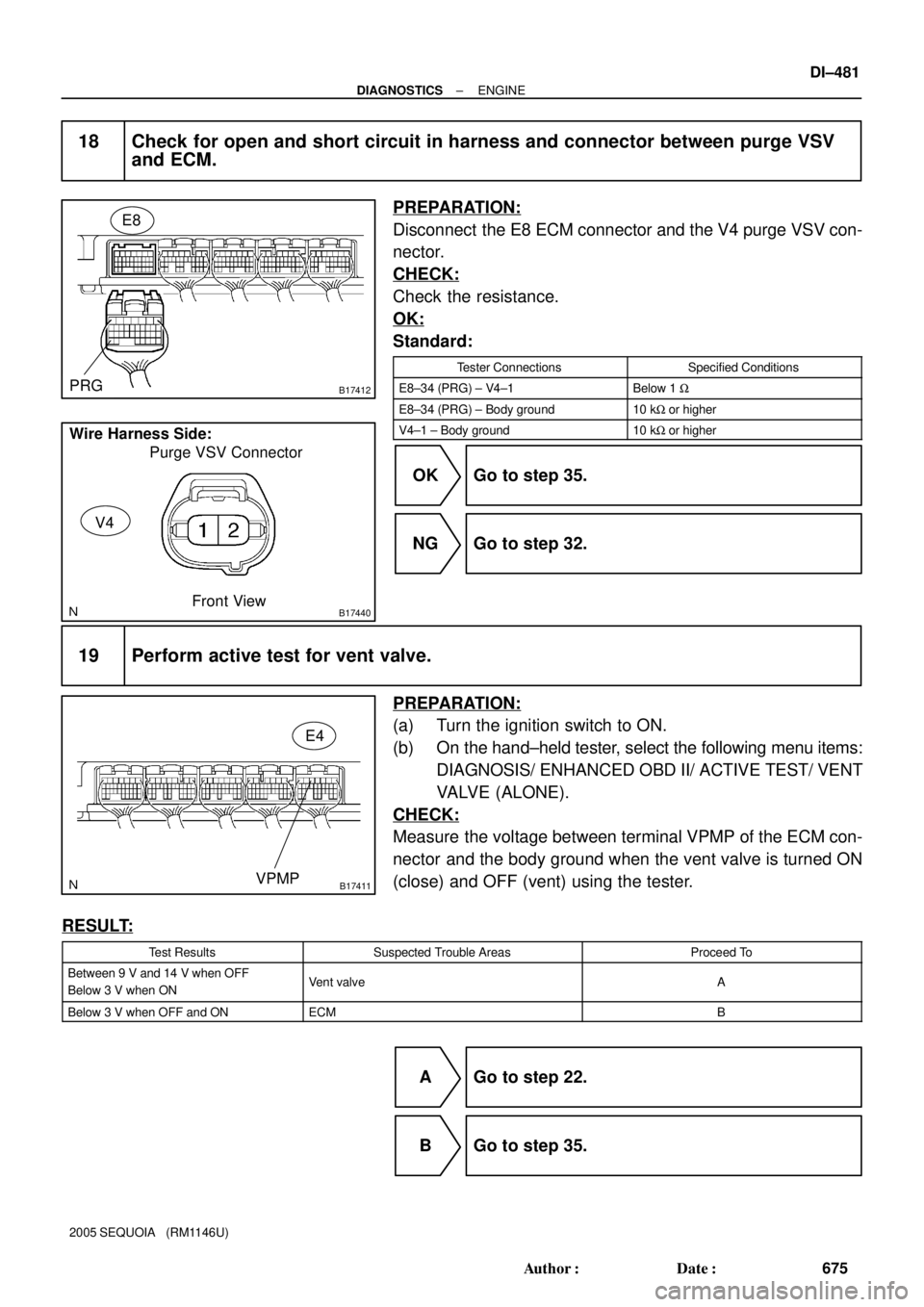
18 Check for open and short circuit in harness and connector between purge VSV
and ECM.
PREPARATION:
Disconnect the E8 ECM connector and the V4 purge VSV con-
nector.
CHECK:
Check the resistance.
OK:
Standard:
Tester ConnectionsSpecified Conditions
E8±34 (PRG) ± V4±1Below 1 W
E8±34 (PRG) ± Body ground10 kW or higher
V4±1 ± Body ground10 kW or higher
OK Go to step 35.
NG Go to step 32.
19 Perform active test for vent valve.
PREPARATION:
(a) Turn the ignition switch to ON.
(b) On the hand±held tester, select the following menu items:
DIAGNOSIS/ ENHANCED OBD II/ ACTIVE TEST/ VENT
VALVE (ALONE).
CHECK:
Measure the voltage between terminal VPMP of the ECM con-
nector and the body ground when the vent valve is turned ON
(close) and OFF (vent) using the tester.
RESULT:
Test ResultsSuspected Trouble AreasProceed To
Between 9 V and 14 V when OFF
Below 3 V when ONVent valveA
Below 3 V when OFF and ONECMB
A Go to step 22.
B Go to step 35.
Page 684 of 4323
B17411VPMP
E4
DI±482
± DIAGNOSTICSENGINE
676 Author�: Date�:
2005 SEQUOIA (RM1146U)
20 Perform active test for vent valve.
PREPARATION:
(a) Turn the ignition switch to ON.
(b) On the hand±held tester, select the following menu items:
DIAGNOSIS/ ENHANCED OBD II/ ACTIVE TEST/ VENT
VALVE (ALONE).
CHECK:
Measure the voltage between terminal VPMP of the ECM con-
nector and the body ground when the vent valve is turned ON
(close) and OFF (vent) using the tester.
RESULT:
Test ResultsSuspected Trouble AreasProceed To
Below 3 V when OFF and ONPower source of vent valveA
Between 9 V and 14 V when OFF
Below 3 V when ONVent valveB
Between 9 V and 14 V when OFF and ONECMC
B Go to step 24.
C Go to step 35.
A
Page 685 of 4323
A23446
L5
A23508
Wire Harness Side:
Canister Connector
Front View
L5
± DIAGNOSTICSENGINE
DI±483
677 Author�: Date�:
2005 SEQUOIA (RM1146U)
21 Inspect pump module power source circuit.
PREPARATION:
(a) Turn the ignition switch to OFF.
(b) Disconnect the L5 canister connector.
(c) Turn the ignition switch to ON.
CHECK:
Measure the voltage between terminal 9 of the canister connec-
tor and the body ground.
RESULT:
Test ResultsSuspected Trouble AreasProceed To
Between 9 V and 14 VNormalA
Between 0 V and 3 VPower source wire harness of vent valveB
B Go to step 32.
A
Page 686 of 4323
B17423
8 (±) 9 (+)Charcoal Canister Assy:
B17411
MPMP
E4
DI±484
± DIAGNOSTICSENGINE
678 Author�: Date�:
2005 SEQUOIA (RM1146U)
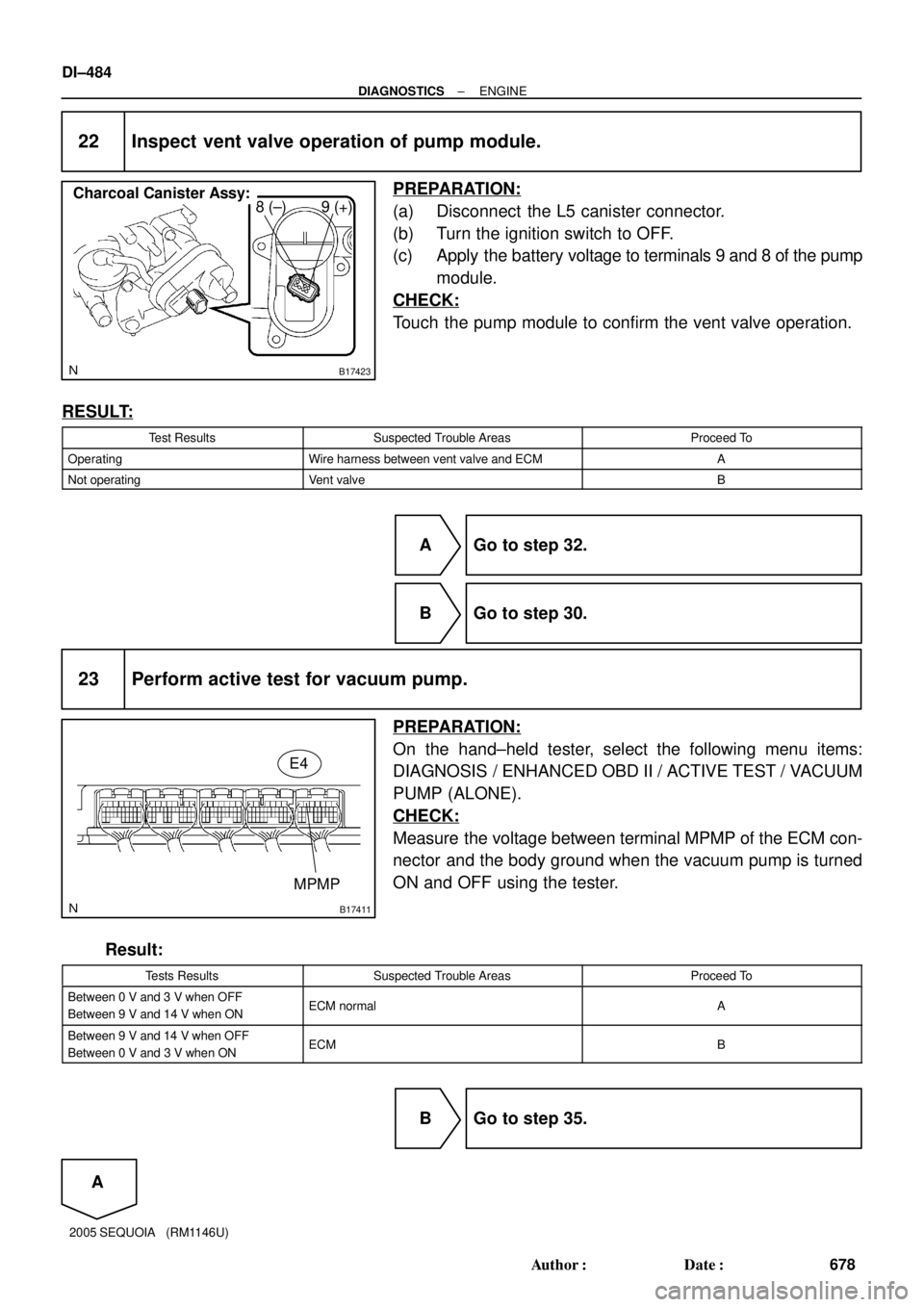
22 Inspect vent valve operation of pump module.
PREPARATION:
(a) Disconnect the L5 canister connector.
(b) Turn the ignition switch to OFF.
(c) Apply the battery voltage to terminals 9 and 8 of the pump
module.
CHECK:
Touch the pump module to confirm the vent valve operation.
RESULT:
Test ResultsSuspected Trouble AreasProceed To
OperatingWire harness between vent valve and ECMA
Not operatingVent valveB
A Go to step 32.
B Go to step 30.
23 Perform active test for vacuum pump.
PREPARATION:
On the hand±held tester, select the following menu items:
DIAGNOSIS / ENHANCED OBD II / ACTIVE TEST / VACUUM
PUMP (ALONE).
CHECK:
Measure the voltage between terminal MPMP of the ECM con-
nector and the body ground when the vacuum pump is turned
ON and OFF using the tester.
Result:
Tests ResultsSuspected Trouble AreasProceed To
Between 0 V and 3 V when OFF
Between 9 V and 14 V when ONECM normalA
Between 9 V and 14 V when OFF
Between 0 V and 3 V when ONECMB
B Go to step 35.
A
Page 687 of 4323
A23446
L5
A23508
Wire Harness Side:
Canister Connector
Front View
L5
± DIAGNOSTICSENGINE
DI±485
679 Author�: Date�:
2005 SEQUOIA (RM1146U)
24 Check for open and short circuit in harness and connecter between pump mod-
ule and ECM.
PREPARATION:
(a) Turn the ignition switch to OFF.
(b) Disconnect the L5 canister connector.
(c) Turn the ignition switch to ON.
(d) On the hand±held tester, select the following menu
items:DIAGNOSIS / ENHANCED OBD II / ACTIVE TEST
/ VACUUM PUMP (ALONE).
(e) Turn the vacuum pump ON.
CHECK:
Measure the voltage between terminal 1 of the canister connec-
tor and the body ground.
RESULT:
Test ResultsSuspected Trouble AreasProceed To
Between 9 V and 14 VNormalA
Between 0 V and 3 VWire harness between ECM and vacuum pumpB
B Go to step 32.
A
Page 688 of 4323
A23508
Wire Harness Side:
Canister Connector
Front View
L5
DI±486
± DIAGNOSTICSENGINE
680 Author�: Date�:
2005 SEQUOIA (RM1146U)
25 Check for open and short in harness and connector between pump module and
ECM.
PREPARATION:
(a) Disconnect the L5 canister connector.
(b) Turn the ignition switch to OFF.
CHECK:
Check the resistance between terminal 6 of the canister con-
nector and the body ground.
RESULT:
Test ResultsSuspected Trouble AreasProceed To
Below 1 WVacuum pumpA
10 kW or moreWire harness between vacuum pump and body
groundB
A Go to step 30.
B Go to step 32.
26 Inspect throttle body.
PREPARATION:
(a) Stop the engine.
(b) Disconnect the EVAP hose from the throttle body.
(c) Start the engine.
CHECK:
(a) Use your finger to confirm that the port of the throttle body has suction.
RESULT:
Test ResultsSuspected Trouble AreasProceed To
Suction appliedEVAP hose between throttle body and purge VSVA
No suctionThrottle bodyB
A Go to step 33.
B Go to step 34.
Page 690 of 4323
DI±488
± DIAGNOSTICSENGINE
682 Author�: Date�:
2005 SEQUOIA (RM1146U)
30 Replace charcoal canister.
NEXT Go to step 37.
31 Replace EVAP VSV (See page EC±8).
(a) Disconnect the connector and the hoses from the purge VSV.
(b) Remove the purge VSV.
(c) Install a new purge VSV.
(d) Reconnect the connector and hoses.
NEXT Go to step 37.
32 Repair or replace wire harness or connector.
NEXT Go to step 37.
33 Replace EVAP hose between EVAP VSV and throttle body.
NEXT Go to step 37.
34 Inspect throttle body.
(a) Remove the throttle body (see page SF±42).
(b) Check that the EVAP purge port of the throttle body is not clogged. If necessary, replace the throttle
body.
NEXT Go to step 37.
35 Replace ECM (See page SF±80)
NEXT Go to step 37.
Page 691 of 4323

± DIAGNOSTICSENGINE
DI±489
683 Author�: Date�:
2005 SEQUOIA (RM1146U)
36 Repair or replace parts and components indicated by output DTCs.
(a) Repair the malfunctioning areas indicated by the DTCs that had been confirmed when the vehicle was
brought in.
NEXT Go to step 37.
37 Perform EVAP system auto operation check.
NOTICE:
�In the EVAP SYSTEM CHECK (AUTO OPERATION), the series of 4 EVAP SYSTEM CHECK steps
is performed automatically. It takes a maximum of approximately 15 minutes.
�Do not perform the EVAP SYSTEM CHECK when the fuel tank is more than 90 % full because
the cut±off valve may be closed and making the leak check of the fuel tank unavailable.
�Do not run the engine in this step.
�When the temperature of the fuel is 35�C (95�F) or more, a large amount of vapor forms and any
check results become inaccurate. When performing an EVAP SYSTEM CHECK, keep the tem-
perature below 35�C
(95�F).
(a) Clear DTCs (see page DI±43).
(b) On the hand±held tester, select the following menu items: DIAGNOSIS / ENHANCED OBD II / SYS-
TEM CHECK / EVAP SYS CHECK / AUTO OPERATION.
(c) After the SYSTEM CHECK is completed, check for pending DTCs by selecting the following menu
items: DIAGNOSIS / ENHANCED OBD II / DTC INFO / PENDING CODES.
HINT:
If no pending DTC is found, the repair has been successfully completed.
NEXT
Completed
Monitor Confirmation
HINT:
After a repair, check Monitor Status by performing the Key±Off Monitor Confirmation and Purge Flow Monitor
Confirmation described below.
1. KEY±OFF MONITOR CONFIRMATION
(a) Preconditions
The monitor will not run unless:
�The vehicle has been driven for 10 minutes or more (in a city area or on a free way)
�The fuel tank is less than 90 % full
�The altitude is less than 8,000 ft (2,400 m)
�The Engine Coolant Temperature (ECT) is between 4.4�C and 35�C (40�F and 95�F)
�The Intake Air Temperature (IAT) is between 4.4�C and 35�C (40�F and 95�F)
�The vehicle remains stationary (the vehicle speed is 0 mph [0 km/h])