2001 CHRYSLER VOYAGER battery
[x] Cancel search: batteryPage 653 of 4284

TEST ACTION APPLICABILITY
3 Turn the ignition on.
With the DRBIIIt, read the current Front Control Module DTC's.
Does the DRBIIItdisplay the ACCESSORY POWER OUTPUT #1 SHORTED TO
BATTERY trouble code?All
Ye s®Replace the Front Control Module.
Perform BODY VERIFICATION TEST - VER 1.
No®Go To 4
4 Turn the ignition on.
With the DRBIIIt, read the current Front Control Module DTC's.
Does the DRBIIItdisplay the ACCESSORY POWER OUTPUT #2 SHORTED TO
BATTERY trouble code?All
Ye s®Replace the Front Control Module.
Perform BODY VERIFICATION TEST - VER 1.
No®This symptom represents an internal malfunction in the Front
Control Module. The condition that caused this symptom is
currently not present.
Perform BODY VERIFICATION TEST - VER 1.
624
INTELLIGENT POWER MODULE
ACCESSORY POWER OUTPUT #2 SHORTED TO BATTERY ÐContinued
Page 654 of 4284

Symptom:
CPA NOT ENGAGED
When Monitored and Set Condition:
CPA NOT ENGAGED
When Monitored: Continuously with the ignition on.
Set Condition: If the connector positive assurance lock is not fully engaged, the Front
Control Module will detect battery voltage on the B(+) Sense circuit. With voltage present,
the FCM determines that there is a poor connection at connector C5 of the Fuse and Relay
Center.
POSSIBLE CAUSES
FRONT CONTROL MODULE INTERNAL MALFUNCTION
FUSE AND RELAY CENTER INTERNAL MALFUNCTION
INTERMITTENT CONDITION
CONNECTOR POSITIVE ASSURANCE LOCK
TEST ACTION APPLICABILITY
1 Turn the ignition on.
With the DRBIIIt, erase the current Front Control Module DTC's.
Turn the ignition off, wait 10 seconds then turn the ignition on.
With the DRBIIIt, read the current Front Control Module DTC's.
Does the DRBIIItdisplay: CPA NOT ENGAGED?All
Ye s®Go To 2
No®The condition that caused this symptom is currently not present.
Inspect the related wiring harness for a possible intermittent
condition.
Perform BODY VERIFICATION TEST - VER 1.
2 Turn the ignition off.
Disconnect the Front Control Module from the Fuse and Relay Center.
Measure the voltage of the B(+) Sense circuit at the Fuse and Relay Center side of the
FCM connector.
Is the voltage above 10.0 volts?All
Ye s®Go To 3
No®Replace the Front Control Module.
Perform BODY VERIFICATION TEST - VER 1.
625
INTELLIGENT POWER MODULE
Page 656 of 4284

Symptom:
IGN RUN/START INPUT WIRING
When Monitored and Set Condition:
IGN RUN/START INPUT WIRING
When Monitored: With the ignition on and battery voltage greater than 10.4 volts.
Set Condition: The Fused Ignition Switch Output circuit voltage at the FCM goes below
0.5 volts.
POSSIBLE CAUSES
TEST FOR CURRENT DTC'S
FRONT CONTROL MODULE INTERNAL MALFUNCTION
FUSE AND RELAY CENTER INTERNAL MALFUNCTION
FUSED IGNITION SWITCH OUTPUT CIRCUIT OPEN
TEST ACTION APPLICABILITY
1 With the DRBIIIt, record and erase the current Front Control Module DTC's.
Cycle the ignition from ON to OFF.
Start the vehicle and observe the DRBIIIt.
With the DRBIIIt, read DTC's.
Does the DRBIIItdisplay: IGNITION RUN-START INPUT WIRING?All
Ye s®Go To 2
No®The condition that caused this DTC is currently not present. Use
the wiring diagram/schematic as a guide, and inspect the related
wiring harness for a possible intermittent condition.
Perform BODY VERIFICATION TEST - VER 1.
2 Turn the ignition off.
Disconnect the Front Control Module from the Fuse and Relay Center.
Measure the voltage of the Fused Ignition Switch Output circuit (cavity 37) at the
Fuse and Relay Center side of the FCM connector.
Turn the ignition on.
Is the voltage above 10.0 volts?All
Ye s®Replace the Front Control Module.
Perform BODY VERIFICATION TEST - VER 1.
No®Go To 3
627
INTELLIGENT POWER MODULE
Page 658 of 4284

Symptom:
IGNITION START INPUT WIRING
When Monitored and Set Condition:
IGNITION START INPUT WIRING
When Monitored: With the ignition on and battery voltage greater than 10.4 volts.
Set Condition: The Fused Ignition Switch Output (Start) circuit voltage at the FCM goes
below 0.5 volts.
POSSIBLE CAUSES
TEST FOR CURRENT DTC'S
FRONT CONTROL MODULE INTERNAL MALFUNCTION
FUSE AND RELAY CENTER INTERNAL MALFUNCTION
FUSED IGNITION SWITCH OUTPUT CIRCUIT OPEN
TEST ACTION APPLICABILITY
1 With the DRBIIIt, record and erase the current Front Control Module DTC's.
Cycle the ignition from ON to OFF.
Start the vehicle and observe the DRBIIIt.
With the DRBIIIt, read DTC's.
Does the DRBIIItdisplay: IGNITION START INPUT WIRING?All
Ye s®Go To 2
No®The condition that caused this DTC is currently not present. Use
the wiring diagram/schematic as a guide, and inspect the related
wiring harness for a possible intermittent condition.
Perform BODY VERIFICATION TEST - VER 1.
2 Turn the ignition off.
Disconnect the Front Control Module from the Fuse and Relay Center.
Measure the voltage of the Fused Ignition Switch Output circuit (cavity 37) at the
Fuse and Relay Center side of the FCM connector.
Turn the ignition on.
Is the voltage above 10.0 volts?All
Ye s®Replace the Front Control Module.
Perform BODY VERIFICATION TEST - VER 1.
No®Go To 3
629
INTELLIGENT POWER MODULE
Page 678 of 4284

TEST ACTION APPLICABILITY
3 Disconnect the Driver Power Seat Front Riser Position Sensor connector.
Measure the voltage between Seat Sensor 5 volt supply circuit and ground.
Turn ignition on.
Is the voltage above 5.5 volts?All
Ye s®Repair the Seat Sensor 5 Volt Supply circuit for a short to battery.
Perform MEMORY SYSTEM VERIFICATION TEST - VER 1.
No®Go To 4
4 Turn ignition off.
Disconnect the Driver Power Seat Front Riser Position Sensor Connector.
Disconnect the Memory Seat Mirror Module C1 Connector.
Turn ignition on.
Measure the voltage between Front Riser Position Signal circuit and ground.
Is the voltage above 0.2 volts?All
Ye s®Repair the Front Riser Position Signal circuit for a short to
voltage.
Perform MEMORY SYSTEM VERIFICATION TEST - VER 1.
No®Go To 5
5 Turn ignition off.
Disconnect the Driver Power Seat Front Riser Position Sensor Connector.
Ensure the Memory Seat Mirror Module is fully connected before proceeding.
Turn ignition on.
With the DRBIIItin Body Memory Seat Sensors
Read the Front Riser Position Sensor voltage.
Is the voltage above 0.2 volts?All
Ye s®Go To 6
No®Replace the Seat Track Assembly.
Perform MEMORY SYSTEM VERIFICATION TEST - VER 1.
6 Ensure all seat and sensor connectors are connected and front riser motor is
operational.
With the DRBIIItin Body Memory Seat Sensors monitor the Front Riser Position
Sensor while operating the front riser motor to both limits.
Did the voltage ever go above 7.0 volts only when the motor was in operation?All
Ye s®Replace the Seat Track Assembly.
Perform MEMORY SYSTEM VERIFICATION TEST - VER 1.
No®Go To 7
7 If there are no possible causes remaining, view repair. All
Repair
Replace the Memory Seat Mirror Module.
Perform MEMORY SYSTEM VERIFICATION TEST - VER 1.
649
MEMORY SEAT
FRONT RISER SENSOR OUT OF RANGE HIGH ÐContinued
Page 690 of 4284
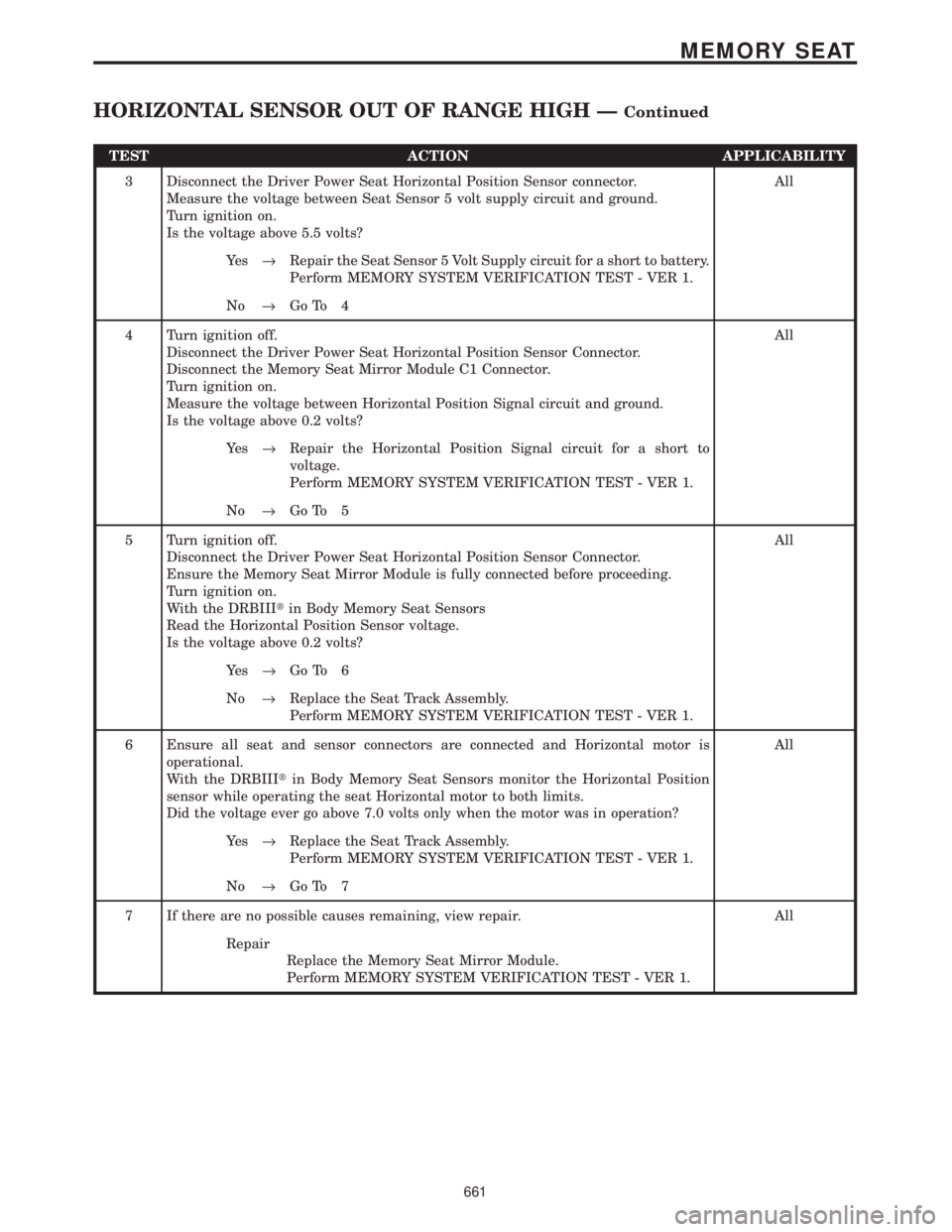
TEST ACTION APPLICABILITY
3 Disconnect the Driver Power Seat Horizontal Position Sensor connector.
Measure the voltage between Seat Sensor 5 volt supply circuit and ground.
Turn ignition on.
Is the voltage above 5.5 volts?All
Ye s®Repair the Seat Sensor 5 Volt Supply circuit for a short to battery.
Perform MEMORY SYSTEM VERIFICATION TEST - VER 1.
No®Go To 4
4 Turn ignition off.
Disconnect the Driver Power Seat Horizontal Position Sensor Connector.
Disconnect the Memory Seat Mirror Module C1 Connector.
Turn ignition on.
Measure the voltage between Horizontal Position Signal circuit and ground.
Is the voltage above 0.2 volts?All
Ye s®Repair the Horizontal Position Signal circuit for a short to
voltage.
Perform MEMORY SYSTEM VERIFICATION TEST - VER 1.
No®Go To 5
5 Turn ignition off.
Disconnect the Driver Power Seat Horizontal Position Sensor Connector.
Ensure the Memory Seat Mirror Module is fully connected before proceeding.
Turn ignition on.
With the DRBIIItin Body Memory Seat Sensors
Read the Horizontal Position Sensor voltage.
Is the voltage above 0.2 volts?All
Ye s®Go To 6
No®Replace the Seat Track Assembly.
Perform MEMORY SYSTEM VERIFICATION TEST - VER 1.
6 Ensure all seat and sensor connectors are connected and Horizontal motor is
operational.
With the DRBIIItin Body Memory Seat Sensors monitor the Horizontal Position
sensor while operating the seat Horizontal motor to both limits.
Did the voltage ever go above 7.0 volts only when the motor was in operation?All
Ye s®Replace the Seat Track Assembly.
Perform MEMORY SYSTEM VERIFICATION TEST - VER 1.
No®Go To 7
7 If there are no possible causes remaining, view repair. All
Repair
Replace the Memory Seat Mirror Module.
Perform MEMORY SYSTEM VERIFICATION TEST - VER 1.
661
MEMORY SEAT
HORIZONTAL SENSOR OUT OF RANGE HIGH ÐContinued
Page 712 of 4284

TEST ACTION APPLICABILITY
3 Disconnect the Rear Riser Position Sensor connector.
Measure the voltage between Seat Sensor 5 volt supply circuit and ground.
Turn ignition on.
Is the voltage above 5.5 volts?All
Ye s®Repair the Seat Sensor 5 Volt Supply circuit for a short to battery.
Perform MEMORY SYSTEM VERIFICATION TEST - VER 1.
No®Go To 4
4 Turn ignition off.
Disconnect the Driver Power Seat Rear Riser Position Sensor Connector.
Disconnect the Memory Seat Mirror Module C1 Connector.
Turn ignition on.
Measure the voltage between Rear Riser Position Signal circuit and ground.
Is the voltage above 0.2 volts?All
Ye s®Repair the Rear Riser Position Signal circuit for a short to
voltage.
Perform MEMORY SYSTEM VERIFICATION TEST - VER 1.
No®Go To 5
5 Turn ignition off.
Disconnect the Driver Power Seat Rear Riser Position Sensor Connector.
Ensure the Memory Seat Mirror Module is fully connected before proceeding.
Turn ignition on.
With the DRBIIItin Body Memory Seat Sensors
Read the Rear Riser Position Sensor voltage.
Is the voltage above 0.2 volts?All
Ye s®Go To 6
No®Replace the Seat Track Assembly.
Perform MEMORY SYSTEM VERIFICATION TEST - VER 1.
6 Ensure all seat and sensor connectors are connected and rear riser motor is
operational.
With the DRBIIItin Body Memory Seat Sensors monitor the Rear Riser Position
sensor while operating the seat rear riser to both limits.
Did the voltage ever go above 7.0 volts only when the motor was in operation?All
Ye s®Replace the Seat Track Assembly.
Perform MEMORY SYSTEM VERIFICATION TEST - VER 1.
No®Go To 7
7 If there are no possible causes remaining, view repair. All
Repair
Replace the Memory Seat Mirror Module.
Perform MEMORY SYSTEM VERIFICATION TEST - VER 1.
683
MEMORY SEAT
REAR RISER SENSOR OUT OF RANGE HIGH ÐContinued
Page 722 of 4284

TEST ACTION APPLICABILITY
3 Disconnect the Driver Power Seat Recliner Position Sensor connector.
Measure the voltage between Seat Sensor 5 volt supply circuit and ground.
Turn ignition on.
Is the voltage above 5.5 volts?All
Ye s®Repair the Seat Sensor 5 Volt Supply circuit for a short to battery.
Perform MEMORY SYSTEM VERIFICATION TEST - VER 1.
No®Go To 4
4 Turn ignition off.
Disconnect the Driver Power Seat Recliner Position Sensor Connector.
Disconnect the Memory Seat Mirror Module C1 Connector.
Turn ignition on.
Measure the voltage between Recliner Position Signal circuit and ground.
Is the voltage above 0.2 volts?All
Ye s®Repair the Recliner Position Signal circuit for a short to voltage.
Perform MEMORY SYSTEM VERIFICATION TEST - VER 1.
No®Go To 5
5 Turn ignition off.
Disconnect the Driver Power Seat Recliner Position Sensor Connector.
Ensure the Memory Seat Mirror Module is fully connected before proceeding.
Turn ignition on.
With the DRBIIItin Body Memory Seat Sensors
Read the Recliner Position Sensor voltage.
Is the voltage above 0.2 volts?All
Ye s®Go To 6
No®Replace the Seat Track Assembly.
Perform MEMORY SYSTEM VERIFICATION TEST - VER 1.
6 Ensure all seat and sensor connectors are connected and Recliner motor is opera-
tional.
With the DRBIIItin Body Memory Seat Sensors monitor the Recliner Position sensor
while operating the seat Recliner motor to both limits.
Did the voltage ever go above 7.0 volts only when the motor was in operation?All
Ye s®Replace the Seat Track Assembly.
Perform MEMORY SYSTEM VERIFICATION TEST - VER 1.
No®Go To 7
7 If there are no possible causes remaining, view repair. All
Repair
Replace the Memory Seat Mirror Module.
Perform MEMORY SYSTEM VERIFICATION TEST - VER 1.
693
MEMORY SEAT
RECLINER SENSOR OUT OF RANGE HIGH ÐContinued