2001 CHRYSLER VOYAGER Rear light
[x] Cancel search: Rear lightPage 57 of 4284
defined as the amount of time from the start of a
wipe to the beginning of the next wipe. The rear
wiper system delay time is based on the following:
7.75 - (MPH x .05) = Seconds delay
Examples:
At zero (0) MPH the delay is 7.75 seconds.
At 100 MPH the delay is 2.75 seconds.
3.21.8 WIPE AFTER WASH
When the driver presses the wash button for over
1.5 seconds and releases it, the wiper will continue
to run for 2 additional wipe cycles.
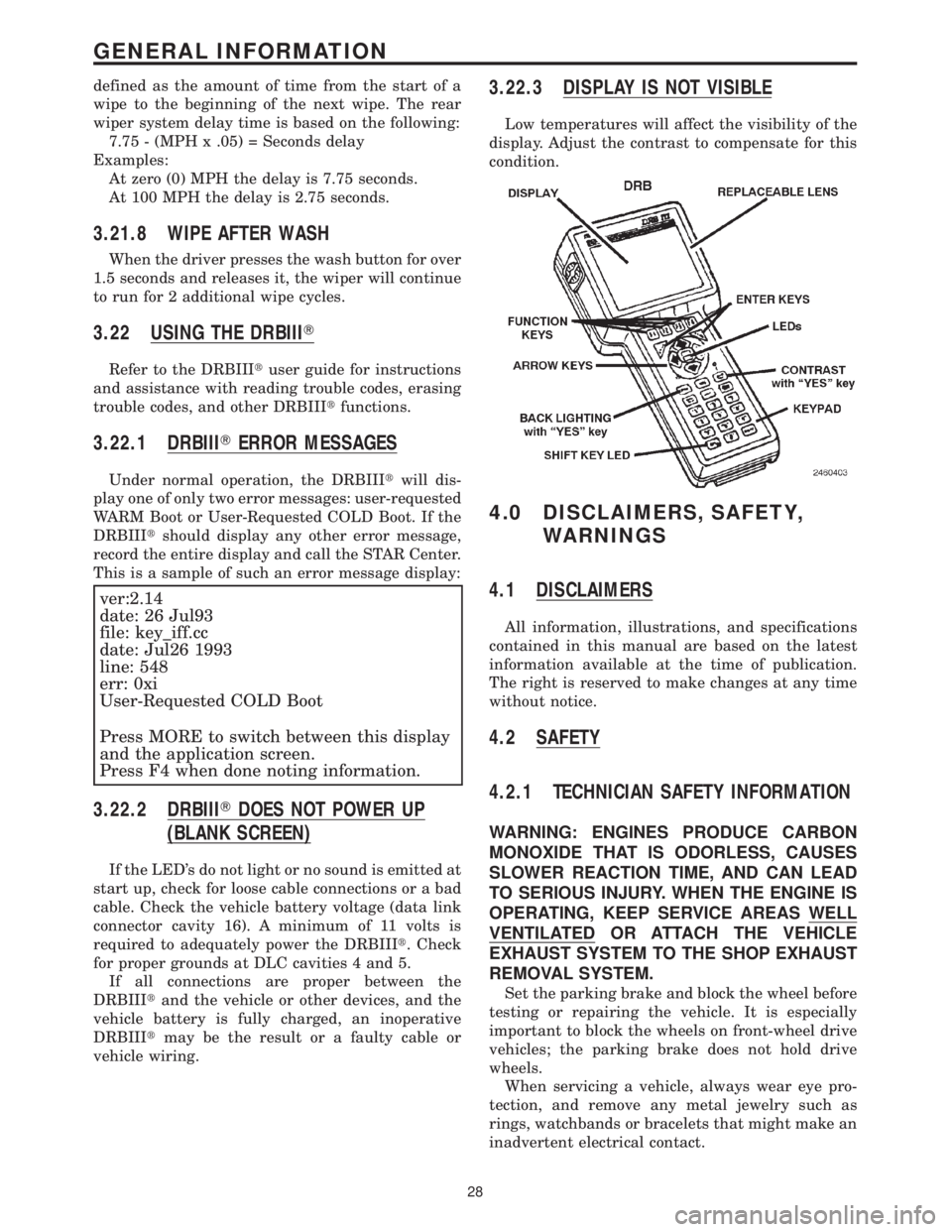
3.22 USING THE DRBIIIT
Refer to the DRBIIItuser guide for instructions
and assistance with reading trouble codes, erasing
trouble codes, and other DRBIIItfunctions.
3.22.1 DRBIIITERROR MESSAGES
Under normal operation, the DRBIIItwill dis-
play one of only two error messages: user-requested
WARM Boot or User-Requested COLD Boot. If the
DRBIIItshould display any other error message,
record the entire display and call the STAR Center.
This is a sample of such an error message display:
ver:2.14
date: 26 Jul93
file: key_iff.cc
date: Jul26 1993
line: 548
err: 0xi
User-Requested COLD Boot
Press MORE to switch between this display
and the application screen.
Press F4 when done noting information.
3.22.2 DRBIIITDOES NOT POWER UP
(BLANK SCREEN)
If the LED's do not light or no sound is emitted at
start up, check for loose cable connections or a bad
cable. Check the vehicle battery voltage (data link
connector cavity 16). A minimum of 11 volts is
required to adequately power the DRBIIIt. Check
for proper grounds at DLC cavities 4 and 5.
If all connections are proper between the
DRBIIItand the vehicle or other devices, and the
vehicle battery is fully charged, an inoperative
DRBIIItmay be the result or a faulty cable or
vehicle wiring.
3.22.3 DISPLAY IS NOT VISIBLE
Low temperatures will affect the visibility of the
display. Adjust the contrast to compensate for this
condition.
4.0 DISCLAIMERS, SAFETY,
WARNINGS
4.1 DISCLAIMERS
All information, illustrations, and specifications
contained in this manual are based on the latest
information available at the time of publication.
The right is reserved to make changes at any time
without notice.
4.2 SAFETY
4.2.1 TECHNICIAN SAFETY INFORMATION
WARNING: ENGINES PRODUCE CARBON
MONOXIDE THAT IS ODORLESS, CAUSES
SLOWER REACTION TIME, AND CAN LEAD
TO SERIOUS INJURY. WHEN THE ENGINE IS
OPERATING, KEEP SERVICE AREAS WELL
VENTILATED OR ATTACH THE VEHICLE
EXHAUST SYSTEM TO THE SHOP EXHAUST
REMOVAL SYSTEM.
Set the parking brake and block the wheel before
testing or repairing the vehicle. It is especially
important to block the wheels on front-wheel drive
vehicles; the parking brake does not hold drive
wheels.
When servicing a vehicle, always wear eye pro-
tection, and remove any metal jewelry such as
rings, watchbands or bracelets that might make an
inadvertent electrical contact.
28
GENERAL INFORMATION
Page 59 of 4284
WARNING: BEFORE ROAD TESTING A
VEHICLE, BE SURE THAT ALL
COMPONENTS ARE REASSEMBLED.
DURING THE TEST DRIVE, DO NOT TRY TO
READ THE DRBIIITSCREEN WHILE IN
MOTION. DO NOT HANG THE DRBIIITFROM
THE REAR VIEW MIRROR OR OPERATE IT
YOURSELF. HAVE AN ASSISTANT
AVAILABLE TO OPERATE THE DRBIIIT.
5.0 REQUIRED TOOLS AND
EQUIPMENT
DRBIIIt(diagnostic read-out box)
Jumper wires
Ohmmeter
Voltmeter
Sentry Key Tester
Test Light
8310 Airbag System Load Tool
8443 SRS Airbag System Load Tool
Diagnostic Junction Port Tester 8339
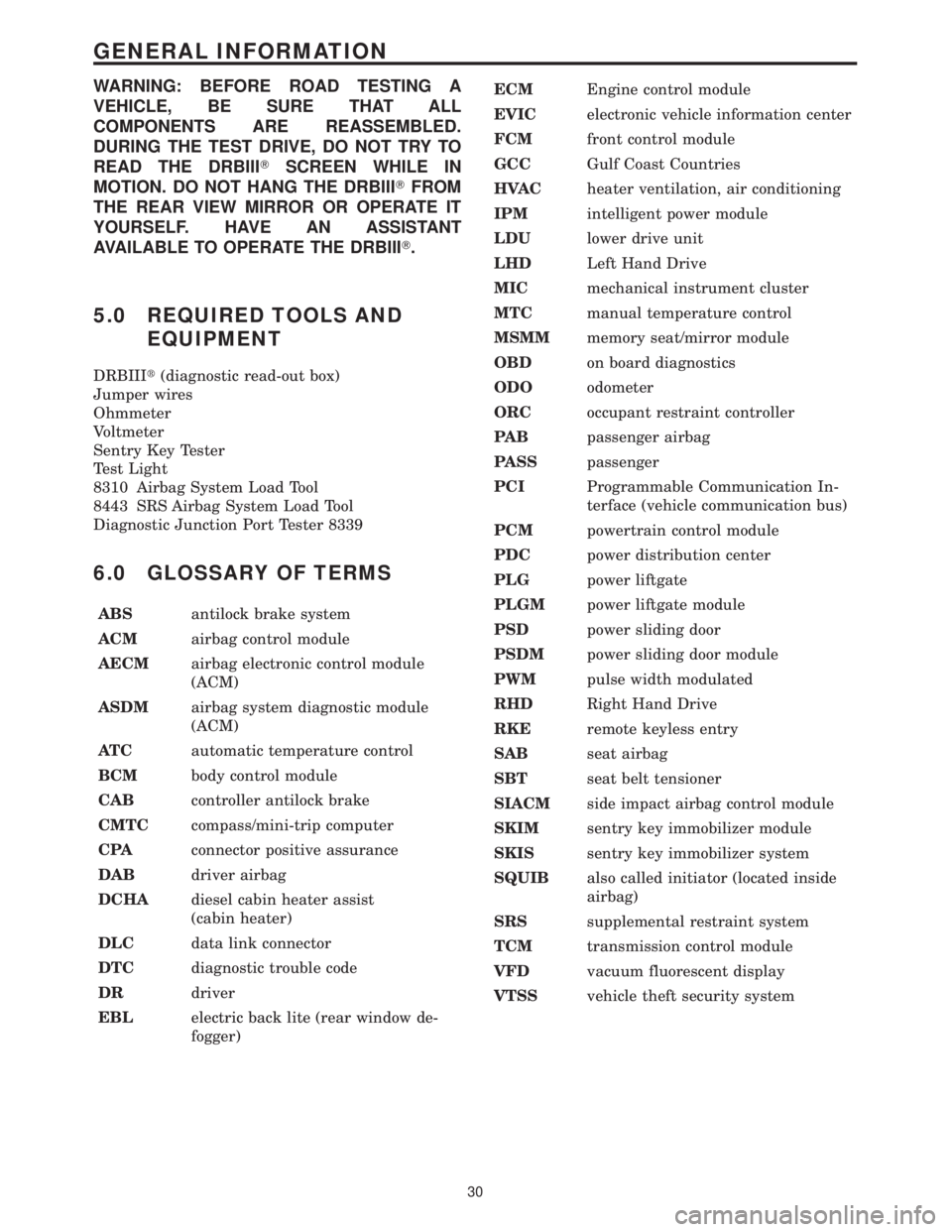
6.0 GLOSSARY OF TERMS
ABSantilock brake system
ACMairbag control module
AECMairbag electronic control module
(ACM)
ASDMairbag system diagnostic module
(ACM)
AT Cautomatic temperature control
BCMbody control module
CABcontroller antilock brake
CMTCcompass/mini-trip computer
CPAconnector positive assurance
DABdriver airbag
DCHAdiesel cabin heater assist
(cabin heater)
DLCdata link connector
DTCdiagnostic trouble code
DRdriver
EBLelectric back lite (rear window de-
fogger)ECMEngine control module
EVICelectronic vehicle information center
FCMfront control module
GCCGulf Coast Countries
HVACheater ventilation, air conditioning
IPMintelligent power module
LDUlower drive unit
LHDLeft Hand Drive
MICmechanical instrument cluster
MTCmanual temperature control
MSMMmemory seat/mirror module
OBDon board diagnostics
ODOodometer
ORCoccupant restraint controller
PA Bpassenger airbag
PASSpassenger
PCIProgrammable Communication In-
terface (vehicle communication bus)
PCMpowertrain control module
PDCpower distribution center
PLGpower liftgate
PLGMpower liftgate module
PSDpower sliding door
PSDMpower sliding door module
PWMpulse width modulated
RHDRight Hand Drive
RKEremote keyless entry
SABseat airbag
SBTseat belt tensioner
SIACMside impact airbag control module
SKIMsentry key immobilizer module
SKISsentry key immobilizer system
SQUIBalso called initiator (located inside
airbag)
SRSsupplemental restraint system
TCMtransmission control module
VFDvacuum fluorescent display
VTSSvehicle theft security system
30
GENERAL INFORMATION
Page 301 of 4284

Symptom:
REAR BLEND DOOR TRAVEL TOO SMALL (ACTIVE)
When Monitored and Set Condition:
REAR BLEND DOOR TRAVEL TOO SMALL (ACTIVE)
When Monitored: With the ignition on and the IOD fuse installed.
Set Condition: This DTC is set when the ATC monitors the travel range during system
initialization and the measured range is less than expected.
POSSIBLE CAUSES
CHECK THE ATC FOR DTCS
AT C
OBSTRUCTED BLEND DOOR
REAR BLEND DOOR ACTUATOR
TEST ACTION APPLICABILITY
1 Turn the ignition on.
With the DRB, read the active ATC DTCs.
Is the REAR BLEND DOOR NOT RESPONDING DTC set?All
Ye s®Return to the symptom list and choose the symptom.
With the DRBIIIt, reset the ATC after repair/replacement is
complete.
Perform BODY VERIFICATION TEST - VER 1.
No®Go To 2
2 Turn the ignition off.
Disconnect the Rear Blend Door Actuator harness connector.
Connect a 12-volt Test Light across the Rear Blend Door Actuator harness connector.
Turn the ignition on.
While monitoring the test light, turn the rear blend control knob from lo to hi.
Note: Observe test light for approximately 30 seconds.
Does the test light start to flash and stay flashing?All
Ye s®Go To 3
No®Replace the ATC.
With the DRBIIIt, reset the ATC after repair/replacement is
complete.
Perform BODY VERIFICATION TEST - VER 1.
272
AUTOMATIC TEMPERATURE CONTROL
Page 317 of 4284

Symptom:
REAR MODE DOOR TRAVEL TOO SMALL (ACTIVE)
When Monitored and Set Condition:
REAR MODE DOOR TRAVEL TOO SMALL (ACTIVE)
When Monitored: With the ignition on and the IOD fuse installed.
Set Condition: This DTC is set when the ATC monitors the travel range during system
initialization and the measured range is less than expected.
POSSIBLE CAUSES
CHECK THE ATC FOR DTCS
AT C
OBSTRUCTED MODE DOOR
REAR MODE DOOR ACTUATOR
TEST ACTION APPLICABILITY
1 Turn the ignition on.
With the DRB, read the active ATC DTCs.
Is the REAR MODE DOOR NOT RESPONDING DTC set?All
Ye s®Return to the symptom list and choose the symptom.
With the DRBIIIt, reset the ATC after repair/replacement is
complete.
Perform BODY VERIFICATION TEST - VER 1.
No®Go To 2
2 Turn the ignition off.
Disconnect the Rear Mode Door Actuator harness connector.
Connect a 12-volt Test Light between the rear mode door driver (A) and (B) circuits
in the Rear A/C Heater Unit harness connector.
Turn the ignition on.
While monitoring the test light, turn the rear mode control knob from lo to hi.
Note: Observe test light for approximately 30 seconds.
Does the test light start to flash and stay flashing?All
Ye s®Go To 3
No®Replace the ATC.
With the DRBIIIt, reset the ATC after repair/replacement is
complete.
Perform BODY VERIFICATION TEST - VER 1.
288
AUTOMATIC TEMPERATURE CONTROL
Page 472 of 4284
Symptom:
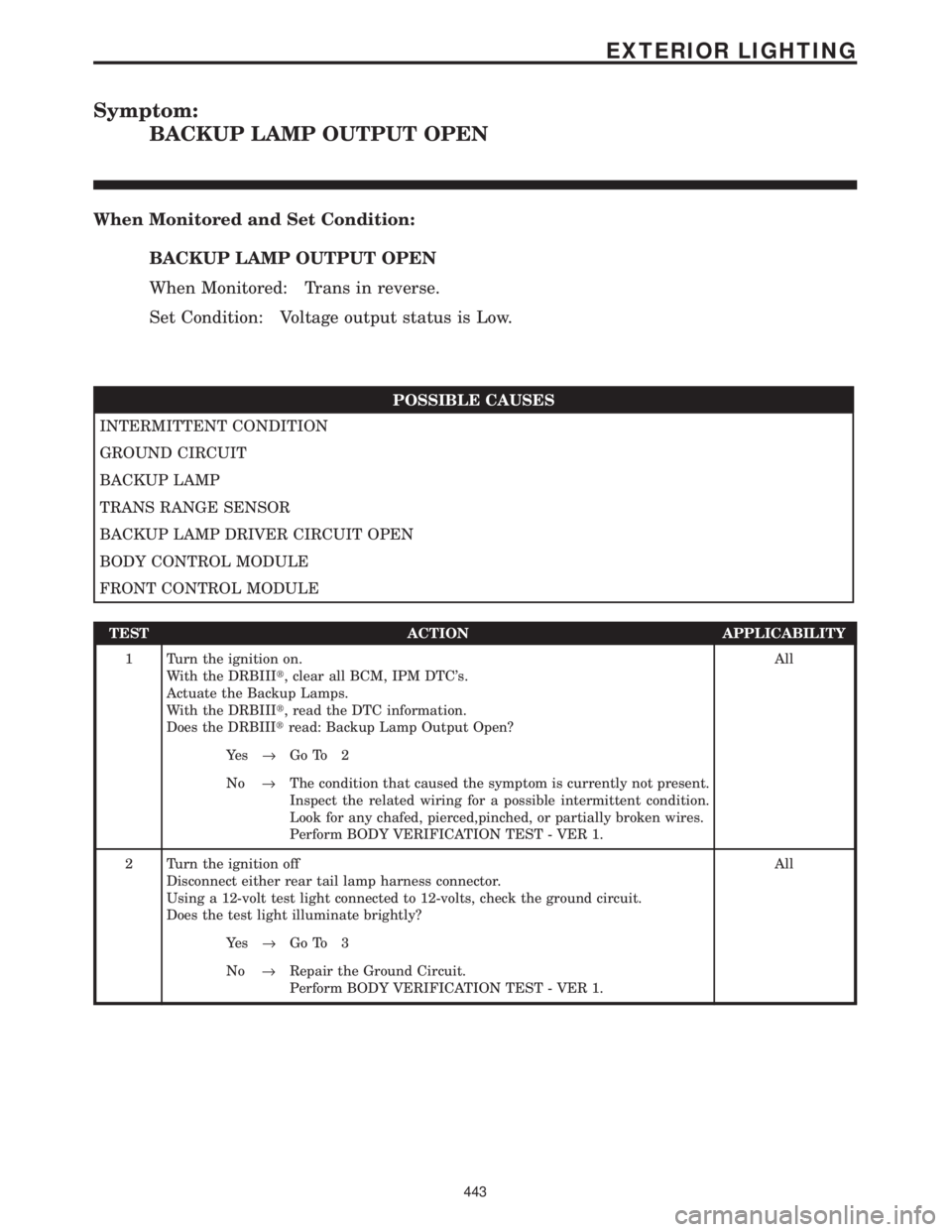
BACKUP LAMP OUTPUT OPEN
When Monitored and Set Condition:
BACKUP LAMP OUTPUT OPEN
When Monitored: Trans in reverse.
Set Condition: Voltage output status is Low.
POSSIBLE CAUSES
INTERMITTENT CONDITION
GROUND CIRCUIT
BACKUP LAMP
TRANS RANGE SENSOR
BACKUP LAMP DRIVER CIRCUIT OPEN
BODY CONTROL MODULE
FRONT CONTROL MODULE
TEST ACTION APPLICABILITY
1 Turn the ignition on.
With the DRBIIIt, clear all BCM, IPM DTC's.
Actuate the Backup Lamps.
With the DRBIIIt, read the DTC information.
Does the DRBIIItread: Backup Lamp Output Open?All
Ye s®Go To 2
No®The condition that caused the symptom is currently not present.
Inspect the related wiring for a possible intermittent condition.
Look for any chafed, pierced,pinched, or partially broken wires.
Perform BODY VERIFICATION TEST - VER 1.
2 Turn the ignition off
Disconnect either rear tail lamp harness connector.
Using a 12-volt test light connected to 12-volts, check the ground circuit.
Does the test light illuminate brightly?All
Ye s®Go To 3
No®Repair the Ground Circuit.
Perform BODY VERIFICATION TEST - VER 1.
443
EXTERIOR LIGHTING
Page 473 of 4284

TEST ACTION APPLICABILITY
3 Turn the ignition off.
Disconnect either rear tail lamp harness connector.
Turn the ignition on.
Engage the transmission to reverse.
Using a 12-volt test light connected to ground, check the Backup Lamps Output
circuit.
Does the test light illuminate brightly?All
Ye s®Replace the applicable Backup Lamp.
Perform BODY VERIFICATION TEST - VER 1.
No®Go To 4
4 Turn the ignition off.
Disconnect the IPM harness connector.
Measure the resistance of the Backup Lamp Output Circuit and ground.
Is the resistance below 5.0 ohms?All
Ye s®Refer to symptom list for problems related to Trans Range Sensor.
Perform BODY VERIFICATION TEST - VER 1.
No®Go To 5
5 Turn the ignition off.
Disconnect the Body Control Module harness connector.
Measure the resistance of the Backup Lamp Driver Circuit to ground.
Is the resistance above 5.0 ohms?All
Ye s®Repair the Backup Lamp Driver Circuit for an open condition.
Perform BODY VERIFICATION TEST - VER 1.
No®Go To 6
6 Turn the ignition off.
Disconnect the Body Control Module harness connector.
Disconnect the FCM from the IPM.
Measure the resistance of the Backup Lamp Driver Circuit and ground.
Is the resistance below 5.0 ohms?All
Ye s®Replace the Body Control Module.
Perform BODY VERIFICATION TEST - VER 1.
No®Replace the Front Control Module.
Perform BODY VERIFICATION TEST - VER 1.
444
EXTERIOR LIGHTING
BACKUP LAMP OUTPUT OPEN ÐContinued
Page 474 of 4284

Symptom:
BACKUP LAMP OUTPUT SHORT
When Monitored and Set Condition:
BACKUP LAMP OUTPUT SHORT
When Monitored: Anytime the Body Control Module is active.
Set Condition: When voltage output status is Low.
POSSIBLE CAUSES
INTERMITTENT CONDITION
BACKUP LAMP
BACKUP LAMP DRIVER CIRCUIT SHORT TO GROUND
BODY CONTROL MODULE
TEST ACTION APPLICABILITY
1 Turn the ignition on.
With the DRBIIIt, clear all BCM DTC's.
Actuate the Backup Lamps.
With the DRBIIIt, read the DTC information.
Does the DRBIIItread: Backup Lamp Output Short?All
Ye s®Go To 2
No®The condition that caused the symptom is currently not present.
Inspect the related wiring for a possible intermittent condition.
Look for any chafed, pierced,pinched, or partially broken wires.
Perform BODY VERIFICATION TEST - VER 1.
2 Turn the ignition off.
Disconnect the rear tail lamp harness connector.
Turn the ignition on.
Actuate the Backup Lamps.
Using a 12-volt test light connected to ground, check the Backup Lamp Output
circuit.
Does the test light illuminate brightly?All
Ye s®Replace the Backup Lamp.
Perform BODY VERIFICATION TEST - VER 1.
No®Go To 3
3 Turn the ignition off.
Disconnect the Body Control Module harness connector.
Disconnect the rear tail lamp harness connector.
Measure the resistance of the Backup Lamp Driver circuit and ground.
Is the resistance below 5.0 ohms?All
Ye s®Repair the Backup Lamp Driver circuit for a short to ground.
Perform BODY VERIFICATION TEST - VER 1.
No®Replace the Body Control Module.
Perform BODY VERIFICATION TEST - VER 1.
445
EXTERIOR LIGHTING
Page 503 of 4284
Symptom:
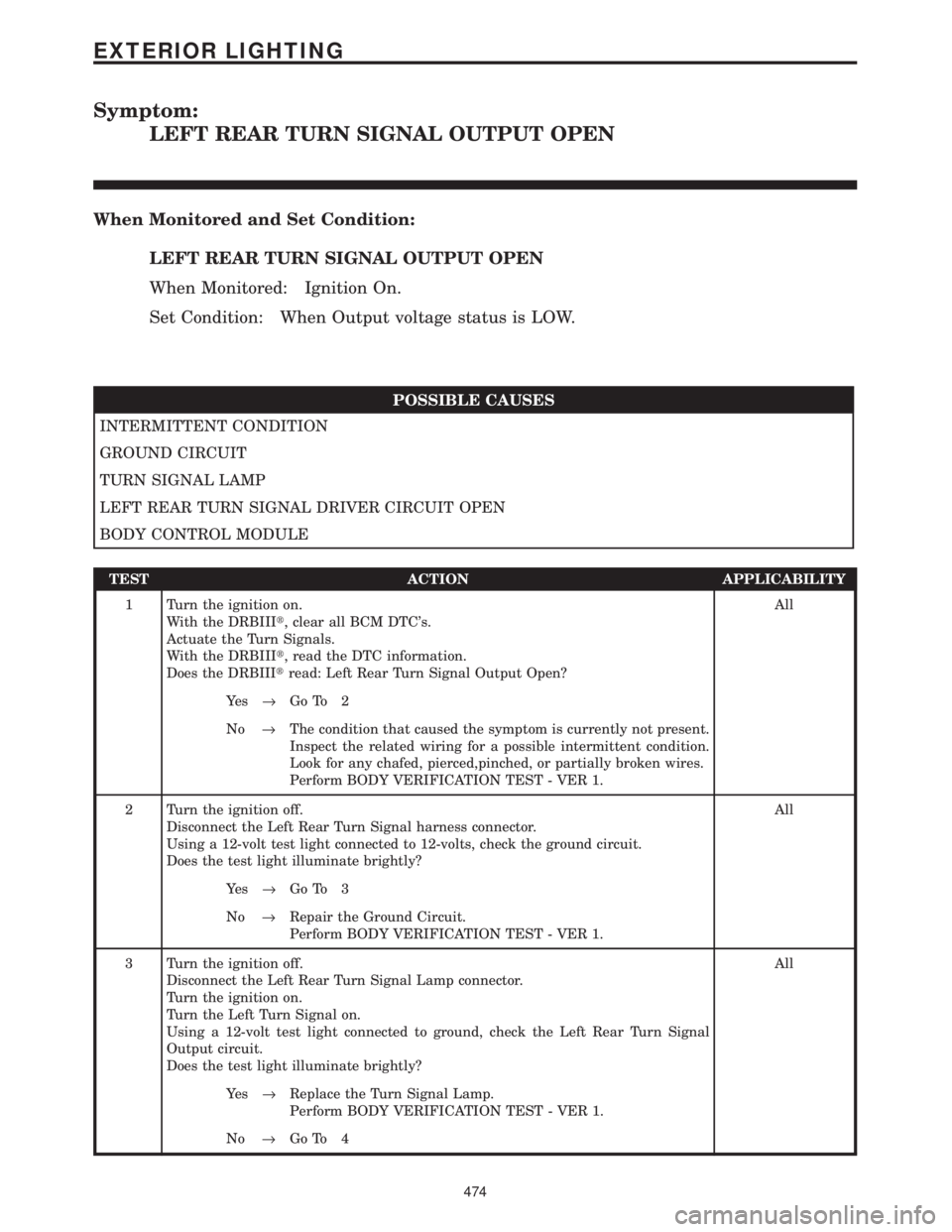
LEFT REAR TURN SIGNAL OUTPUT OPEN
When Monitored and Set Condition:
LEFT REAR TURN SIGNAL OUTPUT OPEN
When Monitored: Ignition On.
Set Condition: When Output voltage status is LOW.
POSSIBLE CAUSES
INTERMITTENT CONDITION
GROUND CIRCUIT
TURN SIGNAL LAMP
LEFT REAR TURN SIGNAL DRIVER CIRCUIT OPEN
BODY CONTROL MODULE
TEST ACTION APPLICABILITY
1 Turn the ignition on.
With the DRBIIIt, clear all BCM DTC's.
Actuate the Turn Signals.
With the DRBIIIt, read the DTC information.
Does the DRBIIItread: Left Rear Turn Signal Output Open?All
Ye s®Go To 2
No®The condition that caused the symptom is currently not present.
Inspect the related wiring for a possible intermittent condition.
Look for any chafed, pierced,pinched, or partially broken wires.
Perform BODY VERIFICATION TEST - VER 1.
2 Turn the ignition off.
Disconnect the Left Rear Turn Signal harness connector.
Using a 12-volt test light connected to 12-volts, check the ground circuit.
Does the test light illuminate brightly?All
Ye s®Go To 3
No®Repair the Ground Circuit.
Perform BODY VERIFICATION TEST - VER 1.
3 Turn the ignition off.
Disconnect the Left Rear Turn Signal Lamp connector.
Turn the ignition on.
Turn the Left Turn Signal on.
Using a 12-volt test light connected to ground, check the Left Rear Turn Signal
Output circuit.
Does the test light illuminate brightly?All
Ye s®Replace the Turn Signal Lamp.
Perform BODY VERIFICATION TEST - VER 1.
No®Go To 4
474
EXTERIOR LIGHTING