Page 2736 of 4770
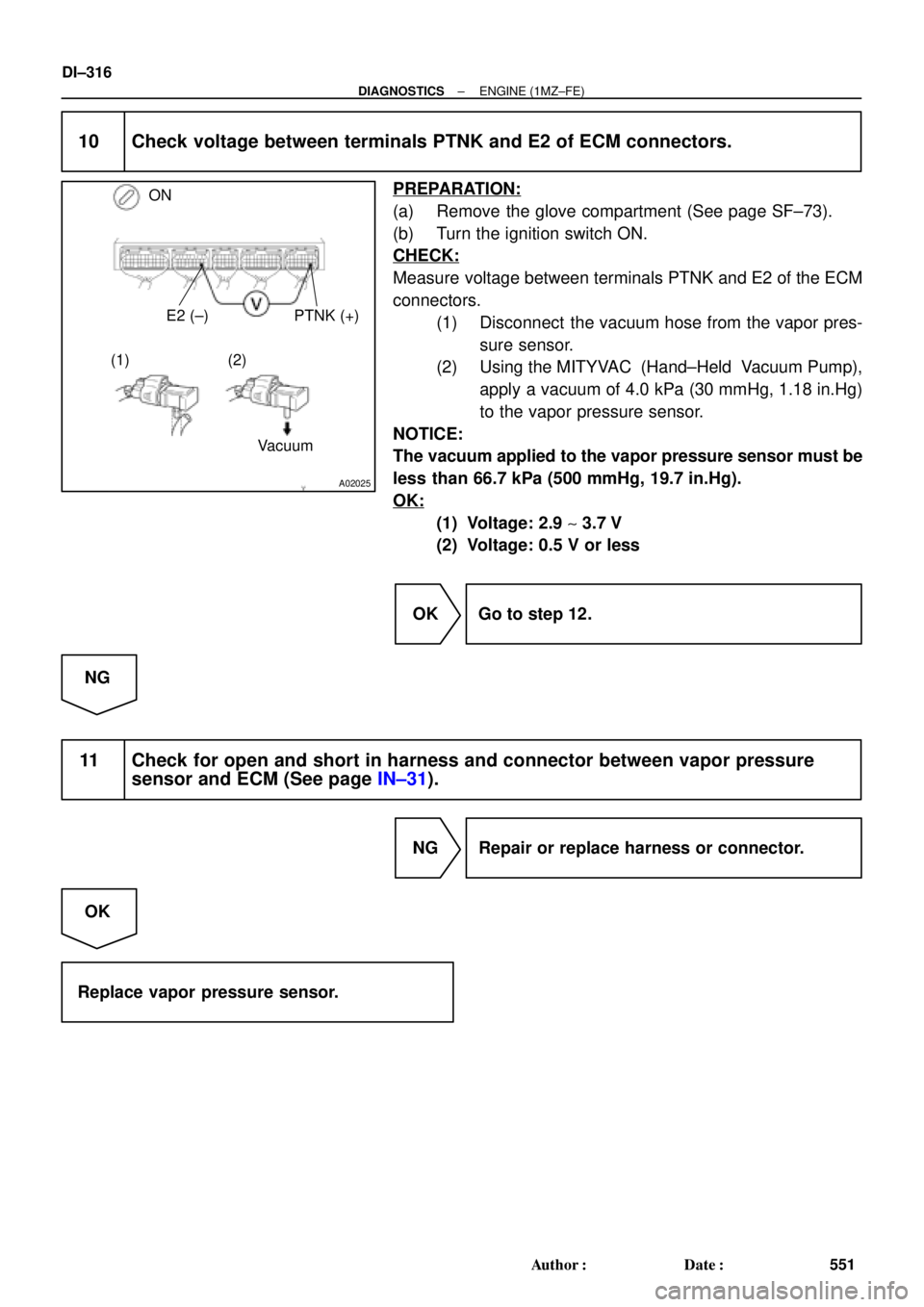
A02025
ON
E2 (±) PTNK (+)
Vacuum (1) (2)
DI±316
± DIAGNOSTICSENGINE (1MZ±FE)
551 Author�: Date�:
10 Check voltage between terminals PTNK and E2 of ECM connectors.
PREPARATION:
(a) Remove the glove compartment (See page SF±73).
(b) Turn the ignition switch ON.
CHECK:
Measure voltage between terminals PTNK and E2 of the ECM
connectors.
(1) Disconnect the vacuum hose from the vapor pres-
sure sensor.
(2) Using the MITYVAC (Hand±Held Vacuum Pump),
apply a vacuum of 4.0 kPa (30 mmHg, 1.18 in.Hg)
to the vapor pressure sensor.
NOTICE:
The vacuum applied to the vapor pressure sensor must be
less than 66.7 kPa (500 mmHg, 19.7 in.Hg).
OK:
(1) Voltage: 2.9 ~ 3.7 V
(2) Voltage: 0.5 V or less
OK Go to step 12.
NG
11 Check for open and short in harness and connector between vapor pressure
sensor and ECM (See page IN±31).
NG Repair or replace harness or connector.
OK
Replace vapor pressure sensor.
Page 2738 of 4770
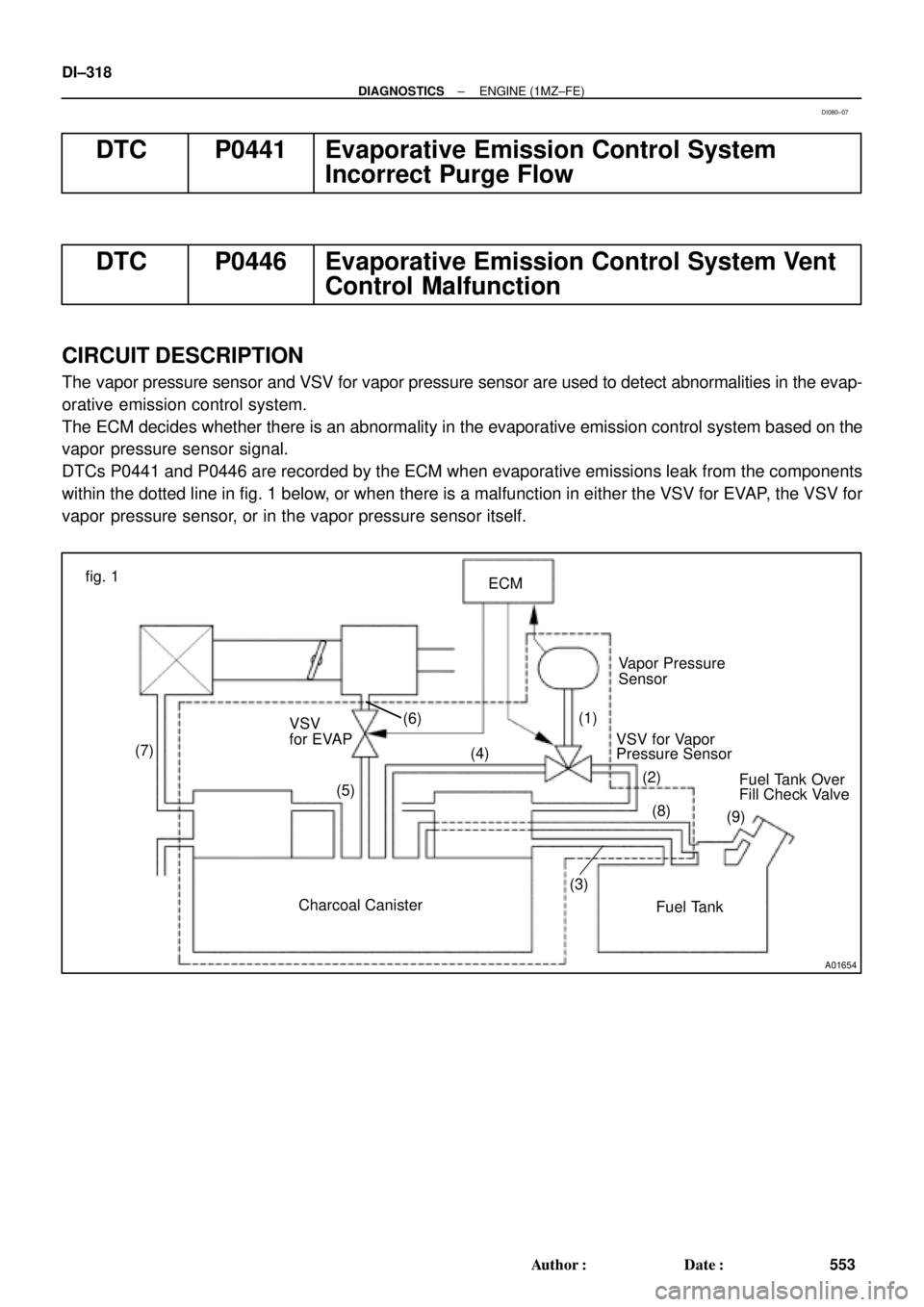
A01654
ECM
Vapor Pressure
Sensor
VSV for Vapor
Pressure Sensor
Fuel Tank Charcoal Canister VSV
for EVAP(1)
(2)
(3) (4)
(5) fig. 1
(6)
(7)
(8)
(9)Fuel Tank Over
Fill Check Valve DI±318
± DIAGNOSTICSENGINE (1MZ±FE)
553 Author�: Date�:
DTC P0441 Evaporative Emission Control System
Incorrect Purge Flow
DTC P0446 Evaporative Emission Control System Vent
Control Malfunction
CIRCUIT DESCRIPTION
The vapor pressure sensor and VSV for vapor pressure sensor are used to detect abnormalities in the evap-
orative emission control system.
The ECM decides whether there is an abnormality in the evaporative emission control system based on the
vapor pressure sensor signal.
DTCs P0441 and P0446 are recorded by the ECM when evaporative emissions leak from the components
within the dotted line in fig. 1 below, or when there is a malfunction in either the VSV for EVAP, the VSV for
vapor pressure sensor, or in the vapor pressure sensor itself.
DI080±07
Page 2739 of 4770

± DIAGNOSTICSENGINE (1MZ±FE)
DI±319
554 Author�: Date�:
DTC No.DTC Detecting ConditionTrouble Area
Pressure in charcoal canister does not drop during purge con-
trol (2 trip detection logic)
P0441During purge cut±off, pressure in charcoal canister is very low
compared with atmospheric pressure
(2 trip detection logic)�Open or short in VSV circuit for EVAP
�Open or short in VSV circuit for vapor pressure sensor
�
Open or short in vaporpressure sensor circuit
When VSV for vapor pressure sensor is OFF, ECM judges that
there is no continuity between vapor pressure sensor and
charcoal canister (2 trip detection logic)
�Open or short in vapor pressure sensor circuit
�VSV for EVAP
�VSV for vapor pressure sensor
�Vapor pressure sensor
P0446
When VSV for vapor pressure sensor is ON, ECM judges that
there is no continuity between vapor pressure sensor and fuel
tank (2 trip detection logic)
Va o r ressure sensor
�Vacuum hose cracks, holed blocked, damaged or
disconnected ((1), (4), (5),(6) and (7) in fig. 1)
�Charcoal canister cracks, holed or damaged
F l t k fill h k l k d d dAfter purge cut off operates, pressure in charcoal canister is
maintained at atmospheric pressure
(2 trip detection logic)�Fuel tank over fill check valve cracked or damaged
WIRING DIAGRAM
Refer to DTC P0440 (Evaporative Emission Control System Malfunction) on page DI±311 for the WIRING
DIAGRAM.
INSPECTION PROCEDURE
HINT:
�If DTCs P0441, P0446, P0450 or P0451 is output after DTC P0440, first troubleshoot DTCs P0441,
P0446, P0450 or P0451. If no malfunction is detected, troubleshoot DTC P0440 next.
�Read freeze frame data using TOYOTA hand±held tester or OBD II scan tool. Because freeze frame
records the engine conditions when the malfunction is detected, when troubleshooting it is useful for
determining whether the vehicle was running or stopped, the engine warmed up or not, the air±fuel
ratio lean or rich, etc. at the time of the malfunction.
�When the ENGINE RUN TIME in the freeze frame data is less than 200 seconds, carefully check the
VSV for EVAP, charcoal canister and vapor pressure sensor.
TOYOTA hand±held tester
1 Check VSV connector for EVAP, VSV connector for vapor pressure sensor and
vapor pressure sensor connector for looseness and disconnection.
NG Repair or connect VSV or sensor connector.
OK
Page 2740 of 4770
DI±320
± DIAGNOSTICSENGINE (1MZ±FE)
555 Author�: Date�:
2 Check vacuum hoses (1), (4), (5), (6), (7) and (8) on page DI±311).
CHECK:
(a) Check that the vacuum hose is connected correctly.
(b) Check the vacuum hose for looseness and disconnection.
(c) Check the vacuum hose for cracks, hole, damage and blockage.
NG Repair or replace.
OK
3 Check voltage between terminals VC and E2 of ECM connector
(See page DI±311, step 9).
NG Check and replace ECM (See page IN±31).
OK
4 Check voltage between terminals PTNK and E2 of ECM connectors
(See page DI±311, step 10).
OK Go to step 6.
NG
5 Check for open and short in harness and connector between vapor pressure
sensor and ECM (See page IN±31).
NG Repair or replace harness or connector.
OK
Replace vapor pressure sensor.
Page 2743 of 4770
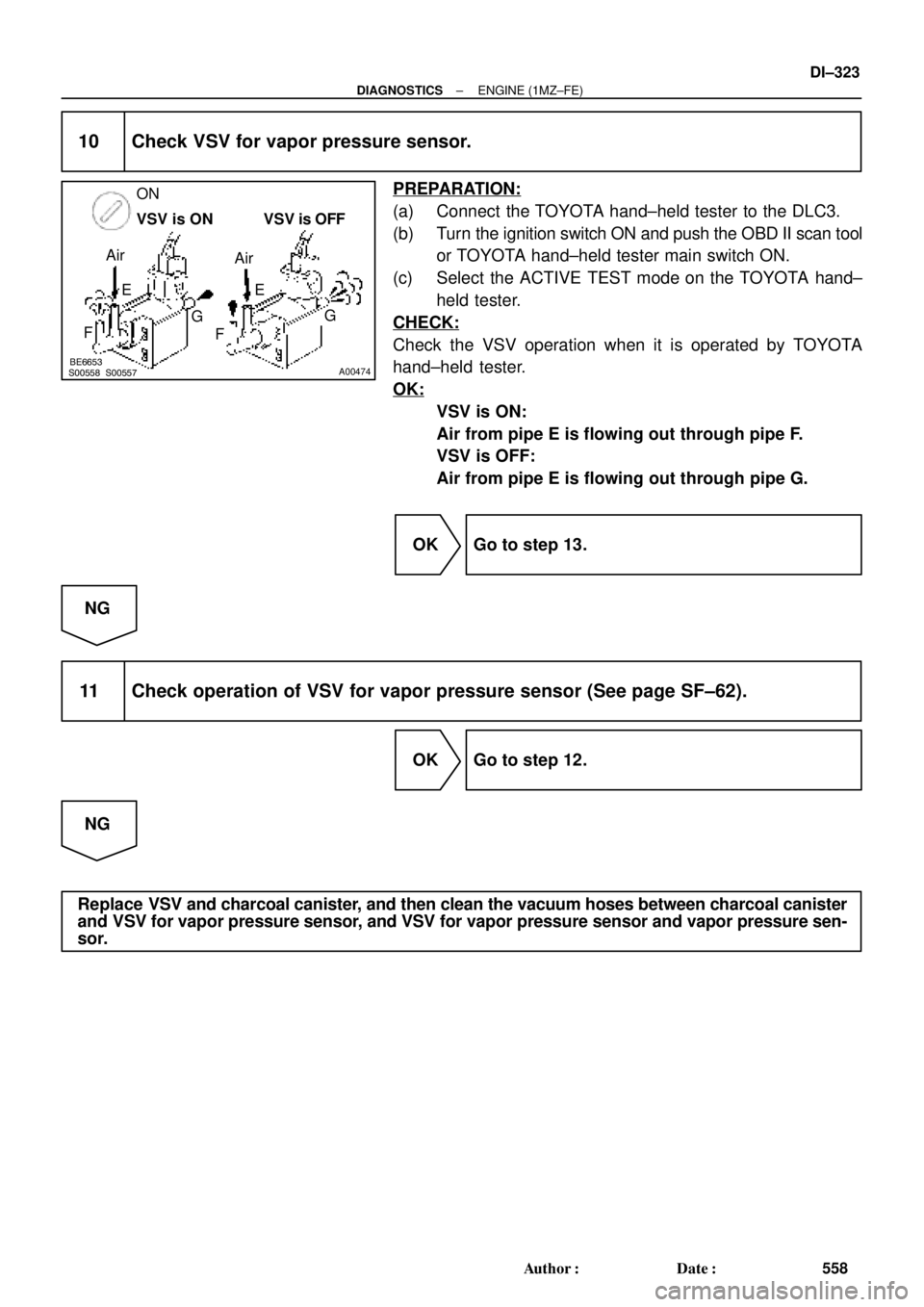
BE6653
S00558 S00557A00474
ON
Air
E Air
E
F
F GG VSV is OFF VSV is ON
± DIAGNOSTICSENGINE (1MZ±FE)
DI±323
558 Author�: Date�:
10 Check VSV for vapor pressure sensor.
PREPARATION:
(a) Connect the TOYOTA hand±held tester to the DLC3.
(b) Turn the ignition switch ON and push the OBD II scan tool
or TOYOTA hand±held tester main switch ON.
(c) Select the ACTIVE TEST mode on the TOYOTA hand±
held tester.
CHECK:
Check the VSV operation when it is operated by TOYOTA
hand±held tester.
OK:
VSV is ON:
Air from pipe E is flowing out through pipe F.
VSV is OFF:
Air from pipe E is flowing out through pipe G.
OK Go to step 13.
NG
11 Check operation of VSV for vapor pressure sensor (See page SF±62).
OK Go to step 12.
NG
Replace VSV and charcoal canister, and then clean the vacuum hoses between charcoal canister
and VSV for vapor pressure sensor, and VSV for vapor pressure sensor and vapor pressure sen-
sor.
Page 2744 of 4770
A07146PTNK (+) E2 (±)
VSV Connector
for Vapor Pressure
Sensor
DI±324
± DIAGNOSTICSENGINE (1MZ±FE)
559 Author�: Date�:
12 Check for open and short in harness and connector between EFI main relay
(Marking: EFI) and VSV for vapor pressure sensor, and VSV for vapor pressure
sensor and ECM (See page IN±31).
NG Repair or replace harness or connector.
OK
Check and replace ECM (See page IN±31).
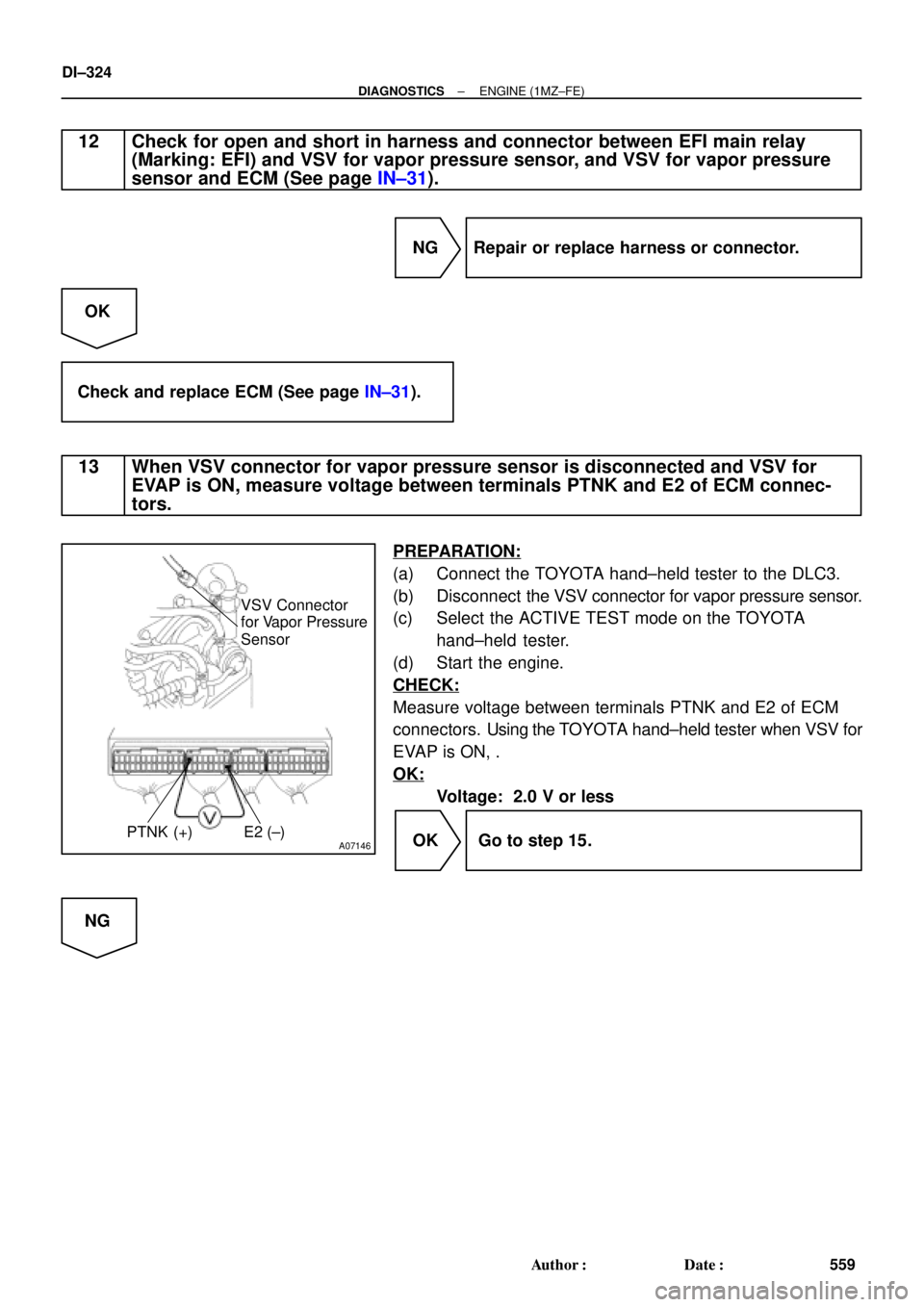
13 When VSV connector for vapor pressure sensor is disconnected and VSV for
EVAP is ON, measure voltage between terminals PTNK and E2 of ECM connec-
tors.
PREPARATION:
(a) Connect the TOYOTA hand±held tester to the DLC3.
(b) Disconnect the VSV connector for vapor pressure sensor.
(c) Select the ACTIVE TEST mode on the TOYOTA
hand±held tester.
(d) Start the engine.
CHECK:
Measure voltage between terminals PTNK and E2 of ECM
connectors. Using the TOYOTA hand±held tester when VSV for
EVAP is ON, .
OK:
Voltage: 2.0 V or less
OK Go to step 15.
NG
Page 2745 of 4770
A07147
E2 (±) PTNK (+)
EngineStart
Stop
OFF ON OFF VSV for
ON
Vapor
Pressure
Sensor
VSV for
EVAP
5 sec.
Measure Voltage
± DIAGNOSTICSENGINE (1MZ±FE)
DI±325
560 Author�: Date�:
14 Check vacuum hoses between charcoal canister and VSV for vapor pressure
sensor, and vapor pressure sensor and VSV for vapor pressure sensor.
CHECK:
(a) Check that the vacuum hose is connected correctly.
(b) Check the vacuum hose for looseness and disconnection.
(c) Check the vacuum hose for cracks, hole, damage and blockage.
NG Repair or replace.
OK
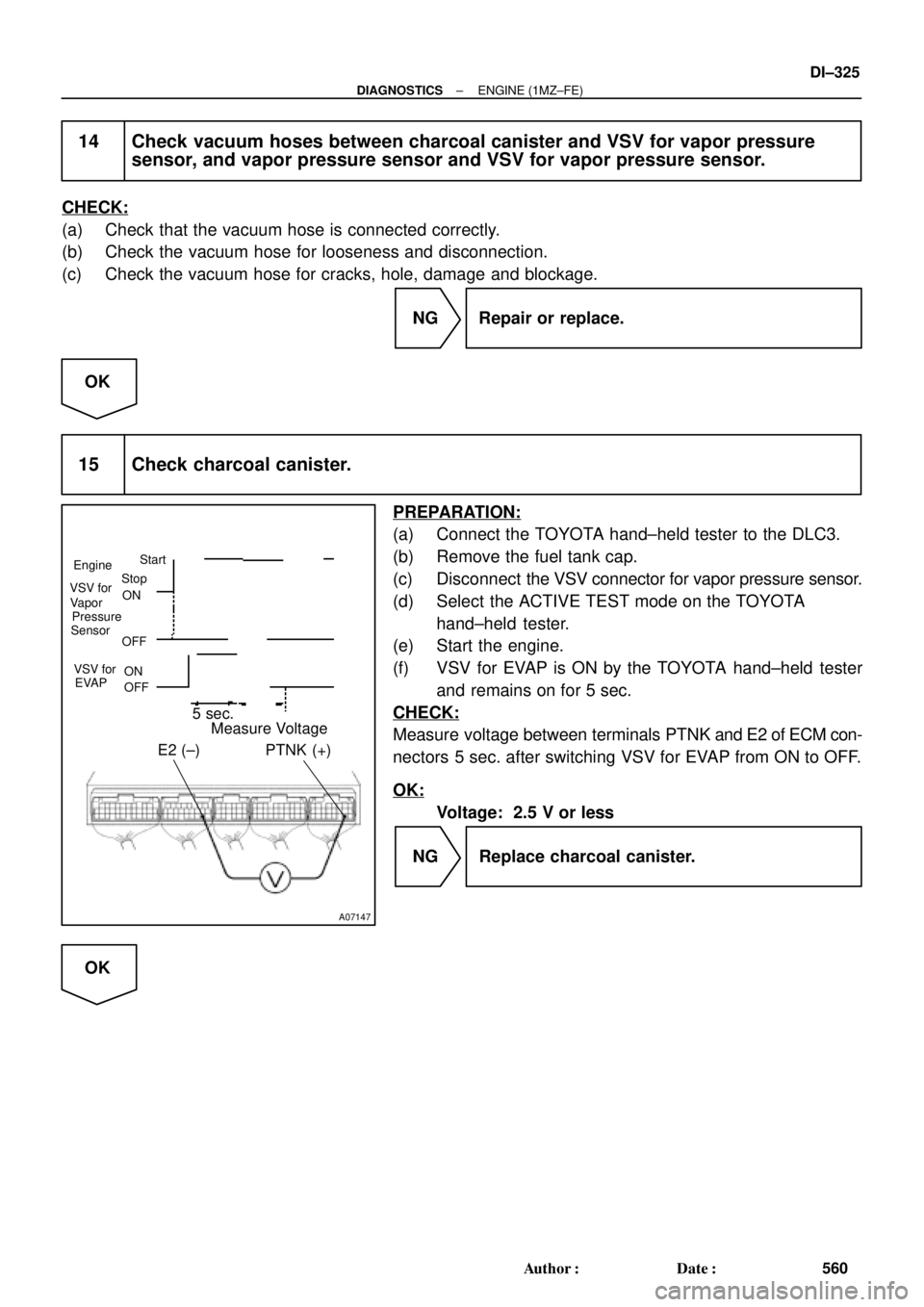
15 Check charcoal canister.
PREPARATION:
(a) Connect the TOYOTA hand±held tester to the DLC3.
(b) Remove the fuel tank cap.
(c) Disconnect the VSV connector for vapor pressure sensor.
(d) Select the ACTIVE TEST mode on the TOYOTA
hand±held tester.
(e) Start the engine.
(f) VSV for EVAP is ON by the TOYOTA hand±held tester
and remains on for 5 sec.
CHECK:
Measure voltage between terminals PTNK and E2 of ECM con-
nectors 5 sec. after switching VSV for EVAP from ON to OFF.
OK:
Voltage: 2.5 V or less
NG Replace charcoal canister.
OK
Page 2746 of 4770
DI±326
± DIAGNOSTICSENGINE (1MZ±FE)
561 Author�: Date�:
16 Remove charcoal canister and check it (See page EC±6).
NG Replace charcoal canister.
OK
17 Check fuel tank over fill check valve (See page EC±2).
NG Replace fuel tank over fill check valve or fuel
tank.
OK
Check and replace ECM (See page IN±31).
OBD II scan tool (excluding TOYOTA hand±held tester)
1 Check VSV connector for EVAP, VSV connector for vapor pressure sensor and
vapor pressure sensor connector for looseness and disconnection.
NG Repair or connect VSV or sensor connector.
OK
2 Check vacuum hoses (1), (4), (5), (6) (7) and (8) on Page DI±311).
CHECK:
(a) Check that the vacuum hose is connected correctly.
(b) Check the vacuum hose for looseness and disconnection.
(c) Check the vacuum hose for cracks, hole, damage and blockage.
NG Repair or replace.
OK