Page 2726 of 4770
FI6514
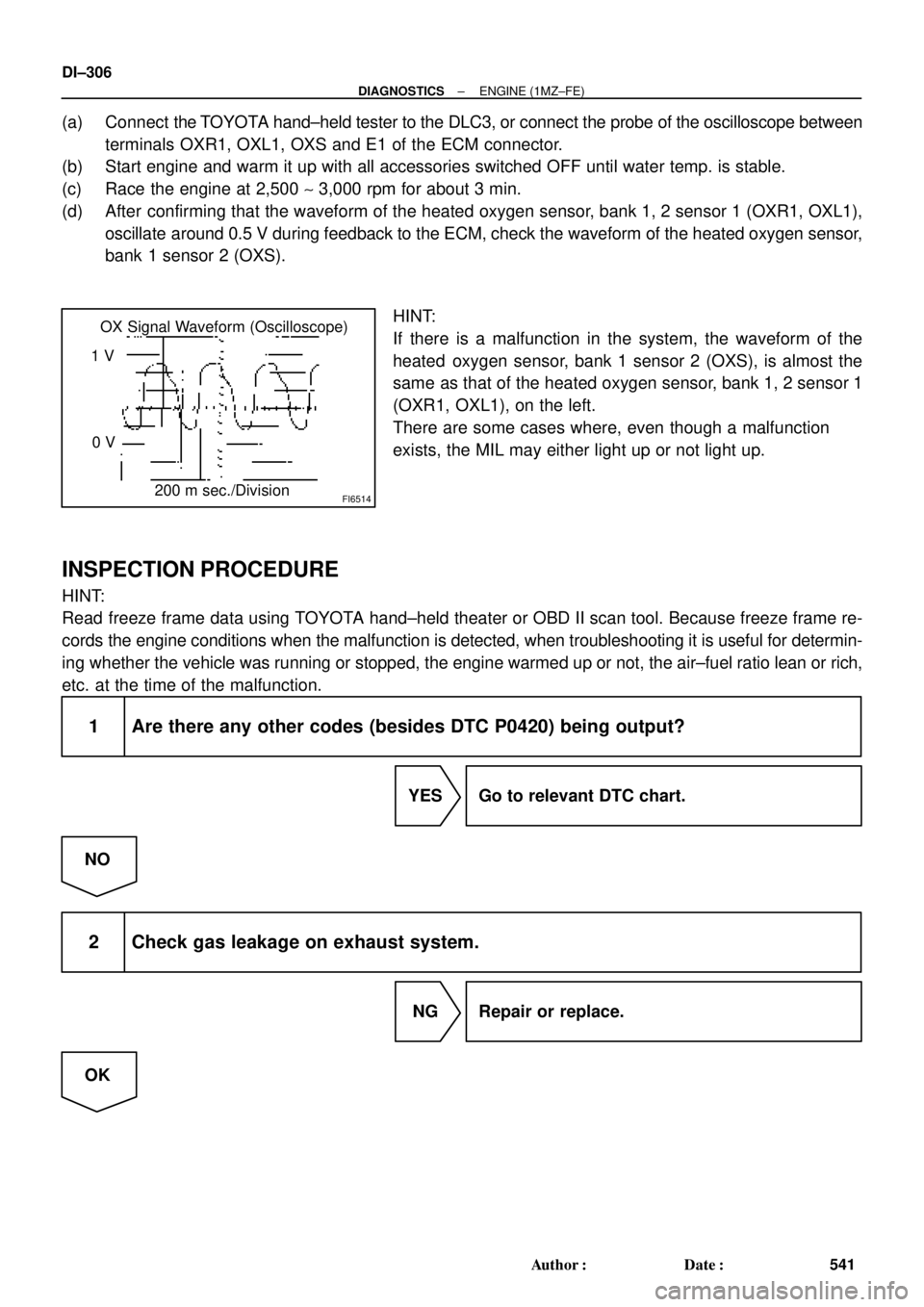
OX Signal Waveform (Oscilloscope)
1 V
0 V
200 m sec./Division
DI±306
± DIAGNOSTICSENGINE (1MZ±FE)
541 Author�: Date�:
(a) Connect the TOYOTA hand±held tester to the DLC3, or connect the probe of the oscilloscope between
terminals OXR1, OXL1, OXS and E1 of the ECM connector.
(b) Start engine and warm it up with all accessories switched OFF until water temp. is stable.
(c) Race the engine at 2,500 ~ 3,000 rpm for about 3 min.
(d) After confirming that the waveform of the heated oxygen sensor, bank 1, 2 sensor 1 (OXR1, OXL1),
oscillate around 0.5 V during feedback to the ECM, check the waveform of the heated oxygen sensor,
bank 1 sensor 2 (OXS).
HINT:
If there is a malfunction in the system, the waveform of the
heated oxygen sensor, bank 1 sensor 2 (OXS), is almost the
same as that of the heated oxygen sensor, bank 1, 2 sensor 1
(OXR1, OXL1), on the left.
There are some cases where, even though a malfunction
exists, the MIL may either light up or not light up.
INSPECTION PROCEDURE
HINT:
Read freeze frame data using TOYOTA hand±held theater or OBD II scan tool. Because freeze frame re-
cords the engine conditions when the malfunction is detected, when troubleshooting it is useful for determin-
ing whether the vehicle was running or stopped, the engine warmed up or not, the air±fuel ratio lean or rich,
etc. at the time of the malfunction.
1 Are there any other codes (besides DTC P0420) being output?
YES Go to relevant DTC chart.
NO
2 Check gas leakage on exhaust system.
NG Repair or replace.
OK
Page 2727 of 4770
± DIAGNOSTICSENGINE (1MZ±FE)
DI±307
542 Author�: Date�:
3 Check heated oxygen sensor (bank 1, sensor 1) (See page DI±255).
NG Repair or replace.
OK
4 Check heated oxygen sensors (bank 1, 2 sensor 2) (See page DI±265).
NG Repair or replace.
OK
Replace three±way catalytic converter.
Page 2728 of 4770
A01674
Waveform of
A/F Sensor
Normal CatalystWaveform of Heated Oxygen
Sensor Behind Catalyst
Abnormal Catalyst DI±308
± DIAGNOSTICSENGINE (1MZ±FE)
543 Author�: Date�:
DTC P0420 Catalyst System Efficiency Below Threshold
(Only for California Spec.)
CIRCUIT DESCRIPTION
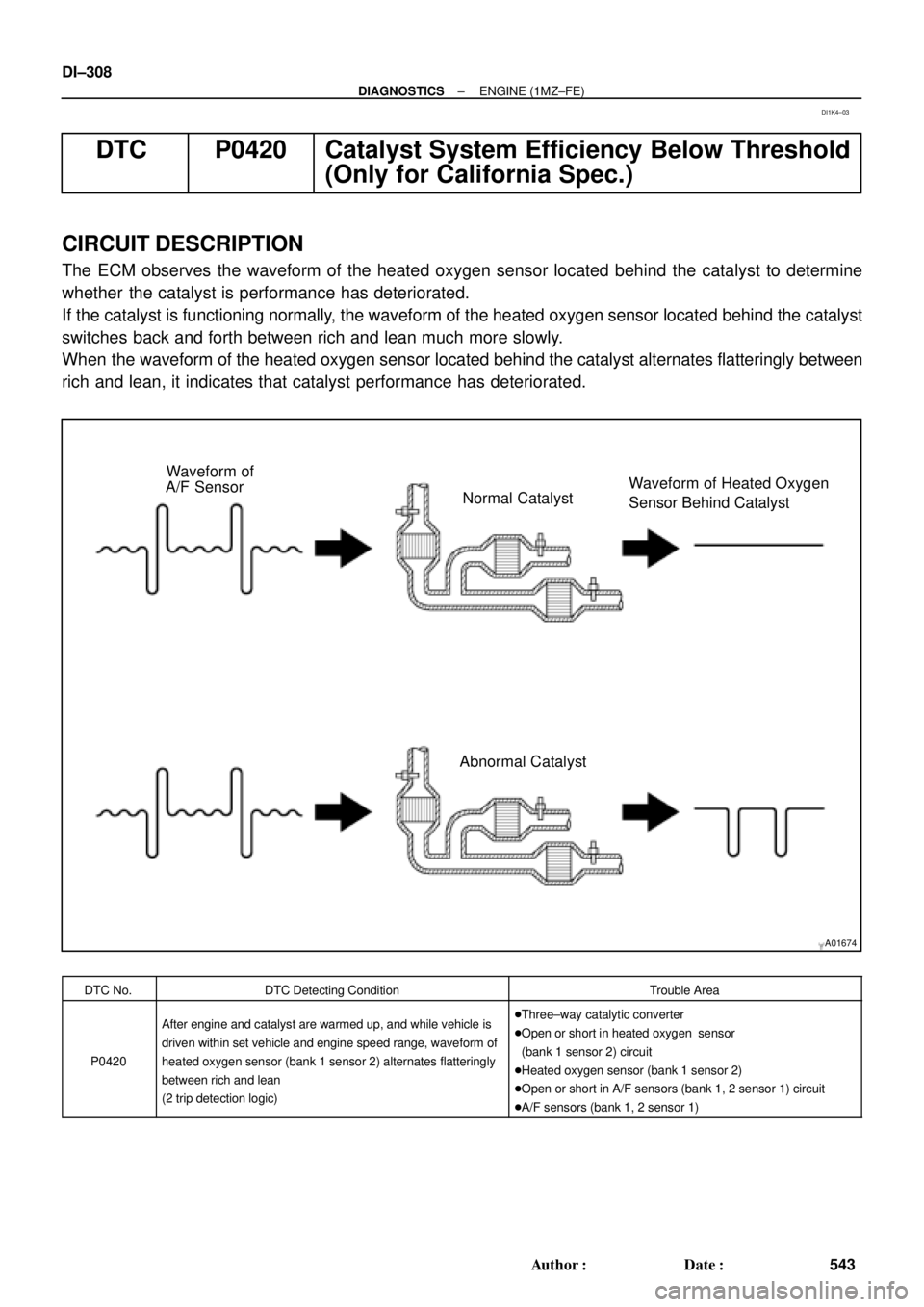
The ECM observes the waveform of the heated oxygen sensor located behind the catalyst to determine
whether the catalyst is performance has deteriorated.
If the catalyst is functioning normally, the waveform of the heated oxygen sensor located behind the catalyst
switches back and forth between rich and lean much more slowly.
When the waveform of the heated oxygen sensor located behind the catalyst alternates flatteringly between
rich and lean, it indicates that catalyst performance has deteriorated.
DTC No.DTC Detecting ConditionTrouble Area
P0420
After engine and catalyst are warmed up, and while vehicle is
driven within set vehicle and engine speed range, waveform of
heated oxygen sensor (bank 1 sensor 2) alternates flatteringly
between rich and lean
(2 trip detection logic)�Three±way catalytic converter
�Open or short in heated oxygen sensor
(bank 1 sensor 2) circuit
�Heated oxygen sensor (bank 1 sensor 2)
�Open or short in A/F sensors (bank 1, 2 sensor 1) circuit
�A/F sensors (bank 1, 2 sensor 1)
DI1K4±03
Page 2729 of 4770
A00479
Engine Speed
3,000 rpm
2,000 rpm
Idling
IG SW OFF(a)
Warmed up3 min. or so
2 sec. 2 sec.
CheckTime (b)(c)
(d)
± DIAGNOSTICSENGINE (1MZ±FE)
DI±309
544 Author�: Date�:
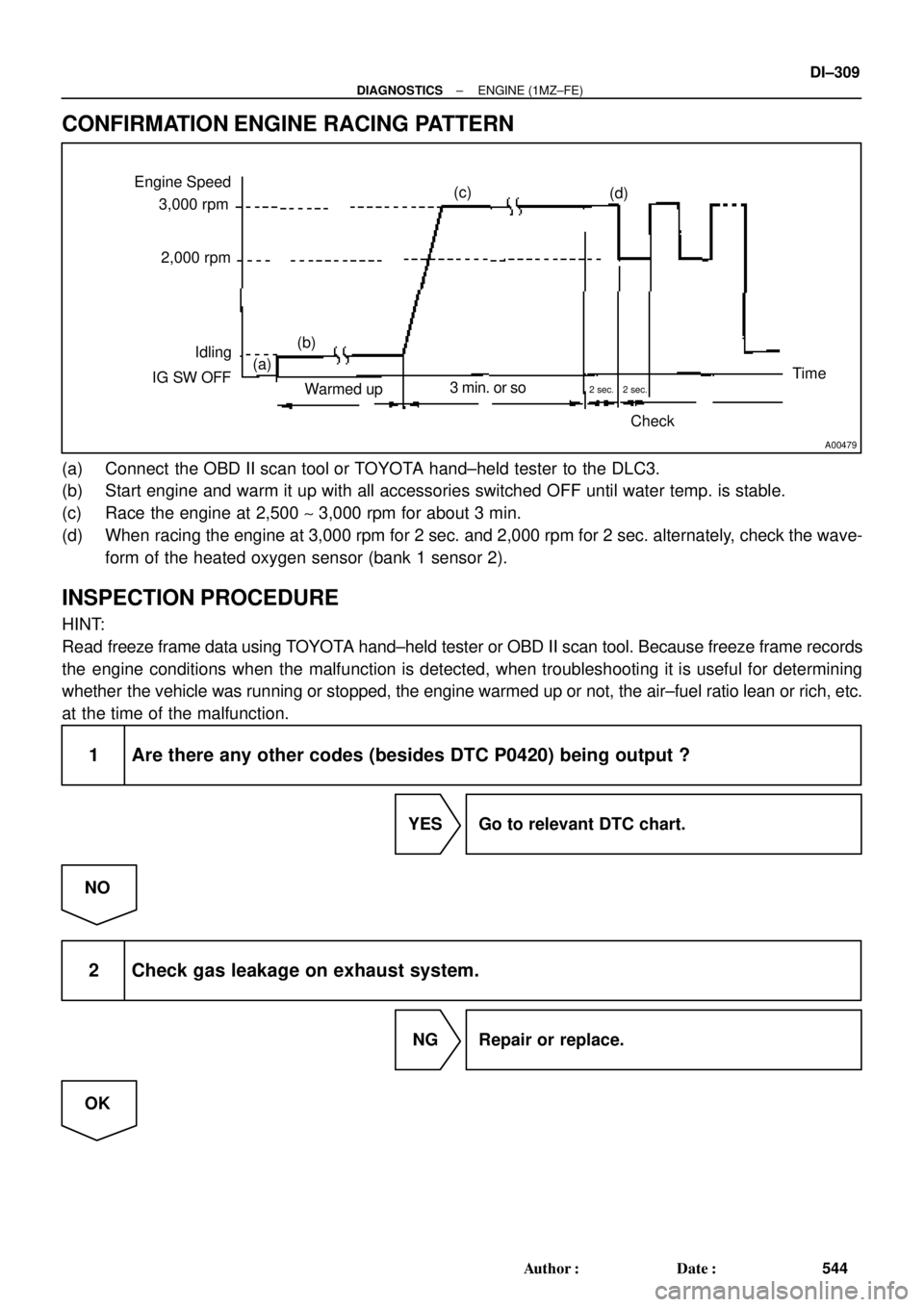
CONFIRMATION ENGINE RACING PATTERN
(a) Connect the OBD II scan tool or TOYOTA hand±held tester to the DLC3.
(b) Start engine and warm it up with all accessories switched OFF until water temp. is stable.
(c) Race the engine at 2,500 ~ 3,000 rpm for about 3 min.
(d) When racing the engine at 3,000 rpm for 2 sec. and 2,000 rpm for 2 sec. alternately, check the wave-
form of the heated oxygen sensor (bank 1 sensor 2).
INSPECTION PROCEDURE
HINT:
Read freeze frame data using TOYOTA hand±held tester or OBD II scan tool. Because freeze frame records
the engine conditions when the malfunction is detected, when troubleshooting it is useful for determining
whether the vehicle was running or stopped, the engine warmed up or not, the air±fuel ratio lean or rich, etc.
at the time of the malfunction.
1 Are there any other codes (besides DTC P0420) being output ?
YES Go to relevant DTC chart.
NO
2 Check gas leakage on exhaust system.
NG Repair or replace.
OK
Page 2730 of 4770
DI±310
± DIAGNOSTICSENGINE (1MZ±FE)
545 Author�: Date�:
3 Check A/F sensors (bank 1, 2 sensor 1) (See page DI±255).
NG Repair or replace.
OK
4 Check heated oxygen sensor (bank 1 sensor 2) (See page DI±265).
NG Repair or replace.
OK
Replace three±way catalytic converter.
Page 2731 of 4770
A01652
ECM
Vapor Pressure
Sensor
VSV for Vapor
Pressure Sensor VSV
for EVAP
Charcoal Canister
Fuel Tank (1)
(2)
(3) fig. 1
(6)
(4)
(5) (7)
Fuel Tank Over Fill
Check Valve
(8)
(9)
± DIAGNOSTICSENGINE (1MZ±FE)
DI±311
546 Author�: Date�:
DTC P0440 Evaporative Emission Control System
Malfunction
CIRCUIT DESCRIPTION
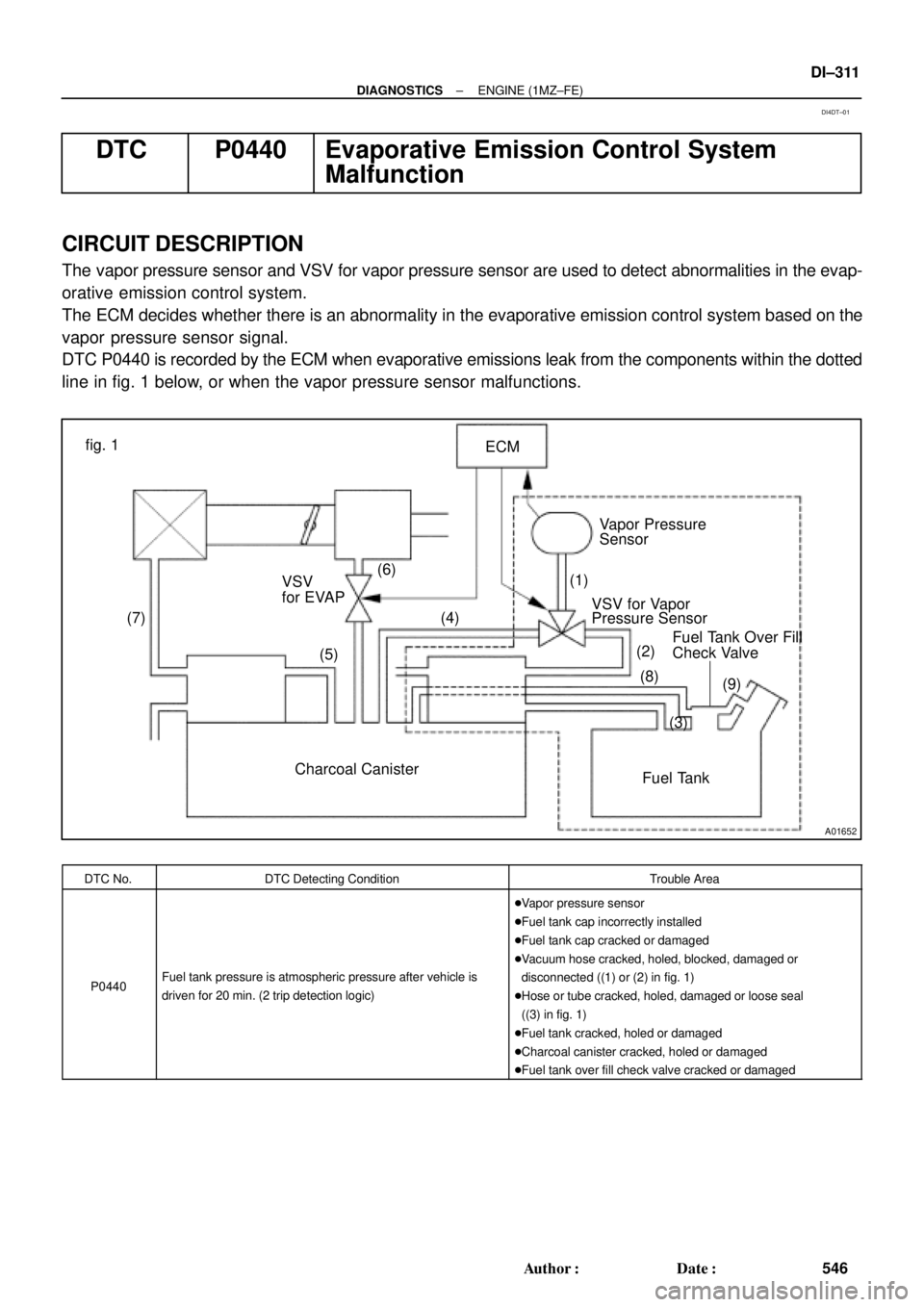
The vapor pressure sensor and VSV for vapor pressure sensor are used to detect abnormalities in the evap-
orative emission control system.
The ECM decides whether there is an abnormality in the evaporative emission control system based on the
vapor pressure sensor signal.
DTC P0440 is recorded by the ECM when evaporative emissions leak from the components within the dotted
line in fig. 1 below, or when the vapor pressure sensor malfunctions.
DTC No.DTC Detecting ConditionTrouble Area
P0440Fuel tank pressure is atmospheric pressure after vehicle is
driven for 20 min. (2 trip detection logic)
�Vapor pressure sensor
�Fuel tank cap incorrectly installed
�Fuel tank cap cracked or damaged
�Vacuum hose cracked, holed, blocked, damaged or
disconnected ((1) or (2) in fig. 1)
�Hose or tube cracked, holed, damaged or loose seal
((3) in fig. 1)
�Fuel tank cracked, holed or damaged
�Charcoal canister cracked, holed or damaged
�Fuel tank over fill check valve cracked or damaged
DI4DT±01
Page 2732 of 4770
A07447
Vapor Pressure Sensor
2J2
9J23
B±Y
V
VSV for EVAP
LG
AA
2
1ECM
5V
VC
PTNK
E1
E2
EVP1
E01
E01
TPC
3
2
Engine Rom J/B
MREL VSV for Vapor
Pressure Sensor
II3
EB
B±W
W±BL±R Y
1BRE10
E7
E10
E72
17
18
7
9
E78
EFI Relay
IA1 L±RY Y
ID1 II13
5
1
II1 BR
BR
ID1 E10
B±Y
J28 J27
B
ID1 10
1
2
ID12 2A
7 1
2C5
2K 53
2
1 EFI
B±WFL MAIN
From
24
B+
J28E B±YB
B±Y
B±Y
V
J35
J35C
C Junction
Connector
Junction
ConnectorJunction
Connector DI±312
± DIAGNOSTICSENGINE (1MZ±FE)
547 Author�: Date�:
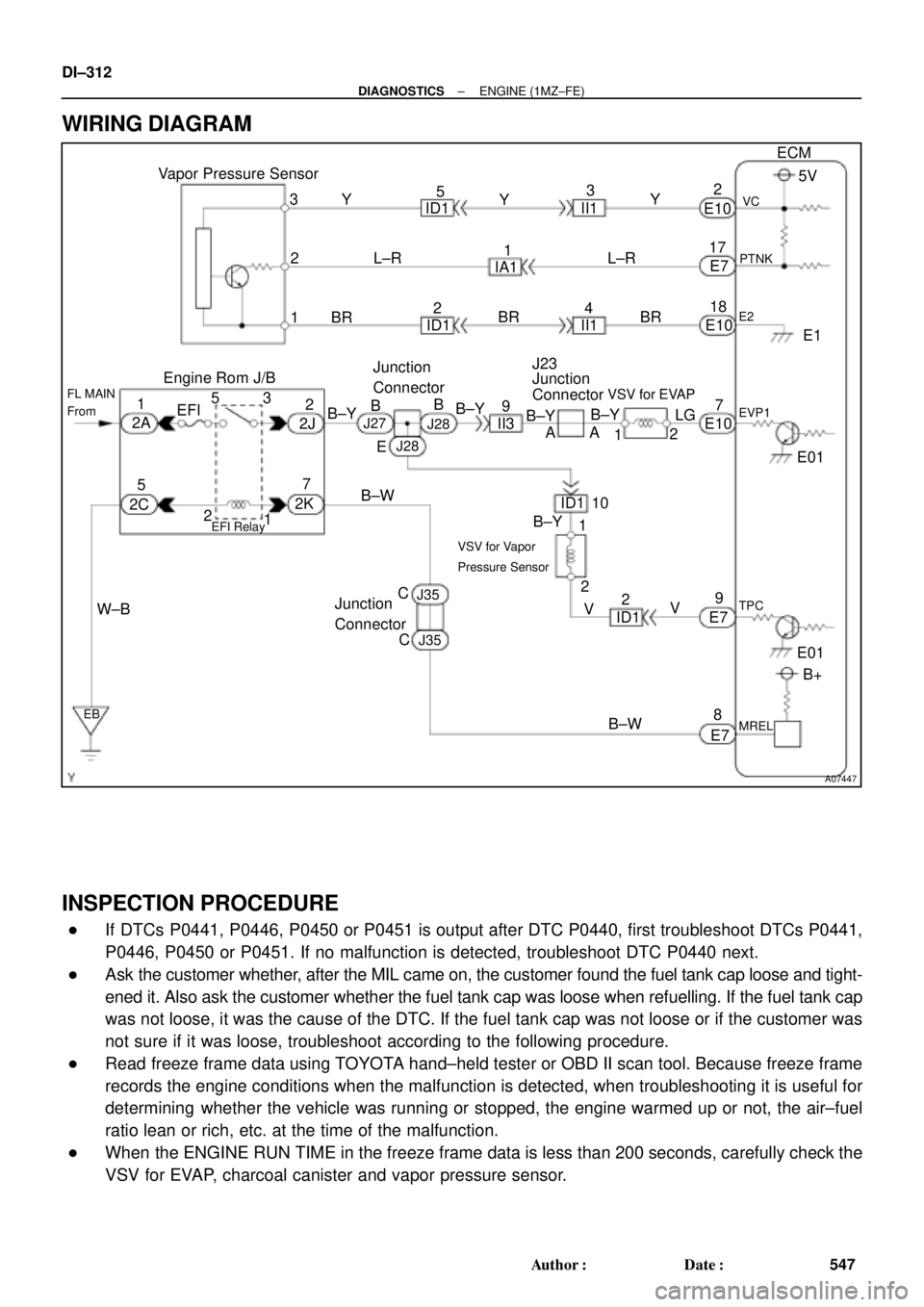
WIRING DIAGRAM
INSPECTION PROCEDURE
�If DTCs P0441, P0446, P0450 or P0451 is output after DTC P0440, first troubleshoot DTCs P0441,
P0446, P0450 or P0451. If no malfunction is detected, troubleshoot DTC P0440 next.
�Ask the customer whether, after the MIL came on, the customer found the fuel tank cap loose and tight-
ened it. Also ask the customer whether the fuel tank cap was loose when refuelling. If the fuel tank cap
was not loose, it was the cause of the DTC. If the fuel tank cap was not loose or if the customer was
not sure if it was loose, troubleshoot according to the following procedure.
�Read freeze frame data using TOYOTA hand±held tester or OBD II scan tool. Because freeze frame
records the engine conditions when the malfunction is detected, when troubleshooting it is useful for
determining whether the vehicle was running or stopped, the engine warmed up or not, the air±fuel
ratio lean or rich, etc. at the time of the malfunction.
�When the ENGINE RUN TIME in the freeze frame data is less than 200 seconds, carefully check the
VSV for EVAP, charcoal canister and vapor pressure sensor.
Page 2734 of 4770
DI±314
± DIAGNOSTICSENGINE (1MZ±FE)
549 Author�: Date�:
5 Check filler neck for damage.
PREPARATION:
Remove the fuel tank cap.
CHECK:
Visually inspect the filler neck for damage.
NG Replace filler pipe.
OK
6 Check vacuum hoses between vapor pressure sensor and VSV for vapor
pressure sensor, and VSV for vapor pressure sensor and charcoal canister
(See page EC±3 , SF±62 and EC±6).
CHECK:
(a) Check that the vacuum hose is connected correctly.
(b) Check the vacuum hose for looseness and disconnection.
(c) Check the vacuum hose for cracks, hole and damage.
NG Repair or replace.
OK
7 Check hose and tube between fuel tank and charcoal canister.
CHECK:
(a) Check for proper connection of the fuel tank and fuel evap pipe (See page SF±1), fuel evap pipe and
fuel tube under the floor, fuel tube under the floor and charcoal canister.
(b) Check the hose and tube for cracks, hole and damage.
NG Repair or replace.
OK