2000 DODGE NEON ECU
[x] Cancel search: ECUPage 1145 of 1285
(2) Install the five screws holding cowl panel to
cowl at base of windshield opening.
(3) Push the hood to cowl seal over the forward
flange of the cowl cover and cowl plenum.
(4) Install windshield wiper arms, refer to Group
8K, Windshield Wiper and Washer Systems, for
proper procedures.
FRONT WHEELHOUSE SPLASH SHIELD
REMOVAL
(1) Hoist and support vehicle on safety stands.
(2) Remove front wheel.
(3) Remove push-in fasteners attaching splash
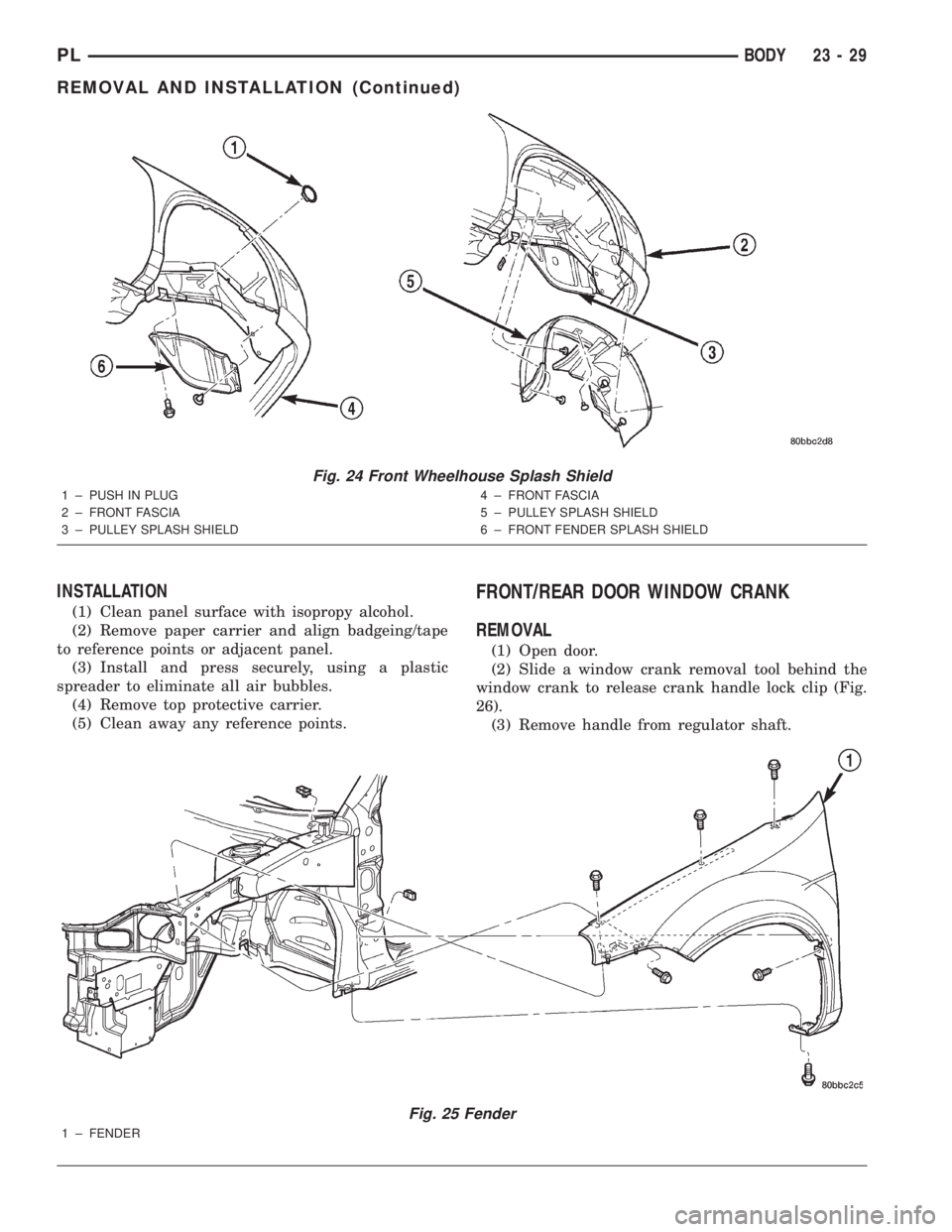
shield to frame rail forward of suspension (Fig. 24).
(4) Remove push in fasteners attaching splash
shield to frame rail rearward of suspension.
(5) Remove screws attaching wheelhouse splash
shield to front fender.
(6) Remove splash shield from vehicle.
INSTALLATION
(1) Place splash shield in position on vehicle.
(2) Install screws attaching wheelhouse splash
shield to front fender.
(3) Install push in fasteners attaching splash
shield to frame rail rearward of suspension.
(4) Install push in fasteners attaching splash
shield to frame rail forward of suspension.
(5) Install front wheel.
(6) Lower vehicle.
FENDER
REMOVAL
(1) Remove headlamp housing.
(2) Right side of vehicle remove pulley splash
shield.(3) Remove inner splash shield.
(4) Remove fender to fascia nuts.
(5) Remove fender bolt to lower rocker panel.
(6) Remove fender bolt to lower cowl.
(7) Pull fascia away from fender.
(8) Remove bolts attaching fender to upper rail.
(9) Remove fender from vehicle (Fig. 25).
INSTALLATION
(1) Place fender in position on vehicle.
(2) Start the center upper rail bolt.
(3) From inside engine compartment, install all
the bolts attaching fender to upper rail and tighten.
(4) Install lower cowl panel bolt to fender.
(5) Install rocker panel bolt to fender.
(6) Place fascia into position.
(7) Install fender to fascia nuts.
(8) Install inner splash shield.
(9) Install right side pulley splash shield.
(10) Install headlamp assembly.
(11) Check fender for flush and gap.
EXTERIOR BADGEING ATTACHED WITH
DOUBLE SIDED FOAM TAPE
REMOVAL
(1) Mark reference points before removing.
(2) Using a heat gun gently apply heat in a circu-
lar motion to loosen the adhesive bond.
(3) Using a nonmetallic prying device, such as a
plastic or wood trim stick gently pry up at corners
and remove.
(4) Clean off all traces of adhesive or double sided
tape from the panel with a general purpose adhesive
remover.
INSTALLATION
(1) Clean panel surface with isopropy alcohol.
(2) Align badgeing to reference points.
(3) Install and press securely to full adhesive con-
tact
(4) Clean away any reference points.
EXTERIOR BADGEING/TAPE STRIPES
ATTACHED WITH ADHESIVES
REMOVAL
(1) Mark reference points before removing.
(2) Using a heat gun gently apply heat in a circu-
lar motion to loosen the adhesive bond.
(3) With your fingernail lift up and peel away
badgeing /tape from panel, using a heat gun as you
go.
(4) Clean off all traces of adhesive from the pan-
el(s) with a general purpose adhesive remover.
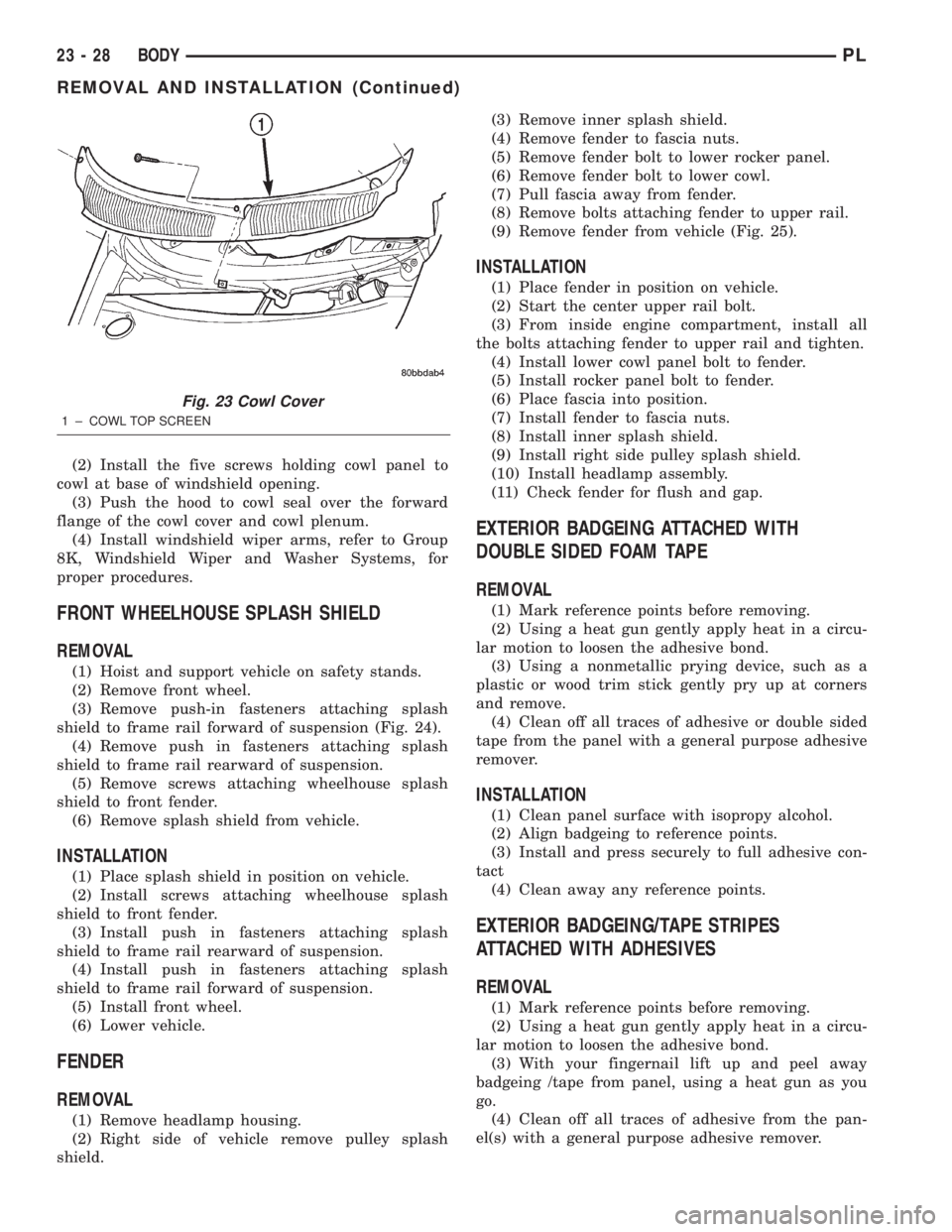
Fig. 23 Cowl Cover
1 ± COWL TOP SCREEN
23 - 28 BODYPL
REMOVAL AND INSTALLATION (Continued)
Page 1146 of 1285
INSTALLATION
(1) Clean panel surface with isopropy alcohol.
(2) Remove paper carrier and align badgeing/tape
to reference points or adjacent panel.
(3) Install and press securely, using a plastic
spreader to eliminate all air bubbles.
(4) Remove top protective carrier.
(5) Clean away any reference points.
FRONT/REAR DOOR WINDOW CRANK
REMOVAL
(1) Open door.
(2) Slide a window crank removal tool behind the
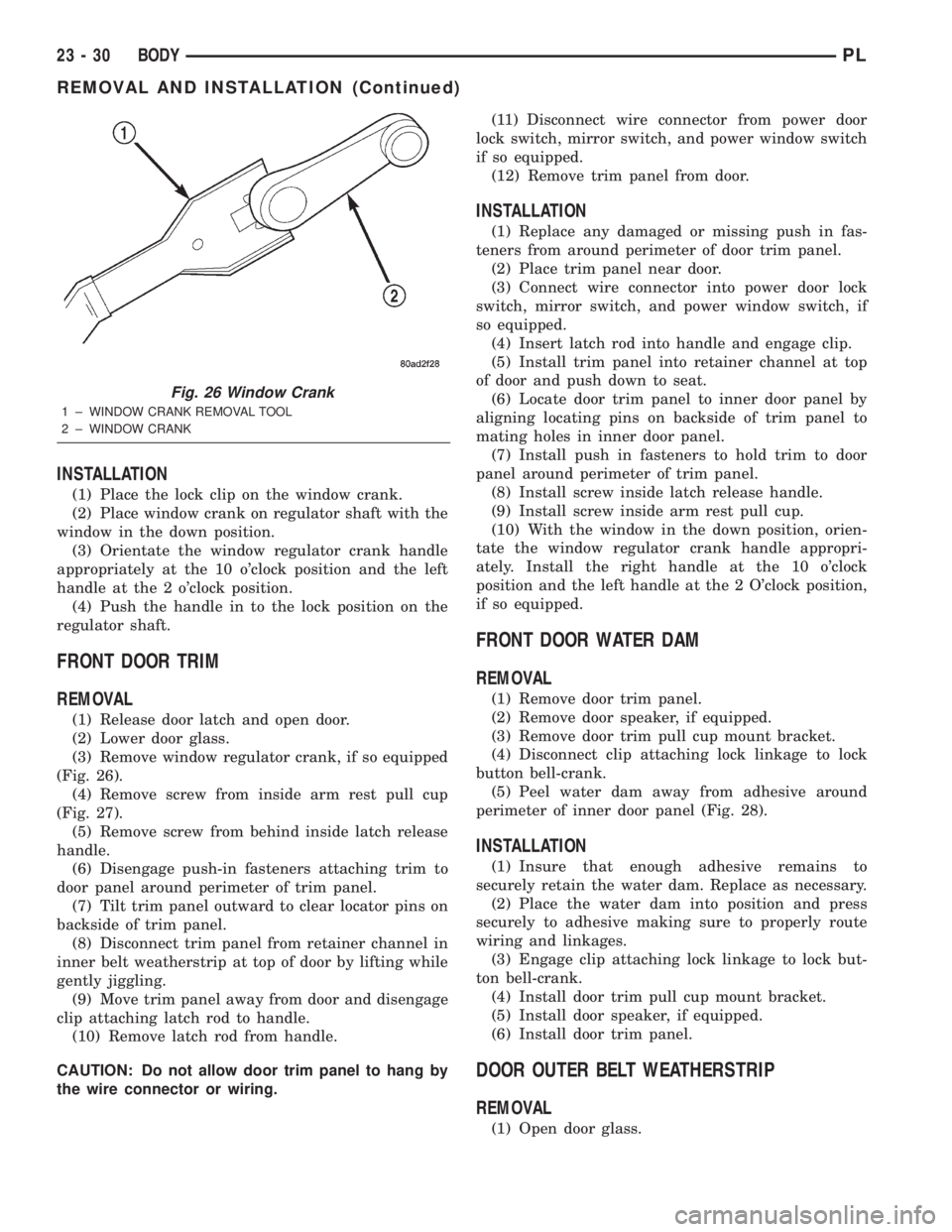
window crank to release crank handle lock clip (Fig.
26).
(3) Remove handle from regulator shaft.
Fig. 25 Fender
1 ± FENDER
Fig. 24 Front Wheelhouse Splash Shield
1 ± PUSH IN PLUG
2 ± FRONT FASCIA
3 ± PULLEY SPLASH SHIELD4 ± FRONT FASCIA
5 ± PULLEY SPLASH SHIELD
6 ± FRONT FENDER SPLASH SHIELD
PLBODY 23 - 29
REMOVAL AND INSTALLATION (Continued)
Page 1147 of 1285
INSTALLATION
(1) Place the lock clip on the window crank.
(2) Place window crank on regulator shaft with the
window in the down position.
(3) Orientate the window regulator crank handle
appropriately at the 10 o'clock position and the left
handle at the 2 o'clock position.
(4) Push the handle in to the lock position on the
regulator shaft.
FRONT DOOR TRIM
REMOVAL
(1) Release door latch and open door.
(2) Lower door glass.
(3) Remove window regulator crank, if so equipped
(Fig. 26).
(4) Remove screw from inside arm rest pull cup
(Fig. 27).
(5) Remove screw from behind inside latch release
handle.
(6) Disengage push-in fasteners attaching trim to
door panel around perimeter of trim panel.
(7) Tilt trim panel outward to clear locator pins on
backside of trim panel.
(8) Disconnect trim panel from retainer channel in
inner belt weatherstrip at top of door by lifting while
gently jiggling.
(9) Move trim panel away from door and disengage
clip attaching latch rod to handle.
(10) Remove latch rod from handle.
CAUTION: Do not allow door trim panel to hang by
the wire connector or wiring.(11) Disconnect wire connector from power door
lock switch, mirror switch, and power window switch
if so equipped.
(12) Remove trim panel from door.
INSTALLATION
(1) Replace any damaged or missing push in fas-
teners from around perimeter of door trim panel.
(2) Place trim panel near door.
(3) Connect wire connector into power door lock
switch, mirror switch, and power window switch, if
so equipped.
(4) Insert latch rod into handle and engage clip.
(5) Install trim panel into retainer channel at top
of door and push down to seat.
(6) Locate door trim panel to inner door panel by
aligning locating pins on backside of trim panel to
mating holes in inner door panel.
(7) Install push in fasteners to hold trim to door
panel around perimeter of trim panel.
(8) Install screw inside latch release handle.
(9) Install screw inside arm rest pull cup.
(10) With the window in the down position, orien-
tate the window regulator crank handle appropri-
ately. Install the right handle at the 10 o'clock
position and the left handle at the 2 O'clock position,
if so equipped.
FRONT DOOR WATER DAM
REMOVAL
(1) Remove door trim panel.
(2) Remove door speaker, if equipped.
(3) Remove door trim pull cup mount bracket.
(4) Disconnect clip attaching lock linkage to lock
button bell-crank.
(5) Peel water dam away from adhesive around
perimeter of inner door panel (Fig. 28).
INSTALLATION
(1) Insure that enough adhesive remains to
securely retain the water dam. Replace as necessary.
(2) Place the water dam into position and press
securely to adhesive making sure to properly route
wiring and linkages.
(3) Engage clip attaching lock linkage to lock but-
ton bell-crank.
(4) Install door trim pull cup mount bracket.
(5) Install door speaker, if equipped.
(6) Install door trim panel.
DOOR OUTER BELT WEATHERSTRIP
REMOVAL
(1) Open door glass.
Fig. 26 Window Crank
1 ± WINDOW CRANK REMOVAL TOOL
2 ± WINDOW CRANK
23 - 30 BODYPL
REMOVAL AND INSTALLATION (Continued)
Page 1157 of 1285
INSTALLATION
(1) Position weatherstrip to opening door.
(2) Press door upper secondary weatherstrip fas-
teners into position.
SILL SECONDARY WEATHERSTRIP
REMOVAL
(1) Using a fork-type prying tool, disengage push
in fasteners attaching sill secondary weatherstrip to
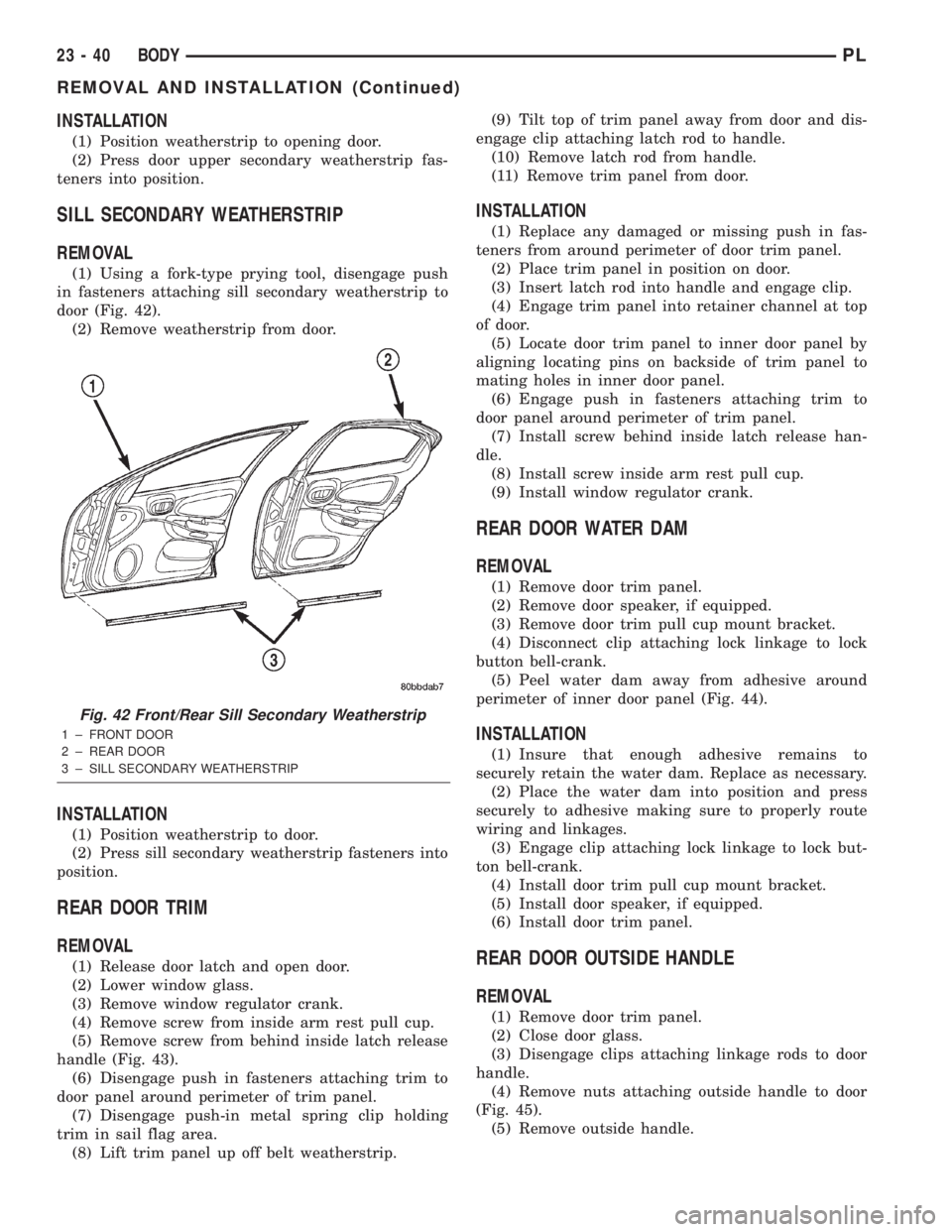
door (Fig. 42).
(2) Remove weatherstrip from door.
INSTALLATION
(1) Position weatherstrip to door.
(2) Press sill secondary weatherstrip fasteners into
position.
REAR DOOR TRIM
REMOVAL
(1) Release door latch and open door.
(2) Lower window glass.
(3) Remove window regulator crank.
(4) Remove screw from inside arm rest pull cup.
(5) Remove screw from behind inside latch release
handle (Fig. 43).
(6) Disengage push in fasteners attaching trim to
door panel around perimeter of trim panel.
(7) Disengage push-in metal spring clip holding
trim in sail flag area.
(8) Lift trim panel up off belt weatherstrip.(9) Tilt top of trim panel away from door and dis-
engage clip attaching latch rod to handle.
(10) Remove latch rod from handle.
(11) Remove trim panel from door.
INSTALLATION
(1) Replace any damaged or missing push in fas-
teners from around perimeter of door trim panel.
(2) Place trim panel in position on door.
(3) Insert latch rod into handle and engage clip.
(4) Engage trim panel into retainer channel at top
of door.
(5) Locate door trim panel to inner door panel by
aligning locating pins on backside of trim panel to
mating holes in inner door panel.
(6) Engage push in fasteners attaching trim to
door panel around perimeter of trim panel.
(7) Install screw behind inside latch release han-
dle.
(8) Install screw inside arm rest pull cup.
(9) Install window regulator crank.
REAR DOOR WATER DAM
REMOVAL
(1) Remove door trim panel.
(2) Remove door speaker, if equipped.
(3) Remove door trim pull cup mount bracket.
(4) Disconnect clip attaching lock linkage to lock
button bell-crank.
(5) Peel water dam away from adhesive around
perimeter of inner door panel (Fig. 44).
INSTALLATION
(1) Insure that enough adhesive remains to
securely retain the water dam. Replace as necessary.
(2) Place the water dam into position and press
securely to adhesive making sure to properly route
wiring and linkages.
(3) Engage clip attaching lock linkage to lock but-
ton bell-crank.
(4) Install door trim pull cup mount bracket.
(5) Install door speaker, if equipped.
(6) Install door trim panel.
REAR DOOR OUTSIDE HANDLE
REMOVAL
(1) Remove door trim panel.
(2) Close door glass.
(3) Disengage clips attaching linkage rods to door
handle.
(4) Remove nuts attaching outside handle to door
(Fig. 45).
(5) Remove outside handle.
Fig. 42 Front/Rear Sill Secondary Weatherstrip
1 ± FRONT DOOR
2 ± REAR DOOR
3 ± SILL SECONDARY WEATHERSTRIP
23 - 40 BODYPL
REMOVAL AND INSTALLATION (Continued)
Page 1164 of 1285
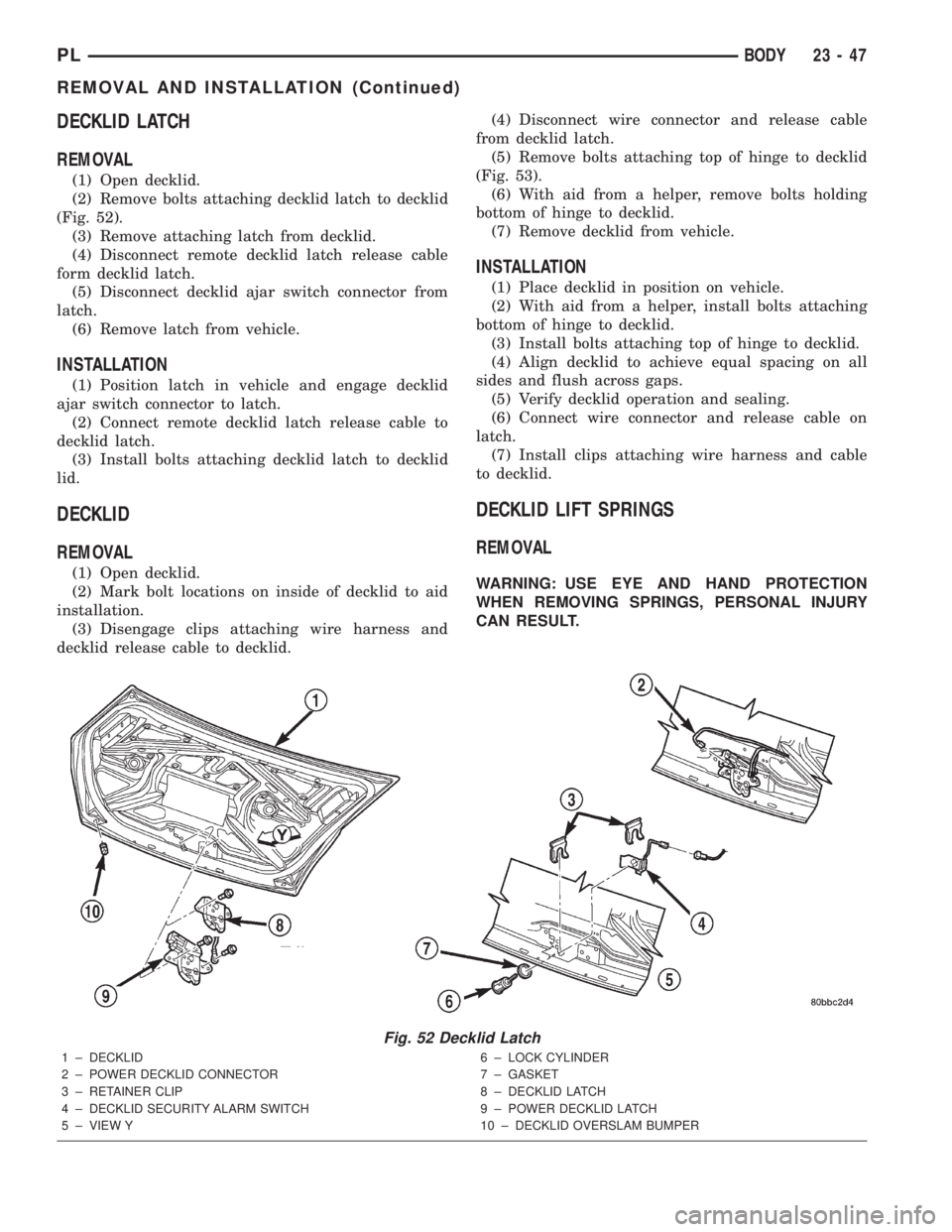
DECKLID LATCH
REMOVAL
(1) Open decklid.
(2) Remove bolts attaching decklid latch to decklid
(Fig. 52).
(3) Remove attaching latch from decklid.
(4) Disconnect remote decklid latch release cable
form decklid latch.
(5) Disconnect decklid ajar switch connector from
latch.
(6) Remove latch from vehicle.
INSTALLATION
(1) Position latch in vehicle and engage decklid
ajar switch connector to latch.
(2) Connect remote decklid latch release cable to
decklid latch.
(3) Install bolts attaching decklid latch to decklid
lid.
DECKLID
REMOVAL
(1) Open decklid.
(2) Mark bolt locations on inside of decklid to aid
installation.
(3) Disengage clips attaching wire harness and
decklid release cable to decklid.(4) Disconnect wire connector and release cable
from decklid latch.
(5) Remove bolts attaching top of hinge to decklid
(Fig. 53).
(6) With aid from a helper, remove bolts holding
bottom of hinge to decklid.
(7) Remove decklid from vehicle.
INSTALLATION
(1) Place decklid in position on vehicle.
(2) With aid from a helper, install bolts attaching
bottom of hinge to decklid.
(3) Install bolts attaching top of hinge to decklid.
(4) Align decklid to achieve equal spacing on all
sides and flush across gaps.
(5) Verify decklid operation and sealing.
(6) Connect wire connector and release cable on
latch.
(7) Install clips attaching wire harness and cable
to decklid.
DECKLID LIFT SPRINGS
REMOVAL
WARNING: USE EYE AND HAND PROTECTION
WHEN REMOVING SPRINGS, PERSONAL INJURY
CAN RESULT.
Fig. 52 Decklid Latch
1 ± DECKLID
2 ± POWER DECKLID CONNECTOR
3 ± RETAINER CLIP
4 ± DECKLID SECURITY ALARM SWITCH
5 ± VIEW Y6 ± LOCK CYLINDER
7 ± GASKET
8 ± DECKLID LATCH
9 ± POWER DECKLID LATCH
10 ± DECKLID OVERSLAM BUMPER
PLBODY 23 - 47
REMOVAL AND INSTALLATION (Continued)
Page 1166 of 1285
DECKLID OPENING WEATHERSTRIP
REMOVAL
(1) Open decklid.
(2) Pull decklid weatherstrip form decklid opening
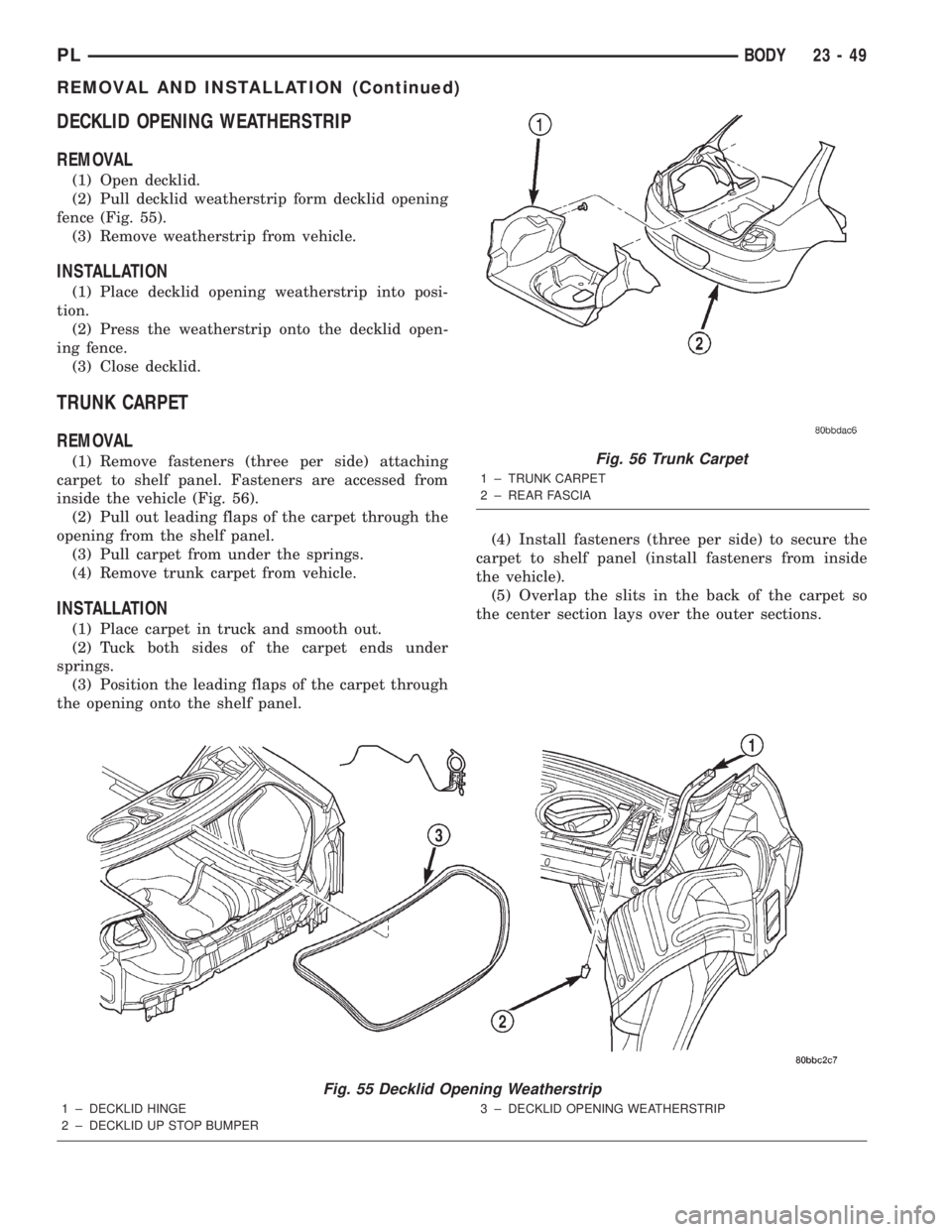
fence (Fig. 55).
(3) Remove weatherstrip from vehicle.
INSTALLATION
(1) Place decklid opening weatherstrip into posi-
tion.
(2) Press the weatherstrip onto the decklid open-
ing fence.
(3) Close decklid.
TRUNK CARPET
REMOVAL
(1) Remove fasteners (three per side) attaching
carpet to shelf panel. Fasteners are accessed from
inside the vehicle (Fig. 56).
(2) Pull out leading flaps of the carpet through the
opening from the shelf panel.
(3) Pull carpet from under the springs.
(4) Remove trunk carpet from vehicle.
INSTALLATION
(1) Place carpet in truck and smooth out.
(2) Tuck both sides of the carpet ends under
springs.
(3) Position the leading flaps of the carpet through
the opening onto the shelf panel.(4) Install fasteners (three per side) to secure the
carpet to shelf panel (install fasteners from inside
the vehicle).
(5) Overlap the slits in the back of the carpet so
the center section lays over the outer sections.
Fig. 55 Decklid Opening Weatherstrip
1 ± DECKLID HINGE
2 ± DECKLID UP STOP BUMPER3 ± DECKLID OPENING WEATHERSTRIP
Fig. 56 Trunk Carpet
1 ± TRUNK CARPET
2 ± REAR FASCIA
PLBODY 23 - 49
REMOVAL AND INSTALLATION (Continued)
Page 1259 of 1285
REMOVAL
(1) Remove the wire connector from the low pres-
sure cut-off switch.
(2) Remove the center bolt of refrigerant line
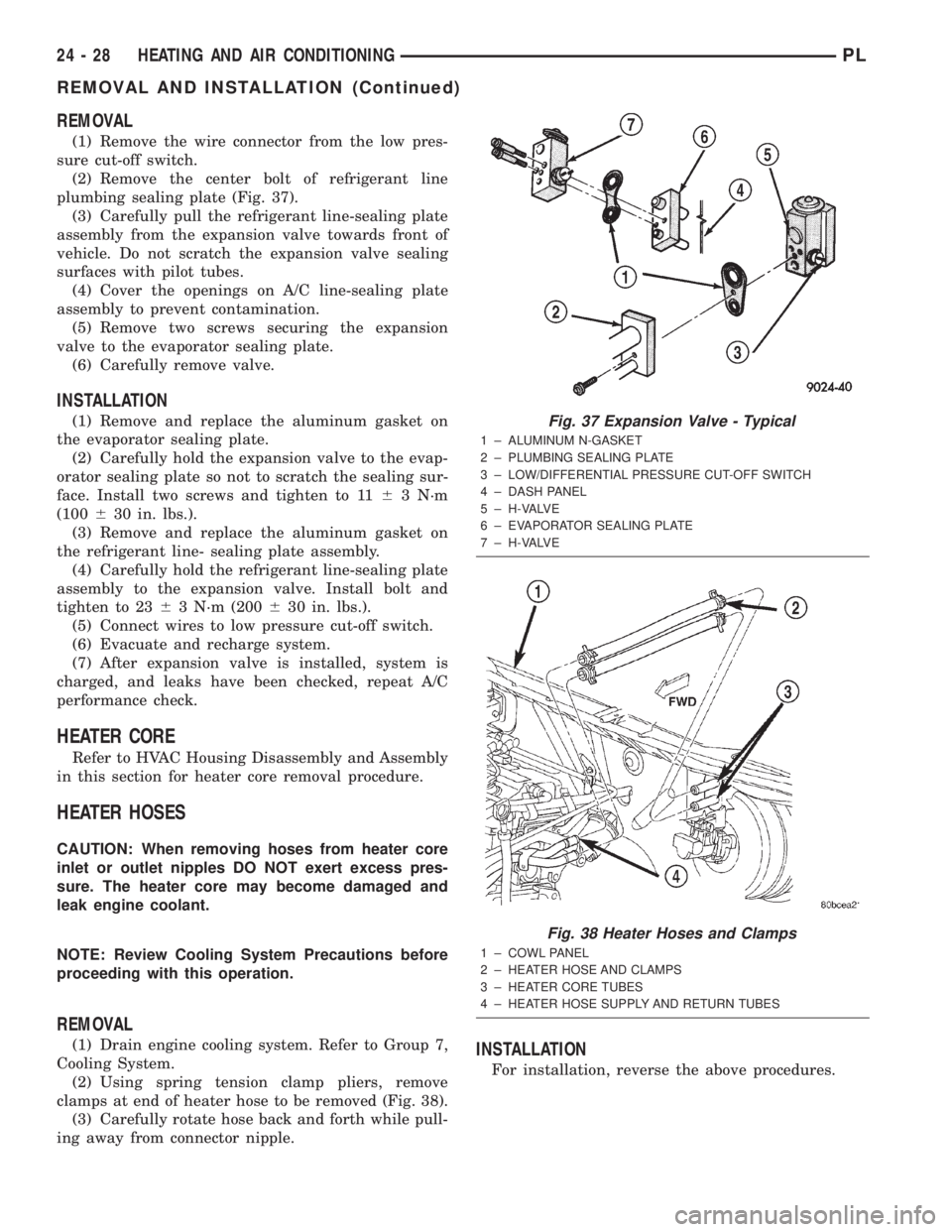
plumbing sealing plate (Fig. 37).
(3) Carefully pull the refrigerant line-sealing plate
assembly from the expansion valve towards front of
vehicle. Do not scratch the expansion valve sealing
surfaces with pilot tubes.
(4) Cover the openings on A/C line-sealing plate
assembly to prevent contamination.
(5) Remove two screws securing the expansion
valve to the evaporator sealing plate.
(6) Carefully remove valve.
INSTALLATION
(1) Remove and replace the aluminum gasket on
the evaporator sealing plate.
(2) Carefully hold the expansion valve to the evap-
orator sealing plate so not to scratch the sealing sur-
face. Install two screws and tighten to 1163 N´m
(100630 in. lbs.).
(3) Remove and replace the aluminum gasket on
the refrigerant line- sealing plate assembly.
(4) Carefully hold the refrigerant line-sealing plate
assembly to the expansion valve. Install bolt and
tighten to 2363 N´m (200630 in. lbs.).
(5) Connect wires to low pressure cut-off switch.
(6) Evacuate and recharge system.
(7) After expansion valve is installed, system is
charged, and leaks have been checked, repeat A/C
performance check.
HEATER CORE
Refer to HVAC Housing Disassembly and Assembly
in this section for heater core removal procedure.
HEATER HOSES
CAUTION: When removing hoses from heater core
inlet or outlet nipples DO NOT exert excess pres-
sure. The heater core may become damaged and
leak engine coolant.
NOTE: Review Cooling System Precautions before
proceeding with this operation.
REMOVAL
(1) Drain engine cooling system. Refer to Group 7,
Cooling System.
(2) Using spring tension clamp pliers, remove
clamps at end of heater hose to be removed (Fig. 38).
(3) Carefully rotate hose back and forth while pull-
ing away from connector nipple.INSTALLATION
For installation, reverse the above procedures.
Fig. 37 Expansion Valve - Typical
1 ± ALUMINUM N-GASKET
2 ± PLUMBING SEALING PLATE
3 ± LOW/DIFFERENTIAL PRESSURE CUT-OFF SWITCH
4 ± DASH PANEL
5 ± H-VALVE
6 ± EVAPORATOR SEALING PLATE
7 ± H-VALVE
Fig. 38 Heater Hoses and Clamps
1 ± COWL PANEL
2 ± HEATER HOSE AND CLAMPS
3 ± HEATER CORE TUBES
4 ± HEATER HOSE SUPPLY AND RETURN TUBES
24 - 28 HEATING AND AIR CONDITIONINGPL
REMOVAL AND INSTALLATION (Continued)
Page 1269 of 1285
(15) Remove the heater core cover from the hous-
ing assembly.
(16) Remove the coolant lines from the heater core.
(17) Remove the screws necessary to disassemble
the A/C-Heater housing assembly.
(18) Remove the evaporator coil from the A/C-
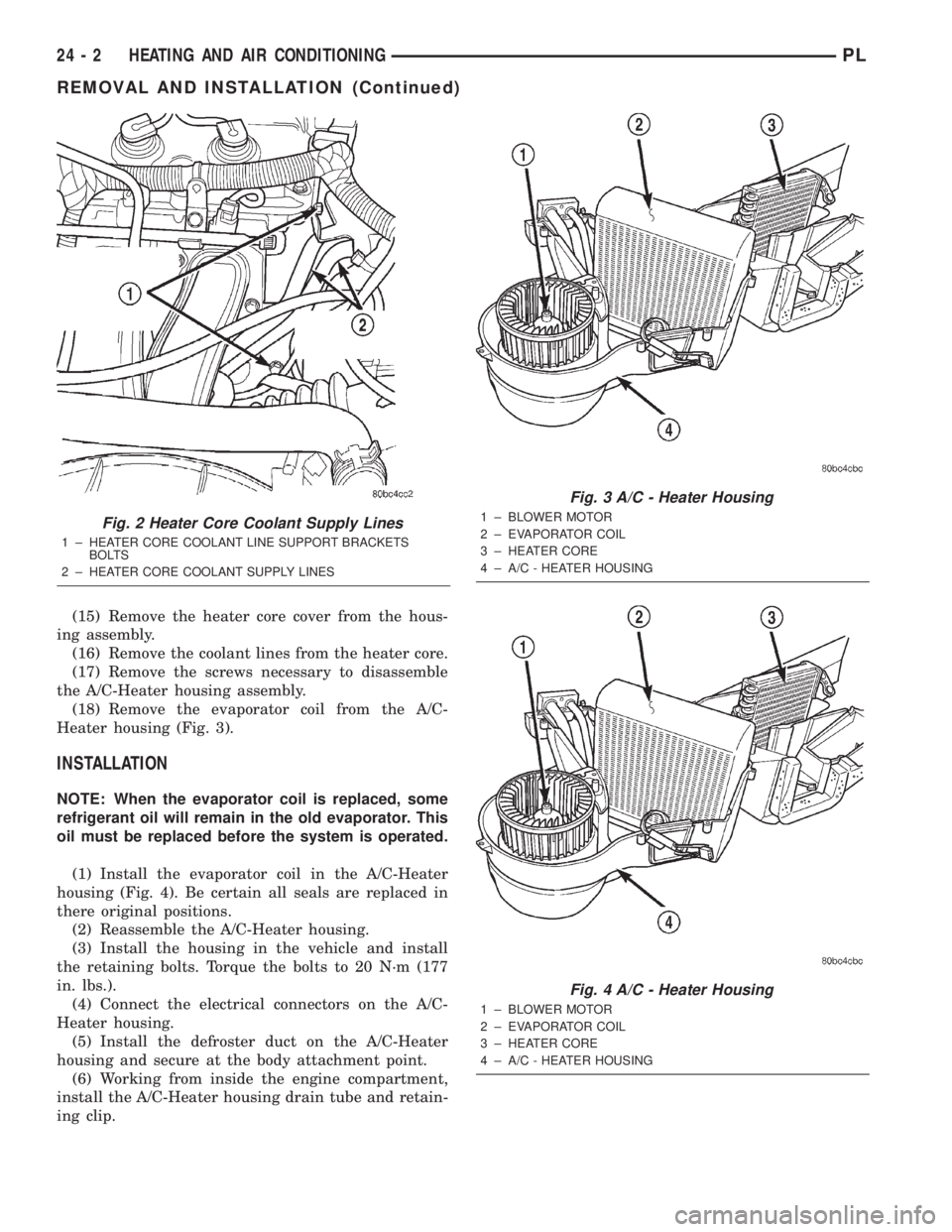
Heater housing (Fig. 3).
INSTALLATION
NOTE: When the evaporator coil is replaced, some
refrigerant oil will remain in the old evaporator. This
oil must be replaced before the system is operated.
(1) Install the evaporator coil in the A/C-Heater
housing (Fig. 4). Be certain all seals are replaced in
there original positions.
(2) Reassemble the A/C-Heater housing.
(3) Install the housing in the vehicle and install
the retaining bolts. Torque the bolts to 20 N´m (177
in. lbs.).
(4) Connect the electrical connectors on the A/C-
Heater housing.
(5) Install the defroster duct on the A/C-Heater
housing and secure at the body attachment point.
(6) Working from inside the engine compartment,
install the A/C-Heater housing drain tube and retain-
ing clip.
Fig. 2 Heater Core Coolant Supply Lines
1 ± HEATER CORE COOLANT LINE SUPPORT BRACKETS
BOLTS
2 ± HEATER CORE COOLANT SUPPLY LINES
Fig. 3 A/C - Heater Housing
1 ± BLOWER MOTOR
2 ± EVAPORATOR COIL
3 ± HEATER CORE
4 ± A/C - HEATER HOUSING
Fig. 4 A/C - Heater Housing
1 ± BLOWER MOTOR
2 ± EVAPORATOR COIL
3 ± HEATER CORE
4 ± A/C - HEATER HOUSING
24 - 2 HEATING AND AIR CONDITIONINGPL
REMOVAL AND INSTALLATION (Continued)