2000 DODGE NEON ECU
[x] Cancel search: ECUPage 1121 of 1285
STATIONARY GLASS
TABLE OF CONTENTS
page page
DESCRIPTION AND OPERATION
SAFETY PRECAUTIONS....................4
REMOVAL AND INSTALLATION
WINDSHIELD.............................4REAR WINDOW...........................6
DESCRIPTION AND OPERATION
SAFETY PRECAUTIONS
WARNING: DO NOT OPERATE THE VEHICLE
WITHIN 24 HOURS OF WINDSHIELD INSTALLATION.
IT TAKES AT LEAST 24 HOURS FOR URETHANE
ADHESIVE TO CURE. IF IT IS NOT CURED, THE
WINDSHIELD MAY NOT PERFORM PROPERLY IN
AN ACCIDENT.
URETHANE ADHESIVES ARE APPLIED AS A SYS-
TEM. USE GLASS CLEANER, GLASS PREP SOL-
VENT, GLASS PRIMER, PVC (VINYL) PRIMER AND
PINCH WELD (FENCE) PRIMER PROVIDED BY THE
ADHESIVE MANUFACTURER. IF NOT, STRUCTURAL
INTEGRITY COULD BE COMPROMISED.
CHRYSLER DOES NOT RECOMMEND GLASS
ADHESIVE BY BRAND. TECHNICIANS SHOULD
REVIEW PRODUCT LABELS AND TECHNICAL DATA
SHEETS, AND USE ONLY ADHESIVES THAT THEIR
MANUFACTURES WARRANT WILL RESTORE A
VEHICLE TO THE REQUIREMENTS OF FMVSS 212.
TECHNICIANS SHOULD ALSO INSURE THAT PRIM-
ERS AND CLEANERS ARE COMPATIBLE WITH THE
PARTICULAR ADHESIVE USED.
BE SURE TO REFER TO THE URETHANE MANU-
FACTURER'S DIRECTIONS FOR CURING TIME
SPECIFICATIONS, AND DO NOT USE ADHESIVE
AFTER ITS EXPIRATION DATE.
VAPORS THAT ARE EMITTED FROM THE URE-
THANE ADHESIVE OR PRIMER COULD CAUSE
PERSONAL INJURY. USE THEM IN A WELL-VENTI-
LATED AREA.
SKIN CONTACT WITH URETHANE ADHESIVE
SHOULD BE AVOIDED. PERSONAL INJURY MAY
RESULT.
ALWAYS WEAR EYE AND HAND PROTECTION
WHEN WORKING WITH GLASS.
CAUTION: Protect all painted and trimmed surfaces
from coming in contact with urethane or primers.
Be careful not to damage painted surfaces when
removing moldings or cutting urethane around
windshield.It is difficult to salvage a windshield during the
removal operation. The windshield is part of the
structural support for the roof. The urethane bonding
used to secure the windshield to the fence is difficult
to cut or clean from any surface. If the moldings are
set in urethane, it would also be unlikely they could
be salvaged. Before removing the windshield, check
the availability of the windshield and moldings from
the parts supplier.
REMOVAL AND INSTALLATION
WINDSHIELD
The urethane adhesive holding the windshield to
the opening pinch weld (fence) can be cut using a
sharp cold knife from the exterior of the vehicle.
Using the cold knife method is effective if the wind-
shield is already broken. If the glass must be sal-
vaged, cutting the urethane adhesive from the
interior of the vehicle using a reciprocating or oscil-
lating power knife is recommended.
RECOMMENDED TOOLS AND ADHESIVE
POWER KNIFE
²FeintPower Cutout Knife
²EqualizertMagnum, Interior Auto Glass Cut
Out Knife
ADHESIVE, PRIMER AND CLEANER
The following urethane adhesive systems are OEM
certified and conform to the FMVSS 212 windshield
retention standard and the FMVSS 216 roof crush
standard.
WINDSHIELD REMOVAL ± EXTERIOR METHOD
(1) Remove inside rear view mirror.
(2) Remove windshield wiper arms.
(3) Remove cowl cover.
23 - 4 BODYPL
Page 1130 of 1285
DESCRIPTION AND OPERATION
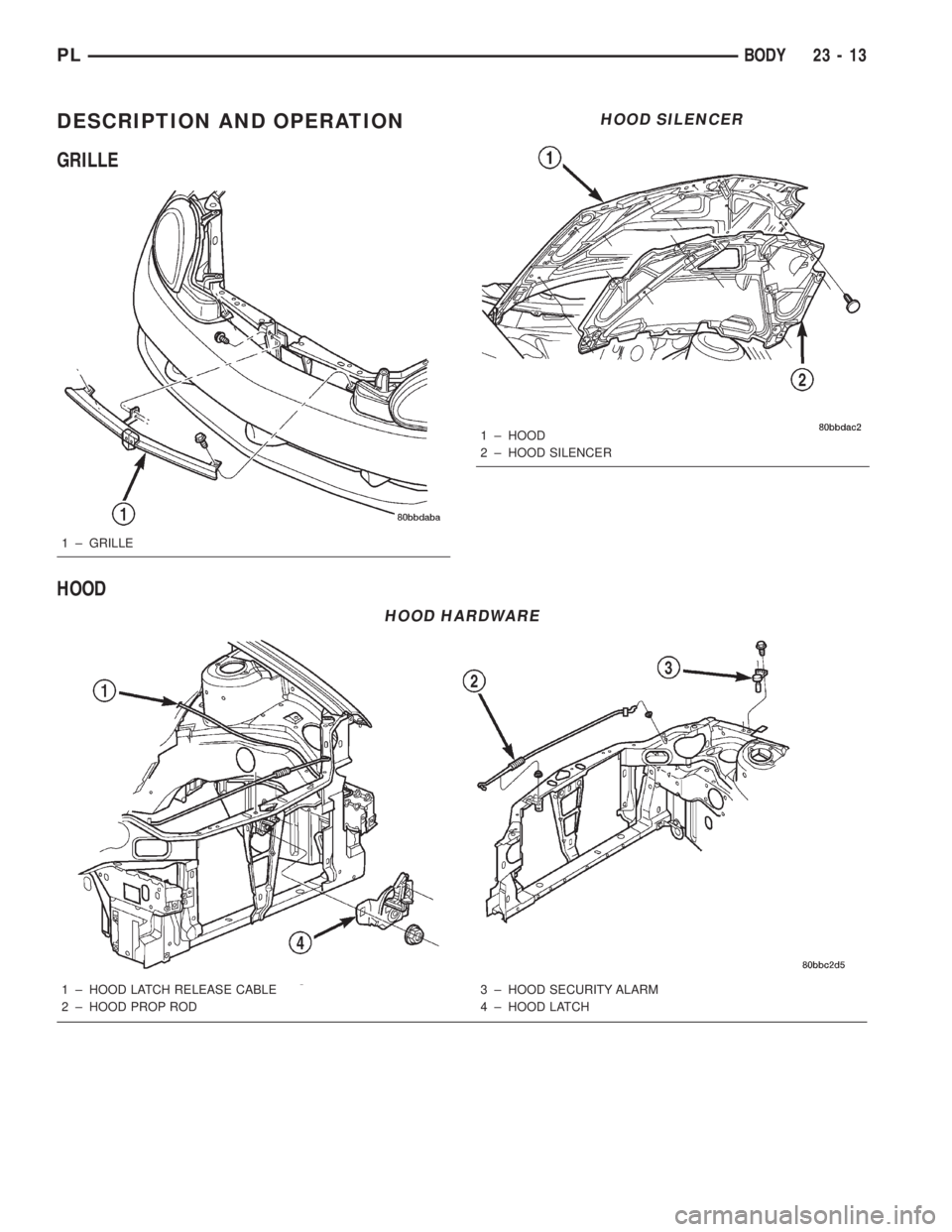
GRILLE
HOOD
1 ± GRILLE
HOOD HARDWARE
1 ± HOOD LATCH RELEASE CABLE
2 ± HOOD PROP ROD3 ± HOOD SECURITY ALARM
4 ± HOOD LATCH
HOOD SILENCER
1 ± HOOD
2 ± HOOD SILENCER
PLBODY 23 - 13
Page 1136 of 1285
WIND NOISE
Wind noise is the result of most air leaks. Air leaks
can be caused by poor sealing, improper body compo-
nent alignment, body seam porosity, or missing plugs
in the engine compartment or door hinge pillar areas.
All body sealing points should be airtight in normal
driving conditions. Moving sealing surfaces will not
always seal airtight under all conditions. At times,
side glass or door seals will allow wind noise to be
noticed in the passenger compartment during high
cross winds. Over compensating on door or glass
adjustments to stop wind noise that occurs under
severe conditions can cause premature seal wear and
excessive closing or latching effort. After a repair pro-
cedure has been performed, test vehicle to verify
noise has stopped before returning vehicle to use.
Wind noise can also be caused by improperly fitted
exterior moldings or body ornamentation. Loose
moldings can flutter, creating a buzzing or chattering
noise. An open cavity or protruding edge can create a
whistling or howling noise. Inspect the exterior of the
vehicle to verify that these conditions do not exist.
VISUAL INSPECTION BEFORE TESTS
Verify that floor and body plugs are in place and
body components are aligned and sealed. If compo-
nent alignment or sealing is necessary, refer to the
appropriate section of this group for proper proce-
dures.
ROAD TESTING WIND NOISE
(1) Drive the vehicle to verify the general location
of the wind noise.
(2) Apply 50 mm (2 in.) masking tape in 150 mm
(6 in.) lengths along weatherstrips, weld seams or
moldings. After each length is applied, drive the vehi-
cle. If noise goes away after a piece of tape is applied,
remove tape, locate, and repair defect.
POSSIBLE CAUSE OF WIND NOISE
²Moldings standing away from body surface can
catch wind and whistle.
²Gaps in sealed areas behind overhanging body
flanges can cause wind-rushing sounds.
²Misaligned movable components.
²Missing or improperly installed plugs in pillars.
²Weld burn through holes.
SERVICE PROCEDURES
HEAT STAKING
(1) Remove trim panel.
(2) Bend or move the trim panel components at
the heat staked joints. Observe the heat staked loca-
tions and/or component seams for looseness.(3) Heat stake the components.
(a) If the heat staked or component seam loca-
tion is loose, hold the two components tightly
together and using a soldering gun with a flat tip,
melt the material securing the components
together. Do not over heat the affected area, dam-
age to the exterior of the trim panel may occur.
(b) If the heat staked material is broken or miss-
ing, use a hot glue gun to apply new material to
the area to be repaired. The panels that are being
heat staked must be held together while the apply-
ing the glue. Once the new material is in place, it
may be necessary to use a soldering gun to melt
the newly applied material. Do not over heat the
affected area, damage to the exterior of the trim
panel may occur.
(4) Allow the repaired area to cool and verify the
repair.
(5) Install trim panel.
PLASTIC BODY PANEL REPAIR
DESCRIPTION OPERATION
Resin Transfer Molded (RTM) body panels are rein-
forced with a continuous fiberglass mesh. Epoxy
resin is injected into a gel-coated and fiberglass-lined
mold to form a body panel. Sheet molded compound
(SMC) body panels are constructed with fiberglass
strands usually 1 inch or shorter, epoxy resin formed
into sheet stock and pressed in mold flowing material
to form a sheet molded compound (SMC) body panel.
RTM and SMC body panels can be repaired with
epoxy adhesive after market products. Refer to
instructions provided by the manufacturer of prod-
ucts being used to repair RTM or SMC. Daimler-
Chrysler Corporation recommends that a trained
automotive body technician perform body panel
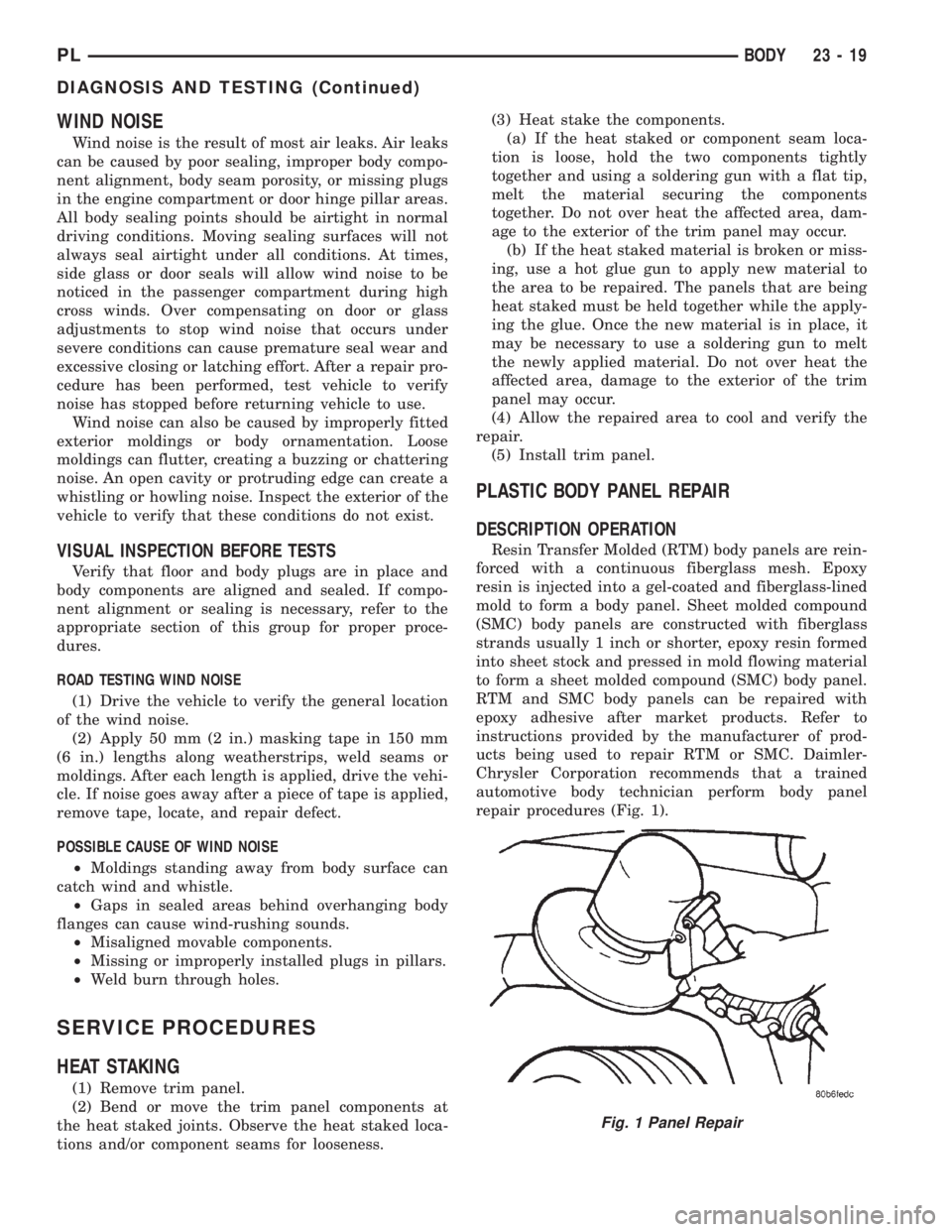
repair procedures (Fig. 1).
Fig. 1 Panel Repair
PLBODY 23 - 19
DIAGNOSIS AND TESTING (Continued)
Page 1139 of 1285
from was and oil. Scuff surfaces around repair area
with 360 grit wet/dry sand paper, or equivalent, to
assure adhesion of epoxy repair materials.
PATCHING PANELS
An RTM or SMC panel that has extensive punc-
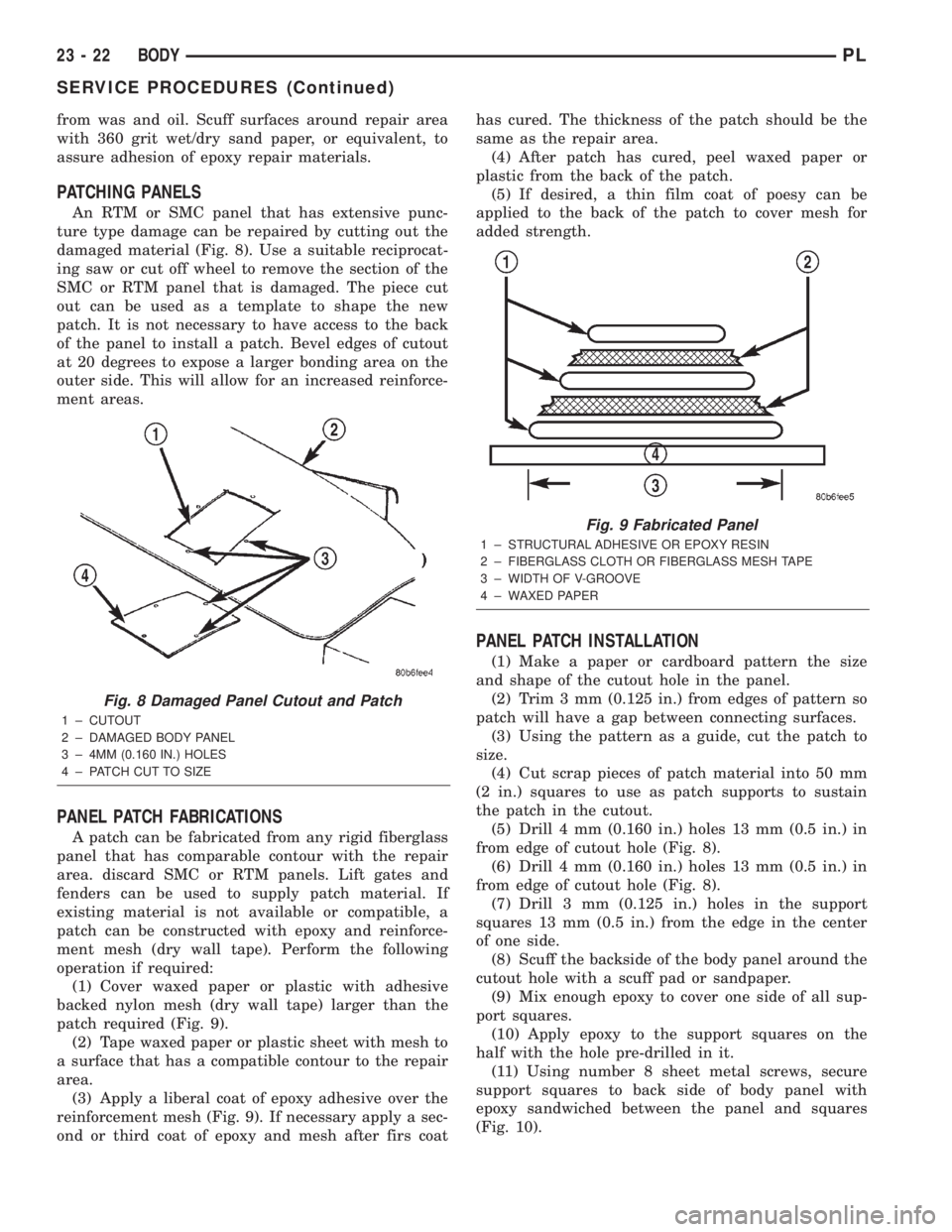
ture type damage can be repaired by cutting out the
damaged material (Fig. 8). Use a suitable reciprocat-
ing saw or cut off wheel to remove the section of the
SMC or RTM panel that is damaged. The piece cut
out can be used as a template to shape the new
patch. It is not necessary to have access to the back
of the panel to install a patch. Bevel edges of cutout
at 20 degrees to expose a larger bonding area on the
outer side. This will allow for an increased reinforce-
ment areas.
PANEL PATCH FABRICATIONS
A patch can be fabricated from any rigid fiberglass
panel that has comparable contour with the repair
area. discard SMC or RTM panels. Lift gates and
fenders can be used to supply patch material. If
existing material is not available or compatible, a
patch can be constructed with epoxy and reinforce-
ment mesh (dry wall tape). Perform the following
operation if required:
(1) Cover waxed paper or plastic with adhesive
backed nylon mesh (dry wall tape) larger than the
patch required (Fig. 9).
(2) Tape waxed paper or plastic sheet with mesh to
a surface that has a compatible contour to the repair
area.
(3) Apply a liberal coat of epoxy adhesive over the
reinforcement mesh (Fig. 9). If necessary apply a sec-
ond or third coat of epoxy and mesh after firs coathas cured. The thickness of the patch should be the
same as the repair area.
(4) After patch has cured, peel waxed paper or
plastic from the back of the patch.
(5) If desired, a thin film coat of poesy can be
applied to the back of the patch to cover mesh for
added strength.
PANEL PATCH INSTALLATION
(1) Make a paper or cardboard pattern the size
and shape of the cutout hole in the panel.
(2) Trim 3 mm (0.125 in.) from edges of pattern so
patch will have a gap between connecting surfaces.
(3) Using the pattern as a guide, cut the patch to
size.
(4) Cut scrap pieces of patch material into 50 mm
(2 in.) squares to use as patch supports to sustain
the patch in the cutout.
(5) Drill 4 mm (0.160 in.) holes 13 mm (0.5 in.) in
from edge of cutout hole (Fig. 8).
(6) Drill 4 mm (0.160 in.) holes 13 mm (0.5 in.) in
from edge of cutout hole (Fig. 8).
(7) Drill 3 mm (0.125 in.) holes in the support
squares 13 mm (0.5 in.) from the edge in the center
of one side.
(8) Scuff the backside of the body panel around the
cutout hole with a scuff pad or sandpaper.
(9) Mix enough epoxy to cover one side of all sup-
port squares.
(10) Apply epoxy to the support squares on the
half with the hole pre-drilled in it.
(11) Using number 8 sheet metal screws, secure
support squares to back side of body panel with
epoxy sandwiched between the panel and squares
(Fig. 10).
Fig. 8 Damaged Panel Cutout and Patch
1 ± CUTOUT
2 ± DAMAGED BODY PANEL
3 ± 4MM (0.160 IN.) HOLES
4 ± PATCH CUT TO SIZE
Fig. 9 Fabricated Panel
1 ± STRUCTURAL ADHESIVE OR EPOXY RESIN
2 ± FIBERGLASS CLOTH OR FIBERGLASS MESH TAPE
3 ± WIDTH OF V-GROOVE
4 ± WAXED PAPER
23 - 22 BODYPL
SERVICE PROCEDURES (Continued)
Page 1140 of 1285
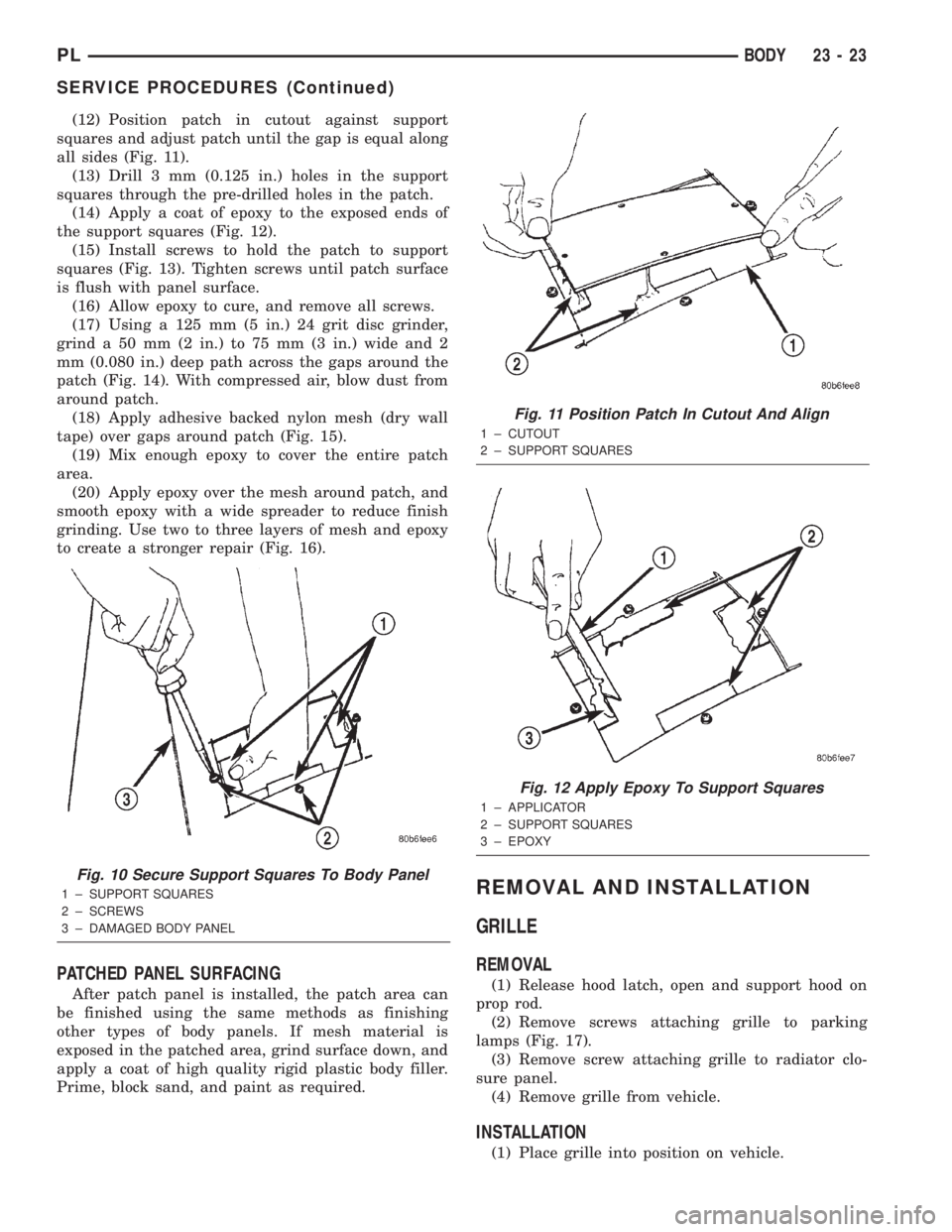
(12) Position patch in cutout against support
squares and adjust patch until the gap is equal along
all sides (Fig. 11).
(13) Drill 3 mm (0.125 in.) holes in the support
squares through the pre-drilled holes in the patch.
(14) Apply a coat of epoxy to the exposed ends of
the support squares (Fig. 12).
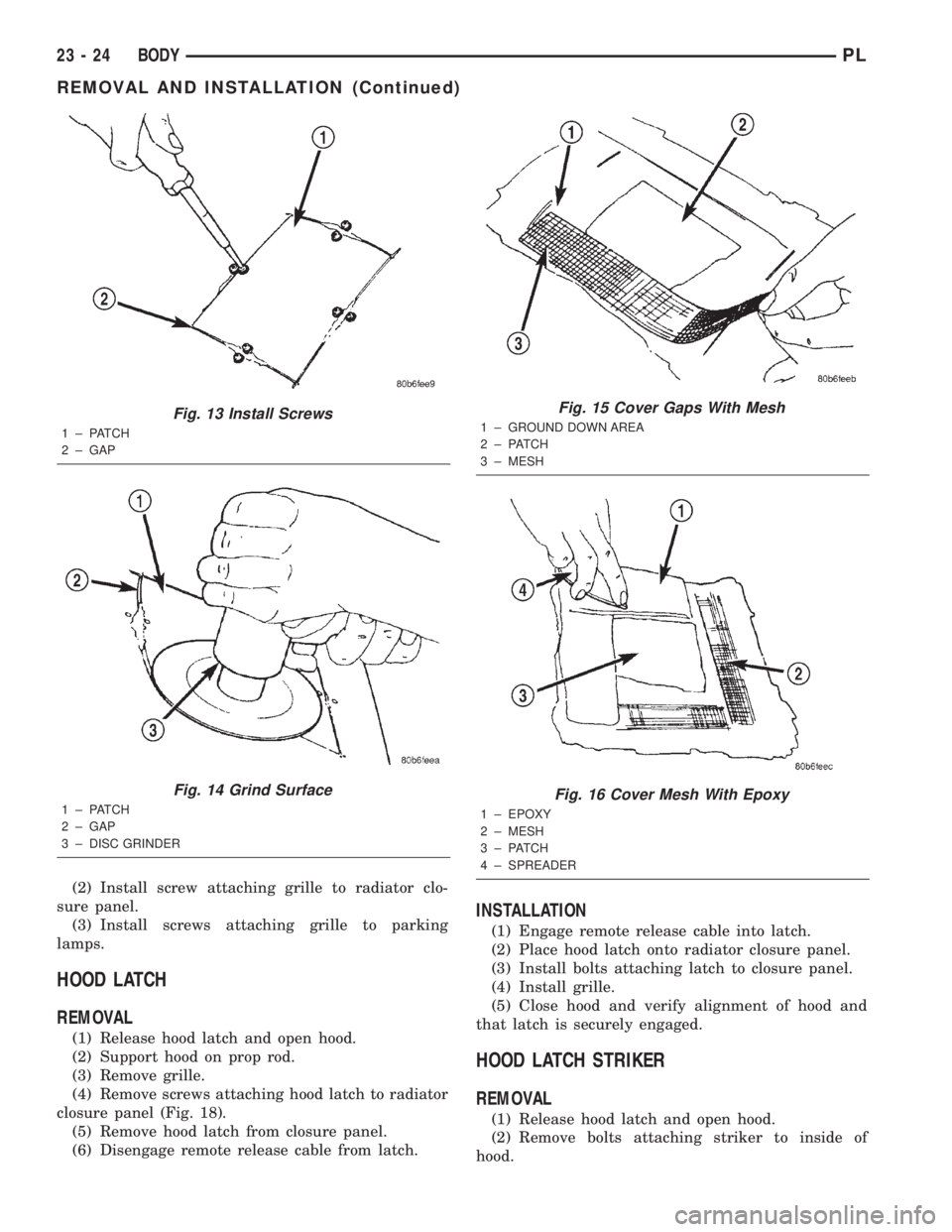
(15) Install screws to hold the patch to support
squares (Fig. 13). Tighten screws until patch surface
is flush with panel surface.
(16) Allow epoxy to cure, and remove all screws.
(17) Using a 125 mm (5 in.) 24 grit disc grinder,
grind a 50 mm (2 in.) to 75 mm (3 in.) wide and 2
mm (0.080 in.) deep path across the gaps around the
patch (Fig. 14). With compressed air, blow dust from
around patch.
(18) Apply adhesive backed nylon mesh (dry wall
tape) over gaps around patch (Fig. 15).
(19) Mix enough epoxy to cover the entire patch
area.
(20) Apply epoxy over the mesh around patch, and
smooth epoxy with a wide spreader to reduce finish
grinding. Use two to three layers of mesh and epoxy
to create a stronger repair (Fig. 16).
PATCHED PANEL SURFACING
After patch panel is installed, the patch area can
be finished using the same methods as finishing
other types of body panels. If mesh material is
exposed in the patched area, grind surface down, and
apply a coat of high quality rigid plastic body filler.
Prime, block sand, and paint as required.
REMOVAL AND INSTALLATION
GRILLE
REMOVAL
(1) Release hood latch, open and support hood on
prop rod.
(2) Remove screws attaching grille to parking
lamps (Fig. 17).
(3) Remove screw attaching grille to radiator clo-
sure panel.
(4) Remove grille from vehicle.
INSTALLATION
(1) Place grille into position on vehicle.
Fig. 10 Secure Support Squares To Body Panel
1 ± SUPPORT SQUARES
2 ± SCREWS
3 ± DAMAGED BODY PANEL
Fig. 11 Position Patch In Cutout And Align
1 ± CUTOUT
2 ± SUPPORT SQUARES
Fig. 12 Apply Epoxy To Support Squares
1 ± APPLICATOR
2 ± SUPPORT SQUARES
3 ± EPOXY
PLBODY 23 - 23
SERVICE PROCEDURES (Continued)
Page 1141 of 1285
(2) Install screw attaching grille to radiator clo-
sure panel.
(3) Install screws attaching grille to parking
lamps.
HOOD LATCH
REMOVAL
(1) Release hood latch and open hood.
(2) Support hood on prop rod.
(3) Remove grille.
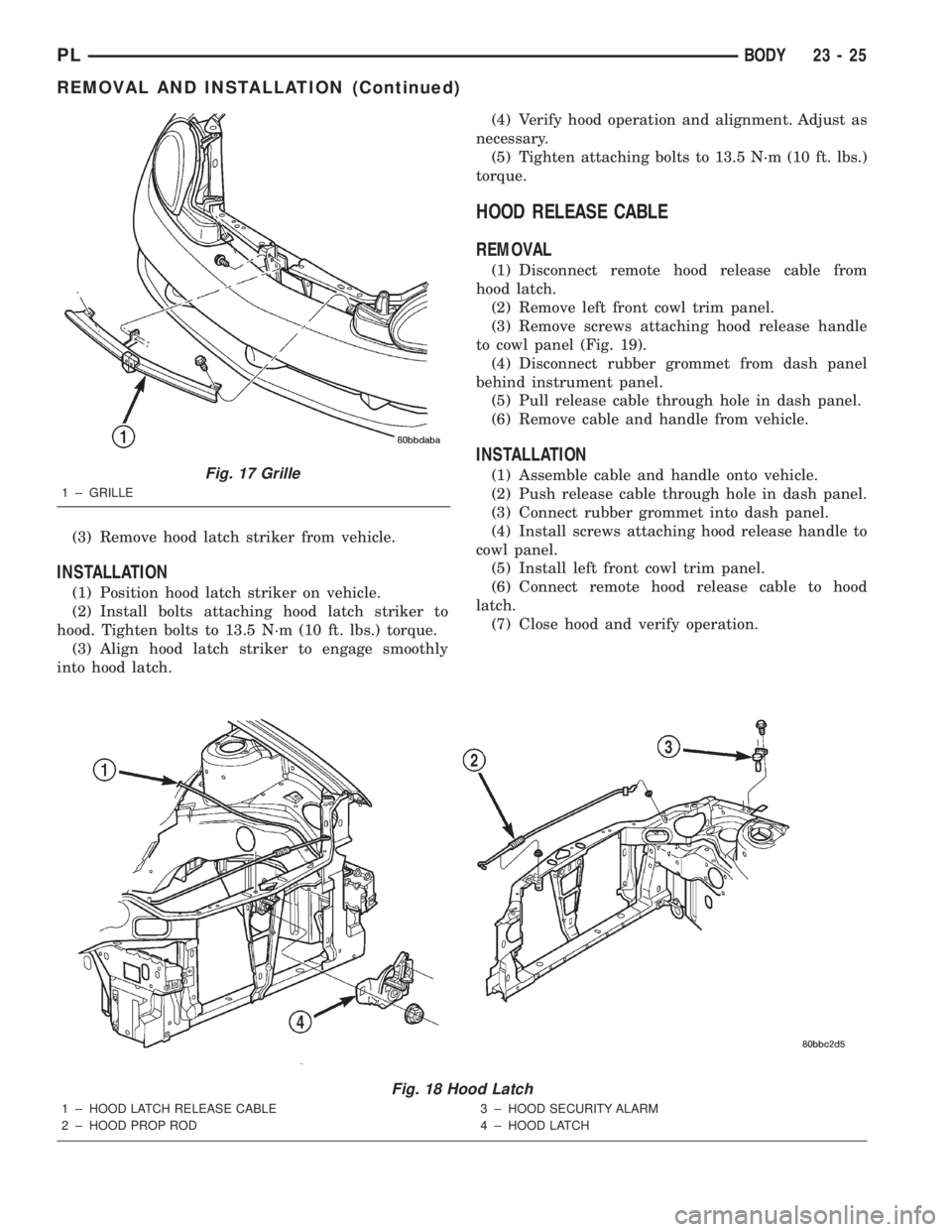
(4) Remove screws attaching hood latch to radiator
closure panel (Fig. 18).
(5) Remove hood latch from closure panel.
(6) Disengage remote release cable from latch.
INSTALLATION
(1) Engage remote release cable into latch.
(2) Place hood latch onto radiator closure panel.
(3) Install bolts attaching latch to closure panel.
(4) Install grille.
(5) Close hood and verify alignment of hood and
that latch is securely engaged.
HOOD LATCH STRIKER
REMOVAL
(1) Release hood latch and open hood.
(2) Remove bolts attaching striker to inside of
hood.
Fig. 13 Install Screws
1 ± PATCH
2 ± GAP
Fig. 14 Grind Surface
1 ± PATCH
2 ± GAP
3 ± DISC GRINDER
Fig. 15 Cover Gaps With Mesh
1 ± GROUND DOWN AREA
2 ± PATCH
3 ± MESH
Fig. 16 Cover Mesh With Epoxy
1 ± EPOXY
2 ± MESH
3 ± PATCH
4 ± SPREADER
23 - 24 BODYPL
REMOVAL AND INSTALLATION (Continued)
Page 1142 of 1285
(3) Remove hood latch striker from vehicle.
INSTALLATION
(1) Position hood latch striker on vehicle.
(2) Install bolts attaching hood latch striker to
hood. Tighten bolts to 13.5 N´m (10 ft. lbs.) torque.
(3) Align hood latch striker to engage smoothly
into hood latch.(4) Verify hood operation and alignment. Adjust as
necessary.
(5) Tighten attaching bolts to 13.5 N´m (10 ft. lbs.)
torque.
HOOD RELEASE CABLE
REMOVAL
(1) Disconnect remote hood release cable from
hood latch.
(2) Remove left front cowl trim panel.
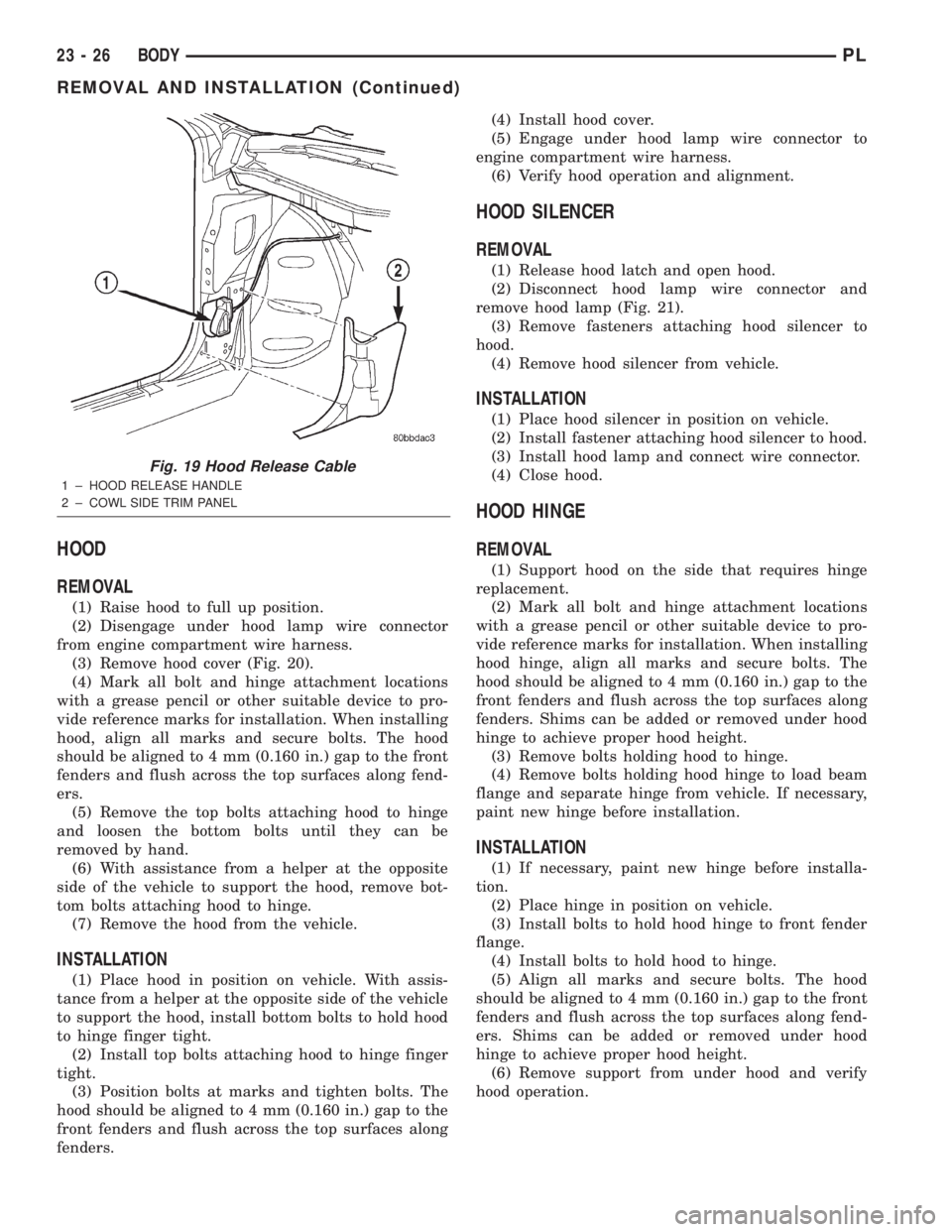
(3) Remove screws attaching hood release handle
to cowl panel (Fig. 19).
(4) Disconnect rubber grommet from dash panel
behind instrument panel.
(5) Pull release cable through hole in dash panel.
(6) Remove cable and handle from vehicle.
INSTALLATION
(1) Assemble cable and handle onto vehicle.
(2) Push release cable through hole in dash panel.
(3) Connect rubber grommet into dash panel.
(4) Install screws attaching hood release handle to
cowl panel.
(5) Install left front cowl trim panel.
(6) Connect remote hood release cable to hood
latch.
(7) Close hood and verify operation.
Fig. 18 Hood Latch
1 ± HOOD LATCH RELEASE CABLE
2 ± HOOD PROP ROD3 ± HOOD SECURITY ALARM
4 ± HOOD LATCH
Fig. 17 Grille
1 ± GRILLE
PLBODY 23 - 25
REMOVAL AND INSTALLATION (Continued)
Page 1143 of 1285
HOOD
REMOVAL
(1) Raise hood to full up position.
(2) Disengage under hood lamp wire connector
from engine compartment wire harness.
(3) Remove hood cover (Fig. 20).
(4) Mark all bolt and hinge attachment locations
with a grease pencil or other suitable device to pro-
vide reference marks for installation. When installing
hood, align all marks and secure bolts. The hood
should be aligned to 4 mm (0.160 in.) gap to the front
fenders and flush across the top surfaces along fend-
ers.
(5) Remove the top bolts attaching hood to hinge
and loosen the bottom bolts until they can be
removed by hand.
(6) With assistance from a helper at the opposite
side of the vehicle to support the hood, remove bot-
tom bolts attaching hood to hinge.
(7) Remove the hood from the vehicle.
INSTALLATION
(1) Place hood in position on vehicle. With assis-
tance from a helper at the opposite side of the vehicle
to support the hood, install bottom bolts to hold hood
to hinge finger tight.
(2) Install top bolts attaching hood to hinge finger
tight.
(3) Position bolts at marks and tighten bolts. The
hood should be aligned to 4 mm (0.160 in.) gap to the
front fenders and flush across the top surfaces along
fenders.(4) Install hood cover.
(5) Engage under hood lamp wire connector to
engine compartment wire harness.
(6) Verify hood operation and alignment.
HOOD SILENCER
REMOVAL
(1) Release hood latch and open hood.
(2) Disconnect hood lamp wire connector and
remove hood lamp (Fig. 21).
(3) Remove fasteners attaching hood silencer to
hood.
(4) Remove hood silencer from vehicle.
INSTALLATION
(1) Place hood silencer in position on vehicle.
(2) Install fastener attaching hood silencer to hood.
(3) Install hood lamp and connect wire connector.
(4) Close hood.
HOOD HINGE
REMOVAL
(1) Support hood on the side that requires hinge
replacement.
(2) Mark all bolt and hinge attachment locations
with a grease pencil or other suitable device to pro-
vide reference marks for installation. When installing
hood hinge, align all marks and secure bolts. The
hood should be aligned to 4 mm (0.160 in.) gap to the
front fenders and flush across the top surfaces along
fenders. Shims can be added or removed under hood
hinge to achieve proper hood height.
(3) Remove bolts holding hood to hinge.
(4) Remove bolts holding hood hinge to load beam
flange and separate hinge from vehicle. If necessary,
paint new hinge before installation.
INSTALLATION
(1) If necessary, paint new hinge before installa-
tion.
(2) Place hinge in position on vehicle.
(3) Install bolts to hold hood hinge to front fender
flange.
(4) Install bolts to hold hood to hinge.
(5) Align all marks and secure bolts. The hood
should be aligned to 4 mm (0.160 in.) gap to the front
fenders and flush across the top surfaces along fend-
ers. Shims can be added or removed under hood
hinge to achieve proper hood height.
(6) Remove support from under hood and verify
hood operation.
Fig. 19 Hood Release Cable
1 ± HOOD RELEASE HANDLE
2 ± COWL SIDE TRIM PANEL
23 - 26 BODYPL
REMOVAL AND INSTALLATION (Continued)