2000 DODGE NEON check engine
[x] Cancel search: check enginePage 848 of 1285
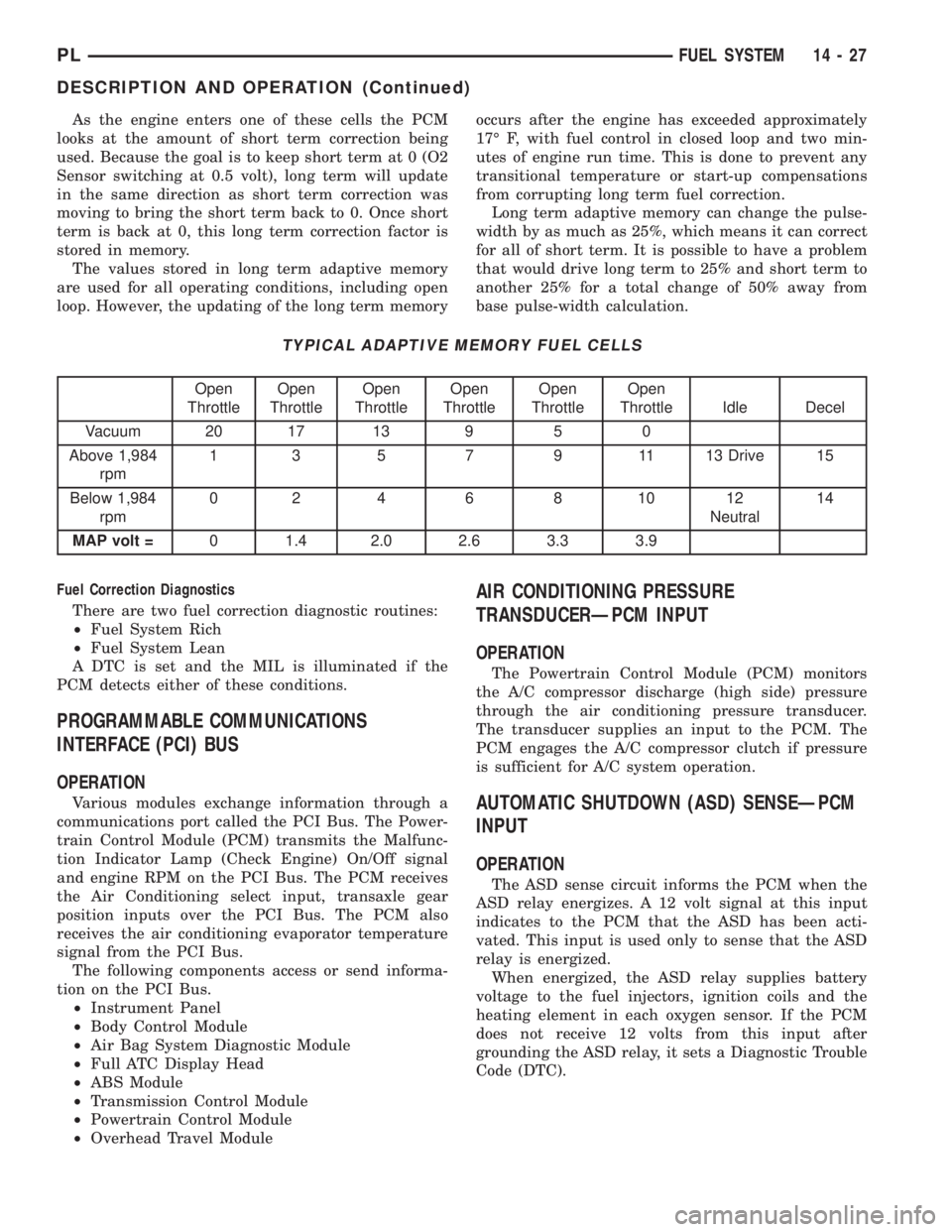
As the engine enters one of these cells the PCM
looks at the amount of short term correction being
used. Because the goal is to keep short term at 0 (O2
Sensor switching at 0.5 volt), long term will update
in the same direction as short term correction was
moving to bring the short term back to 0. Once short
term is back at 0, this long term correction factor is
stored in memory.
The values stored in long term adaptive memory
are used for all operating conditions, including open
loop. However, the updating of the long term memoryoccurs after the engine has exceeded approximately
17É F, with fuel control in closed loop and two min-
utes of engine run time. This is done to prevent any
transitional temperature or start-up compensations
from corrupting long term fuel correction.
Long term adaptive memory can change the pulse-
width by as much as 25%, which means it can correct
for all of short term. It is possible to have a problem
that would drive long term to 25% and short term to
another 25% for a total change of 50% away from
base pulse-width calculation.
TYPICAL ADAPTIVE MEMORY FUEL CELLS
Open
ThrottleOpen
ThrottleOpen
ThrottleOpen
ThrottleOpen
ThrottleOpen
Throttle Idle Decel
Vacuum 20 17 13 9 5 0
Above 1,984
rpm1 3 5 7 9 11 13 Drive 15
Below 1,984
rpm02 4 6 8 1012
Neutral14
MAP volt =0 1.4 2.0 2.6 3.3 3.9
Fuel Correction Diagnostics
There are two fuel correction diagnostic routines:
²Fuel System Rich
²Fuel System Lean
A DTC is set and the MIL is illuminated if the
PCM detects either of these conditions.
PROGRAMMABLE COMMUNICATIONS
INTERFACE (PCI) BUS
OPERATION
Various modules exchange information through a
communications port called the PCI Bus. The Power-
train Control Module (PCM) transmits the Malfunc-
tion Indicator Lamp (Check Engine) On/Off signal
and engine RPM on the PCI Bus. The PCM receives
the Air Conditioning select input, transaxle gear
position inputs over the PCI Bus. The PCM also
receives the air conditioning evaporator temperature
signal from the PCI Bus.
The following components access or send informa-
tion on the PCI Bus.
²Instrument Panel
²Body Control Module
²Air Bag System Diagnostic Module
²Full ATC Display Head
²ABS Module
²Transmission Control Module
²Powertrain Control Module
²Overhead Travel Module
AIR CONDITIONING PRESSURE
TRANSDUCERÐPCM INPUT
OPERATION
The Powertrain Control Module (PCM) monitors
the A/C compressor discharge (high side) pressure
through the air conditioning pressure transducer.
The transducer supplies an input to the PCM. The
PCM engages the A/C compressor clutch if pressure
is sufficient for A/C system operation.
AUTOMATIC SHUTDOWN (ASD) SENSEÐPCM
INPUT
OPERATION
The ASD sense circuit informs the PCM when the
ASD relay energizes. A 12 volt signal at this input
indicates to the PCM that the ASD has been acti-
vated. This input is used only to sense that the ASD
relay is energized.
When energized, the ASD relay supplies battery
voltage to the fuel injectors, ignition coils and the
heating element in each oxygen sensor. If the PCM
does not receive 12 volts from this input after
grounding the ASD relay, it sets a Diagnostic Trouble
Code (DTC).
PLFUEL SYSTEM 14 - 27
DESCRIPTION AND OPERATION (Continued)
Page 862 of 1285
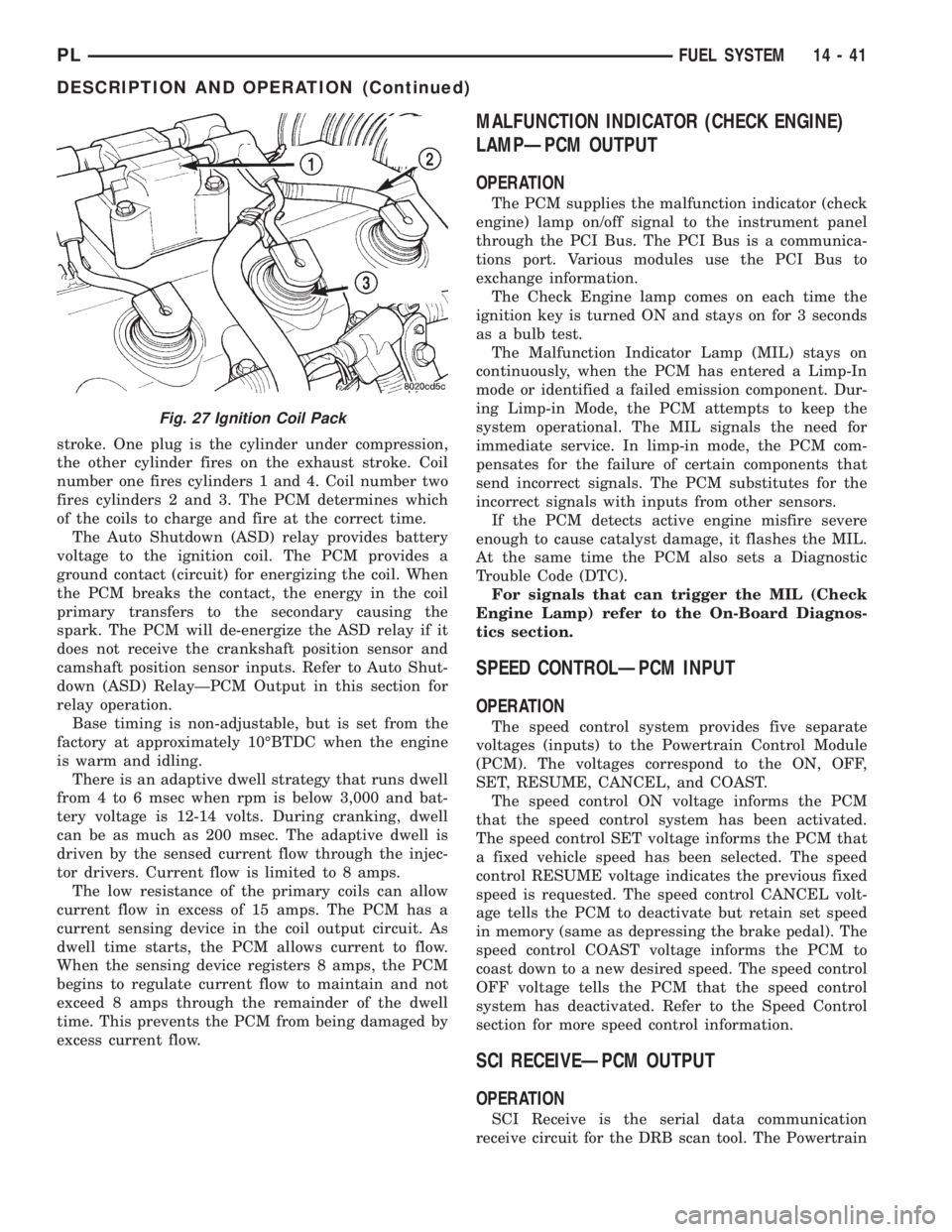
stroke. One plug is the cylinder under compression,
the other cylinder fires on the exhaust stroke. Coil
number one fires cylinders 1 and 4. Coil number two
fires cylinders 2 and 3. The PCM determines which
of the coils to charge and fire at the correct time.
The Auto Shutdown (ASD) relay provides battery
voltage to the ignition coil. The PCM provides a
ground contact (circuit) for energizing the coil. When
the PCM breaks the contact, the energy in the coil
primary transfers to the secondary causing the
spark. The PCM will de-energize the ASD relay if it
does not receive the crankshaft position sensor and
camshaft position sensor inputs. Refer to Auto Shut-
down (ASD) RelayÐPCM Output in this section for
relay operation.
Base timing is non-adjustable, but is set from the
factory at approximately 10ÉBTDC when the engine
is warm and idling.
There is an adaptive dwell strategy that runs dwell
from 4 to 6 msec when rpm is below 3,000 and bat-
tery voltage is 12-14 volts. During cranking, dwell
can be as much as 200 msec. The adaptive dwell is
driven by the sensed current flow through the injec-
tor drivers. Current flow is limited to 8 amps.
The low resistance of the primary coils can allow
current flow in excess of 15 amps. The PCM has a
current sensing device in the coil output circuit. As
dwell time starts, the PCM allows current to flow.
When the sensing device registers 8 amps, the PCM
begins to regulate current flow to maintain and not
exceed 8 amps through the remainder of the dwell
time. This prevents the PCM from being damaged by
excess current flow.
MALFUNCTION INDICATOR (CHECK ENGINE)
LAMPÐPCM OUTPUT
OPERATION
The PCM supplies the malfunction indicator (check
engine) lamp on/off signal to the instrument panel
through the PCI Bus. The PCI Bus is a communica-
tions port. Various modules use the PCI Bus to
exchange information.
The Check Engine lamp comes on each time the
ignition key is turned ON and stays on for 3 seconds
as a bulb test.
The Malfunction Indicator Lamp (MIL) stays on
continuously, when the PCM has entered a Limp-In
mode or identified a failed emission component. Dur-
ing Limp-in Mode, the PCM attempts to keep the
system operational. The MIL signals the need for
immediate service. In limp-in mode, the PCM com-
pensates for the failure of certain components that
send incorrect signals. The PCM substitutes for the
incorrect signals with inputs from other sensors.
If the PCM detects active engine misfire severe
enough to cause catalyst damage, it flashes the MIL.
At the same time the PCM also sets a Diagnostic
Trouble Code (DTC).
For signals that can trigger the MIL (Check
Engine Lamp) refer to the On-Board Diagnos-
tics section.
SPEED CONTROLÐPCM INPUT
OPERATION
The speed control system provides five separate
voltages (inputs) to the Powertrain Control Module
(PCM). The voltages correspond to the ON, OFF,
SET, RESUME, CANCEL, and COAST.
The speed control ON voltage informs the PCM
that the speed control system has been activated.
The speed control SET voltage informs the PCM that
a fixed vehicle speed has been selected. The speed
control RESUME voltage indicates the previous fixed
speed is requested. The speed control CANCEL volt-
age tells the PCM to deactivate but retain set speed
in memory (same as depressing the brake pedal). The
speed control COAST voltage informs the PCM to
coast down to a new desired speed. The speed control
OFF voltage tells the PCM that the speed control
system has deactivated. Refer to the Speed Control
section for more speed control information.
SCI RECEIVEÐPCM OUTPUT
OPERATION
SCI Receive is the serial data communication
receive circuit for the DRB scan tool. The Powertrain
Fig. 27 Ignition Coil Pack
PLFUEL SYSTEM 14 - 41
DESCRIPTION AND OPERATION (Continued)
Page 877 of 1285
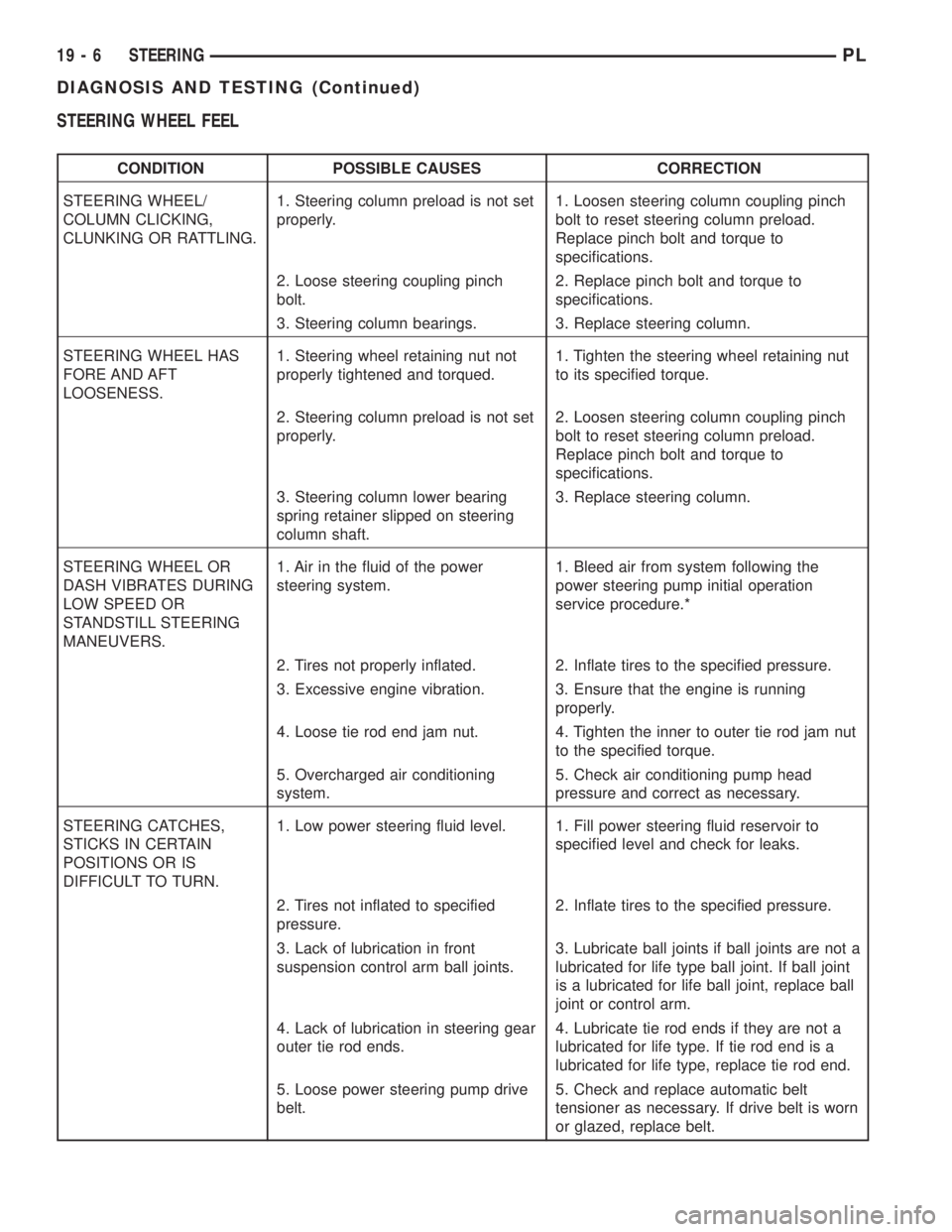
STEERING WHEEL FEEL
CONDITION POSSIBLE CAUSES CORRECTION
STEERING WHEEL/
COLUMN CLICKING,
CLUNKING OR RATTLING.1. Steering column preload is not set
properly.1. Loosen steering column coupling pinch
bolt to reset steering column preload.
Replace pinch bolt and torque to
specifications.
2. Loose steering coupling pinch
bolt.2. Replace pinch bolt and torque to
specifications.
3. Steering column bearings. 3. Replace steering column.
STEERING WHEEL HAS
FORE AND AFT
LOOSENESS.1. Steering wheel retaining nut not
properly tightened and torqued.1. Tighten the steering wheel retaining nut
to its specified torque.
2. Steering column preload is not set
properly.2. Loosen steering column coupling pinch
bolt to reset steering column preload.
Replace pinch bolt and torque to
specifications.
3. Steering column lower bearing
spring retainer slipped on steering
column shaft.3. Replace steering column.
STEERING WHEEL OR
DASH VIBRATES DURING
LOW SPEED OR
STANDSTILL STEERING
MANEUVERS.1. Air in the fluid of the power
steering system.1. Bleed air from system following the
power steering pump initial operation
service procedure.*
2. Tires not properly inflated. 2. Inflate tires to the specified pressure.
3. Excessive engine vibration. 3. Ensure that the engine is running
properly.
4. Loose tie rod end jam nut. 4. Tighten the inner to outer tie rod jam nut
to the specified torque.
5. Overcharged air conditioning
system.5. Check air conditioning pump head
pressure and correct as necessary.
STEERING CATCHES,
STICKS IN CERTAIN
POSITIONS OR IS
DIFFICULT TO TURN.1. Low power steering fluid level. 1. Fill power steering fluid reservoir to
specified level and check for leaks.
2. Tires not inflated to specified
pressure.2. Inflate tires to the specified pressure.
3. Lack of lubrication in front
suspension control arm ball joints.3. Lubricate ball joints if ball joints are not a
lubricated for life type ball joint. If ball joint
is a lubricated for life ball joint, replace ball
joint or control arm.
4. Lack of lubrication in steering gear
outer tie rod ends.4. Lubricate tie rod ends if they are not a
lubricated for life type. If tie rod end is a
lubricated for life type, replace tie rod end.
5. Loose power steering pump drive
belt.5. Check and replace automatic belt
tensioner as necessary. If drive belt is worn
or glazed, replace belt.
19 - 6 STEERINGPL
DIAGNOSIS AND TESTING (Continued)
Page 881 of 1285
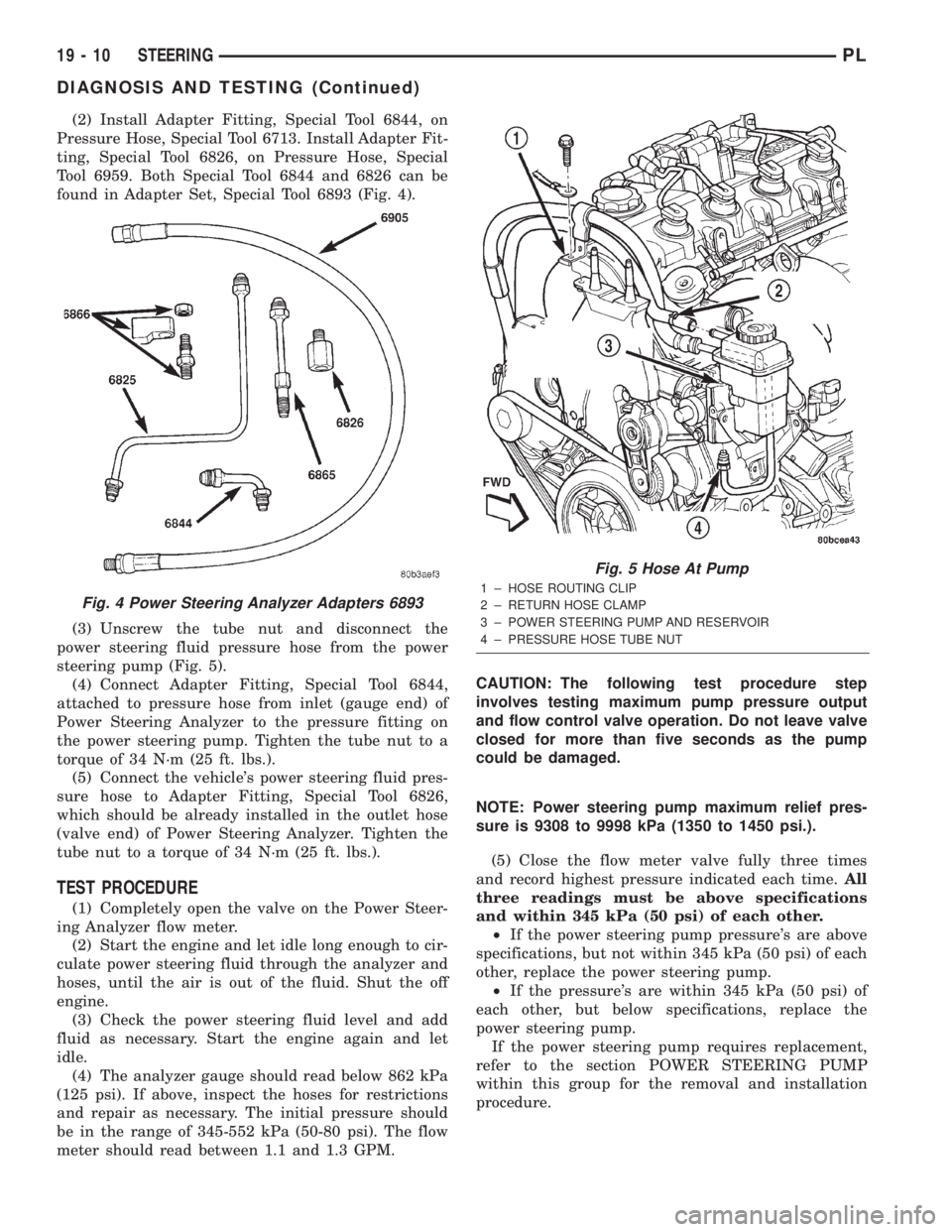
(2) Install Adapter Fitting, Special Tool 6844, on
Pressure Hose, Special Tool 6713. Install Adapter Fit-
ting, Special Tool 6826, on Pressure Hose, Special
Tool 6959. Both Special Tool 6844 and 6826 can be
found in Adapter Set, Special Tool 6893 (Fig. 4).
(3) Unscrew the tube nut and disconnect the
power steering fluid pressure hose from the power
steering pump (Fig. 5).
(4) Connect Adapter Fitting, Special Tool 6844,
attached to pressure hose from inlet (gauge end) of
Power Steering Analyzer to the pressure fitting on
the power steering pump. Tighten the tube nut to a
torque of 34 N´m (25 ft. lbs.).
(5) Connect the vehicle's power steering fluid pres-
sure hose to Adapter Fitting, Special Tool 6826,
which should be already installed in the outlet hose
(valve end) of Power Steering Analyzer. Tighten the
tube nut to a torque of 34 N´m (25 ft. lbs.).
TEST PROCEDURE
(1) Completely open the valve on the Power Steer-
ing Analyzer flow meter.
(2) Start the engine and let idle long enough to cir-
culate power steering fluid through the analyzer and
hoses, until the air is out of the fluid. Shut the off
engine.
(3) Check the power steering fluid level and add
fluid as necessary. Start the engine again and let
idle.
(4) The analyzer gauge should read below 862 kPa
(125 psi). If above, inspect the hoses for restrictions
and repair as necessary. The initial pressure should
be in the range of 345-552 kPa (50-80 psi). The flow
meter should read between 1.1 and 1.3 GPM.CAUTION: The following test procedure step
involves testing maximum pump pressure output
and flow control valve operation. Do not leave valve
closed for more than five seconds as the pump
could be damaged.
NOTE: Power steering pump maximum relief pres-
sure is 9308 to 9998 kPa (1350 to 1450 psi.).
(5) Close the flow meter valve fully three times
and record highest pressure indicated each time.All
three readings must be above specifications
and within 345 kPa (50 psi) of each other.
²If the power steering pump pressure's are above
specifications, but not within 345 kPa (50 psi) of each
other, replace the power steering pump.
²If the pressure's are within 345 kPa (50 psi) of
each other, but below specifications, replace the
power steering pump.
If the power steering pump requires replacement,
refer to the section POWER STEERING PUMP
within this group for the removal and installation
procedure.
Fig. 4 Power Steering Analyzer Adapters 6893
Fig. 5 Hose At Pump
1 ± HOSE ROUTING CLIP
2 ± RETURN HOSE CLAMP
3 ± POWER STEERING PUMP AND RESERVOIR
4 ± PRESSURE HOSE TUBE NUT
19 - 10 STEERINGPL
DIAGNOSIS AND TESTING (Continued)
Page 882 of 1285
CAUTION: Do not force the pump to operate
against the stops for more than 5 seconds at a time
as pump damage may result.
(6) Completely open the valve on the Power Steer-
ing Analyzer flow meter. Turn the steering wheel to
the extreme left until the stop in the steering gear is
met, then turn the steering wheel to the right until
the right stop is met. Record the highest indicated
pressure at each position. Compare the recorded
readings to the specifications. If the highest output
pressure reading against one stop is within 50 psi of
the highest reading at the other stop, the steering
gear is leaking internally and must be replaced.
If the power steering gear requires replacement,
refer to the section POWER STEERING GEAR
within this group for the removal and installation
procedure.
SERVICE PROCEDURES
POWER STEERING SYSTEM FLUID LEVEL
CHECK
WARNING: FLUID LEVEL SHOULD BE CHECKED
WITH THE ENGINE OFF TO PREVENT PERSONAL
INJURY FROM MOVING PARTS.
Before opening power steering system, wipe the
reservoir filler cap free of dirt and debris. Remove
the cap and check the fluid level on its dipstick.
When the fluid is at normal ambient temperature,
approximately 21ÉC to 27ÉC (70ÉF to 80ÉF), the dip-
stick level should indicateCOLD. Do not overfill the
power steering system. In all power steering systems,
use only Mopar Power Steering Fluid, or its equiva-
lent.
NOTE: Do not use any type of automatic transmis-
sion fluid in the power steering system.
REMOVAL AND INSTALLATION
SERVICE WARNINGS AND CAUTIONS
WARNING: POWER STEERING FLUID, ENGINE
PARTS AND EXHAUST SYSTEM MAY BE
EXTREMELY HOT IF ENGINE HAS BEEN RUNNING.
DO NOT START ENGINE WITH ANY LOOSE OR DIS-
CONNECTED HOSES. DO NOT ALLOW HOSES TO
TOUCH HOT EXHAUST MANIFOLD OR CATALYST.WARNING: FLUID LEVEL SHOULD BE CHECKED
WITH THE ENGINE OFF TO PREVENT PERSONAL
INJURY FROM MOVING PARTS.
CAUTION: When the system is open, cap all open
ends of the hoses, power steering pump fittings or
power steering gear ports to prevent entry of for-
eign material into the components.
NOTE: Do not use any type of automatic transmis-
sion fluid in the power steering system.
POWER STEERING FLUID PRESSURE HOSE
NOTE: Before proceeding with this removal and
installation procedure, review SERVICE WARNINGS
AND CAUTIONS at the beginning of REMOVAL AND
INSTALLATION in this section.
REMOVAL
(1) Siphon as much fluid as possible from the
power steering fluid reservoir.
(2) Raise the vehicle. Refer to HOISTING in the
LUBRICATION AND MAINTENANCE group in this
service manual for the correct lifting procedure.
(3) Back out the tube nut securing the power
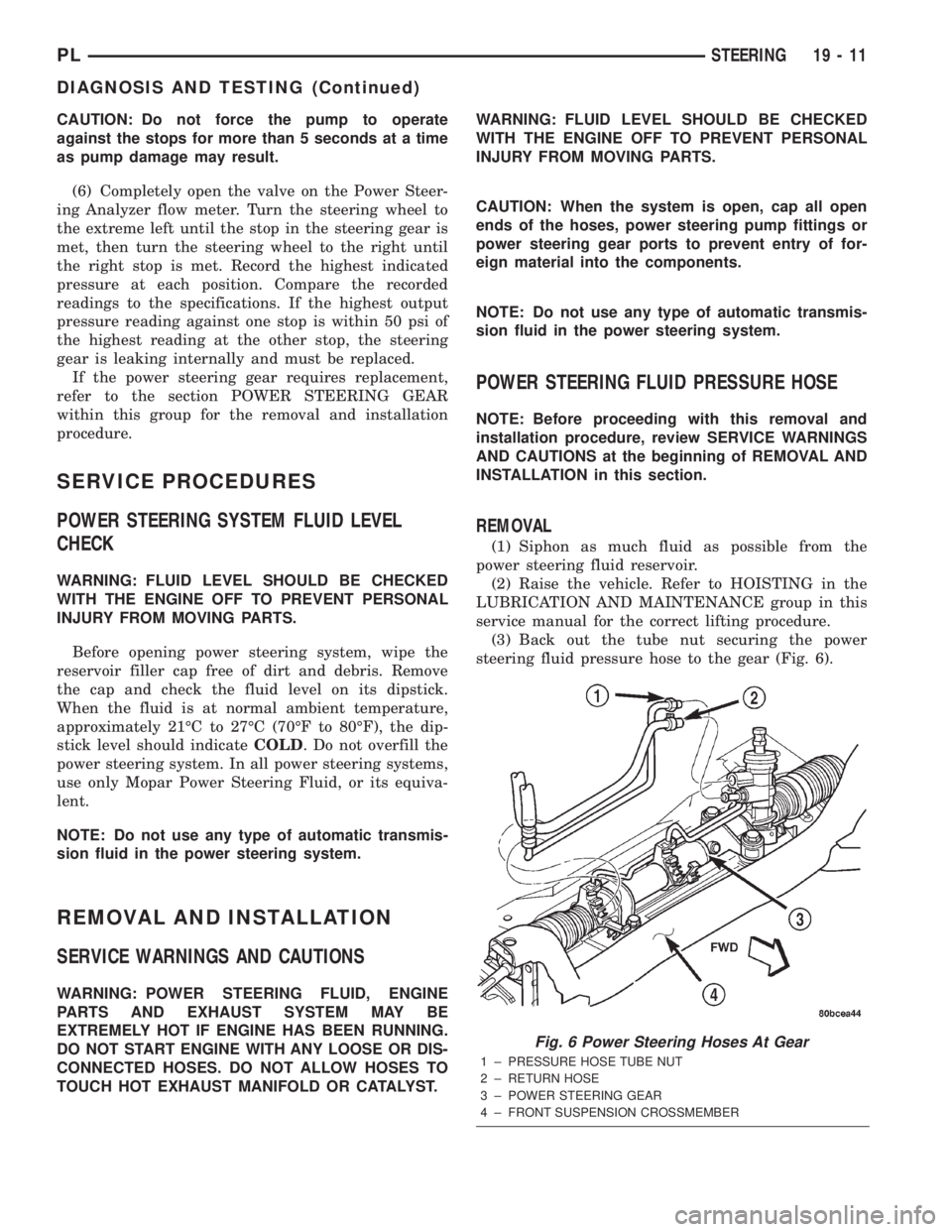
steering fluid pressure hose to the gear (Fig. 6).
Fig. 6 Power Steering Hoses At Gear
1 ± PRESSURE HOSE TUBE NUT
2 ± RETURN HOSE
3 ± POWER STEERING GEAR
4 ± FRONT SUSPENSION CROSSMEMBER
PLSTEERING 19 - 11
DIAGNOSIS AND TESTING (Continued)
Page 883 of 1285
(4) Open the routing clips on the right side of the
power steering gear and remove the power steering
fluid pressure hose tube from the routing clips. At
the same time, remove the pressure hose tube from
the gear.
(5) Lower the vehicle.
(6) Remove the bolt securing the hose routing clip
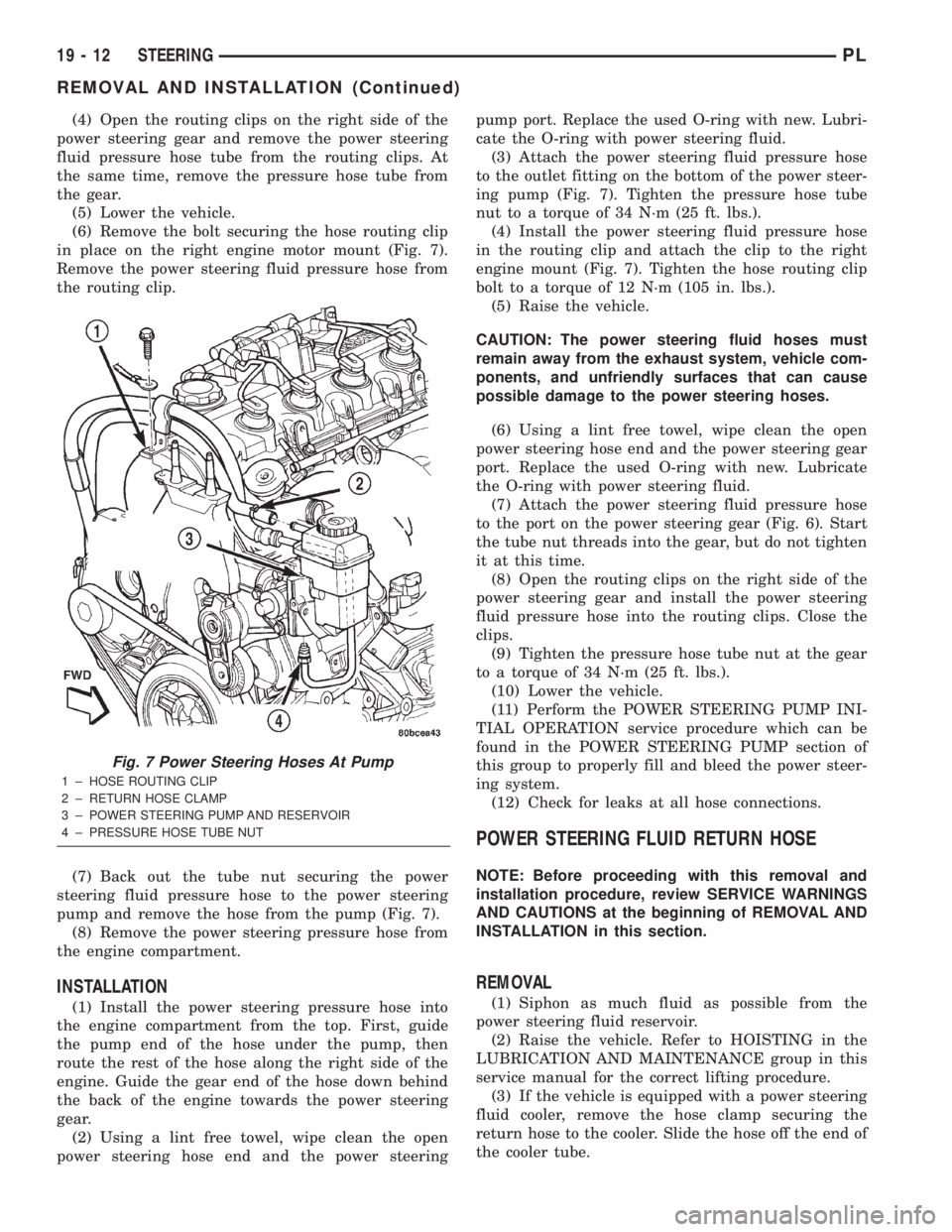
in place on the right engine motor mount (Fig. 7).
Remove the power steering fluid pressure hose from
the routing clip.
(7) Back out the tube nut securing the power
steering fluid pressure hose to the power steering
pump and remove the hose from the pump (Fig. 7).
(8) Remove the power steering pressure hose from
the engine compartment.
INSTALLATION
(1) Install the power steering pressure hose into
the engine compartment from the top. First, guide
the pump end of the hose under the pump, then
route the rest of the hose along the right side of the
engine. Guide the gear end of the hose down behind
the back of the engine towards the power steering
gear.
(2) Using a lint free towel, wipe clean the open
power steering hose end and the power steeringpump port. Replace the used O-ring with new. Lubri-
cate the O-ring with power steering fluid.
(3) Attach the power steering fluid pressure hose
to the outlet fitting on the bottom of the power steer-
ing pump (Fig. 7). Tighten the pressure hose tube
nut to a torque of 34 N´m (25 ft. lbs.).
(4) Install the power steering fluid pressure hose
in the routing clip and attach the clip to the right
engine mount (Fig. 7). Tighten the hose routing clip
bolt to a torque of 12 N´m (105 in. lbs.).
(5) Raise the vehicle.
CAUTION: The power steering fluid hoses must
remain away from the exhaust system, vehicle com-
ponents, and unfriendly surfaces that can cause
possible damage to the power steering hoses.
(6) Using a lint free towel, wipe clean the open
power steering hose end and the power steering gear
port. Replace the used O-ring with new. Lubricate
the O-ring with power steering fluid.
(7) Attach the power steering fluid pressure hose
to the port on the power steering gear (Fig. 6). Start
the tube nut threads into the gear, but do not tighten
it at this time.
(8) Open the routing clips on the right side of the
power steering gear and install the power steering
fluid pressure hose into the routing clips. Close the
clips.
(9) Tighten the pressure hose tube nut at the gear
to a torque of 34 N´m (25 ft. lbs.).
(10) Lower the vehicle.
(11) Perform the POWER STEERING PUMP INI-
TIAL OPERATION service procedure which can be
found in the POWER STEERING PUMP section of
this group to properly fill and bleed the power steer-
ing system.
(12) Check for leaks at all hose connections.
POWER STEERING FLUID RETURN HOSE
NOTE: Before proceeding with this removal and
installation procedure, review SERVICE WARNINGS
AND CAUTIONS at the beginning of REMOVAL AND
INSTALLATION in this section.
REMOVAL
(1) Siphon as much fluid as possible from the
power steering fluid reservoir.
(2) Raise the vehicle. Refer to HOISTING in the
LUBRICATION AND MAINTENANCE group in this
service manual for the correct lifting procedure.
(3) If the vehicle is equipped with a power steering
fluid cooler, remove the hose clamp securing the
return hose to the cooler. Slide the hose off the end of
the cooler tube.
Fig. 7 Power Steering Hoses At Pump
1 ± HOSE ROUTING CLIP
2 ± RETURN HOSE CLAMP
3 ± POWER STEERING PUMP AND RESERVOIR
4 ± PRESSURE HOSE TUBE NUT
19 - 12 STEERINGPL
REMOVAL AND INSTALLATION (Continued)
Page 884 of 1285
(4) If the vehicle is not equipped with a power
steering fluid cooler:
²Remove the hose clamp securing the return hose
to the steel fitting in the outlet port on the power
steering gear (Fig. 6).
²Slide the hose off the end of the steel fitting.
²Pull the hose loose from the C-clamps on the two
routing clips located on the front of the steering gear
(Fig. 6).
(5) Lower the vehicle.
(6) Remove the bolt securing the hose routing clip
in place on the right engine mount (Fig. 7). Remove
the power steering fluid return hose from the routing
clip.
(7) Remove the hose clamp securing the return
hose to the power steering fluid reservoir (Fig. 7).
Slide the hose off the end of the reservoir fitting.
(8) Remove the power steering return hose from
the engine compartment.
INSTALLATION
(1) Slide a hose clamp onto the power steering
pump end of the hose far enough to clear the fitting
on the power steering fluid reservoir once the hose is
installed.
(2) Install the power steering return hose into the
engine compartment from the top. First, guide the
pump end of the hose onto the fitting on the power
steering fluid reservoir, then route the rest of the
hose along the right side of the engine (Fig. 7). Guide
the gear end of the hose down behind the back of the
engine towards the power steering gear.
(3) Expand the hose clamp and slide it onto the
fluid reservoir fitting. Secure the clamp once it is
past the bead formed into the fluid reservoir fitting.
(4) Install the power steering fluid return hose in
the hose routing clip and attach the clip to the right
engine mount (Fig. 7). Tighten the hose routing clip
bolt to a torque of 12 N´m (105 in. lbs.).
(5) Raise the vehicle.
CAUTION: The power steering fluid hoses must
remain away from the exhaust system, vehicle com-
ponents, and unfriendly surfaces that can cause
possible damage to the power steering hoses.
(6) Using a lint free towel, wipe clean the open
power steering hose end and the power steering gear
port fitting or power steering fluid cooler port.
(7) Install a hose clamp onto the end of the hose
far enough to clear the fitting on the steering gear or
cooler once the hose is installed.
(8) If the vehicle is equipped with a power steering
fluid cooler, slide the hose onto the end of the cooler
tube. Install the hose clamp past the bead formed
into the cooler tube and secure in place.(9) If the vehicle is not equipped with a power
steering fluid cooler:
²Slide the hose onto the end of the steel fitting in
the steering gear outlet port (Fig. 6).
²Install the hose clamp past the bead formed into
the steel fitting and secure in place.
²Align and attach the hose to the C-clamps on
the two routing clips located on the front of the steer-
ing gear (Fig. 6).
(10) Lower the vehicle.
(11) Perform the POWER STEERING PUMP INI-
TIAL OPERATION service procedure which can be
found in the POWER STEERING PUMP section of
this group to properly fill and bleed the power steer-
ing system.
(12) Check for leaks at all hose connections.
POWER STEERING FLUID COOLER
NOTE: Before proceeding with this removal and
installation procedure, review SERVICE WARNINGS
AND CAUTIONS at the beginning of REMOVAL AND
INSTALLATION in this section.
REMOVAL
(1) Siphon as much fluid as possible from the
power steering fluid reservoir.
(2) Raise the vehicle. Refer to HOISTING in the
LUBRICATION AND MAINTENANCE group in this
service manual for the correct lifting procedure.
(3) Remove the hose clamp, attaching the power
steering fluid return hose to the power steering fluid
cooler. Remove the return hose from the cooler.
(4) Remove the hose clamp attaching the power
steering cooler fluid hose to the steel fitting in the
power steering gear outlet port (Fig. 8).
(5) Remove the two screws securing the cooler to
the front suspension crossmember. They are located
behind the cooler. They can be accessed from above.
(6) Open the routing clip on the right front of the
power steering gear housing and remove the cooler
tube from it.
(7) Remove the cooler from the vehicle.
INSTALLATION
(1) Slide a hose clamp onto the end of the power
steering cooler fluid hose far enough to clear the steel
fitting on the power steering gear once the hose is
installed.
(2) Slide the hose (with cooler attached) onto the
fitting on the steering gear, then align the tube on
back of the cooler with the open routing clip on the
right front of the power steering gear housing, and
snap it into place. Close the clip.
PLSTEERING 19 - 13
REMOVAL AND INSTALLATION (Continued)
Page 886 of 1285
(6) Start the engine and turn the steering wheel
several times stop-to-stop to bleed any air from the
fluid in the power steering system. Stop the engine,
check the fluid level, and inspect the system for
leaks.
SPECIFICATIONS
POWER STEERING FASTENER TORQUE
SPECIFICATIONS
DESCRIPTION TORQUE
POWER STEERING HOSE:
Tube Nuts............... 34N´m(25ft.lbs.)
Hose Routing Clip Bolt.... 12N´m(105 in. lbs.)
POWER STEERING COOLER:
Mounting Screws.......... 10N´m(90in.lbs.)
POWER STEERING FLUID PRESSURE
SWITCH:
Switch................... 8N´m(70in.lbs.)
POWER STEERING PUMP:
Pressure Hose Tube Nut.... 34N´m(25ft.lbs.)
Pressure Fitting........... 88N´m(65ft.lbs.)
Front Mounting Bolts..... 28N´m(250 in. lbs.)
Rear Mounting Bolt....... 28N´m(250 in. lbs.)
Rear Support Bracket To Engine Bolts . . 54 N´m
(40 ft. lbs.)
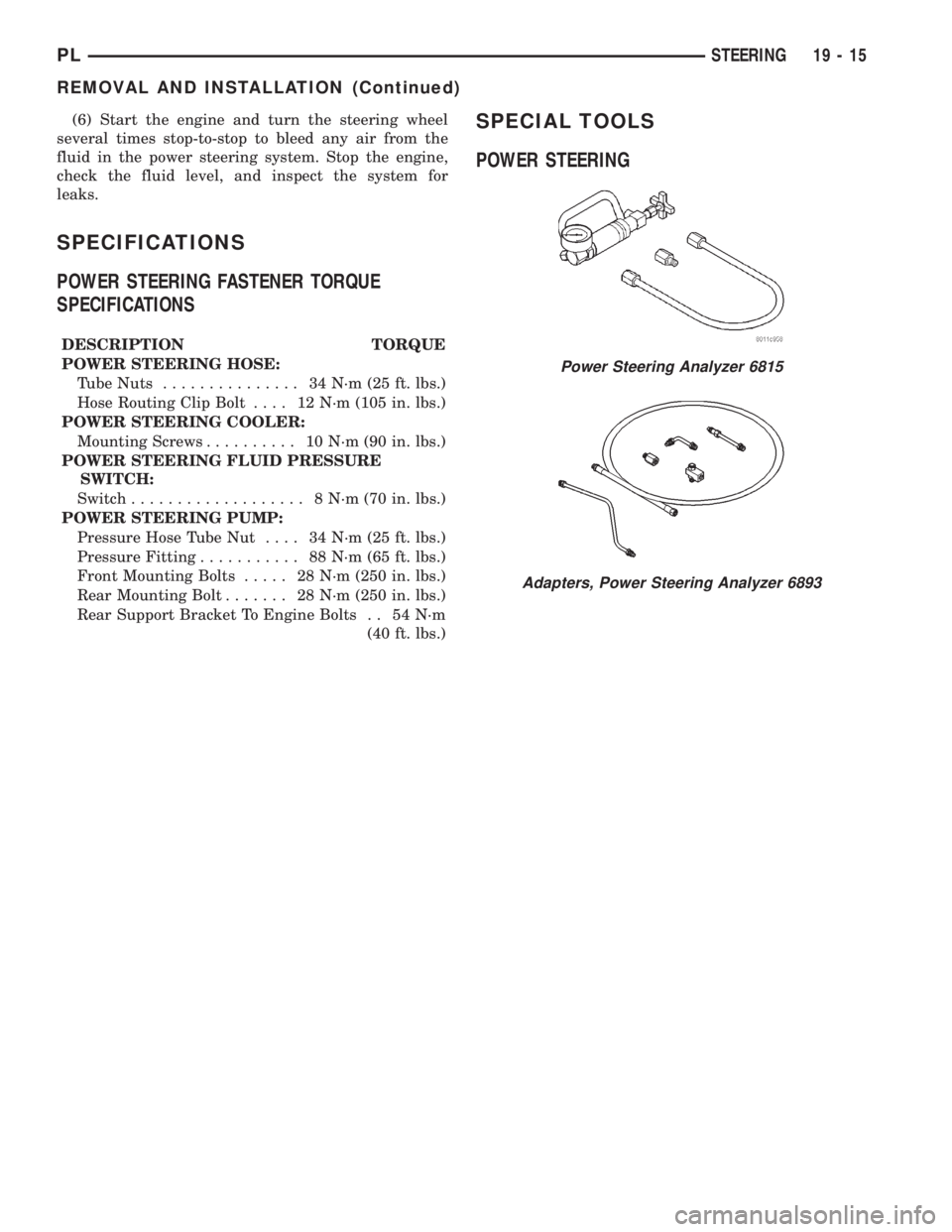
SPECIAL TOOLS
POWER STEERING
Power Steering Analyzer 6815
Adapters, Power Steering Analyzer 6893
PLSTEERING 19 - 15
REMOVAL AND INSTALLATION (Continued)