2016 Peugeot 308 ESP
[x] Cancel search: ESPPage 179 of 398

177
308_en_Chap06_conduite_ed02-2015
Steering mounted controls
6. Cruise control pause / resume indication.
7. Cr uise control mode selection indication.
8.
Speed
value setting.
Cruise control
System which automatically maintains the speed of the vehicle at the value programmed by the driver, without any action on the accelerator pedal.
the cruise control system cannot, in any circumstances,
r eplace the need to observe speed limits, nor can it
replace the need for vigilance on the part of the driver.
You are advised to keep your feet near the pedals at
all times.
the cruise control is switched on m anually: it
requires a minimum vehicle speed of 25 mph
(40 km/h).
1.
Selec
t cruise control mode.
2.
De
crease value or speed setting on the fly.
3.
In
crease value or speed setting on the fly.
4.
Pa
use / resume cruise control.
5.
Dis
play the list of memorised speeds.Displays in the instrument panel
Switching off the ignition cancels any
programmed speed value.
the c
ruise control is paused
manually or
by pressing the brake or clutch pedal or
on triggering of the
eS
C system for safety
reasons.
It is possible to exceed the programmed speed
temporarily by pressing the accelerator pedal.
to re
turn to the programmed speed, simply
release the accelerator pedal until the
programmed cruise speed is reached again. With a manual gearbox, third or fourth gear
(depending on engine) or higher must be
engaged.
For more information on memorising speeds,
refer to the corresponding section.
With an automatic gearbox, second gear or
higher must be engaged.
6
Driving
Page 182 of 398
180
308_en_Chap06_conduite_ed02-2015
Active cruise control
this systems allows the vehicle's speed to be
m aintained at a value set by the driver.
In addition it allows (when circumstances
permit) an inter-vehicle time that you have
selected to be maintained between your vehicle
and the one in front.Principles of
operation
using a radar with a range of about 100 metres,
l ocated at the front of the vehicle, this system
detects a vehicle running in front of your
vehicle.
It automatically adapts the speed of your
vehicle to that of the vehicle in front.
If the vehicle in front is running more slowly,
the system progressively reduces the speed of
your vehicle using just engine braking (as if the
driver had pressed the " -" b ut to n).
If your vehicle is too close to, or approaching
too quickly the vehicle in front, the cruise
control is automatically deactivated.
the
d
river is then alerted by an audible signal,
accompanied by a message.
If the vehicle in front accelerates or changes
lane, the active cruise control progressively
accelerates your vehicle to return to the
programmed speed.
If the driver operates a direction indicator to
overtake a slower vehicle, the active cruise
control allows your vehicle to temporarily
approach the vehicle in front to assist the
overtaking manoeuvre, though never exceeding
the programmed speed.
Switching between the
types of cruise control
the choice between the "active" and "standard"
c ruise control is made in the " Driving
assistance " menu.
the c
ruise control selection thumb wheel must
be in the "CR
uISe" po
sition, other wise the
choice will not be taken into account.
For more information on the
"standard" cruise control, refer to the
corresponding section.
the s
tate of the system is memorised on
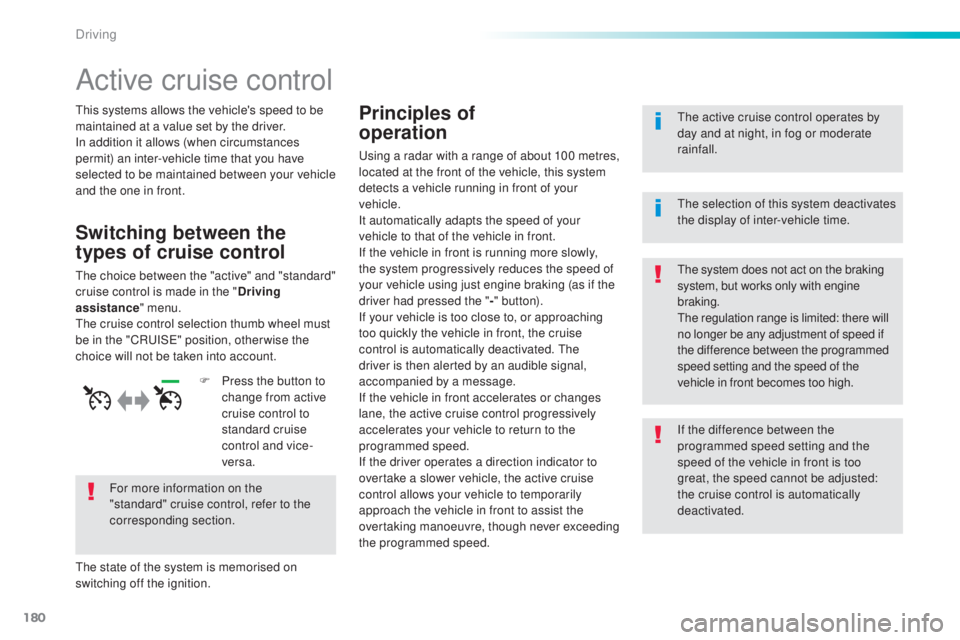
switching off the ignition. F
Pr
ess the button to
change from active
cruise control to
standard cruise
control and vice-
versa.
the a
ctive cruise control operates by
day and at night, in fog or moderate
rainfall.the sy stem does not act on the braking
system, but works only with engine
braking.
the r
egulation range is limited: there will
no longer be any adjustment of speed if
the difference between the programmed
speed setting and the speed of the
vehicle in front becomes too high.
the s
election of this system deactivates
the display of inter-vehicle time.
If the difference between the
programmed speed setting and the
speed of the vehicle in front is too
great, the speed cannot be adjusted:
the cruise control is automatically
deactivated.
Driving
Page 183 of 398
181
308_en_Chap06_conduite_ed02-2015
the active cruise control is switched on m anually,
it requires that the speed of the vehicle be between
25 mph (40 km/h) and 90 mph (150 km/h).
General points
the active cruise control can be paused
m anually with the control, or automatically:
-
by p
ressing the brake or clutch pedal,
-
in t
he event of operation of the
eS
C, for
safety reasons,
-
in t
he event of an action of the electric
parking brake control,
-
wh
en an inter-vehicle time threshold is
reached (calculated according to the
relative speeds of your vehicle and the
vehicle in front and the inter-vehicle time
setting chosen),
-
wh
en the distance between your vehicle
and the one in front becomes to small,
-
wh
en the speed of the vehicle in front is
to
l
ow,
-
wh
en the speed of your vehicle becomes
too low.
the a
ctive cruise control cannot in any
circumstances replace the observation
of speed limits, nor the need for the
vigilance on the part of the driver.
It is recommended that you always keep
your feet close to the pedals.
the i
nter-vehicle time setting is
memorised when switching off the
ignition.
With a manual gearbox, third or fourth gear
(depending on engine) or higher must be
engaged.
With an automatic gearbox, second gear or
higher must be engaged.
If the cruise speed setting is above 90 mph
(150 km/h), the active cruise control switches to
normal cruise control mode (without automatic
adjustment of the safety inter-vehicle distance).
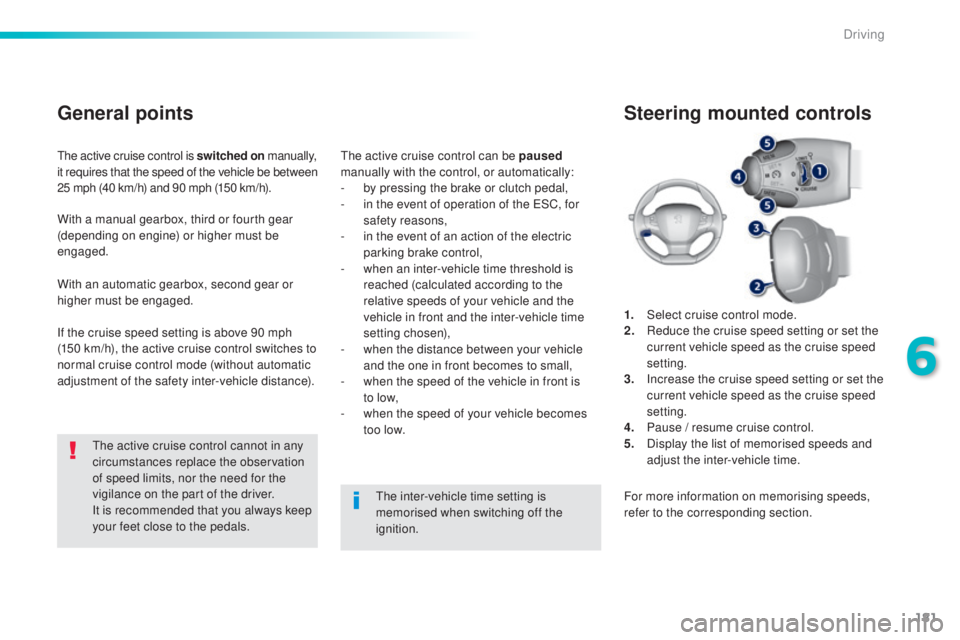
1.
Selec
t cruise control mode.
2.
Re
duce the cruise speed setting or set the
current vehicle speed as the cruise speed
setting.
3.
In
crease the cruise speed setting or set the
current vehicle speed as the cruise speed
setting.
4.
Pa
use / resume cruise control.
5.
Di
splay the list of memorised speeds and
adjust the inter-vehicle time.
Steering mounted controls
For more information on memorising speeds,
refer to the corresponding section.
6
Driving
Page 197 of 398
195
308_en_Chap06_conduite_ed02-2015
Blind spot sensors
Operation
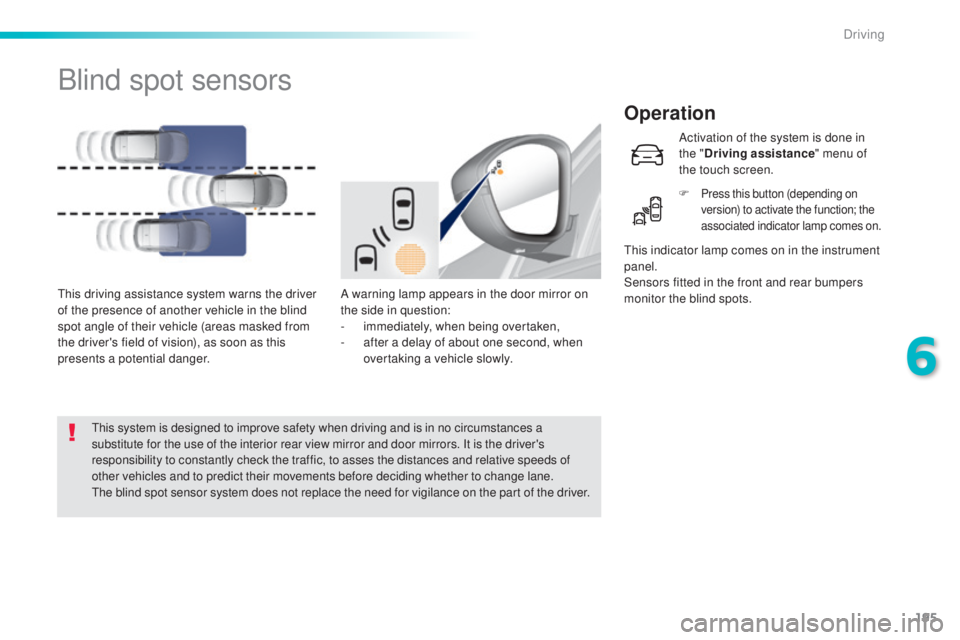
A warning lamp appears in the door mirror on
the side in question:
-
im
mediately, when being overtaken,
-
af
ter a delay of about one second, when
overtaking a vehicle slowly.thi
s driving assistance system warns the driver
of the presence of another vehicle in the blind
spot angle of their vehicle (areas masked from
the driver's field of vision), as soon as this
presents a potential danger.
thi
s indicator lamp comes on in the instrument
panel.
Sensors fitted in the front and rear bumpers
monitor the blind spots.
thi
s system is designed to improve safety when driving and is in no circumstances a
substitute for the use of the interior rear view mirror and door mirrors. It is the driver's
responsibility to constantly check the traffic, to asses the distances and relative speeds of
other vehicles and to predict their movements before deciding whether to change lane.
the b
lind spot sensor system does not replace the need for vigilance on the part of the driver. Activation of the system is done in
the "
Driving assistance " menu of
the touch screen.
F
Press this button (depending on
version) to activate the function; the
associated indicator lamp comes on.
6
Driving
Page 201 of 398
199
308_en_Chap06_conduite_ed02-2015
the system will be deactivated
a utomatically if a trailer is being
towed or a bicycle carrier is fitted on
a towbar (vehicle fitted with a towbar
installed in line with the manufacturer's
recommendations).
Deactivation / Activation of
the front and rear parking
sensors
the system is deactivated in the
" D
riving assistance " menu of the
touch screen.
F
Pr
ess this button.
the i
ndicator
lamp in the button comes on.
Pressing this button again reactivates the function.
the i
ndicator lamp in the button goes off.
the p
arking sensors are deactivated
while the Park Assist system is
measuring a space.
For more information on Park Assist,
refer to the corresponding section. High pressure jet wash
When washing your vehicle, do not
direct the lance within 30 cm of the
sensors.
Operating fault
- this warning lamp comes on in
t
he instrument panel and/or a
message appears, accompanied
by an audible signal,
-
this symbol changes to alert mode,
its warning lamp flashes for a few
moments then stays on and a
message appears, accompanied by
an audible signal.
Contact a Peu geOt d ealer or a qualified
workshop. In bad weather or in winter, ensure
that the sensors are not covered with
mud, ice or snow. When reverse gear is
engaged, an audible signal (long beep)
indicates that the sensors may be dirty.
Certain sound sources (motorcycle,
lorry, pneumatic drill, etc.) may trigger
the audible signals of the parking
sensor system.
Depending on version and when engaging
reverse:
6
Driving
Page 202 of 398
200
308_en_Chap06_conduite_ed02-2015
Reversing camera
Opening the tailgate causes the display
to disappear.
the
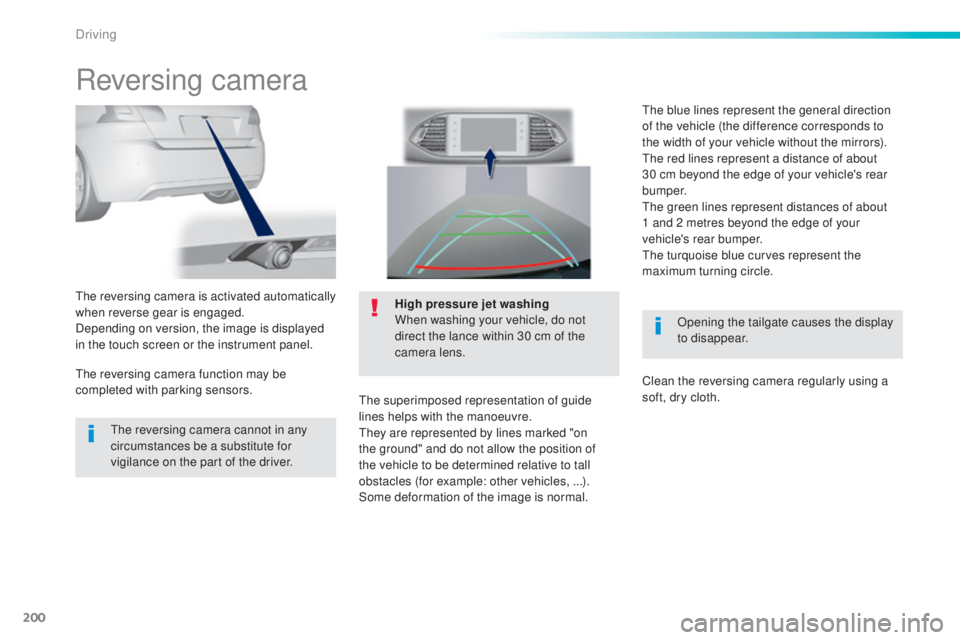
reversing camera is activated automatically
when reverse gear is engaged.
Depending on version, the image is displayed
in the touch screen or the instrument panel. High pressure jet washing
When washing your vehicle, do not
direct the lance within 30 cm of the
camera lens.
the s
uperimposed representation of guide
lines helps with the manoeuvre.
the
y are represented by lines marked "on
the ground" and do not allow the position of
the vehicle to be determined relative to tall
obstacles (for example: other vehicles, ...).
Some deformation of the image is normal.
the r
eversing camera cannot in any
circumstances be a substitute for
vigilance on the part of the driver.
the r
eversing camera function may be
completed with parking sensors.
the b
lue lines represent the general direction
of the vehicle (the difference corresponds to
the width of your vehicle without the mirrors).
the r
ed lines represent a distance of about
30 cm beyond the edge of your vehicle's rear
b u m p e r.
the g
reen lines represent distances of about
1
a
nd 2 metres beyond the edge of your
vehicle's rear bumper.
the t
urquoise blue curves represent the
maximum turning circle.
Clean the reversing camera regularly using a
soft, dry cloth.
Driving
Page 209 of 398
207
308_en_Chap06_conduite_ed02-2015
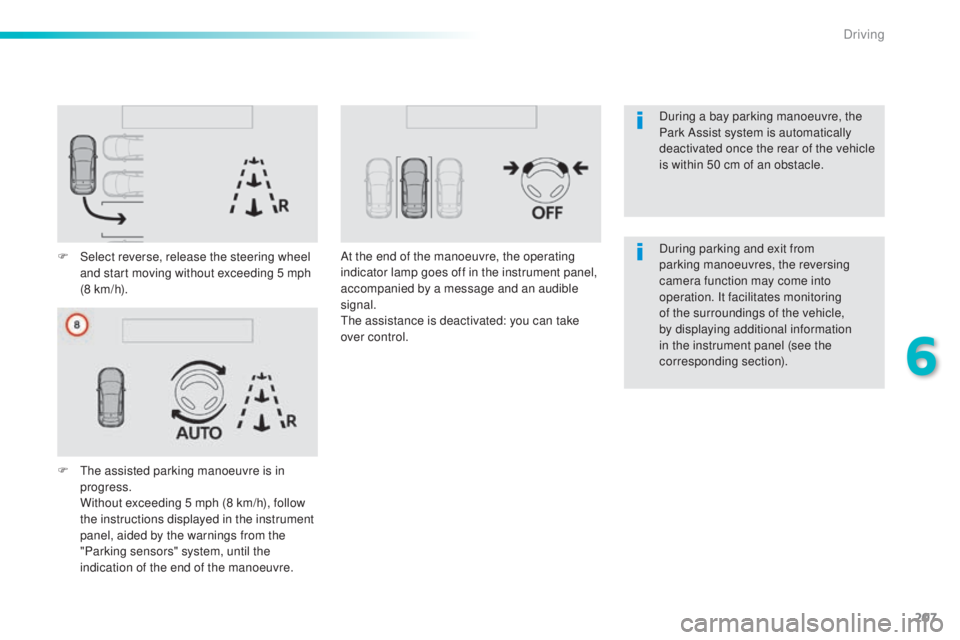
F Select reverse, release the steering wheel
and start moving without exceeding 5 mph
(8 km/h).
F
t
he a
ssisted parking manoeuvre is in
progress.
Wi
thout exceeding 5 mph (8 km/h), follow
the instructions displayed in the instrument
panel, aided by the warnings from the
"Parking sensors" system, until the
indication of the end of the manoeuvre. At the end of the manoeuvre, the operating
indicator lamp goes off in the instrument panel,
accompanied by a message and an audible
signal.
the a
ssistance is deactivated: you can take
over control. During parking and exit from
parking manoeuvres, the reversing
camera function may come into
operation. It facilitates monitoring
of the surroundings of the vehicle,
by displaying additional information
in the instrument panel (see the
corresponding section). During a bay parking manoeuvre, the
Park Assist system is automatically
deactivated once the rear of the vehicle
is within 50 cm of an obstacle.
6
Driving
Page 211 of 398
209
308_en_Chap06_conduite_ed02-2015
Under-inflation detection
the system monitors the pressures in the
f our t yres, once the vehicle is moving.
It compares the information given by the four
wheel speed sensors with reference values,
which must be reinitialised ever y time the
tyre pressures are adjusted or a wheel
changed .
the s
ystem triggers an alert as soon as it
detects a drop in the inflation pressure of one
or more tyres.the u nder-inflation detection system
does not replace the need for vigilance
on the part of the driver.
thi
s system does not avoid the need to
check the tyre pressures (including the
spare wheel) every month as well as
before a long journey.
Driving with under-inflated tyres impairs
road holding, extends braking distances
and causes premature tyre wear,
particularly under arduous condition
(high loading, high speed, long journey).
System which automatically checks the pressures of the tyres while driving.the i
nflation pressures defined for
your vehicle can be found on the tyre
pressure label.
For more information on the
identification markings, refer to the
corresponding section.
tyr
e pressures should be checked
when the tyres are "cold" (vehicle
stopped for 1 hour or after a journey of
less than 6 miles (10 km) at moderate
speeds).
Other wise (when hot), add 0.3 bar to
the pressures shown on the label.
Driving with under-inflated tyres
increases fuel consumption.
Snow chains
the system does not have to be
r einitialised after fitting or removing
snow chains.
6
Driving