Page 72 of 398
70
308_en_Chap02_ouvertures_ed02-2015
Reinitialising the electric
windows
Always remove the key when leaving
the vehicle, even for a short time.
In the event of contact during operation
of the windows, you must reverse the
movement of the window.
to do t
his,
press the switch concerned.
When operating the passenger electric
window switches, the driver must
ensure that no one is preventing correct
closing of the windows.
the d
river must ensure that the
passengers use the electric windows
c o r r e c t l y.
Be aware of children when operating
the windows.
For the safety of your children, press
this switch to prevent operation
of the windows of the rear doors,
irrespective of their position.Deactivating the rear
window controls
With the indicator lamp on, the rear switches
are deactivated.
With the indicator lamp off, the switches are
active.
Following reconnection of the battery, the
safety anti-pinch function must be reinitialised.
the s
afety anti-pinch is not active during these
operations:
-
lo
wer the window completely, then raise
it, it will rise in steps of a few centimetres
each time the switch is pressed. Repeat
the operation until the window closes
completely,
-
pr
ess and hold the switch upwards for
at least one second after reaching this
position, window closed.
Access
Page 76 of 398
74
308_en_Chap03_ergonomie-et-confort_ed02-2015
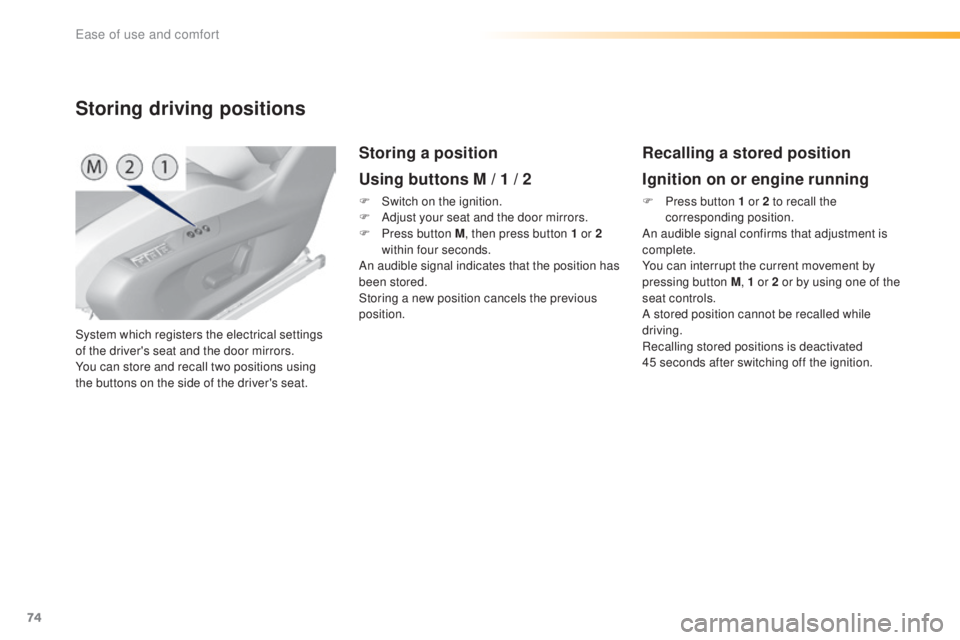
System which registers the electrical settings
of the driver's seat and the door mirrors.
You can store and recall two positions using
the buttons on the side of the driver's seat.
Storing driving positions
Storing a position
Using buttons M / 1 / 2
F Switch on the ignition.
F Ad just your seat and the door mirrors.
F
Pr
ess button M , then press button 1 or 2
within four seconds.
An audible signal indicates that the position has
been stored.
Storing a new position cancels the previous
position.
Recalling a stored position
Ignition on or engine running
F Press button 1 or 2 to recall the
c orresponding position.
An audible signal confirms that adjustment is
complete.
You can interrupt the current movement by
pressing button M , 1 or 2 or by using one of the
seat controls.
A stored position cannot be recalled while
driving.
Recalling stored positions is deactivated
45
s
econds after switching off the ignition.
ease of use and comfort
Page 79 of 398
77
308_en_Chap03_ergonomie-et-confort_ed02-2015
Rear seats (hatchback)
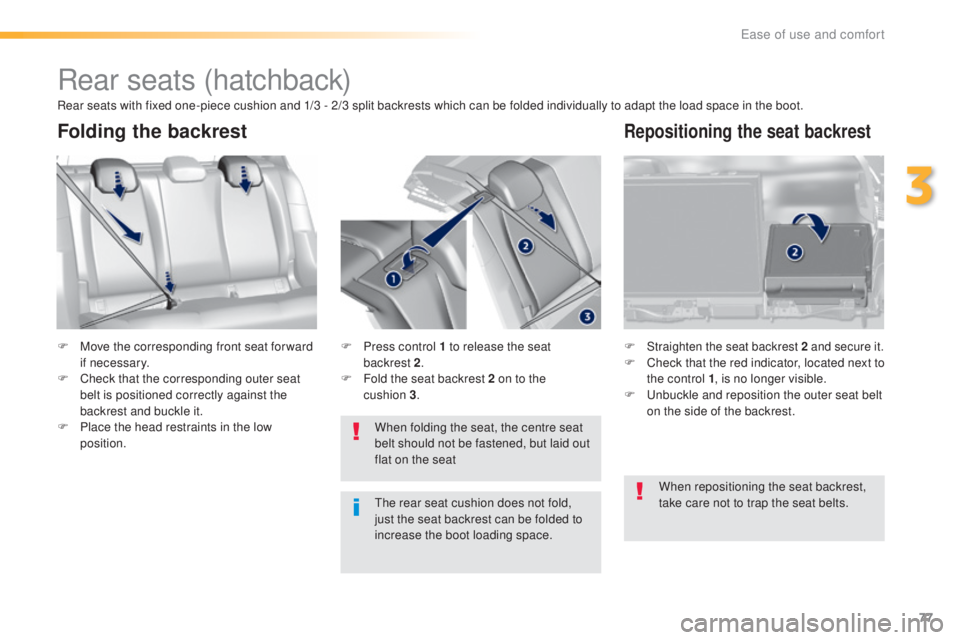
F Move the corresponding front seat for ward
if necessary.
F
Che
ck that the corresponding outer seat
belt is positioned correctly against the
backrest and buckle it.
F
Pl
ace the head restraints in the low
position. F Straighten the seat backrest 2 and secure it.F Check that the red indicator, located next to
t
he control 1 , is no longer visible.
F
u
nb
uckle and reposition the outer seat belt
on the side of the backrest.
When folding the seat, the centre seat
belt should not be fastened, but laid out
flat on the seat
F
Pr
ess control 1 to release the seat
backrest 2 .
F Fo
ld the seat backrest 2 on to the
cushion
3 .
Folding the backrestRepositioning the seat backrest
Rear seats with fixed one-piece cushion and 1/3 - 2/3 split backrests which can be folded individually to adapt the load space in the boot.
the r
ear seat cushion does not fold,
just the seat backrest can be folded to
increase the boot loading space. When repositioning the seat backrest,
take care not to trap the seat belts.
3
ease of use and comfort
Page 80 of 398
78
308_en_Chap03_ergonomie-et-confort_ed02-2015
Rear seats (SW)
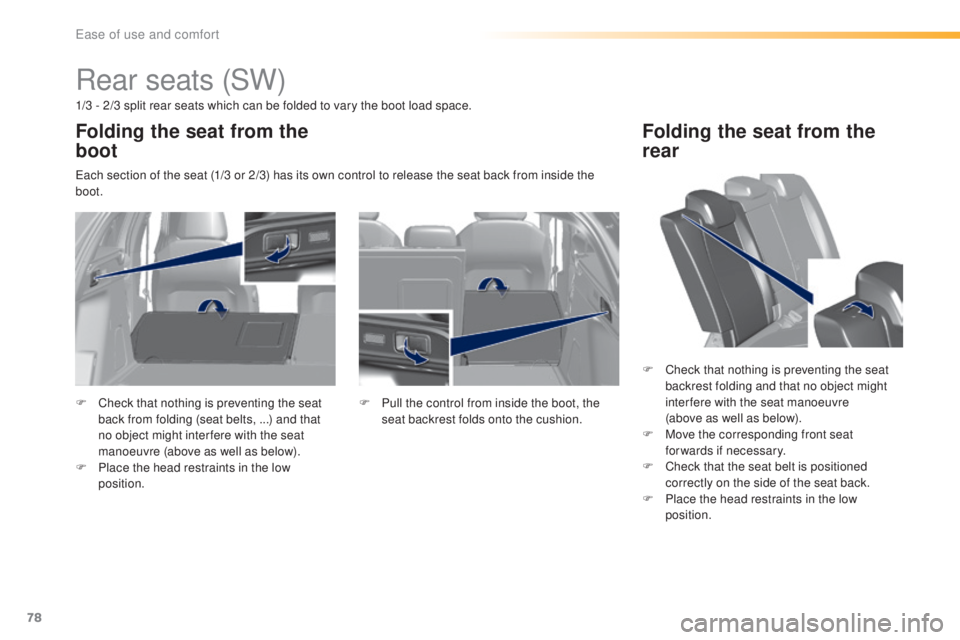
1/3 - 2/3 split rear seats which can be folded to vary the boot load space.
eac
h section of the seat (1/3 or 2/3) has its own control to release the seat back from inside the
boot.
Folding the seat from the
boot
F Check that nothing is preventing the seat
b ack from folding (seat belts, . ..) and that
no object might inter fere with the seat
manoeuvre (above as well as below).
F
Pl
ace the head restraints in the low
position. F Pu
ll the control from inside the boot, the
seat backrest folds onto the cushion.
Folding the seat from the
rear
F Check that nothing is preventing the seat
b ackrest folding and that no object might
interfere with the seat manoeuvre
(above as well as below).
F
Mov
e the corresponding front seat
forwards if necessary.
F
Ch
eck that the seat belt is positioned
correctly on the side of the seat back.
F
Pl
ace the head restraints in the low
position.
ease of use and comfort
Page 89 of 398
87
308_en_Chap03_ergonomie-et-confort_ed02-2015
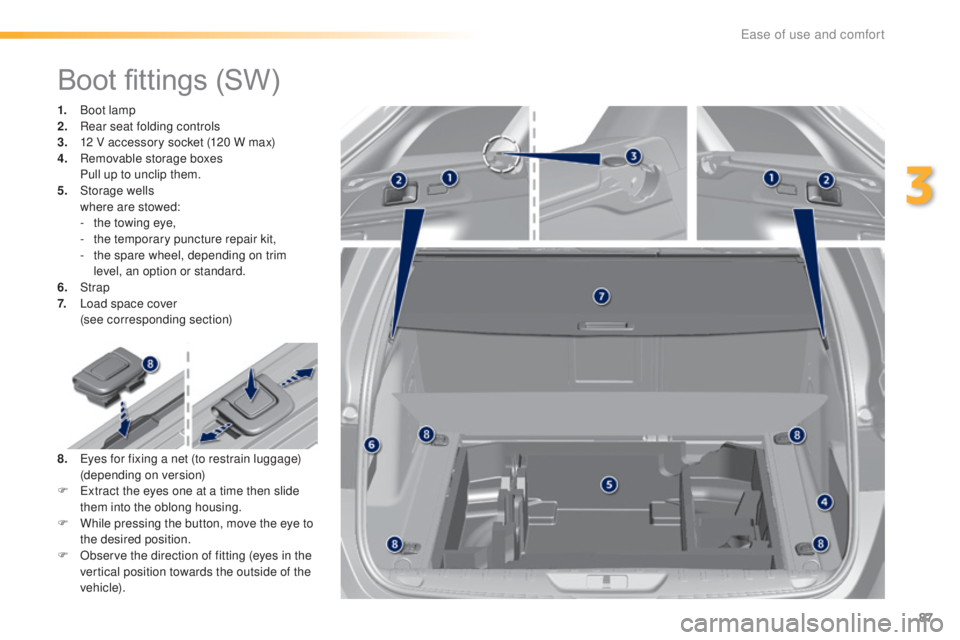
Boot fittings (SW)
1. Boot lamp
2. Rea r seat folding controls
3.
12 V a
ccessory socket (120 W max)
4.
Re
movable storage boxes
Pu
ll up to unclip them.
5.
Sto
rage wells
wh
ere are stowed:
-
th
e towing eye,
-
th
e temporary puncture repair kit,
-
th
e spare wheel, depending on trim
level, an option or standard.
6.
St
rap
7.
Lo
ad space cover
(se
e corresponding section)
8.
eyes f
or fixing a net (to restrain luggage)
(d
epending on version)
F
e
xt
ract the eyes one at a time then slide
them into the oblong housing.
F
Wh
ile pressing the button, move the eye to
the desired position.
F
Ob
serve the direction of fitting (eyes in the
vertical position towards the outside of the
vehicle).
3
ease of use and comfort
Page 91 of 398
89
308_en_Chap03_ergonomie-et-confort_ed02-2015
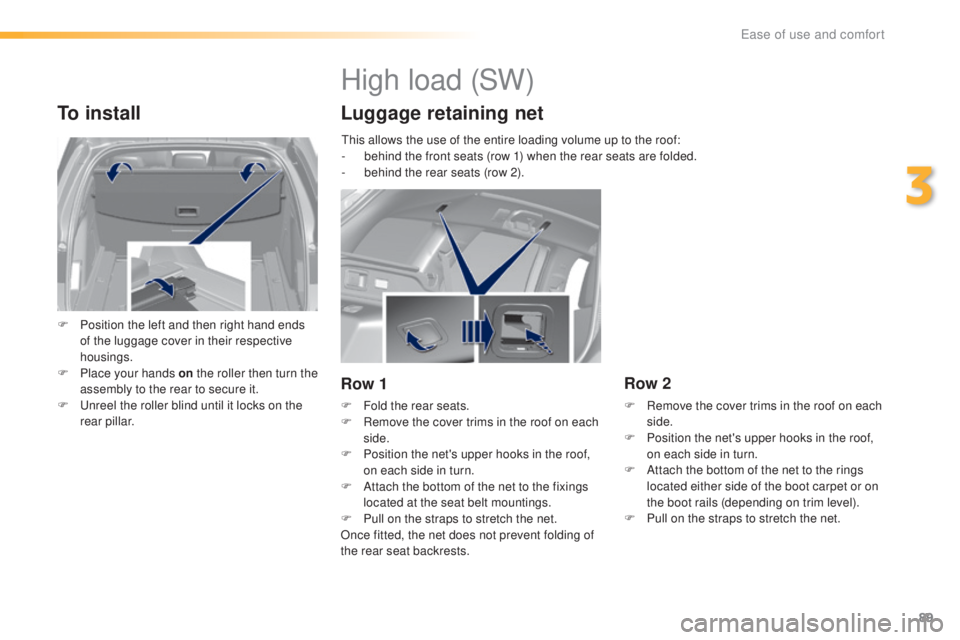
To install
F Position the left and then right hand ends
of the luggage cover in their respective
housings.
F
Pl
ace your hands on the roller then turn the
assembly to the rear to secure it.
F
u
nr
eel the roller blind until it locks on the
rear pillar.
High load (SW)
Luggage retaining net
Row 1
F Fold the rear seats.
F Re move the cover trims in the roof on each
side.
F
Po
sition the net's upper hooks in the roof,
on each side in turn.
F
At
tach the bottom of the net to the fixings
located at the seat belt mountings.
F
Pu
ll on the straps to stretch the net.
Once fitted, the net does not prevent folding of
the rear seat backrests.
Row 2
F Remove the cover trims in the roof on each
si de.
F
Po
sition the net's upper hooks in the roof,
on each side in turn.
F
At
tach the bottom of the net to the rings
located either side of the boot carpet or on
the boot rails (depending on trim level).
F
Pu
ll on the straps to stretch the net.
thi
s allows the use of the entire loading volume up to the roof:
-
be
hind the front seats (row 1) when the rear seats are folded.
-
be
hind the rear seats (row 2).
3
ease of use and comfort
Page 93 of 398
91
308_en_Chap03_ergonomie-et-confort_ed02-2015
In order for these systems to be fully effective, follow the operation and maintenance
guidelines below:
F
t
o ob
tain an even air distribution, take care not to obstruct the exterior air intake grilles
located at the base of the windscreen, the nozzles, the vents and the air outlets, as well
as the air extractor located in the boot.
F
Do n
ot cover the sunshine sensor, located on the dashboard; this is used for regulation
of the air conditioning system.
F
Op
erate the air conditioning system for at least 5 to 10 minutes, once or twice a month
to keep it in per fect working order.
F
e
ns
ure that the passenger compartment filter is in good condition and have the filter
elements replaced regularly.
We r
ecommend the use of a combined passenger compartment filter.
tha
nks to its
special active additive, it contributes to the purification of the air breathed by the
occupants and the cleanliness of the passenger compartment (reduction of allergic
symptoms, bad odours and greasy deposits).
F
t
o en
sure correct operation of the air conditioning system, you are also advised to have
it checked regularly as recommended in the warranty and maintenance record.
F
If t
he system does not produce cold air, switch it off and contact a P
eu
ge
Ot d
ealer or
a qualified workshop.
Recommendations for ventilation and air conditioning
If after an extended stop in sunshine,
the interior temperature is very high, first
ventilate the passenger compartment for
a few moments.
Put the air flow control at a setting high
enough to quickly change the air in the
passenger compartment.
the a
ir conditioning system does not
contain chlorine and does not present
any danger to the ozone layer.
the c
ondensation created by the air
conditioning results in a discharge
of water under the vehicle which is
perfectly normal.
When towing the maximum load on a steep gradient in high temperatures, switching off the
air conditioning increases the available engine power and so improves the towing ability.
Stop & Start
the heating and air conditioning
s ystems only work when the engine
is running.
to ma
intain a comfortable
temperature in the passenger
compartment, you can temporarily
deactivate the Stop & Start system (see
the corresponding section).
3
ease of use and comfort
Page 95 of 398
93
308_en_Chap03_ergonomie-et-confort_ed02-2015
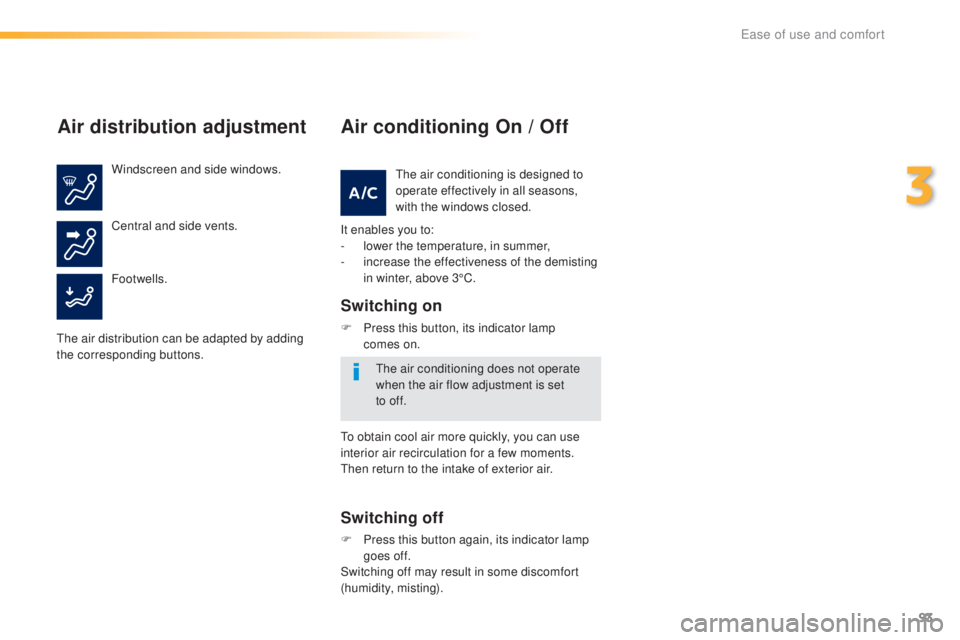
Air distribution adjustment
Windscreen and side windows.
Footwells. Central and side vents.
the a
ir distribution can be adapted by adding
the corresponding buttons.
Air conditioning On / Off
It enables you to:
- lo wer the temperature, in summer,
-
in
crease the effectiveness of the demisting
in winter, above 3°C.
Switching on
F Press this button, its indicator lamp
c omes on.
Switching off
F Press this button again, its indicator lamp
go es off.
Switching off may result in some discomfort
(humidity, misting).
the a
ir conditioning is designed to
operate effectively in all seasons,
with the windows closed.
the a
ir conditioning does not operate
when the air flow adjustment is set
to
of
f.
to ob
tain cool air more quickly, you can use
interior air recirculation for a few moments.
the
n return to the intake of exterior air.
3
ease of use and comfort