2016 Peugeot 308 ESP
[x] Cancel search: ESPPage 98 of 398
96
308_en_Chap03_ergonomie-et-confort_ed02-2015
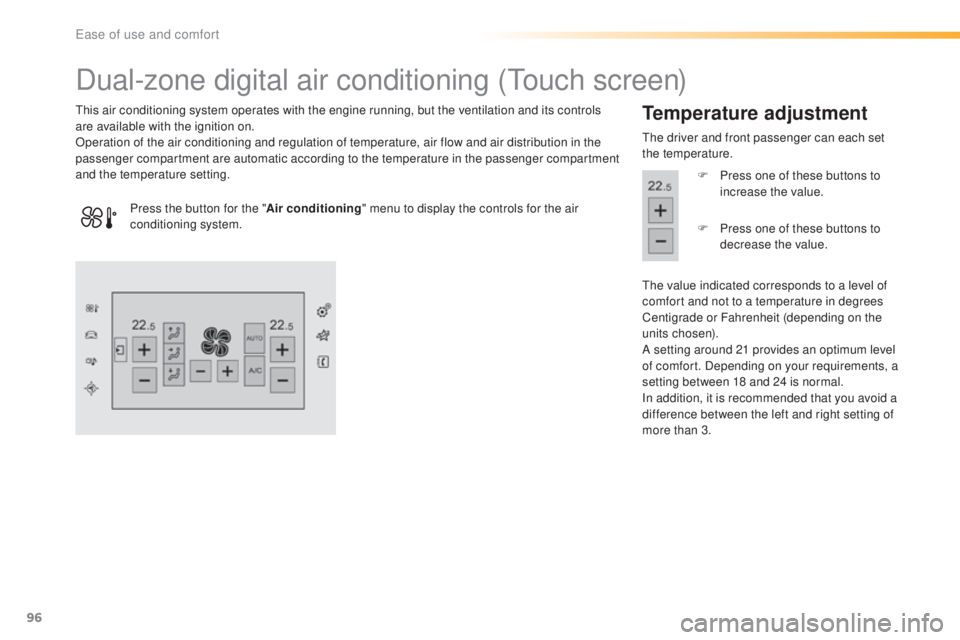
Dual-zone digital air conditioning (touch screen)
this air conditioning system operates with the engine running, but the ventilation and its controls
a re available with the ignition on.
Operation of the air conditioning and regulation of temperature, air flow and air distribution in the
passenger compartment are automatic according to the temperature in the passenger compartment
and the temperature setting.Temperature adjustment
the driver and front passenger can each set
t he temperature.
F
Pr
ess one of these buttons to
increase the value.
the v
alue indicated corresponds to a level of
comfort and not to a temperature in degrees
Centigrade or Fahrenheit (depending on the
units chosen).
A setting around 21 provides an optimum level
of comfort. Depending on your requirements, a
setting between 18 and 24 is normal.
In addition, it is recommended that you avoid a
difference between the left and right setting of
more than 3.
Press the button for the "
Air conditioning" menu to display the controls for the air
conditioning system. F
Pr
ess one of these buttons to
decrease the value.
ease of use and comfort
Page 106 of 398
104
308_en_Chap03_ergonomie-et-confort_ed02-2015
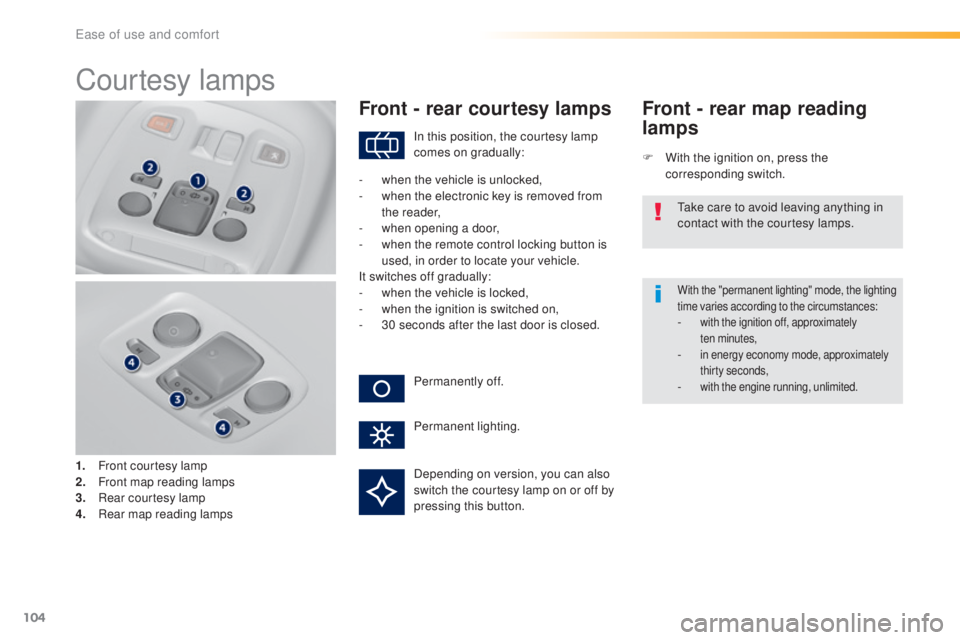
Courtesy lamps
1. Front courtesy lamp
2. Fr ont map reading lamps
3.
Re
ar courtesy lamp
4.
Re
ar map reading lamps
Front - rear courtesy lamps
F With the ignition on, press the
corresponding switch.
Front - rear map reading
lamps
With the "permanent lighting" mode, the lighting
time varies according to the circumstances:
- with the ignition off, approximately
ten m inutes,
- in energy economy mode, approximately
thirty seconds,
- with the engine running, unlimited.
In this position, the courtesy lamp
comes on gradually:
Permanently off.
Permanent lighting.
-
wh
en the vehicle is unlocked,
-
wh
en the electronic key is removed from
the reader,
-
when
opening a door,
-
wh
en the remote control locking button is
used, in order to locate your vehicle.
It switches off gradually:
-
wh
en the vehicle is locked,
-
wh
en the ignition is switched on,
-
30 s
econds after the last door is closed.
tak
e care to avoid leaving anything in
contact with the courtesy lamps.
Depending on version, you can also
switch the courtesy lamp on or off by
pressing this button.
ease of use and comfort
Page 108 of 398
106
308_en_Chap04_eclairage-et-visibilite_ed02-2015
Mirrors
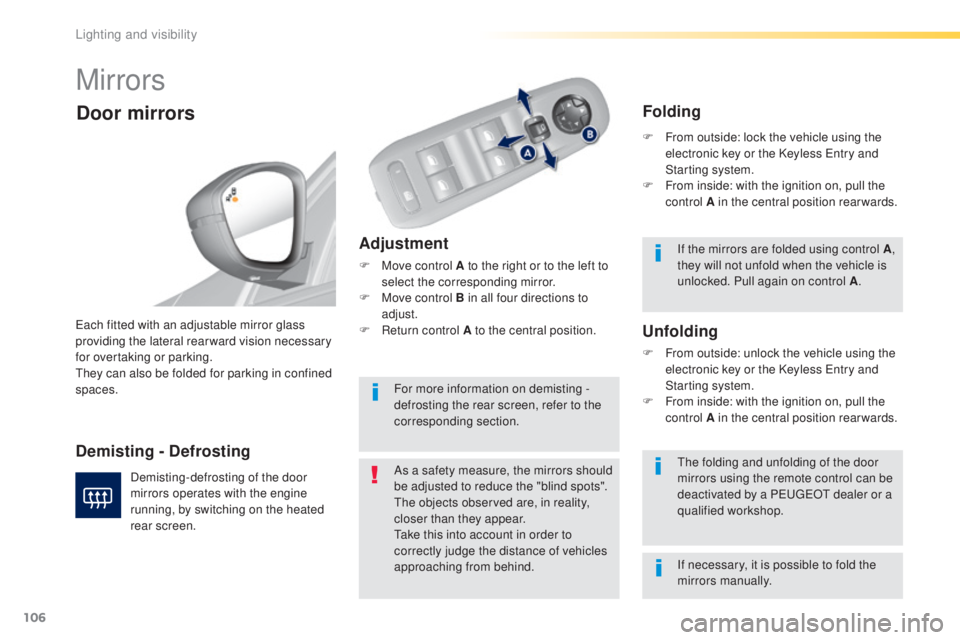
Adjustment
F Move control A to the right or to the left to
select the corresponding mirror.
F
Mov
e control B in all four directions to
adjust.
F
Re
turn control A to the central position.
eac
h fitted with an adjustable mirror glass
providing the lateral rear ward vision necessary
for overtaking or parking.
the
y can also be folded for parking in confined
spaces.
Demisting - Defrosting
Door mirrors
Demisting-defrosting of the door
mirrors operates with the engine
running, by switching on the heated
rear screen. As a safety measure, the mirrors should
be adjusted to reduce the "blind spots".
the o
bjects observed are, in reality,
closer than they appear.
tak
e this into account in order to
correctly judge the distance of vehicles
approaching from behind.the f olding and unfolding of the door
mirrors using the remote control can be
deactivated by a P
eu
ge
Ot d
ealer or a
qualified workshop.
Unfolding
F From outside: unlock the vehicle using the
e lectronic key or the Keyless ent ry and
Starting system.
F
Fr
om inside: with the ignition on, pull the
control A in the central position rearwards.
Folding
F From outside: lock the vehicle using the
e lectronic key or the Keyless ent ry and
Starting system.
F
Fr
om inside: with the ignition on, pull the
control A in the central position rearwards.
If the mirrors are folded using control A ,
they will not unfold when the vehicle is
unlocked. Pull again on control A .
For more information on demisting -
defrosting the rear screen, refer to the
corresponding section.
If necessary, it is possible to fold the
mirrors manually.
Lighting and visibility
Page 111 of 398
109
308_en_Chap04_eclairage-et-visibilite_ed02-2015
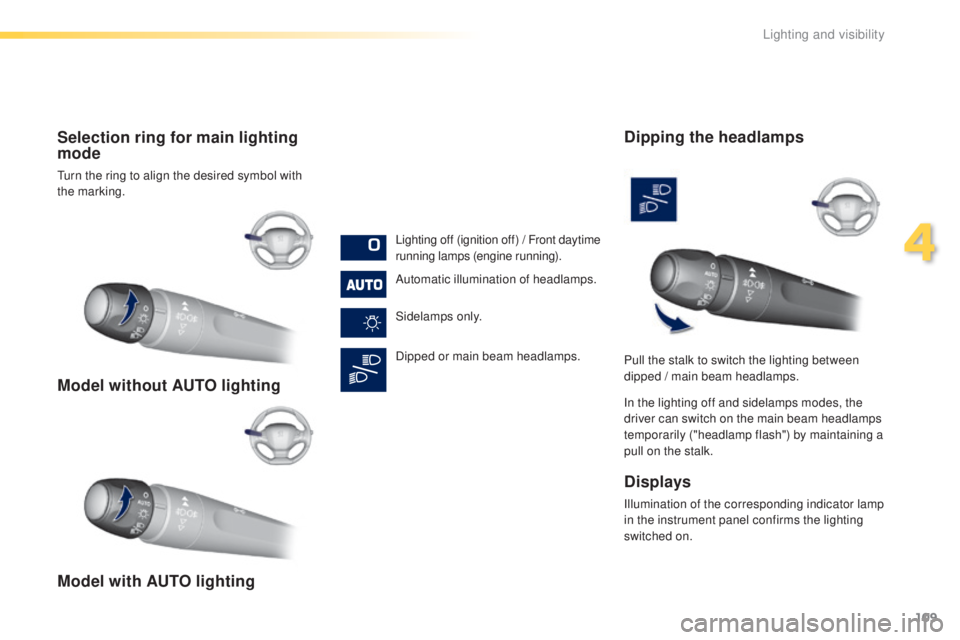
Model without AUTO lighting
Model with AUTO lighting Selection ring for main lighting
mode
turn the ring to align the desired symbol with
t he marking.
Lighting off (ignition off) / Front daytime
running lamps (engine running).
Automatic illumination of headlamps.
Sidelamps only.
Dipped or main beam headlamps.
Dipping the headlamps
In the lighting off and sidelamps modes, the
driver can switch on the main beam headlamps
temporarily ("headlamp flash") by maintaining a
pull on the stalk.
Displays
Illumination of the corresponding indicator lamp
in the instrument panel confirms the lighting
switched on. Pull the stalk to switch the lighting between
dipped / main beam headlamps.
4
Lighting and visibility
Page 113 of 398
111
308_en_Chap04_eclairage-et-visibilite_ed02-2015
In good or rainy weather, both day
and night, the front foglamps and the
rear foglamps are prohibited. In these
situations, the power of their beams
may dazzle other drivers.
they
should
only be used in fog or snow.
In these weather conditions, it is your
responsibility to switch on the foglamps
and dipped headlamps manually as the
sunshine sensor may detect sufficient
light.
Do not forget to switch off the front
foglamps and the rear foglamps when
they are no longer needed.Lighting left on audible signal
An audible signal when a front door
is opened warns the driver that the
vehicle's exterior lighting is on, with the
ignition off and in manual lighting mode.
In this case, switching off the lighting
stops the audible signal.
With the ignition off, if the dipped
headlamps remain on, the vehicle goes
into "
eCO
" mode to avoid discharging
the battery.
the l
ighting goes off when you switch
off the ignition, but you can always
switch it on again using the lighting
control stalk.
Direction indicators
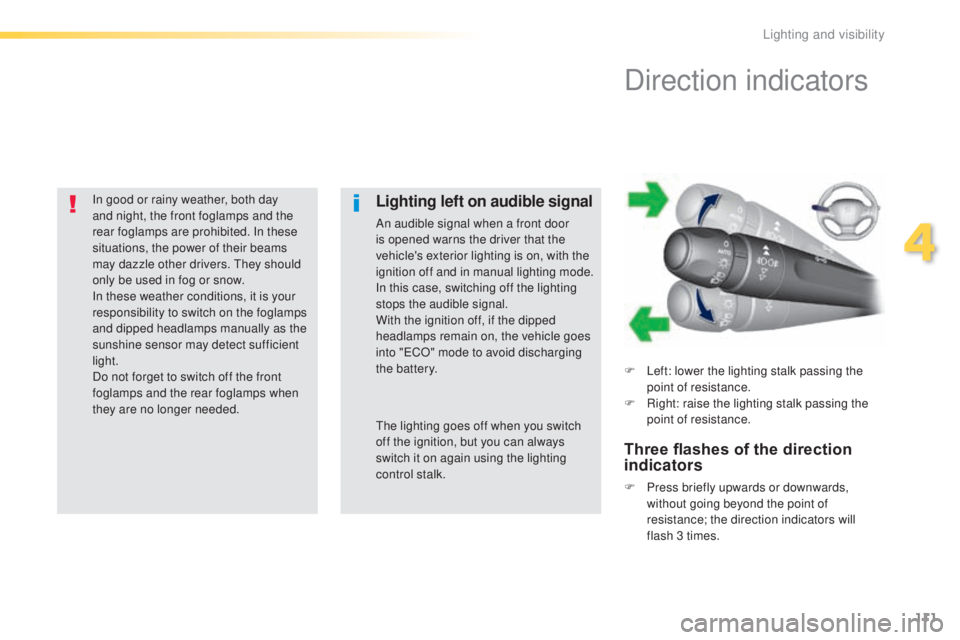
F Left: lower the lighting stalk passing the
p oint of resistance.
F
Ri
ght: raise the lighting stalk passing the
point of resistance.
Three flashes of the direction
indicators
F Press briefly upwards or downwards,
w ithout going beyond the point of
resistance; the direction indicators will
flash 3 times.
4
Lighting and visibility
Page 126 of 398
124
308_en_Chap05_securite_ed02-2015
From approximately 12 mph
(20 km/h), the warning lamp(s)
flash for two minutes accompanied
by an audible signal. Once these
two
m
inutes have elapsed, the
warning lamp(s) remain on until the
driver or one or more passengers
fasten their seat belt.
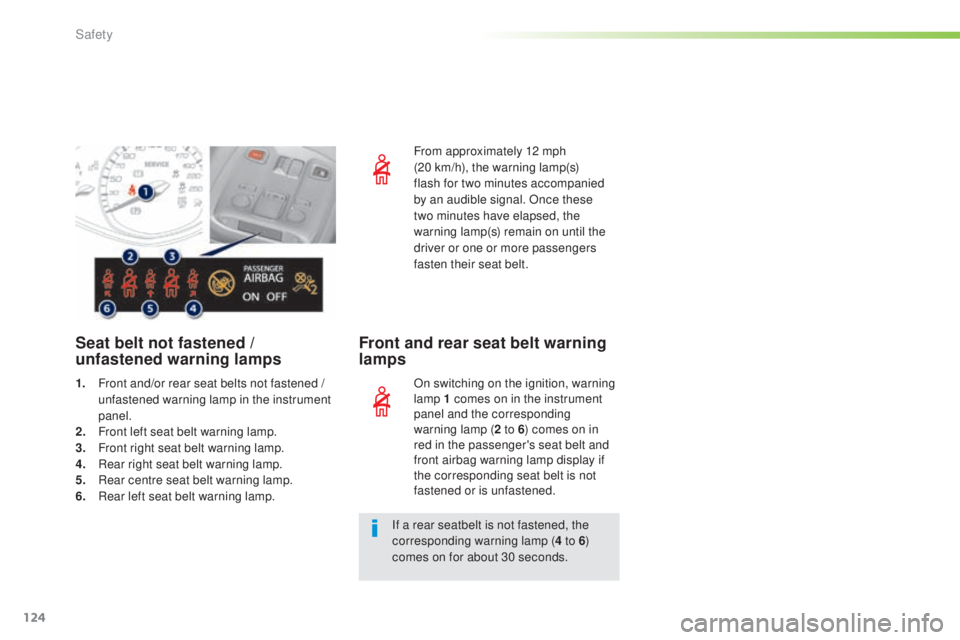
Seat belt not fastened /
un fastened warning lamps Front and rear seat belt warning
lamps
On switching on the ignition, warning
lamp 1 comes on in the instrument
panel and the corresponding
warning lamp (
2 to 6) comes on in
red in the passenger's seat belt and
front airbag warning lamp display if
the corresponding seat belt is not
fastened or is unfastened.
If a rear seatbelt is not fastened, the
corresponding warning lamp ( 4 to 6)
comes on for about 30 seconds.
1. Fr
ont and/or rear seat belts not fastened /
u
nfastened warning lamp in the instrument
panel.
2.
Fr
ont left seat belt warning lamp.
3.
Fr
ont right seat belt warning lamp.
4.
Re
ar right seat belt warning lamp.
5.
Re
ar centre seat belt warning lamp.
6.
Re
ar left seat belt warning lamp.
Safety
Page 127 of 398
125
308_en_Chap05_securite_ed02-2015
Advice
Recommendations for children
use a suitable child seat if the passenger is
l ess than 12 years old or shorter than one
and a half metres.
Never use the same seat belt to secure more
than one person.
Never allow a child to travel on your lap.
For more information on child seats, refer to
the corresponding section.
In order to be effective, a seat belt must:
- be t
ightened as close to the body as
possible,
-
be p
ulled in front of you with a smooth
movement, checking that it does not
twist,
-
be u
sed to restrain only one person,
-
no
t bear any trace of cuts or fraying,
-
no
t be converted or modified to avoid
affecting its performance.
In accordance with current safety
regulations, for all repairs on your vehicle's
seat belts, go to a qualified workshop with
the skills and equipment needed, which a
P
eug
e
Ot de
aler is able to provide.
Have your seat belts checked regularly by a
P
eu
ge
Ot d
ealer or a qualified workshop,
particularly if the straps show signs of
damage.
Clean the seat belt straps with soapy
water or a textile cleaning product, sold by
P
eu
ge
Ot dea
lers.
After folding or moving a seat or rear bench
seat, ensure that the seat belt is positioned
and reeled in correctly.
In the event of an impact
Depending on the nature and
seriousness of the impact , the
pretensioning device may be deployed
before and independently of the airbags.
Deployment of the pretensioners is
accompanied by a slight discharge of
harmless smoke and a noise, due to the
activation of the pyrotechnic cartridge
incorporated in the system.
In all cases, the airbag warning lamp
comes
on
.
Following an impact, have the seat belts
system checked, and if necessary replaced,
by a P
eu
ge
Ot d
ealer or a qualified
workshop.
the d
river must ensure that passengers use
the seat belts correctly and that they are all
fastened before setting off.
Wherever you are seated in the vehicle,
always fasten your seat belt, even for short
journeys.
Do not interchange the seat belt buckles as
they will not fulfil their role fully.
the s
eat belts are fitted with an inertia reel
permitting automatic adjustment of the
length of the strap to your size.
the s
eat belt
is stowed automatically when not in use.
Before and after use, ensure that the seat
belt is reeled in correctly.
the l
ower part of the strap must be
positioned as low as possible on the pelvis.the u
pper part must be positioned in the
hollow of the shoulder.
the i
nertia reels are fitted with an automatic
locking device which comes into operation in
the event of a collision, emergency braking
or if the vehicle rolls over. You can release
the device by pulling the strap firmly and
then releasing it so that it reels in slightly.
5
Safety
Page 130 of 398
128
308_en_Chap05_securite_ed02-2015
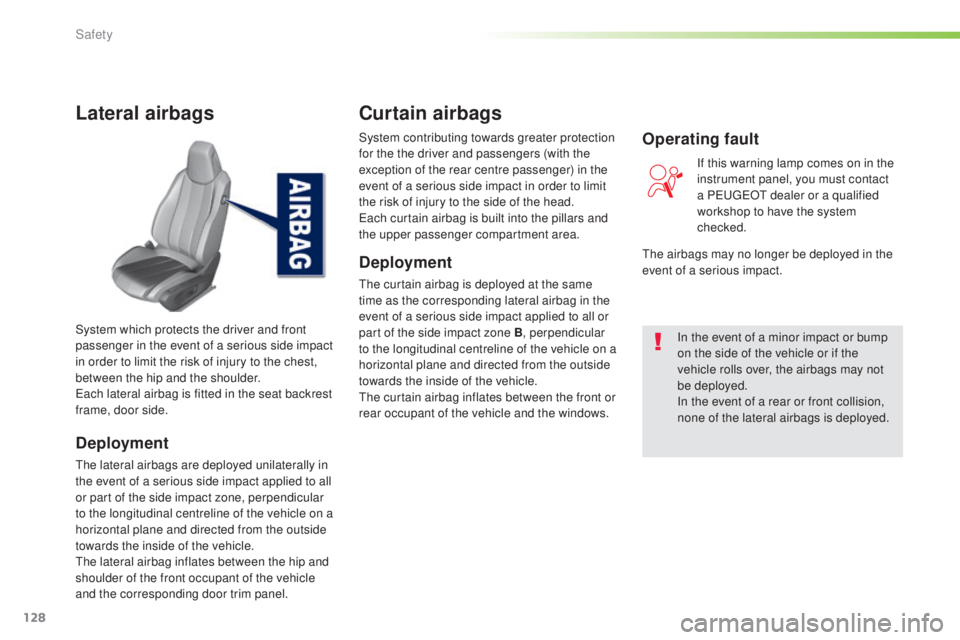
Lateral airbags
Deployment
the lateral airbags are deployed unilaterally in
t he event of a serious side impact applied to all
or part of the side impact zone, perpendicular
to the longitudinal centreline of the vehicle on a
horizontal plane and directed from the outside
towards the inside of the vehicle.
the l
ateral airbag inflates between the hip and
shoulder of the front occupant of the vehicle
and the corresponding door trim panel. System which protects the driver and front
passenger in the event of a serious side impact
in order to limit the risk of injury to the chest,
between the hip and the shoulder.
eac
h lateral airbag is fitted in the seat backrest
frame, door side. System contributing towards greater protection
for the the driver and passengers (with the
exception of the rear centre passenger) in the
event of a serious side impact in order to limit
the risk of injury to the side of the head.
eac
h curtain airbag is built into the pillars and
the upper passenger compartment area.
Deployment
the curtain airbag is deployed at the same
t ime as the corresponding lateral airbag in the
event of a serious side impact applied to all or
part of the side impact zone B, perpendicular
to the longitudinal centreline of the vehicle on a
horizontal plane and directed from the outside
towards the inside of the vehicle.
the c
urtain airbag inflates between the front or
rear occupant of the vehicle and the windows. In the event of a minor impact or bump
on the side of the vehicle or if the
vehicle rolls over, the airbags may not
be deployed.
In the event of a rear or front collision,
none of the lateral airbags is deployed.If this warning lamp comes on in the
instrument panel, you must contact
a P
eu
ge
Ot d
ealer or a qualified
workshop to have the system
checked.
Operating fault
Curtain airbags
the airbags may no longer be deployed in the
e vent of a serious impact.
Safety