Page 238 of 398
236
308_en_Chap07_info-pratiques_ed02-2015
Range indicators
Once the AdBlue® tank is on reserve or after
detection of a fault with the SCR emissions
control system, when the ignition is switched
on, an indicator displays an estimate of the
distance that can be covered, the range, before
engine starting is prevented.
In the event of simultaneous system fault and
low AdBlue
® level, the shortest range figure is
the one displayed.
In the event of the risk of non-starting related to a lack of AdBlue®
the engine start prevention system
r equired by regulations is activated
automatically once the AdBlue
® tank is
e m pt y.
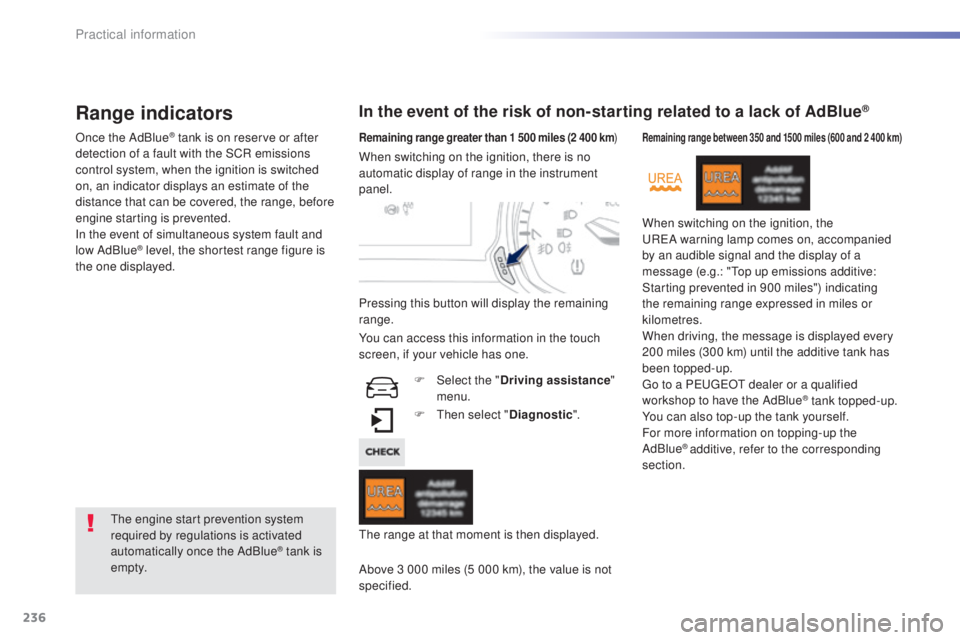
Remaining range greater than 1 500 miles (2 400 km )
Pressing this button will display the remaining
range.
F
t
hen se
lect "Diagnostic ".
Above 3 000 miles (5 000 km), the value is not
specified. When switching on the ignition, there is no
automatic display of range in the instrument
panel.
the r
ange at that moment is then displayed.
You can access this information in the touch
screen, if your vehicle has one.
F
Selec
t the "Driving assistance "
menu.
Remaining range between 350 and 1500 miles (600 and 2 400 km)
When switching on the ignition, the uReA w arning lamp comes on, accompanied
by an audible signal and the display of a
message (e.g.: "
top u
p emissions additive:
Starting prevented in 900 miles") indicating
the remaining range expressed in miles or
kilometres.
When driving, the message is displayed every
200 miles (300 km) until the additive tank has
been topped-up.
go to a Peu
ge
Ot d
ealer or a qualified
workshop to have the AdBlue
® tank topped-up.
You can also top-up the tank yourself.
For more information on topping-up the
AdBlue
® additive, refer to the corresponding
section.
Practical information
Page 239 of 398
237
308_en_Chap07_info-pratiques_ed02-2015
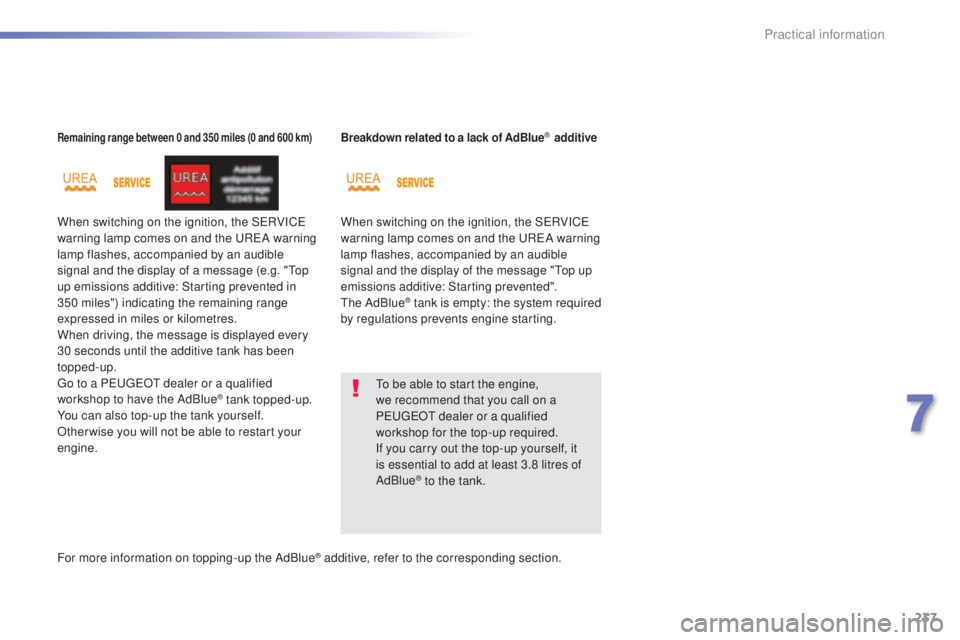
Remaining range between 0 and 350 miles (0 and 600 km)
When switching on the ignition, the SeRVICe
w arning lamp comes on and the uReA wa rning
lamp flashes, accompanied by an audible
signal and the display of a message (e.g. "
top
u
p emissions additive: Starting prevented in
350 miles") indicating the remaining range
expressed in miles or kilometres.
When driving, the message is displayed every
30 seconds until the additive tank has been
topped-up.
go to a Peu
ge
Ot d
ealer or a qualified
workshop to have the AdBlue
® tank topped-up.
You can also top-up the tank yourself.
Other wise you will not be able to restart your
engine.
Breakdown related to a lack of AdBlue® additive
When switching on the ignition, the SeRV ICe
w arning lamp comes on and the uReA wa rning
lamp flashes, accompanied by an audible
signal and the display of the message "
top u
p
emissions additive: Starting prevented".
the
AdBlue
® tank is empty: the system required
by regulations prevents engine starting.
to be a
ble to start the engine,
we recommend that you call on a
P
eu
ge
Ot d
ealer or a qualified
workshop for the top-up required.
If you carry out the top-up yourself, it
is essential to add at least 3.8 litres of
AdBlue
® to the tank.
For more information on topping-up the AdBlue
® additive, refer to the corresponding section.
7
Practical information
Page 246 of 398
244
308_en_Chap08_en-cas-de-panne_ed02-2015
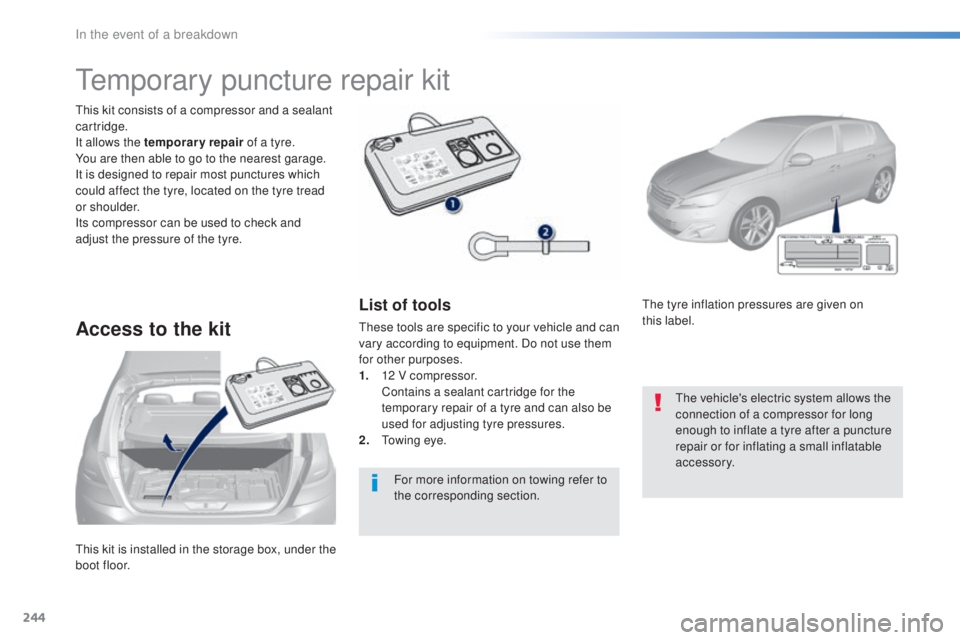
this kit is installed in the storage box, under the
bo ot floor.
thi
s kit consists of a compressor and a sealant
cartridge.
It allows the temporary repair of a tyre.
You are then able to go to the nearest garage.
It is designed to repair most punctures which
could affect the tyre, located on the tyre tread
or shoulder.
Its compressor can be used to check and
adjust the pressure of the tyre.
temporary puncture repair kit
Access to the kit
List of tools
these tools are specific to your vehicle and can
v ary according to equipment. Do not use them
for other purposes.
1.
12 V c
ompressor.
Co
ntains a sealant cartridge for the
temporary repair of a tyre and can also be
used for adjusting tyre pressures.
2.
tow
ing eye.
the t
yre inflation pressures are given on
this lab el.
the v
ehicle's electric system allows the
connection of a compressor for long
enough to inflate a tyre after a puncture
repair or for inflating a small inflatable
accessory.
For more information on towing refer to
the corresponding section.
In the event of a breakdown
Page 251 of 398
249
308_en_Chap08_en-cas-de-panne_ed02-2015
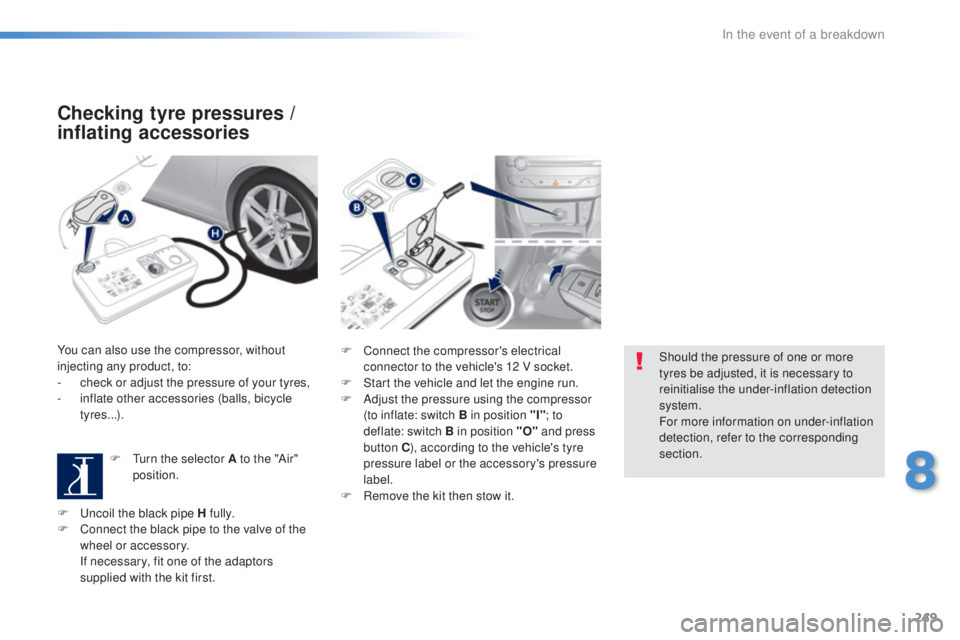
Checking tyre pressures /
inflating accessories
You can also use the compressor, without
injecting any product, to:
-
ch
eck or adjust the pressure of your tyres,
-
in
flate other accessories (balls, bicycle
tyres...).
F
t
ur
n the selector A to the "Air"
position. F Con
nect the compressor's electrical
connector to the vehicle's 12 V socket.
F
St
art the vehicle and let the engine run.
F
Ad
just the pressure using the compressor
(to inflate: switch B in position "I" ; to
deflate: switch B in position "O" and press
button C ), according to the vehicle's tyre
pressure label or the accessory's pressure
label.
F
Re
move the kit then stow it.Should the pressure of one or more
tyres be adjusted, it is necessary to
reinitialise the under-inflation detection
system.
For more information on under-inflation
detection, refer to the corresponding
section.
F
u
nc
oil the black pipe H fully.
F
Co
nnect the black pipe to the valve of the
wheel or accessory.
If n
ecessary, fit one of the adaptors
supplied with the kit first.
8
In the event of a breakdown
Page 252 of 398
250
308_en_Chap08_en-cas-de-panne_ed02-2015
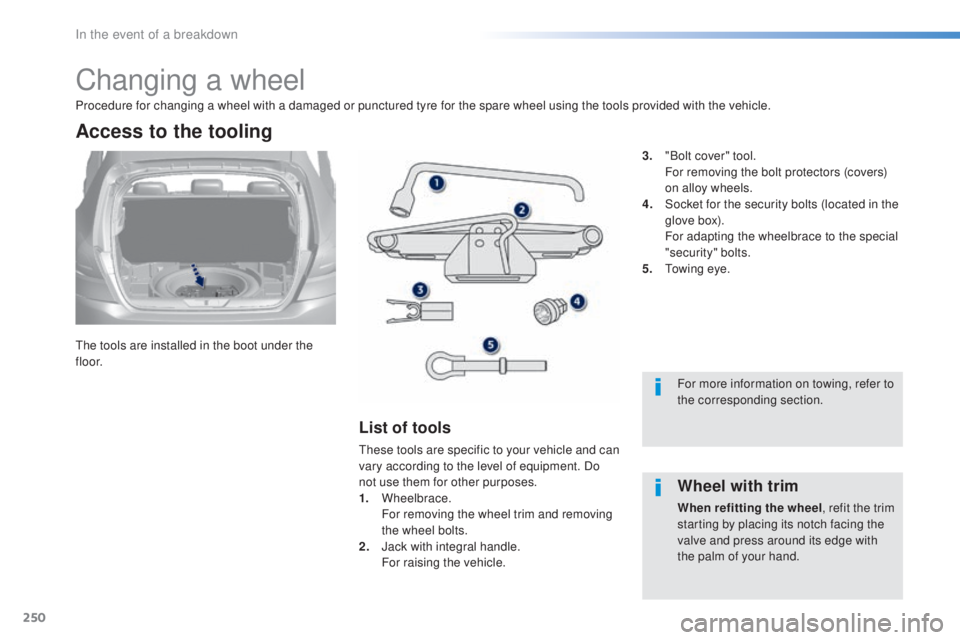
Changing a wheel
the tools are installed in the boot under the
f l o o r.
Access to the tooling
List of tools
these tools are specific to your vehicle and can
v ary according to the level of equipment. Do
not use them for other purposes.
1.
W
heelbrace.
Fo
r removing the wheel trim and removing
the wheel bolts.
2.
Ja
ck with integral handle.
Fo
r raising the vehicle. 3.
"B
olt cover" tool.
Fo
r removing the bolt protectors (covers)
on alloy wheels.
4.
So
cket for the security bolts (located in the
glove box).
Fo
r adapting the wheelbrace to the special
"security" bolts.
5.
tow
ing eye.
Procedure for changing a wheel with a damaged or punctured tyre for the spare wheel using the tools provided with the vehicle.
For more information on towing, refer to
the corresponding section.
Wheel with trim
When refitting the wheel, refit the trim
starting by placing its notch facing the
valve and press around its edge with
the palm of your hand.
In the event of a breakdown
Page 257 of 398
255
308_en_Chap08_en-cas-de-panne_ed02-2015
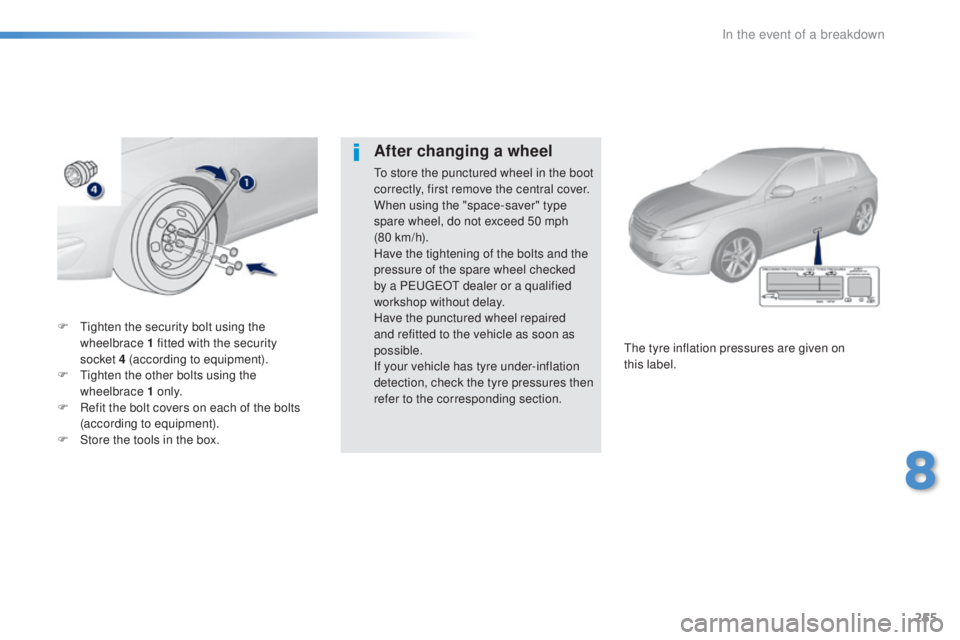
F tighten the security bolt using the
w heelbrace 1 fitted with the security
socket
4
(according to equipment).
F
t
ig
hten the other bolts using the
wheelbrace 1 o n l y.
F
Re
fit the bolt covers on each of the bolts
(according to equipment).
F
St
ore the tools in the box.
the t
yre inflation pressures are given on
this
lab
el.
After changing a wheel
to store the punctured wheel in the boot
c orrectly, first remove the central cover.
When using the "space-saver" type
spare wheel, do not exceed 50 mph
(80
k
m/h).
Have the tightening of the bolts and the
pressure of the spare wheel checked
by a P
eu
ge
Ot d
ealer or a qualified
workshop without delay.
Have the punctured wheel repaired
and refitted to the vehicle as soon as
possible.
If your vehicle has tyre under-inflation
detection, check the tyre pressures then
refer to the corresponding section.
8
In the event of a breakdown
Page 269 of 398
267
308_en_Chap08_en-cas-de-panne_ed02-2015
PeugeOt w ill not accept responsibility
for the cost incurred in repairing your
vehicle or for rectifying malfunctions
resulting from the installation of
accessories not supplied and not
recommended by P
eu
ge
Ot a
nd
not installed in accordance with its
instructions, in particular when the
combined consumption of all of the
additional equipment connected
exceeds 10 milliamperes.Installing electrical
accessories
Your vehicle's electrical system is
designed to operate with standard or
optional equipment.
Before installing other electrical
equipment or accessories on your
vehicle, contact a P
eu
ge
Ot d
ealer or
a qualified workshop.
8
In the event of a breakdown
Page 275 of 398

273
308_en_Chap08_en-cas-de-panne_ed02-2015
Starting using another battery
First check that the slave battery has a
nominal voltage of 12 V and a capacity
at least equal to that of the discharged
battery.
Do not try to start the engine by
connecting a battery charger.
Do not disconnect the (+) terminal when
the engine is running.
F
Re
move the plastic cover from
the
(
+)
t
erminal, if your vehicle has one.
F
Co
nnect the red cable to the positive
terminal (+) of the flat battery A , then to the
positive terminal (+) of the slave battery B.
F
Co
nnect one end of the green or black
cable to the negative terminal (-) of the
slave battery B (or earth point on the other
vehicle).
F
Co
nnect the other end of the green or black
cable to the earth point C on the broken
down vehicle (or on the engine mounting).
F
St
art the engine of the vehicle with the
good battery and leave it running for a
few
m
inutes. F
Op
erate the starter on the broken down
vehicle and let the engine run
If t
he engine does not start straight
away, switch off the ignition and wait a
few
m
oments before trying again.
F
Wa
it until the engine returns to idle then
disconnect the jump lead cables in the
reverse order.
F
Re
fit the plastic cover to the (+) terminal, if
your vehicle has one.
When your vehicle's battery is discharged, the
engine can be started using a slave battery
(external or on another vehicle) and jump lead
cables.Before disconnecting the battery
Wait 2 minutes after switching off the ignition
before disconnecting the battery.
Close the windows and the doors before
disconnecting the battery.
Following reconnection of the
battery
Following reconnection of the battery, switch on
the ignition and wait 1 minute before starting to
permit initialisation of the electronic systems.
However, if problems remain following this
operation, contact a P
eu
ge
Ot d
ealer or a
qualified workshop.
Referring to the corresponding section, you
must yourself reinitialise (depending on
version):
-
th
e remote control key,
-
th
e electric blind(s),
-
... S
ome functions are not available if the
battery is not sufficiently charged.
8
In the event of a breakdown