Page 135 of 398
133
308_en_Chap05_securite_ed02-2015
Passenger airbag OFF
For more information on deactivating
the passenger's airbag, refer to the
corresponding section.
Deactivating the passenger's front airbag
Never install a rear ward facing child
restraint system on a seat protected by
an active front airbag.
thi
s could cause the death of the child
or serious injury.the w arning label present on both sides of the
passenger's sun visor repeats this advice.
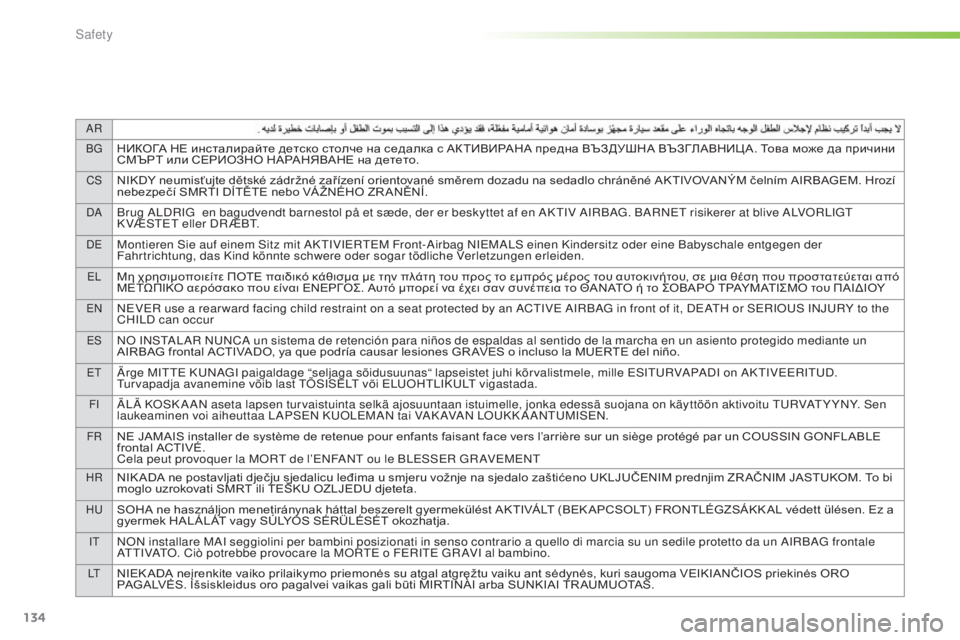
In line with current legislation, the following
tables contain this warning in all of the
languages required.
5
Safety
Page 136 of 398
134
AR
B
gНИКОГА НЕ инсталирайте детско столче на седалка с АКТИВИРАНА предна ВЪЗДУШНА ВЪЗГЛАВНИЦ А. Това може да причини
СМЪРТ или СЕРИОЗНО НАРАНЯВАНЕ на детето.
CSNIKDY neumisťujte dětské zádržné zařízení orientované směrem dozadu na sedadlo chráněné AKTIVOVANÝM čelním AIRBAGEM. Hrozí
nebezpečí SMRTI DÍTĚTE nebo VÁ ŽNÉHO ZR ANĚNÍ.
DABrug ALDRIg e n bagudvendt barnestol på et sæde, der er beskyttet af en AKtIV A IRBAg. BA RNet r isikerer at blive ALVORLIgt
K VÆSte t e ller DR ÆBt.
DeMontieren Sie auf einem Sitz mit AKtIV IeRteM Fr ont-Airbag NIeMA LS einen Kindersitz oder eine Babyschale entgegen der
Fahrtrichtung, das Kind könnte schwere oder sogar tödliche Verletzungen erleiden.
eLΜη χρησιμοποιείτε ΠΟΤΕ παιδικό κάθισμα με την πλάτη του προς το εμπρός μέρος του αυτοκινήτου, σε μια θέση που προστατεύεται από
ΜΕΤΩΠΙΚΟ αερόσακο που είναι ΕΝΕΡΓΟΣ. Αυτό μπορεί να έχει σαν συνέπεια το ΘΑΝΑΤΟ ή το ΣΟΒΑΡΟ ΤΡΑΥΜΑΤΙΣΜΟ του ΠΑΙΔΙΟΥ
eNNeVeR use a rear ward facing child restraint on a seat protected by an ACtIVe A IRBAg i n front of it, DeAtH or SeRI OuS IN JuRY t o the
CHILD can occur
eSNO INStALAR NuNC A un sistema de retención para niños de espaldas al sentido de la marcha en un asiento protegido mediante un
AIRBAG frontal ACTIVADO, ya que podría causar lesiones GR AVES o incluso la MUERTE del niño.
etÄrge MItte KuNAgI pa igaldage “seljaga sõidusuunas“ lapseistet juhi kõrvalistmele, mille eSIt uRV APADI on AKtI VeeRIt uD. tur
vapadja avanemine võib last tÕS ISeLt v õi eLuOHtLI KuLt v igastada.
FIÄLÄ KOSK A AN aseta lapsen tur vaistuinta selkä ajosuuntaan istuimelle, jonka edessä suojana on käyttöön aktivoitu tuRV AtY Y NY. Sen
laukeaminen voi aiheuttaa LAPSeN KuOLeMA N tai VAK AVAN LOuKK A ANtuMI SeN.
FRNE JAMAIS installer de système de retenue pour enfants faisant face vers l’arrière sur un siège protégé par un COUSSIN GONFLABLE
frontal ACTIVÉ.
Cela peut provoquer la MOR
t d
e l’
eNF
AN
t o
u le BL
eSSeR gR A
V
eMeNt
HRNIK ADA ne postavljati dječju sjedalicu leđima u smjeru vožnje na sjedalo zaštićeno UKLJUČENIM prednjim ZR AČNIM JASTUKOM. To bi
moglo uzrokovati SMRT ili TEŠKU OZLJEDU djeteta.
HuSOHA ne használjon menetiránynak háttal beszerelt gyermekülést AKTIVÁLT (BEK APCSOLT) FRONTLÉGZSÁKK AL védett ülésen. Ez a
gyermek HALÁLÁT vagy SÚLYOS SÉRÜLÉSÉT okozhatja.
ItNON installare MAI seggiolini per bambini posizionati in senso contrario a quello di marcia su un sedile protetto da un AIRBAg f rontale
AttIV AtO. C iò potrebbe provocare la MORte o FeRIte gR A VI al bambino.
LtNIEK ADA neįrenkite vaiko prilaikymo priemonės su atgal atgręžtu vaiku ant sėdynės, kuri saugoma VEIKIANČIOS priekinės ORO
PAGALVĖS. Išsiskleidus oro pagalvei vaikas gali būti MIRTINAI arba SUNKIAI TR AUMUOTAS.
308_en_Chap05_securite_ed02-2015
Safety
Page 145 of 398
143
308_en_Chap05_securite_ed02-2015
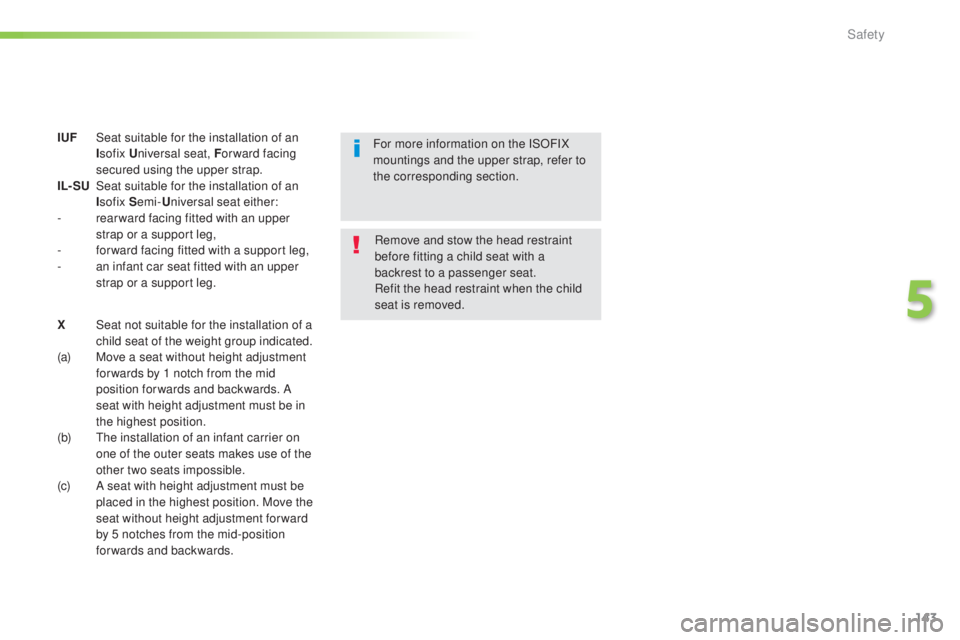
IUF Seat suitable for the installation of an
Is
ofix Universal seat, F or ward facing
secured using the upper strap.
IL- SU
Se
at suitable for the installation of an
I sofix S emi-Universal seat either:
-
re
ar ward facing fitted with an upper
strap or a support leg,
-
fo
r ward facing fitted with a support leg,
-
an i
nfant car seat fitted with an upper
strap or a support leg. For more information on the ISOFIX
mountings and the upper strap, refer to
the corresponding section.
X
Se
at not suitable for the installation of a
child seat of the weight group indicated.
(a)
Mov
e a seat without height adjustment
for wards by 1 notch from the mid
position for wards and backwards. A
seat with height adjustment must be in
the highest position.
(b)
t
he i
nstallation of an infant carrier on
one of the outer seats makes use of the
other two seats impossible.
(c)
A se
at with height adjustment must be
placed in the highest position. Move the
seat without height adjustment forward
by 5 notches from the mid-position
forwards and backwards. Remove and stow the head restraint
before fitting a child seat with a
backrest to a passenger seat.
Refit the head restraint when the child
seat is removed.
5
Safety
Page 149 of 398
147
308_en_Chap06_conduite_ed02-2015
When towing
Distribution of loads
F Distribute the load in the trailer so that the
heaviest items are as close as possible to
the axle and the nose weight approaches
the maximum permitted without
exceeding
it
.
Air density decreases with altitude, thus
reducing engine performance. Above
1
0
00
m
etres, the maximum towed load must
be reduced by 10
% f
or every 1
0
00 metres of
altitude.
Side wind
F take into account the increased sensitivity
t o side wind.
Cooling
towing a trailer on a slope increases the
t emperature of the coolant.
As the fan is electrically controlled, its cooling
capacity is not dependent on the engine speed.
F
t
o lo
wer the engine speed, reduce your
speed.
the m
aximum towed load on a long incline
depends on the gradient and the ambient
temperature.
In all cases, keep a check on the coolant
temperature.
F
If t
he warning lamp and the
STOP warning lamp come on,
stop the vehicle and switch off
the engine as soon as possible.
Braking
towing a trailer increases the braking distance.to av oid overheating of the brakes, the use of
engine braking is recommended.
Ty r e s
F Check the tyre pressures of the towing
v ehicle and of the trailer, observing the
recommended pressures.
Lighting
F Check the electrical lighting and signalling
o n the trailer and the hadlamp beam height
of your vehicle.
For more information on adjusting the
headlamp beam height, refer to the
corresponding section.
For more information on weights (and
the towed loads which apply to your
vehicle) refer to the corresponding
section.
the r
ear parking sensors will be
deactivated automatically if a genuine
P
eu
ge
Ot t
owbar is used.
6
Driving
Page 168 of 398
166
308_en_Chap06_conduite_ed02-2015
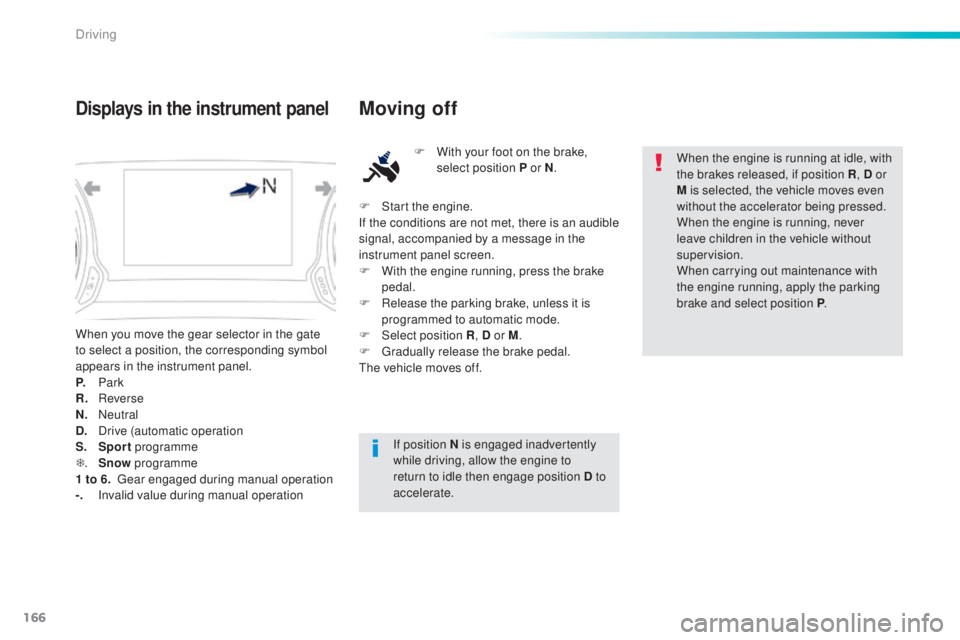
When you move the gear selector in the gate
to select a position, the corresponding symbol
appears in the instrument panel.
P.
Pa
rk
R.
Re
verse
N.
Ne
utral
D.
Dr
ive (automatic operation
S.
Sp
ort programme
T .
Sn
ow programme
1 to 6.
g
ear
engaged during manual operation
-.
In
valid value during manual operation
Displays in the instrument panelMoving off
F With your foot on the brake,
select position P or N .
If position N is engaged inadvertently
while driving, allow the engine to
return to idle then engage position D to
accelerate. When the engine is running at idle, with
the brakes released, if position R
, D or
M is selected, the vehicle moves even
without the accelerator being pressed.
When the engine is running, never
leave children in the vehicle without
supervision.
When carrying out maintenance with
the engine running, apply the parking
brake and select position P .
F
St
art the engine.
If the conditions are not met, there is an audible
signal, accompanied by a message in the
instrument panel screen.
F
Wi
th the engine running, press the brake
pedal.
F
Re
lease the parking brake, unless it is
programmed to automatic mode.
F
Selec
t position R , D or M.
F
g
rad
ually release the brake pedal.
the v
ehicle moves off.
Driving
Page 175 of 398
173
308_en_Chap06_conduite_ed02-2015
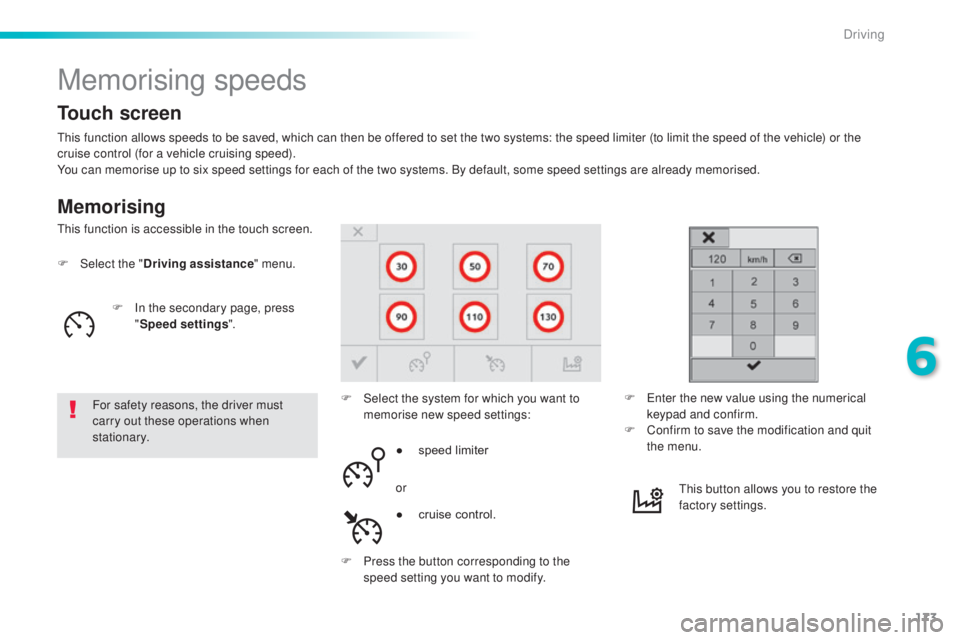
Memorising speeds
Memorising
this function allows speeds to be saved, which can then be offered to set the two systems: the speed limiter (to limit the speed of the vehicle) or the
c ruise control (for a vehicle cruising speed).
You can memorise up to six speed settings for each of the two systems. By default, some speed settings are already memorised.
F
Selec
t the "Driving assistance " menu.
For safety reasons, the driver must
carry out these operations when
stationary. F
Se
lect the system for which you want to
memorise new speed settings:
thi
s function is accessible in the touch screen.
F
e
nt
er the new value using the numerical
keypad and confirm.
F
Co
nfirm to save the modification and quit
the menu.
●
sp
eed limiter
or
F
Pr
ess the button corresponding to the
speed setting you want to modify.
thi
s button allows you to restore the
factory settings.
Touch screen
F In the secondary page, press
" S
peed settings ".
●
cr
uise control.
6
Driving
Page 176 of 398
174
308_en_Chap06_conduite_ed02-2015
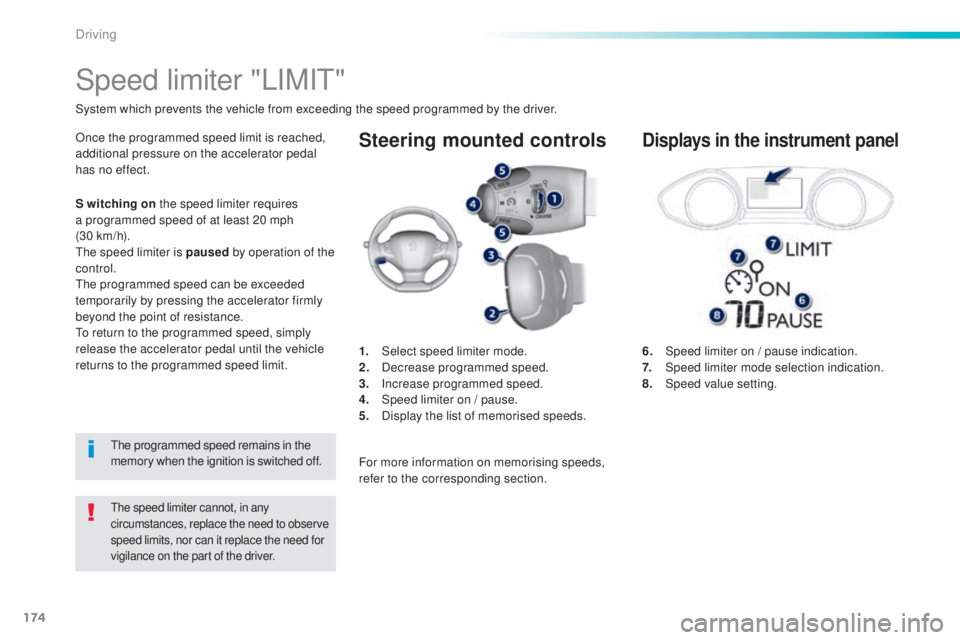
Steering mounted controls
6. Speed limiter on / pause indication.
7. Speed limiter mode selection indication.
8.
Speed
value setting.
Speed limiter "LIMIt"
System which prevents the vehicle from exceeding the speed programmed by the driver.
the speed limiter cannot, in any
c ircumstances, replace the need to observe
speed limits, nor can it replace the need for
vigilance on the part of the driver.
Once the programmed speed limit is reached,
additional pressure on the accelerator pedal
has no effect.
1.
Selec
t speed limiter mode.
2.
Dec
rease programmed speed.
3.
Inc
rease programmed speed.
4.
Sp
eed limiter on / pause.
5.
Di
splay the list of memorised speeds.Displays in the instrument panel
S witching on the speed limiter requires
a programmed speed of at least 20 mph
(30
k
m/h).
the s
peed limiter is paused by operation of the
control.
the
programmed speed can be exceeded
temporarily by pressing the accelerator firmly
beyond the point of resistance.
to re
turn to the programmed speed, simply
release the accelerator pedal until the vehicle
returns to the programmed speed limit.
the p
rogrammed speed remains in the
memory when the ignition is switched off. For more information on memorising speeds,
refer to the corresponding section.
Driving
Page 177 of 398
175
308_en_Chap06_conduite_ed02-2015
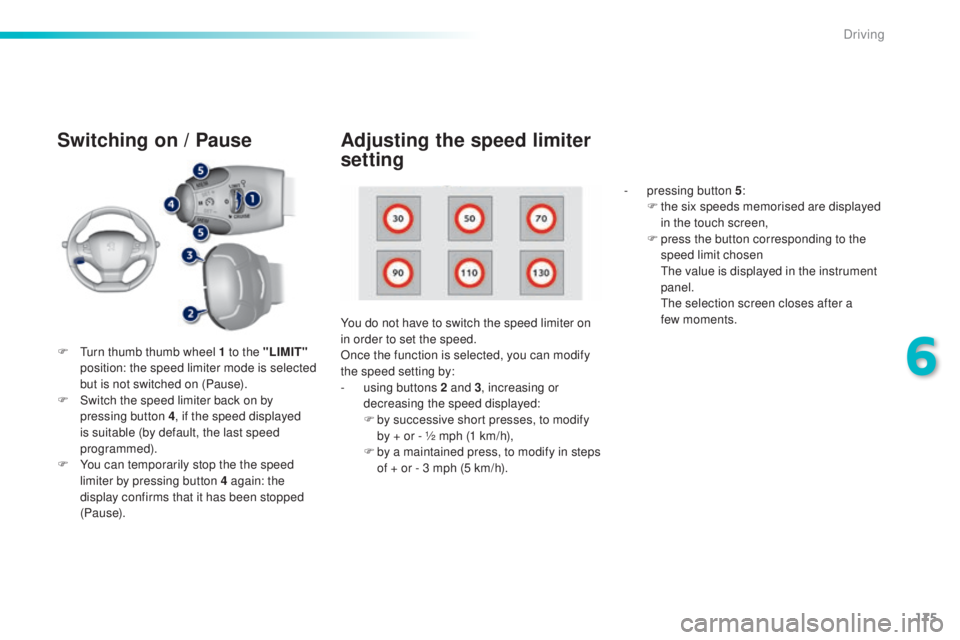
Switching on / Pause
F turn thumb thumb wheel 1 to the "LIMIT"
p osition: the speed limiter mode is selected
but is not switched on (Pause).
F
Sw
itch the speed limiter back on by
pressing button 4 , if the speed displayed
is suitable (by default, the last speed
programmed).
F
Yo
u can temporarily stop the the speed
limiter by pressing button 4 again: the
display confirms that it has been stopped
(Pause). You do not have to switch the speed limiter on
in order to set the speed.
Once the function is selected, you can modify
the speed setting by:
-
us
ing buttons 2 and 3, increasing or
decreasing the speed displayed:
F
by s
uccessive short presses, to modify
by + or - ½ mph (1 km/h),
F
by a m
aintained press, to modify in steps
of + or - 3 mph (5 km/h). -
pr
essing button 5
:
F
th
e six speeds memorised are displayed
in the touch screen,
F
pr
ess the button corresponding to the
speed limit chosen
the v
alue is displayed in the instrument
panel.
the s
election screen closes after a
few moments.
Adjusting the speed limiter
setting
6
Driving
