Page 666 of 1449
MPI -On-vehicle Service13A-134
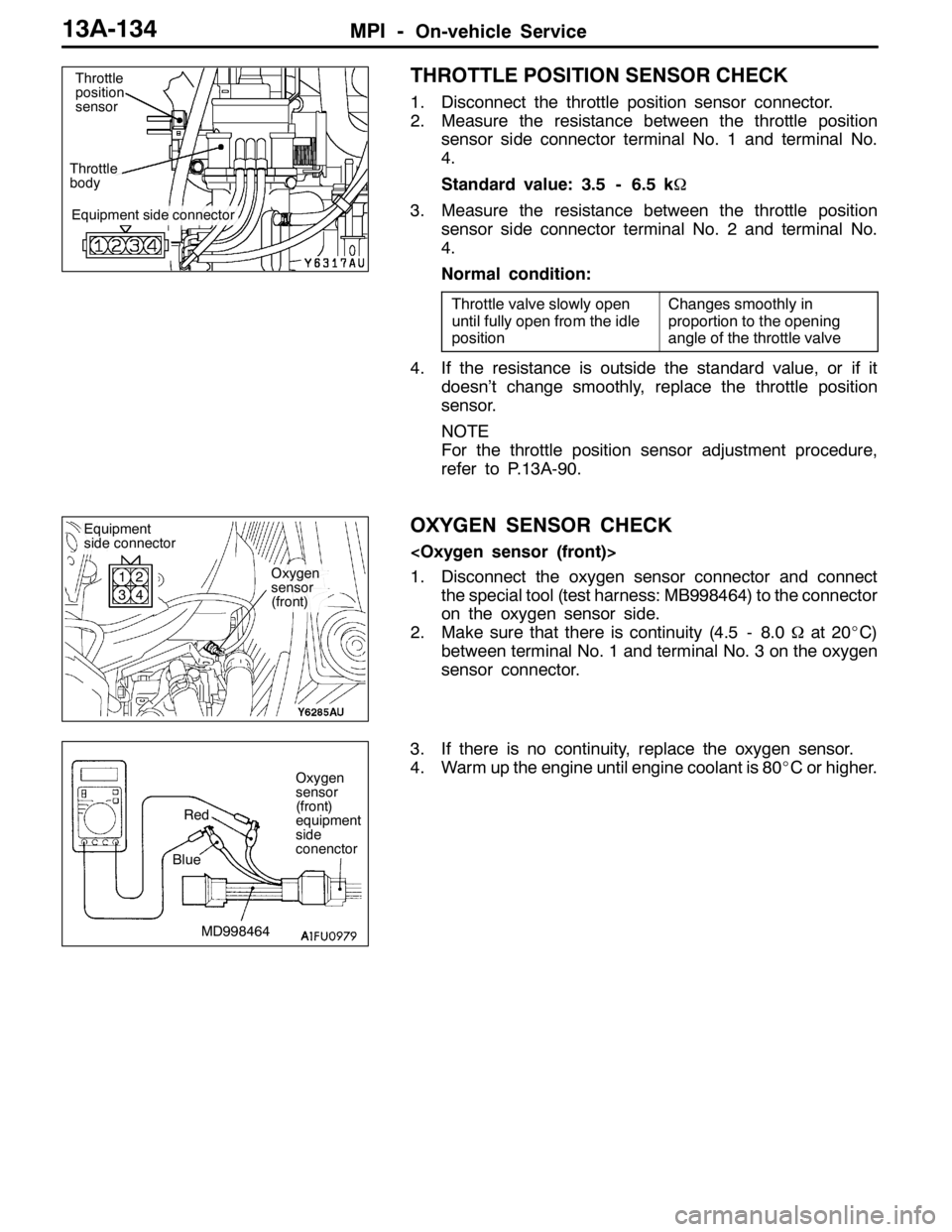
THROTTLE POSITION SENSOR CHECK
1. Disconnect the throttle position sensor connector.
2. Measure the resistance between the throttle position
sensor side connector terminal No. 1 and terminal No.
4.
Standard value: 3.5 - 6.5 kΩ
3. Measure the resistance between the throttle position
sensor side connector terminal No. 2 and terminal No.
4.
Normal condition:
Throttle valve slowly open
until fully open from the idle
positionChanges smoothly in
proportion to the opening
angle of the throttle valve
4. If the resistance is outside the standard value, or if it
doesn’t change smoothly, replace the throttle position
sensor.
NOTE
For the throttle position sensor adjustment procedure,
refer to P.13A-90.
OXYGEN SENSOR CHECK
1. Disconnect the oxygen sensor connector and connect
the special tool (test harness: MB998464) to the connector
on the oxygen sensor side.
2. Make sure that there is continuity (4.5 - 8.0Ωat 20_C)
between terminal No. 1 and terminal No. 3 on the oxygen
sensor connector.
3. If there is no continuity, replace the oxygen sensor.
4. Warm up the engine until engine coolant is 80_C or higher.
Equipment side connector
Throttle
bodyThrottle
position
sensor
Oxygen
sensor
(front)
Equipment
side connector
1
32
4
Oxygen
sensor
(front)
equipment
side
conenctor
MD998464 BlueRed
Page 690 of 1449

ENGINE COOLING -GeneralInformation/
Service Specifications/Lubricant/Sealant14-2
GENERAL INFORMATION
The cooling system is designed to keep every part
of the engine at appropriate temperature in
whatever condition the engine may be operated.
The cooling method is of the water-cooled, pressure
forced circulation type in which the water pump
pressurizes coolant and circulates it throughout the
engine. If the coolant temperature exceeds the
prescribed temperature, the thermostat opens to
circulate the coolant through the radiator as well
so that the heat absorbed by the coolant may be
radiated into the air.The water pump is of the centrifugal type and is
driven by the drive belt from the crankshaft.
The radiator is the corrugated fin, down flow type.
The cooling fan is controlled by the radiator fan
controller and engine-ECU depend on driving
conditions.
ItemSpecification
Radiator performance kJ/h216,700
SERVICE SPECIFICATIONS
ItemsStandard valueLimit
Radiator cap opening pressure kPa93 - 12383
Range of coolant antifreeze concentration of radiator %30 - 60-
ThermostatValve opening temperature of thermostat_C80±1.5-
Full-opening temperature of thermostat_C93-
Valve lift (at 93_C) mm9.5 or more-
LUBRICANT
ItemSpecified coolantQuantity L
Engine coolantMITSUBISHI GENUINE COOLANT or equivalent6.0Enginecoolant
(including reserve tank)
MITSUBISHIGENUINECOOLANTorequivalent6.0
SEALANT
ItemSpecified sealantRemark
Cylinder block drain plug3M Nut Locking Part No. 4171 or equivalentDrying sealant
Page 700 of 1449

ENGINE COOLING -Thermostat14-12
INSTALLATION SERVICE POINTS
"AATHERMOSTAT INSTALLATION
Install the thermostat being careful not to fold over or scratch
the rubber ring.
Caution
Make absolutely sure that no oil is adhering to the rubber
ring of the thermostat. In addition, be careful not to fold
over or scratch the rubber ring when inserting. If the
rubber ring is damage, replace the thermostat.
"BARADIATOR UPPER HOSE CONNECTION
1. Insert each hose as far as the projection of the water
outlet fitting.
2. Align the mating marks on the radiator hose and hose
clamp, and then connect the radiator hose.
INSPECTION
THERMOSTAT CHECK
1. Immerse the thermostat in water, and heat the water while
stirring. Check the thermostat valve opening temperature.
Standard value:
Valve opening temperature: 80±1.5_C
2. Check that the amount of valve lift is at the standard value
when the water is at the full-opening temperature.
Standard value:
Full-opening temperature: 93_C
Amount of valve lift: 9.5 mm or more
NOTE
Measure the valve height when the thermostat is fully
closed, and use this measurement to calculate the valve
height when the thermostat is fully open.
Valve lift
Page 702 of 1449
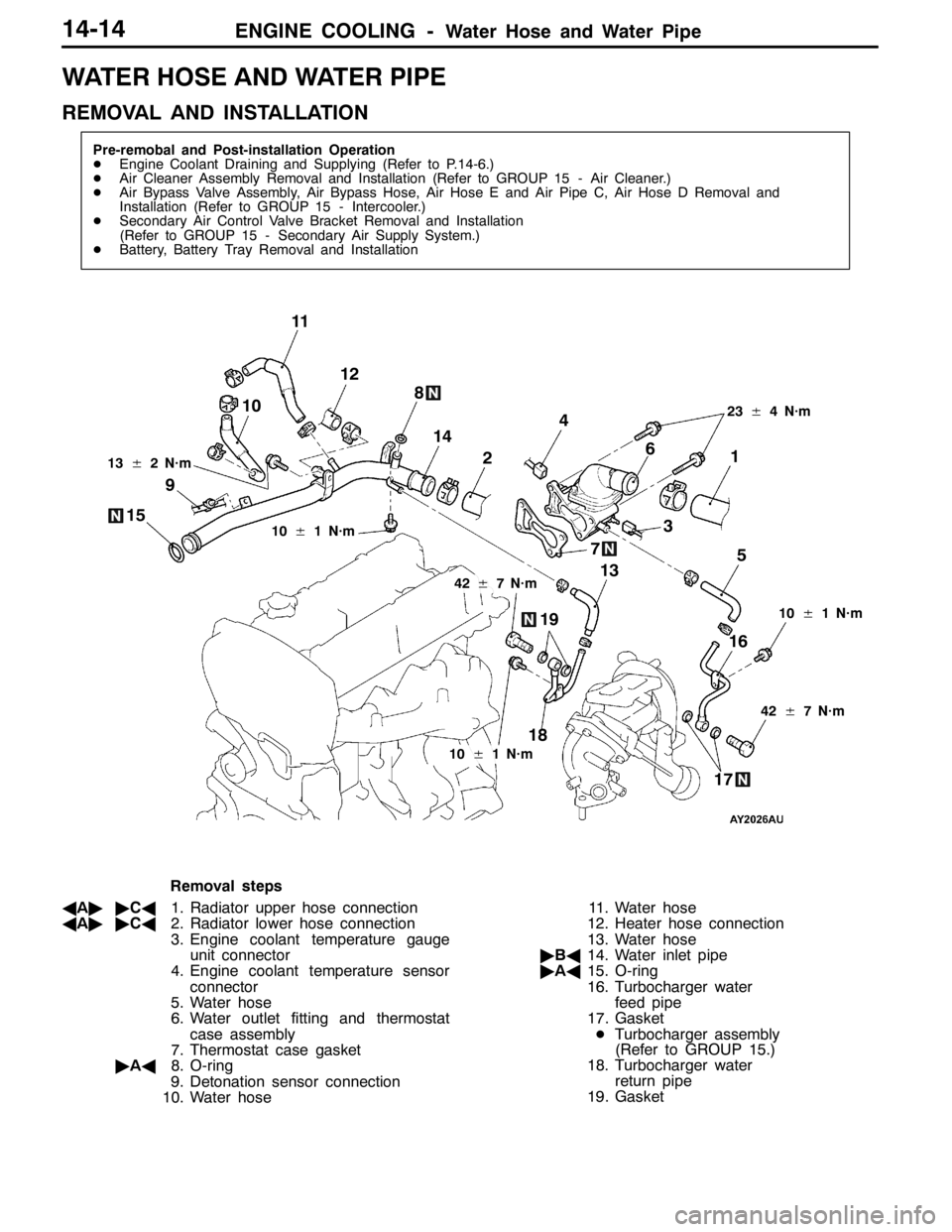
ENGINE COOLING -Water Hose and Water Pipe14-14
WATER HOSE AND WATER PIPE
REMOVAL AND INSTALLATION
Pre-remobal and Post-installation Operation
DEngine Coolant Draining and Supplying (Refer to P.14-6.)
DAir Cleaner Assembly Removal and Installation (Refer to GROUP 15 - Air Cleaner.)
DAir Bypass Valve Assembly, Air Bypass Hose, Air Hose E and Air Pipe C, Air Hose D Removal and
Installation (Refer to GROUP 15 - Intercooler.)
DSecondary Air Control Valve Bracket Removal and Installation
(Refer to GROUP 15 - Secondary Air Supply System.)
DBattery, Battery Tray Removal and Installation
3 4
5 6
7 8
9
1012
10±1 N·m
42±7 N·m 13±2 N·m
11
1
2
23±4 N·m
18
1716 1514
13
19
10±1 N·m
42±7 N·m
10±1 N·m
Removal steps
AA""CA1. Radiator upper hose connection
AA""CA2. Radiator lower hose connection
3. Engine coolant temperature gauge
unit connector
4. Engine coolant temperature sensor
connector
5. Water hose
6. Water outlet fitting and thermostat
case assembly
7. Thermostat case gasket
"AA8. O-ring
9. Detonation sensor connection
10. Water hose11. Water hose
12. Heater hose connection
13. Water hose
"BA14. Water inlet pipe
"AA15. O-ring
16. Turbocharger water
feed pipe
17. Gasket
DTurbocharger assembly
(Refer to GROUP 15.)
18. Turbocharger water
return pipe
19. Gasket
Page 708 of 1449
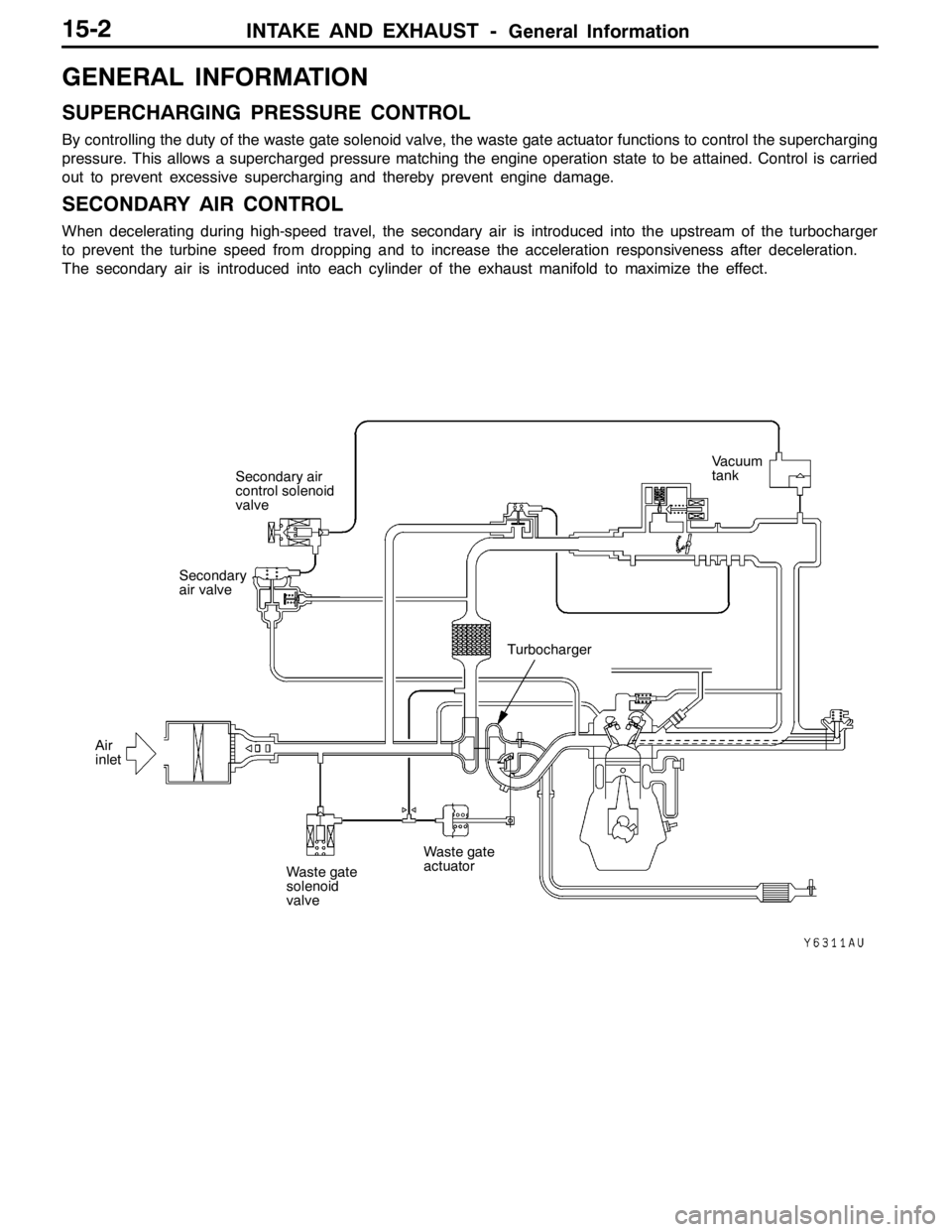
INTAKE AND EXHAUST -General Information15-2
GENERAL INFORMATION
SUPERCHARGING PRESSURE CONTROL
By controlling the duty of the waste gate solenoid valve, the waste gate actuator functions to control the supercharging
pressure. This allows a supercharged pressure matching the engine operation state to be attained. Control is carried
out to prevent excessive supercharging and thereby prevent engine damage.
SECONDARY AIR CONTROL
When decelerating during high-speed travel, the secondary air is introduced into the upstream of the turbocharger
to prevent the turbine speed from dropping and to increase the acceleration responsiveness after deceleration.
The secondary air is introduced into each cylinder of the exhaust manifold to maximize the effect.
Secondary air
control solenoid
valve
Air
inletSecondary
air valve
Waste gate
solenoid
valve
Waste gate
actuator
TurbochargerVacuum
tank
Page 709 of 1449
INTAKE AND EXHAUST -Service Specifications/Special Tool/On-vehicle Service15-3
SERVICE SPECIFICATIONS
ItemStandard valueLimit
Turbocharger supercharging pressure (waste gate solenoid
valve not operating) kPa59 - 84-
Initial activation pressure of waste gate actuator (at the stroke
of approximately 1 mm) kPaApproximately 100-
Waste gate solenoid valve coil resistance (at 20_C)Ω29 - 35-
Initial activation pressure of air bypass valve kPaApproximately 53-
Secondary air control solenoid valve coil resistance
(at 20_C)Ω29 - 35-
Manifold distortion of the installation surface mm0.15 or less0.20
SPECIAL TOOL
ToolNumberNameUse
MD998770Oxygen sensor wrenchRemoval and installation of oxygen sensor
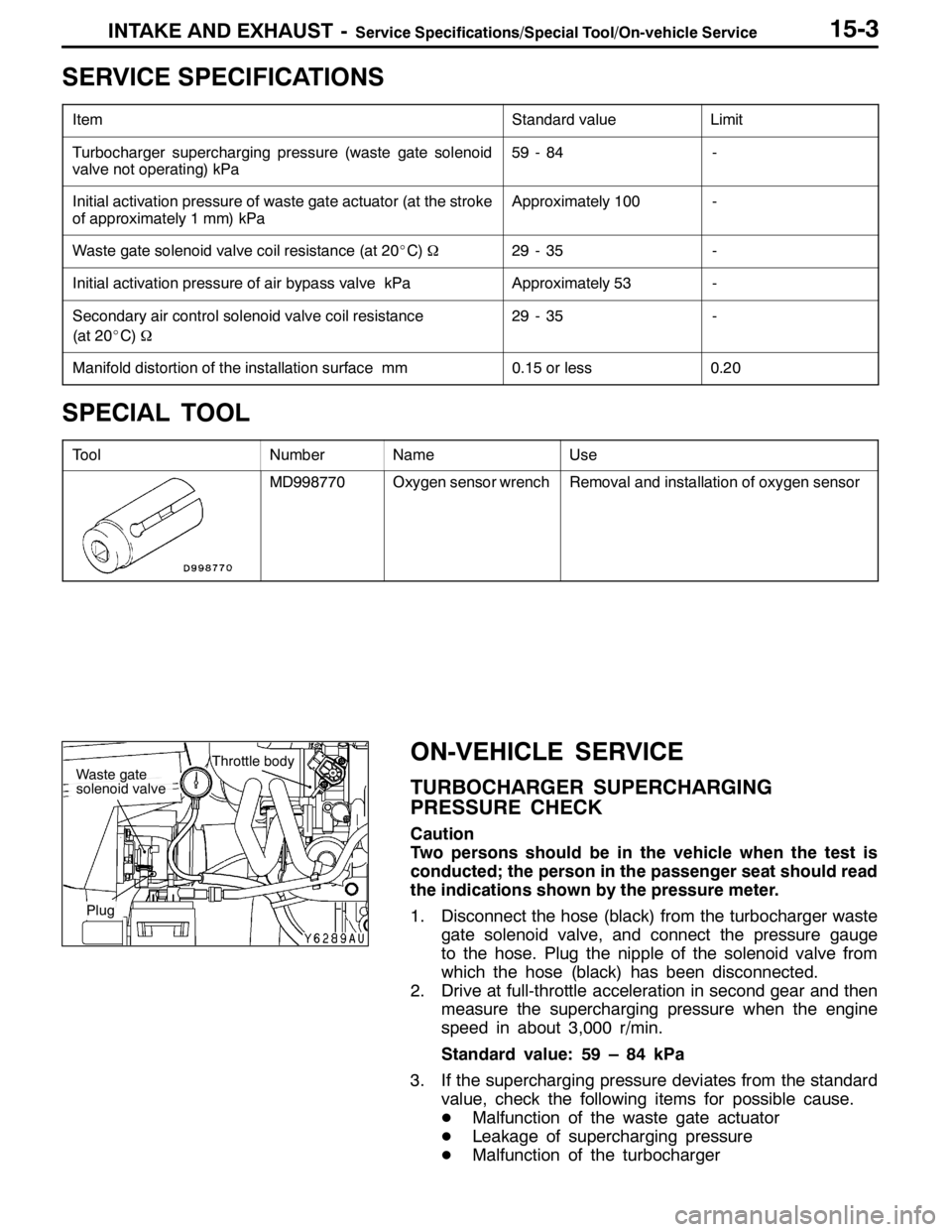
ON-VEHICLE SERVICE
TURBOCHARGER SUPERCHARGING
PRESSURE CHECK
Caution
Two persons should be in the vehicle when the test is
conducted; the person in the passenger seat should read
the indications shown by the pressure meter.
1. Disconnect the hose (black) from the turbocharger waste
gate solenoid valve, and connect the pressure gauge
to the hose. Plug the nipple of the solenoid valve from
which the hose (black) has been disconnected.
2. Drive at full-throttle acceleration in second gear and then
measure the supercharging pressure when the engine
speed in about 3,000 r/min.
Standard value: 59 – 84 kPa
3. If the supercharging pressure deviates from the standard
value, check the following items for possible cause.
DMalfunction of the waste gate actuator
DLeakage of supercharging pressure
DMalfunction of the turbocharger
Throttle bodyWaste gate
solenoid valve
Plug
Page 710 of 1449
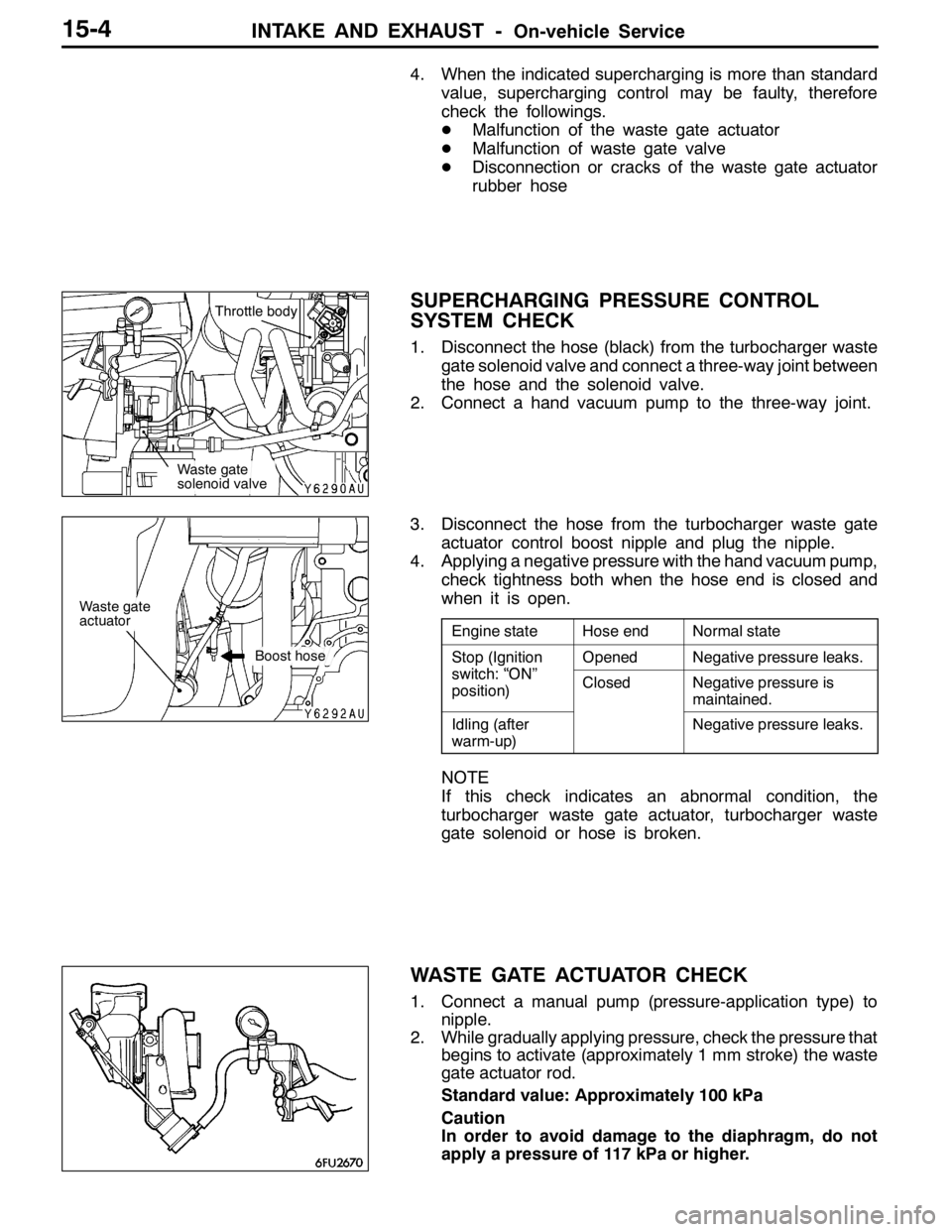
INTAKE AND EXHAUST -On-vehicle Service15-4
4. When the indicated supercharging is more than standard
value, supercharging control may be faulty, therefore
check the followings.
DMalfunction of the waste gate actuator
DMalfunction of waste gate valve
DDisconnection or cracks of the waste gate actuator
rubber hose
SUPERCHARGING PRESSURE CONTROL
SYSTEM CHECK
1. Disconnect the hose (black) from the turbocharger waste
gate solenoid valve and connect a three-way joint between
the hose and the solenoid valve.
2. Connect a hand vacuum pump to the three-way joint.
3. Disconnect the hose from the turbocharger waste gate
actuator control boost nipple and plug the nipple.
4. Applying a negative pressure with the hand vacuum pump,
check tightness both when the hose end is closed and
when it is open.
Engine stateHose endNormal state
Stop (Ignition
it h“ON”
OpenedNegative pressure leaks.p(g
switch: “ON”
position)ClosedNegative pressure is
maintained.
Idling (after
warm-up)Negative pressure leaks.
NOTE
If this check indicates an abnormal condition, the
turbocharger waste gate actuator, turbocharger waste
gate solenoid or hose is broken.
WASTE GATE ACTUATOR CHECK
1. Connect a manual pump (pressure-application type) to
nipple.
2. While gradually applying pressure, check the pressure that
begins to activate (approximately 1 mm stroke) the waste
gate actuator rod.
Standard value: Approximately 100 kPa
Caution
In order to avoid damage to the diaphragm, do not
apply a pressure of 117 kPa or higher.
Waste gate
solenoid valveThrottle body
Waste gate
actuator
Boost hose
Page 712 of 1449

INTAKE AND EXHAUST -On-vehicle Service15-6
INTAKE MANIFOLD PRESSURE CHECK
Refer to GROUP 11A – On-vehicle Service.
SECONDARY AIR CONTROL SYSTEM CHECK
1. Start the engine and carry out idling.
2. Confirm that the secondary air valve lifts up when the
engine-ECU connector No. 53 terminal is short-circuited
with the earth using a jumper wire.
The engine-ECU connector must be connected at this
time.
SECONDARY AIR CONTROL SOLENOID
VALVE CHECK
OPERATION CHECK
1. Disconnect the vacuum hose (white-striped, yellow-
striped) from the solenoid valve.
2. Separate the harness connector.
3. Connect the hand vacuum pump to the solenoid valve’s
A nipple.
4. Connect the solenoid valve terminal and battery terminal
with a jumper wire.
5. Disconnect the jumper wire between the battery’s ( - )
terminals, apply a negative pressure, and inspect the
tightness.
Jumper wireState of B
nippleNormal state
ConnectedOpenedNegative pressure leaks.
ClosedNegative pressure is
maintained.
DisconnectedClosedNegative pressure leaks.
Vacuum tank
Secondary
air control
solenoid
valve
Battery A B