2007 MITSUBISHI LANCER EVOLUTION engine valve
[x] Cancel search: engine valvePage 599 of 1449
MPI -Troubleshooting13A-67
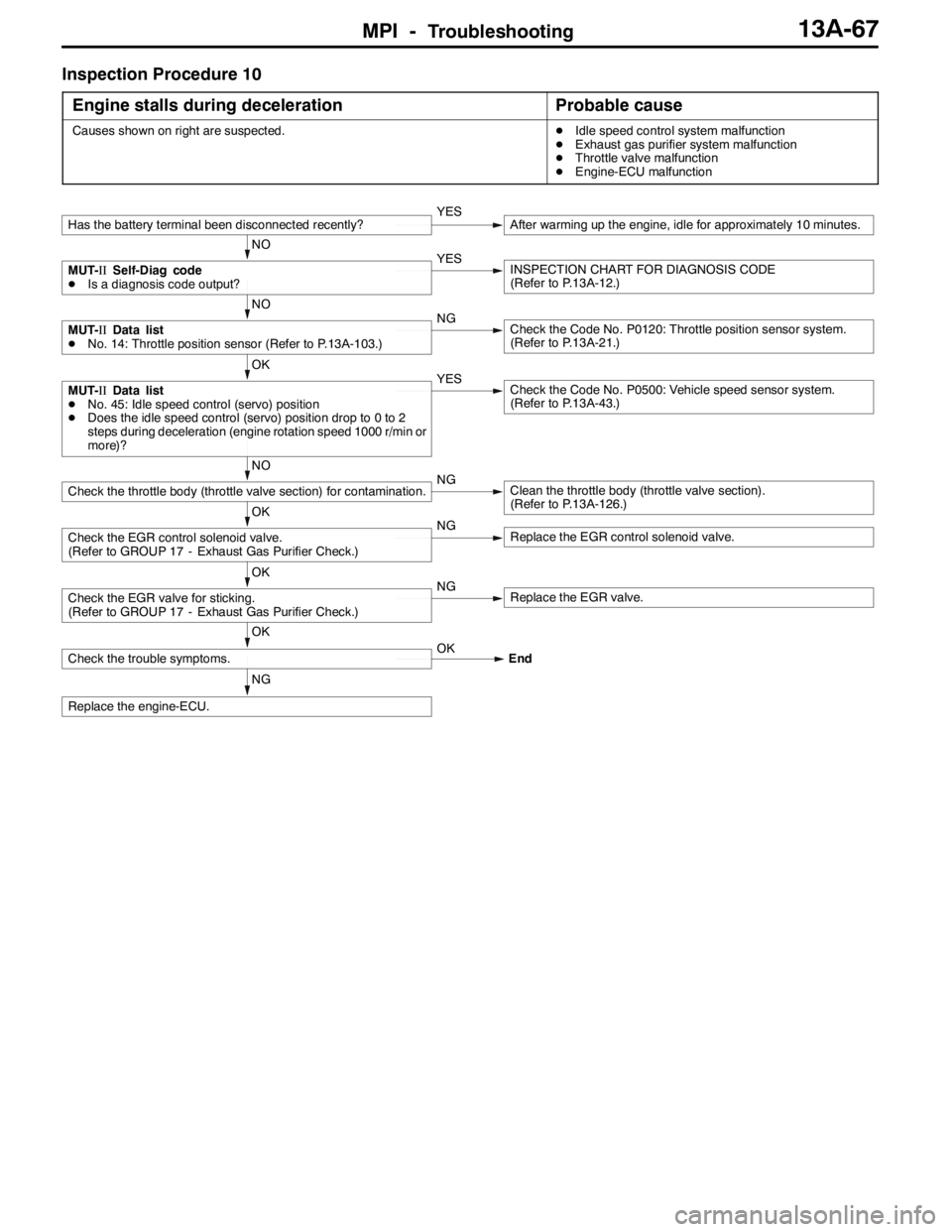
Inspection Procedure 10
Engine stalls during deceleration
Probable cause
Causes shown on right are suspected.DIdle speed control system malfunction
DExhaust gas purifier system malfunction
DThrottle valve malfunction
DEngine-ECU malfunction
NG
Replace the engine-ECU.
OK
Check the trouble symptoms.OK
End
OK
Check the EGR valve for sticking.
(Refer to GROUP 17 - Exhaust Gas Purifier Check.)NGReplace the EGR valve.
OK
Check the EGR control solenoid valve.
(Refer to GROUP 17 - Exhaust Gas Purifier Check.)NGReplace the EGR control solenoid valve.
NO
Check the throttle body (throttle valve section) for contamination.NGClean the throttle body (throttle valve section).
(Refer to P.13A-126.)
OK
MUT-IIData list
DNo. 45: Idle speed control (servo) position
DDoes the idle speed control (servo) position drop to 0 to 2
steps during deceleration (engine rotation speed 1000 r/min or
more)?YESCheck the Code No. P0500: Vehicle speed sensor system.
(Refer to P.13A-43.)
NO
MUT-IIData list
DNo. 14: Throttle position sensor (Refer to P.13A-103.)NGCheck the Code No. P0120: Throttle position sensor system.
(Refer to P.13A-21.)
NO
MUT-IISelf-Diag code
DIs a diagnosis code output?YESINSPECTION CHART FOR DIAGNOSIS CODE
(Refer to P.13A-12.)
Has the battery terminal been disconnected recently?YESAfter warming up the engine, idle for approximately 10 minutes.
Page 600 of 1449

MPI -Troubleshooting13A-68
Inspection Procedure 11
Pulsation (Hesitation, sag), poor acceleration, stumbling,
surging
Probable cause
Causes shown on right are suspected.DAir/fuel ratio control system malfunction
DIgnition system malfunction
DFuel system malfunction
DIntake and exhaust system malfunction
DExhaust gas purifier system malfunction
DImproper compression pressure
DTurbocharger system malfunction
OK
To the next page
OK
MUT-IIData list
DNo. 59: Oxygen sensor (rear) (Refer to P.13A-105.)
(Refer to P.13A-27.)
OK
MUT-IIData list
DNo. 11: Oxygen sensor (front) (Refer to P.13A-102.)NGCheck the Code No. P0130: Oxygen sensor (front) system.
(Refer to P.13A-24.)
OK
Check the EGR valve for sticking.
(Refer to GROUP 17 - Exhaust Gas Purifier Check.)NGReplace the EGR valve.
OK
Check the EGR control solenoid valve.
(Refer to GROUP 17 - Exhaust Gas Purifier Check.)NGReplace the EGR control solenoid valve.
OK
Check the purge control solenoid valve.
(Refer to GROUP 17 - Exhaust Gas Purifier Check.)NGReplace the purge control solenoid valve.
OK
MUT-IIData list
DNo. 13: Intake air temperature sensor
DNo. 14: Throttle position sensor
DNo. 21: Engine coolant temperature sensor
DNo. 25: Barometric pressure sensor
(Refer to P.13A-102.)
Proceed to OK if all service data values are correct.
Proceed to NG if there is even one abnormal service data value.NGRefer to inspections for diagnosis code of sensor showing
abnormal service data. (Refer to P.13A-12.)
OK
Check the injector operation sound. (Use sound scope.)NGCheck the Code No. P0201 - 204: Injector system for faulty
cylinder.
NO
Check the ignition timing.
(Refer to GROUP 11 - Engine Adjustment.)NGCheck mounting state of crank angle sensor and timing belt cover.
MUT-IISelf-Diag code
DIs a diagnosis code output?YESINSPECTION CHART FOR DIAGNOSIS CODE
(Refer to P.13A-12.)
Page 601 of 1449
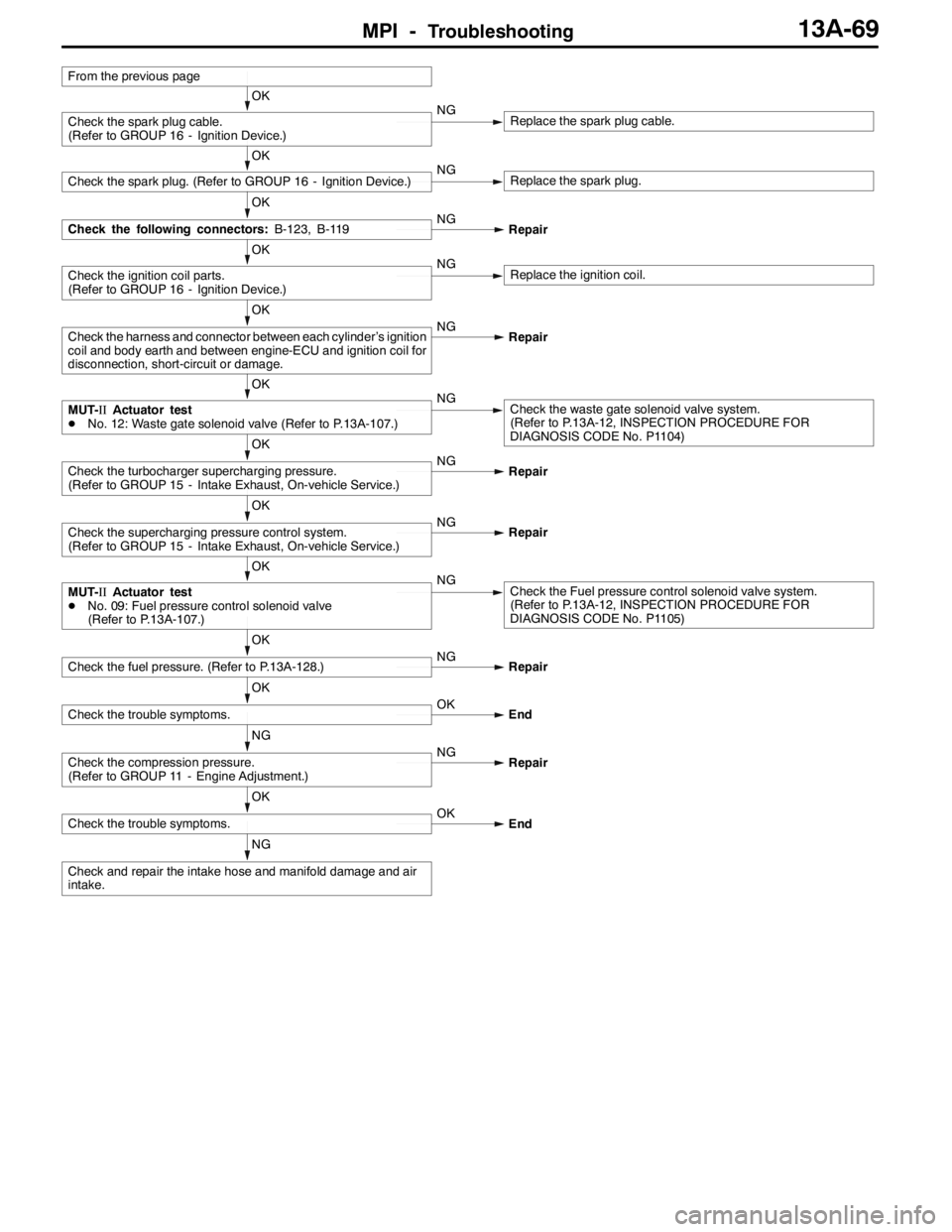
MPI -Troubleshooting13A-69
NG
Check and repair the intake hose and manifold damage and air
intake.
OK
Check the trouble symptoms.OK
End
NG
Check the compression pressure.
(Refer to GROUP 11 - Engine Adjustment.)NG
Repair
OK
Check the trouble symptoms.OK
End
OK
Check the fuel pressure. (Refer to P.13A-128.)NG
Repair
OK
MUT-IIActuator test
DNo. 09: Fuel pressure control solenoid valve
(Refer to P.13A-107.)NGCheck the Fuel pressure control solenoid valve system.
(Refer to P.13A-12, INSPECTION PROCEDURE FOR
DIAGNOSIS CODE No. P1105)
OK
Check the supercharging pressure control system.
(Refer to GROUP 15 - Intake Exhaust, On-vehicle Service.)NG
Repair
OK
Check the turbocharger supercharging pressure.
(Refer to GROUP 15 - Intake Exhaust, On-vehicle Service.)NG
Repair
OK
MUT-IIActuator test
DNo. 12: Waste gate solenoid valve (Refer to P.13A-107.)NGCheck the waste gate solenoid valve system.
(Refer to P.13A-12, INSPECTION PROCEDURE FOR
DIAGNOSIS CODE No. P1104)
OK
Check the harness and connector between each cylinder’s ignition
coil and body earth and between engine-ECU and ignition coil for
disconnection, short-circuit or damage.NG
Repair
OK
Check the ignition coil parts.
(Refer to GROUP 16 - Ignition Device.)NGReplace the ignition coil.
OK
Check the following connectors:B-123, B-119NG
Repair
OK
Check the spark plug. (Refer to GROUP 16 - Ignition Device.)NGReplace the spark plug.
OK
Check the spark plug cable.
(Refer to GROUP 16 - Ignition Device.)NGReplace the spark plug cable.
From the previous page
Page 608 of 1449
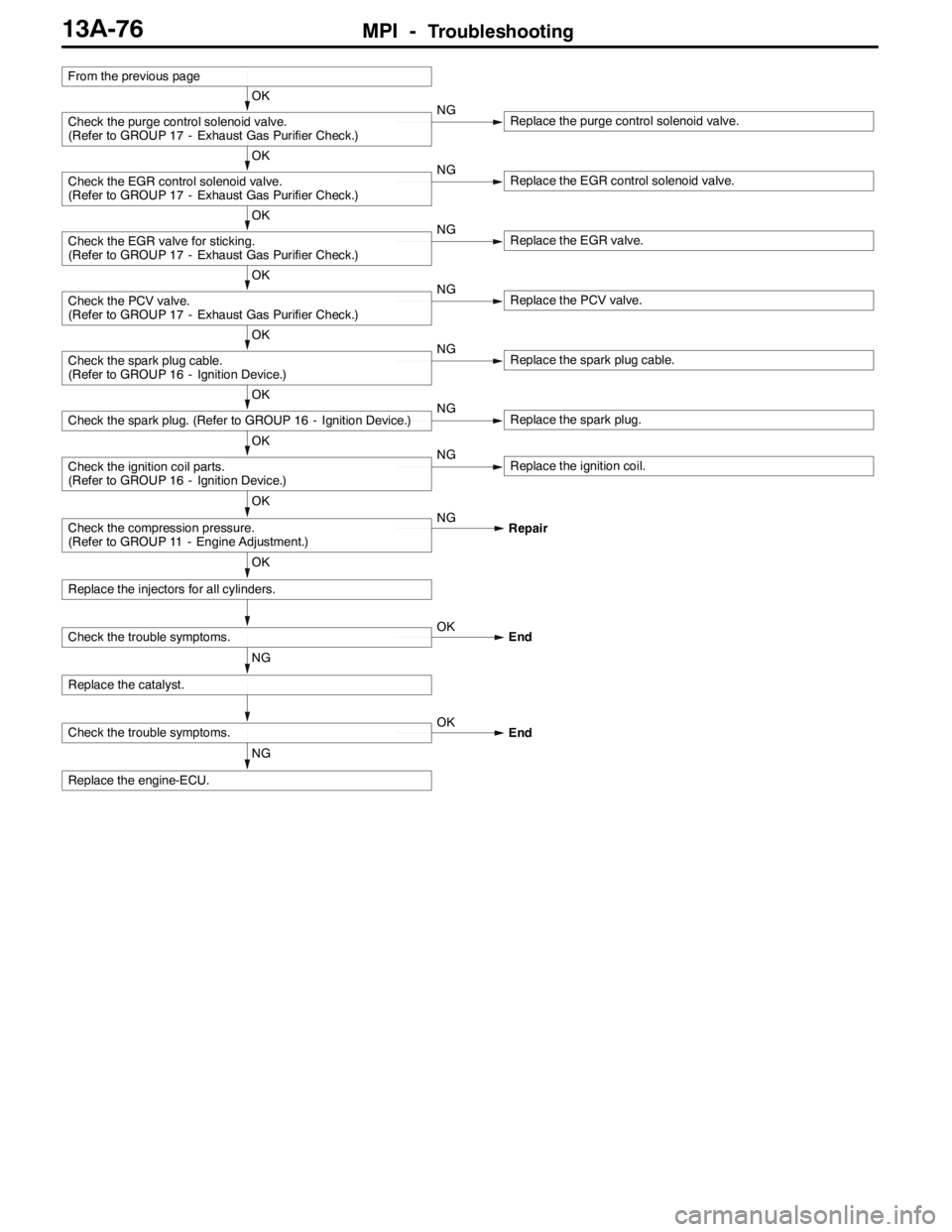
MPI -Troubleshooting13A-76
NG
Replace the engine-ECU.
Check the trouble symptoms.OK
End
NG
Replace the catalyst.
Check the trouble symptoms.OK
End
OK
Replace the injectors for all cylinders.
OK
Check the compression pressure.
(Refer to GROUP 11 - Engine Adjustment.)NG
Repair
OK
Check the ignition coil parts.
(Refer to GROUP 16 - Ignition Device.)NGReplace the ignition coil.
OK
Check the spark plug. (Refer to GROUP 16 - Ignition Device.)NGReplace the spark plug.
OK
Check the spark plug cable.
(Refer to GROUP 16 - Ignition Device.)NGReplace the spark plug cable.
OK
Check the PCV valve.
(Refer to GROUP 17 - Exhaust Gas Purifier Check.)NGReplace the PCV valve.
OK
Check the EGR valve for sticking.
(Refer to GROUP 17 - Exhaust Gas Purifier Check.)NGReplace the EGR valve.
OK
Check the EGR control solenoid valve.
(Refer to GROUP 17 - Exhaust Gas Purifier Check.)NGReplace the EGR control solenoid valve.
OK
Check the purge control solenoid valve.
(Refer to GROUP 17 - Exhaust Gas Purifier Check.)NGReplace the purge control solenoid valve.
From the previous page
Page 627 of 1449
MPI -Troubleshooting13A-95
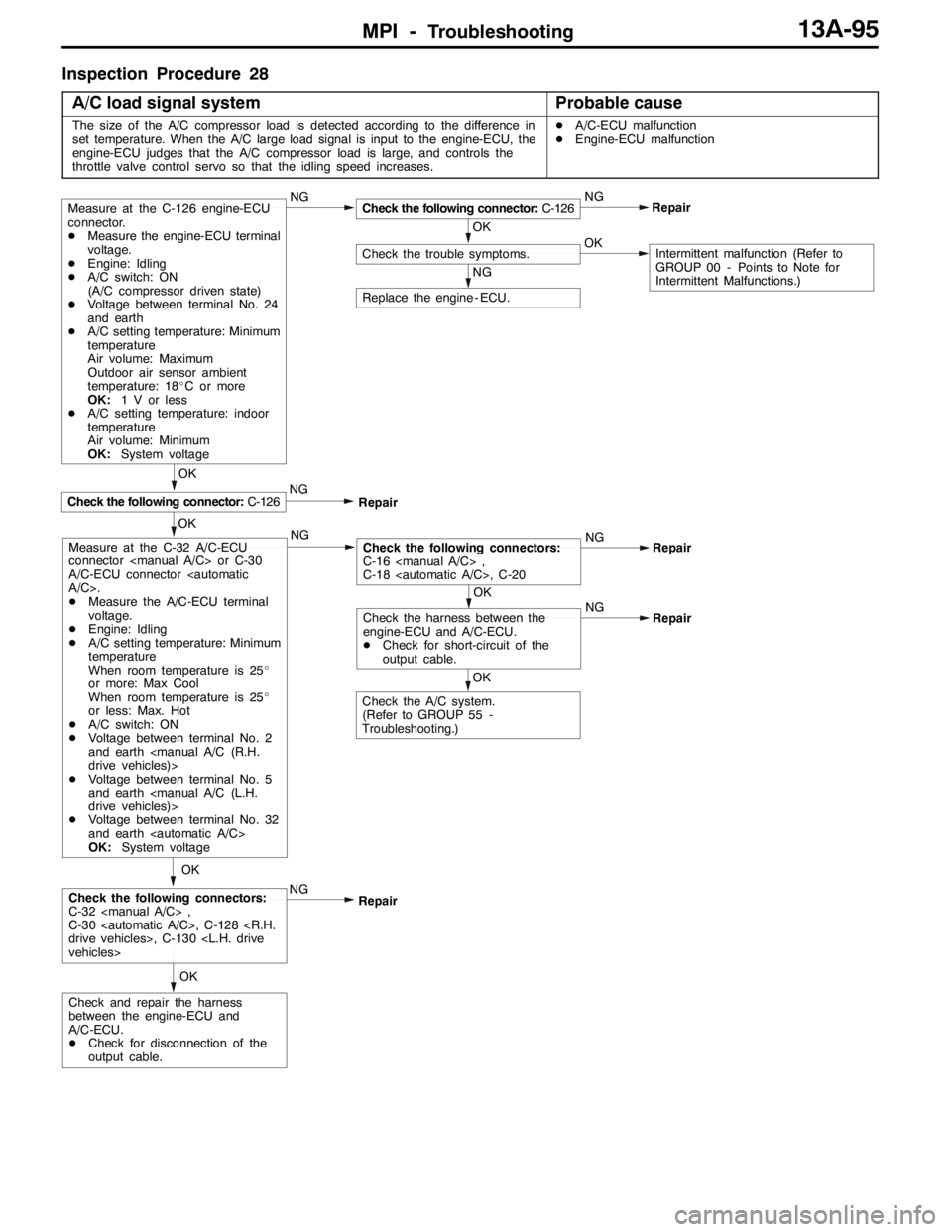
Inspection Procedure 28
A/C load signal system
Probable cause
The size of the A/C compressor load is detected according to the difference in
set temperature. When the A/C large load signal is input to the engine-ECU, the
engine-ECU judges that the A/C compressor load is large, and controls the
throttle valve control servo so that the idling speed increases.DA/C-ECU malfunction
DEngine-ECU malfunction
OK
NG
OK
NG
Check the trouble symptoms.NG
Check the following connector:C-126Repair
OK
Check the following connector:C-126
Replace the engine - ECU.
Measure at the C-126 engine-ECU
connector.
DMeasure the engine-ECU terminal
voltage.
DEngine: Idling
DA/C switch: ON
(A/C compressor driven state)
DVoltage between terminal No. 24
and earth
DA/C setting temperature: Minimum
temperature
Air volume: Maximum
Outdoor air sensor ambient
temperature: 18_C or more
OK:1 V or less
DA/C setting temperature: indoor
temperature
Air volume: Minimum
OK:System voltage
NG
Repair
NGNG
Repair
OK
OK
Check the harness between the
engine-ECU and A/C-ECU.
DCheck for short-circuit of the
output cable.NG
Repair
Check the A/C system.
(Refer to GROUP 55 -
Troubleshooting.)OK
Intermittent malfunction (Refer to
GROUP 00 - Points to Note for
Intermittent Malfunctions.)
Check the following connectors:
C-16
C-18
NG
Repair OK
OK
Check and repair the harness
between the engine-ECU and
A/C-ECU.
DCheck for disconnection of the
output cable.
Check the following connectors:
C-32
C-30
Measure at the C-32 A/C-ECU
connector
A/C-ECU connector
DMeasure the A/C-ECU terminal
voltage.
DEngine: Idling
DA/C setting temperature: Minimum
temperature
When room temperature is 25_
or more: Max Cool
When room temperature is 25_
or less: Max. Hot
DA/C switch: ON
DVoltage between terminal No. 2
and earth
DVoltage between terminal No. 5
and earth
DVoltage between terminal No. 32
and earth
OK:System voltage
Page 628 of 1449
MPI -Troubleshooting13A-96
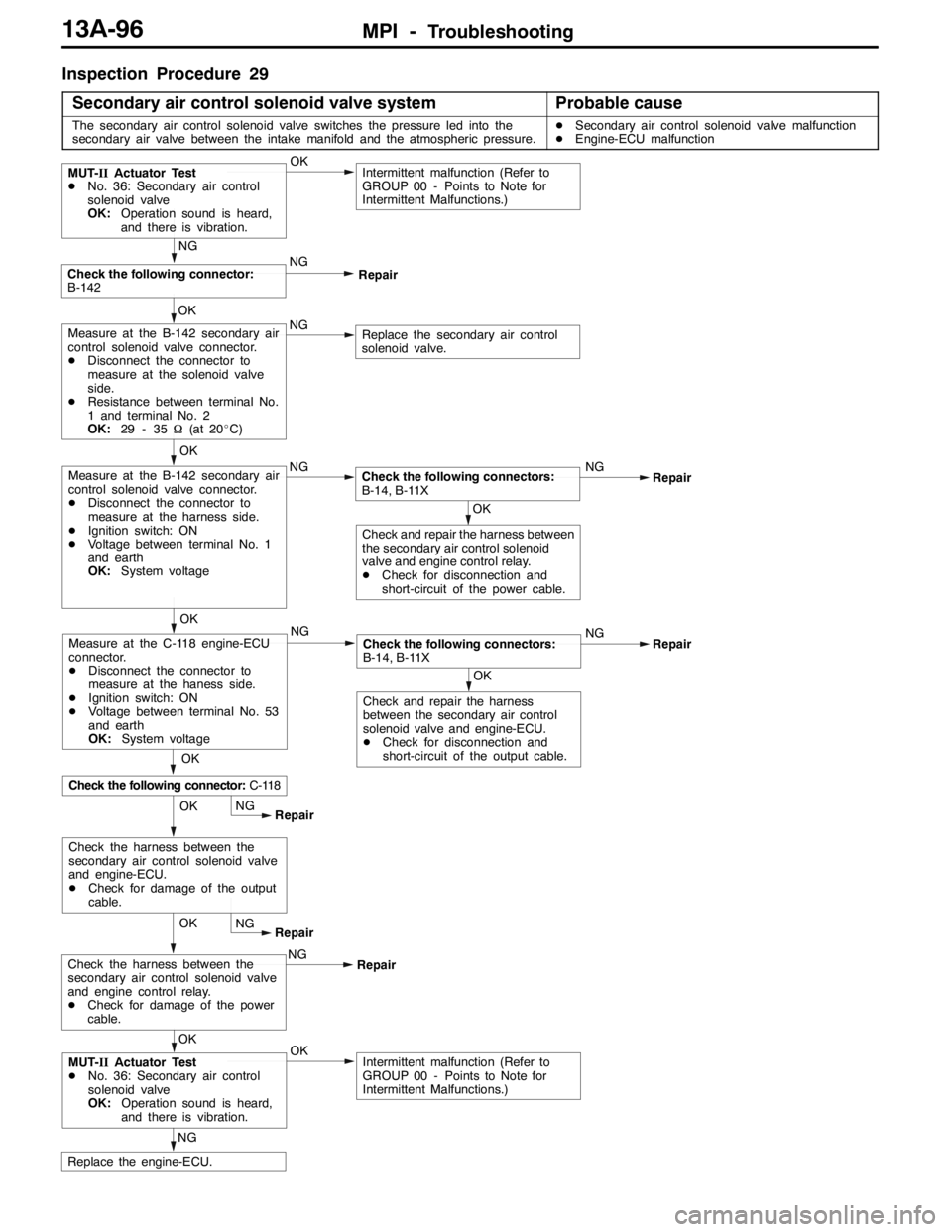
Inspection Procedure 29
Secondary air control solenoid valve system
Probable cause
The secondary air control solenoid valve switches the pressure led into the
secondary air valve between the intake manifold and the atmospheric pressure.DSecondary air control solenoid valve malfunction
DEngine-ECU malfunction
OK
NG
Replace the engine-ECU.
OKIntermittent malfunction (Refer to
GROUP 00 - Points to Note for
Intermittent Malfunctions.)MUT-IIActuator Test
DNo. 36: Secondary air control
solenoid valve
OK:Operation sound is heard,
and there is vibration.OKNG
Repair
OK
NG
Intermittent malfunction (Refer to
GROUP 00 - Points to Note for
Intermittent Malfunctions.)
OK
Check the following connector:
B-142
MUT-IIActuator Test
DNo. 36: Secondary air control
solenoid valve
OK:Operation sound is heard,
and there is vibration.
NG
Repair
NGNG
Repair
OK
Check and repair the harness
between the secondary air control
solenoid valve and engine-ECU.
DCheck for disconnection and
short-circuit of the output cable.
Check the following connectors:
B-14, B-11X
OK
Check the following connector:C-118
Measure at the C-118 engine-ECU
connector.
DDisconnect the connector to
measure at the haness side.
DIgnition switch: ON
DVoltage between terminal No. 53
and earth
OK:System voltageNG
Replace the secondary air control
solenoid valve.Measure at the B-142 secondary air
control solenoid valve connector.
DDisconnect the connector to
measure at the solenoid valve
side.
DResistance between terminal No.
1 and terminal No. 2
OK:29 - 35Ω(at 20_C)
OK
NG
Measure at the B-142 secondary air
control solenoid valve connector.
DDisconnect the connector to
measure at the harness side.
DIgnition switch: ON
DVoltage between terminal No. 1
and earth
OK:System voltage
OKNG
Repair
OK
OK
Check and repair the harness between
the secondary air control solenoid
valve and engine control relay.
DCheck for disconnection and
short-circuit of the power cable.
Check the following connectors:
B-14, B-11X
NG
RepairCheck the harness between the
secondary air control solenoid valve
and engine control relay.
DCheck for damage of the power
cable.NG
Repair
OK
Check the harness between the
secondary air control solenoid valve
and engine-ECU.
DCheck for damage of the output
cable.
Page 639 of 1449

MPI -Troubleshooting13A-107
ACTUATOR TEST REFERENCE TABLE
Item
No.Inspection
itemDrive contentsInspection contentsNormal conditionInspection
procedure
No.Reference
page
01InjectorsCut fuel to No.
1 injectorEngine: After having warmed
up/Engine is idling
(C tthfllth
Idling condition
becomes different
(becomesunsta
Code No.
P020113A-30
02Cut fuel to No.
2 injector(Cut the fuel supply to each
injector in turn and check
cylinders which don’t affect
idli )
(becomes unsta-
ble).Code No.
P020213A-31
03Cut fuel to No.
3 injector
y
idling.)Code No.
P020313A-32
04Cut fuel to No.
4 injectorCode No.
P020413A-33
07Fuel pumpFuel pump
operates and
fuel is recircu-
lated.DEngine:
Cranking
DFuel
pump:
Forced
driving
Inspect
according
Pinch the
return hose
with fingers
to feel the
pulse of the
fuel being
recirculated.Pulse is felt.Procedure
No. 2313A-85
according
to both
the above
conditions.
Listen near
the fuel tank
for the
sound of
fuel pump
operation.Sound of opera-
tion is heard.
08Purge
control
solenoid
valveSolenoid valve
turns from
OFF to ON.Ignition switch: “ON”Sound of opera-
tion can be heard
when solenoid
valve is driven.Code No.
P044313A-41
09Fuel
pressure
control
solenoid
valveSolenoid valve
turns from
OFF to ON.Ignition switch: “ON”Sound of opera-
tion can be heard
when solenoid
valve is driven.Code No.
P110513A-48
10EGR con-
trol sole-
noid valveSolenoid valve
turns from
OFF to ON.Ignition switch: “ON”Sound of opera-
tion can be heard
when solenoid
valve is driven.Code No.
P040313A-39
12Waste
gate sole-
noid valveSolenoid valve
turns from
OFF to ON.Ignition switch: “ON”Sound of opera-
tion can be heard
when solenoid
valve is driven.Code No.
P110413A-47
13Fuel pump
relay 3Fuel pump
relay 3 turns
from OFF to
ON.DIgnition switch: “ON”
DListen near the fuel tank
for the sound of fuel pump
operation.Sound of opera-
tion is heard.Procedure
No. 2313A-85
17Basic igni-
tion timingSet to ignition
timing
adjustment
modeEngine: Idling
Timing light is set5_BTDC--
Page 640 of 1449

MPI -Troubleshooting13A-108
Item
No.Reference
page Inspection
procedure
No. Normal condition Inspection contents Drive contents Inspection
item
21Fan
controllerRadiator fan
motor is
driven.Ignition switch: “ON”Fan motor rotates
at high speed.Procedure
No. 2413A-87
36Secondary
air control
solenoid
valveSolenoid valve
turns from
OFF to ON.Ignition switch: “ON”Sound of opera-
tion can be heard
when solenoid
valve is driven.Procedure
No. 2913A-96
37Condenser
fan (HI)Condensor
fan motor is
driven.Ignition switch: “ON”Fan motor rotates
at high speed.Procedure
No. 2513A-89
38Condenser
fan (LOW)Second air
control
solenoid valveIgnition switch: “ON”Fan motor rotates
at low speed.
CHECK AT THE ENGINE-ECU TERMINALS
TERMINAL VOLTAGE CHECK CHART
1. Connect a needle-nosed wire probe (test harness:
MB991223 or paper clip) to a voltmeter probe.
2. Insert the needle-nosed wire probe into each of the
engine-ECU connector terminals from the wire side, and
measure the voltage while referring to the check chart.
NOTE
(1) Make the voltage measurement with the engine-ECU
connectors connected.
(2) You may find it convenient to pull out the engine-ECU
to make it easier to reach the connector terminals.
(3) The checks can be carried out off the order given
in the chart.
Caution
Short-circuiting the positive (+) probe between a
connector terminal and earth could damage the
vehicle wiring, the sensor, engine-ECU or all of them.
Be careful to prevent this!
3. If voltmeter shows any division from standard value, check
the corresponding sensor, actuator and related electrical
wiring, then repair or replace.
4. After repair or replacement, recheck with the voltmeter
to confirm that the repair has corrected the problem.
Needle-nosed wire probe