Page 720 of 1449
INTAKE AND EXHAUST -Secondary Air Supply System15-14
SECONDARY AIR SUPPLY SYSTEM
REMOVAL AND INSTALLATION
Pre-removal and Post-installation Operation
DAir Duct Removal and Installation (Refer to P.15-8.)
DStrut Tower Bar Removal and Installation (Refer to GROUP 42.)
1
2 34
5
49±5 N·m14±1 N·m 22±4 N·m
14±1 N·m 14±1 N·m 20±2 N·m
6
8 9 10
22±4 N·m24±3 N·m23±4 N·m
11±1 N·m Air pipe C 5.9±1.0 N·m
7
7 11
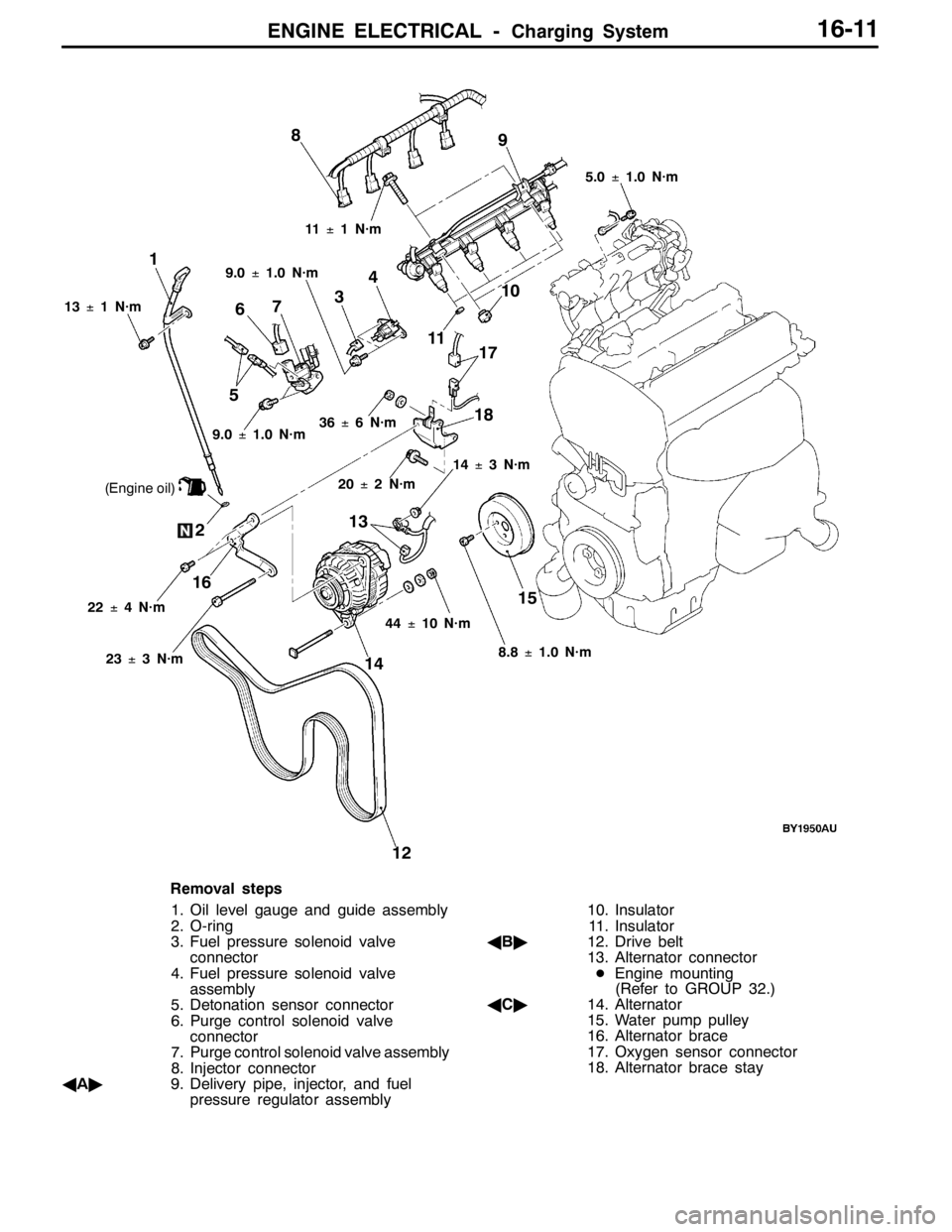
Removal steps
1. Control harness connector
connection
2. Heat protector
3. Vacuum hose connection
DAir pipe C (Refer to P.15-9.)
4. Vacuum pipe
5. Secondary air hose6. Secondary air pipe assembly
"AA7. Gasket
"BA8. Gasket
9. Secondary air control valve
10. Engine hanger
11. Secondary air control valve bracket
Page 722 of 1449
INTAKE AND EXHAUST -Intake Manifold15-16
INTAKE MANIFOLD
REMOVAL AND INSTALLATION
Pre-removal and Post-installation Operation
DAir Duct Removal and Installation (Refer to P.15-8.)
DStrut Tower Bar Removal and Installation
(Refer to GROUP 42.)
DUnder Cover Removal and Installation
(Refer to GROUP 51 - Front Bumper.)
DEngine Coolant Draining and Supplying
(Refer to GROUP 14 - On-vehicle Service.)
DThrottle Body Removal and Installation (Refer to
GROUP 13A - Throttle Body.)DCrossmember Bar Removal and Installation (Refer
to GROUP 32 - Engine Roll Stopper, Centermember.)
DFront Exhaust Pipe Removal and Installation (Refer
to GROUP 15 - Exhaust Pipe and Main Muffler.)
DSecondary Air Control Valve Bracket Removal and
Installation (Refer to P.15-14.)
DEngine Oil Draining and Supplying
1
2
3 4
5 6 7
8 10
11
1214
13
15
16 17
18
9
11±1 N·m3.0±0.5 N·m
13±1 N·m
(Engine oil)
(Engine oil) 5.0±1.0 N·m
14 8
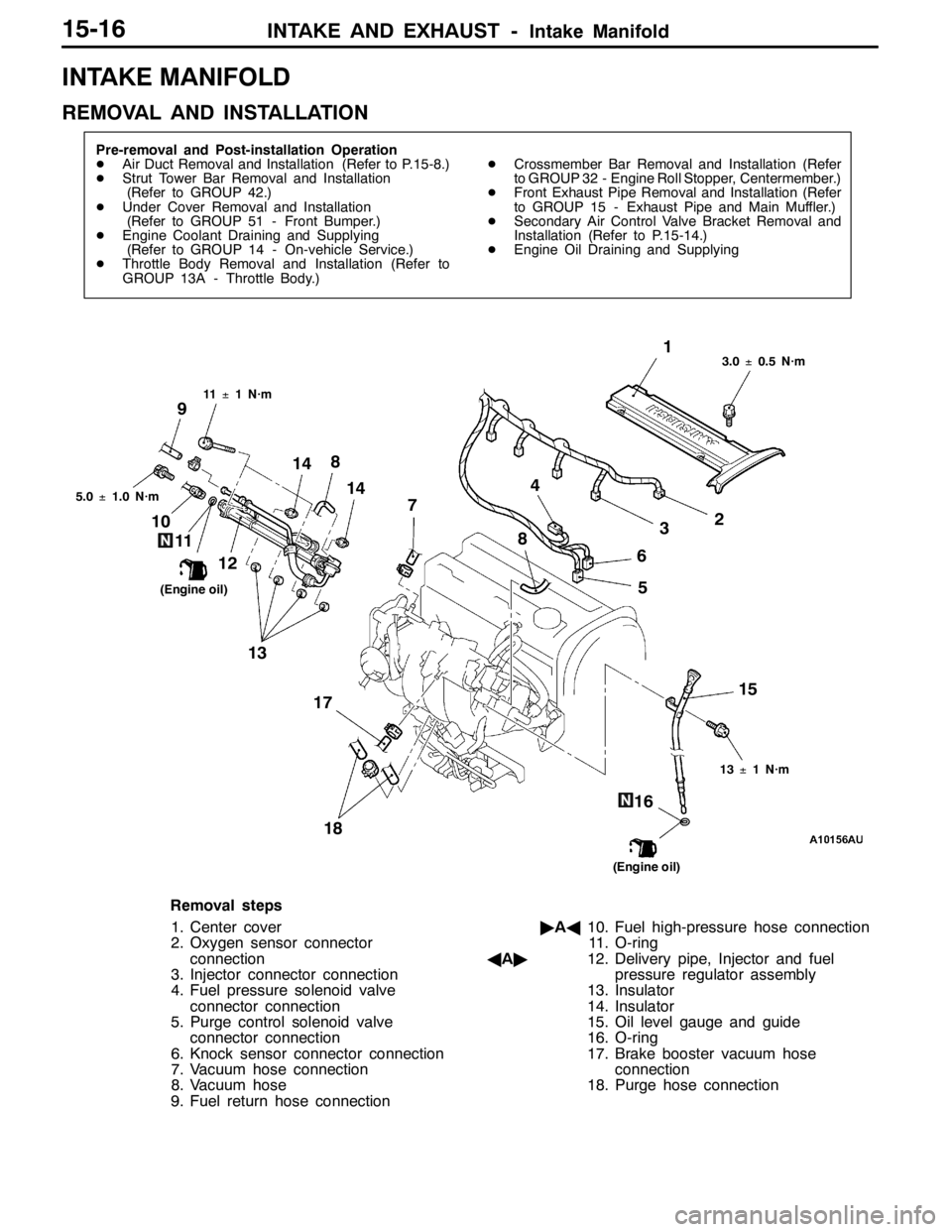
Removal steps
1. Center cover
2. Oxygen sensor connector
connection
3. Injector connector connection
4. Fuel pressure solenoid valve
connector connection
5. Purge control solenoid valve
connector connection
6. Knock sensor connector connection
7. Vacuum hose connection
8. Vacuum hose
9. Fuel return hose connection"AA10. Fuel high-pressure hose connection
11. O-ring
AA"12. Delivery pipe, Injector and fuel
pressure regulator assembly
13. Insulator
14. Insulator
15. Oil level gauge and guide
16. O-ring
17. Brake booster vacuum hose
connection
18. Purge hose connection
Page 743 of 1449
ENGINE ELECTRICAL -Charging System16-11
1
234
5
8.8±1.0 N·m 22±4 N·m
23±3 N·m11±1 N·m
13±1 N·m
8
(Engine oil)
679
10
20±2 N·m 36±6 N·m
1211
44±10 N·m
14±3 N·m
13
1415 18
1617
9.0±1.0 N·m
9.0±1.0 N·m5.0±1.0 N·m
Removal steps
1. Oil level gauge and guide assembly
2. O-ring
3. Fuel pressure solenoid valve
connector
4. Fuel pressure solenoid valve
assembly
5. Detonation sensor connector
6. Purge control solenoid valve
connector
7. Purge control solenoid valve assembly
8. Injector connector
AA"9. Delivery pipe, injector, and fuel
pressure regulator assembly10. Insulator
11. Insulator
AB"12. Drive belt
13. Alternator connector
DEngine mounting
(Refer to GROUP 32.)
AC"14. Alternator
15. Water pump pulley
16. Alternator brace
17. Oxygen sensor connector
18. Alternator brace stay
Page 771 of 1449

17-1
ENGINE AND
EMISSION
CONTROL
CONTENTS
ENGINE CONTROL SYSTEM 2.........
GENERAL INFORMATION 2................
SERVICE SPECIFICATIONS 2...............
ON-VEHICLE SERVICE 2...................
Accelerator Cable Check and
Adjustment 2................................
ACCELERATOR CABLE AND PEDAL 3......
EMISSION CONTROL SYSTEM 4......
GENERAL INFORMATION 4................
Emission Control Device Reference
Table 4.....................................
SERVICE SPECIFICATIONS 5..............
VACUUM HOSE 5..........................
Vacuum Hose Piping Diagram 5..............
Vacuum Circuit Diagram 6....................
Vacuum Hose Check 7......................
Vacuum Hose Installation 7..................
CRANKCASE EMISSION CONTROL
SYSTEM 8................................
General Information 8........................
System Diagram 8..........................
Component Location 9.......................
Positive Crankcase Ventilation System Check 9....
PCV Valve Check 9.........................
EVAPORATIVE EMISSION CONTROL
SYSTEM 10...............................
General Information 10.......................
System Diagram 10..........................
Component Location 10......................
Purge Control System Check 11...............
Purge Port Vacuum Check 11.................
Purge Control Solenoid Valve Check 12.........
Check Valve Check 12.......................
EXHAUST GAS RECIRCULATION (EGR)
SYSTEM 13...............................
General Information 13.......................
Operation 13................................
System Diagram 13..........................
Component Location 14......................
Exhaust Gas Recirculation (EGR) Control System
Check 14...................................
EGR Valve Check 15.........................
EGR Port Vacuum Check 15..................
EGR Control Solenoid Valve Check 16..........
EGR VALVE 17............................
CANISTER 18.............................
CATALYTIC CONVERTER 19................
General Information 19.......................
Page 774 of 1449

ENGINE AND EMISSION CONTROL -Emission Control System17-4
EMISSION CONTROL SYSTEM
GENERAL INFORMATION
The emission control system consists of the following subsystems:
DCrankcase emission control system
DEvaporative emission control system
DExhaust emission control system
ItemsNameSpecification
Crankcase emission
control systemPositive crankcase ventilation (PCV) valveVariable flow type
(Purpose: HC reduction)
Evaporative emission
control systemCanister
Purge control solenoid valve
Check valveEquipped
Duty cycle type solenoid valve
Equipped
(Purpose: HC reduction)
Exhaust emission
control systemAir-fuel ratio control device - MPI systemOxygen sensor feedback type
(Purpose: CO, HC, NOx reduction)
Exhaust gas recirculation system
DEGR valve
DEGR control solenoid valveEquipped
Single type
Duty cycle type solenoid valve
(Purpose: NOx reduction)
Catalytic converterMonolith type
(Purpose: CO, HC, NOx reduction)
EMISSION CONTROL DEVICE REFERENCE TABLE
Related partsCrankcase
emission
control
systemEvaporative
emission
control
systemAir/fuel
ratio
control
systemCatalytic
converterExhaust
gas
recirculation
systemReference
page
PCV valve×17-9
Purge control solenoid valve×17-12
Check valve×17-12
MPI system component××GROUP 13A
Catalytic converter×17-19
EGR valve×17-15
EGR control solenoid valve×17-16
Page 775 of 1449
ENGINE AND EMISSION CONTROL -Emission Control System17-5
SERVICE SPECIFICATIONS
ItemsStandard value
Purge control solenoid valve coil resistance (at 20_C)Ω30 - 34
EGR control solenoid valve coil resistance (at 20_C)Ω29 - 35
VACUUM HOSE
VACUUM HOSE PIPING DIAGRAM
Fuel
pressure
control
solenoid
valve
Oxygen
sensor
(front)
Check
valve
Fuel
pressure
regulator
PCV valve To
fuel tank
Oxygen sensor (rear) From
fuel pump
Air
inletEGR control
solenoid valve
Purge
control
solenoid
valveCanisterFrom
fuel tank
EGR
valve Injector
Three - way
catalytic converter A
P
E
Page 776 of 1449
ENGINE AND EMISSION CONTROL -Emission Control System17-6
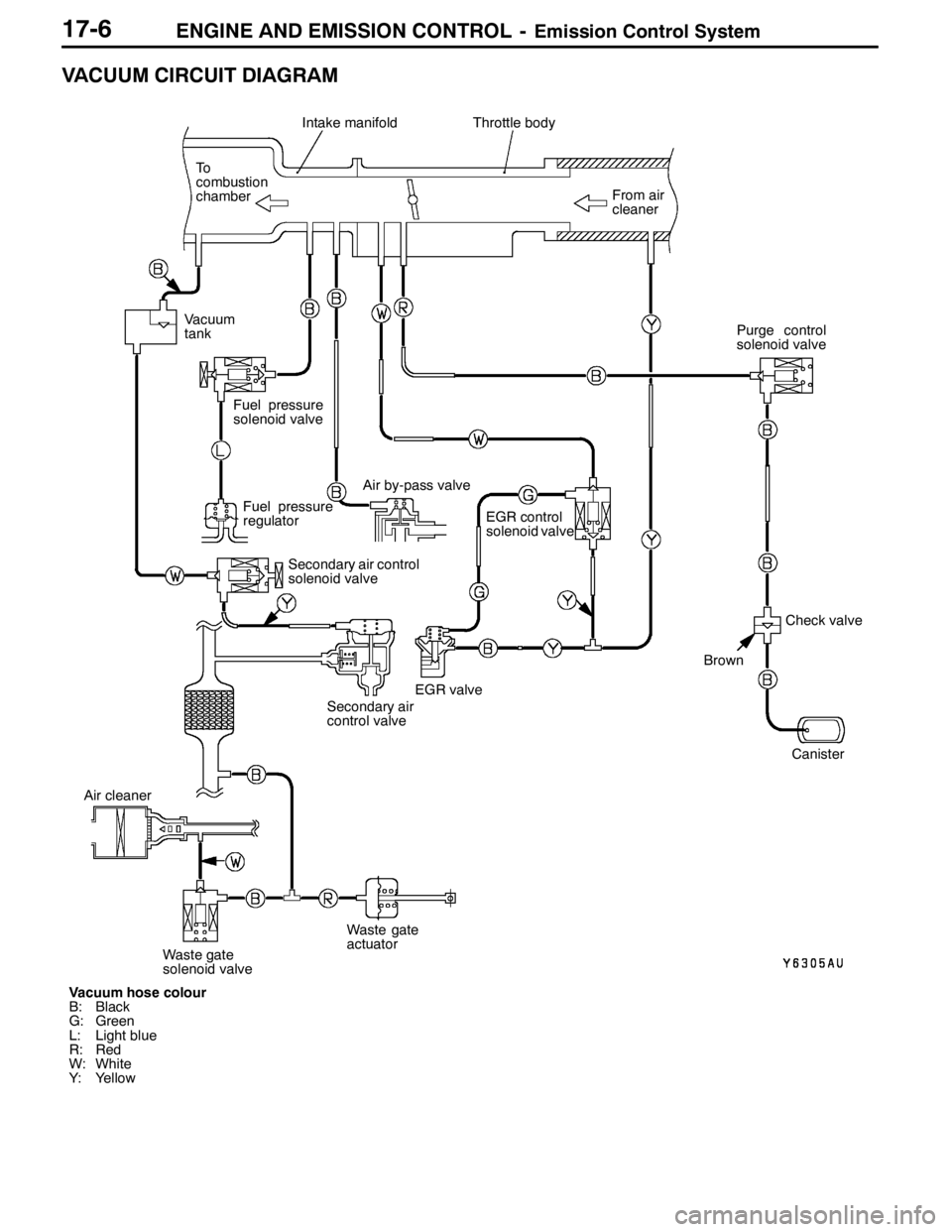
VACUUM CIRCUIT DIAGRAM
Vacuum hose colour
B: Black
G: Green
L: Light blue
R: Red
W: White
Y: YellowFrom air
cleaner
Intake manifoldThrottle body
To
combustion
chamber
Fuel pressure
regulator
EGR control
solenoid valve
Canister
EGR valve
Brown
Check valve Vacuum
tank
Fuel pressure
solenoid valve
Air by-pass valve
Secondary air control
solenoid valve
Secondary air
control valvePurge control
solenoid valve
Air cleaner
Waste gate
solenoid valveWaste gate
actuator
Page 778 of 1449
ENGINE AND EMISSION CONTROL -Emission Control System17-8
CRANKCASE EMISSION CONTROL SYSTEM
GENERAL INFORMATION
The crankcase emission control system prevents
blow-by gases from escaping inside the crankcase
into the atmosphere.
Fresh air is sent from the air cleaner into the
crankcase through the breather hose. The air
becomes mixed with the blow-by gases inside the
crankcase.
The blow-by gas inside the crankcase is drawn
into the intake manifold through the positivecrankcase ventilation (PCV) valve.
The PCV valve lifts the plunger according to the
intake manifold vacuum so as to regulate the flow
of blow-by gas properly. In other words, the blow-by
gas flow is regulated during low load engine
operation to maintain engine stability, while the flow
is increased during high load operation to improve
the ventilation performance.
SYSTEM DIAGRAM
Ventilation hose
PCV valve Breather hose