Page 1850 of 2305
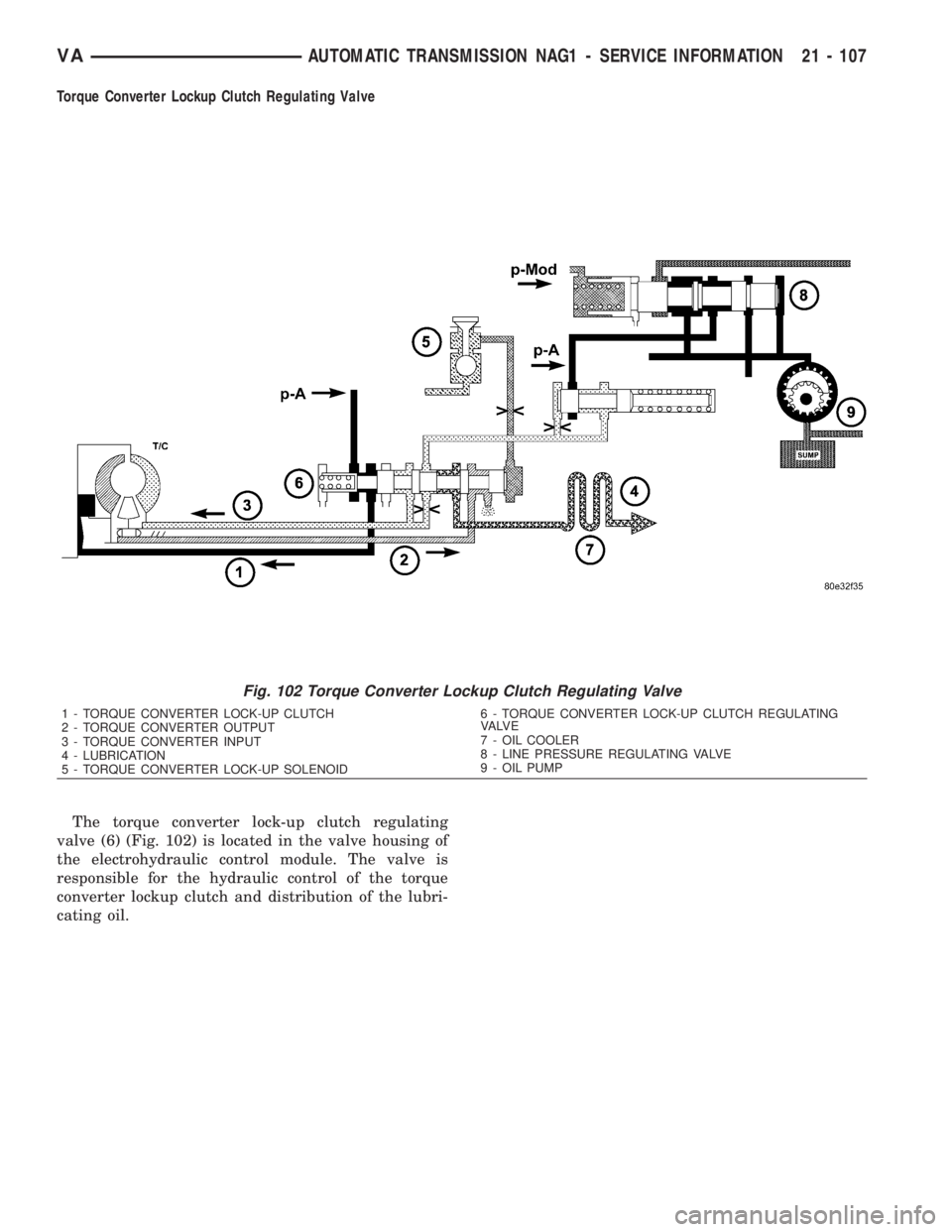
Torque Converter Lockup Clutch Regulating Valve
The torque converter lock-up clutch regulating
valve (6) (Fig. 102) is located in the valve housing of
the electrohydraulic control module. The valve is
responsible for the hydraulic control of the torque
converter lockup clutch and distribution of the lubri-
cating oil.
Fig. 102 Torque Converter Lockup Clutch Regulating Valve
1 - TORQUE CONVERTER LOCK-UP CLUTCH
2 - TORQUE CONVERTER OUTPUT
3 - TORQUE CONVERTER INPUT
4 - LUBRICATION
5 - TORQUE CONVERTER LOCK-UP SOLENOID6 - TORQUE CONVERTER LOCK-UP CLUTCH REGULATING
VA LV E
7 - OIL COOLER
8 - LINE PRESSURE REGULATING VALVE
9 - OIL PUMP
VAAUTOMATIC TRANSMISSION NAG1 - SERVICE INFORMATION 21 - 107
Page 1854 of 2305
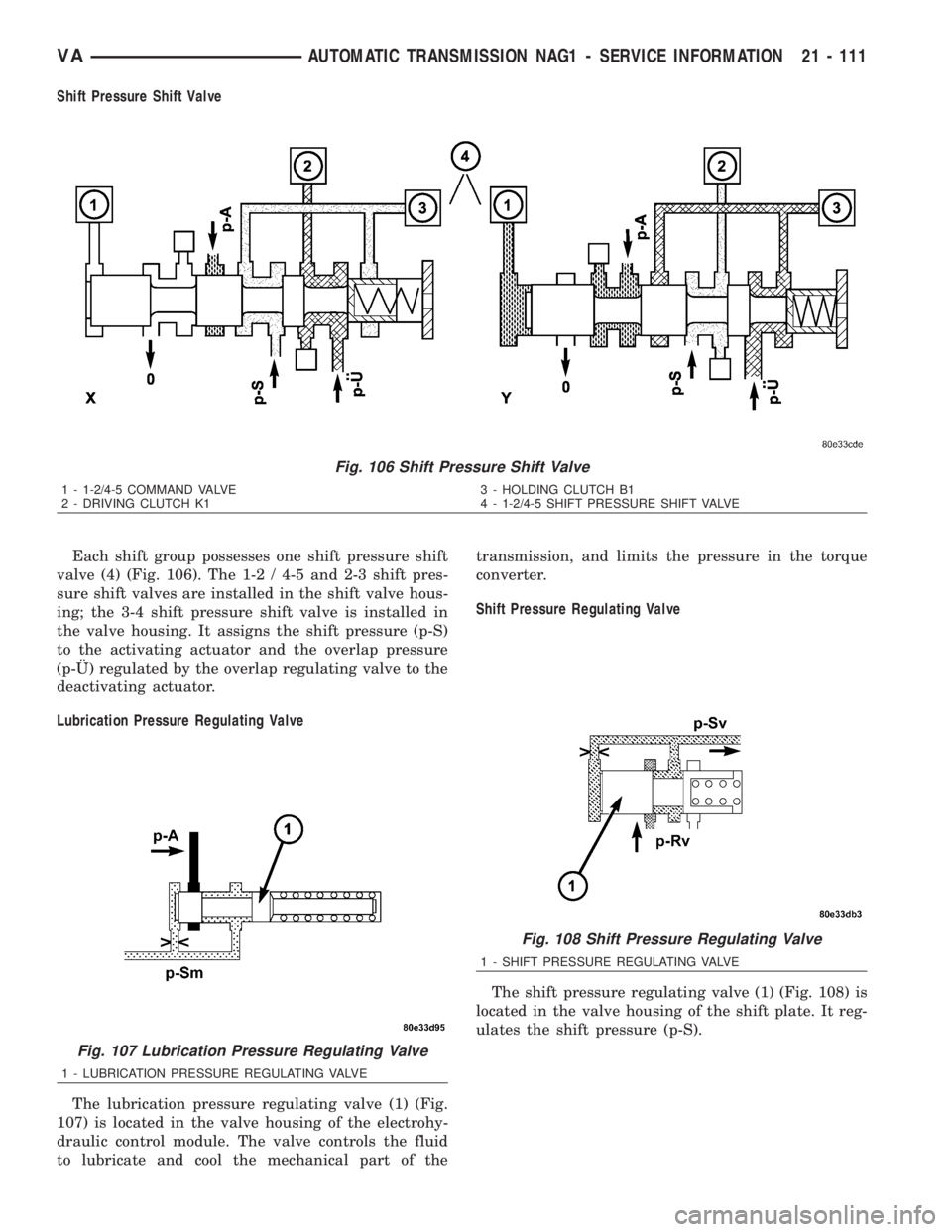
Shift Pressure Shift Valve
Each shift group possesses one shift pressure shift
valve (4) (Fig. 106). The 1-2 / 4-5 and 2-3 shift pres-
sure shift valves are installed in the shift valve hous-
ing; the 3-4 shift pressure shift valve is installed in
the valve housing. It assigns the shift pressure (p-S)
to the activating actuator and the overlap pressure
(p-š) regulated by the overlap regulating valve to the
deactivating actuator.
Lubrication Pressure Regulating Valve
The lubrication pressure regulating valve (1) (Fig.
107) is located in the valve housing of the electrohy-
draulic control module. The valve controls the fluid
to lubricate and cool the mechanical part of thetransmission, and limits the pressure in the torque
converter.
Shift Pressure Regulating Valve
The shift pressure regulating valve (1) (Fig. 108) is
located in the valve housing of the shift plate. It reg-
ulates the shift pressure (p-S).
Fig. 106 Shift Pressure Shift Valve
1 - 1-2/4-5 COMMAND VALVE
2 - DRIVING CLUTCH K13 - HOLDING CLUTCH B1
4 - 1-2/4-5 SHIFT PRESSURE SHIFT VALVE
Fig. 107 Lubrication Pressure Regulating Valve
1 - LUBRICATION PRESSURE REGULATING VALVE
Fig. 108 Shift Pressure Regulating Valve
1 - SHIFT PRESSURE REGULATING VALVE
VAAUTOMATIC TRANSMISSION NAG1 - SERVICE INFORMATION 21 - 111
Page 1855 of 2305
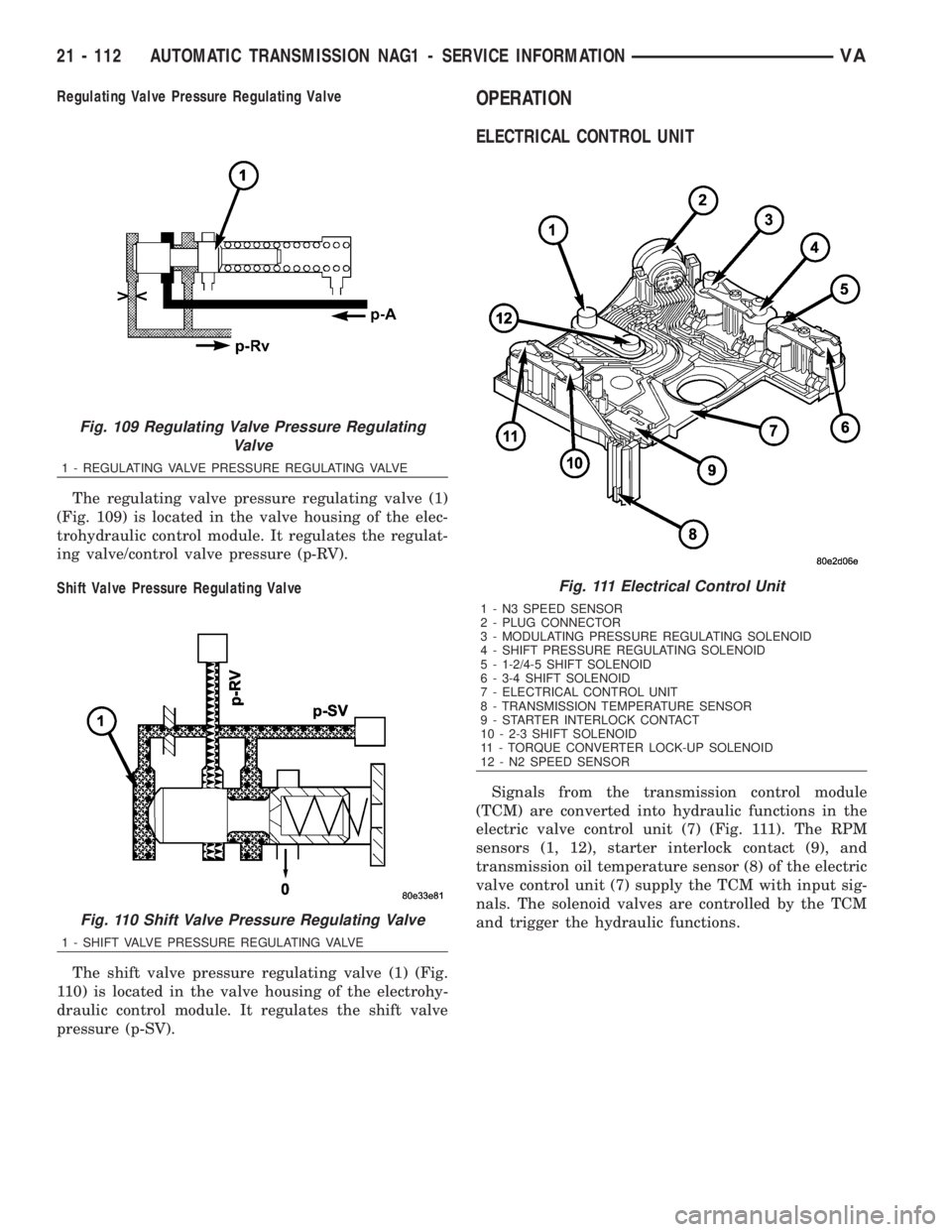
Regulating Valve Pressure Regulating Valve
The regulating valve pressure regulating valve (1)
(Fig. 109) is located in the valve housing of the elec-
trohydraulic control module. It regulates the regulat-
ing valve/control valve pressure (p-RV).
Shift Valve Pressure Regulating Valve
The shift valve pressure regulating valve (1) (Fig.
110) is located in the valve housing of the electrohy-
draulic control module. It regulates the shift valve
pressure (p-SV).OPERATION
ELECTRICAL CONTROL UNIT
Signals from the transmission control module
(TCM) are converted into hydraulic functions in the
electric valve control unit (7) (Fig. 111). The RPM
sensors (1, 12), starter interlock contact (9), and
transmission oil temperature sensor (8) of the electric
valve control unit (7) supply the TCM with input sig-
nals. The solenoid valves are controlled by the TCM
and trigger the hydraulic functions.
Fig. 109 Regulating Valve Pressure Regulating
Valve
1 - REGULATING VALVE PRESSURE REGULATING VALVE
Fig. 110 Shift Valve Pressure Regulating Valve
1 - SHIFT VALVE PRESSURE REGULATING VALVE
Fig. 111 Electrical Control Unit
1 - N3 SPEED SENSOR
2 - PLUG CONNECTOR
3 - MODULATING PRESSURE REGULATING SOLENOID
4 - SHIFT PRESSURE REGULATING SOLENOID
5 - 1-2/4-5 SHIFT SOLENOID
6 - 3-4 SHIFT SOLENOID
7 - ELECTRICAL CONTROL UNIT
8 - TRANSMISSION TEMPERATURE SENSOR
9 - STARTER INTERLOCK CONTACT
10 - 2-3 SHIFT SOLENOID
11 - TORQUE CONVERTER LOCK-UP SOLENOID
12 - N2 SPEED SENSOR
21 - 112 AUTOMATIC TRANSMISSION NAG1 - SERVICE INFORMATIONVA
Page 1857 of 2305
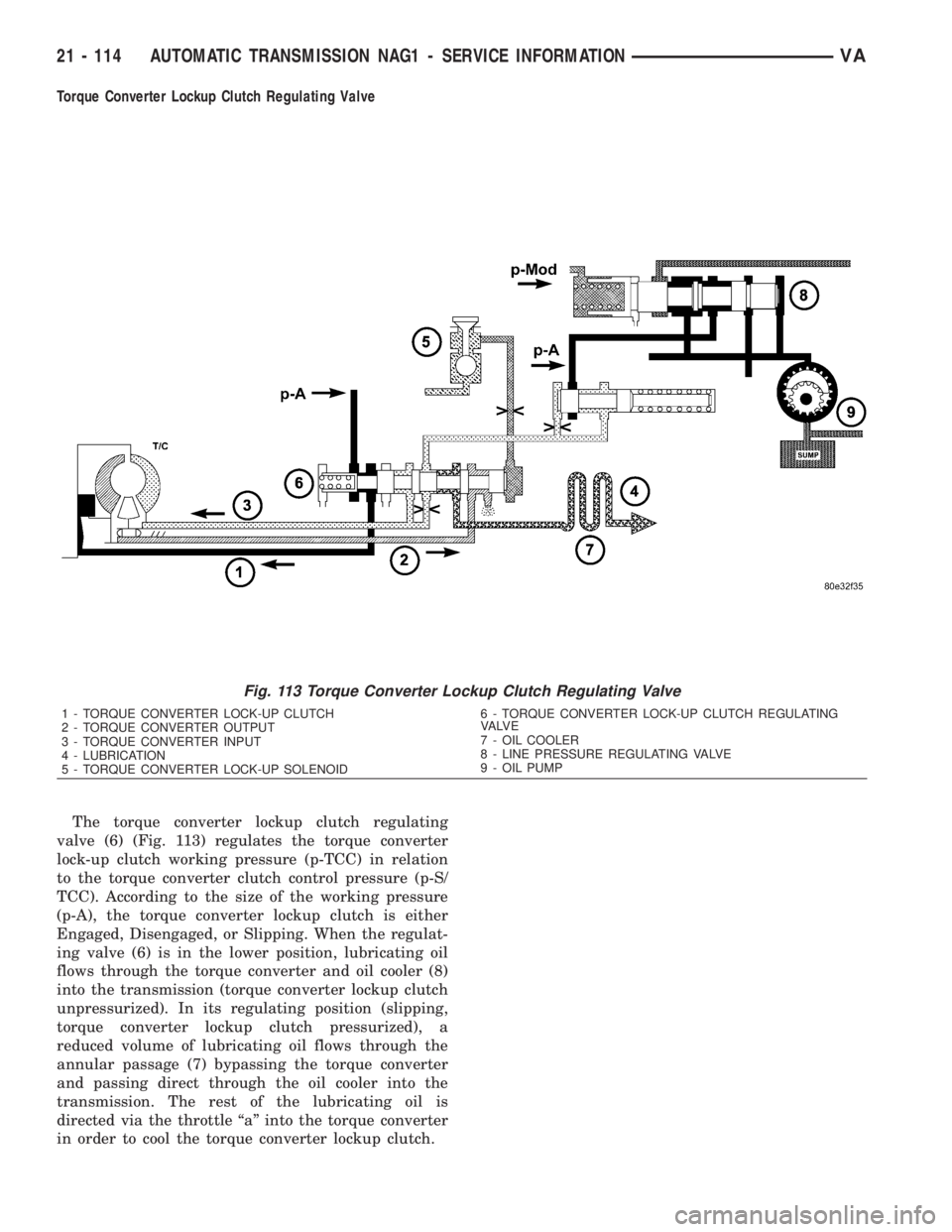
Torque Converter Lockup Clutch Regulating Valve
The torque converter lockup clutch regulating
valve (6) (Fig. 113) regulates the torque converter
lock-up clutch working pressure (p-TCC) in relation
to the torque converter clutch control pressure (p-S/
TCC). According to the size of the working pressure
(p-A), the torque converter lockup clutch is either
Engaged, Disengaged, or Slipping. When the regulat-
ing valve (6) is in the lower position, lubricating oil
flows through the torque converter and oil cooler (8)
into the transmission (torque converter lockup clutch
unpressurized). In its regulating position (slipping,
torque converter lockup clutch pressurized), a
reduced volume of lubricating oil flows through the
annular passage (7) bypassing the torque converter
and passing direct through the oil cooler into the
transmission. The rest of the lubricating oil is
directed via the throttle ªaº into the torque converter
in order to cool the torque converter lockup clutch.
Fig. 113 Torque Converter Lockup Clutch Regulating Valve
1 - TORQUE CONVERTER LOCK-UP CLUTCH
2 - TORQUE CONVERTER OUTPUT
3 - TORQUE CONVERTER INPUT
4 - LUBRICATION
5 - TORQUE CONVERTER LOCK-UP SOLENOID6 - TORQUE CONVERTER LOCK-UP CLUTCH REGULATING
VA LV E
7 - OIL COOLER
8 - LINE PRESSURE REGULATING VALVE
9 - OIL PUMP
21 - 114 AUTOMATIC TRANSMISSION NAG1 - SERVICE INFORMATIONVA
Page 1861 of 2305
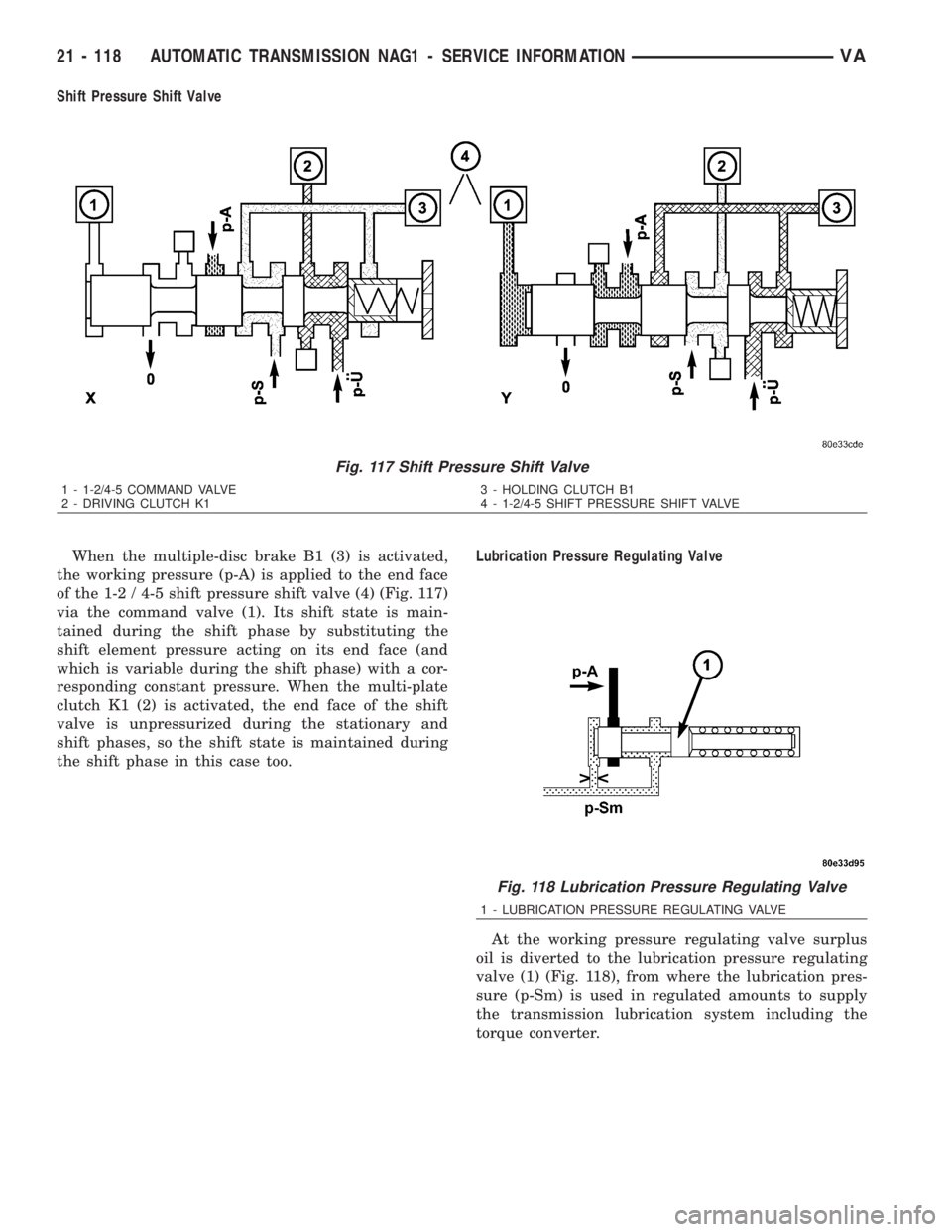
Shift Pressure Shift Valve
When the multiple-disc brake B1 (3) is activated,
the working pressure (p-A) is applied to the end face
of the 1-2 / 4-5 shift pressure shift valve (4) (Fig. 117)
via the command valve (1). Its shift state is main-
tained during the shift phase by substituting the
shift element pressure acting on its end face (and
which is variable during the shift phase) with a cor-
responding constant pressure. When the multi-plate
clutch K1 (2) is activated, the end face of the shift
valve is unpressurized during the stationary and
shift phases, so the shift state is maintained during
the shift phase in this case too.Lubrication Pressure Regulating Valve
At the working pressure regulating valve surplus
oil is diverted to the lubrication pressure regulating
valve (1) (Fig. 118), from where the lubrication pres-
sure (p-Sm) is used in regulated amounts to supply
the transmission lubrication system including the
torque converter.
Fig. 117 Shift Pressure Shift Valve
1 - 1-2/4-5 COMMAND VALVE
2 - DRIVING CLUTCH K13 - HOLDING CLUTCH B1
4 - 1-2/4-5 SHIFT PRESSURE SHIFT VALVE
Fig. 118 Lubrication Pressure Regulating Valve
1 - LUBRICATION PRESSURE REGULATING VALVE
21 - 118 AUTOMATIC TRANSMISSION NAG1 - SERVICE INFORMATIONVA
Page 1862 of 2305
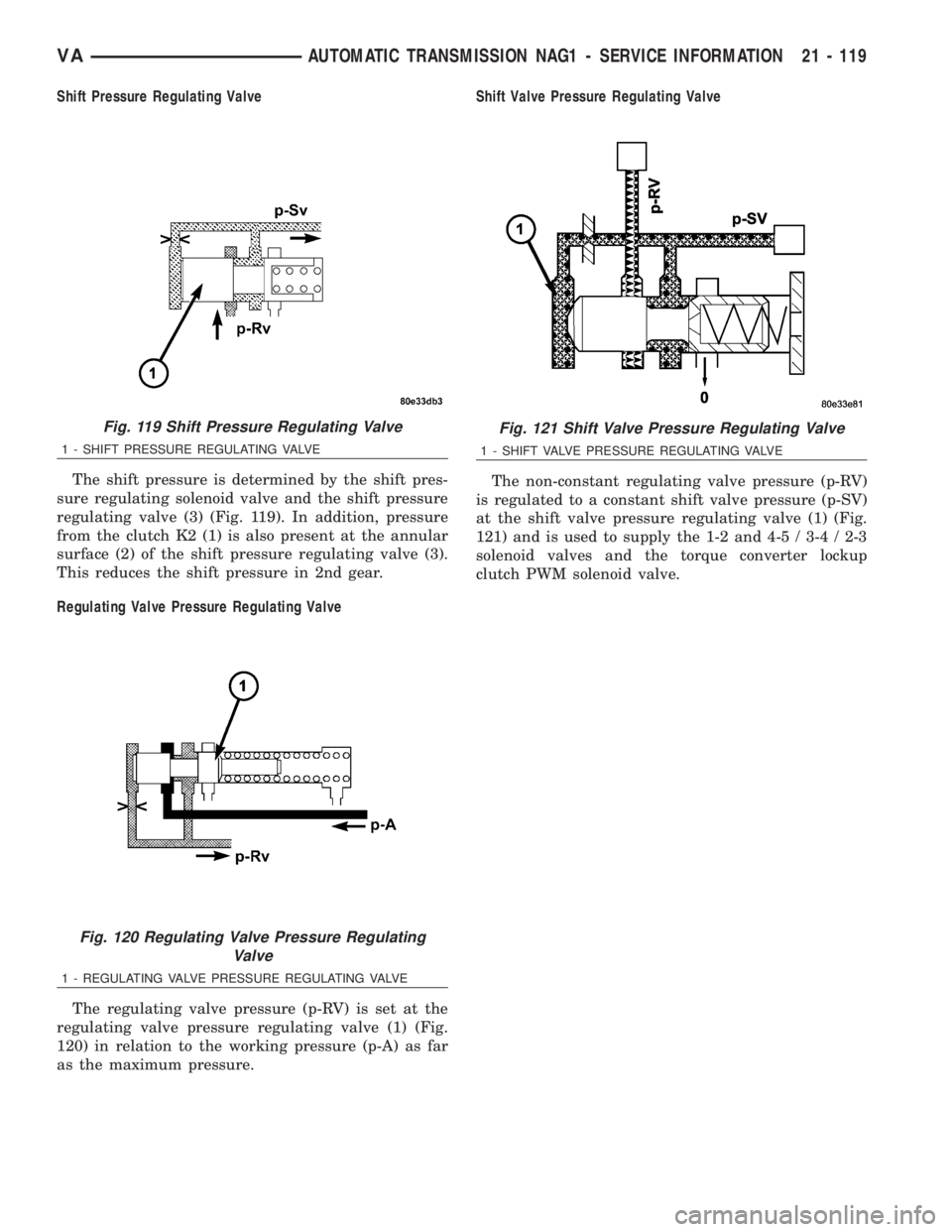
Shift Pressure Regulating Valve
The shift pressure is determined by the shift pres-
sure regulating solenoid valve and the shift pressure
regulating valve (3) (Fig. 119). In addition, pressure
from the clutch K2 (1) is also present at the annular
surface (2) of the shift pressure regulating valve (3).
This reduces the shift pressure in 2nd gear.
Regulating Valve Pressure Regulating Valve
The regulating valve pressure (p-RV) is set at the
regulating valve pressure regulating valve (1) (Fig.
120) in relation to the working pressure (p-A) as far
as the maximum pressure.Shift Valve Pressure Regulating Valve
The non-constant regulating valve pressure (p-RV)
is regulated to a constant shift valve pressure (p-SV)
at the shift valve pressure regulating valve (1) (Fig.
121) and is used to supply the 1-2 and 4-5 / 3-4 / 2-3
solenoid valves and the torque converter lockup
clutch PWM solenoid valve.
Fig. 119 Shift Pressure Regulating Valve
1 - SHIFT PRESSURE REGULATING VALVE
Fig. 120 Regulating Valve Pressure Regulating
Valve
1 - REGULATING VALVE PRESSURE REGULATING VALVE
Fig. 121 Shift Valve Pressure Regulating Valve
1 - SHIFT VALVE PRESSURE REGULATING VALVE
VAAUTOMATIC TRANSMISSION NAG1 - SERVICE INFORMATION 21 - 119
Page 1864 of 2305
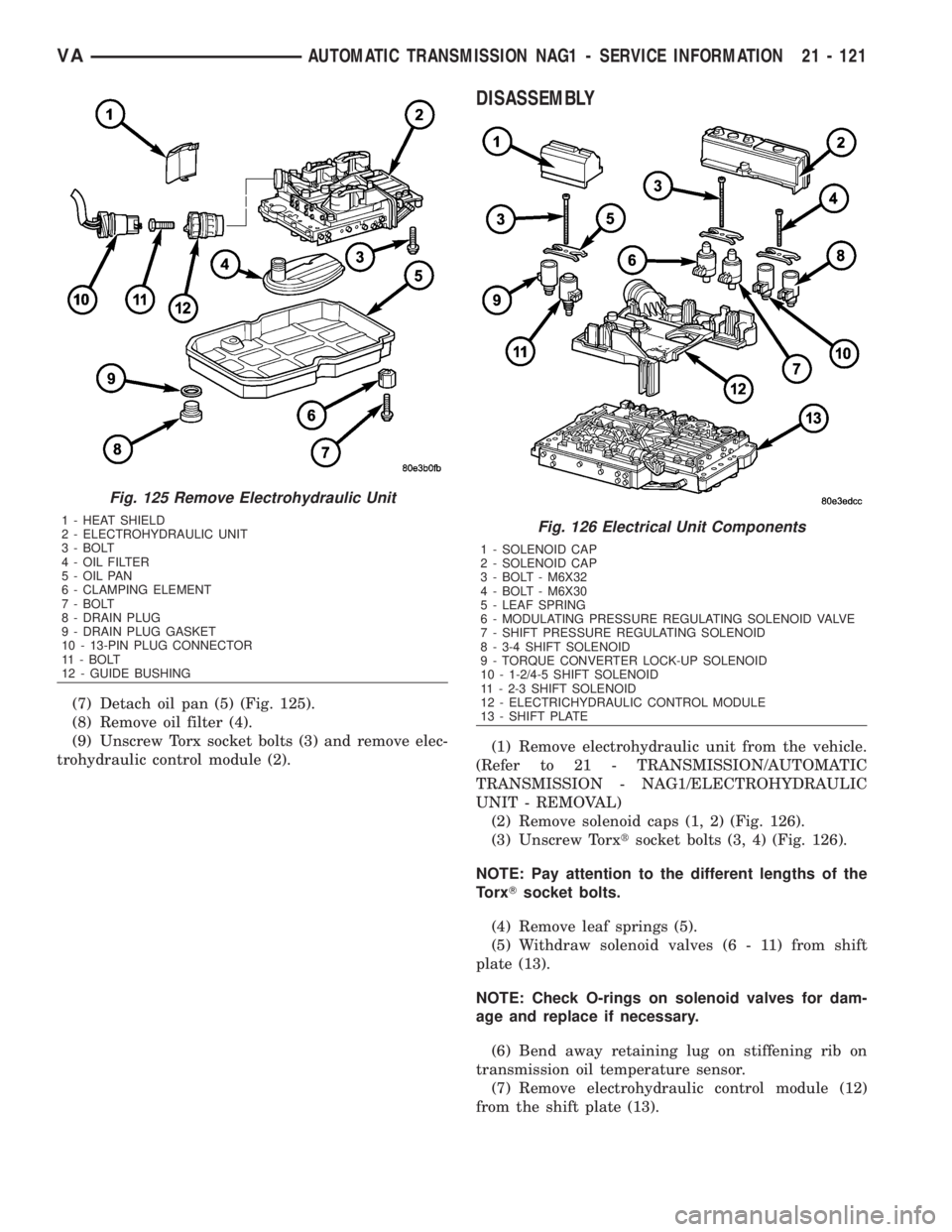
(7) Detach oil pan (5) (Fig. 125).
(8) Remove oil filter (4).
(9) Unscrew Torx socket bolts (3) and remove elec-
trohydraulic control module (2).
DISASSEMBLY
(1) Remove electrohydraulic unit from the vehicle.
(Refer to 21 - TRANSMISSION/AUTOMATIC
TRANSMISSION - NAG1/ELECTROHYDRAULIC
UNIT - REMOVAL)
(2) Remove solenoid caps (1, 2) (Fig. 126).
(3) Unscrew Torxtsocket bolts (3, 4) (Fig. 126).
NOTE: Pay attention to the different lengths of the
TorxTsocket bolts.
(4) Remove leaf springs (5).
(5) Withdraw solenoid valves (6 - 11) from shift
plate (13).
NOTE: Check O-rings on solenoid valves for dam-
age and replace if necessary.
(6) Bend away retaining lug on stiffening rib on
transmission oil temperature sensor.
(7) Remove electrohydraulic control module (12)
from the shift plate (13).
Fig. 125 Remove Electrohydraulic Unit
1 - HEAT SHIELD
2 - ELECTROHYDRAULIC UNIT
3 - BOLT
4 - OIL FILTER
5 - OIL PAN
6 - CLAMPING ELEMENT
7 - BOLT
8 - DRAIN PLUG
9 - DRAIN PLUG GASKET
10 - 13-PIN PLUG CONNECTOR
11 - BOLT
12 - GUIDE BUSHINGFig. 126 Electrical Unit Components
1 - SOLENOID CAP
2 - SOLENOID CAP
3 - BOLT - M6X32
4 - BOLT - M6X30
5 - LEAF SPRING
6 - MODULATING PRESSURE REGULATING SOLENOID VALVE
7 - SHIFT PRESSURE REGULATING SOLENOID
8 - 3-4 SHIFT SOLENOID
9 - TORQUE CONVERTER LOCK-UP SOLENOID
10 - 1-2/4-5 SHIFT SOLENOID
11 - 2-3 SHIFT SOLENOID
12 - ELECTRICHYDRAULIC CONTROL MODULE
13 - SHIFT PLATE
VAAUTOMATIC TRANSMISSION NAG1 - SERVICE INFORMATION 21 - 121
Page 1866 of 2305
(13) Remove the strainers (1, 2) for the modulating
pressure and shift pressure control solenoid valves
(Fig. 129) from the valve housing.
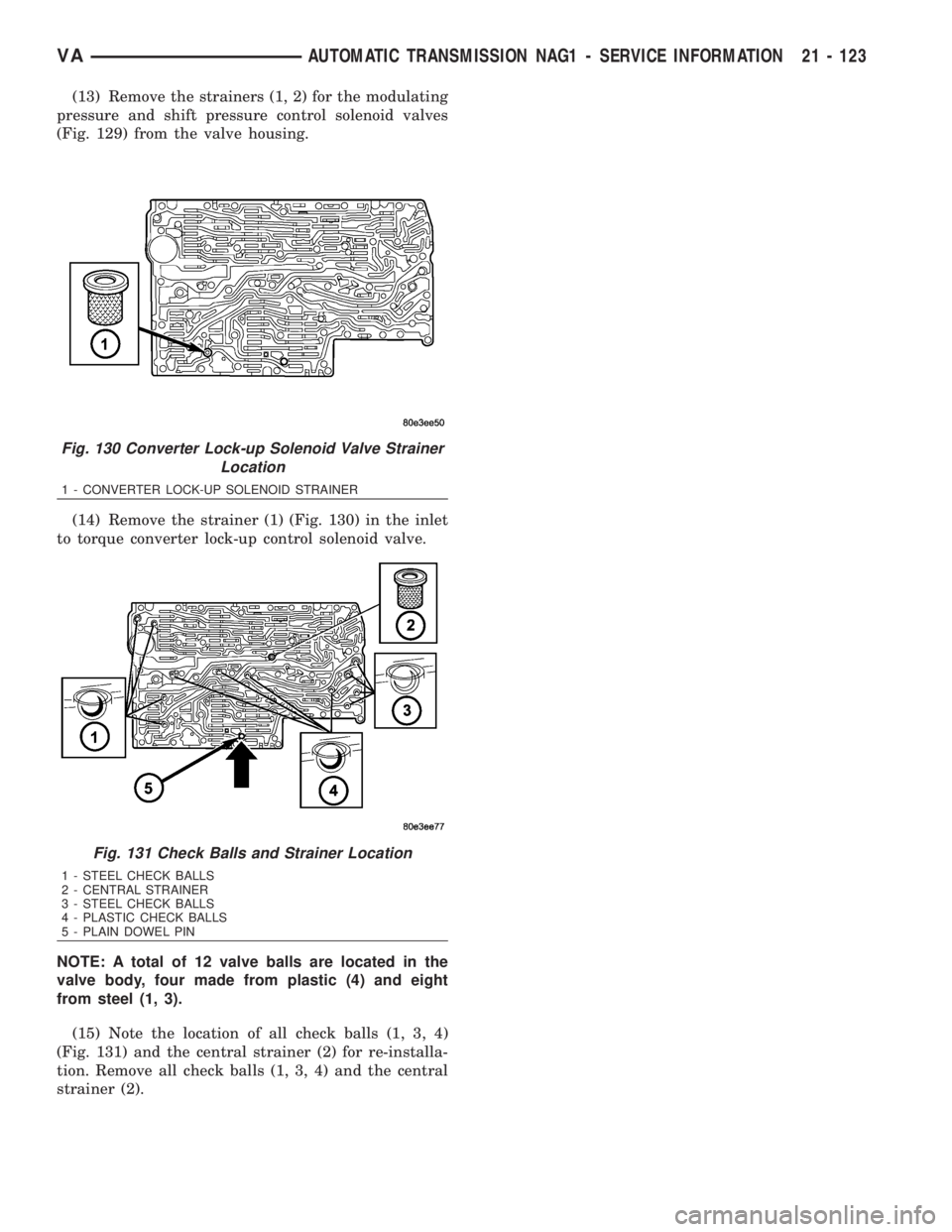
(14) Remove the strainer (1) (Fig. 130) in the inlet
to torque converter lock-up control solenoid valve.
NOTE: A total of 12 valve balls are located in the
valve body, four made from plastic (4) and eight
from steel (1, 3).
(15) Note the location of all check balls (1, 3, 4)
(Fig. 131) and the central strainer (2) for re-installa-
tion. Remove all check balls (1, 3, 4) and the central
strainer (2).
Fig. 130 Converter Lock-up Solenoid Valve Strainer
Location
1 - CONVERTER LOCK-UP SOLENOID STRAINER
Fig. 131 Check Balls and Strainer Location
1 - STEEL CHECK BALLS
2 - CENTRAL STRAINER
3 - STEEL CHECK BALLS
4 - PLASTIC CHECK BALLS
5 - PLAIN DOWEL PIN
VAAUTOMATIC TRANSMISSION NAG1 - SERVICE INFORMATION 21 - 123