2006 MERCEDES-BENZ SPRINTER torque
[x] Cancel search: torquePage 1797 of 2305
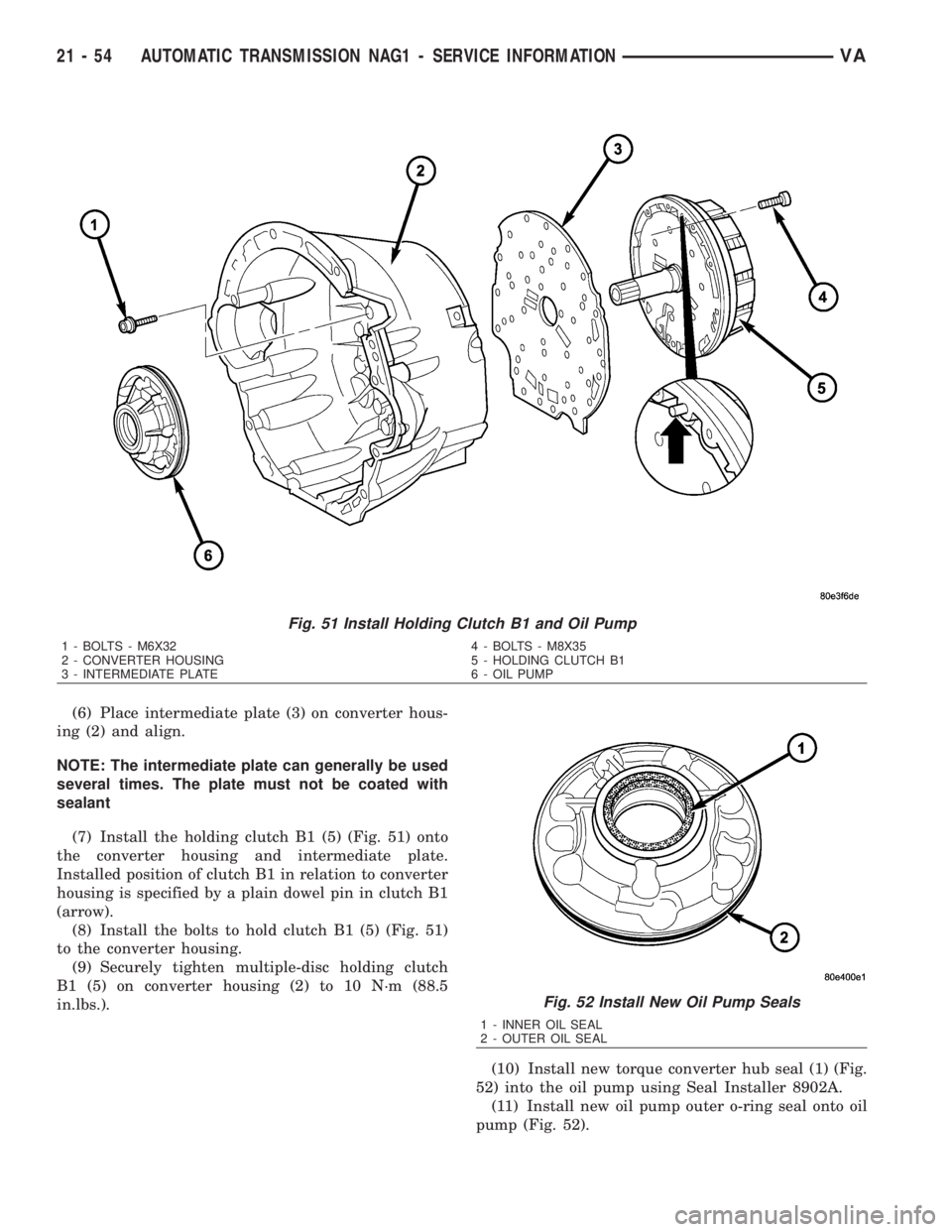
(6) Place intermediate plate (3) on converter hous-
ing (2) and align.
NOTE: The intermediate plate can generally be used
several times. The plate must not be coated with
sealant
(7) Install the holding clutch B1 (5) (Fig. 51) onto
the converter housing and intermediate plate.
Installed position of clutch B1 in relation to converter
housing is specified by a plain dowel pin in clutch B1
(arrow).
(8) Install the bolts to hold clutch B1 (5) (Fig. 51)
to the converter housing.
(9) Securely tighten multiple-disc holding clutch
B1 (5) on converter housing (2) to 10 N´m (88.5
in.lbs.).
(10) Install new torque converter hub seal (1) (Fig.
52) into the oil pump using Seal Installer 8902A.
(11) Install new oil pump outer o-ring seal onto oil
pump (Fig. 52).
Fig. 51 Install Holding Clutch B1 and Oil Pump
1 - BOLTS - M6X32 4 - BOLTS - M8X35
2 - CONVERTER HOUSING 5 - HOLDING CLUTCH B1
3 - INTERMEDIATE PLATE 6 - OIL PUMP
Fig. 52 Install New Oil Pump Seals
1 - INNER OIL SEAL
2 - OUTER OIL SEAL
21 - 54 AUTOMATIC TRANSMISSION NAG1 - SERVICE INFORMATIONVA
Page 1803 of 2305
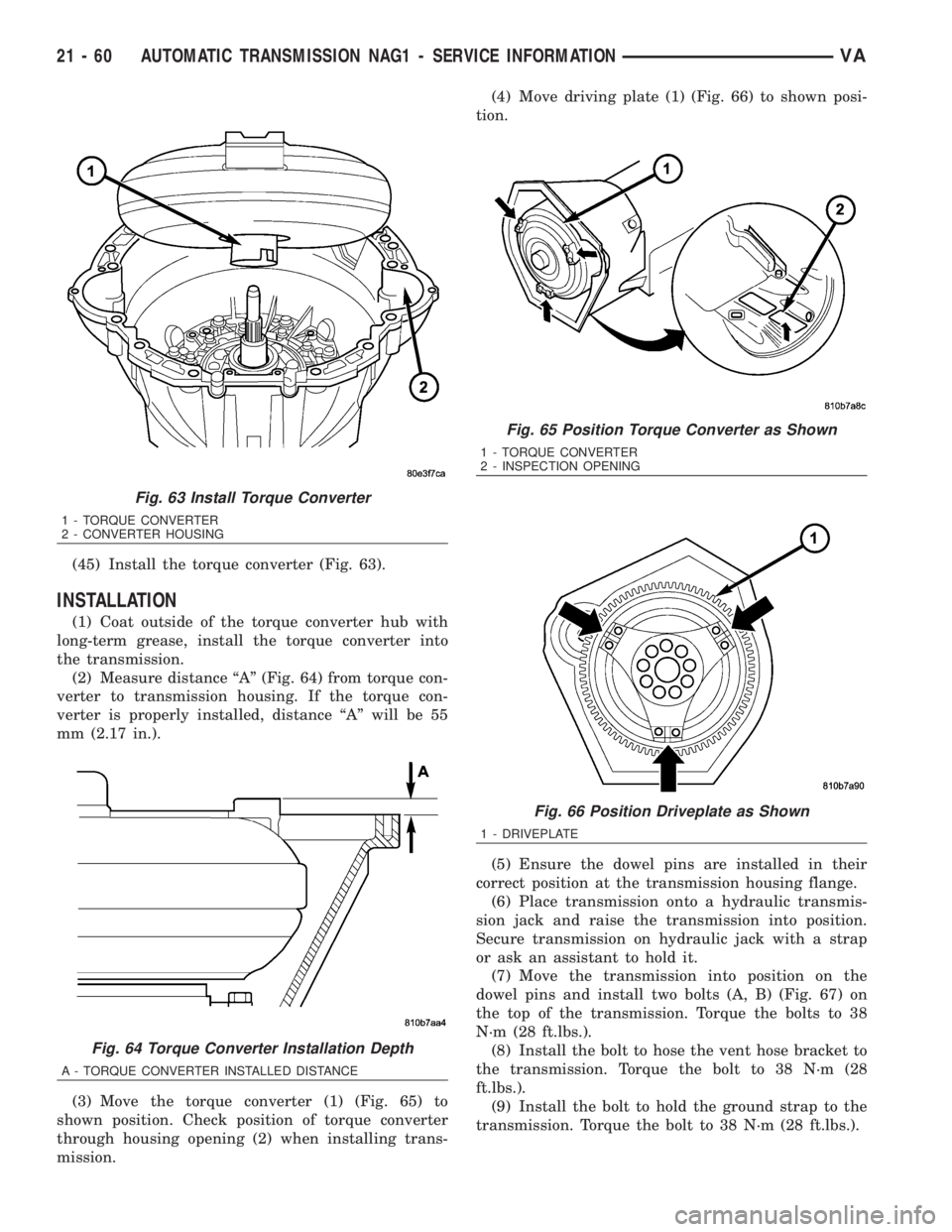
(45) Install the torque converter (Fig. 63).
INSTALLATION
(1) Coat outside of the torque converter hub with
long-term grease, install the torque converter into
the transmission.
(2) Measure distance ªAº (Fig. 64) from torque con-
verter to transmission housing. If the torque con-
verter is properly installed, distance ªAº will be 55
mm (2.17 in.).
(3) Move the torque converter (1) (Fig. 65) to
shown position. Check position of torque converter
through housing opening (2) when installing trans-
mission.(4) Move driving plate (1) (Fig. 66) to shown posi-
tion.
(5) Ensure the dowel pins are installed in their
correct position at the transmission housing flange.
(6) Place transmission onto a hydraulic transmis-
sion jack and raise the transmission into position.
Secure transmission on hydraulic jack with a strap
or ask an assistant to hold it.
(7) Move the transmission into position on the
dowel pins and install two bolts (A, B) (Fig. 67) on
the top of the transmission. Torque the bolts to 38
N´m (28 ft.lbs.).
(8) Install the bolt to hose the vent hose bracket to
the transmission. Torque the bolt to 38 N´m (28
ft.lbs.).
(9) Install the bolt to hold the ground strap to the
transmission. Torque the bolt to 38 N´m (28 ft.lbs.).
Fig. 63 Install Torque Converter
1 - TORQUE CONVERTER
2 - CONVERTER HOUSING
Fig. 64 Torque Converter Installation Depth
A - TORQUE CONVERTER INSTALLED DISTANCE
Fig. 65 Position Torque Converter as Shown
1 - TORQUE CONVERTER
2 - INSPECTION OPENING
Fig. 66 Position Driveplate as Shown
1 - DRIVEPLATE
21 - 60 AUTOMATIC TRANSMISSION NAG1 - SERVICE INFORMATIONVA
Page 1804 of 2305
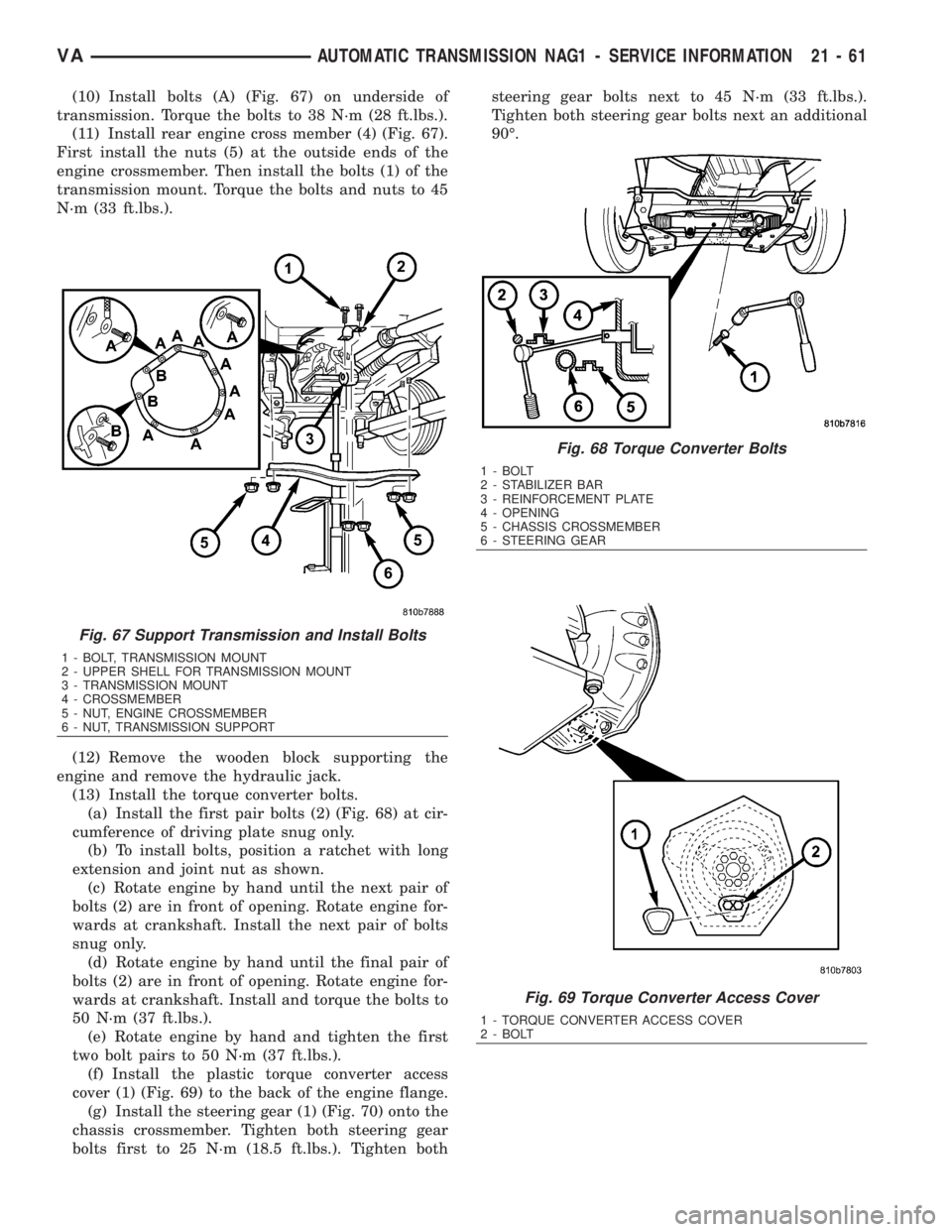
(10) Install bolts (A) (Fig. 67) on underside of
transmission. Torque the bolts to 38 N´m (28 ft.lbs.).
(11) Install rear engine cross member (4) (Fig. 67).
First install the nuts (5) at the outside ends of the
engine crossmember. Then install the bolts (1) of the
transmission mount. Torque the bolts and nuts to 45
N´m (33 ft.lbs.).
(12) Remove the wooden block supporting the
engine and remove the hydraulic jack.
(13) Install the torque converter bolts.
(a) Install the first pair bolts (2) (Fig. 68) at cir-
cumference of driving plate snug only.
(b) To install bolts, position a ratchet with long
extension and joint nut as shown.
(c) Rotate engine by hand until the next pair of
bolts (2) are in front of opening. Rotate engine for-
wards at crankshaft. Install the next pair of bolts
snug only.
(d) Rotate engine by hand until the final pair of
bolts (2) are in front of opening. Rotate engine for-
wards at crankshaft. Install and torque the bolts to
50 N´m (37 ft.lbs.).
(e) Rotate engine by hand and tighten the first
two bolt pairs to 50 N´m (37 ft.lbs.).
(f) Install the plastic torque converter access
cover (1) (Fig. 69) to the back of the engine flange.
(g) Install the steering gear (1) (Fig. 70) onto the
chassis crossmember. Tighten both steering gear
bolts first to 25 N´m (18.5 ft.lbs.). Tighten bothsteering gear bolts next to 45 N´m (33 ft.lbs.).
Tighten both steering gear bolts next an additional
90É.
Fig. 67 Support Transmission and Install Bolts
1 - BOLT, TRANSMISSION MOUNT
2 - UPPER SHELL FOR TRANSMISSION MOUNT
3 - TRANSMISSION MOUNT
4 - CROSSMEMBER
5 - NUT, ENGINE CROSSMEMBER
6 - NUT, TRANSMISSION SUPPORT
Fig. 68 Torque Converter Bolts
1 - BOLT
2 - STABILIZER BAR
3 - REINFORCEMENT PLATE
4 - OPENING
5 - CHASSIS CROSSMEMBER
6 - STEERING GEAR
Fig. 69 Torque Converter Access Cover
1 - TORQUE CONVERTER ACCESS COVER
2 - BOLT
VAAUTOMATIC TRANSMISSION NAG1 - SERVICE INFORMATION 21 - 61
Page 1805 of 2305
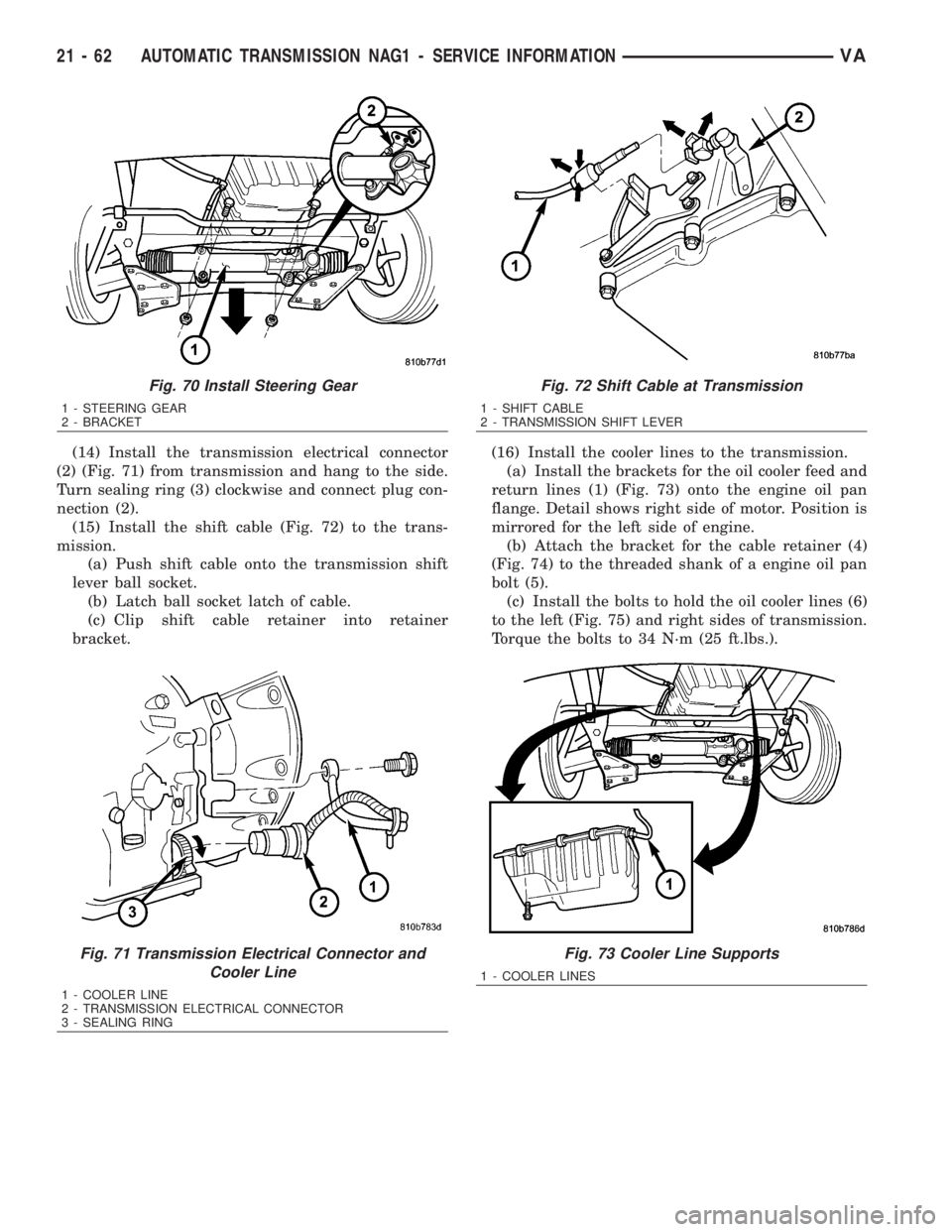
(14) Install the transmission electrical connector
(2) (Fig. 71) from transmission and hang to the side.
Turn sealing ring (3) clockwise and connect plug con-
nection (2).
(15) Install the shift cable (Fig. 72) to the trans-
mission.
(a) Push shift cable onto the transmission shift
lever ball socket.
(b) Latch ball socket latch of cable.
(c) Clip shift cable retainer into retainer
bracket.(16) Install the cooler lines to the transmission.
(a) Install the brackets for the oil cooler feed and
return lines (1) (Fig. 73) onto the engine oil pan
flange. Detail shows right side of motor. Position is
mirrored for the left side of engine.
(b) Attach the bracket for the cable retainer (4)
(Fig. 74) to the threaded shank of a engine oil pan
bolt (5).
(c) Install the bolts to hold the oil cooler lines (6)
to the left (Fig. 75) and right sides of transmission.
Torque the bolts to 34 N´m (25 ft.lbs.).
Fig. 70 Install Steering Gear
1 - STEERING GEAR
2 - BRACKET
Fig. 71 Transmission Electrical Connector and
Cooler Line
1 - COOLER LINE
2 - TRANSMISSION ELECTRICAL CONNECTOR
3 - SEALING RING
Fig. 72 Shift Cable at Transmission
1 - SHIFT CABLE
2 - TRANSMISSION SHIFT LEVER
Fig. 73 Cooler Line Supports
1 - COOLER LINES
21 - 62 AUTOMATIC TRANSMISSION NAG1 - SERVICE INFORMATIONVA
Page 1830 of 2305
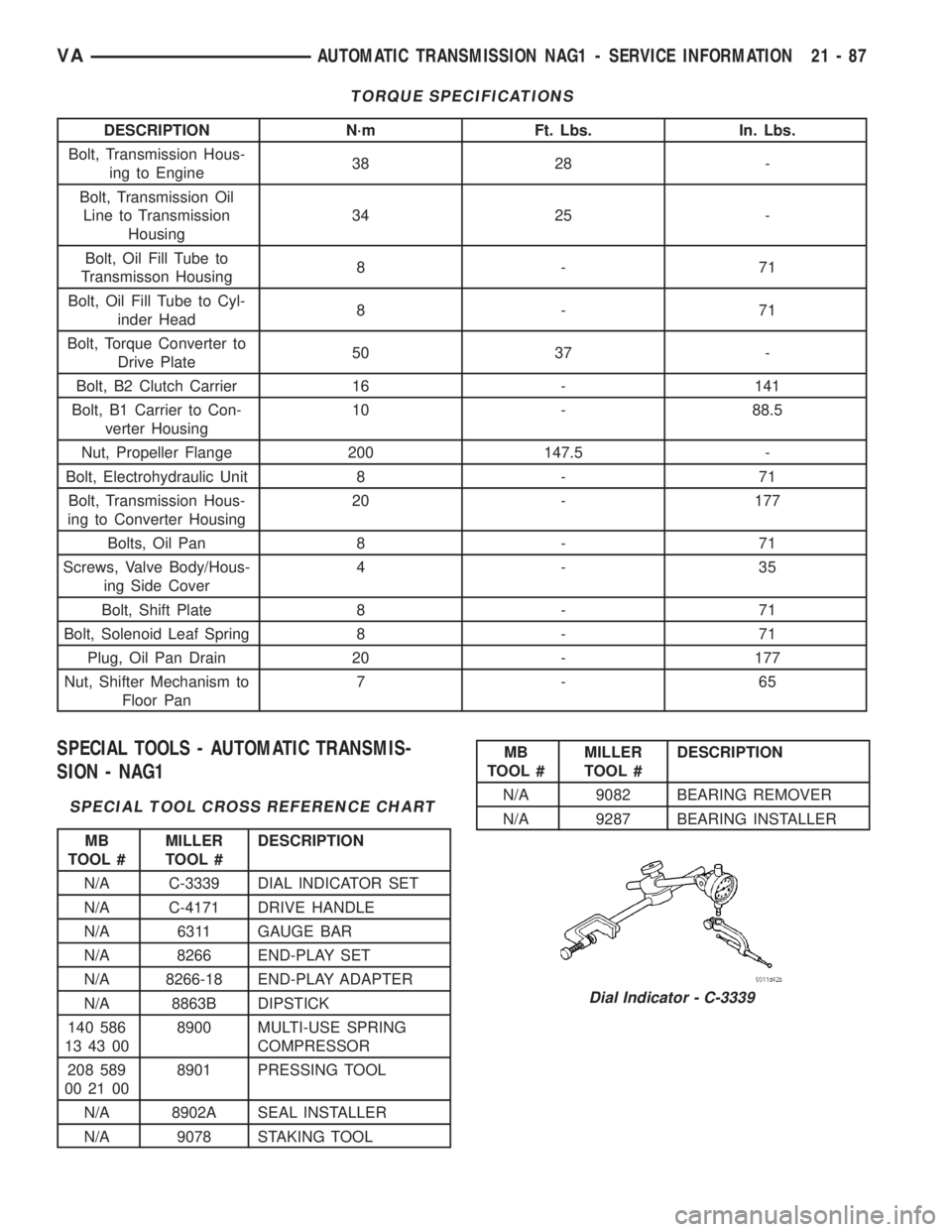
TORQUE SPECIFICATIONS
DESCRIPTION N´m Ft. Lbs. In. Lbs.
Bolt, Transmission Hous-
ing to Engine38 28 -
Bolt, Transmission Oil
Line to Transmission
Housing34 25 -
Bolt, Oil Fill Tube to
Transmisson Housing8-71
Bolt, Oil Fill Tube to Cyl-
inder Head8-71
Bolt, Torque Converter to
Drive Plate50 37 -
Bolt, B2 Clutch Carrier 16 - 141
Bolt, B1 Carrier to Con-
verter Housing10 - 88.5
Nut, Propeller Flange 200 147.5 -
Bolt, Electrohydraulic Unit 8 - 71
Bolt, Transmission Hous-
ing to Converter Housing20 - 177
Bolts, Oil Pan 8 - 71
Screws, Valve Body/Hous-
ing Side Cover4-35
Bolt, Shift Plate 8 - 71
Bolt, Solenoid Leaf Spring 8 - 71
Plug, Oil Pan Drain 20 - 177
Nut, Shifter Mechanism to
Floor Pan7-65
SPECIAL TOOLS - AUTOMATIC TRANSMIS-
SION - NAG1
SPECIAL TOOL CROSS REFERENCE CHART
MB
TOOL #MILLER
TOOL #DESCRIPTION
N/A C-3339 DIAL INDICATOR SET
N/A C-4171 DRIVE HANDLE
N/A 6311 GAUGE BAR
N/A 8266 END-PLAY SET
N/A 8266-18 END-PLAY ADAPTER
N/A 8863B DIPSTICK
140 586
13 43 008900 MULTI-USE SPRING
COMPRESSOR
208 589
00 21 008901 PRESSING TOOL
N/A 8902A SEAL INSTALLER
N/A 9078 STAKING TOOL
MB
TOOL #MILLER
TOOL #DESCRIPTION
N/A 9082 BEARING REMOVER
N/A 9287 BEARING INSTALLER
Dial Indicator - C-3339
VAAUTOMATIC TRANSMISSION NAG1 - SERVICE INFORMATION 21 - 87
Page 1834 of 2305
OPERATION
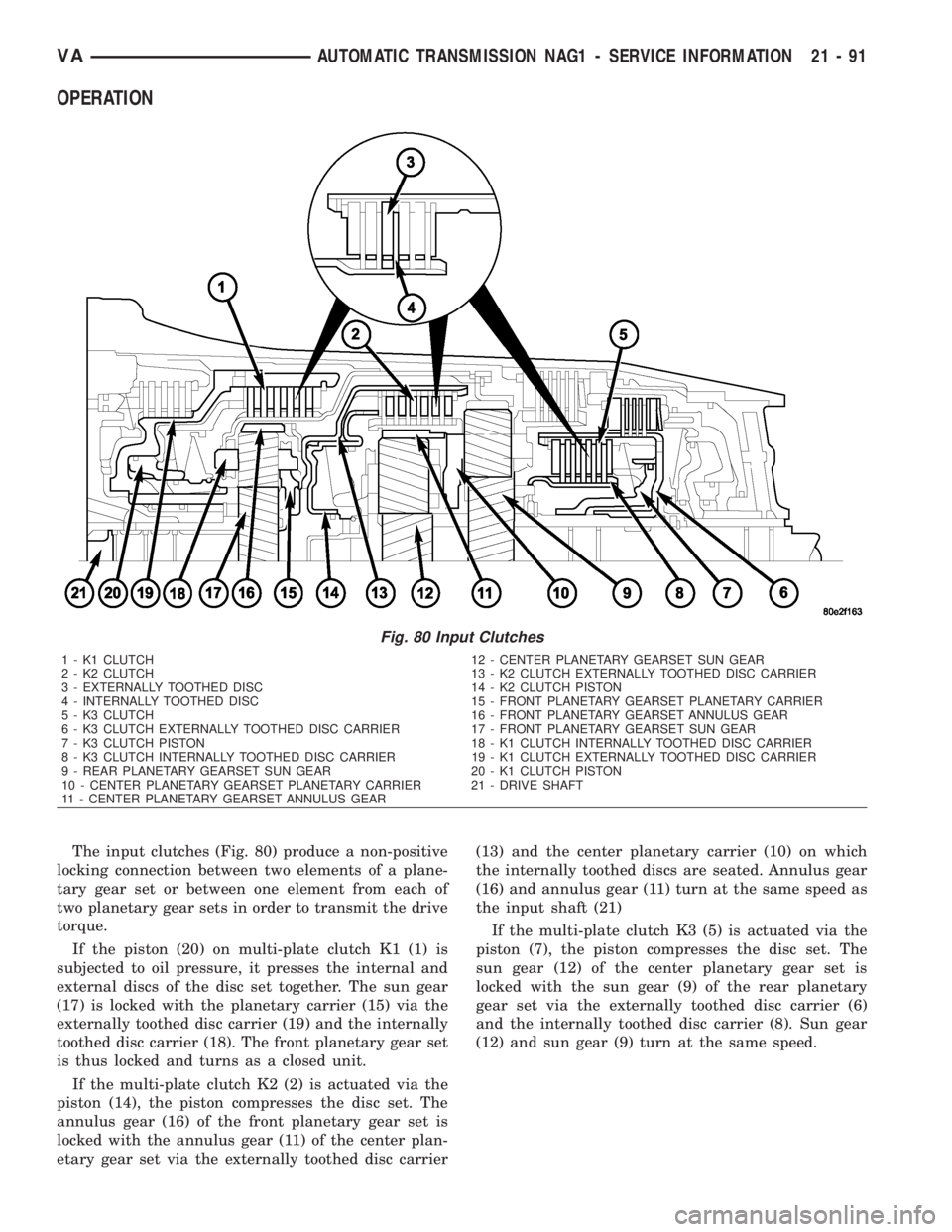
The input clutches (Fig. 80) produce a non-positive
locking connection between two elements of a plane-
tary gear set or between one element from each of
two planetary gear sets in order to transmit the drive
torque.
If the piston (20) on multi-plate clutch K1 (1) is
subjected to oil pressure, it presses the internal and
external discs of the disc set together. The sun gear
(17) is locked with the planetary carrier (15) via the
externally toothed disc carrier (19) and the internally
toothed disc carrier (18). The front planetary gear set
is thus locked and turns as a closed unit.
If the multi-plate clutch K2 (2) is actuated via the
piston (14), the piston compresses the disc set. The
annulus gear (16) of the front planetary gear set is
locked with the annulus gear (11) of the center plan-
etary gear set via the externally toothed disc carrier(13) and the center planetary carrier (10) on which
the internally toothed discs are seated. Annulus gear
(16) and annulus gear (11) turn at the same speed as
the input shaft (21)
If the multi-plate clutch K3 (5) is actuated via the
piston (7), the piston compresses the disc set. The
sun gear (12) of the center planetary gear set is
locked with the sun gear (9) of the rear planetary
gear set via the externally toothed disc carrier (6)
and the internally toothed disc carrier (8). Sun gear
(12) and sun gear (9) turn at the same speed.
Fig. 80 Input Clutches
1 - K1 CLUTCH 12 - CENTER PLANETARY GEARSET SUN GEAR
2 - K2 CLUTCH 13 - K2 CLUTCH EXTERNALLY TOOTHED DISC CARRIER
3 - EXTERNALLY TOOTHED DISC 14 - K2 CLUTCH PISTON
4 - INTERNALLY TOOTHED DISC 15 - FRONT PLANETARY GEARSET PLANETARY CARRIER
5 - K3 CLUTCH 16 - FRONT PLANETARY GEARSET ANNULUS GEAR
6 - K3 CLUTCH EXTERNALLY TOOTHED DISC CARRIER 17 - FRONT PLANETARY GEARSET SUN GEAR
7 - K3 CLUTCH PISTON 18 - K1 CLUTCH INTERNALLY TOOTHED DISC CARRIER
8 - K3 CLUTCH INTERNALLY TOOTHED DISC CARRIER 19 - K1 CLUTCH EXTERNALLY TOOTHED DISC CARRIER
9 - REAR PLANETARY GEARSET SUN GEAR 20 - K1 CLUTCH PISTON
10 - CENTER PLANETARY GEARSET PLANETARY CARRIER 21 - DRIVE SHAFT
11 - CENTER PLANETARY GEARSET ANNULUS GEAR
VAAUTOMATIC TRANSMISSION NAG1 - SERVICE INFORMATION 21 - 91
Page 1848 of 2305
(0.114 in.), 3.2 mm (0.126 in.), and 3.5 mm (0.138
in.).
ELECTROHYDRAULIC UNIT
DESCRIPTION
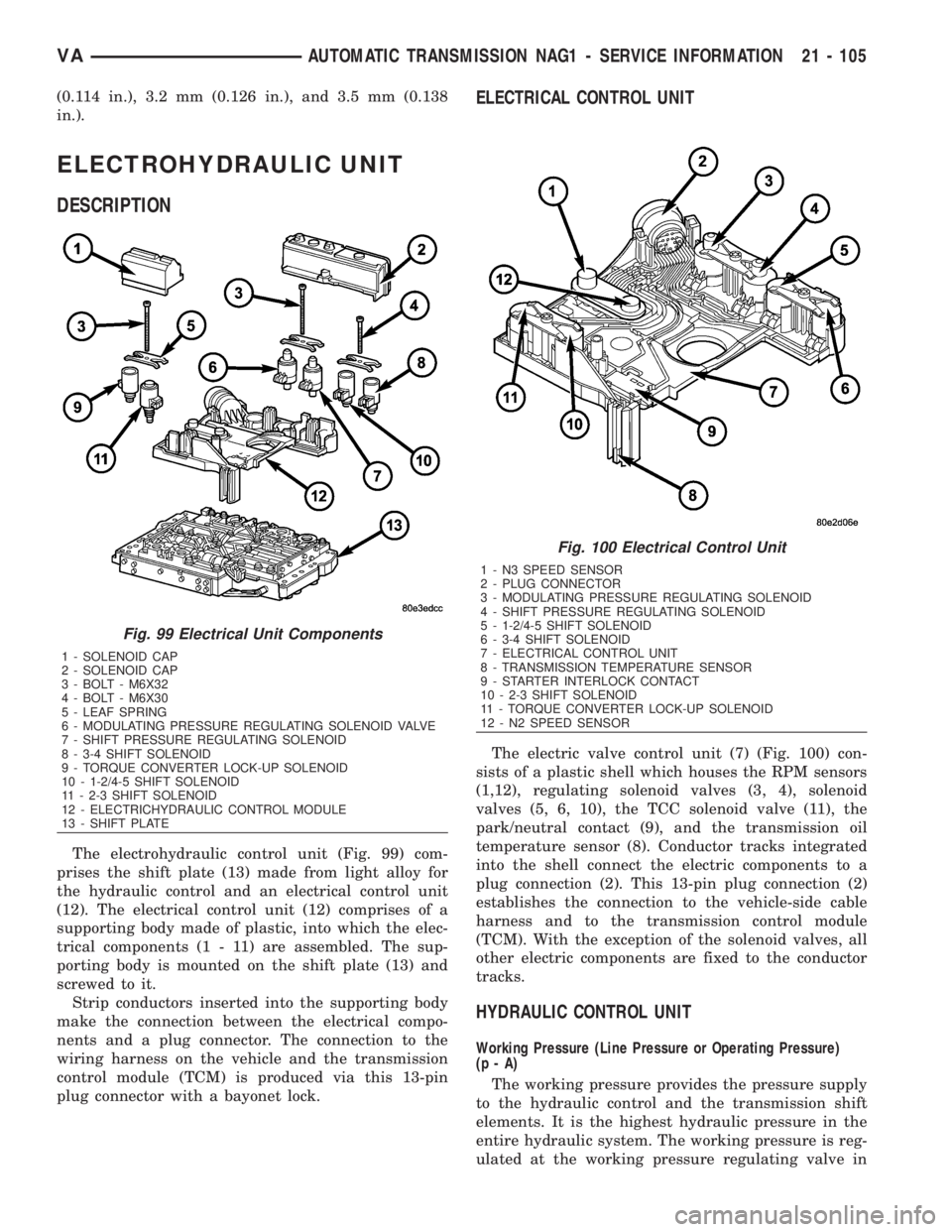
The electrohydraulic control unit (Fig. 99) com-
prises the shift plate (13) made from light alloy for
the hydraulic control and an electrical control unit
(12). The electrical control unit (12) comprises of a
supporting body made of plastic, into which the elec-
trical components (1 - 11) are assembled. The sup-
porting body is mounted on the shift plate (13) and
screwed to it.
Strip conductors inserted into the supporting body
make the connection between the electrical compo-
nents and a plug connector. The connection to the
wiring harness on the vehicle and the transmission
control module (TCM) is produced via this 13-pin
plug connector with a bayonet lock.
ELECTRICAL CONTROL UNIT
The electric valve control unit (7) (Fig. 100) con-
sists of a plastic shell which houses the RPM sensors
(1,12), regulating solenoid valves (3, 4), solenoid
valves (5, 6, 10), the TCC solenoid valve (11), the
park/neutral contact (9), and the transmission oil
temperature sensor (8). Conductor tracks integrated
into the shell connect the electric components to a
plug connection (2). This 13-pin plug connection (2)
establishes the connection to the vehicle-side cable
harness and to the transmission control module
(TCM). With the exception of the solenoid valves, all
other electric components are fixed to the conductor
tracks.
HYDRAULIC CONTROL UNIT
Working Pressure (Line Pressure or Operating Pressure)
(p-A)
The working pressure provides the pressure supply
to the hydraulic control and the transmission shift
elements. It is the highest hydraulic pressure in the
entire hydraulic system. The working pressure is reg-
ulated at the working pressure regulating valve in
Fig. 99 Electrical Unit Components
1 - SOLENOID CAP
2 - SOLENOID CAP
3 - BOLT - M6X32
4 - BOLT - M6X30
5 - LEAF SPRING
6 - MODULATING PRESSURE REGULATING SOLENOID VALVE
7 - SHIFT PRESSURE REGULATING SOLENOID
8 - 3-4 SHIFT SOLENOID
9 - TORQUE CONVERTER LOCK-UP SOLENOID
10 - 1-2/4-5 SHIFT SOLENOID
11 - 2-3 SHIFT SOLENOID
12 - ELECTRICHYDRAULIC CONTROL MODULE
13 - SHIFT PLATE
Fig. 100 Electrical Control Unit
1 - N3 SPEED SENSOR
2 - PLUG CONNECTOR
3 - MODULATING PRESSURE REGULATING SOLENOID
4 - SHIFT PRESSURE REGULATING SOLENOID
5 - 1-2/4-5 SHIFT SOLENOID
6 - 3-4 SHIFT SOLENOID
7 - ELECTRICAL CONTROL UNIT
8 - TRANSMISSION TEMPERATURE SENSOR
9 - STARTER INTERLOCK CONTACT
10 - 2-3 SHIFT SOLENOID
11 - TORQUE CONVERTER LOCK-UP SOLENOID
12 - N2 SPEED SENSOR
VAAUTOMATIC TRANSMISSION NAG1 - SERVICE INFORMATION 21 - 105
Page 1849 of 2305
relation to the load and gear. All other pressures
required for the transmission control are derived
from the working pressure.
Lubrication Pressure (p - Sm)
At the working pressure regulating valve surplus
oil is diverted to the lubrication pressure regulating
valve, from where it is used in regulated amounts to
lubricate and cool the mechanical transmission com-
ponents and the torque converter. Furthermore, the
lubrication pressure (p-Sm) is also used to limit the
pressure in the torque converter.
Shift Pressure (p - S)
The shift pressure is determined by the shift pres-
sure regulating solenoid valve and the shift pressure
regulating valve. The shift pressure:
²Regulates the pressure in the activating shift
element during the shift phase.
²Determines together with the modulating pres-
sure the pressure reduction at the deactivating shift
element as regulated by the overlap regulating valve.
²Initializes 2nd gear in limp-home mode.
Modulating Pressure (p - Mod)
The modulating pressure influences the size of the
working pressure and determines together with the
shift pressure the pressure regulated at the overlap
regulating valve. The modulating pressure is regu-
lated at the modulating pressure regulating solenoid
valve, which is under regulating valve pressure. The
modulating pressure is variable and relative to the
engine load.
Regulating Valve / Control Valve Pressure (p - RV)
The regulating valve pressure is regulated at the
regulating valve pressure regulating valve in relation
to the working pressure (p-A) up to a maximum pres-
sure of 8 bar (116 psi). It supplies the modulating
pressure regulating solenoid valve, the shift pressure
regulating solenoid valve and the shift valve pressure
regulating valve.
Shift Valve Pressure (p - SV)
The shift valve pressure (p-SV) is derived from the
regulating valve pressure (p-RV), is regulated at the
shift valve pressure regulating valve and is then
present at the:
²1-2 and 4-5 shift solenoid valve.
²3-4 shift solenoid valve.
²2-3 shift solenoid valve.
²Torque converter lockup solenoid valve.
²3-4 and 2-3 shift pressure shift valve.
The shift valve pressure (p-SV) controls the com-
mand valves via the upshift/downshift solenoid
valves.Overlap Pressure (p - š)
The overlap pressure controls the shift component
pressure reduction during a shift phase. The pres-
sure in a shift element as it disengages is controlled
during the shift phase depending on engine load
(modulating pressure) and the pressure in the shift
element as it engages. The adjusted pressure is
inversely proportional to the transmission capability
of the shift element being engaged (controlled over-
lap).
Working Pressure Regulating Valve (Operating Pressure)
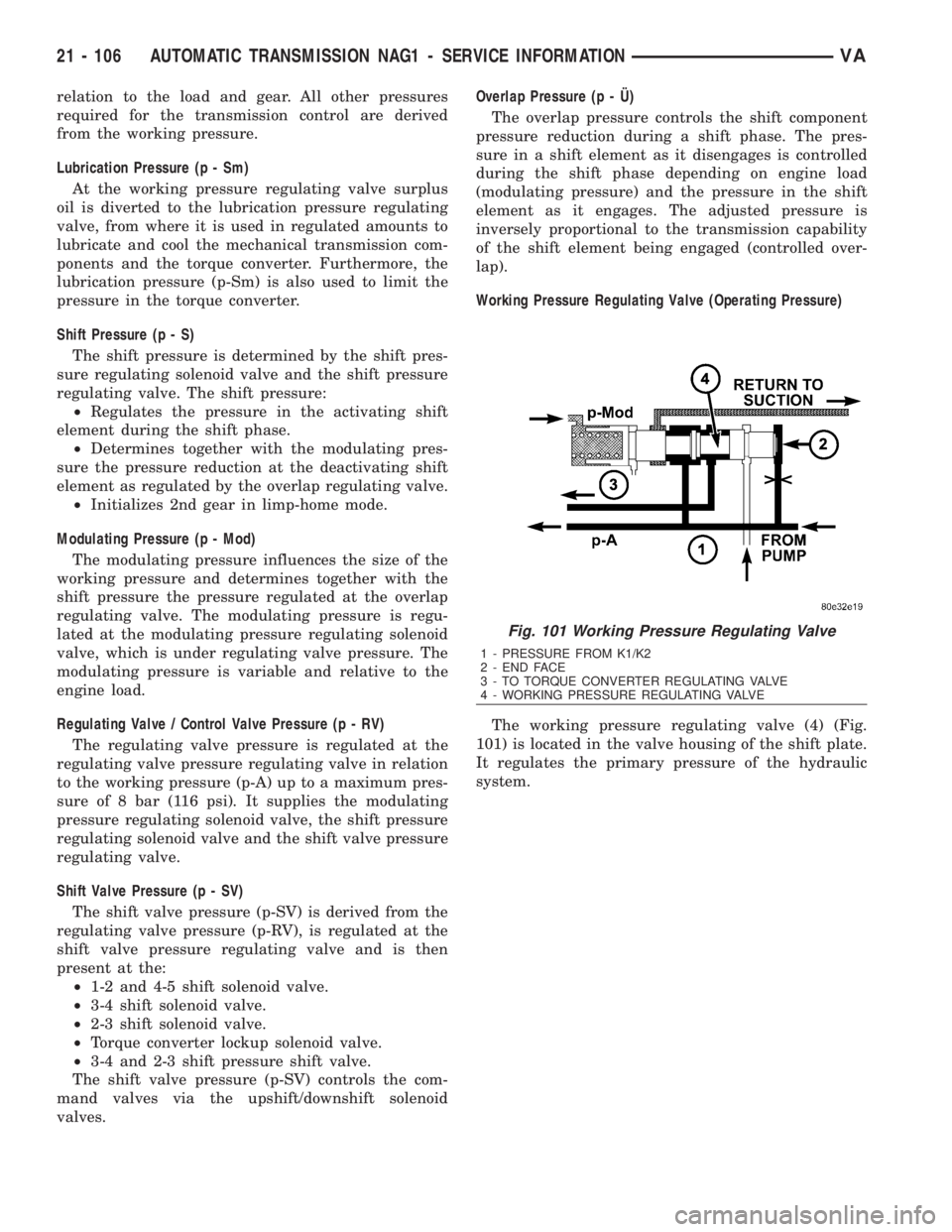
The working pressure regulating valve (4) (Fig.
101) is located in the valve housing of the shift plate.
It regulates the primary pressure of the hydraulic
system.
Fig. 101 Working Pressure Regulating Valve
1 - PRESSURE FROM K1/K2
2 - END FACE
3 - TO TORQUE CONVERTER REGULATING VALVE
4 - WORKING PRESSURE REGULATING VALVE
21 - 106 AUTOMATIC TRANSMISSION NAG1 - SERVICE INFORMATIONVA